Jill Ortman-Fouse Announces for Council At-Large

By Adam Pagnucco.

Board of Education Member Jill Ortman-Fouse just announced on Facebook that she will be running for Council At-Large.  This comes eleven days after she said she would be running for reelection to the school board.  We will have more to say about this and other events in the Council At-Large race, but for now, we reprint Ortman-Fouse’s Facebook post below.

*****

Black men make up 2% of the nation’s educators in our schools. John Robertson is one of those role models who would like to make a bigger difference as your at-large Board of Education member. As you might recall, that’s my seat. 😉

I’m going to try not to give you whiplash from my candidacy for board announcement last week, but here it goes:

I really appreciated all the amazing responses to my announcement — from educators, students, parents, neighbors and community members. You all are wonderful and I’m extremely blessed to know you.

Then I heard that someone had jumped in my race. Nervously, my whole family set about searching to see who he was.

We found his graduation speech. I read it and I thought, wow. Another search revealed he had a masters in social work. I literally talk about MSWs’ skills in terms of the mental health challenges we are facing in our schools all the time. As you know, our students’ (and their family’s) mental health needs, have been a priority for me. Then I texted some folks to see who might know him. He was described as “smart, mature, innovative.”

My friends said I could beat him. Incumbents always have an advantage — especially in a county of over 1 million people where getting your name out is hard. Then I’d text them the links, and they would agree with me, that he sounds amazing.

So, Mr. Robertson and I had coffee. I went down my list of biggest concerns and things I’m passionate about for our students, staff and school system. We are clearly on the same page. I’m going to step out of the race because I’m confident John would be a great addition to the team, and I can’t wait for you to learn more about him.

What next? Well, one of the things I get in trouble for is working outside my approved lane of education policy — because I care as passionately about the issues that impact our kids and families outside of our schools as the ones inside. So, why not try making it official as a member of our County Council? I realize others have made the suggestion along the way (which I appreciated) and in a much timelier fashion. 😉 But I didn’t want to leave the work unsupported.

I know there are about 30 candidates running for four at-large seats. I know I haven’t even started to raise money for a campaign. I know some organizations have already endorsed, and other candidates have been campaigning for almost a year.

But I also know that we have made a difference together, and I would like to continue to work with our community and our leaders at the county and state level to make our collective vision a reality. I would bring everything you have counted on in my work on the board to the council. I certainly would understand if members of our community were disappointed. I know how valuable your partnership is, but I think we could actually have an even bigger impact together on the council.

I would bring the education focus and knowledge of where the gaps are to continue to advocate for our schools. I would continue to be a strong voice for transparency, accountability and responsiveness, to ensure our county resources are used most efficiently and effectively. And I would bring my experience as an elected leader representing your interests, my desire to listen closely to different voices and respect them — even when I disagree, working as hard as I can for our community to win together, to the council role if I were so fortunate to win that position.

I am going to need 250 contributions of $150 or less, totalling $20,000 in about 75 days to qualify for public financing. I know it’s a very steep climb. But I’m an eternal optimist, and my friends who have volunteered to help are amazing. So, stay tuned…

I know I made you scroll twice. That’s my thing.

Share

Other Systems May Have Problems but Only Metro is Hemorrhaging

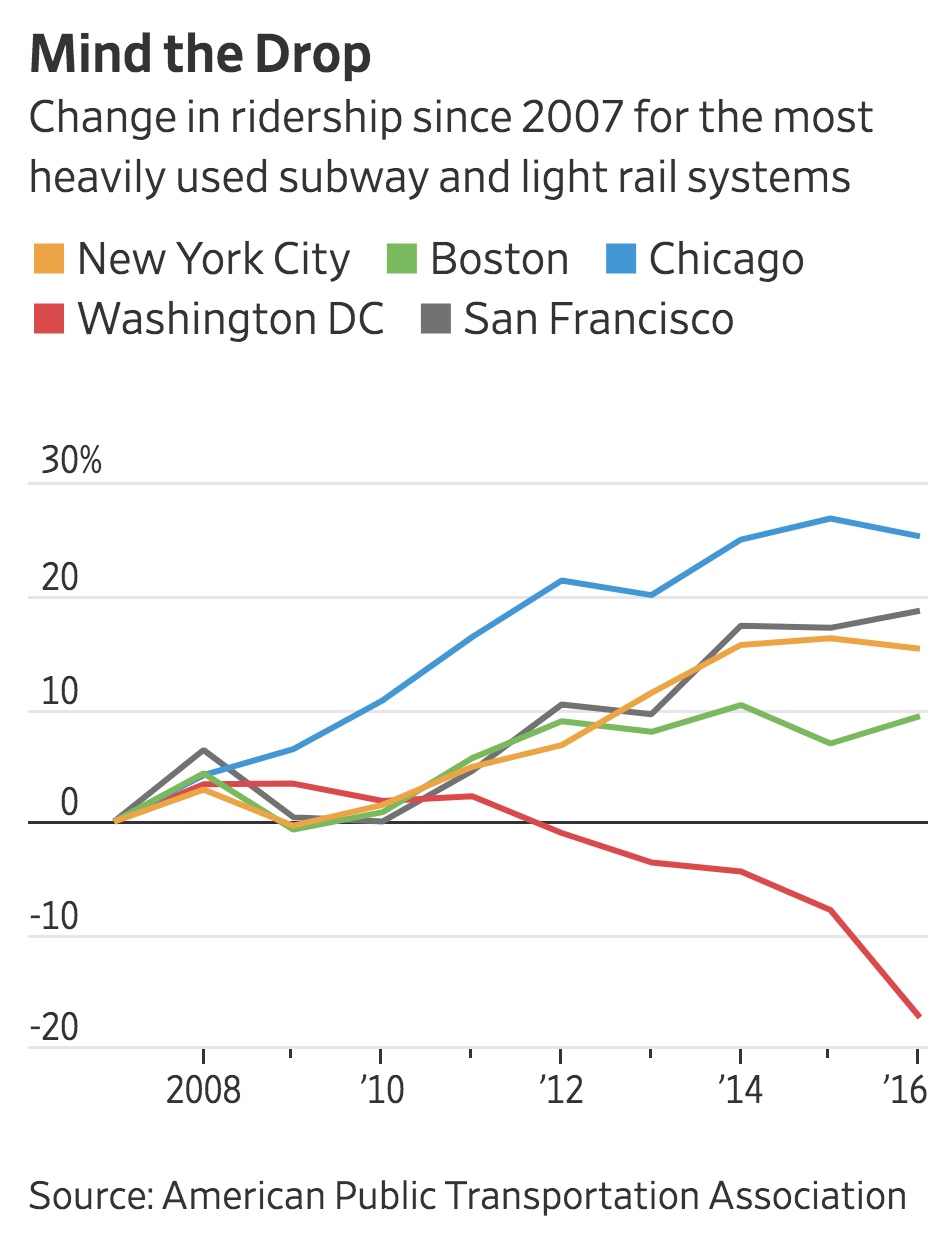
One of the responses to Metro’s critics is a variation of “things are tough all over.” Not so fast. Other major subway and light-rail systems may have problems but this graph from yesterday’s Wall St. Journal shows that WMATA is in a class all its own. Ridership is down 19% from 2011 through 2016. And no one thinks those figures are picking up even though SafeTrack is over and we’re theoretically “Back to Good.”

You can make the case that this proves the dire need for more money invested in capital improvements to make the system more reliable. But it also makes the case for improved accountability for WMATA. This goes beyond Paul Wiedefeld to include Metro’s ineffectual board and problematic unions.

Resources are important but it’s also how they are spent. Consider how many escalators have been “fixed” or even completely replaced only to stop working almost immediately. Consider further how many problems federal inspectors found with the tracks even right after SafeTrack passed through an area.

ATU Local 689 has fought against firing track inspectors who falsified inspection reports and put public safety at risk. You can say that the union is doing its job for its workers. But the workers, and the union that defends them, sure aren’t working for Metro’s riders or public safety here.

My sense is that Paul Wiedefeld has pushed change in a positive direction of actually trying to fix the the system. But the ridership numbers tell the story. I want Metro to get more money but I equally want evidence that Metro will spend it better.

We’re hearing a lot from Maryland state legislators, and even the Governor, about dedicated funding. Not as much about reforming its expenditure. Dels. Marc Korman (D-16) and Erek Barron (D-24), who have been leaders on dedicated funding, also have a bill in to improve how we appoint Maryland’s board members. (Sen. Brian Feldman D-15 is sponsoring the Senate bills.) It’s a start. But far, far more is needed to restore public confidence.

Share

SEIU Local 500 To Endorse Five in MoCo Races

By Adam Pagnucco.

SEIU Local 500, one of the largest unions in Maryland, will be endorsing five candidates in MoCo races soon.  The local’s membership of more than 8,000 is concentrated among MCPS support staff, adjunct college faculty and child care workers.  It has one of the most aggressive political operations in the state and its endorsement is highly valued in MoCo.

At this time, the local will be endorsing:

Marc Elrich for County Executive

Gabe Albornoz, Ashwani Jain and Will Jawando for Council At-Large

Ben Shnider for Council District 3

The union has not decided on an endorsement yet in Council District 1 and may announce one later.  It has postponed endorsement decisions for incumbent Council Members outside District 3 pending further actions of the council.  Since MCPS accounts for a significant portion of the local’s membership, budget decisions on the schools may impact the union’s thinking.

Congratulations to the endorsees.  To be continued!

Share

Who is Getting Money from the NRA?

By Adam Pagnucco.

In the wake of the latest mass school shooting, many are asking about the influence of the National Rifle Association (NRA), which is dedicated to blocking virtually all restrictions on firearms.  The NRA has not been particularly successful in Maryland, where one of the nation’s strictest gun control laws was signed by Governor Martin O’Malley five years ago.  But that has not stopped the NRA from trying to influence Maryland politicians by contributing money.

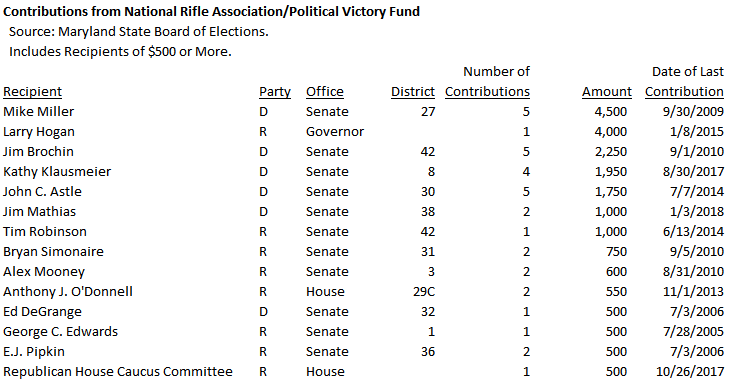
We looked up all contributions to state and local political committees in Maryland from the NRA itself and its PAC, the NRA Political Victory Fund, on the State Board of Elections website.  We identified 49 contributions totaling $22,450 from the 2006 cycle on.  Of that total, $12,300 (55%) went to Democratic committees and $10,150 (45%) went to Republicans.  Fourteen committees received $500 or more and we identify them below.  We also list the last date of contribution from the NRA; bear in mind that some folks on this list have not received NRA money in several years.

All of the above candidates were incumbents except Tim Robinson, who ran as a Republican against Senator Jim Brochin (D-42) in 2014.  Brochin was himself a former recipient of NRA money and is now running for Baltimore County Executive.  Democratic Senators Kathy Klausmeier (D-8) and Jim Mathias (D-38) are facing tough GOP challengers this cycle and have accepted NRA money in the last year.

Ten of the above recipients were in the General Assembly when the Firearm Safety Act of 2013, Governor O’Malley’s landmark gun control law, was passed after the Sandy Hook Elementary School massacre.  Those voting for the bill included Senators Mike Miller (D-27) and Jim Brochin (D-42).  Those voting no included Senators John Astle (D-30), Ed DeGrange (D-32), George Edwards (R-1), Kathy Klausmeier (D-8), Jim Mathias (D-38), E.J. Pipkin (R-36) and Bryan Simonaire (R-31) and Delegate Tony O’Donnell (R-29C).

Additionally, Astle’s campaign committee actually gave money to the NRA.  In 2006, Astle’s account made a $300 expenditure to the NRA and remarked, “This membership increases Senator Astle’s visibility and allows him to network with potential voters and contributors.”

One more recipient of NRA cash stands out:  Derek Hopkins, the Republican Register of Wills in Harford County, who collected $100 from the NRA in 2010.  Perhaps this is unsurprising since mass proliferation of guns and the writing of wills seem sadly interrelated.

Share

Who Really Deserves Criminal Charges for Ignoring Known Child Abuse?

By Adam Rosenberg, Executive Director, and Joyce Lombardi, Director of Government Relations, Baltimore Child Abuse Center.

For the past several years, the Baltimore Child Abuse Center has been advocating for a new law that will allow misdemeanor charges against front-line professionals who deliberately chose not to report child abuse.

Sounds like an easy sell, but it isn’t. Not in Maryland. Or, at least not in Maryland’s House Judiciary Committee. The bill (SB132 this year) has already unanimously sailed through the Senate two years in a row thanks to Senator Susan Lee and Senator Robert Zirkin. But, despite the efforts of Delegate Carlo Sanchez, State’s Attorney Angela Alsobrooks and several Democrats and Republicans, HB500 is still stalled in the House Judiciary Committee.

Why?  Partially it’s because leadership there questions the need for yet another law, and partially because many people rightfully struggle with the idea of putting “jail” and “teacher” or “nurse” in the same sentence.

But many of the dozens and dozens of people we’ve been talking with – which includes social workers, pediatricians and elected officials in Annapolis – instantly picture who this law is talking about: not your average teacher or nurse, but instead the people who knew but chose to protect themselves or their institutions. “Right!” they say, “like at USA Gymnastics or Penn State.”  Yes, bingo. The enablers.

Former Penn State administrators Tim Curley, left, and Gary Schultz (Centre County Correctional Facility, AP)

Still, others struggle.  Instead of seeing the egregious enablers, they see their friends, their kid’s soccer coach, their homeroom teacher, their family doctor.  They see themselves.  They can picture the predators, sure, the eerily bland face of Larry Nasser or maybe even the bulldog mug of Harvey Weinstein. But they can’t see the quiet cadre of adults standing just behind the predators, the ones who are always there, desperately denying the crimes of the colleague or friend or beloved in their midst. They might see the good doctor who isn’t sure the head trauma was abuse and doesn’t report, or they might see a teacher who didn’t report that a girl felt uncomfortable on her colleague’s lap. They see nuance. They see negligence at best.

Professionals in Maryland all have a duty to report SUSPECTED abuse, but this bill, HB 500, isn’t criminalizing negligence.  Instead, it targets those rare but persistent cases when a mandatory reporter “KNOWS” about the abuse and STILL doesn’t act.  Think Morgan State University, USA Gymnastics, and think Penn State. Think about the horror of seeing a naked boy in a shower sexually assaulted by a grown man. Think about several girls coming forward to say their doctor’s hands inside them “didn’t feel right,” “felt wrong,” or “he was aroused.”

There is a a running list of professionals in Maryland who chose not to report, for example: cigarette burns on a girl’s arm;  a 5-year old boy disclosing that “daddy kisses my wee wee and makes it big; ”a distressed tween disclosing that her grandfather takes her to the basement and puts his hand under her dress;  lacerations and scars on an 8-year old; a 3-year old with visible bruises who said he gets hit with a belt, numerous 5th graders disclosing that a volunteer school aide was making boys do “nasty stuff.”

Also, let’s clarify what has been proposed:  a misdemeanor with a max of 6 months in jail or a $1,000 fine.  That’s the same penalty you get in Maryland if you board someone’s boat for a second time without permission or if you install an air conditioner without a license ((Crim. Law 6-403; Bus. Reg. 9A-501).

Secondly, every other state in the country has a penalty of some sort and most make it a misdemeanor for deliberately failing to report SUSPECTED abuse – except Wyoming and Maryland. In Maryland, after years and years of wrangling and compromise with various legislators and professional associations for doctors, nurses, therapists, etc., this law would only target the worst of the worst: those who ignored KNOWN abuse.  The proposed law (HB500) has an “actual knowledge” standard, an extremely high bar to reach, and one that reaches felony status elsewhere.  The bar is so high that, for the first time, it has gained support from some professional associations and censure from some activists.

Leadership in the House Judiciary Committee questions why we need a new law when there are two on the books that get little use: a fairly new one, sponsored by Delegate Kathleen Dumais in 2015, which provides notice to a licensing board or employer for a failure to report, and an older one that criminalizes anyone who obstructs a report.  Our answer is simply that this law, HB500, fills in the gap between the two.  Saying more than that sounds like an attack on the current laws and their sponsors.  It isn’t meant to be an attack.  It’s a plea for another way. It’s an “And,” not an “Or.”

We all agree that child abuse needs to be reported, we just respectfully disagree whether Maryland needs a new law to help make that happen.  After years of research and experience in the field, we believe that it does and HB500 is that law.

If you agree that Maryland’s children deserve better protections too, call the Maryland House Judiciary Committee at 301-858-3488 or 410-841-3488 to share your support for HB500.

Share

MoCo’s Skyrocketing Debt

By Adam Pagnucco.

Last fall, County Executive Ike Leggett proposed cutting the volume of new general obligation bonds issued by the county in future years and the County Council concurred unanimously.  Advocates for school construction fretted over the move as the county’s needs in that area, as well as in transportation investment, are enormous.  But Leggett and the council had a point.  The county’s debt has skyrocketed in the past twenty years and especially in the last decade.  It now presents a substantial challenge to the county’s fiscal well-being that the next generation of county leaders will have to deal with.

The county government does not use debt to finance its operating budget, but it does use debt to finance its capital budget, known as the Capital Improvements Program (CIP).  The CIP is a six-year budget that is fully renewed every two years and is adjusted in off years.  The Executive’s latest recommended CIP currently totals $4.5 billion, of which $1.8 billion is recommended for school construction.  The CIP has many funding streams for its projects, but the single largest one is debt.  As of June 30, 2017, the county had $4.1 billion of outstanding primary government debt, of which the largest category is general obligation (GO) bonds, which accounts for $2.7 billion.  GO bonds are backed by the full faith and credit of county government.  The fact that the county’s GO bonds have had a AAA rating assigned to them by the nation’s three largest credit agencies for many years is a substantial source of interest savings to the county.  Other major categories of debt are short-term bond anticipation notes ($500 million outstanding), taxable Build America Bonds created during the recession ($308 million) and revenue bonds which are backed by dedicated revenue streams ($222 million).  All of this is separate from the substantial liabilities the county has for pension funding and retiree health benefits.

There are two salient facts about the county’s debt.  First, it has been growing rapidly.  And second, it is paid off through debt service that is part of the county’s operating budget.  These debt service payments MUST be paid and they compete with other spending priorities.  Along with total debt, debt service has also been growing rapidly.

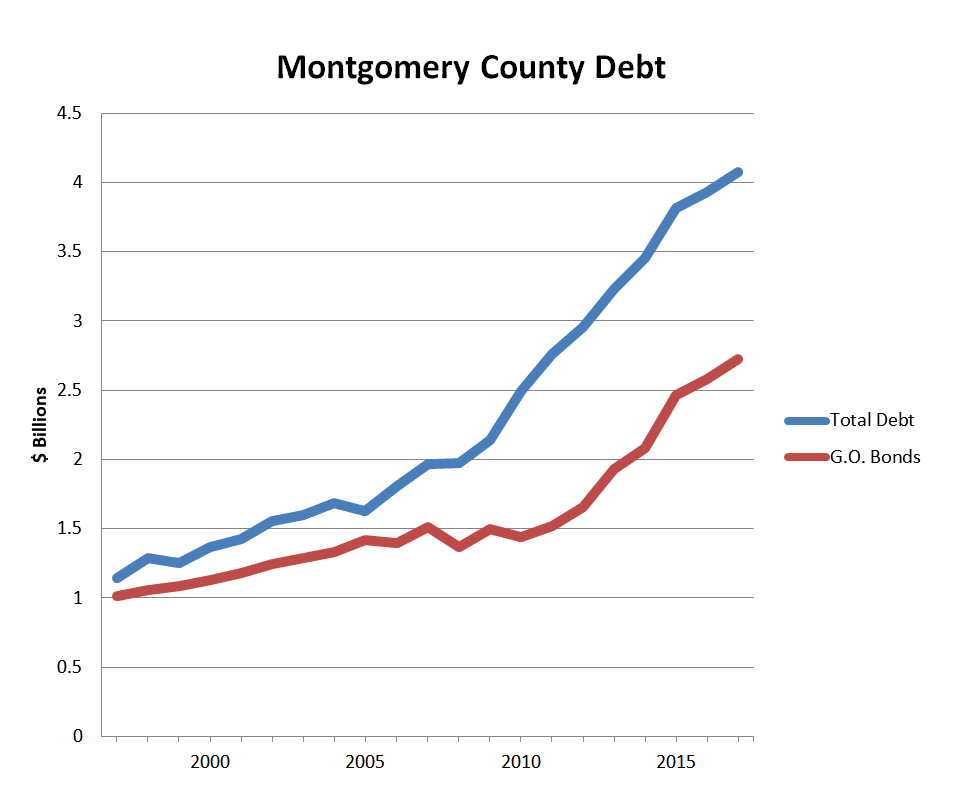
The chart below shows growth in total outstanding primary government debt and in GO bonds over the last twenty years.  While growth has occurred throughout the entire period, it has accelerated since the onset of the Great Recession.  From 1998 through 2008, GO bond debt grew by an average of 2.9% per year, about equal to growth in the Washington-Baltimore CPI (3.0% per year).  Total debt grew by an average of 5.2% annually over that period.  From 2009 through 2017, GO bond debt grew by an annual average of 8.1%.  Total debt grew by 8.4% annually.  The average rate of inflation in the Washington-Baltimore CPI was 1.5%.  Over the last eight years, the county’s debt has been growing by more than 5 times the rate of inflation.

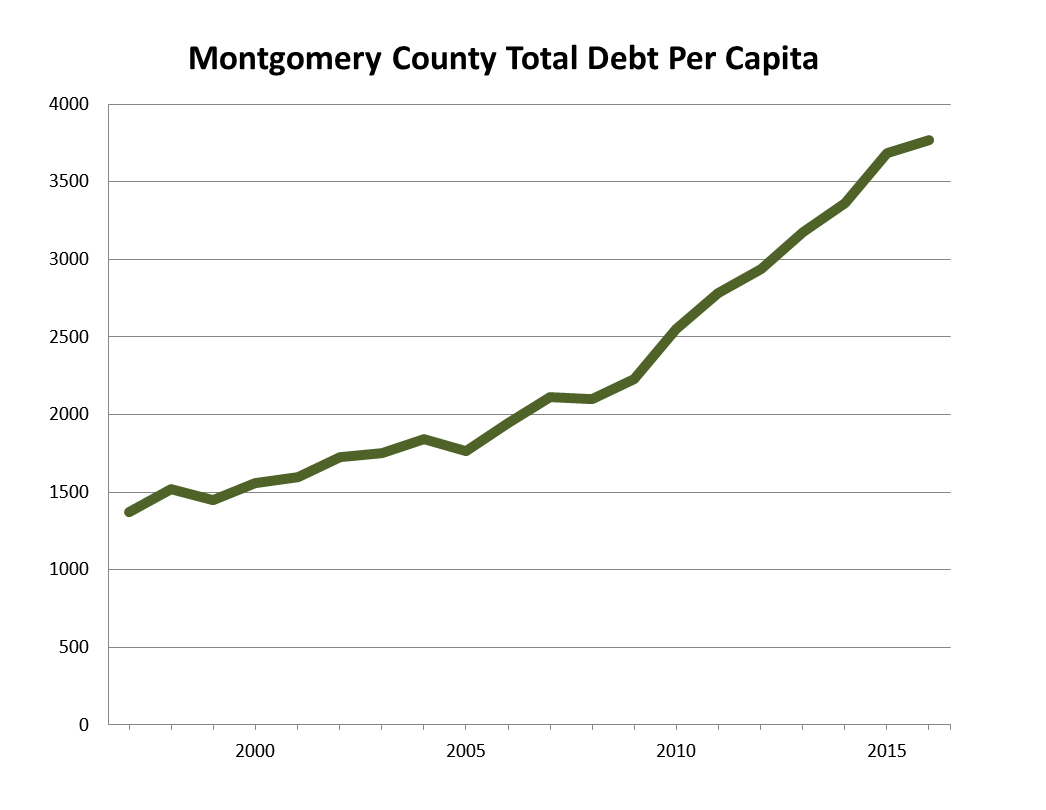
Relative to the size of the population, the debt has been rising too.  When we compared the county’s total debt levels to population estimates from the U.S. Bureau of Economic Analysis, we found that total debt per capita has grown from $1,370 in 1997 to $3,768 in 2017.

As for debt service, it has risen from $140 million in FY97 to $408 million in FY18.  If debt service was a county agency, it would be the largest agency in county government other than MCPS.  Debt service payments are mandatory and cannot be cut like most other categories of spending during recessions.  The pit of the Great Recession came in FY11, when debt service was $258 million and the county slashed services, doubled the energy tax and furloughed its workforce.  Now that debt service exceeds $400 million a year, it will present a much greater impediment to the maintenance of county services when the next recession comes.

Let’s remember that debt is not an inherently bad thing.  It is the primary vehicle by which the county pays for core government functions like school construction and transportation projects.  The county’s needs in those areas are absolutely undeniable.  Also, construction costs were moderated during the recession, so the county was able to take advantage of that to build relatively cheaply in those years.  But over the long term, if you are going to have rapidly growing debt, you need to have a rapidly growing economy to pay for it.  And MoCo does not have that – instead, it has had weak growth in employment and incomes in recent years.  It saw 57 new business filings in 2015 and 19 new filings a year later.  It passed a 9% property tax hike and a year and a half later suffered a $120 million budget shortfall.

This is evidence yet again that an economic revival has to be a huge priority for the next generation of county elected officials.  Without it, debt service will consume larger and larger chunks of the budget and eventually lead to service cuts and/or tax hikes.  As for those who oppose economic growth or have worked to undermine it, the debt situation makes this clear: you cannot oppose growth and favor expanding school construction and transportation investment.  The economy and the credit markets won’t allow elected leaders to have it both ways.

Bear that in mind as we head to Election Day.

Share

Lamone Backs Election Observers in Letter to Kagan

State Board of Elections Administrator Linda Lamone continues to stand by Maryland’s traditional willingness to welcome international elections observers in a letter to Sen. Cheryl Kagan (D-17), despite absurd Maryland Republican hysteria raised over the prospect of Russian interference as a result.

Will Gov. Larry Hogan now finally stand up and put a stop to these shameless anti-democratic attacks by the Maryland GOP?

Here is a copy of the letter:

SBE Letter to Kagan on Election Observers by David Lublin on Scribd

Share

Women’s Democratic Club President Responds to Cooper

The following piece by Fran Rothstein, President of the Montgomery County Women’s Democratic Club, is a response to Jordan Cooper’s critique of the Montgomery County Democratic Central Committee’s (MCDCC) recent actions.

As a lifelong Democrat and a 36-year resident of Montgomery County, I must protest Jordan Cooper’s recent opinion piece, “Montgomery County Democrats make a mockery of democracy.”

I know what a mockery of democracy looks like, and Montgomery County isn’t it.  I grew up in Washington DC, where my parents were completely disenfranchised. They couldn’t even vote for President until 1964. I grew up with no home rule at all.  Even today, Washingtonians remain scandalously unable to participate fully in our democracy.

Contrary to Mr. Cooper’s assertion that “the Democratic Party of Maryland has long prioritized the party above the public interest,” I see exactly the opposite in today’s State and County Party.

At the State level, Maryland Democratic Party chair Kathleen Matthews has worked tirelessly to reach out to the many new activists who have come together in new groups since the 2016 election.  Some of these activists are outspoken Democrats; others are progressives active in new nonpartisan but progressive organizations.  She has met with them, she’s invited them into the Party’s big tent, and quite a few of them have joined the Woman’s Democratic Club of Montgomery County (WDC), which I lead.

At the County level, rather than the “gross abuse of the public trust” Mr. Cooper sees, I see a Democratic Central Committee striving to expand voter choice in selecting our representation.  I happened to be at the most recent Central Committee meeting, when the Committee became the first in Maryland to endorse Del. David Moon’s legislative proposal to create special elections to fill a General Assembly vacancies.  Why is this important?  If passed, a state Senator or Delegate vacancy in the first year of a term would trigger a special election, rather than being filled by Central Committee appointment as is now the practice.  (When a vacancy occurs later in a term, the Central Committee would make a temporary appointment, with a special election held during the next Presidential election, thus avoiding the cost of a special election when a regularly scheduled election is on the horizon.)

The vote that seems to have prompted Mr. Cooper’s protestation was the adoption of a proposal to restrict candidates from running on the same ballot for a government office as well as the Central Committee.  This makes great sense, for several reasons.  First, it would avoid the possibility that a candidate may – intentionally or not – use public financing and traditional financing simultaneously.  Second, it avoids the possibility of conflicts of interest that would inevitably arise should one person hold both positions.  And third, from my perspective, is that it opens up more opportunities for the many newly energized Democrats to serve in leadership positions.

Personally, I appreciate the County Central Committee leadership’s willingness – indeed, enthusiasm – to engage in collaborative efforts.  Among many examples, the Central Committee and WDC are working together to recruit and train precinct officials, a critically important function.  Precinct officials are the ones who rally local residents to vote – certainly the essence of a strong democracy.

Share

Joel Rubin Launches Campaign for Delegate

Town of Chevy Chase Councilmember is launching his campaign for the Democratic nomination for delegate in District 18 this Sunday. Recently, he sent out the following postcard:


A former assistant secretary at the State Department who frequently comments on national security issues for national news networks, Rubin’s campaign issued the following press release on Russian interference in Maryland elections:

Maryland District 18 Delegate Candidate Joel Rubin Calls on Maryland Officials to Protect the Integrity of 2018 Midterm Elections.

For Immediate Release:

Joel Rubin, Candidate for the Maryland House of Delegates (District 18) and a former senior national security official in the Obama Administration, today calls on Governor Hogan, the State Board of Elections, and the Maryland Attorney General to take immediate steps to ensure the integrity of the 2018 elections, beginning with the June 26th primary. Now that Governor Hogan has made Russian meddling in Maryland’s elections a partisan issue, it’s incumbent upon Maryland’s Democrats to make it clear that he must protect the integrity of our elections, rather than blindly follow the position of President Trump, who is laying us bare to continued Russian attack.

“As we learned from this week’s U.S. Senate Intelligence Committee hearings, despite the unanimous view of our intelligence chiefs that Russia is planning to attack our 2018 elections, President Trump is not ordering countermeasures to ensure that our most basic right as Americans – the right to vote – will be protected this year. This is a national security crisis. With Russian influence operations continuing unabated, the responsibility to protect our democracy now falls squarely to the states in a manner that goes beyond the traditional state responsibilities of guaranteeing proper voting rights, procedures and election integrity.”

“This means that the states are now responsible for rebutting cyber attacks by a hostile foreign power, a role traditionally assumed by the federal government. Therefore, I am calling on Governor Hogan, State Election Board Chair David McManus, and Attorney General Brian Frosh to immediately take the steps necessary for ensuring the integrity of our vote. They should also inform the legislature of any additional authority or funding needed to get the job done, and the legislature should immediately approve it.”

“Election security and justice require several steps. It is past time that they are taken. For instance, it is worth recalling that professors at the University of Maryland demonstrated that machines that were in use in Maryland just a few years ago were easily hacked. I urge our state’s leaders to consult the University and other authorities, such as cybersecurity experts, civil rights organizations, and others who have provided poll watchers and legal assistance in recent years, regarding the steps they would recommend be taken to strengthen our election security. This is an existential fight for both our state and our nation.”

Rubin, a Council Member in the Town of Chevy Chase, has worked for nearly two decades in national security, including as a senior official in the Obama Administration’s State Department and in the U.S. Congress. He believes that when our country is under attack, and our federal government fails to live up to its responsibilities, that it is incumbent upon the state government to fill the gap in order to protect its citizens.

Share

Ed Kimmel: Sex Discrimination at MCDCC

Today, Seventh State is pleased to present “Sex Discrimination at MCDCC” by Edward Kimmel, the first of a short series of posts on the Montgomery County Democratic Central Committee’s (MCDCC) decision to switch to separate elections for male and female members of the committee.

Democrats who read all the way down to the bottom of the ballot in June, 2018 will discover  that the Montgomery County Democratic Central Committee has divided itself into “male candidates” and “female candidates.   Most will think nothing of the fact that Homer cannot run against Marge.  But I believe that this is a huge step backwards in the quest to end sex discrimination.

I protested this in a piece on Facebook.  There, I warned that such blatant, de jure discrimination that would be enforced by the  Board of Elections (obviously, an agency of the State of Maryland) was almost certainly illegal.   I took down once I saw a Fourth Circuit opinion that upheld Maryland’s rule that half of the national convention delegates must be male and half female.   Although that opinion found that the Fourteenth Amendments restrictions against sex discrimination must be balanced against the amount of the imposition upon the First Amendment’s protection of free association, the fact that a voter who wanted to vote for only one gender of delegates suffered little because the voter’s principle decision was to vote for one candidate or another.  That tipped the balance in favor of keeping its hands off of the party’s delegate-gender rules.

I was hugely disappointed to find that political parties are, generally, beyond the reach of heightened scrutiny of governmental sorting of the sexes.  Anti-discrimination laws that would prohibit golf clubs from obtaining tax exemptions if they have too many “men only” golf tournaments would likely not prevent MCDCC “men only” elections for seats on the “government” of the Democratic Party of Montgomery County.

So I gave up trying to warn them that what they are doing is illegal.  Courts might well strike down their system – there are no controlling opinions on elections that absolutely forbid elections that pit men against women – but I was shocked to find that generally, courts that will allow girls to play on the boy’s football team are reluctant to declare that competition between male politicians and female candidates may be made illegal.

That shifts the debate to “why?”   Why does the Democratic Party of Montgomery County want to ban inter-gender competition in 2018?

They say that this is their attempt to comply with the Democratic National Committee’s  “Equal Division Rule” that requires that governing bodies of Democratic state and local parties have equal numbers of male and female members.   For years, they have been achieving “gender balance” on MCDCC by waiting until after the election and then adding some extra members of the gender that lost.  As if to prove that the entire notion of second guessing the voters by diluting their choice with some appointed members, sometimes this has required them to add men and sometimes they have had to add women to achieve “gender balance.”

Not many comments on my now-deleted thread attempted to defend the policy.  Some said that compliance with the DNC’s Equal Division Rule was mandatory so that debate was nugatory.  Some said that under the system of appointing new members of the MCDCC to bring the committee into balance, the number of members had swelled from the statutory 24 members to more than 30, a situation that will be corrected if men who resigned are only replaced by men and women with women – without addressing why they couldn’t do that before.

But mostly, they reacted with rage, ad hominem attacks and outright defamation.  An officer of a state-wide Democratic organization said he was disappointed with me for suggesting that “separate is inherently not equal.”  He said that as an attorney, I “knew” that the Supreme Court was stating that segregated schools could not be equal because the minority schools were dingy and not maintained at the same level as majority schools were and that this was inapplicable here because male members and female members would serve in the same quarters.

I beg to differ.

I believe that what SCOTUS was saying was that the act of categorizing along discriminatory lines is what makes them unequal.   Drawing a line between black students and white students was what placed the stigma.  Asserting that there is a reason to sort blacks from whites is, by itself, illegal discrimination.

And so it is with gender.  Pretending that there is something about ovaries or testicles that causes a person to make better/worse/different policy decisions is, itself, a slanderous statement.

Finally, I don’t believe that it is women who will have seats preserved on any Democratic body this year.  Although, as the courts have noted without presentation of evidence, the population at-large may be presumed to be about equally split between males and females, I don’t think that is true of Democrats and especially not of active, working Democratic activists.   My view may have been skewed by the fact that I have been among the most active Hillary Clinton supporters over the past ten years, but the events I have been to have been dominated by women.   Saying that the voters will not be allowed to elect seventy or eighty percent female leaders of our party may well be what keeps a certain amount of men at the table.

It is time to allow Democratic voters to decide who they want to lead them.

Share

Maryland Politics Watch