Israeli Election 2015: Guide for the Perplexed

Monty Python on Israeli Politics

I don’t know much about the current highly interesting politics of the Montgomery County School Board. (Fortunately, Lou Peck over at Bethesda Magazine does). However, Israeli politics are famously fractious and complex, so I thought it could be useful to present this guide to the lists competing in March’s Knesset elections. (Note: as with everything involving Israel, someone invariably with vehemently disagree. This is my take.)

The System

Israelis elect MKs (Members of the Knesset) off of closed party lists within a single national district by the d’Hondt method of proportional representation. Parties must receive 3.25% of the vote to qualify for seats–up from 2% at the time of the last election. Put another way, seats are distributed proportionally to parties above the threshold, though d’Hondt (called Bader-Ofer in Israel) has a  bias toward larger parties.

Left-Wing Zionist

The major left-wing Zionist parties favor the two-state solution and fall on the secular side of the secular/religious divide. Their other key commonality is that none would join a Netanyahu government, even though all but Meretz have in the past.

A coalition of Labor and Hatnuah, Zionist Union is the major mainstream left list. Labor was Israeli’s dominant party for decades after independence in 1948. No more. It came in third in the 2013 elections. Labor continues its struggle to reinvent itself, mainly by focusing on bread-and-butter economic issues. Appealing to Sephardim remains a problem for this party identified with its historically Ashkenazi leadership.

Hatnuah (The Movement) has an unintentionally ironic name as the party is really Tzipi Livni’s one woman show. Originally a member of Likud and then centrist Kadima, Livni continues her hegira to the left by forming an alliance with Labor. Hatnuah is most closely identified with support for peace negotiations and the two-state solution.

Yair Lapid’s Yesh Atid (There is a Future) was traditional flash in the pan success story in 2013–Israeli elections nearly always feature one–and is expected to lose roughly one-half of its MKs in March. While favoring the two-state solution, this center left party (i.e. to Labor’s right) is more known for its strident support of secularism and focus on economic issues.

Strongly dovish and secular, Meretz (Vigor or Energy) is the most clearly left-wing primarily Jewish party. Heavily Ashkenazi, Meretz has had trouble broadening its support.

Right-Wing Zionist

These parties range from center right (Kulanu) to the extreme right (Bayit Yehudi). Excepting Kulanu, none would join a coalition led by Labor/Zionist Camp.

The leader of the mainstream right, Likud (Unity) has moved steadily rightward. Mirroring the RINO phenomenon in the US, the party has dumped party stalwarts like Dan Meridor–someone hardly identified with the left–for more right-wing candidates. As a result, Netanyahu now is among the most left-wing Likud MKs. Historically, Likud has received more support from Sephardim.

Bayit Yehudi (Jewish Home) is a very successful extreme right party that favors settlements and opposes the two-state solution. This religious (but not Haredi) nationalist party has experienced growing success under tech businessman Naftali Bennett, whose ambition is to displace his former boss–Netanyahu–as PM.

Yisrael Beitenu (Israel Our Home) is led by Avigdor Lieberman and appeals foremost to Russian immigrants. Lieberman is well-known for his anti-Arab comments and hawkish views. However, he has taken a new tack in this election in suggesting that it could be time for Netanyahu to go and that Israeli needs a peace deal. Mired in a corruption scandal, Yisrael Beitenu will lose seats this year.

A former Likud minister best known for having brought down cell phone costs, Moshe Kahlon founded Kulanu (All of Us) for the 2015 election. Expected to be this year’s flash in the pan party, the polls suggest that Kulanu is steadily losing support, though it should still enter the Knesset. Much like Yesh Atid, it focuses on middle class concerns and leans secular.

Religious Parties

The religious parties are most keenly interested in funding for their school systems and religious observance (e.g. preventing El Al from flying on Shabbat). They bitterly opposed the narrowing of draft exemptions for yeshiva students.

Shas is the major Sephardic religious party but has now split into two parts due to the defection of former leader Eli Yishai. The party is now led by Aryeh Deri, who suffered recent embarrassment upon the release of tapes showing Shas’ spiritual leader, the now deceased Rabbi Ovadia Yosef, criticizing him. Deri served time in prison for corruption while he was Interior Minister. Shas has usually taken a more right-wing stand on the conflict but seems more open to aligning with the left under Deri’s leadership.

Ha’am Itanu (The Nation is with Us) is Eli Yishai’s new party. Unlike Shas, it would only join a right-wing coalition. At this point, it’s unclear if the party can pass Israel’s new, higher 3.25% threshold to enter the Knesset.

United Torah Judaism (UTJ), the Ashkenazi religious party, unites two Haredi (i.e. very strictly Orthodox) parties, Degel HaTorah (Torah Flag) and Agudat Israel (Union of Israel). While Agudat gains its support from Hasidic Jews, Degel HaTorah receives support from non-Hasidic Haredi Jews associated with the Lithuanian yeshivas.

Arab Parties

The new 3.25% threshold has forced the three major Arab lists to unite in order to evade the possibility that one of more of them might fall short of the necessary share of the vote. United Arab List encompasses Hadash, Balad (National Democratic Assembly), and Ra’am-Ta’al (the eponymous United Arab List).

Hadash is rooted in the Communist Party and claims to be the only bicommunal party. Balad supports the two-state solution with Israel being a binational state. United Arab List brings together the Islamic Ra’am with Ahmad Tibi’s Ta’al.

Next Up: To Bibi or Not to Bibi.


Share

Hogan Stops Pollution Regulation Critical to Public Health

One of Governor Hogan’s very first decisions has been to rescind a pending air-quality regulation that would have curtailed emissions from existing coal fired power plants.  This regulation had been extensively vetted by industry, the public and the Maryland Department of the Environment. The Maryland Air Quality Control Advisory Council (AQCAC) concurred unanimously with the proposed regulation in October 2014. Note that the AQCAC:

consists of 15 members appointed by the Secretary of the Department. Members include representatives from industry, labor, professional associations, local and regional government organizations, academia, farming, the medical community and the general public.

Indeed, AQCAC is currently chaired by a BGE employee–John Quinn.

According the the Baltimore Sun,

Hogan has ordered a comprehensive review of all pending regulations, opening them up for further “public input, public hearing and full due process” before they can be finalized.

But that due process has already occurred. These sorts of regulations go through truly extensive vetting before they get published in the Maryland Register. The unanimous approval by all AQCAC members present on October 6, 2014 is testament to the success of the vetting process.

These environmental regulations will have an important impact on public health in Maryland. MIT published a study in 2013 showing that air pollution is the source of 200,000 excess deaths annually in the US.  On the east coast, a substantial share of the air pollution is due to electricity generation by coal  fired power plants.  Among the types of fossil fuels used to produce electricity, coal is far and away the greatest source of air pollution.  And guess which city has the highest mortality rate in the country due to air pollution:

The researchers also mapped local emissions in 5,695 U.S. cities, finding the highest emissions-related mortality rate in Baltimore, where 130 out of every 100,000 residents likely die in a given year due to long-term exposure to air pollution.

Among the many regulations that Gov. Hogan vetoed or delayed, this should not have been one of them. It had extensive review with unanimous concurrence by the full spectrum of stakeholders. The regulation was key part of the effort to address directly the root cause of the multi-year failure of the greater Baltimore metro area to meet National Ambient Air Quality Standards, and reduce the associated cost of pollution to public health.

Regulations are often onerous with some having less merit than others. Environmental regulations, however, are critical because they force businesses to pay a cost–either in terms of public health or cleanup–that they otherwise would dump on the public. Open for business is great but not at the cost of the well-being of Maryland’s citizens.

Share

Fosselman Continues as Deputy Secretary of State

In a surprising move, Governor Larry Hogan has allowed and Kensington Mayor Pete Fosselman has agreed to continue in his job as Deputy Secretary of State:

fossellman

Pete was an early and very active supporter of Anthony Brown’s campaign for governor, as well as closely linked to Governor Martin O’Malley’s administration. So this is a somewhat out of the box decision by all concerned.

Congratulations, Pete.

Share

Johnny Tremain is Calling. Will You Answer?

The Baltimore Sun reports that a majority of the Carroll County Republican Central Committee (CCRCC) has now grudgingly agreed to appoint additional names beyond the ever controversial Robin Frazier’s for the vacancy created by Sen. Joe Getty’s planned move to the Hogan administration once Getty resigns from the Senate.

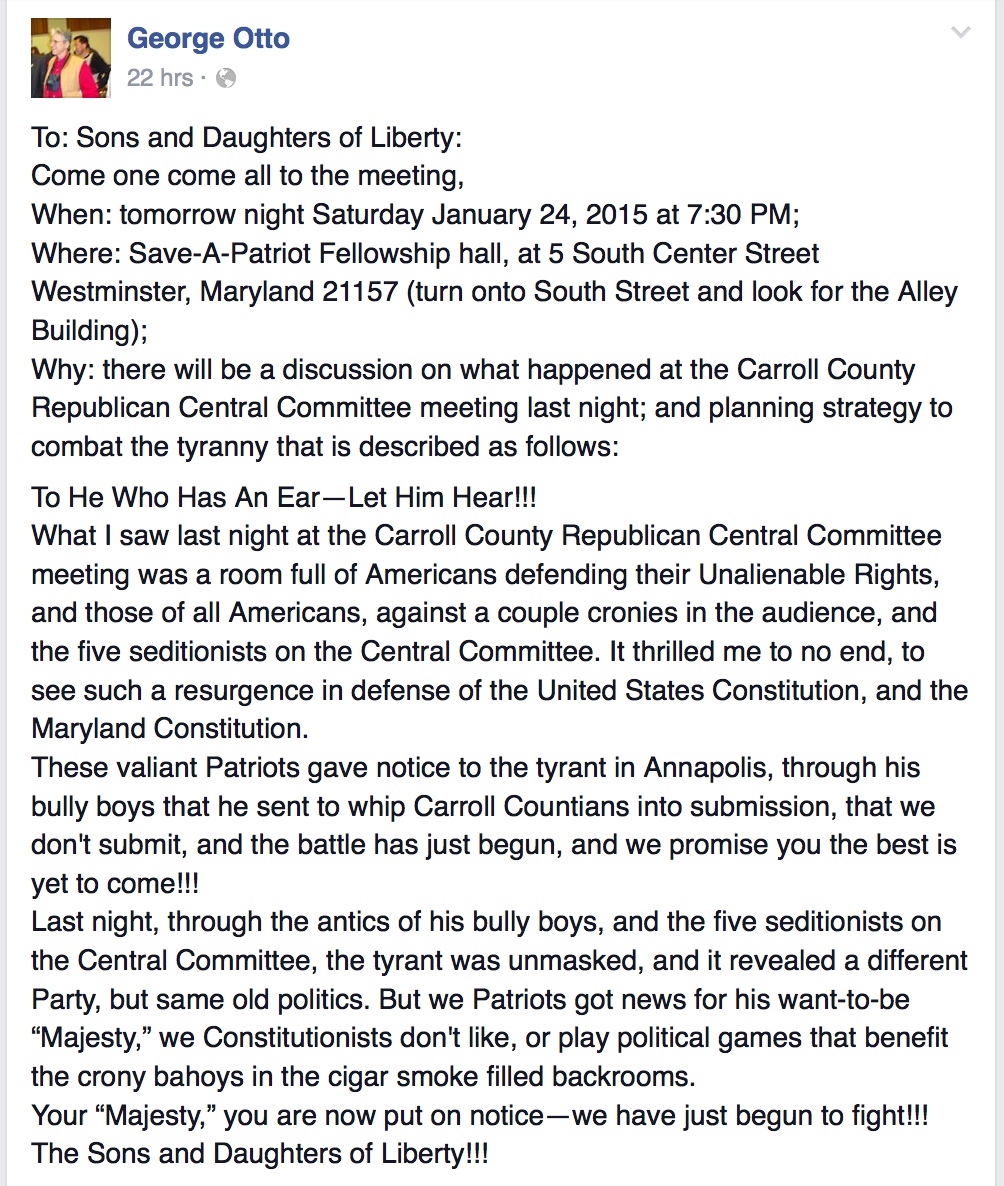
This is becoming epic as Frazier’s most ardent Facebook supporter is calling for all “Sons and Daughters of Liberty” (politically correct even!) to flight against “the tyrant in Annapolis.”

Otto

Share

Getty Staying Put? Robin Frazier Not Going to Annapolis

To the grave disappointment of Maryland bloggers but the relief of more sensible folk, it looks like wingnut Republican Robin Frazier will not be taking up a Senate seat any time soon. The Carroll County Republican Central Committee (CCRCC) bowed to Gov. Hogan’s will to nominate additional candidates when taking up the appointment of a vacant delegate seat in Carroll but declined to revisit the nomination of Robin Frazier:

Members of the Carroll County Republican Central Committee voted 5-4 Thursday to submit three names for their second open state legislative seat at the request of officials from Gov. Larry Hogan’s administration. They did not, however, reconsider former County Commissioner Robin Bartlett Frazier’s nomination for Sen. Joe Getty’s seat.
So, despite accommodating the governor on the delegate nomination, there is a standoff in Carroll County between Governor Hogan and the incumbent Sen. Joe Getty on one side and the CCRCC on the other. That being the case, Sen. Joe Getty looks to stay in the Senate for the time being:
The governor’s office said this afternoon that Getty had decided to stay in the Senate for a while longer to finish some initiatives.

Senate Minority Leader J.B. Jennings of Baltimore County said he still expects Getty to join the administration but knows he still has some local bills pending that he’s very interested in.

Yes, um, very interested.

Meanwhile, the bulk of the Republican activists who showed up at the meeting along with several members of the CCRCC are mad at the governor either for how the process was handled or the attempt to shove Robin Frazier aside, as George Otto and JoAnn Nichols, two Frazier supporters explained:
otto
Wow. Just two days into his administration, Larry Hogan has already been declared a tyrant. And people are seeing Democratic plots in the heart of the new Republican administration.
This is a textbook case of how to lose friends and influence over people. Carroll County Republicans have managed to keep their senator out of the heart of a new Republican administration in order to push for the nomination of walking embarrassment Robin Frazier to replace him while undoubtedly teeing off the new governor who they overwhelmingly supported and created a public spectacle.
Share

Facebook for Frazier

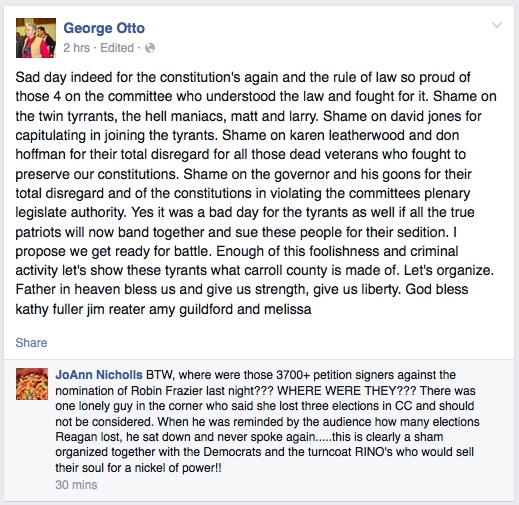
Well, the honeymoon for Gov. Larry Hogan–with Republicans, not Democrats–was short. Republican activists are already accusing Gov. Hogan of usurpation of the Maryland Constitution on Facebook:

frazier1.5

Otto attacks the Left too:

frazier1.7

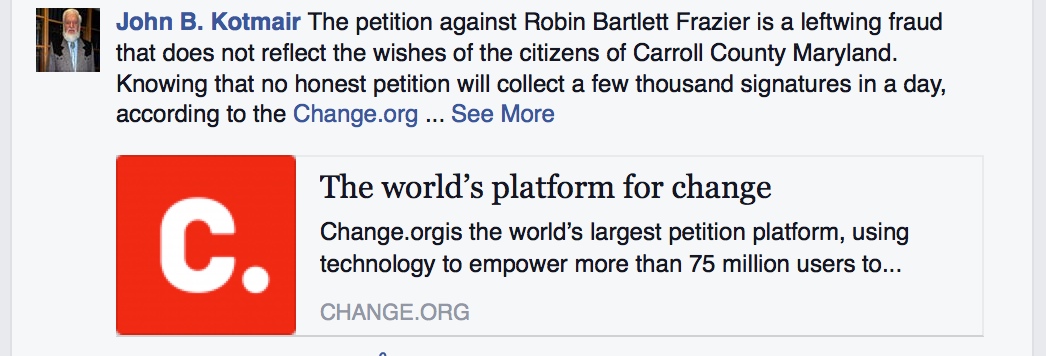
Uh oh, he’s on to us. Opposition to Frazier is all a part of the global plot to get the Carroll County Republican Central Committee to choose a socialist to fill Getty’s seat.

frazier1.8

How Kotmair explains Frazier’s spanking in the Republican primary in her bid for renomination to her seat on the commission is unclear. More left-wing fraud? Or is it pinko infiltration?

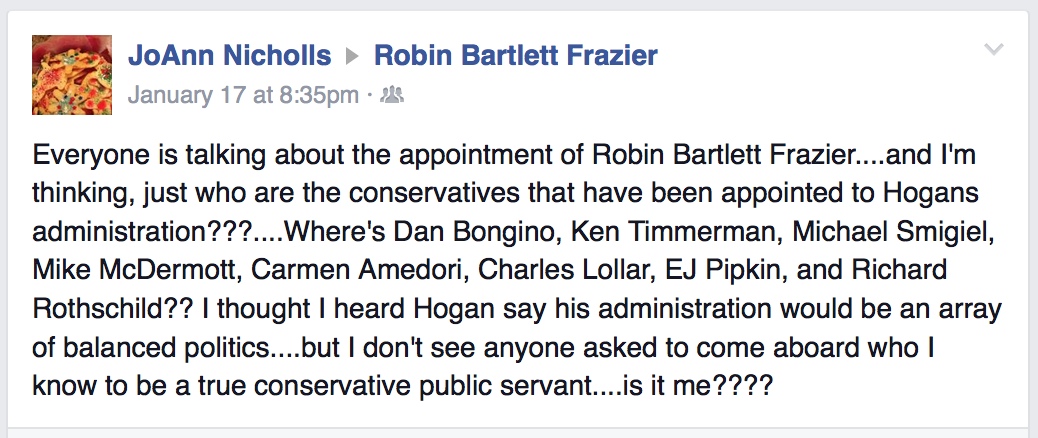
Finally, we also have good old-fashioned passive aggressive:

Frazier2

Good news, JoAnn. It’s definitely you.


Share

Joe Getty Hasn’t Resigned

Sen. Joe Getty (R-Carroll) is slated to take up a new position in the Hogan administration. However, a quick call to the Senate President’s office revealed that while Sen. Chris Shank (R-Washington), another Hogan appointee, stepped down with Hogan’s inauguration, Getty has not.

Getty’s continuance in office is likely not because he is especially slow off the dime or wants to hold on to his senate seat as long as possible but because of the kerfuffle surrounding the Carroll County Republican Central Committee’s (CCRC) strange decision to nominate walking political disaster Robin Frazier to the vacancy.

Democrats salivate at the thought of a Frazier appointment. She is guaranteed to generate endless bad press for the GOP. Needless to say, Hogan is less than thrilled. As Len Lazarick reported, he has demanded that the CCRC send up three names to him (read: someone other than Robin Frazier) in what I imagine is the desire to avoid tying his party or sharing the media cycle with this millstone. However, the CCRC website continues to announce Robin Frazier’s nomination.

Can Hogan get the CCRC to change its mind? That hasn’t occurred so far and neither has Getty’s resignation.

However, Facebook reports that the CCRC is going to meet tonight. Should be quite a show.

Share

Del. Al Carr’s Address to the House on MLK Day

mlkI heard that Del. Carr’s speech was very well received and thought that I would post it here. You can also listen to his speech here (starts at 3:19).

Thank you Mr. Speaker.

Good evening distinguished colleagues and guests

Before I begin, Please give a warm welcome to my family.

My wife Barrie and my sons Miles, Toby and Oliver and our friend Doris are in the gallery.

It is a dream come true for me to be able to serve in this chamber with all of you and to represent my constituents.

I want to acknowledge all of the friends, family, and supporters over the years who helped me achieve my dream.

We are going honor Dr. King tonight by listening to him in his own words and song.

This past summer while sifting through family possessions visiting my mother in Ohio, I stumbled on a cassette tape.

My late grandmother Dorothy Douglass had served as the assistant principal at Addison Junior High School in Cleveland.

I had heard that she had met Dr. King and recorded his remarks on the occasion when he visited her school and spoke to the assembled 7th, 8th and 9th grade students.

I had been told that she sent the original tape to the King Center archives in Atlanta. But I did not know that she had kept a copy.

I made a Facebook posting about my finding this 50-year old time capsule. My friend, audio engineer Brian Whitney told me “Don’t play it! Bring it to me!” And I thank him for digitizing, preserving and enhancing the sound quality of the tape.

No recording of this event is available on the internet. The only places it has been heard is at a few small gatherings of people where I have shared it.

I learned that this school assembly on October 22, 1964 was Dr. King’s very first public appearance after being awarded the Nobel Peace Prize.

Lyndon B. Johnson had been sworn in as president less than a year ago and was on the ballot in the presidential election set for twelve days later.

Dr. King and LBJ had partnered on the landmark Civil Rights Act of 1964 which had been signed into law just a few months earlier.

King’s role in Ohio was that of a barnstorming campaigner working to get out the vote in the largest swing state to ensure their continued partnership.

Events a few months later including those in Selma, Alabama culminated in the passage of the Voting Rights Act of 1965.

King would return to Cleveland the following year to help elect Carl Stokes, the first African American Mayor of a large US City.

To better understand why my grandmother prized the recording you should know a little bit about her life.

Geraldine Dorothy Gordon was born in 1911 to George and his wife Mary. George was an African American who grew up near Hagerstown. Mary was white, a Canadian immigrant of Scottish descent.

dorothyAs an interracial family, they were part of the black community. Their marriage was legal in Ohio but not in many states including George’s home state of Maryland.

Dorothy was the first person in our family to earn a college education. At Kent State University during the Great Depression, she and the other black students were excluded from living on campus because of their race.

After earning a degree in education, she found work as an elevator operator until landing a substitute teaching gig.

Teachers in the Cleveland Public Schools were not allowed to be married, so her career was interrupted when she wed my grandfather Carl Douglass, an African American entrepreneur.

She resumed her career after my grandfather’s passing, and went on to become a distinguished educator serving as a teacher, counselor and assistant principal.

The highlight of Dorothy’s career was her work as an administrator of a Ford Foundation program and Project Manager of Transitions helping seventh grade students labeled as troubled. Her peers were amazed at the results she achieved when the students’ performance exceeded that of eighth and ninth graders.

As her grandchildren, my sisters and I benefited from Dorothy’s high expectations and her willingness to give her time, her presence and her encouragement. But her generosity extended to many other lives that she touched.

Dorothy saved the recording of Dr. King because she knew it was historic and educational, and she wanted it to be shared.

Let’s listen.

Dr. King speaks for about ten minutes and the assembly ends with a sing along led by his colleague, future Atlanta Mayor and UN Ambassador Andy Young.

And if you are so moved, please feel free to sing along.

Thank you.

Share

Why BWI Beats IAD

pax

Source: Airport Council International

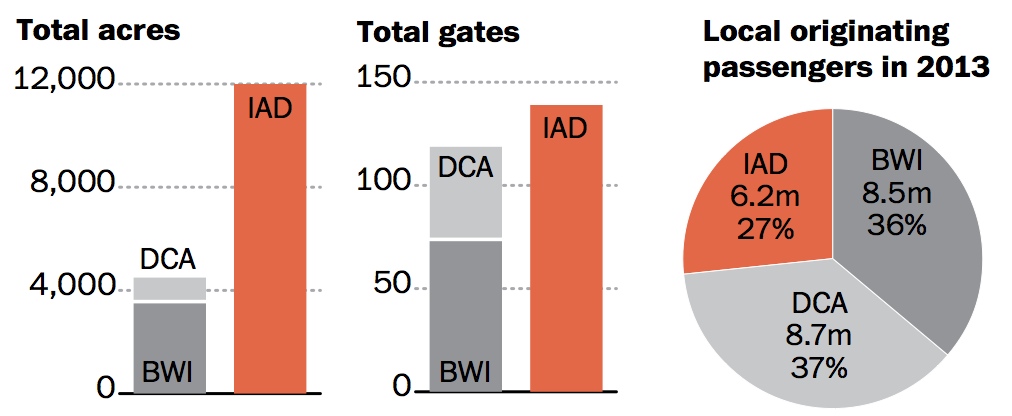
BWI Airport, Maryland’s perennial also ran, is now leaving the juggernaut of Virginia’s Dulles Airport (IAD) in the dust. In 2007, BWI had roughly 3 million fewer passengers than IAD. Reduced traffic at IAD juxtaposed  with increases at BWI resulted in BWI surpassing IAD by 700,000 passengers in 2013.

BWI has blossomed even though IAD has far more land and gates, as the Washington Post revealed:

Airports

Why is BWI killing IAD?

1. Architecture. Dulles has Eero Saarinen’s soaring design. But the need to preserve it and the impressive view prevents changes to make the airport more functional. The entry area is a disaster. The island check-in desks force many passengers to play hunt the airline and then to go around to the back.

The space between the counters and the front windows is not wide enough for all of the people to move. In contrast, the unmemorable buildings at BWI are more easily altered for functionality, including the creation of far wider (and modern) spaces in front of the check-in counters that make it easier to pass and a far less miserable experience.

2. Intra-Airport Transportation. I recall when mobile lounges were the height of cool. The AeroTrain designed to replace them cost $1.4 billion (!) but leaves passengers incredibly far from the concourses and doesn’t go to the D Concourse (mobile lounge or walk from C). While Concourses C and D expected to be torn down at some point, it stinks for the forseeable future. You can walk to all the gates at BWI.

Passengers arriving on international flights still have to take mobile lounges to immigration. No one wants to move to the back because that puts them at the end of the customs line, so everyone ends up walking over other people as it gets packed like a sausage for a voyage that takes place at a majestic pace.

3. United versus Southwest. It has taken me a very long time–I must have ridden a mobile lounge–to get converted to the virtues of budget instead of legacy carriers. United and American have convinced me otherwise. They’ve managed to combine passive aggressive service, inefficiency, and pseudo perks with all of the budget airline charges. United has a planned cluster every afternoon at IAD when the international flights are set to depart with not enough agents to handle the traffic.

Southwest loads its planes faster, partly because they don’t charge for the first bag, and most of their employees don’t seem to hate their employer or their customers. They also don’t charge honking fees to change a ticket. (I’m still waiting for the day for when an airline sends me $150 when they change my flight times.) While United accounts for around two-thirds of the traffic at IAD, Southwest has over 70% of the traffic at BWI.

4. Getting There. Like many in southwest Montgomery, I’ve been hesitant to go to BWI because of greater potential for traffic problems. Going to IAD, you know you’re golden once you hit the Dulles Access Road even if you have to spend quality time on the Beltway. However, the Intercounty Connector has created another option to BWI, where parking is substantially cheaper.

The big planned improvement for IAD is the Silver Line. But it won’t attract many from Montgomery because passengers will have to ride downtown first before heading out to Dulles. Like the AeroTrain, it will end up far away from the terminal, again due to difficulties related to the building.

Share

Maryland Politics Watch