House of Delegates Tax Bill Vastly Superior

The Maryland Senate has passed a tax cut that is directed at the top 11.1% of taxpayers. It would reduce marginal tax rates for individual taxpayers who make more than $100,000 and joint taxpayers who make more than $150,000, while the people who earn less than this receive no cut in their rates and get peanuts – or more specifically, money enough to buy a meal at Chipotle.

In contrast, the House of Delegates has passed far superior tax legislation. Instead of focusing the benefits on wealthy Marylanders, the House bill would lower the marginal rates on income earned between $3001 and $100,000 (and up to $150,000 for joint taxpayers). The wealthy would still get a break but this bill, appropriately, directs far more of the benefit to the much-squeezed working and middle classes. Like the Senate bill, the House bill also expands the Earned Income Tax Credit (EITC).

Politically, it should be a no brainer to junk the Senate bill and adopt the House legislation, particularly for Democrats. While maintaining the EITC changes much needed by the working poor, the House bill distributes the tax cut far more widely and equitably. Let’s hope that the House and the Speaker stand firm.

Share

The GOP Bench, Part IV

The following is a guest post by Adam Pagnucco:

Most attention concerning the next round of state and local elections centers on the Governor’s office. Can the Democrats find a nominee to knock off Larry Hogan or can the Governor earn a second term? But the playing field is much larger than that. In truth, we are about to find out whether Maryland is on its way to becoming a genuine two-party state.

For most of the last few decades, the Maryland Republican Party has been almost irrelevant. Their sole Governor from the seventies through the early 2000s, Bob Ehrlich, was ejected after one term. Their presence in the General Assembly was negligible. Most of the large local governments were controlled by Democrats most of the time. The great debates of the day were driven by discussions within the Democratic Party and were not affected very much by those on the outside. But there is a real question now as to whether that sort of Democratic dominance will continue.

Regardless of whether Governor Hogan is reelected, the GOP enjoys a stronger position for future elections than anyone can recall in recent times. In 2022, the County Executives of Anne Arundel, Harford and Howard could very well be running for the GOP gubernatorial nomination whether Hogan wins a second term or not. If and when they do, Republican council members and/or state legislators will run to fill those Executive seats and become the next generation of local leaders. Competition for local council seats will be fierce in swing jurisdictions like Frederick, Howard and Baltimore County. Term-limited local officials will run for the General Assembly. In other words, in the absence of an earth-shattering event (like a Donald Trump presidency) or a mass revival of the Maryland Democratic Party, the Republicans’ recent gains could become self-sustaining.

The GOP will probably never be the majority party in Maryland in our lifetimes, but they don’t have to be. All they have to do is become competitive. That will enable them to become a factor in public policy debates both through their ability to win and hold elected office and through the threat of their doing so. We may already be seeing the effects of this as a bill to steer public funding to private schools has passed the Maryland Senate. Of the 25 Senators who voted in favor it, 14 were Republicans and some of the Democrats came from competitive areas like Anne Arundel, Southern Maryland and the Eastern Shore. The House did not pass the Senate’s proposal, but did agree to use public money to fund private school scholarships for the first time in the budget. Rising right-wing influence may also be a factor in the Senate’s passage of tax cuts for the rich. This is a reversal from the Senate’s approval of tax hikes for “half millionaires” (those making $500,000 or more) in 2012 and the General Assembly’s approval of a temporary millionaire tax in 2008.

Another consequence of the GOP’s ascent could be the empowerment of its extremist elements. Governor Hogan presents a moderate face to the public. But a recent Baltimore Sun poll found that 34% of Republican primary voters supported Donald Trump for President and another 25% supported Ted Cruz. That is sure to capture the attention of Republican elected officials and influence their behavior. Republicans like race-baiting Delegate Pat McDonough (labeled by the Sun as “the Trump of Baltimore County”); neo-Confederate Anne Arundel Council Member Michael Peroutka; Delegate Neil Parrott, who wants to require HIV victims to get tattoos to obtain medicine; Hogan-appointed anti-LGBT and anti-immigrant Baltimore County school board member Ann Miller; and Frederick County Council Member Kirby Delauter are all part of the GOP bench. Imagine what they would do with real power.

The challenge facing Maryland Democrats is not just Governor Hogan – it’s also the growth of the GOP in areas other than the two Beltways and the portion of I-95 connecting them. Will the Democrats respond with a sweeping statewide effort to regain their past dominance? Or will Republican gains at the local level be entrenched? That may be an even bigger question than the identity of the next Governor and it could set the political table for many years to come.

Share

Broadcast TV Spending in CD8

The following is a guest post by Adam Pagnucco:

Unlike most state and local races below the level of Governor, the contest in Congressional District 8 has seen a lot of television ads.  These ads are trackable, although not easily.  Today we present a first cut on who is advertising where, and for how much.

The Federal Communications Commission (FCC) requires TV and radio stations to report on political ad purchases.  In 2012, the FCC required broadcast TV stations to post political ad purchases on the agency’s website, but with a large caveat: the files are in pdf format.  They are not accessible through spreadsheet or database software, and are therefore not readily crunchable.  They are also not searchable.  A researcher has to go through every relevant station, one at a time, review all pertinent folders and manually enter the data to prep it for analysis.  This is a challenging and time consuming task!

The data is also incomplete.  Cable and satellite TV stations and radio stations are not currently required to report their political ads to the website, although they will be starting in the next cycle.  Furthermore, the reports do not include production costs.  They only include amounts paid to the TV stations, both gross and net of commissions.  So the information reflects only a portion of candidate spending on TV.  That said, broadcast TV is an important part of large-scale federal elections and data on it is worth looking at.

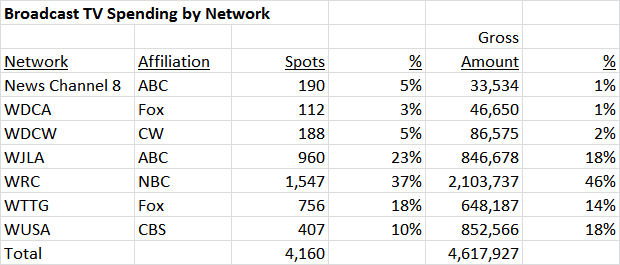
We assembled political ad data for all CD8 candidates in the year 2016 for all of the Washington area’s broadcast TV stations.  Contracts often cover a week or more into the future, so the most recent ones we obtained are active through April 16 – ten days before primary election day.  The broadcasters reported a combined total of 127 contracts through noon, April 4.  Here is the number of spots and gross amount for each broadcaster reporting.

Broadcast TV Spending by Network

Unsurprisingly, the big four networks dominate.  Also not surprising is that WRC-TV, long the top-rated local network, is a runaway leader in ad spending.

Broadcast TV Spending by Month

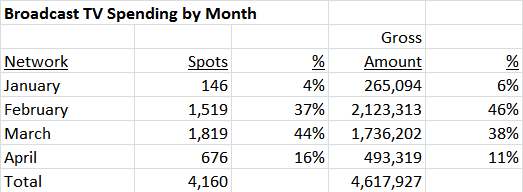
David Trone kicked off the 2016 ad season on January 26, when he began advertising on every network in our dataset.  On February 7, he paid for five spots worth $200,000 on WUSA on Super Bowl Sunday.  (That amount is more than what most candidates for State Senator and Delegate spend in their entire campaigns.)  Kathleen Matthews began advertising on February 8.  Jamie Raskin joined in on March 24 and Kumar Barve followed on April 6.  The drop in total spending between February and March was caused by a decline in Trone’s spending, part of which is due to the fact that there was no Super Bowl in March.  April spending is down because the contracts have not all been reported yet.

Candidate and Cost per Spot

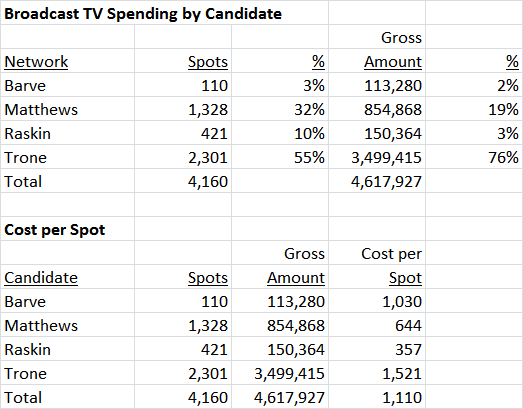
Trone dominates this category of spending, accounting for the majority of spots and roughly three quarters of gross amounts paid to broadcasters.  There are big differences in the costs paid by the candidates, and that reflects their strategies.  All four candidates advertise during news programs and those shows tend to charge the highest rates.  Matthews mixes in cheaper daytime television like The Meredith Viera Show, Days of Our Lives, Who Wants to be a Millionaire, CBS Soaps and The Insider.  Raskin is keeping his costs down by running 15-second spots, half the length of his competitors.

Candidate and Month

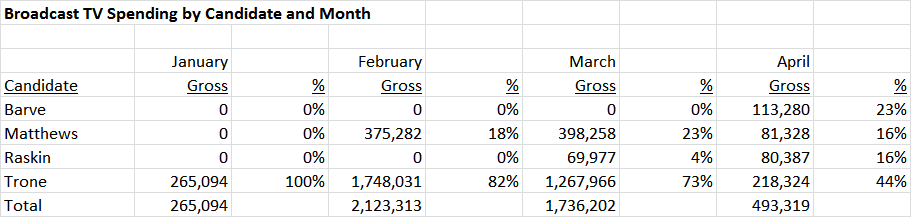
Trone’s edge in TV has been eroding over time.  He had January all to himself.  But his CD8 TV market share dropped to 82% in February, 73% in March and 44% in April (so far) as other candidates have gone live.  (That April number could change a lot!)  Late TV commercials may mean more than early ones because many voters, especially casual ones, make up their minds late.

A few other things are worth mentioning.

  1. Trone’s real dominance may not be on TV or in mail, but in his digital advertising program. His ads are everywhere on the Washington Post and Bethesda Magazine websites.  There is no known source of reporting on those ads outside of the candidates’ campaign finance reports, and even they may be a bit murky.  In any case, Trone is making a big bet on digital and his opponents are not.
  1. Matthews reported an end-of-year cash balance of $1.1 million, but this data shows that she has spent over $800,000 on broadcast TV alone. Matthews has a formidable campaign operation, with staff, field, mail, office expenses and more.  This suggests that she has had a strong fundraising quarter, or is self-financing, or perhaps both.
  1. Raskin is emphasizing mail over TV. He has the second-most extensive mail program in the race behind Trone.  This is a deliberate calculation.  Mail is much easier to target than broadcast TV.  Mail can be sent to regular Democratic primary voters – the people who tend to pay closer attention to elections than others – while TV ads are sprayed into the ether to be viewed by regular voters, casual voters, non-voters, members of other parties and residents outside the district.  Raskin believes that regular voters will support him if they know that he is a) very liberal, b) very experienced in passing liberal bills and c) has a better chance to win than the other liberal elected officials running against him.  (That message has offended Barve, who has been in office for sixteen years more than Raskin and is a high-ranking member of House leadership.)  All three publicly disclosed polls in the race show Raskin at close to 30% of the vote.  If he can hold on to his supporters and his mail strategy gets him another five points, could that be enough to win?

How much does TV spending matter?  John Delaney won his seat in Congress in part through TV ads, and David Trone has so far spent at least double his total.  Kathleen Matthews trails, but she has spent enough to be heard.  The other candidates have not made a major commitment to TV.  Will they pay a price for that?

We will have an update on this data shortly before the primary.

Share

Who Supports the Senate’s Tax Cut for the Wealthy? Bueller? Bueller?

The Maryland Senate passed a cut in marginal tax rates that will only benefit the top 11.1% of Maryland taxpayers. It’s a tax cut that literally gives the wealthy enough to buy a nice iPad but leaves the middle class with barely enough to buy a meal for one at Chipotle (but they only get even that if they have exemptions).

The bill has crossed over to the House of Delegates. Lots of people and groups testified against the bill at the hearing before the House Ways and Means Committee, including:

Maryland CASH Campaign
Maryland Center on Economic Policy
Maryland Nonprofits
Health Care for the Homeless
Maryland State Education Association
Advocates of Children and Youth
Maryland Alliance for the Poor
League of Women Voters of Maryland
MD/DC State Council of SEIU
Maryland Working Families
AFSCME

The following groups also signed on to a letter protesting holding the increase in the Earned Income Tax Credit (EITC) hostage to a tax cut for high earners:

Advocates for Children and Youth
AFSCME Council 3
Baltimore CASH Campaign
Baltimore County Arts Guild
Baltimore Neighborhoods, Inc.
CAFÉ Montgomery
CASA of Baltimore County
Council for Bile Acid Deficiency Diseases
Fuel Fund of Maryland
Health Care for the Homeless
Job Opportunities Task Force
Laurel Advocacy and Referral Services
League of Women Voters of Maryland
Maryland CASH Campaign
Maryland Center on Economic Policy
Maryland Disability Law Center
Maryland Education Coalition
Maryland Nonprofits
Maryland PTA
Maryland State Education Association
Maryland Working Families
NAMI Maryland
National Association of Social Workers, Maryland Chapter
Pain Connection-Chronic Pain Outreach Center, Inc.
Public Justice Center
Progressive Maryland
SEIU Maryland Council
The Way Out Program

So who testified on the bill at the House Ways and Means Committee hearing?

Not Governor Larry Hogan. His office didn’t even bother to send anyone to support the tax cut for the wealthy.

In fact, no one testified in favor of the tax cut. Maybe the House should take that as a hint and shelve it.

Share

The GOP Bench, Part III

The following is a guest post by Adam Pagnucco:

Far from the eyes of Annapolis, Baltimore, Rockville and Upper Marlboro, the GOP is steadily expanding its grip on county governments in Maryland. In fact, the Republicans hold majorities of almost all categories of powerful county officials.

Let’s start with County Executives (including the Mayor of Baltimore).

Executives

In 2003, six counties plus the City of Baltimore had executive positions. Only Harford County had a Republican Executive. By 2015, three more counties (Wicomico, Cecil and Frederick) had executive positions. The Democrats and Republicans are now tied at 5-5. Anne Arundel and Howard, both strategically critical suburban counties, have flipped from Democratic to Republican. The current Republican Executive of Wicomico defeated an incumbent Democrat to claim the seat. Republicans are a threat to claim the Executive seat in Frederick if they run someone other than Blaine Young, and that would give them a majority for this office.

Now let’s examine County Councils and Commissions.

Councils Commissions

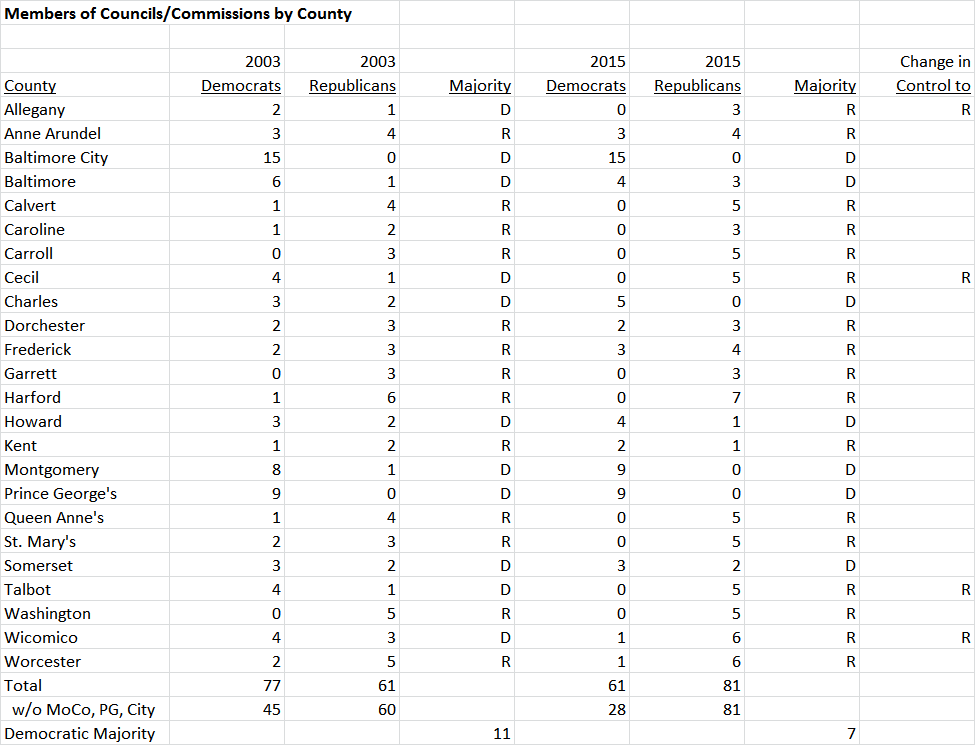
In 2003, the Democrats had local legislative majorities in 11 of 24 counties. By 2015, the Democrats had majorities in 7 counties as Allegany, Cecil, Talbot and Wicomico had flipped to GOP control. In 2003, Democratic local legislators outnumbered Republicans by 77-61. In 2015, the Republicans had an 81-61 lead. Omitting the Big Three Democratic strongholds of the City, Montgomery and Prince George’s, the GOP’s edge increased from 60-45 to 81-28. The Maryland Association of Counties (MACo) is effectively Republican-held territory.

Here are the splits for State’s Attorneys and Sheriffs.

SA Sheriffs

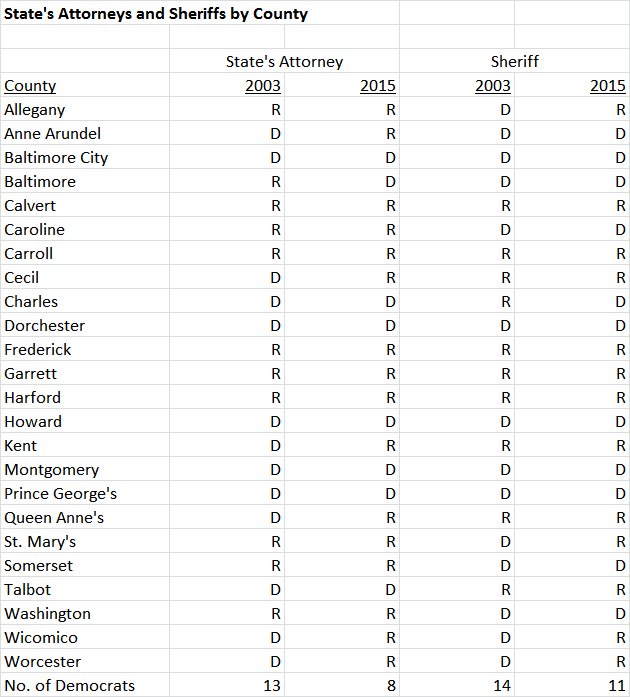
Democrats went from having 13 State’s Attorneys in 2003 to 8 now. Among Sheriffs, Democrats went from 14 to 11. Democratic majorities turned to Republican majorities in both offices.

We’ll have some thoughts about what this means in Part Four.

Share

The GOP Bench, Part II

The following is a guest post by Adam Pagnucco:

The Maryland Democratic Party’s top goal is defeating Governor Larry Hogan. The Maryland Republican Party’s top goal is getting him reelected. But the context of the next election is not simply about Hogan and his Democratic opponent. The context also includes other state and local offices, and in that arena, the GOP is on the march.

To demonstrate that, we compiled data on party identification of office holders at the state and local levels in 2003 (the first year of Governor Ehrlich’s term) and 2015 (the first year of Governor Hogan’s term). The offices we examined are State Senate, Delegate, County Executive (including the Mayor of Baltimore), county councils and commissions, State’s Attorneys and Sheriffs. For Senators and Delegates we compiled results at the regional level (large individual counties and groups of small counties) because state legislative districts often cross over county lines. All local offices are reported by county.

Let’s look at State Senators first.

State Senators

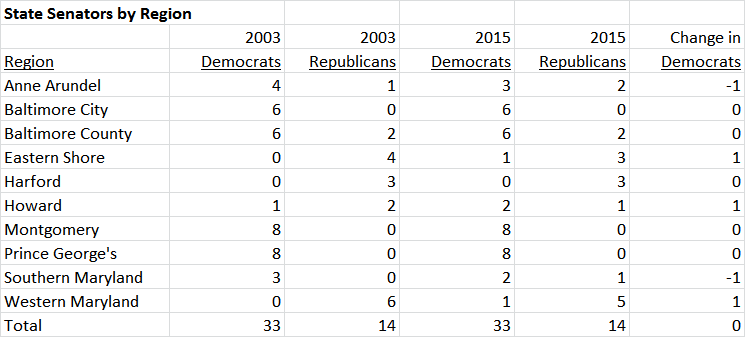
The party split of Senators is identical for both 2003 and 2015: 33 Democrats and 14 Republicans. There were no major regional changes between the two years. The imbalance in favor of Democrats is preserved in this category. (Note that the change numbers in the right column don’t add to zero because some regions overlap each other.)

Now let’s look at Delegates.

Delegates

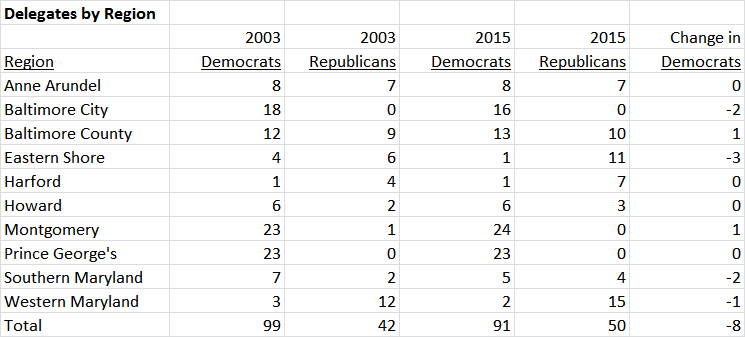
The GOP won a record number of Delegate seats in 2014, but their total (50) is not that much more than it was in 2003 (42). A few regional trends are apparent. The Democrats are down to one Delegate on the Eastern Shore. They are close to an even count in Southern Maryland, although that is because one of the area’s three legislative districts is split with heavily Democratic Prince George’s County. The two Democratic Delegates in Western Maryland come from a district that is narrowly drawn around the City of Frederick. Baltimore City has lost two Delegates who would normally be Democrats because of population shifts.

Despite these changes, the Democrats are firmly in control of the General Assembly and proved it by overriding all six of Governor Hogan’s vetoes. The REAL changes are taking place in local governments, far from the attention of Annapolis and Democratic officials in the party’s strongholds of the City of Baltimore, Montgomery and Prince George’s.

We’ll illustrate that in Part Three.

Share

The GOP Bench, Part I

The following is a guest post by Adam Pagnucco:

Competition between Governor Larry Hogan and General Assembly Democrats has been hot and heavy since the Governor’s first State of the State speech and his first budget. The Governor has alternated between calling for bipartisanship and landing heavy partisan blows against his opponents. The Democrats have responded by holding up some of his legislative agenda and overriding all six of his vetoes. Battle lines are clearly being drawn for 2018.

Hogan is sometimes compared to his former employer, Governor Bob Ehrlich. When Ehrlich won the 2002 general election, Democrats chalked it up to the lackluster campaign run by their nominee and regarded him as a fluke. They soon rallied around Baltimore Mayor Martin O’Malley and kicked out Ehrlich after one term. O’Malley decimated Ehrlich in their 2010 rematch by 14 points. Senate President Mike Miller promised to bury the Republicans and predicted it would take them forty years to recover. And then Hogan was elected.

Like Ehrlich, Hogan ran against an underwhelming Democratic Lieutenant Governor. Like Ehrlich, Hogan has positive job approval ratings (although Hogan’s are a bit higher for the moment.) And like Ehrlich, Hogan has problematic relations with the General Assembly. But there is one major difference between the two: the Maryland Republican Party is stronger now than it was in Ehrlich’s day.

Prior to Ehrlich, the last Republican Governor was former Baltimore County Executive Spiro Agnew, elected in 1966. Four straight multi-term Democratic Governors (and one Acting Governor) separated Ehrlich and Agnew. In that time period, the GOP had two U.S. Senators (John Glenn Beall and Charles Mathias) but those offices have both been held by Democrats since Barbara Mikulski’s election in 1986. The Democrats held most U.S. House seats and controlled most of the large local governments during the majority of this period. The GOP was rarely a factor in either politics or government.

Ehrlich was criticized by some for not doing enough to change this imbalance. During his time in office, the GOP’s voter registration percentage fell slightly and the party did not substantially increase its reach around the state. After his defeat in 2006, Ehrlich conceded Democratic dominance. He told WBAL, “It’s clear in Maryland that there is a direction people are more comfortable with… It’s the way it’s always been. And then we had this four-year sort of off-course thing, and people are clearly more comfortable with a single-party kind of deal here. They did not like the conflict.”

That is not Governor Hogan’s point of view. He is happy to battle Democrats through his dominant social media machine and uses them as whipping boys for all that ails the state. And Hogan has something that Ehrlich did not: a growing GOP bench. Whatever happens in the next election, that bench is something that demands attention from the Democrats for the foreseeable future.

What does the GOP’s bench look like? We’ll find out more in Part Two.

Share

Chump Change for the Middle Class

In 2020, when the tax cuts proposed in the Senate bill supported by the Governor and Senate President have been completely phased in, an individual that earns $375,000 will receive enough money annually to be able to pay for this brand new iPad Air 2 with 64GB of storage (price: $524 including tax):

ipadAn individual who earns $50,000 to $100,000 will receive nothing (price $0) unless they have exemptions. For each additional exemption, an individual will be able to buy this Chipotle Chicken Burrito (Barbacoa is too expensive) along with Chips and Guacamole:

chipotle1Good news! This middle-class taxpayer will also be able to buy a large coke (total price: $15.68, including tax).

chipotle sodaI suppose the good news is that the 2127 calories are more than enough for one person for the entire day.

Share

Senate Votes Tax Cut for the Wealthy

The Maryland Senate has adopted a bill that provides significant tax cuts for wealthy Marylanders.

Marginal Tax Rates

Changes in marginal taxes rates for individual taxpayers:

First, there is no change in the lower rates:

2% on income of $1 through $1000
3% on income on $1001 through $2000
4% on income on $2001 through $3000
4.75% on income on $3001 through $100,000

All of the change is in the higher brackets:

Rates were previously set at 5% on income $100,001 through $125,000. The Senate bill reduces them to 4.975% in 2016, 4.95% in 2017, 4.925% in 2018, 4.90% in 2019, and 4.875% after that.

Rates were previously set at 5.25%  on income $125,001 through $150,000. The Senate bill reduces them to 5.20% in 2016, 5.15% in 2017, 5.10% in 2018, 5.05% in 2019, and 5.00% after that.

Rates were previously set at 5.5% on income $150,001 through $250,000. The Senate bill reduces them to 5.45% in 2016, 5.40% in 2017, 5.35% in 2018, 5.30% in 2019, and 5.25% after that.

Rates were previously set at 5.75% on income in excess of $250,000. The Senate bill reduces them to 5.725% in 2016, 5.70% in 2017, 5.675% in 2018, 5.65% in 2019, and 5.60% after that.

Changes in marginal taxes rates for joint taxpayers are similar except that the brackets are different. Again, there is no change in the lower rates:

2% on income of $1 through $1000
3% on income on $1001 through $2000
4% on income on $2001 through $3000
4.75% on income on $3001 through $150,000

All of the change is in the higher brackets:

Rates were previously set at 5% on income $150,001 through $175,000. The Senate bill reduces them to 4.975% in 2016, 4.95% in 2017, 4.925% in 2018, 4.90% in 2019, and 4.875% after that.

Rates were previously set at 5.25%  on income $175,001 through $225,000. The Senate bill reduces them to 5.20% in 2016, 5.15% in 2017, 5.10% in 2018, 5.05% in 2019, and 5.00% after that.

Rates were previously set at 5.5% on income $225,001 through $300,000. The Senate bill reduces them to 5.45% in 2016, 5.40% in 2017, 5.35% in 2018, 5.30% in 2019, and 5.25% after that.

Rates were previously set at 5.75% on income in excess of $300,000. The Senate bill reduces them to 5.725% in 2016, 5.70% in 2017, 5.675% in 2018, 5.65% in 2019, and 5.60% after that.

Impact of Marginal Tax Rate Reduction

Here is the net change in what individuals will pay at different income levels due strictly to the Senate’s proposed changes in marginal rates:

Tax Changes

As you can see, people who earn $500K will see their taxes go down by $719, while people who earn $100K or less get no break.

Benefits to Lower and Middle Income Marylanders

No doubt its advocates will point out the the bill also increases the value of each exemption from $3200 to $3250 in 2016, $3300 in 2017, $3350 in 2018, and $3400 in 2019. Of course, wealthy people can claim these exemptions too, though they will comprise a lower share of their incomes.

More importantly, the bill will increase the Earned Income Tax Credit (EITC) to the benefit of the poorest set of working Marylanders. So poor Marylanders will pay less in taxes and even see increases in refunds if they owe no taxes.

Bad Legislation

The bill reduces the already modest level of progressive taxation in Maryland’s tax code. The largest gap in the marginal rates was only 1% between low and high income earners. That will decline to 0.85%. The difference in the overall rate (shown in the table) paid by low and high income tax payers will decline by roughly 10%.

Moreover, I don’t see why we need to give wealthy people significant tax breaks in order to increase the EITC. As the economy has picked up, the wealthy have seen the lion’s share of the benefit. Affluent Marylanders hardly need a break not only because they already have more but because they’ve gained a lot lately.

In contrast, working and middle-class Marylanders have seen their earnings stagnate or decline. The money used to give high-end tax payers a break could instead be used to augment the EITC or give a break to middle-income tax payers.

The economic rationale is poor as well. No one who earns $500K a year is going to pick up stakes and move for $700 per year. And the talk about helping the “job creators” is pure hokum. As anyone who took basic economics knows, we’re all “job creators” when we spend money whether rich or poor. Indeed, the poor likely do more to help stimulate the economy precisely because they will spend more of it to meet daily needs.

Who Opposed the Tax Cuts for the Wealthy?

Lee
Madaleno
Manno
Muse
Pinsky
Ramirez
Raskin
Rosapepe

The eight liberal legislators are all are from Montgomery and Prince George’s Counties.

Share

Senate Unveils Portrait of Sen. Gwendolyn Britt

Britt PortraitPortrait of Sen. Gwendolyn Britt

Yesterday, the Maryland Senate unveiled a portrait of the late Sen. Gwendolyn Britt. She represented Prince George’s County in the Senate from 2003 until her death in 2008. However, Britt’s public service began long before her election to the General Assembly:

In 1960, at the young age of 18, Gwendolyn Green became a leader with the Non-Violent Action group out of Howard University, where she was a student. She traveled to lunch counters throughout Maryland, D.C. and Virginia protesting segregation. . . .  In June of that year, she staged a sit-in protest on the carousel of segregated Glen Echo Park in Montgomery County. Gwen and four others were arrested and convicted of criminal trespass. Those arrests were appealed, and the U.S. Supreme Court found the convictions unconstitutional. . .

During the Civil Rights Movement, Sen. Britt took part in Freedom Rides and joined the Student Non-Violent Coordinating Committee (SNCC) voter registration drive under constant threat of violence:

In Jackson, the group of Freedom Riders used the whites-only facilities at the train station. Police attempted to evict them, leading to mass arrests where officers herded the Riders onto paddy wagons with billy clubs, spitting on them. She spent forty days in the maximum security Parchman Penitentiary for her arrest.

Britt could have rested on her laurels but her passion for civil rights for all people continued in the General Assembly:

During her tenure as a state senator, Gwen helped shepherd a bill through the General Assembly that restored voting rights to ex-offenders, telling The Baltimore Sun that “a person’s right to vote is his or her badge of citizenship, and without it all other rights are in jeopardy” . . . She also worked to ensure ensure emergency shelter for victims fleeing domestic violence in the home, and was honored by the Family Crisis Center of Prince George’s County with a fund named in her honor. . .

One of Gwen’s last signature issues was working to achieve marriage equality for same-gender couples. In the days prior to her passing, she was soliciting co-sponsors to the marriage bill she planned to file.

Gwendolyn Britt was survived by Travis Britt, her husband of 46 years, who passed away at the end of last year before he could see his wife’s portrait unveiled. A great example and leader from early in life until her untimely death, I hope the General Assembly places Sen. Britt’s portrait in a prominent place in the legislative complex.

Share

Maryland Politics Watch