The State of Play Before Primary Night I

The Presidential

Maryland was made for Hillary Clinton. She has done very well among African-American voters, who form 30% of the State’s population and will comprise a higher share of Democratic primary voters. The exit polls from 2008 indicated that women composed a staggering 62% of the primary vote, another good demographic for Clinton this year.

Finally, Bernie Sanders is running as an anti-establishment candidate in a State where many primary voters literally live inside the Beltway. While the Obama campaign swept many of these same areas in 2008, there is no remotely parallel wave for Bernie Sanders.

On the Republican side, I suspect Trump will have a good night. Class dynamics are unusually inverted in Maryland with many upper class Democrats and working class Republicans, who have provided the backbone for Trump’s support elsewhere.  Will Gov. Larry Hogan end up having to explain whether he’ll support Trump to the same Republican coalition that elected him?

The U.S. Senate

In Maryland, the presidential primary has ceded marquee status to the hard fought battle between Donna Edwards and Chris Van Hollen. It has become a battle between the uncompromising progressive and the person who gets progressive results.

EMILY’s List upped the octane in this race by dumping millions on the side of Edwards, providing the bulk of her campaign funding. No doubt this has been a unpleasant surprise for Van Hollen, who likely expected to dominate due to his fundraising prowess and has enjoyed strong support from women’s groups in the past.

Lately, however, these advertisements have become a mixed blessing, as bizarre attempts to characterize Van Hollen as opposed to gun control or campaign finance provoked a backlash from the White House and critics. See Jonathan Shurberg’s excellent summary.

Edwards has been hoping that her compelling personal story, ability to bring some diversity to the Senate, and strong progressive credentials will help her unite progressive white and African-American voters into a winning coalition.

However, after months of a tight race, polls indicate that Van Hollen is pulling ahead but the voters will have the ultimate say tonight. If he does become the Democratic senatorial nominee, commenters will likely point to several factors.

First, I don’t think Edwards has convinced voters that she is more progressive than Van Hollen in any meaningful way. Van Hollen has also managed to sell the argument that he is not just progressive but accomplishes progressive goals more compellingly than Hillary Clinton in the presidential race.

Next, Edwards has not obtained support from key African-American officials, like County Executives Rushern Baker and Isiah Leggett. The silences from Rep. Elijah Cummings’ office and the Congressional Black Caucus are also deafening. Edwards has nonetheless done an impressive job uniting black support across the State, particularly in light of these gaps in her support base.

As she goes into the final stretch, Edwards has hammered home her personal story and that she would be only the second black woman in the Senate. No one could seriously argue against the desirability for more diversity in the Senate.

But the dominance of this argument risks reducing her campaign to only identity politics. It needs leavening with other elements to sustain substantial cross-racial appeal even though the Black Lives Matter movement gives it a natural energy that could still make this a close race tonight.

I know too little about the Republican race to comment.

Share

How David Trone Could Win

A guest blog by Adam Pagnucco.

Congressional District 8 has three strong Democratic candidates with a chance to win.  One of them is Total Wine co-founder David Trone.

Strengths

Let’s start with the obvious: Trone has accounted for two-thirds of all funding in the race and three-quarters of broadcast TV spending.  He leads the field in mail and digital ads too.  As David Lublin has written, his campaign has been well run and professional.  Trone’s rags-to-riches life story is compelling and will appeal to many.  He is running as the outsider candidate in a year in which outsiders have seen success at the presidential level in both parties.  He is running against PACs and lobbyists more than he is against his opponents.  (Only PACs and lobbyists could rival the current Congress in unpopularity!)  And Trone has been an active campaigner at the retail level, appearing at Metro stations and many events.

Weaknesses

Trone had a bad start, openly saying “I sign my checks to buy access” when questioned about why he contributed to Republicans and having to apologize when his campaign sent a spy to the Matthews and Raskin offices.  He is pilloried by Raskin loyalists and some of his opponents for his self-funding.  He is not a natural politician and has had to learn the ropes quickly.  He was unknown in the district in the beginning (boy, has that changed!) and has no local political history.  And he is not as good a fit for the district’s electorate as a liberal state senator or a telegenic, professional woman.  But Trone’s financing as well as the competent campaign operation he has built virtually overnight make him a big factor in this race.

What Our Sources Say

Source: “Trone is not a naturally attractive candidate, but he seems to be the rare self-funding first-timer who has allocated his resources wisely and widely across the spectrum of voter contact methods and has mostly avoided unforced errors, some early missteps notwithstanding. He has hired competent professionals to produce television ads and direct mail pieces of workmanlike quality while also using paid canvassers, online ads, etc. If he loses it will not be because he failed to touch all of the bases or because he failed to heed the advice of people who know how to run political campaigns.”

Source: “If there’s anything Montgomery County politics could use, it’s someone to shake things up. Our politics are boring and our politicians are all the same. I love the fact that Trone’s not part of the small insiders club, and rather than being shy about it, he’s proud of it. With the Republican Party shifting hard to the far right nationally, the Democratic Party should be seizing the hole left for the business community – and with his business background and progressive politics, David Trone is the kind of guy who can help make that happen.”

Source: “Running a terrific outsider gubernatorial campaign, but he’s running it for a House seat.  Good ads, good mail, and showing up everywhere he needs to, just not getting traction because the legislative job doesn’t match his executive credentials.”

Source: “David’s candidacy will test the political theory about whether the Delaney model for victory was a fluke or is a viable way to reach Congress in Maryland. In terms of policy, demeanor, desire and political acumen, he is the best choice. He has the potential to actually change Congress for the better. So, did his late entry hurt him? Do enough people know him? Is money the ultimate decider in our local Congressional races? He’s never held political office, does that matter? If he is elected, does that mean that most MoCo voters are actually more moderate and business friendly than we think they are? David’s candidacy is the most intriguing because it tests all of these questions. If he wins, the party establishment loses two congressional seats in a row – CD6 and CD8.”

How He Could Win

Because of his resource advantage, Trone doesn’t have to run a targeted race – he can communicate with everybody.  His television and digital ads go out to regular voters, casual voters, non-voters, members of other parties and non-residents alike.  His mail program can reach out to all registered Democrats.  Raskin’s base will never abandon him and many women will go for Matthews, but there are thousands of Democrats in the district who know only one candidate: David Trone.  If turnout is high and is not based just in the Downcounty areas that are the home of the district’s liberal, high-information voters, there will be lots of people who will vote for President, know nothing of Congress, and vote for U.S. House candidates based on little more than name recognition.  This is the antithesis of the scenario most favorable to Jamie Raskin – a large, casual, mixed-ideology electorate who come from Carroll, Frederick and Upcounty nearly as much as they do from the Beltway region.  If that happens and turnout approaches 2008 levels, David Trone could be going to Congress.

Share

How Jamie Raskin Could Win

A guest blog by Adam Pagnucco.

Congressional District 8 has three strong Democratic candidates with a chance to win.  One of them is District 20 State Senator Jamie Raskin.

Strengths

Raskin has successfully established his brand as the effective, results-oriented progressive in the race, and he uses it as a contrast against two well-funded opponents who have never held office and have no local political history.  He started with a geographic base that accounted for roughly a sixth of the district and expanded it into other areas with a nearly year-long ground campaign.  His supporters are passionate, knowledgeable, loyal and numerous.  It would not be a stretch to say that he has wrapped up close to 90% of the district’s regular Democratic activists, the kind of people who play big roles in County Council and state legislative races.  His fundraising has been mostly local and is competitive with Kathleen Matthews.  His mail program has been second only to David Trone’s, although Emily’s List has been catching up in their advocacy for Matthews.

Weaknesses

As the third-ranking candidate in terms of finances, Raskin is running a more targeted race than either Matthews or Trone.  He has made a token investment in television in favor of a robust mail campaign, which can be targeted to regular voters.  There is good reason for this, but let’s remember that Rob Garagiola made a similar choice against John Delaney in 2012.  If turnout is high and jammed with low information voters who have not seen Raskin’s mail, he would be at a disadvantage.  Also, Raskin’s dispute with Delegate Kumar Barve over an inaccurate television ad has earned him negative coverage in the Post (twice), the Sun and Bethesda Magazine during the crucial final weeks of the race.

What Our Sources Say

Source: “Raskin has had the clearest message – that you should vote for him because he is the one who has actually passed bills that deliver on the progressive values all of the candidates say they support – but the question is whether he has put enough resources into TV ads to compete with the Trone-a-thon (and to a lesser extent the Matthews ads) that have blanketed the region with spots for his competitors.”

Source: “A hypothetical: If you could choose between a candidate who had a fantastic TV game but mediocre ground game, or a candidate with a fantastic ground game but mediocre TV game, who would you choose?  If you chose the latter, congrats, you’ve picked the winner of the CD8 race.”

Source: “Raskin isn’t a bad guy but the issues he’s advanced in the State Senate that he talks about frequently on the trail — a place with only 14 Republicans — have absolutely ZERO chance of happening in a Republican Congress. The key progressive battles in Congress won’t be waged in the near term on social issues, but as Chris Van Hollen showed, they’ll be fought on budget issues. That’s the effective progressive void CVH will leave in the House and Raskin simply doesn’t have the budget chops to fill it.”

Source: “He inherited Frosh’s very strong Montgomery County network which, along with his own record, gave him an instant third of the vote.  That’s an enviable position to be in.  On the other hand, he has a long voting record in a year of outsiders, is arguably to the left of Bernie Sanders, and doesn’t have a great deal of humility.  Still, if he wins it is a great victory for activism, involvement, and progressivism.”

Source: “Jamie’s candidacy is the test of whether there is value to being in the state legislature for people who aspire to higher profile office (offices on the top of the ballot that most voters learned about in civics class in high school – President, Senate, House). Hard working legislator, deep community connections, excellent reputation and undeniably brilliant. But, does he have any kind of advantage from having all of those elements in front of an electorate that does not follow Annapolis? Do the liberal party insiders who support him have as much electoral power as the state legislators and county councilmembers think they do? We’re about to find out!”

How He Could Win

Raskin supporters tend to be very liberal, know that Raskin is very liberal, and have lots of information about the race.  That message is reinforced through the grass-roots network that Raskin has built.  High information voters like these almost always vote and they will have an outsize impact on a low turnout election.  Turnout in Montgomery County has been trending downwards for years, and if that continues, it will favor Raskin.  Under this scenario, his people will stay with him and the remaining low information voters will be divided between Matthews and Trone.  Whether this will play out in the context of a competitive Democratic presidential primary is anyone’s guess, but Raskin’s base is the envy of the field and he has a good chance to win.

Share

How Kathleen Matthews Could Win

A guest blog by Adam Pagnucco.

Congressional District 8 has three strong Democratic candidates with a chance to win.  One of them is former WJLA anchor and Marriott executive Kathleen Matthews.

Strengths

Matthews is an attractive, polished female candidate – an advantage in any Democratic primary dominated by women.  She has been a great fundraiser, excels on television and has run an intelligent campaign based on her strengths.  She has been endorsed by the Washington Post, as was John Delaney in 2012.  Emily’s List has basically taken over her mail program, enabling her to shift more money to her home medium of TV.  And she has not made any significant mistakes during the campaign.

Weaknesses

Matthews started out with no history in local politics, even though she was once well-known as a local journalist.  That caused skepticism from local Democratic Party activists, most of whom quickly lined up behind Senator Jamie Raskin.  Her history of running Marriott’s PAC, which donated to Republicans as well as Democrats, is an issue for some.  Comptroller Peter Franchot, Delegate Bill Frick and former County Executive Doug Duncan are among her few local endorsements.  She has raised far more money out of state than in state.  And her campaign, while professional, has emphasized more standard national Democratic issues than local issues.  Still, Matthews’s strengths outweigh her weaknesses and she has a very good chance to win.

What Our Sources Say

Source: “Matthews started slow – she was so poorly informed and unfamiliar with the people and issues in the district that she bordered on offensive in early appearance and meetings with activists and other potential supporters – but she has become much more comfortable and has performed reasonably well in later candidate forums and debates. The conventional wisdom – and I suspect it is correct – is that Trone takes a bigger chunk of support from Matthews than from Raskin, because Raskin is presumably strongest among the most intensively engaged Democratic base voters, while Trone and Matthews are competing for voters who are less ideological and are less likely to know much about his legislative record.”

Source: “Among insiders, there’s a sense that Kathleen is running a very generic campaign.  Campaign-in-a-box kinda thing.  But insiders are usually wrong, and she obviously has gender on her side (and isn’t afraid to use it).”

Source: “With all due respect to Kathleen who seems like a perfectly nice and intelligent woman, female voters in this District are far too smart to be pandered to the way she has this election cycle. To talk about her time at Marriott in the context of creating jobs and being a business person is like saying her husband – who was Tip O’Neill’s press secretary – served as Speaker of the House.”

Source: “Strong candidate and strong campaign.  If it weren’t for a completely unprecedented amount of self-funding by another outsider candidate, she would have the race sealed.”

How She Could Win

Matthews and her chief ally, Emily’s List, are running an all-female, all-the-time kind of campaign.  And they are smart to do so since women account for roughly 60% of Montgomery County’s Democratic voters, no matter how you cut the electorate.  If Matthews gets a majority of women, she could start with 35 points.  If she adds just five more points from men, she has 40, and that’s probably good enough to win.

Share

Delegates for Corporate Welfare

The General Assembly managed to pass a tax subsidy worth $37.5 million for Northrup Grumman but not to enact the increase in the Earned Income Tax Credit (EIRC) that both houses favor. Laudably, the House  did not tie the EITC increase to a tax cut for the wealthy like the Senate but instead adopted a broad based tax cut.

Nonetheless, the corporate welfare for Northrup Grumman easily passed the House of Delegates 76-57. Twenty-eight House Democrats supported this giveaway, including several who identify themselves as progressive leaders in the House:

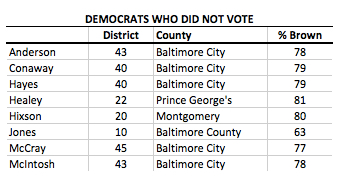
NG Dem DelEight Democrats didn’t vote on the issue, including a few members of the House leadership team:

NG Dem NV

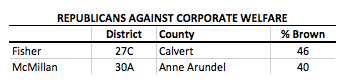
Two Republicans stood for conservative principles and did not give away your tax dollars to a corporation that already does quite well at the federal trough.

NG GOP

Share

Updated: Fundraising in Congressional District 8

This is a guest blog by Adam Pagnucco.

Last October, we summarized fundraising in Congressional District 8 through the third quarter of 2015.  Today, we present updated numbers incorporating campaign finance reports through April 6, 2016, which are the last reports due before the primary.

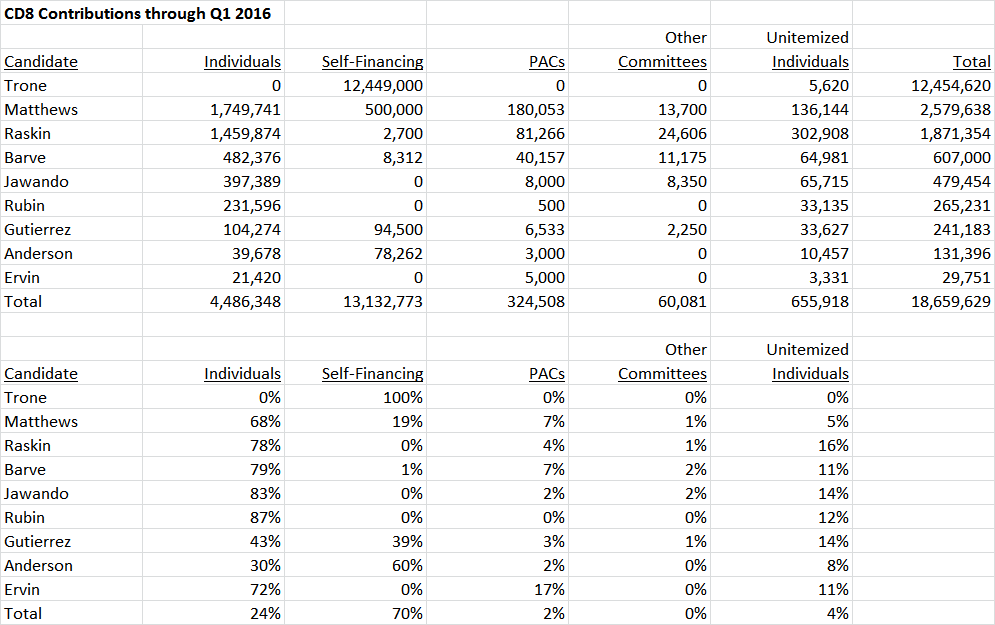
First, let’s look at the top-line numbers by category.

Total Wine co-owner David Trone stands out.  His $12.5 million in resources, almost entirely self-funded, accounts for 67% of all money in the race.  Trone has set the all-time nationwide record for self-funding in a U.S. House primary and his financing approaches the range of recent major candidates for Maryland Governor.

Former WJLA anchor and Marriott executive Kathleen Matthews and Senator Jamie Raskin have both done well.  At the beginning of the race, many observers were predicting that it would take $2 million to win, and both Matthews and Raskin are roughly at that mark.  If it were not for Trone, their financial performance would be attracting more comment.  The other candidates combined have accounted for 9% of the election’s funding and face steep challenges to be heard.  (Dan Bolling’s report has not been filed as of this writing, so his numbers are not included here.)

Top Line

Unlike state and county contributions, federal contributions must be designated for the primary or the general.  The candidates have collected relatively little general election money and their budgets are almost entirely available for the primary.

Primary vs General

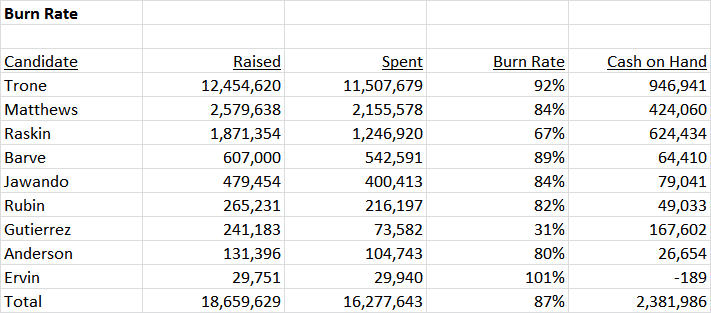
Burn rate, which is the percentage of money raised that has been spent, is not a terribly meaningful statistic at this point.  Most of the candidates’ money is gone now with the exception of Delegate Ana Sol Gutierrez, who can afford some late mailers if she wishes.  But Trone and Matthews have additional self-financing capacity, and even Raskin can self-fund to a limited extent.  (So far, he has given himself just $2,700.)  Additionally, this statistic is affected by the timing of bill payments.  Candidates who pay late look better on cash-on-hand than those who pay early.  Note: Trone’s raised figure includes the two self-funding contributions he made last week, but his cash on hand applies to April 6.  That makes his data not strictly comparable to the other candidates, but at this point, he and the others are spending as fast as they take money in.

Burn Rate

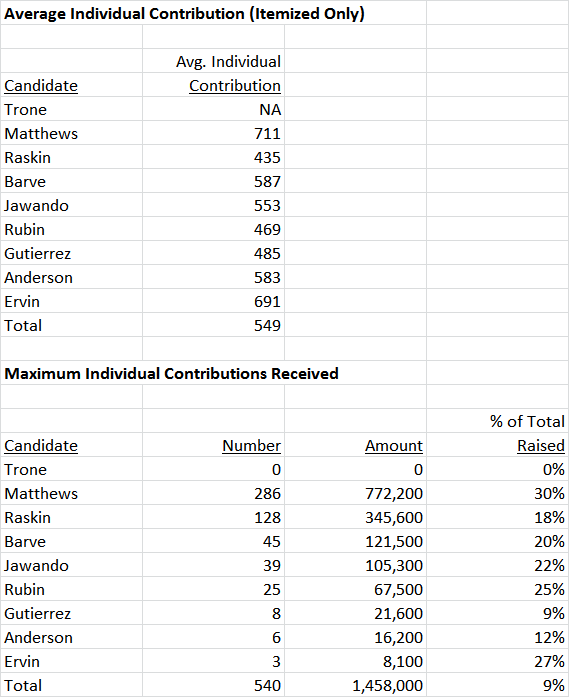
The maximum allowable individual contribution is $2,700 per election, both primary and general.  Matthews leads in this category.  Thirty percent of her fundraising has come from maximum checks and her average individual contribution is the highest in the field.  Raskin has the smallest average individual contribution, but that does not include his lead in unitemized contributions of $200 or less.  There’s no way to tell from the campaign finance reports how many of those small contributions he has received, but they total over $300,000.  Raskin is the race’s small dollar leader.

Avg Max Individual

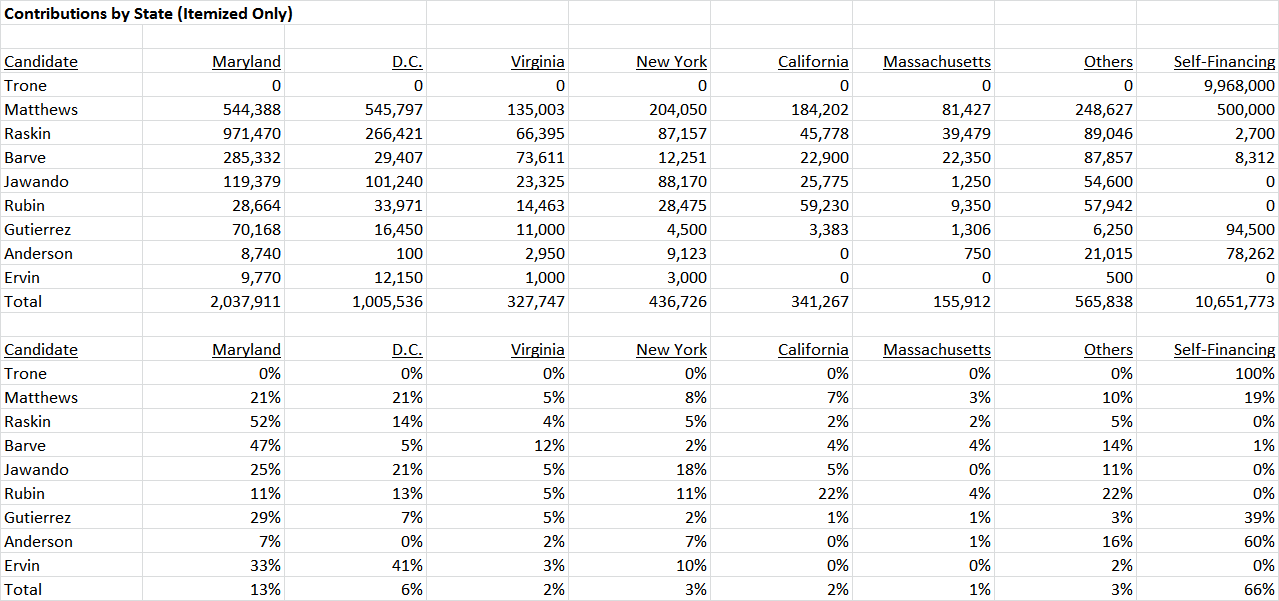
In terms of geography, large amounts of out-of-state cash have been flowing into CD8.  Excluding self-financing and unitemized contributions, only Raskin has received a majority of his contributions from Maryland while Delegate Kumar Barve is close at 47%.  Nearly half of all money from Marylanders in this race has gone to Raskin.  Matthews, Gutierrez, Will Jawando, Joel Rubin and Dave Anderson have all received less than a third of their contributions from Marylanders other than themselves.  Rubin’s take from California is more than double his receipts from Maryland.  Matthews’ number one location of contributions is the District of Columbia and she leads in receipts from the District, Virginia, New York, California and Massachusetts.

By State

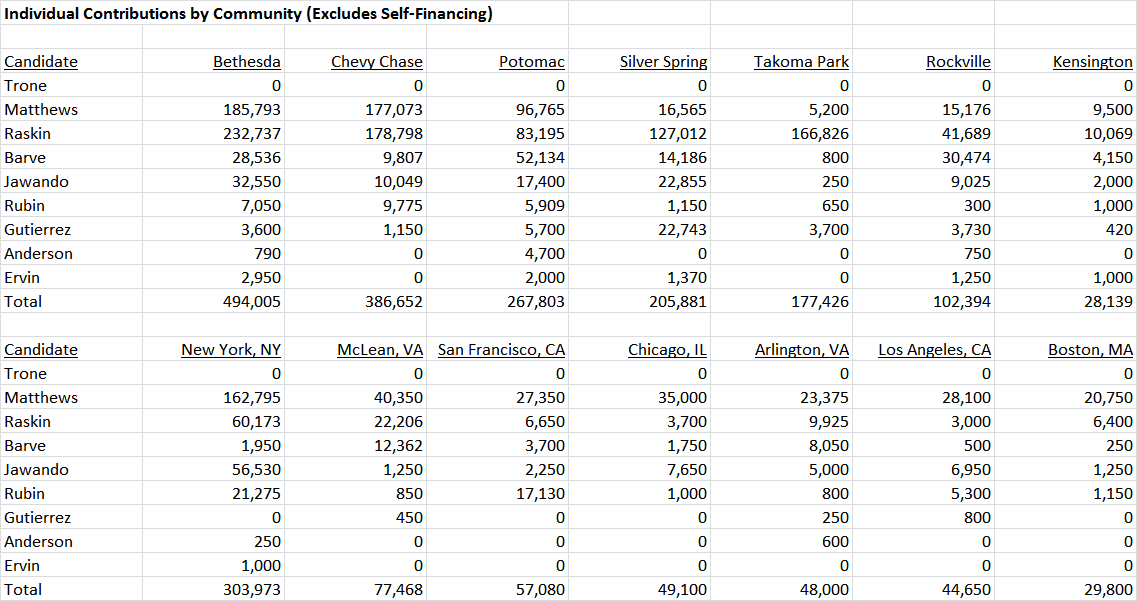
Here’s a breakdown by locality, both inside and outside the district.  Matthews leads in funding from Potomac and is basically tied with Raskin in Chevy Chase, while Raskin leads in Bethesda, Silver Spring, Rockville, Kensington and Takoma Park (the latter by light years).  Matthews dominates in fundraising from large localities outside the district.  She has raised more than three times as much money from New York City as she has from Silver Spring, Takoma Park, Rockville and Kensington combined.

By City

This data makes clear the fundraising strengths of CD8 candidates.  Trone is self-funding A LOT.  Matthews has tapped into a large monetary base combining national level Democrats, PACs and business money.  Raskin has national and PAC money too, but most of his financing is local and much of it is small dollar.  All three have the resources they need to win.  Given the fact that these three account for 91% of the funding in this race, it’s hard for the other candidates to break through.

Share

On the Trone Campaign

Once this election is over, Democrats all over the Eighth Congressional District are going to feel jilted as the never ending stream of direct mail from David Trone comes to a sudden halt. So I’m playing this one in advance of primary day.

Seriously though, David Trone is running an excellent campaign. Many wealthy people decide to run for office but are completely oblivious to their lack of political expertise and spend their money badly. David Trone has hired experts, and he has hired good ones.

Trone’s direct mail is not only plentiful, it’s attractive and well-designed. It comes in a variety of formats. If you don’t read the postcard, maybe you open the letter. It’s also targeted; I received at least two pieces based on my ethnicity.

His television ads are similarly well done based on the few I’ve seen. Thanks to the blessings of Tivo, I see fewer political ads than many. (Some friends are impressed that I manage to watch TV not see most of Trone’s ads.) Increasingly, I suspect, viewers of commercials on television skew older. But that’s not bad in a primary because so do the voters.

Younger viewers may have been forced to watch when they viewed shows online, as most do nowadays. I imagine I might’ve seen more videos for Trone if I clicked on the many net ads, though I wonder greatly if they are effective.

Trone also has a large staff of paid canvassers. They’re way better than paid people that I’ve seen in most state legislative campaigns, who usually can’t wait to dump the literature and get home. Nonetheless, Trone’s people remain less passionate and knowledgeable than volunteers. Scratch the surface of his pleasant crew, though I am not sure many do, and they don’t know much about their guy.

The canvassers are also well targeted. Anyone who requested an absentee ballot soon had a Trone canvasser at their door. And Trone has very heavily promoted absentee ballot requests from people who have not voted in primaries previously.

If Trone loses, it won’t be because he spent his money badly.

The real question remains why Trone wants to be a freshman member of Congress. It doesn’t seem to be any particular issue passion. A clear campaign weakness is that his stances on public policy are cookie cutter and undeveloped.

Beyond wanting this to acquire this particular political success and to highlight his considerable business acumen, one wonders why he doesn’t run for an office where he could really shake things up. A Trone campaign for County Executive would sure unsettle the plans of most of the County Council.

Share

Senators for Corporate Welfare

The General Assembly couldn’t manage to pass an increase in the Earned Income Tax Credit (EITC) even though both houses supported it. In contrast, the bill giving Northrup Grumman a $37.5 million tax credit sailed to passage.

Who in the Maryland Senate supported this fine example of corporate welfare?

One Republican Against Corporate Welfare

Just about every Republican voted for the bill. Sen. Michael Hough (R-4) was the sole Republican who voted no, possibly because he is a conservative who (1) wants a simple tax code, (2) doesn’t think government should interfere in the free market by helping out only favored businesses, and (3) wonders why his tax paying constituents shouldn’t get the break instead of Northrup Grumman.

Democrats for Corporate Welfare

Nineteen Democrats joined the twelve Republicans who voted for the bill. The following chart lists them in decreasing order of support for Democrat Anthony Brown in the last election:

DforNGThough seven represent legislative districts that voted for Hogan, the rest hail from districts won by Brown. Nine of the 19 represent extremely safe Democratic districts. In these nine, Brown won by 59% or more, and all won election in 2014 by 62% or more.

Four more represent districts carried only narrowly by Brown (i.e. 50-52%). But even these senators do not face serious general election danger. Obama fared much better in the same territory, and Democrats won them by 57% or more in 2014 despite the terrible electoral fortunes faced by Democrats around the country.

Sen. Craig Zucker (D-14), recently appointed to replace retired Sen. Karen Montgomery, is tacking to the right of his predecessor. Besides voting in favor of giving money to Northrup Grumman, he also supported the tax cut for the wealthy. An interesting strategy as incumbent Sen. Rona Kramer lost to then-Del. Montgomery the primary after being attacked as too pro-business.

Dumb Politics

The politics of the legislation make little sense. It’s not even a question of alienating liberals. It’s hard to see how Democrats win more votes here from anyone. Are moderates, let alone liberals, really going to vote Democratic because Northrup Grumman received a tax giveaway?

The icing on the cake is that the Senate simultaneously killed off an increase in the EITC by standing firm in favor of a tax cut for the wealthy instead of for the middle class.

Share

EITC Increase Dies But Northrup Grumman Gets Corporate Welfare

One of the big battles of the General Assembly’s now ended legislative session centered around proposals to increase the Earned Income Tax Credit (EITC) and to cut taxes. Both the Senate and the House proposed an increase in the EITC. But while the Senate tied it to a cut in marginal rates for the top 11.1%, the House passed a broad based tax cut.

No EITC or Middle Class Tax Cuts

Conference negotiations resulted in stalemate, as the Senate held out for its tax cut on the wealthy. As a result, no tax cuts and no increase in the EITC. The political sense in the Senate’s position was lost on me. The Democratic-controlled Senate held the EITC hostage to a tax cut for the wealthy for which the Governor would inevitably claim all the credit. Bad policy and bad politics.

Don’t Worry, We Have Northrup Grumman’s Back

Meanwhile, the General Assembly passed a $37.5 million tax credit for Northrup Grumman. The Senate even voted down an amendment that proposed to make it nonrefundable. While the legislature made progress on other fronts, the General Assembly bombed the fundamentals on tax policy.

Heck, Republicans should have opposed this turkey too. If you really believe in the free market, then you should also believe that government should not pick winners and losers or give some businesses special treatment.

Sen. Rich Madaleno, who opposed the tax cut for the wealthy and the corporate welfare for Northrup Grumman, summed up the situation well in a tweet: “Sadly only Northrup Grumman gets expanded EITC.”

How Did They Vote?

That’s for tomorrow’s post.


Share

Maryland Politics Watch