Downcounty Dominates Public Financing, Part Three

By Adam Pagnucco.

In Part Two, we learned that downcounty accounts for less than one-quarter of the county’s population but comprised 52% of individual contributions eligible for matching funds to countywide candidates in 2018. Let’s look at the contribution geography of the candidates who won countywide offices and used public financing that year.

Marc Elrich

Elrich was a city council member in Takoma Park from 1987 through 2006 and an at-large member of the county council from 2006 through 2018. He was elected county executive for the first time two years ago. He raised more money in public financing than anyone else because of two factors: 1. county executive candidates have more generous matching formulas than council candidates, and 2. he had a competitive general election that necessitated more fundraising. In both the primary and the general, Elrich hit the matching funds cap of $750,000 for each election.

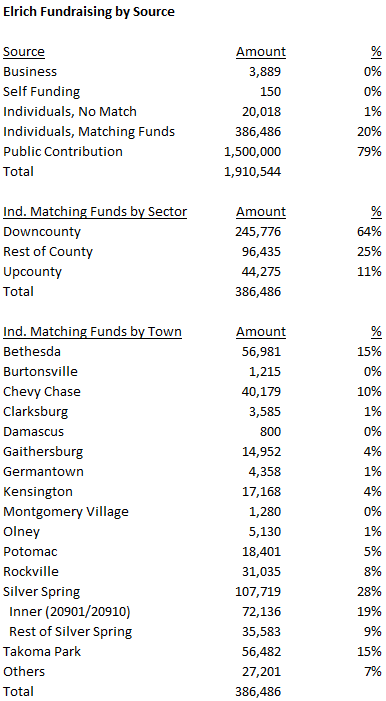
Elrich received $386,486 in individual contributions from county residents. Subject to the $750,000 caps, these contributions were eligible for public matching funds. Of the $386,486 in eligible contributions, 64% came from downcounty, higher than the all-candidate average of 52%. Elrich’s biggest sources of fundraising were inner Silver Spring (19%), Bethesda (15%) and Takoma Park (15%). Only 11% of Elrich’s eligible individual contributions came from upcounty.
Hans Riemer

Riemer has been an at-large council member since 2010. He was the only at-large incumbent who ran for reelection in 2018, a crucial advantage that helped him finish first in the primary. He is prevented by term limits from running for reelection to his current seat but he is free to run for other offices.

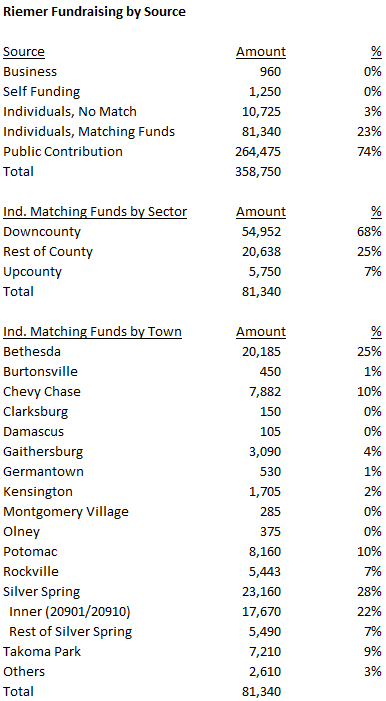
Riemer received $81,340 in individual contributions from county residents. Of these, 68% came from downcounty, higher than the all-candidate average of 52%. Riemer’s biggest sources of fundraising were Bethesda (25%), inner Silver Spring (22%) and Chevy Chase and Potomac (10% each). Only 7% of Riemer’s eligible individual contributions came from upcounty.
Will Jawando

Jawando ran for Delegate in District 20 in 2014 and he ran for Congress in District 8 in 2016. He finished second in the 2018 council at-large primary. Jawando raised more money than any other council candidate in public financing but has nonetheless chosen to use traditional financing in this cycle.

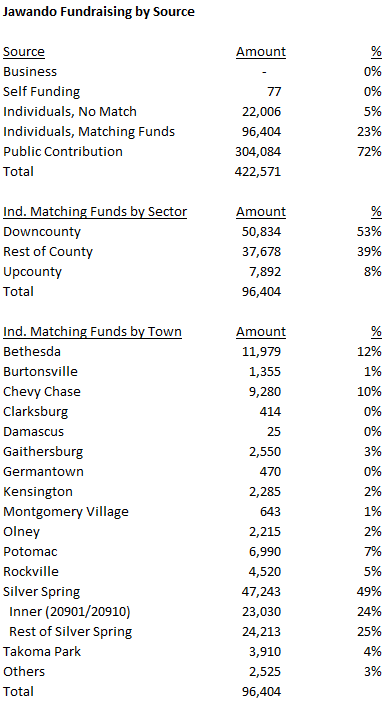
Jawando received $96,404 in individual contributions from county residents. Of these, 53% came from downcounty, about the same as the all-candidate average of 52%. Jawando’s biggest sources of fundraising were outer Silver Spring (25%), inner Silver Spring (24%) and Bethesda (12%). Only 8% of Jawando’s eligible individual contributions came from upcounty.
Evan Glass

Glass was a long-time civic leader who ran for the District 5 council seat in 2014 and barely lost to then-District 20 Delegate Tom Hucker. He finished third in the 2018 council at-large primary.

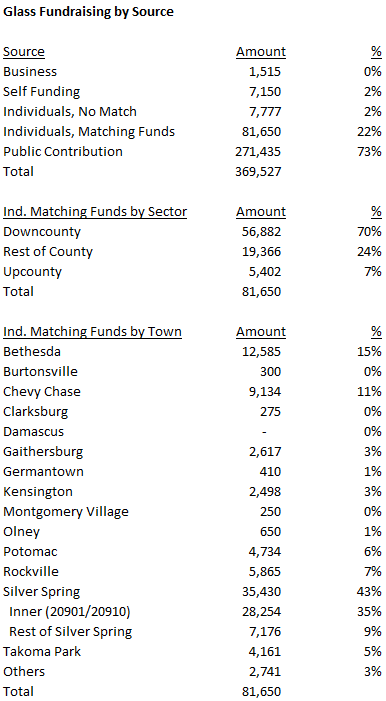
Glass received $81,650 in individual contributions from county residents. Of these, 70% came from downcounty, higher than the all-candidate average of 52%. Glass’s biggest sources of fundraising were inner Silver Spring (35%), Bethesda (15%) and Chevy Chase (11%). Only 7% of Glass’s eligible individual contributions came from upcounty.
Gabe Albornoz

Albornoz was the county’s director of recreation for 12 years and is a former chair of the county’s Democratic Party. He finished fourth in the 2018 council at-large primary.

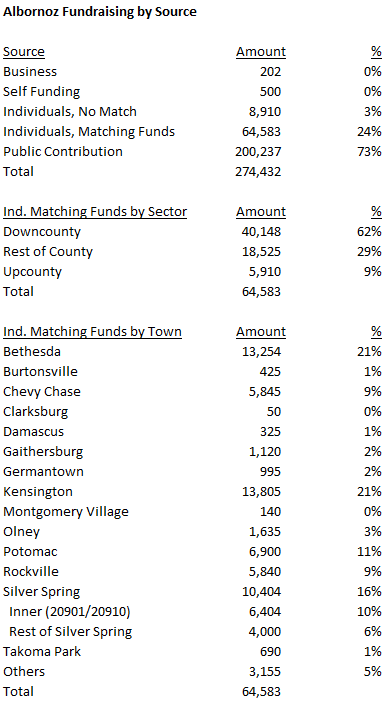
Albornoz received $64,583 in individual contributions from county residents. Of these, 62% came from downcounty, higher than the all-candidate average of 52%. Albornoz’s biggest sources of fundraising were Kensington (21%), Bethesda (21%) and Potomac (11%). Only 9% of Albornoz’s eligible individual contributions came from upcounty.
Brandy Brooks

Brooks was a new resident in the 2018 cycle, having registered to vote in Maryland in April 2016. She picked up a number of important endorsements and ran a strong race, ultimately finishing seventh in the 2018 council at-large primary. Even though Brooks didn’t win, she is in this list because she is running again and is off to a fast head start.

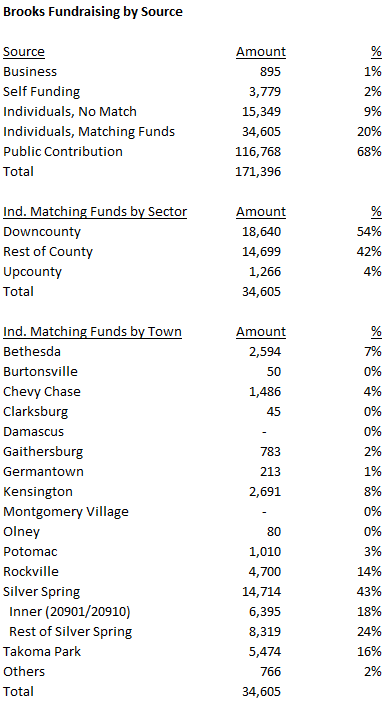
Brooks received $34,605 in individual contributions from county residents. Of these, 54% came from downcounty and 43% came from Silver Spring. Despite receiving just 4% of her contributions from upcounty, Brooks finished fourth there with a second-place showing in Montgomery Village.
The five winning candidates for countywide office, all of whom used public financing, have two things in common. First, all of them received a majority of their in-county individual contributions from downcounty, which accounts for less than a quarter of MoCo’s population. Second, none of them received more than 11% of their in-county individual contributions from upcounty despite the fact that roughly a third of MoCo residents live in upcounty.

This is as good a demonstration of downcounty’s political influence as any.

In Part Four, we will begin looking at who led in fundraising in each of the county’s major population centers.

Share

Raskin to IRS: Extend the Tax Filing Deadline

By Adam Pagnucco.

Congressman Jamie Raskin has spearheaded a joint letter from more than 100 members of Congress in both parties asking the IRS to extend its April 15 tax filing deadline. Among the reasons for the request are the agency’s late kickoff for tax filings, a change in the American Rescue Plan Act regarding taxation of unemployment benefits and the fact that the IRS is only answering 1 out of 4 phone calls from taxpayers with questions. The joint letter is reprinted below.

*****

Dear Commissioner Rettig and Acting Assistant Secretary Mazur:

We write to urge you to extend the impending April 15th federal tax filing and payment deadline. We welcomed the Internal Revenue Service’s (IRS) decision last year, after bipartisan calls from Congress, to provide an automatic filing and payment extension to July 15, 2020. Almost a year later, we are still grappling with the massive economic, logistical and health challenges wrought by this devastating pandemic. Millions of stressed-out taxpayers, businesses and preparers would appreciate an extension of the deadline to file their 2020 tax returns.

Over the past year, Congress enacted four historic emergency stimulus packages to deliver relief to Americans through Economic Impact Payments, the Paycheck Protection Program, and the Employee Retention Tax Credit. The American Rescue Plan Act of 2021, signed into law by President Biden on March 11, 2021, contained a provision excluding from income the first $10,200 of unemployment benefits received in 2020 for those with an adjusted gross income under $150,000. The IRS will need to take action to address the changes in the tax law, and taxpayers will need additional time to fully understand how this affects their tax liability. Further, taxpayers and tax return preparers are awaiting guidance from the IRS regarding these recent tax changes and are still waiting for some IRS forms to be made available for electronic filing. Compounding these complicating factors, the IRS did not begin the 2020 filing season until February 12, 2021, nearly three weeks later than usual, creating a lot less time for constituents and businesses to file taxes overall.

With limited in-person tax assistance at local tax preparation clinics, libraries, and community centers, tens of millions of our constituents are facing the same logistical hurdles as last year.

Additionally, the IRS is struggling to address taxpayer issues, with the agency reporting that it is answering only 1 out of 4 telephone calls. As our leaders on the House Ways and Means Committee have pointed out, compared with the same time last year, 27% fewer tax returns have been filed already and 31% fewer returns have been processed by the IRS.

For these reasons, we respectfully urge you to extend the federal tax filing and payment deadline as Americans, and the IRS, continue to grapple with the disruptions caused by the COVID-19 pandemic. Thank you for your thoughtful attention to this urgent matter.

Share

Downcounty Dominates Public Financing, Part Two

By Adam Pagnucco.

Downcounty exerts a disproportionate impact in voting for countywide offices. It also exerts disproportionate influence in public financing. Let’s begin analyzing why that is.

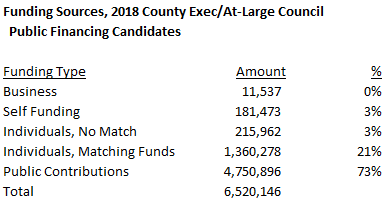
The table below summarizes the types of contributions received by the four candidates for county executive and the 25 candidates for county council at-large who enrolled in public financing in 2018.

Receipts from businesses primarily relate to refunds, especially deposit refunds. They show up in public financing reports as contributions, but they are not true contributions in that they don’t add net financial value to campaigns. Self-funding of up to $12,000 (including money from spouses) is allowed for publicly financed candidates. Money received in the “individual, no match” category comes from individuals who live outside the county. Under the county’s public financing system, their contributions are not eligible for public matching funds. Money received in the “individual, matching funds” category comes from county residents. Their contributions ARE eligible for public matching funds. Finally, money received in the “public contributions” category are public matching funds. In 2018, 94% of all money received by publicly financed politicians came from individual contributions eligible for matching funds plus the matching funds distributed for them.

Because public matching funds are distributed through a formula tied to eligible individual contributions from county residents, it is the latter that is key to determining overall fundraising for publicly financed politicians. The more individual contributions from county residents, the more public matching funds the politician receives (subject to caps). As seen above, there are no other major sources of money available to candidates in public financing.

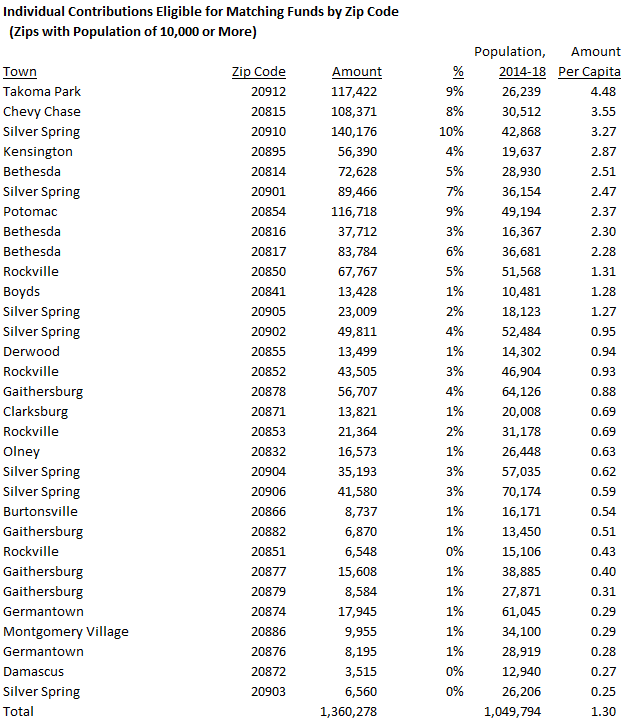
Now let’s look at where individual contributions from county residents that are eligible for public matching funds come from. The table below shows their distribution for each zip code with more than 10,000 residents. Again, this includes individual contributions from county residents to executive and council at-large candidates but not district council candidates (since they would skew the geography).

The average eligible individual contribution per capita was $1.30. In terms of per capita contributions, the top six zip codes, as well as eight of the top nine, were in downcounty. Takoma Park led the way at $4.48 per capita, more than three times the county average. (It’s probably not a coincidence that Marc Elrich, the top fundraiser in public financing and the winning candidate for county executive, is a long-time resident and former city council member in Takoma Park.) Six of the bottom seven zip codes in per capita contributions were in upcounty. The exception was zip code 20903, which has one of the lowest average household incomes in MoCo.

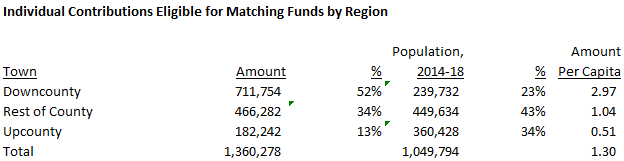
The table below summarizes individual contributions from county residents that are eligible for public matching funds by region.

According to the U.S. Census Bureau, downcounty accounts for less than a quarter of the county’s population. However, downcounty donated 52% of individual contributions eligible for matching funds in 2018. Upcounty accounts for about a third of the county’s population but donated less than one-seventh of individual contributions eligible for matching funds in 2018. In per capita terms, downcounty residents contributed $2.97 each to publicly financed candidates, almost six times the per capita amount contributed by upcounty residents (51 cents).

It’s really no contest. Downcounty dominated public financing in 2018. Upcounty lagged badly.

In Part Three, we will discuss the fundraising geography of individual candidates.

Share

Downcounty Dominates Public Financing, Part One

By Adam Pagnucco.

When Montgomery County passed public financing more than six years ago, many predictions were made. Public financing was supposed to empower small donors. (It did.) It was supposed to draw in more candidates for office. (It did.) It was supposed to reduce the influence of “special interests.” (That’s debatable.) But one of its biggest impacts was something no one predicted because it wasn’t on anyone’s radar when it was passed:

Public financing has amplified the political influence of downcounty.

In this series, we are going to investigate the geography of political contributions made in the county’s public financing system. That’s important because just as politicians pay special attention to the sources of their votes, they certainly pay special attention to the sources of their campaign contributions. Knowing where the money comes from greatly aids the understanding of our political system and public financing is no exception.

First, let’s discuss methodology. This series looks at public financing contributions to 2018 candidates for county executive and county council at-large. It excludes candidates for district council seats because their contributions naturally skew towards their districts. Of particular interest are individual contributions that are eligible for public matching funds. (We’ll explain more about this below.)

In terms of geography, we will look at towns, zip codes and two regions: downcounty and upcounty. Downcounty is defined as the “Democratic Crescent,” a term I coined that includes Takoma Park, Silver Spring (inside the Beltway), Chevy Chase, Kensington, Bethesda, Glen Echo and Cabin John. Because there are thousands of individual contributions, I am using zip codes 20901 and 20910 as proxies for Silver Spring inside the Beltway. Upcounty is defined as Ashton, Barnesville, Boyds, Beallsville, Brookeville, Clarksburg, Damascus, Dickerson, Gaithersburg, Germantown, Laytonsville, Montgomery Village, Olney, Poolesville, Sandy Spring, Spencerville and Washington Grove. Lots of communities, including but not limited to Rockville, Potomac, Wheaton, Glenmont, Burtonsville and most of East County are in neither downcounty nor upcounty.

Public financing changes fundraising incentives for politicians. Those who use traditional financing are interested in big checks, whether they come from PACs, businesses, wealthy people or self-funding. Those who use the county’s public financing system (it’s voluntary) are interested in individual contributions from county residents, with the allowable maximum at $250. (The maximum was $150 in the 2018 cycle.) That’s because the county will match individual contributions from residents of up to $150 on a sliding scale, with smaller contributions getting a larger percentage match. Public financing participants can collect individual contributions from non-county residents but those will not get public matching funds. Public financing participants can’t collect contributions from PACs, unions, businesses or other non-individual sources but they can give themselves up to $12,000 in self-funded seed money. (That amount includes money from a spouse.)

And so publicly financed politicians raise money by collecting lots and lots of small checks from county residents and getting public matching funds for them. Those matching funds are capped depending on which office the candidate is seeking and they are only available when certain thresholds of individual contributions are reached. All of this means that it’s really important that publicly financed candidates come into contact with lots of county residents who are going to write checks, even small ones. They will go wherever they think such residents are located. They will hold whatever events are necessary to attract them. They will ask surrogates to round them up on their behalf. And if certain communities don’t contribute as much money and/or don’t fit the politician’s electoral strategy, the politician will spend less time there. From a fundraising perspective, what’s the point of talking to people who either can’t or won’t write checks that can be matched with public funds?

In a previous post, I wrote that downcounty accounted for a disproportionate percentage of voting in the 2018 Democratic primary. That was the case long before 2018 and county politicians understand that reality. It turns out that downcounty residents not only vote more, they contribute more too. That has had a measurable impact in the public financing system.

We will begin analyzing that in Part Two.

Share

Biden’s Billions

By Adam Pagnucco.

President Joe Biden and Democrats in Congress passed a mammoth economic stimulus plan last week. The plan contains hundreds of billions of dollars in aid to states and local governments. How much of that is coming to Maryland?

According to U.S. Senators Ben Cardin and Chris Van Hollen, a LOT.

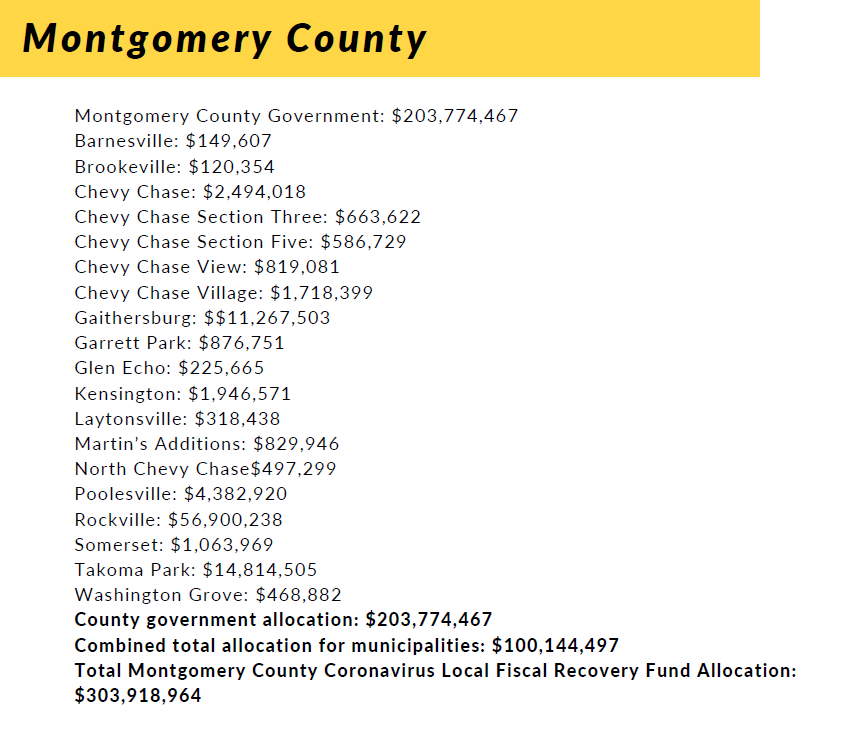
Cardin and Van Hollen estimate that Maryland and its local jurisdictions will receive a total of nearly $6.4 billion, with the state getting $3.9 billion, the counties getting $1.2 billion and municipalities getting $1.1 billion. The money can be used to respond to or mitigate the COVID-19 health emergency or its negative economic impacts, including assistance to households, small businesses, nonprofits, and aid for tourism, travel, and hospitality; provide essential workers with premium pay; cover revenue loss as a result incurred as a result of the COVID-19 emergency; or to make necessary investments in water, sewer, or broadband infrastructure. The money cannot be used to support any pension fund or offset a tax cut.

The table below shows the estimated distribution of funds by county.

The table below shows the estimated distribution of funds for MoCo and its municipalities.

The plan also includes lots of additional money for education, transportation and more.

This doesn’t solve all of MoCo’s budget problems, especially the issues connected to the county’s long-term lack of competitiveness in the region. But it should help the county balance its budget without raiding reserves or retiree health care so long as it practices some spending restraint. One mistake that the county should not make is to use this one-time funding to initiate new indefinite, long-term spending. This federal money, while welcome, is temporary.

The executive’s recommended budget comes out later today.

Share

Most MoCo State Legislators Oppose Single Tracking the Purple Line

By Adam Pagnucco.

A majority of MoCo’s state legislators have written to the Maryland Transit Administration (MTA) opposing County Executive Marc Elrich’s proposal to single track the Purple Line through a tunnel in Downtown Bethesda. In the letter, signed by 5 of MoCo’s 8 state senators and 15 of MoCo’s 24 delegates, the lawmakers “strongly urge” that MTA adhere to its “previously approved” plan to build two tracks in the Purple Line tunnel. The letter is reprinted below.

*****

March 9, 2021

Mr. Kevin B. Quinn, Jr.
Administrator
Maryland Transit Administration
6 Saint Paul Street
Baltimore, Maryland 21202

Dear Administrator Quinn:

We are writing to strongly urge the Maryland Transit Administration’s continued commitment to the planned Bethesda Purple Line Station and operations in and out of that station as previously approved. It is important to our Montgomery County constituents that the Capital Crescent Trail (CCT) be rebuilt beneath Wisconsin Avenue as promised and that the Purple Line’s operations are not adversely impacted.

The CCT Tunnel—previously known as the Air Rights Tunnel—is an important part of our region’s multi-modal transportation infrastructure. From 1998 until its closure for Purple Line construction, it was a major bicycle commuting route utilized by thousands of Marylanders each day. Local bicyclists and other trail users were repeatedly assured that the CCT would be rebuilt below ground to ensure this vital pathway remained safe and uninterrupted. Indeed, many bicyclists strongly advocated for the Purple Line because of the thoughtful, forward-looking plan that allowed both the transit line and a safer trail.

As for the Bethesda Station, the Purple Line has been under study since 1992 and project plans were approved long ago. Construction of this transformative project is, as you know, well underway. As such, we encourage MTA to uphold its commitments to our constituents by implementing the existing, two-track plan for the Bethesda Purple Line Station and accompanying operations. The two-track plan allows us to meet the full potential of the Purple Line: rapid travel times, short headways, and reliable boarding.

We recognize that Montgomery County has a significant role to play to fund and build the below ground CCT. And we appreciate the substantial commitment our County has already made in bringing the Purple Line and the replacement Capital Crescent Trail this far. But we also need MTA to reject major mid-construction changes to infrastructure and, ultimately, operations.

Such changes may lead to some short-term savings but they will only harm the Purple Line’s success in the long-run. To the extent, however, that the currently pending process of selecting a new design-build contractor for the project can be used to reduce the cost of the underground Capital Crescent Trail and the two-track plan in collaboration with the county, we welcome such efforts.

Thank you for your consideration of our request.

Sincerely,

Senator Brian J. Feldman
Senator Benjamin F. Kramer
Senator Susan C. Lee
Senator William C. Smith, Jr.
Senator Jeff Waldstreicher
Delegate Kumar P. Barve
Delegate Charlotte Crutchfield
Delegate Kathleen M. Dumais
Delegate Jim Gilchrist
Delegate Ariana B. Kelly
Delegate Marc Korman
Delegate Lesley J. Lopez
Delegate Sara Love
Delegate David Moon
Delegate Julie Palakovich Carr
Delegate Lily Qi
Delegate Kirill Reznik
Delegate Emily Shetty
Delegate Jared Solomon
Delegate Jheanelle K. Wilkins

cc: Matthew Pollack, Executive Director, Maryland Transit Administration

Share

Marylanders Strongly Support Legalizing Marijuana

By Adam Pagnucco.

Part Two of Goucher College’s latest poll of Marylanders is out and one of the questions it asks is this: “Do you [support or oppose] making marijuana legal for recreational use in Maryland?” Here are the results on this question from the poll’s crosstabs. The margin of error is 3.8% for all voters and is higher for subsamples.

All adults

Oppose: 28%
Support: 67%
Sample size: 725

Women

Oppose: 31%
Support: 63%
Sample size: 383

Men

Oppose: 26%
Support: 71%
Sample size: 340

Registered voters

Oppose: 29%
Support: 66%
Sample size: 654

Democrats

Oppose: 18%
Support: 77%
Sample size: 352

Republicans

Oppose: 47%
Support: 50%
Sample size: 171

Unaffiliated

Oppose: 34%
Support: 60%
Sample size: 115

Age 18-34

Oppose: 16%
Support: 79%
Sample size: 219

Age 35-54

Oppose: 25%
Support: 74%
Sample size: 249

Age 55+

Oppose: 42%
Support: 50%
Sample size: 257

Black

Oppose: 21%
Support: 74%
Sample size: 217

White

Oppose: 33%
Support: 63%
Sample size: 442

Other races

Oppose: 22%
Support: 68%
Sample size: 65

No college degree

Oppose: 25%
Support: 70%
Sample size: 443

College degree

Oppose: 33%
Support: 62%
Sample size: 283

Montgomery/Prince George’s

Oppose: 24%
Support: 73%
Sample size: 232

Central/Baltimore Metro

Oppose: 26%
Support: 67%
Sample size: 333

Outside urban corridor

Oppose: 40%
Support: 57%
Sample size: 160

Conservative

Oppose: 42%
Support: 54%
Sample size: 203

Moderate

Oppose: 30%
Support: 65%
Sample size: 315

Progressive

Oppose: 11%
Support: 84%
Sample size: 180

Children in household

Oppose: 23%
Support: 73%
Sample size: 259

No children in household

Oppose: 31%
Support: 63%
Sample size: 362

Share

House Subcommittee Kills Grocery Store Alcohol Sales Bill

By Adam Pagnucco.

The Daily Record has reported that a House of Delegates subcommittee has effectively killed Delegate Lily Qi’s bill allowing some grocery stores to sell beer and wine.

Passing this legislation was always going to be an uphill battle even though more than 70% of Marylanders support grocery store sales of beer and wine and the Maryland Retailers Association was making a big push for it. The Daily Record quoted Eastern Shore Republican Delegate Steven Arentz making the classic argument against the bill:

Most of our package stores are family-owned… We have three major grocery stores in Queen Anne’s County, and each one of them has a liquor store within 100 yards of them… this will put them out of business.

But Delegate Qi correctly noted that six MoCo grocery stores allowed to sell beer and wine had smaller beer and wine stores nearby, as we reported on Seventh State. The notion that grocery store alcohol sales will wipe out package stores is a myth and we proved it. But this myth is hard to kill because many people, including elected officials, repeat it endlessly despite evidence to the contrary.

The map above shows the Giant on New Hampshire Avenue in Silver Spring, which is allowed to sell beer and wine, and the White Oak Convenience Store, a beer and wine shop, directly behind it. Both appear in purple ovals.

The bill is still technically alive in the Senate as it was introduced there by Baltimore City Senator Cory McCray. But the vote by the Alcoholic Beverages Subcommittee of the House Economic Matters Committee against Qi’s version of the bill prompted her to say that she is withdrawing it.

Delegate Qi told me that she believes the vote in the Alcoholic Beverages Subcommittee against her bill was unanimous. The members of the subcommittee are:

Talmadge Branch, Chair (Democrat – Baltimore City)
Jay Walker, Vice Chair (Democrat – Prince George’s)
Steven Arentz (Republican – Eastern Shore)
Benjamin Brooks (Democrat – Baltimore County)
Ned Carey (Democrat – Anne Arundel)
Seth Howard (Republican – Anne Arundel)
Kriselda Valderrama (Democrat – Prince George’s)

Share

Crosstabs: Goucher College Poll on COVID

By Adam Pagnucco.

Part One of Goucher College’s latest poll of Marylanders is out and it asks several questions related to the COVID pandemic. The accompanying crosstabs spreadsheet is also available. Here are the results for all voters along with two crosstabs of interest to Seventh State readers: statewide Democrats and residents of Montgomery and Prince George’s counties. (Because of the size and partisan nature of those two counties, there will be some overlap.) The margin of error is 3.8% for all voters and higher for subsamples.

Question: Do you [approve or disapprove] of how Governor Larry Hogan has handled the outbreak of the coronavirus in Maryland?

Answer from all voters

Disapprove: 21%
Approve: 77%
Sample size: 654

Answer from Democrats

Disapprove: 17%
Approve: 81%
Sample size: 351

Answer from MoCo/Prince George’s

Disapprove: 20%
Approve: 76%
Sample size: 232

Note: 32% of Republicans disapprove and 65% approve, so Hogan’s ratings on this question are better with Democrats than Republicans.

Question: Do you think Maryland is moving [too quickly or too slowly] to ease restrictions and reopen businesses, or has the pace been about right?

Answer from all voters

Too slowly: 25%
About right: 57%
Too quickly: 16%
Sample size: 654

Answer from Democrats

Too slowly: 13%
About right: 66%
Too quickly: 20%
Sample size: 351

Answer from MoCo/Prince George’s

Too slowly: 18%
About right: 64%
Too quickly: 16%
Sample size: 232

Question: Are public schools in your area moving [too quickly or too slowly] to reopen for in-person classroom instruction, or has the pace been about right?

Answer from all voters

Too slowly: 29%
About right: 36%
Too quickly: 31%
Sample size: 654

Answer from Democrats

Too slowly: 11%
About right: 41%
Too quickly: 43%
Sample size: 351

Answer from MoCo/Prince George’s

Too slowly: 19%
About right: 39%
Too quickly: 36%
Sample size: 232

Note: 65% of Republicans say the schools are reopening too slowly so there is a huge partisan difference on this question.

Question: Please tell me if you’ve experienced these feelings [more often, less often or about the same] as you did before the outbreak of the coronavirus last year… stressed.

Answer from all voters

Less often: 13%
About the same: 38%
More often: 49%
Sample size: 654

Answer from Democrats

Less often: 12%
About the same: 35%
More often: 53%
Sample size: 351

Answer from MoCo/Prince George’s

Less often: 15%
About the same: 30%
More often: 55%
Sample size: 232

Question: Please tell me if you’ve experienced these feelings [more often, less often or about the same] as you did before the outbreak of the coronavirus last year… frustrated.

Answer from all voters

Less often: 10%
About the same: 34%
More often: 55%
Sample size: 654

Answer from Democrats

Less often: 11%
About the same: 34%
More often: 55%
Sample size: 352

Answer from MoCo/Prince George’s

Less often: 10%
About the same: 34%
More often: 56%
Sample size: 233

Question: Please tell me if you’ve experienced these feelings [more often, less often or about the same] as you did before the outbreak of the coronavirus last year… angry.

Answer from all voters

Less often: 16%
About the same: 49%
More often: 34%
Sample size: 654

Answer from Democrats

Less often: 16%
About the same: 47%
More often: 36%
Sample size: 352

Answer from MoCo/Prince George’s

Less often: 15%
About the same: 49%
More often: 37%
Sample size: 232

Question: Please tell me if you’ve experienced these feelings [more often, less often or about the same] as you did before the outbreak of the coronavirus last year… sad.

Answer from all voters

Less often: 13%
About the same: 41%
More often: 45%
Sample size: 654

Answer from Democrats

Less often: 13%
About the same: 34%
More often: 53%
Sample size: 352

Answer from MoCo/Prince George’s

Less often: 13%
About the same: 36%
More often: 51%
Sample size: 233

Question: How concerned are you—[very, somewhat, a little, or not at all]—about yourself personally or a close family member getting the coronavirus?

Answer from all voters

Little/not at all: 28%
Very/somewhat: 71%
Sample size: 654

Answer from Democrats

Little/not at all: 17%
Very/somewhat: 82%
Sample size: 351

Answer from MoCo/Prince George’s

Little/not at all: 24%
Very/somewhat: 76%
Sample size: 232

Note: Among Republicans, 49% are a little or not at all concerned and 50% are very or somewhat concerned. Democrats are much more concerned about family members getting COVID than Republicans.

Question: When the Covid-19 vaccine is available to you, do you think you’ll get it as soon as you can, wait and see how it’s working before you get it, only get it if required, or are you definitely not going to get the Covid-19 vaccine?

Answer from all voters

Already received at least one dose / will get it as soon as they can: 67%
Wait and see how it’s working: 14%
Only get it if required / Will not get the vaccine: 18%
Sample size: 654

Answer from Democrats

Already received at least one dose / will get it as soon as they can: 71%
Wait and see how it’s working: 15%
Only get it if required / Will not get the vaccine: 13%
Sample size: 352

Answer from MoCo/Prince George’s

Already received at least one dose / will get it as soon as they can: 69%
Wait and see how it’s working: 18%
Only get it if required / Will not get the vaccine: 11%
Sample size: 232

Question: Overall, do you think the Maryland state government is doing a(n) [excellent, good, fair, or poor] job distributing the COVID-19 vaccine?

Answer from all voters

Poor / fair: 64%
Excellent / good: 33%
Sample size: 654

Answer from Democrats

Poor / fair: 62%
Excellent / good: 36%
Sample size: 351

Answer from MoCo/Prince George’s

Poor / fair: 72%
Excellent / good: 27%
Sample size: 232

Question: When do you think the country will get the outbreak under control and be able to return to normal: in the next month or two, by the summer, before the end of the year, later than this year, or never?

Answer from all voters

Next month or two / by the summer: 17%
Before the end of the year: 39%
Later than this year / never: 40%
Sample size: 654

Answer from Democrats

Next month or two / by the summer: 11%
Before the end of the year: 43%
Later than this year / never: 45%
Sample size: 351

Answer from MoCo/Prince George’s

Next month or two / by the summer: 11%
Before the end of the year: 44%
Later than this year / never: 43%
Sample size: 232

Share

New MoCo GOP Chair Throws Predecessors Under the Bus

By Adam Pagnucco.

Our post yesterday – MoCo Republicans in Freefall – has caught the attention of the county GOP. In an email sent to his colleagues shortly after our post went up, new MoCo Republican Central Committee Chairman Reardon Sullivan admitted that the party’s decline was real, blamed prior party leaders for their dilemma and listed a number of steps he and others are taking to turn things around.

That’s going to be tough. After all, the local party’s most famous figure is Robin Ficker, it has a long history of infighting and its top field guy (Brad Botwin) sends out regular blast emails attacking “illegal alien criminals/gang members.” Having Donald Trump and Bikini Chewbacca as the two national symbols of the GOP is also unhelpful in MoCo.

Here’s a guy who knows how to communicate.

Sullivan’s email is reprinted below. Grammar and spelling appear as in the email.

*****

Good Morning Central Committee and supporters

This morning’s emails gave us this post from the liberal blog “Seventh State” stating that the Republican Party is in freefall, and they are correct.

The past actors within our local party had failed to respond to changing demographics, utilize technology and support local candidates and initiatives resulting in a significant decline it the party during the past twelve years.

While our local party was asleep at the wheel, our conservative American values continue to be eroded by the liberals and progressives here in Montgomery County… I am dedicated to changing this trajectory but need your help…

We are building a new MCGOP, but this will not happen overnight. We are formally setting up subject matter committees, utilizing technology to reach current and prospective members, doing oppositional research and looking for new ways to lay the groundwork for a successful organization. We are looking for new ways to rebuild our presents in Montgomery County, reaching out to Republicans, independents with soft democrats with basic, clear simple, concise solutions give people reasons to want to be Republican and part of the solution.

In the past two months, we have:

1. Worked on strategies to increase our contact database using BOE data and lists compiled by others.
2. Reviewed our outreach strategies and are considering more tools than ever before.
3. Updated the MCGOP website to with an election tab to provide direction to people to register to vote and change parties. Thanks to Brad Botwin for the idea and Sharon Cohen for the updates.
4. Instituted orientation at MCGOP headquarters, led by Dan Cuda. We currently have double digit sign ups and growing.
5. Anne is working with the woman’s groups regarding legislative initiatives. Sandy is also working the legislative angle and Brad is testifying.
6. Ann is looking at candidate recruitment for both local municipal races as well as the county and state races.
7. Bill is working on Police and SRO issues.

Also critical to our comeback is fundraising as this effort takes money implement. I will personally donate $1000 today to the MCGOP and ask that each to you donate at least 10% or $100 this week.

I want to hear your ideas… feel free to e-mail me personally with “I will” action plans vs “we should” suggestions…

This will be a tough road, but I am confident that working together we can make a difference!!!!

Sully

Share

Maryland Politics Watch