Last month, Delegate Kumar Barve, chair of the House Environment and Transportation Committee, warned the county council not to pass a version of a zoning text amendment that effectively prevented most solar development in the agricultural reserve. Now that they have ignored his warning and passed it anyway, Barve has authored a blistering opinion piece in the Washington Post condemning the majority of the council for “sabotaging affordable clean energy.” Barve also wrote that the council’s action has spawned imitators, possibly leading to “a chain reaction of solar prohibitions.”
The state delegation and county electeds have long had ups and downs, sometimes cooperating and sometimes grumbling. Usually the grumbling does not appear in public, but there are exceptions like Delegate Eric Luedtke’s op-ed criticizing county officials for ignoring upcounty. Barve’s piece is harsher and, coming from one of the top environmental policy makers in the state, may ultimately be more consequential.
That said, the council has made its decision on solar in the agricultural reserve. What’s next? Obviously, an election is coming. The most important single change to the original zoning text amendment was one restricting placement of solar panels on certain soil types. That change passed on a 6-3 vote. Three council members are term limited: two who voted for the change (Council Members Craig Rice and Nancy Navarro) and one who voted against it (Hans Riemer). So assuming that all of the remaining incumbents return, the tally would be 4-2 in favor of the soil restriction.
The next council will have 11 members because of the passage of Question C last year. If 4 of the 5 new council members favor solar in the ag reserve, they could undo the soil restriction on a 6-5 vote. Could that happen? It’s possible but it becomes more likely if the Sierra Club – which supported the original zoning text amendment – conditions its endorsement in the next election on whether candidates favor liberalizing solar restrictions. If that occurs, solar proponents have a shot at getting their way. If not, MoCo’s restrictions have a greater chance of becoming permanent unless Barve and the General Assembly find a way to preempt them.
Though he doesn’t say his name, Planning Board Chairman Casey Anderson disparaged County Executive Marc Elrich at the Board’s Thrive Montgomery meeting, saying it was a “dumb idea” for Elrich to suggest that the Purple Line be single tracked under Wisconsin Ave. to save money. Just to make it extra clear who he is thinking isn’t too bright, Anderson references an Elrich proposal from 2009.
Only the discussion doesn’t make clear that the idea now is simply to single track under Wisconsin Ave.–a distance of 900 feet–to save money rather than all the way from Bethesda to around Connecticut Ave. as in the idea from over a decade ago. [Note: The Purple Line was originally planned as entirely single track.]
No discussion of the merits of the idea occurs. Nor does the Planning Board Chairman suggest a means to fund this expensive project. Anderson’s comments would likely have been even worse if a planning board staffer had not cut him off in the midst of another negative comment.
When asked for comment, Chairman Anderson said:
Well, I said it, and if I had it to do over again I might say it’s a bad idea, or even a terrible idea, but whatever word is used to describe it the fact is that It was suggested in 2009 and rejected for reasons that were pretty obvious at the time and I don’t think it has improved with age.
Not exactly an apology. Even worse, it reiterates the false claim that this is the same as the 2009 proposal. It’s not. The 2009 proposal planned for single-tracking over a much longer distance, so I queried: “Except that Elrich’s proposal in 2009 had a single track to CT—not just under Wisconsin—so that’s not true, right?” Anderson texted back:
It’s pretty obvious that it creates the same problem – single tracking limits the ability to improve frequency of service because it limits the number of trains you can run. In places where it’s been tried the result has been to come back later and make expensive fixes to add back the second track.
Except that what’s more far obvious is that single-tracking over a very short distance at the end of the line could well have quite different effects than doing the same over a much longer distance. It’s a very strong, unsupported assumption in service to his preferences. More to the point, repeatedly stating that the two proposals are the same is not playing straight with the public.
Around the same time as I heard back from Anderson, I also received a comment from County Executive Elrich:
Not quite sure what Casey’s referring to but when it was first suggested, the single track went all the way to the country club. We’re talking about pulling into and out of the station on a single track. It’s nine hundred feet – a fraction of the distance to the country club. And the trains have to switch tracks over there any way because the train entering on the westbound track has to leave on the eastbound track.
At the headway’s the system uses, there’s no way that two trains would conflict and there would be no bottleneck or degradation in service. It would save $50 million that could be spent on other important things. And without a second track you get a nice wide path.
Of course, the state would have to study it, I can’t mandate it, so we’ll see if it works. And if it does, why would a sane person say no. In the meantime his policies of developer giveaways is wrecking our ability to build the capital projects we need. Which schools, libraries, or public facilities should we kill to spend $50 million on a 500 ft tunnel if you can solve the problem and get the project done faster for far less cost. I’m trying to get it done quickly, without damaging our budget.
I don’t think many would contest that the two-track tunnel would be better. The question that Elrich raises is whether it’s worth studying the alternative in light of other pressing needs demanding the county’s scarce capital dollars. He also points out, correctly, that we’d get a much better bike path and trail through the tunnel.
Bottom Line: The public contempt by the Planning Board Chairman for an idea proposed by the County Executive to deal with the decline in projected capital funds is irresponsible and inappropriate for an official chairing a public meeting. Indeed, it’s the sort of remark that the Council reacted to sharply when Elrich said something similarly tactless–and, unlike Elrich, Anderson knew he was being taped.
What’s even worse, however, is intentionally misleading the public into believing that Elrich’s current proposal for single tracking just under Wisconsin had been studied when he could have simply said that he didn’t think it is a good idea. The Planning Board Chair should not misrepresent facts. It undermines the public trust.
The mess seems unlikely to be meaningfully resolved until the overall supply of vaccines increases substantially.
The letter from Raskin and Trone appears below.
*****
Dear Governor Hogan and Acting Secretary Schrader:
We write to respectfully urge your support for locating a COVID-19 mass vaccination site in Montgomery County. As you know, Montgomery is the most populous county in our state and has experienced the highest number of COVID-19 deaths in the state. Yet, despite Montgomery suffering the worst casualty rate in Maryland and despite having the second-highest number of cases in the state, it still has no mass vaccination site for its population of more than one million people. Of the six mass vaccination sites that will soon be operating across Maryland, not a single site is in Montgomery. Not surprisingly, Montgomery ranks 15th among all Maryland counties in percentage of its population vaccinated even though its County Department of Health and Human Services (DHHS) has administered 87% of its allocated vaccines.
Beyond the sheer numbers of people involved, a mass vaccination site in Montgomery County would clearly promote your administration’s goal of ensuring equitable vaccine distribution to vulnerable communities. Montgomery has a majority-minority population and is the most diverse County in our state. Around 20% of residents are Hispanic, 19% are Black/African American, and 15% are Asian/Pacific Islander. Montgomery has a significant health care workforce and a substantial elderly population over the age of 75. These demographics present complex challenges for the local health department in vaccine distribution which could be successfully addressed with a local mass vaccine site.
Although you have emphasized that the mass vaccination sites in Baltimore and Prince George’s counties are open to Montgomery County residents, this offer seems like cold comfort when so many logistical hurdles face lower-income, working-class, immigrant, and senior residents in Montgomery who are unable to arrange transportation or get time off from work to travel to distant sites. These realities for tens of thousands of people make the suggestion of daytime travel to other parts of the state seem like wishful thinking. We urge you to work with Montgomery County officials and your team to provide a state-run mass vaccination site in Montgomery County.
If the Maryland Department of Health is unable to support another state-run mass vaccination site, we urge you to sufficiently increase the number of vaccines provided to the County to enable the Montgomery County Department of Health and Human Services to operate its own mass vaccination site. Moreover, as the state prepares to improve its equity framework in the coming weeks, we urge you to increase vaccine distribution efforts to better serve the diverse and vulnerable communities in Montgomery County. In Montgomery County, we know local leaders look forward to working with you to increase vaccine access and improve vaccine equity throughout the state. Thank you in advance for your consideration of this urgent and significant request. We are available to discuss it at your pleasure.
Very truly yours,
Congressman Jamie Raskin and Congressman David Trone
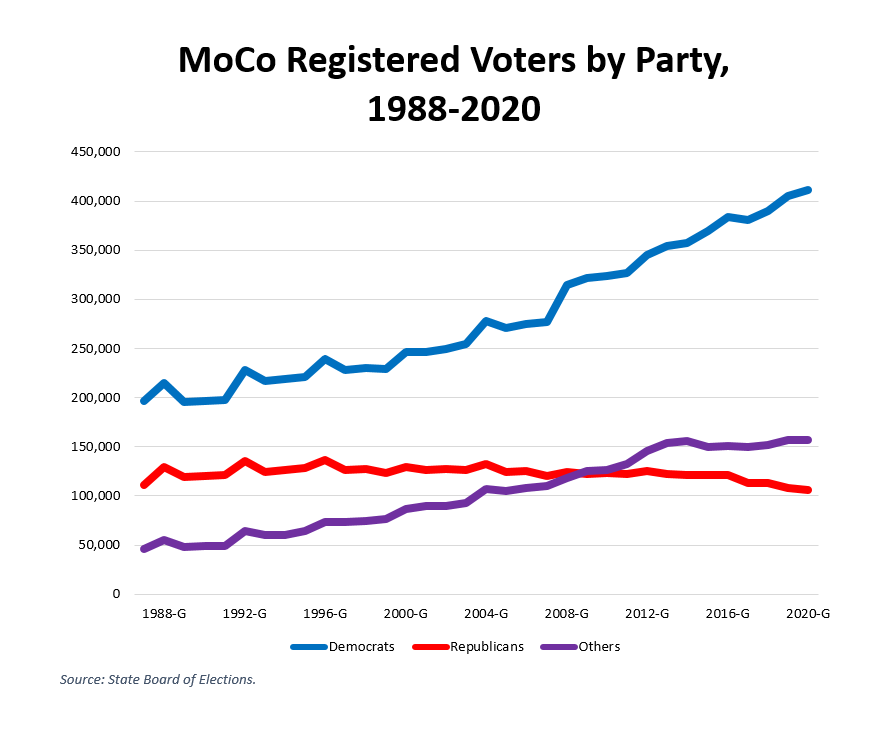
Montgomery County’s Republican Party is in free fall. Consider the following five facts, all derived from data provided by the State Board of Elections.
1. While the numbers of MoCo Democratic and unaffiliated registered voters have been growing, the number of registered Republicans is lower now than in 1988.
In the 1988 primary, there were 110,829 registered Republicans in MoCo. That number peaked at 136,269 in the 1996 general election. Since then, the number of registered Republicans fell to 105,561 in the 2020 general. From the 1988 primary through the 2020 general, growth in MoCo registered voters was 109% for Democrats, 241% for unaffiliated and third party voters and minus 5% for Republicans.
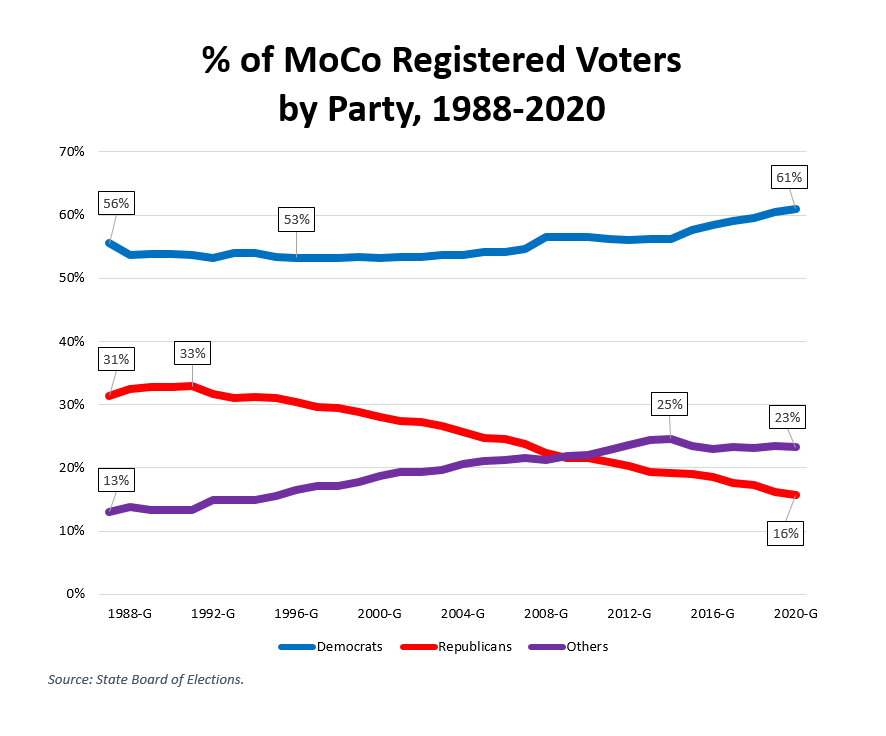
2. The share of registered MoCo voters who are Republicans has fallen by half in the last three decades.
In the 1992 primary, 33% of all registered MoCo voters were Republicans. In the 2020 general, the GOP share fell to 16%. The number of registered unaffiliated and third party voters (156,702 in the 2020 general) greatly exceeds the number of registered Republicans (105,561).
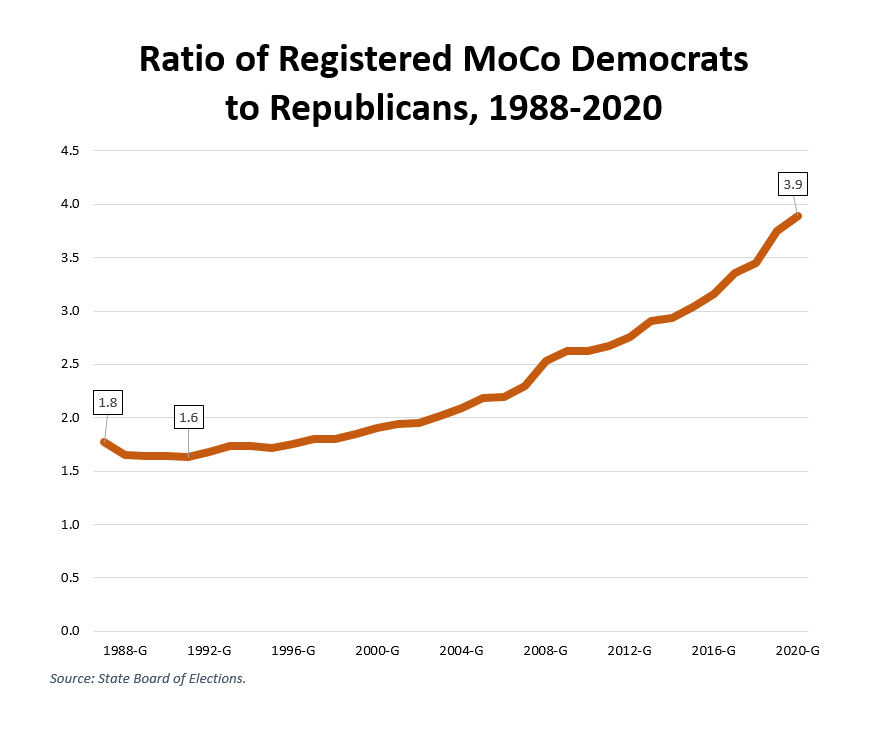
3. The ratio of registered MoCo Democrats to Republicans is at its highest level since at least 1988.
In the 1992 primary, there were 1.6 registered MoCo Democrats for every MoCo Republican. By the 2020 general, there were 3.9 registered MoCo Democrats for every Republican.
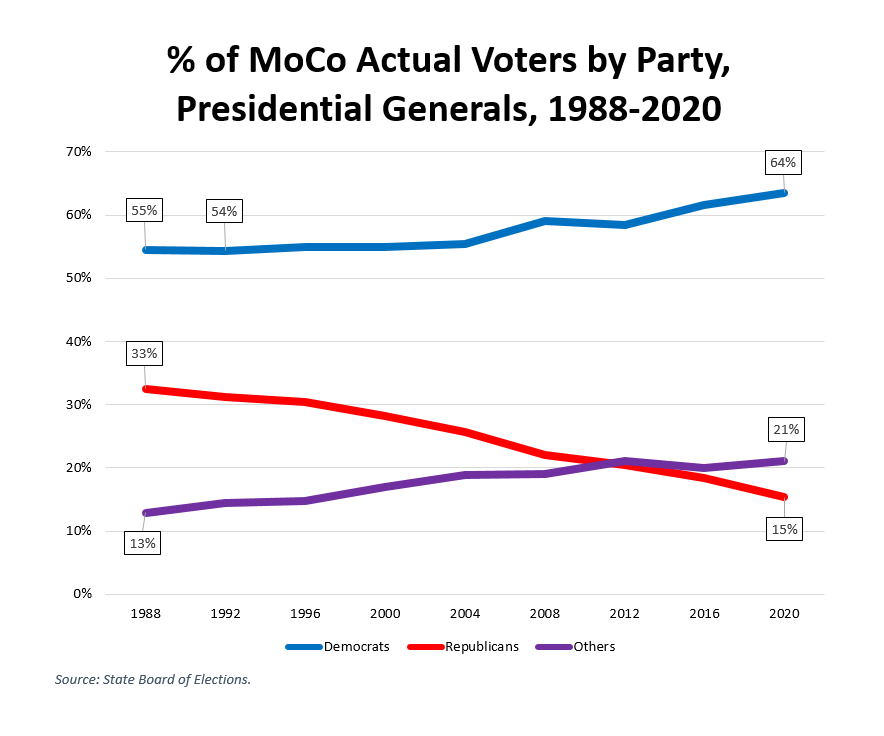
4. Among actual voters in MoCo, the share who are Republicans has fallen behind unaffiliated and third party voters while Democrats dominate.
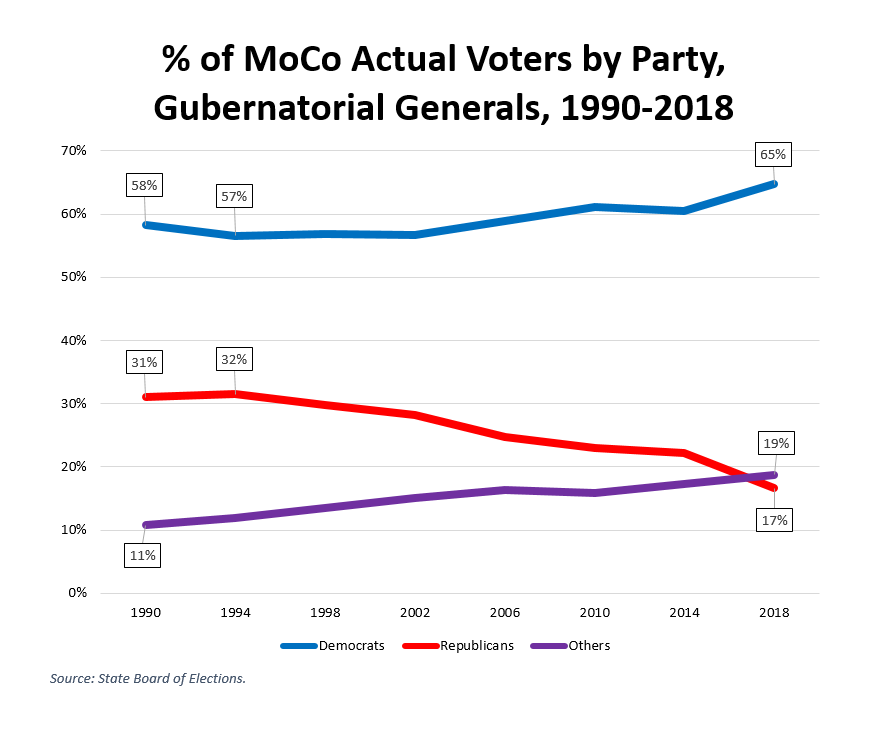
Republicans compete directly with Democrats in general elections. In 1988 and the early 1990s, Republicans comprised 30% or more of actual voters in MoCo general elections, both presidential and gubernatorial. Their share of actual voters fell to 17% in 2018 and 15% in 2020. Unaffiliated and third party voters were 19% of actual voters in 2018 and 21% of actual voters in 2020. Democrats now exceed 60% of actual voters, up from the mid-to-high 50s in the 1990s.
5. MoCo Republican registrations and voting have taken big hits under Donald Trump.
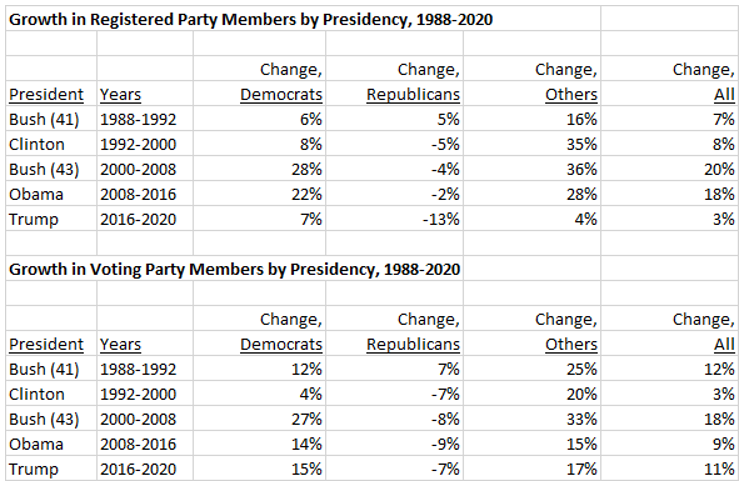
The table below shows changes in MoCo registrations and actual voting by party under the past 5 U.S. presidents. For each president, the general election in which they were first elected is used as the starting point and the general election near the end of their tenure in office is used as the ending point.
Democrats saw surges in registrations under both Bush 43 and Obama and enjoyed a large increase in actual voting under Bush 43. Unaffiliated and third party voters saw significant increases in registrations and voting during most periods although registration growth was slow under Trump. Republican registrations and voting grew under Bush 41 but fell under the next four presidents. Voting decline under Trump was about the same as under Clinton, Bush 43 and Obama, but consider that Trump was the only one of them who served just one term. Republican registration decline was huge under Trump (13%), far exceeding declines under his predecessors.
The GOP was once a factor in MoCo politics. GOP Congresswoman Connie Morella served in Congressional District 8, which accounts for most MoCo voters, from 1987 through 2003. Jim Gleason, who was MoCo’s first county executive in 1970-78, was a Republican. The GOP held county council and state legislative seats in the western and northern parts of the county for years. In the 1994 election, one-quarter of MoCo’s partisan elected offices were won by Republicans. But the last MoCo Republican office holders, District 1 Council Member Howie Denis and District 15 Delegate Jean Cryor, were defeated in 2006 and the party has not come close to winning a seat since.
MoCo Republicans might still matter in two ways. First, they are the third-largest group of Republicans in the state behind Baltimore County and Anne Arundel County. That makes them relevant in statewide GOP primaries for whatever that’s worth. Second, they have money. Republicans from all over the state come to MoCo to raise money just as Democrats do. Republicans might even toss some money to centrist Democrats just to prevent progressives from winning.
Once upon a time, the case could be made that MoCo Republicans were relevant on ballot questions. They certainly played a part in passing term limits four years ago. But given the fact that they are now just 15% of actual voters and their partisan embrace of nine districts helped kill Question D, even that is in question.
Is there anything the local party can do to reverse this free fall? That’s a tough nut to crack. MoCo is a diversifying county that looks nothing like the national Republican base that supported Trump. Not all is politically settled here as there are differences even among county Democrats on taxes, school reopening, school boundaries, criminal justice, land use, housing, economic development and other issues which are likely to surface in Democratic primaries. But it’s hard for county Republicans to be regarded as credible on local issues when their national counterparts are ransacking the U.S. Capitol and defending a seditious former president. Without a national GOP that adopts a very different brand and political strategy from the one it has now, it’s hard to imagine a local GOP reversing the trends above.
Last fall, I wrote about a bombshell General Assembly audit of the State Department of Assessments and Taxation which found that the agency had miscalculated property taxes for thousands of MoCo home owners. As a result, some home owners had been overcharged property taxes for years. The agency’s response was to deny that its prior practice was inaccurate but also to change its methodology going forward. Overcharged home owners would then get no refunds for past overpayments.
That wasn’t good enough for Senator Craig Zucker (D-14) and Delegate Al Carr (D-18), who each represent parts of Montgomery County. They introduced legislation that would enshrine the new tax calculation methodology in law and would provide three years of refunds to affected home owners. One of the best parts of the bill is that the burden is placed on the state, not the home owners, to calculate and apply the refunds. The fiscal note states:
For taxable years beginning after June 30, 2017, but before July 1, 2021, the State Department of Assessments and Taxation (SDAT) must determine whether a homeowner is owed a refund of property taxes paid by the homeowner as a result of the changes made to the calculation of the homeowners’ property tax credit by the bill and if so, the amount of the refund owed.
SDAT must notify the homeowner and the county within which the homeowner’s dwelling is located of the amount of the refund. Upon certification by SDAT, the Comptroller must pay eligible homeowners the amount of the refund from the Local Reserve Account.
Every MoCo state senator co-sponsored the bill. MoCo delegates co-sponsoring the house version include Carr (the lead sponsor), Charlotte Crutchfield (D-19), Julie Palakovich Carr (D-17) and Jared Solomon (D-18). Because the problem also affected Baltimore City, several city lawmakers co-sponsored the bill as did a number of Republicans.
The bill’s senate version passed the senate on a unanimous 47-0 vote yesterday. It now proceeds to the House Ways and Means Committee, which is chaired by MoCo Delegate Anne Kaiser (D-14). Please look favorably on this bill, Delegate Kaiser!
Thank you to Senator Zucker, Delegate Carr and all others who are standing up for their constituents by supporting this legislation.
SEIU Local 32BJ, which represents building service workers, and the Apartment and Office Building Association (AOBA), which represents owners and landlords, are often at odds. The union advocates for wage and benefit standards for its members and non-members alike while AOBA often pushes back on such measures over cost. But this time, the two combatants have joined forces to advocate for the workforce both depend on.
The union and the association have issued an unusual joint press release demanding that Maryland, D.C. and Virginia prioritize building service employees for vaccinations. They write: “Not only are frontline cleaners, building managers, engineers, maintenance and security personnel critical to keeping us safe and controlling the spread of COVID-19, but they are also getting sick and dying at vastly higher rates as a result. Because social distancing is often impossible for these at-risk workers who are servicing the properties, commercial and apartment tenants, university students, staff, and the public at airports, they are at a higher risk of contracting COVID.”
We love unholy alliances here at Seventh State! Their entire press release is reprinted below.
*****
FOR MORE INFORMATION: Julie Karant: jkarant@seiu32bj.org
32BJ SEIU and the Apartment and Office Building Association (AOBA) Urge Prioritization of At-Risk Frontline Property Services Workers for Vaccines to Expedite Region’s Reopening
“We applaud D.C. Mayor Muriel Bowser for leading the region by making at-risk frontline property service workers eligible for COVID vaccines a top priority, as this is an important first step to vaccinating all. Virginia Governor Ralph Northam should also be commended for allowing employers to register eligible employees for vaccines. We urge Maryland state officials to follow their responsible lead, and for the three jurisdictions to begin expediting access to vaccines for all frontline property service workers – the quicker that happens, the quicker our region can recover and reopen.
Not only are frontline cleaners, building managers, engineers, maintenance and security personnel critical to keeping us safe and controlling the spread of COVID-19, but they are also getting sick and dying at vastly higher rates as a result. Because social distancing is often impossible for these at-risk workers who are servicing the properties, commercial and apartment tenants, university students, staff, and the public at airports, they are at a higher risk of contracting COVID.
Just as the emptying of offices triggered a downward spiral for surrounding businesses, eateries and our economy, reversing that damage and spurring recovery requires getting people to come back. Yet, this process won’t begin until people are safe, and their safety is contingent on making frontline property service workers eligible for vaccination immediately. The case couldn’t be clearer or the need more urgent. We call upon the District of Columbia, Maryland and Virginia to prioritize vaccinating all of our frontline property service workers – a critical step to our region’s recovery and reopening.”
AOBA members are owners or managers of commercial and multifamily residential properties, as well as companies that provide products and services to the real estate industry. Currently, the combined portfolio of AOBA’s membership is approximately 185 million square feet of commercial office space and more than 350,000 residential units in the District of Columbia, Maryland, and Virginia.
With more than 175,000 members in 11 states, including over 20,000 in the D.C. Area and Baltimore, MD, 32BJ SEIU is the largest property service workers union in the country.
The post about the Capitol insurrection by Julie Tagen, who is Congressman Jamie Raskin’s Chief of Staff, is the first one to lead our list two months in a row. After a strong run in January, this article took off again starting February 9 when Raskin told this story to the U.S. Senate in his opening argument at the impeachment trial. It remains one of the most riveting items we have ever posted on Seventh State.
The article about White Flint is the first item to appear on our list three months in a row. This one won’t go away. It’s about more than politics; it’s about whether our county can build appealing new communities that can compete with the rest of the region. There is a real hunger for that in MoCo and it will resume prominence after the COVID pandemic winds down.
Then there are the stories about solar in the agricultural reserve. They reveal a split not just among politicians but also inside the county’s environmental community. Some see environmentalism as concerned with the preservation of nature. Others see environmentalism’s biggest priority as preventing climate change from making Earth inhospitable to humans. Both sides are right, of course, but in the case of solar in the ag reserve, their short-term prescriptions for action were at odds. This is not the first sign of an enviro split in MoCo. The Sierra Club’s endorsement of Roger Berliner over Marc Elrich in the 2018 county executive primary was extremely controversial. We may be headed for more internal conflicts in the environmental community in the future.
Adam Pagnucco wrote a lengthy post about how Councilmember Andrew Friedson (D-1) is upset that the County Executive is proposing single-tracking the Purple Line to accommodate the Capital Crescent Trail in the other tunnel. It is indeed less ideal.
Except that Friedson is now reaping the results of his own actions. Earlier this year, Friedson vehemently supported legislation sponsored by Councilmember Hans Riemer (D-AL) to provide corporate welfare in the form of tax breaks for developments on Metro properties.
As County Executive Marc Elrich explained in his veto message, the property tax subsidies proposed for Grosvenor-Strathmore alone cost the county over $100 million in revenue. And that’s just one project and the start of the giveaway bonanza the Council insisted upon when it overrode Elrich’s veto.
Moreover, this is likely the first step, as ideas for providing similar subsidies on private property around Metro have been bandied about by both councilmembers and the Planning Board. Yet the Council seems much happier contemplating additions than subtractions to the budget.
The Council has also been busy reducing impact tax fees that go directly into the capital budget as part of its “no developer left behind during a pandemic” program. They may call it social justice but it sure looks like a giveaway to connected, wealthy interests known for generous campaign contributions.
It’s too bad that Friedson wasn’t around during the days of the U.S. House of Representatives Committee on the Post Office. Its members had two core beliefs: (1) stamp prices should never rise, and (2) the wages of postal workers should always go up.
I sympathize with Friedson’s desire for a two-track Purple Line and a separate tunnel for the Capital Crescent Trail. I just wish someone touted so often as a financial wizard would pay greater attention to the budgetary impact of his desire to engage in tax giveaways to developers on the Council’s other priorities.
In order to save money in the county’s capital budget, the administration of County Executive Marc Elrich has asked the state to single-track the Purple Line through a tunnel in Downtown Bethesda. That has aroused concern from Council Member Andrew Friedson, whose district includes the area, and advocates for both the Purple Line and its accompanying Capital Crescent Trail.
The Purple Line, the state’s light rail project between Bethesda and New Carrollton, has long been tied to the bicycle-pedestrian path known as the Capital Crescent Trail. The state is responsible for the Purple Line, the county is responsible for the trail and the two are supposed to run in parallel for most of the way between Silver Spring and Bethesda. The old version of the trail proceeded through an existing tunnel under Downtown Bethesda to enable pedestrians and bikers to avoid crossing Wisconsin Avenue, one of the most congested roads in the county. The new trail project is supposed to contain a new tunnel while the Purple Line uses the existing tunnel to connect to the Bethesda Metro Station.
This year is different in one respect. According to the executive’s new recommended trail project: “To provide an alternative approach, the County has requested that the State consider single-tracking through the Purple Line tunnel, freeing up space for the trail at considerable cost savings.” So instead of building a new tunnel, there would only be one tunnel containing one (not two) rail tracks plus the trail.
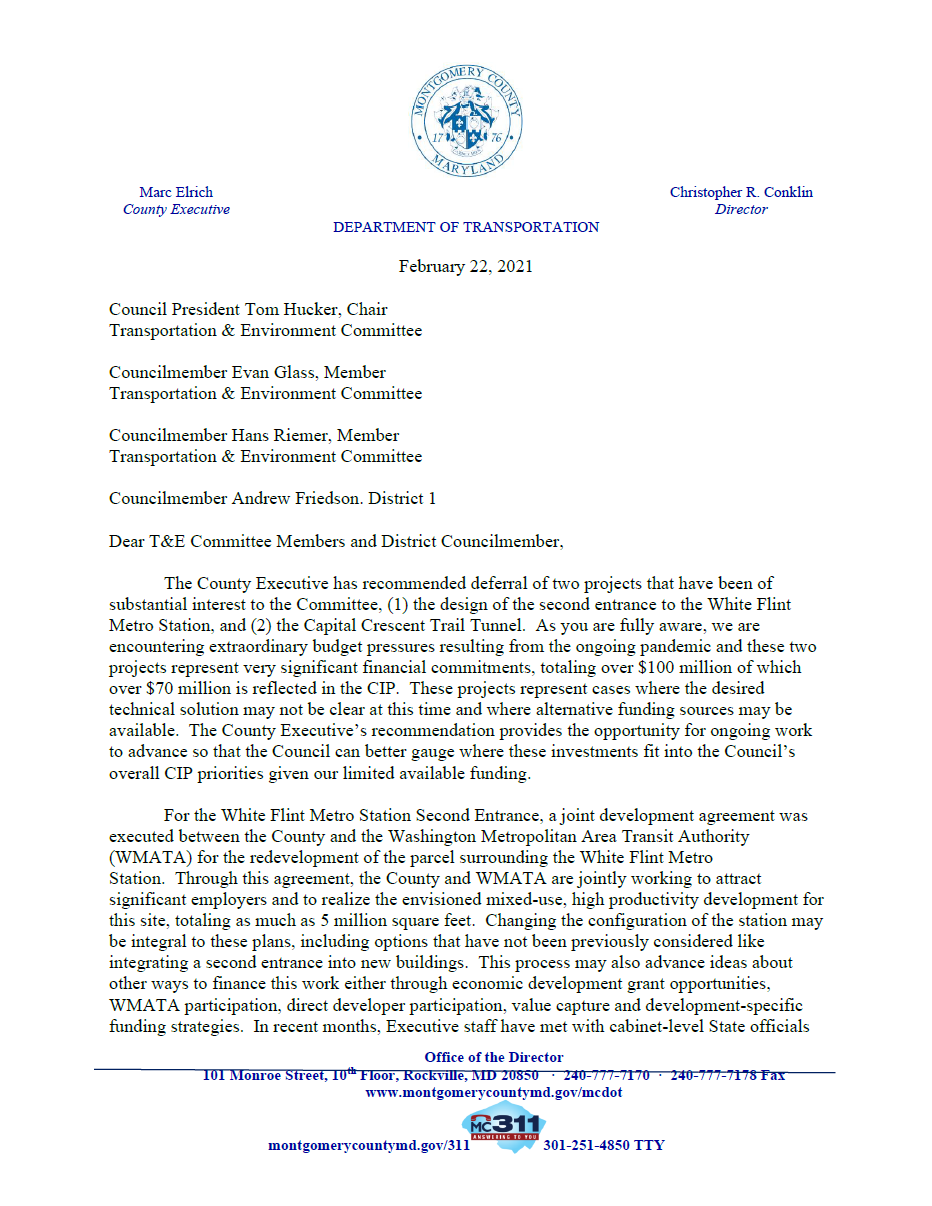
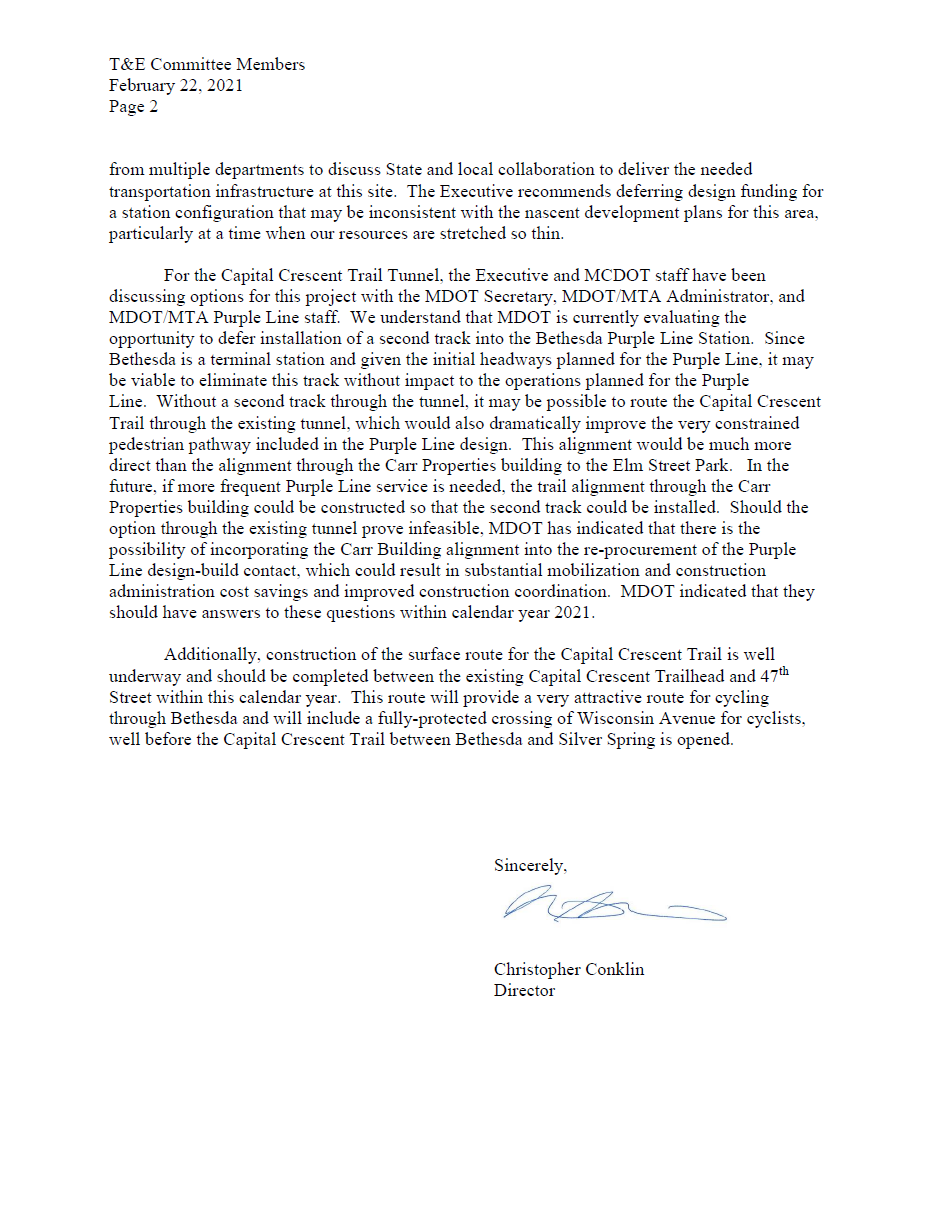
County transportation director Chris Conklin elaborated on the executive’s position in a letter to Friedson and the county council’s Transportation and Environment Committee. Conklin wrote:
For the Capital Crescent Trail Tunnel, the Executive and MCDOT staff have been discussing options for this project with the MDOT Secretary, MDOT/MTA Administrator, and MDOT/MTA Purple Line staff. We understand that MDOT is currently evaluating the opportunity to defer installation of a second track into the Bethesda Purple Line Station. Since Bethesda is a terminal station and given the initial headways planned for the Purple Line, it may be viable to eliminate this track without impact to the operations planned for the Purple Line. Without a second track through the tunnel, it may be possible to route the Capital Crescent Trail through the existing tunnel, which would also dramatically improve the very constrained pedestrian pathway included in the Purple Line design. This alignment would be much more direct than the alignment through the Carr Properties building to the Elm Street Park. In the future, if more frequent Purple Line service is needed, the trail alignment through the Carr Properties building could be constructed so that the second track could be installed.
The County Executive’s suggestion to explore single-tracking the Purple Line in the existing tunnel in order to accommodate the new Capital Crescent Trail is highly problematic and would represent a dramatic departure from the County’s longstanding commitments to the community. To my knowledge, the Maryland Transit Administration (MTA) has never expressed that such an arrangement is feasible. Project plans were approved long ago and construction has already started. For those reasons, and based on deep concerns that single-tracking would delay travel times and light-rail vehicle headways, I am firmly opposed to the County Executive’s proposal. Even if an abrupt change to single-tracking is possible at this late stage, it would make this critical light-rail system less functional and would fall well short of our shared commitment to reliable, high-quality public transit.
This is not the first time that Elrich has proposed single tracking the Purple Line. Back in 2009, Elrich (along with Council Member Roger Berliner, who was Friedson’s predecessor) suggested single tracking the Purple Line inside the rail right of way in Chevy Chase that was then used as the original version of the Capital Crescent Trail. Elrich was interested in single tracking to save trees along the trail. The Maryland Transit Administration (MTA) responded with a statement noting longer travel times, less frequent service and lower passenger capacity on single-tracked light rail lines built in San Diego, Portland, Sacramento, and Baltimore. MTA concluded:
In sum, introducing a single-track segment between Bethesda and Connecticut Avenue would significantly compromise travel time savings, service frequency, passenger carrying capacity, and the maintenance and operating reliability of the Purple Line, thereby reducing the effectiveness, efficiency, and the return on a $1.3 billion investment. The reduction in the amount of tree clearance hoped for from building a trail and single-track segment would not likely be achieved. For the many reasons stated above the MTA strongly recommends against single-tracking any portion of the Purple Line.
In fairness to Elrich, the capital budget is extremely tight and the council’s move to reduce impact taxes used to pay for capital projects was not helpful. However, Elrich’s proposal to single track the Purple Line through a tunnel is a huge change to the project that could limit its effectiveness. The state should heed input from the county council, the county’s state legislators, the public and its own transit agency (which came out against single tracking a decade ago) before deciding on its merits.
In Part Three, we learned that rising average wages during the pandemic are likely a sign of growing income inequality as job losses are concentrated in lower paying positions. Preliminary data from the U.S. Bureau of Labor Statistics (BLS) suggests how this is playing out across Maryland.
BLS’s county employment series has a six-month lag in release time. As of this writing, county-level data are only available through the second quarter of 2020. However, BLS also has a state and metro area series that is more up to date. Preliminary data for that series is currently available through the end of 2020. BLS releases that data for metropolitan statistical areas in Maryland defined as follows:
Baltimore-Columbia-Towson: Anne Arundel, Baltimore City, Baltimore County, Carroll, Harford, Howard and Queen Anne’s counties. California-Lexington Park: St. Mary’s County. Cumberland: Allegany County in Maryland and Mineral County in West Virginia. Hagerstown-Martinsburg: Washington County in Maryland and Berkeley and Morgan counties in West Virginia. Silver Spring-Frederick-Rockville: Frederick and Montgomery counties. Baltimore City Calvert-Charles-Prince George’s
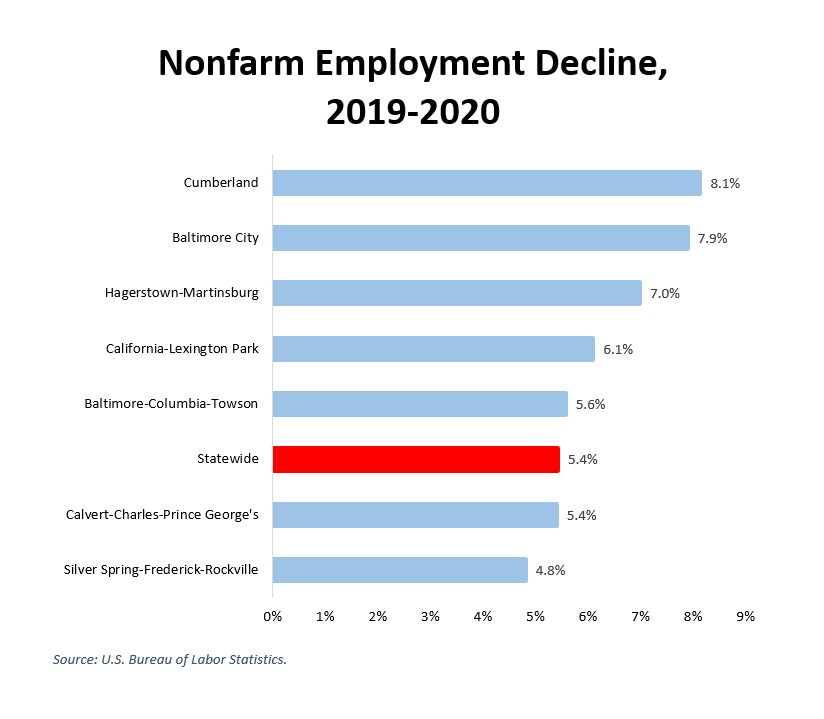
The chart below shows nonfarm employment declines by Maryland metro area in 2020.
According to the state’s wealth measures, Allegany County, Washington County and Baltimore City, which had some of the largest job losses, are three of the least wealthy jurisdictions in Maryland. The Silver Spring-Frederick-Rockville metro area, which had one of the smallest job losses, is dominated by Montgomery County, one of the wealthiest jurisdictions in Maryland. This chart, while admittedly incomplete, hints at widening geographic inequality between different parts of the state.
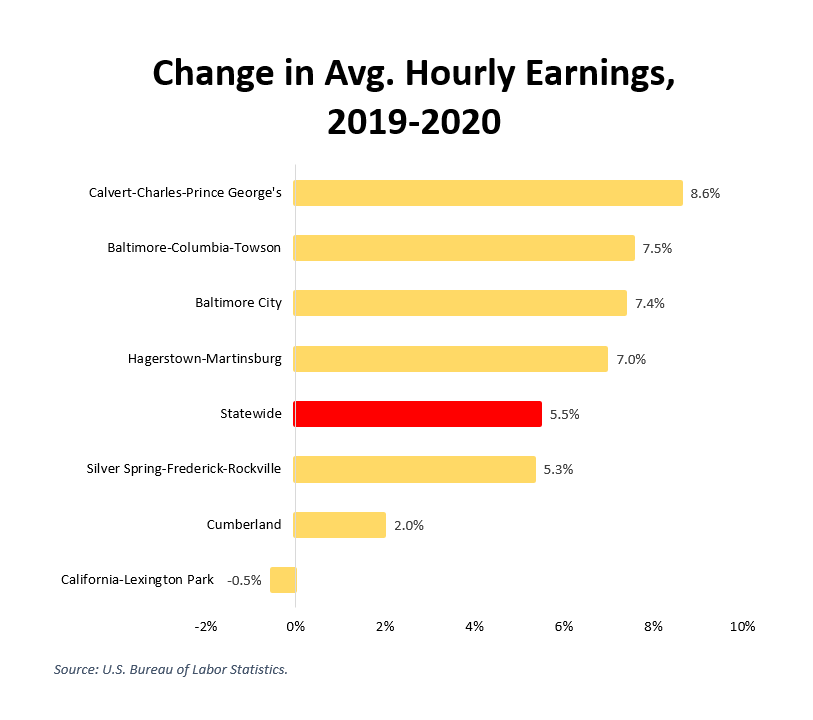
The chart below shows change in average hourly earnings by Maryland metro area in 2020.
California-Lexington Park (St. Mary’s County) is the only metro area here showing a drop in average hourly earnings. All the other areas show an increase exceeding the 1.4% rise in the national consumer price index last year. Remember what we learned in Part Three: because low-wage workers have likely been disproportionately affected by the COVID recession, a rising average wage is probably a sign of rising income inequality. This chart, while also incomplete, hints at rising inequality inside many local jurisdictions in the state.
There is a silver lining for state and local budgets here: low income workers pay lower absolute amounts of property and income taxes than higher income workers. To the extent that the recession’s impact falls disproportionately on the lower end of the income distribution, budget losses may turn out to be less than initially feared. But that’s cold comfort to those who have been let go from payroll jobs and have turned to the gig economy to survive. Governments that benefit from less-than-expected budget pain have a responsibility to help these people until the economy revives.