Ginsburg hoped to reshape district she looks to represent

Bethesda Beat reports that Friends of White Flint Executive Director Amy Ginsburg is looking at running for the Montgomery County Council from newly crafted District 4.

Prior to announcing her interest in running for the Council, Ginsburg used her position at Friends of White Flint to advocate vocally for a very different version of District 4. Here is one email sent out by Friends of White Flint:

From an email sent by Friends of White Flint on November 18th.

The map configurations promoted by Ginsburg would almost certainly have excluded Takoma Park, home to Mayor Kate Stewart–the other publicly interested candidate–and included more territory in closer proximity to White Flint (a.k.a. North Bethesda).

Friends of White Flint is one of those “neighborhood” organizations that is put together by developers and business to advocate for their interests. A quick glance at the its leadership confirms that business and developer representatives compose two-thirds of the board.

While Ginsburg says her background makes her a natural candidate for “the most progressive district in the county,” Friends of White Flint has consistently argued in favor of business and development interests. Supporters of developer interests regularly repackage them in social justice language, but I suspect Ginsburg’s record at other nonprofits, such as Neediest Kids and Manna Food Center, does more to burnish her progressive credentials.

Share

Smart Choice, Puzzling Choice

Two Democratic gubernatorial candidates have already chosen running mates for the Lt. Governor slot on their ticket. One created buzz but the other inspired head scratching.

Wes Moore Picks Aruna Miller

Former Del. Aruna Miller (D-15) is well-liked and well-respected among her former colleagues in the General Assembly and more generally among people active in Montgomery politics. For Wes Moore, a running mate from the D.C. area balances his own roots in Baltimore. It also is a choice that indicates not only that Moore is dead set on becoming governor but also that he’s supported by a respected former legislator and cares seriously about governing.

Four years ago, Miller ran for the U.S. House in the Sixth District. Despite having a good base of volunteer support and solid fundraising, she lost to now Rep. David Trone, who had pots of money and was already well-known in the media market due to his unsuccessful run in the neighboring Eighth. Though ending in disappointment, the run raised Miller’s profile and created a positive impression.

Rushern Baker Picks Nancy Navarro

Baker has thrown any sense of geographic balance to the wind by reaching out all the way from Prince George’s to Montgomery to pick Nancy Navarro. Though a former County Council President, Navarro’s profile in the county is not especially high outside of her council district. Navarro’s emphasis on being a tribune for the Latino community has limited her broad appeal without nailing down the Latino vote, which is sticking with Tom Perez. Navarro is known neither as a prolific fundraiser nor a relentless campaigner.

At the Committee for Montgomery Forum, Rushern Baker touted Navarro’s racial equity legislation that requires analysis of all legislation from a racial equity perspective as what he’d bring to Maryland to address racial disparities. Whatever one thinks of expanding the diversity bureaucracy, it’s a proposal that connects with a narrow base rather than a broad swath of voters and jars with Baker’s image as a proud Black but non-identity based politician.

Share

First Impressions

Doug Gansler, Wes Moore, Tom Perez and Rushern Baker

The Committee for Montgomery’s annual legislative breakfast at the Bethesda Marriott Conference Center is one of those annual events that brings together the political class of Montgomery County for a good schmooze. This year, CfM also held a forum moderated by Washington Post Reporter Ovetta Wiggins that was open to all gubernatorial candidates. For me, it was either the first time seeing the candidate or the first time in a long while.

Wes Moore is the candidate that stood out as a comer. By far the best speaker in the group, he came across as authentic rather than simply silver tongued. Getting former Del. Aruna Miller to be his running mate adds legislative experience. I still don’t know much about him but he’s one to watch.

After getting shellacked by Anthony Brown in 2014, former Attorney General Doug Gansler is back for another go. He’s running as a practical liberal—moderate by Maryland standards—who has the experience to get things done. The subtext is that he’s also matured and grown since his time out from politics.

Tom Perez would be the first Latino governor but is also running as the insider, establishment candidate who knows just everyone. As well he should. Since he finished his one term on the Montgomery County Council in 2006, he’s served as Assistant Attorney General for Civil Rights, Secretary of Labor and DNC Chair. That gives him a lot of chits and fundraising ability but also means that he’s little known by voters.

Former Prince George’s County Executive Rushern Baker, one of the most decent people in Maryland politics, lost the primary for governor in 2018 but left many thinking he would’ve been the better nominee. The forum left me wondering exactly why he wants to be governor. He highlighted his Montgomery running mate, Nancy Navarro.

Ashwani Jain is campaigning as young, smart and passionate progressive, but I just don’t get it. He ran for one of four at-large county council seats in 2018 and came in eighth in the primary. Not a signal to run for governor. Likes to consult his diary.

Former New York Education Commissioner and Secretary of Education John King seems like another smart guy who nobody knows and who failed to stand out, even on education, in a crowd of candidates who are better known and more experienced on the Maryland scene. Left me wondering why he’s running.

Jon Baron struck me as yet another earnest, perfectly likeable candidate with primarily Washington experience who won’t gain traction. This year’s Alec Ross?

Comptroller Peter Franchot is from Montgomery County yet didn’t show. Not especially popular with the political class, he returned the compliment. They aren’t the base of this former hard progressive, now moderate, so I doubt it matters.

Robin Ficker showed up with his hackneyed anti-tax message. He promised to cut the sales tax by 2%, which he oddly labelled a rebate, but per usual didn’t mention one spending item he’d cut. He attacked teachers “Where were they?” for not teaching and went after mask mandates for school kids, though he’s vaccinated.

Neither Del. Dan Cox, (R-QAnon) nor former Del. and Maryland Commerce Secretary Kelly Schulz showed. Perhaps a missed opportunity for Schulz. Though a Democratic heartland, Montgomery still casts a lot of Republican primary votes and she’ll need to make inroads here like Larry Hogan to win in the general.

Libertarian Larry Lashar came across as what Republicans used to be—a bit dull but with a coherent viewpoint and some innovative ideas, like school choice. If the Republicans nominate a wackadoodle, he could get more votes than your usual third-party candidate.

Ovetta Wiggins did an excellent job as moderator by asking straightforward policy-oriented questions and letting the forum be about the candidates.

Share

Redistricting Plan analysis

Montgomery County’s decennial redistricting not only had to equalize populations but also had to squeeze in two new districts in addition to the existing five. The County additionally elects four at-large members.

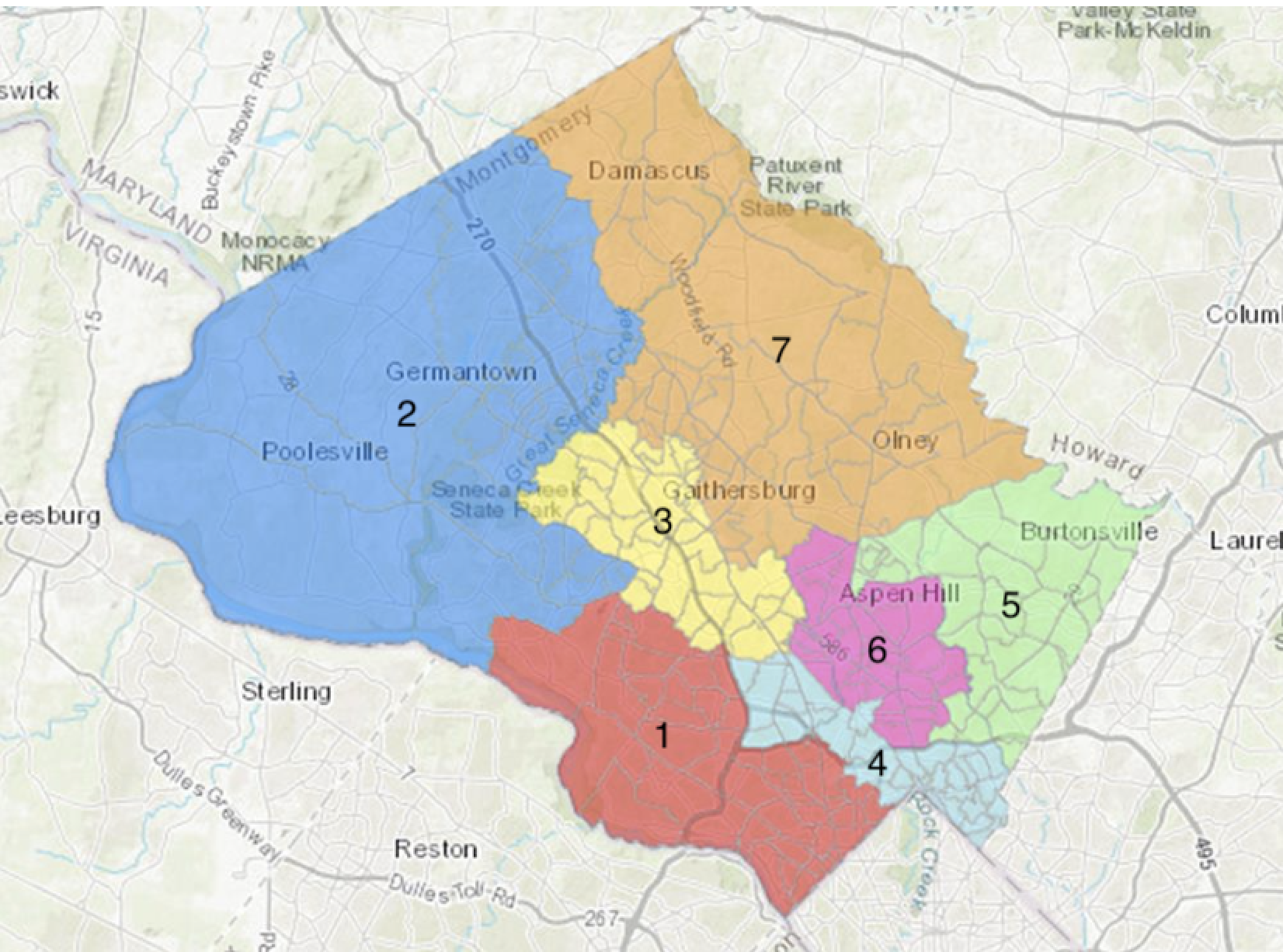
Montgomery County Council Districts 2022-2030

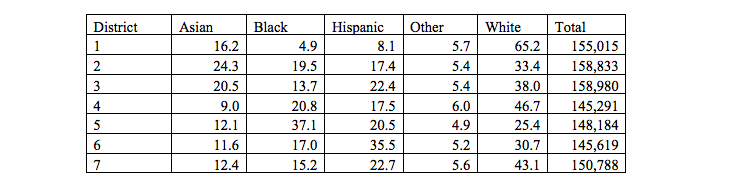
All of the districts in the final plan are within 5% of the ideal district population of 151,816. At 4.7% above the ideal, the new Third (Gaithersburg-Rockville) is the most populous. But the new Second (Germantown-Poolsville) is not far behind at 4.6%. The new Fourth (Kensington-Takoma) is the smallest–4.3% undersized–followed closely by the new Sixth (Wheaton), which is 4.2% too small.

The 65% White First (Bethesda-Potomac) is the only district where a single race predominates. The 47% White Fourth and the 43% White Seventh (Olney-Damascus) are the only two other districts where a single group forms more than 40% of the population.

Whites form pluralities in two more districts–the Second and the Third–but Blacks (37%) are the largest group in the Fifth (Burtonsville) and Latinos (35%) in the Sixth. Blacks will likely comprise a much larger share in the open Fifth’s critical Democratic primary due to lopsided Democratic registration rates among African Americans.

On the other hand, the share of Latinos in the primary remains cloudier. Latinos are also disproportionately Democratic, but less so than Blacks. More importantly, immigrant communities have many non-citizens who cannot participate.

Participation rates among Latinos who are citizens is generally lower than for other groups. One reason is that eligible Latino voters skew young, as they are more likely to be citizens, and young people vote at far lower rates than older voters.

A multiplicity of Latino candidates could also split the vote. Former Planning Board Member Natalie Fani-Gonzalez and former Del. Maricé Morales are among the candidates seeking the seat. Councilmember Nancy Navarro currently represents the area.

I’d be careful not to overestimate the extent to which Montgomery voters cast ballots on racial lines. African-American Councilmember Craig Rice now represents the district with the highest share of Whites and lowest share of Blacks in the county. Both Black and Latino candidates won at-large seats in 2018.

Asians are not the most numerous group in any district. The Second has the highest share of Asians at 24%. No Asian American has ever been elected to the Montgomery County Council. Will that change in 2022 with the addition of two new districts?

Share

Farewell For Now

By Adam Pagnucco.

Dear readers, this will be my last post on Seventh State for the foreseeable future. That’s because I am joining David Blair’s campaign for county executive. I can’t work for a campaign and simultaneously write about it, or issues connected to it, for the public. So it’s time for me to go, at least for now.

To our readers: thank you. In my early days of writing more than a decade ago, it felt like I was throwing messages in bottles out to sea. Off the bottle would go into the deep waters, and who knew if anything would return. But that began to change as more and more of you contacted me to discuss our content. You showed me that MoCo residents are the smartest, most thoughtful and most interesting people on Planet Earth. Sure, I produced the content, but you educated me, challenged me and ultimately improved my work in return. YOU are responsible for the success of Seventh State.

And now to the founder of Seventh State, David Lublin. It’s not easy to be my partner. I am sure David has heard many, MANY complaints about me over the years. He is just too nice to say so! David, thank you for giving me an opportunity to contribute to this county. Thank you for putting up with me and offering me the wisest of counsel over the years. Most of all, thank you for being my friend.

That’s all for now. See you on the campaign trail!

Share

It’s Hard to Beat Incumbents

By Adam Pagnucco.

Recently, Bethesda Beat kicked off the primary season with news that County Executive Marc Elrich and most of the county council are running for reelection. That’s not surprising and there will be plenty more news to come. But for the moment, let’s start with this general observation.

It’s hard to beat incumbents.

This may be the least surprising statement in all of politics, but it bears repeating for each new crop of candidates who come along. Opensecrets.org charts incumbent performance in Congress and finds their win rates generally in the 80-90% range for decades. And since the passing of President Franklin Delano Roosevelt, 8 of 12 U.S. presidents who ran for reelection won.

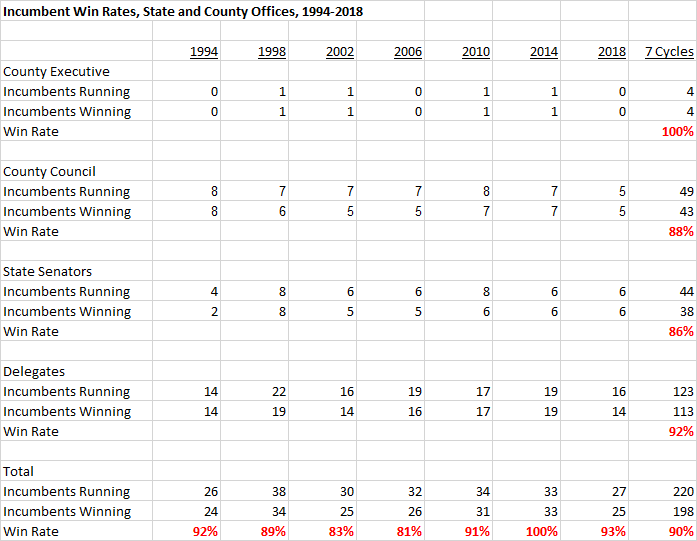
Montgomery County is no exception to this rule. The table below shows MoCo incumbent performance for county and state legislative offices over the last 7 cycles. During that period, MoCo incumbents won 90% of their reelections to their current seats. (The data does not show performance in runs for higher office.)

Incumbents might be getting stronger here over time. Over the last two cycles, only two incumbents – Delegates Marice Morales (D-19) and Shane Robinson (D-39) – lost reelection. Incumbent county council members and state senators won every reelection race in 2014 and 2018. As for county executive, incumbents have run for reelection seven times since the office was established in 1970. Only once, when five-term Council Member Neal Potter knocked off County Executive Sidney Kramer in 1990 with 52% of the vote, was an incumbent executive defeated.

Incumbents have so many advantages: money, relationships, knowledge of the job, policy and political experience, records of performance… it goes on and on. Rather than asking why they win, it’s more interesting to ask why they sometimes lose. I asked that question in a five-part series in 2010 that still holds up today. In MoCo, incumbents typically lose for one of four reasons: they are Republicans (not a factor today!), they get lazy and take their races for granted, they make too many enemies in their districts and – the rarest reason of all – they draw historically great challengers.

Back in 2010, I identified just four great challengers in recent years: Chris Van Hollen (who beat District 18 Senator Pat Sher in 1994 and longtime Congresswoman Connie Morella in 2002), Phil Andrews (who beat County Council Member Bill Hanna in 1998), Rob Garagiola (who beat District 15 Senator Jean Roesser in 2002) and Jamie Raskin (who beat District 20 Senator Ida Ruben in 2006). I will add Roger Manno to that list, who defeated District 19 State Senator Mike Lenett in one of the wildest MoCo races ever in 2010. If you include Congressional District 4, which once had part of east MoCo in it, then Donna Edwards deserves to be on the list for almost taking out Congressman Al Wynn in 2006 and then crushing him two years later.

Here is something I hear in every cycle. Politician X is a freshman incumbent who won his seat by a small margin last time. So inevitably X must be vulnerable in a reelection race, yeah? Actually, this is almost always WRONG. Let’s take District 5 Council Member Tom Hucker for example. A two-term delegate and founder of Progressive Maryland, Hucker won a surprisingly close race over civic activist Evan Glass and three other candidates by 222 votes in 2014. For the next four years, all I heard was “Hucker is vulnerable.”

Silly rabbits! Hucker is a pro. He knows the business. He hired good people, paid attention to constituent service, raised money, voted with his district and locked it down. In 2018, he won by 45 points because – among other things – he knows how to capitalize on being an incumbent. For those of you who think freshman Council Member Andrew Friedson is vulnerable just because he won 28% of the vote in his crowded first race, pay attention. Things tend to change when you’re an incumbent and you know how to be one.

Does this mean incumbents inevitably win? Certainly not – as the table above shows, they have lost 22 times in MoCo since 1994. But let’s be realistic: in MoCo, in Maryland, in the United States and probably in the rest of the Milky Way Galaxy, it’s hard to beat incumbents.

Share

Downcounty Dominates Public Financing, Part Five

By Adam Pagnucco.

Part Four illustrated the significant flows of political contributions from downcounty to candidates in public financing. Today, we shall see which communities lagged behind.

Gaithersburg

Gaithersburg combines an incorporated area with a municipal government and an unincorporated area administered directly by the county. Zip codes in the incorporated and unincorporated areas together account for roughly 14% of the county’s population, and along with Germantown, comprise one of the two biggest population centers in upcounty.

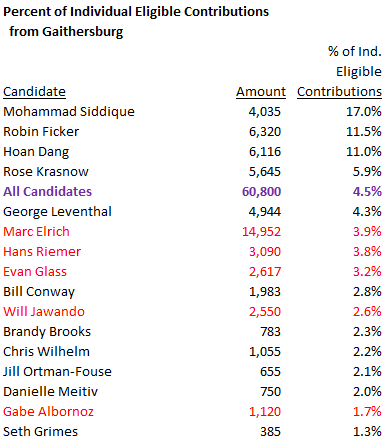
The table below shows amounts and percentages of fundraising from Gaithersburg by executive and council at-large candidates who qualified for matching funds. Winning candidates are shown in red.

Despite its size, Gaithersburg accounted for less than 5% of individual contributions eligible for matching funds. Gaithersburg’s population is slightly larger than the combined populations of Bethesda, Chevy Chase and Kensington. Residents of those areas gave $358,885 to publicly-financed candidates while Gaithersburg residents gave $60,800.

Germantown

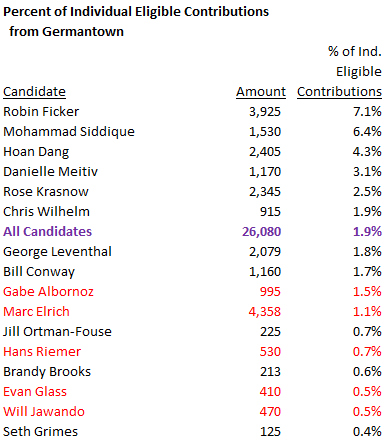
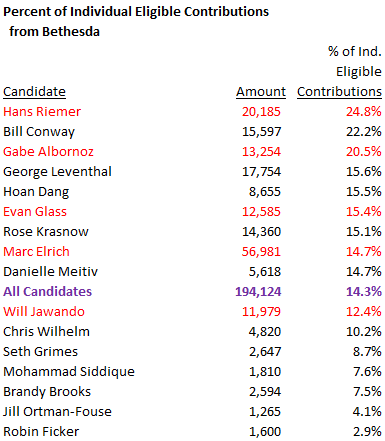
Germantown’s zip codes account for roughly 9% of the county’s population but its residents donated less than 2% of the in-county individual contributions received by candidates in public financing. Germantown’s population is larger than Bethesda’s. Nevertheless, Bethesda residents contributed $194,124 to publicly financed candidates while Germantown residents gave $26,080.

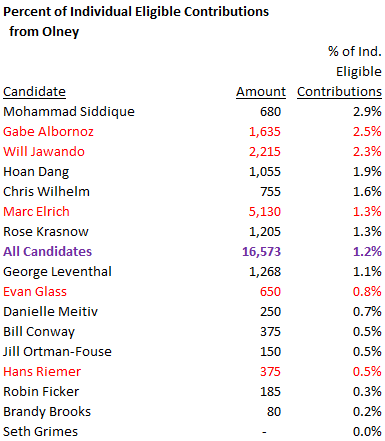
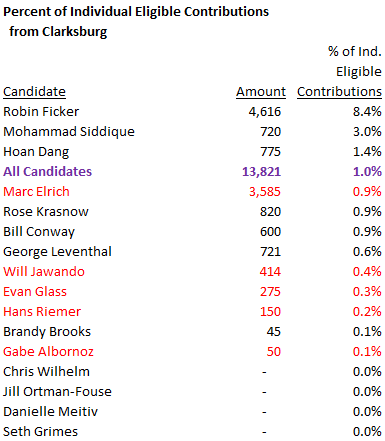
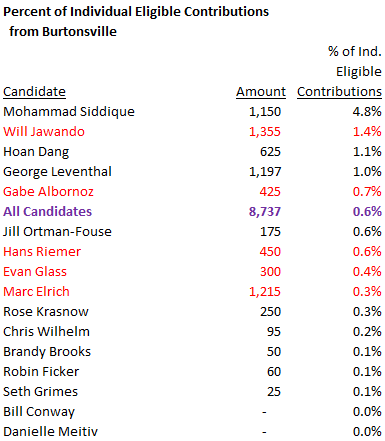
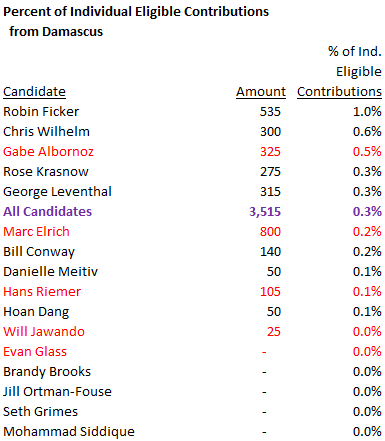
The tables below shows areas with significant population but lower than average participation rates in public financing. Note their concentration in upcounty and east county.

Public financing is here to stay and many – perhaps even most – county politicians will use it. Politicians go where the money is and they tend to be particularly attentive to constituencies who contribute. Right now, this system favors downcounty, where concentrations of contributors and high-frequency voters tend to be located. If other parts of the county want to get equal attention, they are going to have to run some candidates and get behind them with money and votes.

Share

Downcounty Dominates Public Financing, Part Four

By Adam Pagnucco.

There were huge differences in public financing participation by geography in 2018. In some areas, residents donated significant amounts of money to publicly-financed candidates which were enhanced by matching funds paid out by the county. In other areas, residents contributed very little to publicly-financed candidates. These areas match existing patterns of political influence that were greatly amplified through distributions of matching public funds.

Let’s start with downcounty, hereby defined as the Democratic Crescent that sent Jamie Raskin to Congress. Downcounty is diverse in terms of demographics and economics but it is characterized by moderate to high turnout rates in Democratic primaries, high degrees of civic organization and lots of progressive activism.

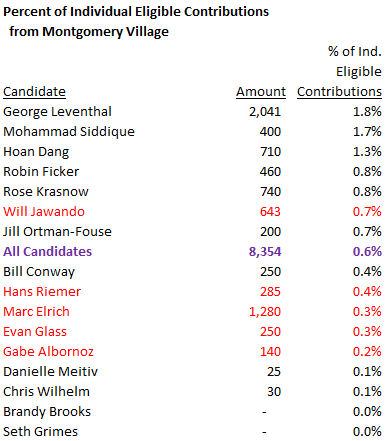
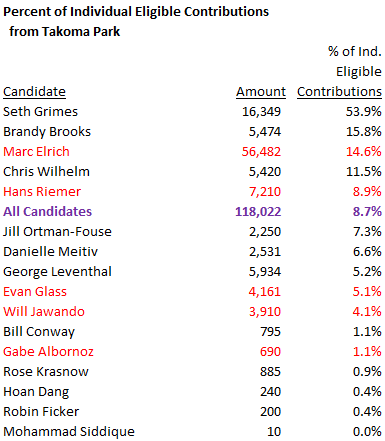
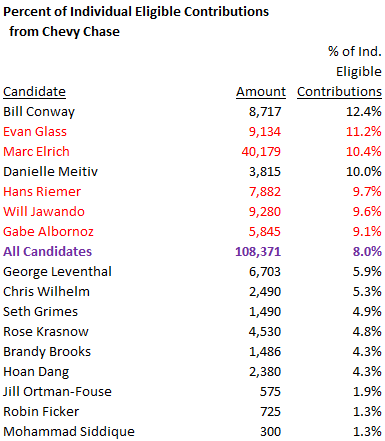
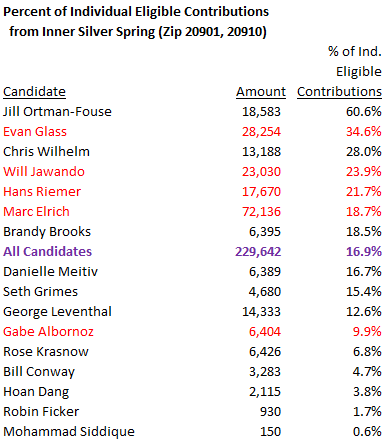
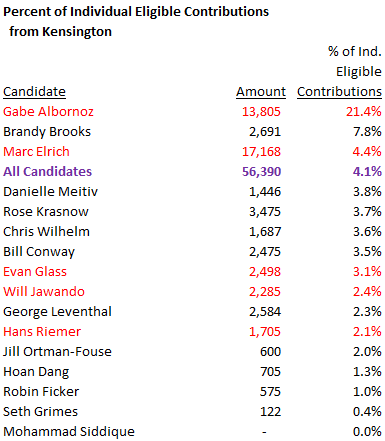
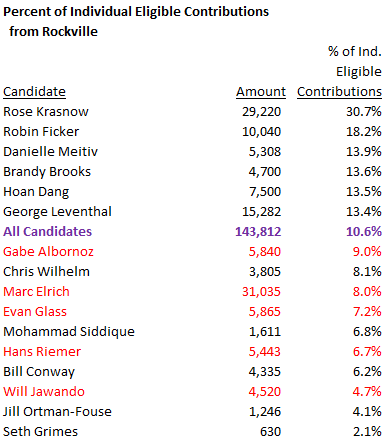
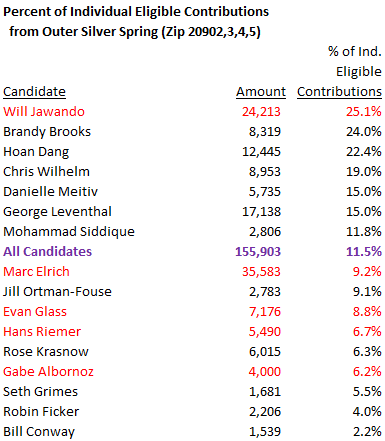
The downcounty areas shown below have two things in common. First, all of them exceeded per capita averages of individual contributions to publicly-financed candidates. Second, the winning candidates (Marc Elrich for executive and Hans Riemer, Will Jawando, Evan Glass and Gabe Albornoz for council at-large) tended to receive higher percentages of their campaign funding from these areas than most of the losing candidates. That makes sense – under public financing, fundraising and voting tend to go together. The tables below show amounts and percentages of fundraising by downcounty area for executive and council at-large candidates who qualified for matching funds. Winning candidates are shown in red.

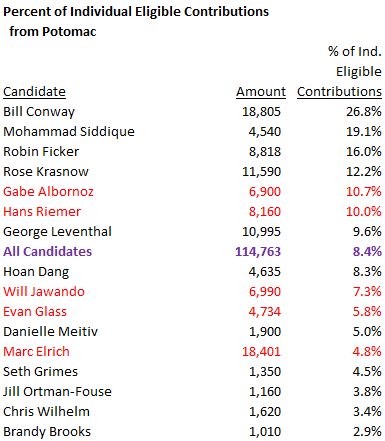
All five downcounty areas participated a lot in public financing. Below are three populated areas located neither in downcounty nor in upcounty that had neither really high nor really low participation rates in public financing.

In Part Five, we shall see which areas disproportionately did not participate in public financing.

Share

Elrich: Maybe We Don’t Need Developers

By Adam Pagnucco.

Last week, Bethesda Beat reported that County Executive Marc Elrich was seeking a developer to partner with the county on redeveloping White Flint, an area that has fallen far short of its potential over the last decade. That sounds like a good idea except for this: Elrich said in a public forum just three days before that maybe the county should not partner with developers at all.

Yes, dear reader, you read that correctly!

Elrich was a panelist at a forum held by the Housing Association of Nonprofit Developers on affordable housing on March 9. In response to a question from the moderator about the difficult economics of affordable housing, Elrich said this:

Part of me wonders whether we ought to be looking at not partnering with developers but just partnering with construction companies, where basically, here’s the – I want to build a building. What’s the price? I modified my own house, I have lots of experience in this. But I also did three tenant conversions in Takoma Park while I was a council member in Takoma Park and, you know, we took – there was no developer involved. We just looked at what’s the cost of the building, the units, what’s the cost of bringing in repair, and we dealt with it as a straight up transaction and we took anybody out of it who was going to take money out of the project in addition to the costs of just doing the physical work. And you know, it may be that we look more toward builders on a contract basis rather than developers. Because then I don’t have to deal with their rate of return.

You can see this at 1:25:37 of the video below.

Let’s remember that this was said not on a street corner or in a restaurant but during a forum for developers. One can reasonably assume that many of them heard the county executive loud and clear.

These remarks are problematic for two reasons. First, they fail to recognize what developers actually do. They don’t just oversee construction contractors. They analyze market economics; hire architects and engineers; design the project; obtain financing; go through land use, transportation and environmental reviews; negotiate with the community; market the property and/or hire agents to market it; manage the property or hire a property manager (if they continue to own it) and more. Construction contractors tend not to do those things, because if they did, they would be… developers. Eliminate developers from project development and who is going to do all of the above? County bureaucrats? Good luck in saving any money that way.

Second, it is totally banana cakes to publicly say that the county is looking to partner with a developer in White Flint and then to wonder out loud – in front of developers – whether the county should be partnering with developers at all. That’s right, developers, you are invited to partner with an elected official who believes that maybe you should not be on the project. Who is going to take that deal?

Anyone want to place any bets on when White Flint gets done?

Share

Maryland Politics Watch