MoCo’s Two Electorates, Part One

By Adam Pagnucco.

Montgomery County voters are some of the most progressive people in the nation.  They elect only Democrats, and almost all very liberal ones.  They celebrate diversity and respect civil rights.  They support a large, active government that passes liberal laws, provides excellent schools and generous social services and has extensive environmental programs.  Perhaps most importantly, they are willing to pay the taxes that support all of this.

Is the above a true statement?  Yes.  And maybe no.  It all depends on which electorate you’re talking about.  Montgomery County has two of them.

The first electorate is comprised of those Democrats who vote in the closed primaries for County Executive, County Council and members of the General Assembly.  Many of these are liberals who vote for candidates with similar views.  Indeed, there is an old aphorism that it’s nearly impossible to run too far to the left in MoCo elections.  Most elected officials here regard these voters as their political base and tend to be highly responsive to them.

But there is a second electorate: those residents who vote in general elections.  These voters come from all political parties and have significant ideological diversity.  For the most part, they tend not to reject the nominees of the Democratic Party for local and state office.  (The last Republican elected officials here were defeated ten years ago.)  But they can and do weigh in on charter amendments and ballot questions, and they do not always behave in accordance with the county’s progressive reputation.

This blog series examines the differences between these two electorates on the eve of the general election, when a landmark ballot question on term limits will be decided.  Of the two electorates, only one – the general election voters – will decide whether term limits will pass.

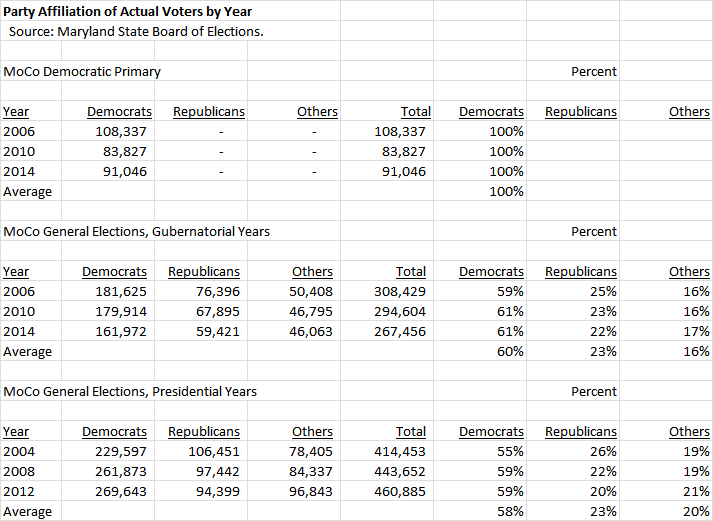
First, we examine the party composition of the two electorates.  The Democratic primary voters are of course 100% Democrats since Maryland uses closed primaries.  The general election voters are roughly 60% Democratic, slightly more than 20% Republican and slightly less than 20% unaffiliated or members of other parties.
party-affiliation

Are liberals a majority of the general electorate?  That’s hard to say, but a little math can help.  If just a fifth of the Democrats, who comprise 60% of general election voters, are not liberals, then a majority of the general electorate would probably not be liberal.  (There are a handful of Green Party members in MoCo, but not enough to change the basic math here.)  So while a majority of Democratic primary voters may be liberal, it’s difficult to apply that characterization to the entire electorate.

Another factor that can be easily seen from the data above is the relative size of the electorates.  There are about three times as many voters in gubernatorial general elections as there are in gubernatorial Democratic primaries.  Presidential general election voters outnumber gubernatorial primary Democrats by five to one.  So while Democratic primary voters pick our elected officials, the presidential general voters are a much closer gauge of the political sentiments of the entire community.

We will begin contrasting MoCo’s two electorates in Part Two.

Share

MoCo Board of Elections Responds to 7S Report on Early Voting Problems

The following was sent to 7S by Marjorie M. Roher, Public Information Officer of the Montgomery County Board of Elections:

Regarding “A Critical Error in Early Voting”

The Montgomery County Board of Elections would like to take this opportunity to address the concern raised in “A Critical Error in Early Voting.”    Mr. Pagnucco’s description of the process that occurs in an early voting center is correct, and the Board appreciates his acknowledgement that the mistakes were honest.

Board staff learned of similar occurrences sporadically in several of the Early Voting Centers.  In each case brought to our attention, the voter received the correct ballot prior to scanning and was able to cast his or her vote in the appropriate congressional race.  The Election Director immediately contacted each Early Voting Center Manager to reinforce the need for accuracy in ballot distribution, instructed that Check-in Judges be reminded to circle the ballot style number on the Voter Authority Card (VAC) to make it easier to see, and Ballot Judges be reminded to double check the ballot style number on the VAC and ensure that they were issuing the correct ballot to each voter.  The design of the ballot issuance tables at each Early Voting Center was reviewed to ensure that the possibility of co-mingling ballot styles was eliminated.  Finally, a copy of The Seventh State blog was sent to each Early Voting Election Judge so that they might better understand the perception of the public when these types of errors occur.

All of these measures will assist in keeping errors to a minimum, but we urge voters also to pay attention to the ballot they are issued and, if they think they have the wrong ballot or if they have any other concerns regarding the voting process, speak to an election judge immediately so corrective action may be taken prior to scanning the ballot.  This will assist the election judges, who are voters who volunteer to work at election time to assist their neighbors with the voting process.

When the State Board of Elections selected the voting system to be used in 2016, it intended to utilize Ballot Marking Devices (BMD) at all Early Voting Centers.  This system would have allowed the Check-in Judge to hand each voter a ballot activation card with a bar code on the top, which  would contain the voter’s ballot style and, when inserted in the BMD, cause the correct ballot style to appear on the screen.  This would eliminate the need for an election judge to select the correct paper ballot for each voter.  Unfortunately, problems with how the BMD screen displayed contests with many names could cause voters to not see all candidates before voting.  For that reason, the State Board of Elections determined that the BMDs would only be used in 2016 by those individuals who requested them.

The State Board of Elections has requested the manufacturer of the BMD to modify the device so that all names in a contest would appear on the same screen.  We believe that this will be accomplished by 2018 so that all voters choosing to vote during Early Voting would be able to utilize this method, thereby eliminating the need for multiple styles of paper ballots at each location and the possibility of human errors.

The Montgomery County Board of Elections strives to ensure that each voter has a pleasant, efficient, and accurate voting process and we encourage voters to contact us with comments or suggestions for improvement, so that  we all can work together  to make a good voting experience even better.

Marjorie M. Roher
Public Information Officer
Montgomery County Board of Elections

Share

Early Voting Turnout Heavy Among Older and African-American Voters

Yesterday, I looked at the partisanship of early voters. Today, I take a peek of the age and racial demographics of early voters based on data graciously provided by a reader.

The estimates of the racial composition of the electorate are based on estimates of the race of voters with the caveat of the potential for errors. Not everyone named Morales is Latino just as not everyone called Goldberg is Jewish. Nonetheless, the information provide a useful first cut at who is participating in early voting.

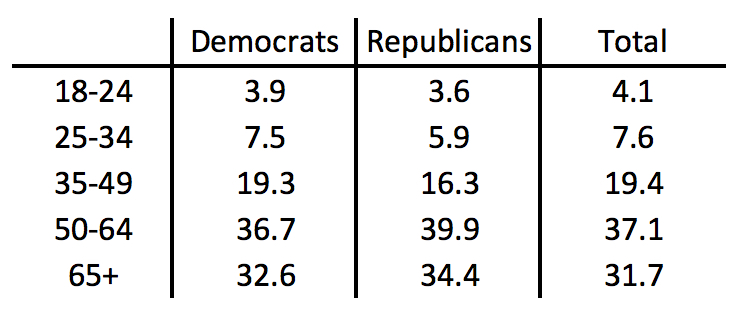
Let’s start with the percentage of the electorate in each age group broken down by party:

partybyageEarly voters skew heavily towards older voters, especially among Republicans. At 74.4%, nearly three-quarters of GOP voters are over age 50. The Democratic share older than 50 is around 5% lower at 69.3%. Among all early voters, which includes unaffiliated and third-party registrants, the share is 68.9%, slightly lower than for Democrats. The low figure reflects much less skew towards older voters among non-major party voters.

In contrast, people 35 and under make up a low share of early voters–11.7% among all voters and just 11.4% among Democrats and 9.5% among Republicans. The latter figure reflects the heavy skew away from Republicans among millennials.

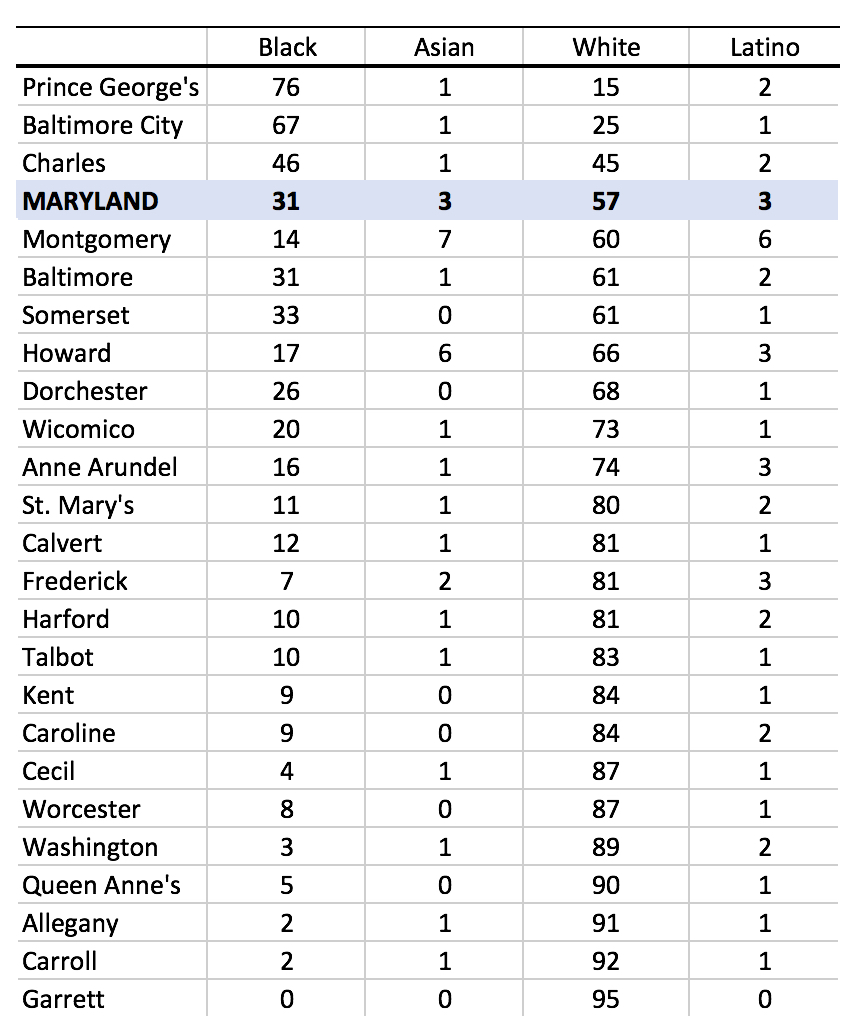
The next table shows the racial composition of each county’s electorate. Percentages add up to less than 100% because the race or ethnicity of many voters is unknown and cannot be reasonably gauged to any extent by proxies. As a result, the percentages presented here are invariably low end estimates.

countybyraceAmong early voters, African Americans are high participants (31%), exceeding their share of the voting-age population. Unsurprisingly, black participants overwhelmingly outnumber other groups in Prince George’s and Baltimore City. In Charles, African-American early voters barely edge out whites–a sign of the continuing evolution of racial demographics in that county.

The encouraging rates of black participation help explain why Democrats are consistently outperforming Republicans in early voting. Not only does Maryland have vastly more Democrats, they are voting at a higher rate than Republicans.

In contrast, Latinos (3%) and Asians (3%) appear to be casting early votes at low rates, reflecting lower rates of citizenship and turnout. Asians compose the highest share of early voters in Montgomery (7%) and Howard (6%). Latinos comprise 6% of early voters in Montgomery, and 3% in Anne Arundel, Frederick and Howard.

In Maryland as a whole, approximately 57% of early voters are white. Again, as the percentages are calculated out of total voters and many could not be placed in any category, the estimates for all racial groups are low.

Share

Early Voting Day 4 Stats

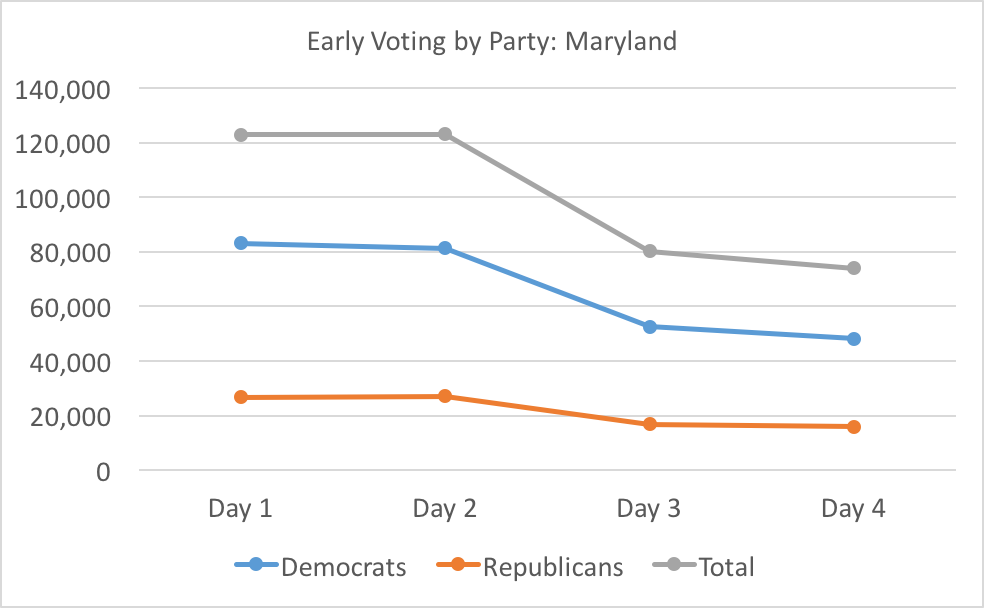
ev4mdEarly voting continues apace in Maryland. As in 2014, early voting dropped off precipitously over the weekend–an argument against switching Election Day to a weekend. So far, 400,235 Marylanders have voted early. This is already 93% of the people who voted early four years ago, so we will likely surpass the 2012 total today.

The increase is unsurprising due to the substantial increase in the number of early voting centers. Additionally, Governor O’Malley suspended early voting for two days in 2012 due to Hurricane Sandy and then extended it for two more days to make up the time.

While 10.3% of eligible voters have already cast their ballots, the rates differ greatly by party. 12.3% of registered Democrats have voted early compared to only 8.5% of registered Republicans.

The early vote is even more impressive when presented as a share of the number who voted in 2012. The 2016 early vote equals 14.6% of the 2012 total turnout. The number of Democrats who have voted early in 2016 is 17.0% of the total number of Democratic voters in 2012. In contrast, the number of Republican early voters is just 9.0% of the total 2012 Republican vote.

Despite the large gap between the parties, Republicans have improved very slightly relative to 2012, as the number of Republicans who have voted early this year is 97% of the 2012 total compared to 92% for the Democrats.

Note that all of these figures exclude absentee ballots. When I checked, the Board of Elections has not updated these figures since October 28th. As of that date, 78,299 Marylanders had cast absentee ballots. No doubt many more have arrived at the Board of Elections over the past few days.

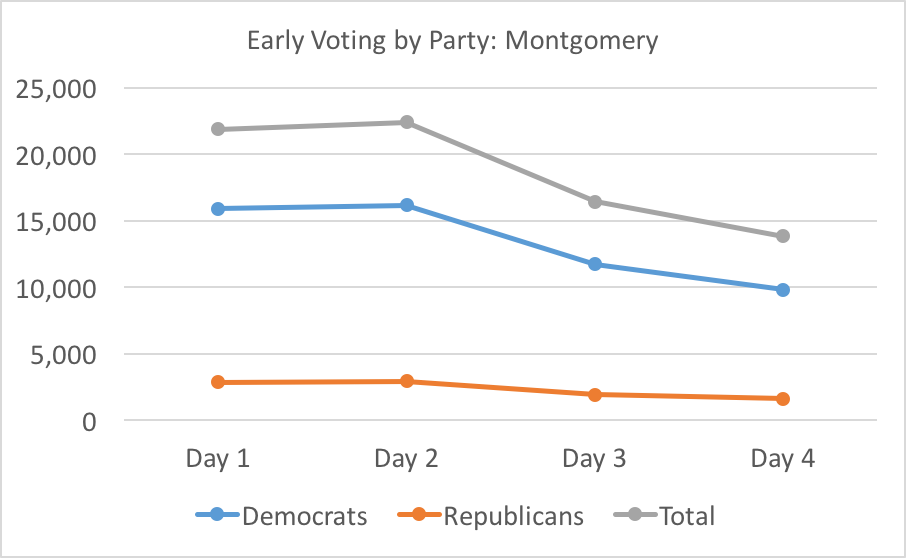
The following graph shows that Montgomery County, the State’s largest jurisdiction largely reflects the State pattern.

ev4mocoIn Montgomery, 74,525 voters participated in the first four days of early voting. This equals 96% of the people who voted early four years ago, so Montgomery is performing slightly better than four years ago relative to the rest of the State (93%).

However, Montgomery still lags behind Maryland, as just 11.3% of eligible voters have voted early in the county. This includes 13.9% of registered Democrats but just 7.6% of registered Republicans. The 2016 early vote equals 12.1% of the 2012 total turnout.

Again, this masks a large partisan gap. The number of Democrats who have voted early in 2016 equals 17.0% of the total number of 2012 Democratic voters. In contrast, the number of Republican early voters is just 9.0% of the total 2012 Republican vote.

Share

A Critical Error in Early Voting

By Adam Pagnucco.

On Saturday, I was given a ballot by election officials at the Wheaton early voting site that would have allowed me to vote for John Sarbanes for Congress.  The problem is that I live in Jamie Raskin’s district.  And after I posted the story on Facebook, three friends of mine said that similar things happened to them.  This incident points to a significant flaw in the early voting system that needs to be addressed.

To understand what happened, let’s review how the early voting system works.  A key difference between early voting and election day voting is that voters are allowed to use any early voting site in their county regardless of where they live.  So unlike election day voting at a precinct location, election officials at early voting sites are responsible for making sure that voters get ballots reflecting the districts in which they live.

The first step in early voting is a check-in, during which a staffer verifies a voter’s identity and gives the voter a registration slip indicating his or her precinct and district information.  Next, the voter proceeds to a table at which another staffer checks the registration slip and gives the voter an appropriate ballot.  The voter then fills out the ballot in a booth and proceeds to a scanning device, where the registration slip is collected and the ballot is inserted, scanned and retained.  Lastly, the much-desired “I Voted” stickers are disbursed.

In my case, I checked in, got a registration slip reflecting my information accurately and was given a ballot.  When I started marking the ballot, I noticed that one of my choices for Congress was John Sarbanes.  That was a problem since I don’t live in his district – I live in Congressional District 8, home of Jamie Raskin.  I returned to the ballot table and told them I had the wrong ballot.  Upon checking, the election staffer said, “Good catch,” gave me a new ballot and told me to take my old ballot to a different area.  Acting on instructions, I marked the old ballot as spoiled, folded it in half and put it in an envelope containing other spoiled ballots.  I asked the election staff what would have happened had I indeed voted for Sarbanes.  They said they didn’t know.

Once I told the story on Facebook, two of my friends told me that they were initially given the wrong ballots by staffers at early voting, but the mistakes were caught before they could bring the ballots to the voting booth.  A third friend said she was given a wrong ballot and, like me, she returned it to the staff to get a correct ballot.  This latter incident happened during the primary.

These were honest mistakes, and whenever human beings are involved in a process like this, mistakes happen.  The problem from a systemic perspective is that there is insufficient redundancy built in to prevent and correct these mistakes.  Once the ballot staffer gives a voter a ballot, there is no person other than the voter who can make sure that the ballot is the correct one.  By the time the voter approaches the scanner, there is no way to be sure that the ballot accurately reflects that voter’s districts.  And when the ballot is scanned, it’s too late to tell because there is nothing on the ballot itself identifying the precinct of the voter who cast it.  For all anyone knows, that ballot is accurately counted.  A paper recount would not find otherwise.  Worst of all, there is no way to track these mistakes.  Unless people like me report their experiences, it would be hard to know that this problem is occurring at all.

The result of all this is that an unknown number of ballots are being cast for candidates by voters who do not live in their districts.  The scale of that problem is mitigated somewhat because this is a presidential year, and the only variability in this county’s ballots occurs between the three Congressional Districts.  But in a mid-term year, there will be elections in five County Council districts and eight state legislative districts in addition to the three Congressional Districts.  There will be many ballot permutations reflecting voters who live in different configurations of these districts.  So the potential for mistakes is much higher.  Relying on individual voters to prevent these mistakes is not an adequate solution.

It’s too late to correct these errors for the ballots already cast, and unless election officials act immediately, it may be too late to clean up the process for this election.  But there is time to build safeguards into the system for the 2018 elections, during which the issue will be even more critical.  The State Board of Elections and their overseers in the General Assembly need to make sure that this problem gets fixed.

Share

Early Voting Stats Day 1

Democracy rules! On the first day of early voting, my polling place was packed with people waiting to cast their ballot. Either people can’t wait to be done with this election or they feel strongly about their candidates, or both.

On their Twitter feed, the Maryland State Board of Elections reports that a record 125,914 people voted on the first day of early voting. That compares to just 78,409 people who voted on the first day of early voting four years ago–an increase of 60.6%. Statistics for this year are not yet available by county.

As of today, 68,377 have returned absentee ballots out of a total of 196,450 that have been sent out, so 65.2% of absentee ballots are still outstanding. The total number of people who have already voted in Maryland is 194,291.

How does this compare with 2012? There were 153,100 absentee votes four years ago, so we are currently at 44.7% of 2012’s total with Election Day 12 days away. Maryland looks set to blow way past early voting totals from 2012 as we have already reached 28.8% of the 437,600 early votes cast that year. Right now, the total votes cast as a share of the 2012 total of 3,693,600 is just 5.3%, so the vast majority of votes are still to come.

Share

Leventhal Blasts the Dumbest Lobbying Campaign of All Time

By Adam Pagnucco.

On the evening of October 20, a representative of Clark Enterprises (Bob Eisenberg) appeared before the Montgomery County Council to testify on the Downtown Bethesda Master Plan.  Clark has been involved in a dispute with its next-door neighbor, fellow developer Brookfield Properties, over Brookfield’s plan to erect a new building on top of the Bethesda Metro Station.  Clark hired PR firm KOFA Public Affairs to wage a campaign to block the new building that accused Council Members of being tools of developers and criticized their salaries.  Accordingly, we labeled it “The Dumbest Lobbying Campaign of All Time” since even dimwitted lobbyists understand that elected officials don’t respond well to attacks on their integrity.

Above is the reaction of Council Member George Leventhal to KOFA’s insult-laden campaign.  Hide the children, folks!


Share

On Term Limits

This year’s term limits vote is the hot local topic of debate in Montgomery County. Or it would be, if either the pro or anti-term limits campaigns had any money to broadcast their message. Voters will largely have to decide for themselves whether they want term limits for the County Executive and County Council.

Political scientists tend to oppose term limits as anti-democratic. The exception is that presidential term limits often seen as preventing an unhealthy concentration of power. In emerging democracies, presidential term limits are increasingly seen as a good means to promote the rotation of power.

So why are so many Montgomery County voters ready to approve term limits that anti-democratically limit their own rights to reelect people to public office?

The Selectorate

A key reason is that many people don’t feel that they have much say over their government. This isn’t just hot air. Unless you vote in the critical Democratic primary that effectively decides elections for all partisan offices, you don’t.

Consider that the Census estimated Montgomery’s voting-age population at 788,043. (Note: this figure includes non-citizens, so it is an  inflated estimate of the potential voters.) Among the eligible population, 630,355 were registered voters including 354,078 registered Democrats at the time of the 2014 primary elections.

Only 88,007 people participated in the hotly contested Democratic primary for County Executive. That’s just 11% of the voting-age population, 14% of registered votes, and 25% of registered Democrats. It’s also just 33% of 2014 general election voters, and 19% of 2012 general election voters.

Moreover, the Democratic primary selectorate is skewed heavily toward the more Democratic areas of the County. It’s no accident that so many councilmembers live very close together in the southeastern corner of the County–and most people never cast a vote in the key election to choose them.

Beyond the overwhelming strength of the Democrats, Republicans offer very weak alternatives. As a result, the general election, held in the lower turnout midterm election, feels more like a kabuki ritual even if the outcome accurately ratifies the preference of the voters for Democratic over Republican nominees.

The Fantasy

The great advantage of term limits compared to the status quo is that every voter can imagine that the new Council will be more responsive to whatever their political bent–even though some of the major dreams advocated are contradictory.

Robin Ficker touts lower taxes as County unions envision a Council  willing to raise their pay higher. Civic associations imagine a Council less in thrall to developers while Chamber dreams of a more business friendly Council.

These claims cannot all be true but that doesn’t prevent voters from comparing their fantasy government to the much less glamorous reality. As the same people will choose new councilmembers by the same process, change may be more elusive than imagined.

Share

Political Scientists Predict the Outcome

PollyVote surveyed 673 political scientists over the past four days and asked them to predict the outcome of the election in their state. These forecasts suggest that Clinton will win with 358 electoral votes with just 180 going to Trump:

prediction

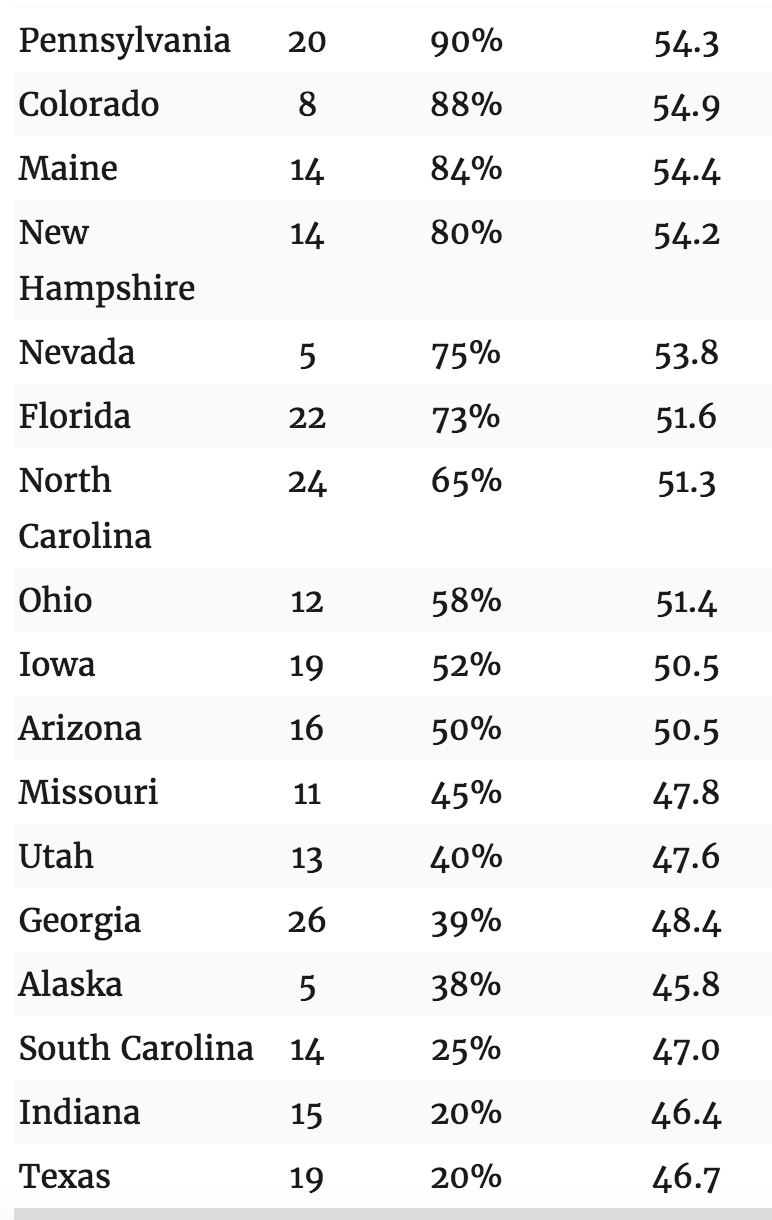
Here are the predictions for the swingier states. The second column is the number of political scientists who responded to the survey. The third column is the predicted chance that Clinton will carry the state and the final column is the share of the two-party vote.

swing

Needless to say, Maryland is not a swing state with the 26 respondents gauging the likelihood of Clinton winning at 100% and guessing her share of the two-party vote at 67.0%.

Share

Maryland Politics Watch