Playing Trump’s Game II: White Privilege

(See the introduction of this series in Part I: Are Democrats Buying into Trumps’s Narrative?)

There is a reason that Democratic congressional candidates who have made striking gains from Kansas to Montana to Georgia haven’t included “check your privilege” in their stump speeches.

Democratic appeals to working-class whites as screwed by the system and middle-class whites as under enormous pressure don’t even get a chance to work when the party simultaneously says they’re privileged. It’s easy to understand why people living paycheck to paycheck who feel bad they can’t get their kid something nice for Christmas resent being called privileged.

The privilege narrative communicates that Democrats think whites have everything handed to them. Most people, even if they acknowledge the advantages that gave them a leg up, think their talents and striving played a critical role in their achievements. Moreover, parents of all races hope to help their kids get ahead.

As a result, focus on racial advantage comes across to individual white voters as a dismissal of their problems and a denigration of their success. Exhorting whites to “check their privilege” is heard as telling them to shut up and that their interests should go to the back of the line. Not a winning appeal to any group.

Some argue that one only needs to explain white privilege properly to white people. But when a party’s message requires defensive explanation—and not one amenable to a sound bite—it is already losing. In any case, once you’ve told voters that their concerns should count less, they’re not even interested in listening.

It’s easy to deride white voters as “snowflakes” if they don’t cotton to white privilege narratives. Of course, this approach just adds to the perceived insult. Said snowflakes will continue melting away if they sense Democrats disrespect them. In other words, there is a real cost when privileged progressive whites say “check your privilege” to show (off) their cultural sensitivity.

My point is not to debate the veracity of white privilege but to argue that it is a political loser. As a message, it sets one group against another, which is exactly the game that Trump likes to play. Losing elections, of course, prevents Democrats from enacting meaningful measures like those taken by Maryland Democrats on issues from policing and sentencing reform to the DREAM Act.

Making one’s case in the context of a unifying American narrative has broader appeal. One reason the DREAM Act had so much support was that it appealed directly to a thread running through American history. Descendants of immigrants can understand well the desire of people to come here to work hard for a better life.

Of course, the bill’s title echoed Dr. Martin Luther King, Jr. “I Have a Dream” speech in which he warned America of the dire consequences of ignoring black demands for justice but also inspired by calling for America live up to the best of its ideals in the shadow of the Lincoln Memorial.

Share

What Can We Learn About 2018 from Google Trends?

By Adam Pagnucco.

A fascinating, but rather depressing, article in Vox makes the following allegation: political scientists can learn as much, or more, about political sentiment from Google Trends as they can from polls.  The reason?  People are more honest with Google in their search behavior than they are with pollsters.  Subjects that they might never admit would be of interest are in fact searched when no one is watching!  Search data may not tell us which candidate will get the most votes.  But it can tell us what voters are thinking about when they head to the ballot box.  And that is definitely politically relevant.

Let’s do an exercise using Google search trends by people in Maryland over the last twelve months.  First, let’s look at searches on five issues that Democrats often run on: public schools, transportation, health care, climate change and diversity.  The chart below shows relative search frequency on each of these terms.  The horizontal axis shows weeks over time.  The vertical axis shows search frequency as an index relative to the peak of the most popular search term in the data set (which is set at 100).  In this issue set, public schools wins out, with an average search index of 22 out of 100.  Health care gets 20, followed by climate change (18), transportation (11) and diversity (8).

Next, let’s look at five issues that Republicans often run on: guns, taxes, illegal immigration, crime and terrorism.  Taxes is number one here, with an average search index of 37 out of 100.  Crime gets 25, followed by guns (19), terrorism (3) and illegal immigration (1).

Now let’s compare the top two Democratic issues (public schools and health care) to the top two Republican issues (taxes and crime).  Public schools wins this set with an average search index of 24, followed by taxes (15), crime (10) and health care (8).  The fact that public schools gets a higher search index than taxes would seem to be good news for Democrats.

There is another search term that rivals these four: Donald Trump.  When Trump is inserted into the mix, he gets an average search index of 17 for the past twelve months, followed by public schools (13), taxes (8), crime (6) and health care (5).  Much of this is due to spikes in Trump interest around the general election and the inauguration, although he has held his own against the other search terms for most of this year.

So should Trump-chanting Democrats celebrate?  Not so fast.  There is a politically relevant search term that trumps Trump: jobs.  A straight-up comparison between jobs and Trump shows the former search term blowing away the Tweeter in Chief 54-17.  That three-to-one edge held up roughly the same in the Baltimore and Washington metro areas and on the Eastern Shore.  In fact, the only time in which Trump had more searches in Maryland than jobs was around the general election.

What does all this mean?  Maybe not much.  Google Trends is a very new source of data subject to much interpretation.  It has almost none of the mathematical science built around it that polling has.  That said, here’s a suggestion.  Donald Trump is indeed on the minds of Marylanders.  But they are thinking much more about jobs.  To the extent that Trump fixation detracts from the Democrats’ ability to promulgate a positive economic message, Governor Larry Hogan will benefit.

Share

Playing Trump’s Game I: Are Democrats Buying Into Trump’s Narrative?

Talking about race is rarely easy. In the wake of the 2016 election, it has become even more difficult on the Left because many people are understandably very angry and fearful. America elected a candidate who freely trafficked in racist and sexist rhetoric during his campaign. Trump attacked Latinos, Blacks, Asians, Muslims, Jews, and revealed his misogyny towards women in both business and politics.

Much of that anger, hurt and fear has been directed towards whites, whose increased support for the Republican candidate was crucial to his election. People who wanted to believe that America is better than Donald Trump were deeply let down by their fellow citizens, overwhelmingly white, who voted for them.

Maryland Republicans, like U.S. Rep. Andy Harris, Maryland Sen. Gail Bates and Del. Kathy Szeliga have stood with him. Gov. Larry Hogan has mostly stayed strategically silent but backed Trump’s divisive actions on immigration and other areas.

Some have argued that Democrats should just give up on most white voters, as too racist and a shrinking part of the electorate. This viewpoint dangerously oversimplifies. Although whites threw the election to Donald Trump, they also gave enough votes to Barack Obama to make him president twice. Indeed, Barack Obama gained a higher share of the white vote in 2008 than Bill Clinton, Al Gore, or John Kerry won when they ran for president.

Moreover, Democrats don’t need to win back most white voters in order to win—even small gains among whites would have been enough to deprive Trump of his electoral college victory. Giving up on white voters is political folly. Increases in the rising black, Latino and Asian vote won’t be enough alone to win many of the states moving in the Democratic direction, at least in the medium term.

Additionally, geographic distribution renders capturing more white votes key to Democratic control of federal and state legislatures as well as the presidency. In Maryland, white votes will determine the outcome of legislative elections in most seats targeted by Republicans, such as those held by Sens. Kathy Klausmeier and Jim Mathias, and whether Democrats retain their ability to overturn gubernatorial vetoes in both houses  of the legislature.

All of the anger and fear whipped up by Trump has engendered outrage helpful in whipping up Democrats to fight Trump’s many excesses and to mobilize for the next election. To the extent that outrage buys into rhetoric that supports Trump’s framing of politics in racial terms and perceived by whites as hostile, it aids Trump’s efforts to unify whites behind him and further divide the country.

Democrats also cannot assume that they will retain as high a share of nonwhite votes. A less polarizing Republican candidate could easily attract more of the voters that Trump worked so hard to alienate in 2016. Trump left them with little choice but many would welcome conservative candidates who were not viscerally hostile.

Fortunately, most of this sort of rhetoric is easy for Democrats to avoid without giving up on either the party’s economic or equality agenda. Treating whites with respect and taking their interests seriously is not a zero-sum game that requires disrespecting and ignoring African-American, Latino, or other nonwhite voters.  As it turns out, raising people up and promoting fuller inclusion and equality does not require dividing America on racial lines. The bad news is that, based on progressive social media feeds, this seems unlikely to occur.

In the current state of polarization and heightened outrage among both parties, racial topics have become virtually toxic unless one goes reiterates dominant viewpoints with accusations of racism and sexism ready to fly among both Democrats and Republicans. As a result, these posts focusing on how Democrats can better white voters may jar some readers.

Nonetheless, over the next few days, I hope to outline a few narratives that Democrats should avoid if they want to expand their coalition to include more white voters. This doesn’t mean I think there are not issues particular to specific other key, important Democratic constituencies. By acting more politically adroit, Democrats will be better positioned to address them. Democrats need to think strategically and not play Trump’s game of racial fear and division.

Share

Cherri Branson Running for Council At-Large

By Adam Pagnucco.

Former Montgomery County Council Member Cherri Branson established a campaign committee on June 20.  Branson told us she intends to run for County Council At-Large.

Branson is a former counsel for the U.S. House of Representatives’ Committees on Government Oversight and Homeland Security.  She is also a former President of the Montgomery County African American Democratic Club.  In 2014, the Montgomery County Council appointed Branson to fill the remaining time in the term of District 5 County Council Member Valerie Ervin, who had resigned.  She is now the Director of the county’s Office of Procurement.

Branson had been the subject of speculation for a possible run in District 5 against incumbent Tom Hucker.  Her decision to run at-large might leave Hucker with no opponent.  Her campaign committee is currently not enrolled in public financing.  She joins an increasingly jam-packed field of at-large candidates with more on the way.

Share

More Crime at the Liquor Monopoly

By Adam Pagnucco.

The Montgomery County Police Department has reported that two men, one of whom worked for the county’s Department of Liquor Control (DLC), were arrested for a series of liquor thefts from trucks parked at the county’s warehouse.  The Washington Post and Bethesda Magazine also reported the story.  Note that this was not only an inside job but that DLC’s security procedures were so inadequate that the suspects were able to commit eight different thefts before being caught!  But neither the Post nor Bethesda Magazine fully examined the history of criminal, unethical and suspicious activity at DLC.

Consider these other recent events.

1. In November 2014, NBC4 discovered that DLC employees were skimming booze from deliveries and attempting to sell it to licensees under the table.  People inside DLC told NBC4 that the scams had been going on for years.  Four delivery workers were fired and another quit after NBC4’s undercover investigation.  Yet another worker was fired later.

2. That same month, NBC4 caught DLC employees drinking and driving on the job.

3. In March 2015, the county’s Inspector General found that DLC’s warehouse was run with sticky notes.  He said “as many as 154 cases a day go missing without anyone investigating why.”

Corruption and ethics issues go back a long, LONG ways at the liquor monopoly.  In 2001, its Director pleaded guilty to misconduct in office, misappropriating funds and felony theft.  A subsequent Inspector General’s report blamed the county for failure of oversight.  In 1980, a consultant who found that DLC was steering disproportionate business to a company connected to the County Executive was forced out – by that same County Executive.  That incident mushroomed into a major political scandal, complete with secret tapes and hiring abuses, known as “Liquorgate.”  All of this is on top of continued poor service for decades including two consecutive New Year’s Eve meltdowns.  No wonder consumers flee the liquor monopoly.

Next year, elections will be held for County Executive, County Council and the state legislature.  Which candidates will stand up against DLC and advocate for ending its monopoly status once and for all?

Share

Leventhal Qualifies for Public Financing

Council Member George Leventhal, who is running for County Executive, has announced that he has qualified for matching funds in the county’s public financing program.  Following is his press release.

*****

FOR IMMEDIATE RELEASE: Tuesday, June 27, 2017

George Leventhal First to Announce He Has Achieved Initial Fundraising Target Under County’s Public Campaign Finance Law

Montgomery County Councilmember George Leventhal (D-At Large), a candidate for Montgomery County Executive, announced today that his campaign has collected more than 500 contributions from Montgomery County residents, totaling more than $40,000. Once the contributions have been certified by the Maryland State Board of Elections, Leventhal’s campaign will be eligible for more than $180,000 from the Public Campaign Fund.

“The support of hundreds of my constituents means so much to me, and I am humbled and grateful,” Leventhal said. “I am an enthusiastic participant in the Clean Money program that the County Council enacted in 2013. Our constituents want to know that elected officials are accountable to them, not subject to the influence of big money. The Clean Money program maximizes the power of small contributions from individual donors.”

Under the public campaign finance law, a candidate for County Executive qualifies for matching funds after receiving at least 500 contributions totaling at least $40,000 from county residents. Contributions are matched under the following schedule: first $50 is matched 6×1; second $50 is matched 4×1; third $50 is matched 2×1. This results in a $50 donation becoming $350, a $100 donation becoming $600 and a $150 donation becoming $750. Candidates for County Council may also participate in the program and are eligible for smaller amounts of matching funds.

Candidates who voluntarily participate in the program must limit contributions to no more than $150 per individual and may not accept contributions from PACs, corporations or labor unions.

The first date on which contributions may be submitted to the Maryland State Board of Elections for a determination of eligibility for matching funds is July 4, 2017.

“As your next County Executive, I will provide government that works for you and provides results,” Leventhal added. “In keeping with the accountability and transparency that will characterize my work, I will release the names of all contributors as soon as they are certified by the Maryland State Board of Elections.”

Leventhal officially announced his candidacy for County Executive at a kickoff in Wheaton Regional Park on Saturday, June 24, but he has been raising qualifying contributions since October, 2016.

First elected to the County Council in November, 2002, Leventhal was re-elected in 2006, 2010 and 2014. His colleagues elected him twice as Council President, in 2006 and 2015. He has served since 2002 as chairman of the council’s Health and Human Services Committee.

###

Contact:

Jessica Moore, Campaign Director

George Leventhal for Montgomery County

301-580-4517

Jessica@GeorgeLeventhal.com

Share

The Towering Legacy of Phil Andrews

By Adam Pagnucco.

Montgomery County’s 2018 primary is now roughly a year away.  Many uncertainties have yet to be decided.  But one thing is for sure: the two most influential people in the election are not on the ballot.  One is the current occupant of the Oval Office.  The other is a retired County Council Member whose towering legacy will affect everyone running for county office one way or another.  He is the last person who would ever make such a claim, so we will do it for him.  He is Phil Andrews.

Andrews was a former Executive Director of Common Cause who ran unsuccessfully for council at-large in 1994 but was elected after defeating an incumbent in District 3 four years later.  Early in his career, Andrews was a progressive darling, passing a living wage law and a restaurant smoking ban in his first term.  Later, he became known for fiscal prudence and authored the county’s public campaign financing law in his last year at the council.  Andrews finished third in the 2014 County Executive Democratic primary with 22% of the vote and is now employed by the State’s Attorney’s office.

Andrews’s shadow looms large over the coming election in three ways.

Public Campaign Financing

During his career, Andrews never accepted campaign contributions from PACs or developers.  He wrote the county’s public campaign financing law in part to allow candidates following his example to be competitive with traditionally financed rivals.  The growing number of candidates who are using it testifies to its popularity.  One at-large council candidate, MCPS teacher Chris Wilhelm, even has a petition demanding that all county candidates enroll.  One thing is for sure: all county candidates, whether they use it or not, will have to deal with its political implications.

During his time in office, Andrews was surrounded by colleagues who freely accepted money from PACs and developers.  Now some of those same people are enrolling in public financing.  Andrews must feel like a country pastor welcoming reformed sinners to church.

Opposition to Tax Hikes

After having been in office for a few years, Andrews became concerned that growth in the county’s budget was unsustainable.  He began opposing what he viewed as excessive spending, especially on union contracts, and started working against tax hikes.  In 2008, Andrews teamed up with at-large Council Member Duchy Trachtenberg to reduce the size of a proposed property tax hike.  Two years later, he voted against a county budget partly because it raised the energy tax.

The conventional wisdom is that opposition to the 2016 tax hikes was responsible for passing term limits, although the truth is probably more complicated than that.  Still, the majority of Democrats voted for term limits and that fact is not lost on new candidates for office.  Several of them are leery of more tax hikes and more than one will make an issue of it during the next election.  One potential at-large candidate recently told your author, “I will be the hardest vote to get for any tax hike.”  Reggie Oldak, running in District 1, has said, “We can’t keep increasing property taxes.”  Neil Greenberger, the County Council’s now-former spokesman, openly denounces the 2016 increases.  There will be others making similar arguments.

How many components of Phil Andrews’s 2014 message will show up in next year’s election?  Our bet: lots.

Temperament and Demeanor

In our conversations with those who are running or thinking of running for county office, we have often asked who their favorite Council Member is.  Hands down, the winner is Phil Andrews.  That choice is made regardless of ideology and even whether the candidate is using public financing.  The most common reason cited is his temperament and demeanor in office.

“Phil was a grown-up,” said one candidate.  Another said, “He could disagree without fighting.  It was never personal.”  A third said, “He never BS’d you.  He told you what he thought and that was it.”  That’s all true.  His lack of pretentiousness is also mentioned.  Indeed, Andrews chose to conduct his first interview with your author years ago in the most humble venue imaginable: the council cafeteria.  No steak or cocktails for him (or sadly, for me)!

Andrews looks particularly good in comparison to those politicians who argue with constituents or block them on Facebook.  In one respect, that was easy for him: Andrews was almost never on social media.  Even so, your author has yet to find a constituent who describes Andrews as being anything other than polite and cordial.  Regardless of his personal feelings – and there were certainly some who tried to get his temperature up – Andrews never took the bait.

While some candidates will cite Andrews on the campaign trail and perhaps even seek his endorsement – probably fruitlessly – there will never be another one exactly like him on the council.  His combination of tax skepticism, willingness to do battle with labor, resistance to factionalism, total invulnerability to peer pressure and raw humility is an unusual one in local politics.  But Andrews will be able to look at the next council and see fragments of his influence everywhere, with different pieces appearing in different members.  Somewhere deep in the rectory, the country pastor just might smile.

Share

Hamza Khan’s Statement on the D39 Race

Following is Hamza Khan’s statement on his candidacy in District 39, which he released today.

*****

Over the past few days, I have been contacted by numerous party leaders, elected officials and voters asking me remain in the race for Delegate in District 39 or to alternatively consider running for county council at-large. I wish to express my deep gratitude in the faith that so many supporters have put in my candidacy for public office. In light of these appeals, I have decided that the wisest course of action at this time is to take some time to reflect. I plan to meet with voters and stakeholders in our community in order to discuss the merits of my campaign and seek their counsel, because it is their voices that matter for any decision to be made in our democracy. Therefore, I will make an final decision about running for office later this summer.

No matter what my decision will be, I believe that all the Democrats seeking our party’s nomination for delegate in District 39 and for County Council next June are accomplished individuals who represent some of the best our beautiful county and state have to offer. Thanks to many of them, I am excited for the future of our party, county and state. Together, I know we can and will liberate Government House from Larry Hogan, and fight the alt-right agenda of his fellow Republicans in Washington. I look forward to being in touch.
Democratically Yours,
Hamza Khan
Share

Hucker Files for Reelection in District 5

By Adam Pagnucco.

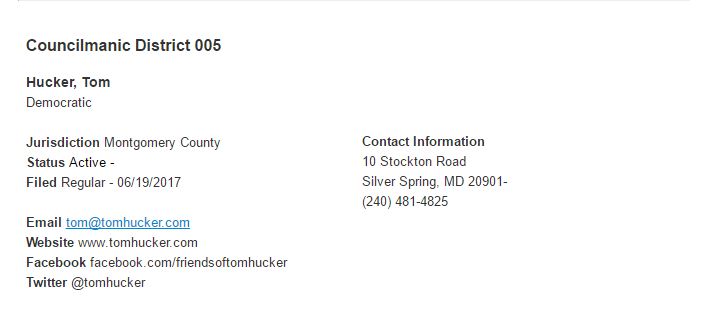
District 5 County Council Member Tom Hucker filed for reelection to his current seat on June 19.  Hucker’s decision ends speculation that he was considering the at-large race, in which he would have been a formidable contender.  It may also lead 2014 District 5 candidate Evan Glass, who came very close to winning, to run at-large.  What is currently unknown is whether Hucker will have any challengers.  Below is his filing from the state’s candidate list.

Share

Maryland Politics Watch