Madaleno-Hettleman to Sponsor $15 Minimum Wage Legislation

Here is the press release from the Madaleno campaign:

ECHOING THE WORDS OF MARTIN LUTHER KING, MADALENO TO INTRODUCE $15 MINIMUM WAGE LEGISLATION

To quote Dr. King, ‘Ultimately a great nation is a compassionate nation. No individual or nation can be great if it does not have a concern for ‘the least of these.’”

Annapolis, MD – Advocates, faith, labor and community leaders, social justice organizers, and elected officials gathered in Annapolis Monday in recognition of Dr. Martin Luther King Jr.’s birth and spirit of social and economic justice by calling for enactment of legislation to increase the minimum wage in Maryland to $15 an hour.  Senator Richard S. Madaleno, Jr. (D-18), who is also a Democratic candidate for governor, is the lead sponsor in the Maryland Senate.  Delegate Shelly Hettleman (D-11) is the lead sponsor in the Maryland House.

“Today we not only honor the spirit and legacy of Dr. King, but we heed his words by taking action to benefit those who perform the work that so few of us would choose to do, yet do the work that is indispensible to a functioning society,” said Senator Madaleno.  “Whether it be cleaning offices, serving food, or taking care of those who need assistance, there is dignity in all work, and we need to recognize and honor that dignity.”

The Madaleno-Hettleman legislation phases in a minimum wage to $15 per hour by July 1, 2023.  Once the minimum wage hits $15, the minimum wage may increase further since it is indexed to inflation.  Other important provisions in the bill include a phase-out of the “tipped credit”, an issue Sen. Madaleno has been working on for many years.  Eliminating the tipped credit is a significant step toward addressing the wage gap between men and women, particularly in the restaurant industry, an industry dominated by women.

Madaleno concluded, “In Dr. King’s acceptance speech upon being awarded the Nobel Peace Prize in 1964, he said, ‘Ultimately a great nation is a compassionate nation. No individual or nation can be great if it does not have a concern for ‘the least of these.’”  Today surrounded by so many whom are living the words of Dr. King through their deeds, we ask that the General Assembly and Governor Hogan join us in supporting, passing and enacting a $15 minimum wage.  Because, to quote another Dr. King phrase, ‘The time is always right to do what is right.’”

Rich Madaleno has served Montgomery County for 15 years in the Maryland General Assembly.  Rich has the distinction of being the first openly gay person elected to the Maryland House of Delegates and the first openly gay person elected to the Maryland State Senate. He is an expert on budget issues, serving as Vice-Chair of the Budget and Taxation Committee.  Additionally, Rich has been a leader in passing legislation on key progressive issues like marriage equality, ensuring funding for Planned Parenthood, investing in education, gender identity anti-discrimination, and protecting the environment.

###

BY AUTHORITY: Marylanders for Rich Madaleno. Linda Eisenstadt, Treasurer.

Share

Polling the D18 Senate Race

The state senate primary is really heating up! A fellow District 18 resident reported to me that someone is out with a very lengthy poll for the state senate race. Dana Beyer mentioned to me just the other day that “I’m getting started this week, with my polling,” so I imagine it’s for her campaign.

The poll tested potential negatives that could be used against Beyer, including concerns about her being a millionaire and whether she is all about her own agenda while Jeff Waldstreicher has been getting the work done.

Neither candidate is impoverished and Jeff is a corporate attorney, so I’m not sure how or why Jeff would use Dana’s wealth against her. In any case, attacking your opponent based on their wealth seems ill-advised in a district dominated by affluent communities like Chevy Chase, Kensington and Silver Spring.

Similarly, though Jeff is a three-term incumbent and Dana has achieved name recognition through her past campaigns, I doubt the vast majority of primary voters have more than vague knowledge about the achievements or deficits of either. It’s not a knock against them but just the nature of Maryland state legislative races.

Testing the negatives might ironically give them more exposure than they would receive otherwise. The late Jonathan Shurberg, a good friend and political ally of Dana Beyer, made the same polling decision when he ran unsuccessfully for the House in 2014.

Dana Beyer’s willingness to drop a lot of money on a poll once again shows her serious determination to win this race. Having a good message is key to any race. At the same time, I believe that most campaigns would be well advised to focus more directly on voter contact. It’s even more critical and it doesn’t really take a poll to divine the major issues that concern Democrats these days.

Share

Vote Analysis on Sick Leave Override

As far as I can tell, the sick leave override was almost a complete party line vote in the House of Delegates. Dels. Eric Bromwell (D-8) and Ned Carey (D-31A) were the only Democrats who voted no. Interestingly, Del. C.T. Wilson (D-28) was recorded as absent but initially voted no according to a legislator on the floor.

The Senate was more suspenseful but it turned out that the Democrats had one vote to spare. Just three Democrats – Sens. Jim Brochin (D-42), Ed DeGrange (D-32) and Kathy Klausmeier (D-8) – voted with the governor. Brochin and Klausmeier represent Baltimore County while DeGrange hails from Anne Arundel.

This year, Brochin is running for the Democratic nomination for Baltimore County Executive. Klausmeier is locked in a fierce reelection battle against Del. Christian Miele in her Baltimore County district. It voted for Hogan by 36 points but for Trump by less than 1. Bromwell represents the same turf.

In Anne Arundel, DeGrange has already announced his retirement from the Senate. His district went for Hogan by 17 but for Clinton by 12. Del. Pam Beidle, who is running for the Senate vacancy, voted to override Hogan’s veto in the House. Carey represents a more Republican leaning slice of Anne Arundel that went for Hogan by 30 points but gave Trump just 4% more than Clinton.

Wilson represents increasingly safe Democratic turf in Charles County – it went for Brown by 4 and Clinton beat Trump by 23 – so his flirtation with voting no would not have been due to reelection concerns. All other legislators from his district voted to override.

Despite the few defections by Democrats in both houses, party trumped any fear of Hogan. Increasingly, Democrats are betting that the political landscape in their district will resemble 2016 more than 2014. Even though Hogan will undoubtedly do better than Trump, his ability to pressure Democrats into agreement appears limited.

Share

General Assembly Overrides Hogan’s Veto on Sick Leave

Yesterday, the House of Delegates overrode Hogan’s veto by an 88-52 margin. Today, the Senate followed suit and voted 30-17 to do the same. This is a major loss for Hogan who lobbied hard for the General Assembly to sustain his veto.

According to the bill synopsis, the legislation will require “employers with 15 or more employees to provide employees with earned sick and safe leave that is paid at the same wage rate as the employee normally earns.” Smaller businesses will have to provide unpaid sick leave.

Share

Beyer Rejects Waldstreicher Slate Offer

I’ve heard from multiple sources, and Dana Beyer confirmed, that Del. Jeff Waldstreicher (D-18) offered to run on a slate with Dana if she would run for delegate instead of senate. Instead, Beyer is pressing ahead full-steam with her Senate campaign. When I mentioned the rumored offer in passing when I saw Jeff, he neither confirmed nor denied it.

Waldstreicher’s Offer

Jeff’s offer makes perfect sense from a political perspective. While Jeff is the favorite against Dana, why not get a candidate with a fair amount of name recognition from previous races and very deep pockets – Dana has self-funded to the tune of hundreds of thousands of dollars – out of the way?

It’s reminiscent of Jeff’s first run for delegate, as James Browning reported that an MCEA political operative tried to talk him out of running in 2006 as part of his effort to ease the path for Jeff, who had been endorsed by the teachers union. (Browning used pseudonyms in his write-up of the race.)

Jeff’s offer makes it somewhat more awkward for him to attack Dana in the Senate race. After all, if she is so awful, why was he willing to run on a ticket with her? It probably won’t stop Jeff’s campaign from sending out negative mailers attacking his opponent but should make people a bit more cynical about them.

Dana’s Rejection

While Jeff’s offer makes sense, Dana’s rejection is more perplexing. Having spent a fortune running thrice previously, she is clearly extremely intent on winning election to the General Assembly. Running on a ticket with an established incumbent with two open delegate seats would seemingly put her on a strong path towards that goal. So why joust with Jeff? Why not take yes for an answer?

First, Beyer has long been no fan of Waldstreicher. She ran against him not just in 2006 but also in 2010. Jeff strongly supported Rich Madaleno in 2014 when Dana challenged him. Beyond there being no love lost, Dana undoubtedly views herself as a stronger progressive leader with better credentials as both a doctor and an activist. Alliance building has never been her strong suit and she’d would have had to swallow hard to make the strategic decision to accept Jeff’s offer. In any case, Dana wants to conduct the orchestra – not play second violin to Jeff.

Second, my guess is that Dana thinks she can win. She was utterly convinced that she was going to win in 2006 and angry and flummoxed when she came in a strong fifth. In each new campaign, Dana has believed that she has identified the silver bullet– be it more professional polling or spending buckets more money – and come back again. Jeff may be an extremely focused campaigner but one cannot overstate Dana’s determination.

Finally, having run for the Senate last time, I suspect that Dana would view it a step down to run for the House. Running for Senate, moreover, gives Dana the opportunity to become the first transgender senator, as Danica Roem has stolen Dana’s thunder with her fairy-tale story of a David versus Goliath victory over an incredibly bigoted incumbent in Virginia, instead of the second delegate.

Share

MoCo After Discovery

By Adam Pagnucco.

Word of Discovery Communications’ exit from Silver Spring has exploded like a bomb in local politics, prompting attacks by the state Democrats on Governor Larry Hogan and two outsider County Executive candidates on the county government.  But the answer to the real question is not to be found in political soundbites: where does MoCo go from here?

Let’s start by acknowledging the unusual nature of Discovery.  The only reason the company was in MoCo to begin with is that its founder, John Hendricks, moved here in his 20s and started it at age 30.  If Hendricks had instead lived in, say, Philadelphia, the company would have been started there.  Discovery was largely a stand-alone organization that was not surrounded by peers.  When Hendricks retired as Chairman three years ago, it was probably inevitable that the company was going to move with media-packed New York City as a prime option.  Accordingly, no one your author knows who has been associated with Discovery is surprised at its exit.  While the company was important to Silver Spring, the departure of a firm like United Therapeutics, a key player in the local bio-tech industry, would have been more troublesome because of the county’s long-time efforts to build up that sector.

That said, Discovery will leave a big hole in Downtown Silver Spring.  Its 1,300 employees are hugely important to Silver Spring’s lunch scene and happy hour crowds.  (Anyone who sees the sheer number of people walking through the Georgia Avenue crosswalk near the building to access Ellsworth Place can appreciate this.)  The building itself was constructed to house one tenant.  Subdividing it for multiple tenants could be costly and challenging, thereby complicating its reuse.  Discovery is looking to sell it but it may not be occupied for a while.  Finally, the viability of Silver Spring as an employment center may be questioned by developers and tenants alike.  Will the central business district continue to be a jobs base or will new development be overwhelmingly residential, thereby cementing Silver Spring as a bedroom community for D.C.?  And could that worry be applied to most of the rest of the county?  It’s telling that the two most prominent new office buildings in the pipeline, the Park and Planning headquarters in Wheaton and the new Marriott headquarters in Downtown Bethesda, are supported by public money.

Aside from the usual political elbow-throwing, the reaction of the county has focused on the financial incentive it offered to Discovery to stay.  County Executive Ike Leggett said in a statement, “The County and State made a substantial proposal designed to accommodate Discovery’s challenges. Together, we were ready to provide considerable incentives to retain their presence in the County.”  Bethesda Magazine quoted Leggett as saying, “The incentive package was one of the largest offered to a company during his time in office, although he did not reveal specific details about the package Tuesday.”  We hear it was in the same ballpark as the $22 million offered by the county to retain Marriott with more money coming from the state.  Notably, New York State offered no incentives to attract Discovery.

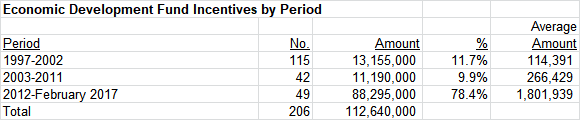
The county’s reliance on corporate welfare for economic development is one of the great untold local stories of the last few years.  Business incentives, usually contained in grants convertible to loans when job targets go unmet, are disbursed through the county’s Economic Development Fund (EDF).  They are approved in secret under an exemption from the state’s Open Meetings Act.  Residents do not learn of the amounts spent or the recipients’ identities until after the agreements are signed.  Summary details are available only in annual EDF reports released during the County Council’s budget process.  Aggregations of those reports show that the county has approved 49 incentives totaling $88.3 million between 2012 and February 2017, of which 35 incentives worth $79.7 million were used for retention.  That’s right, folks – over the last five years, the county agreed to pay almost $80 million to existing employers to stay.  Six of those incentives consist of annual disbursements payable over periods ranging from six to fifteen years, thereby continually weighing on the tax base.  For the sake of comparison, the county is spending $80 million for libraries and recreation combined this fiscal year.  Just this month, the County Executive has proposed a mid-year savings plan of $60 million, including a $25 million cut for MCPS, while corporate welfare remains untouched.

Since 2012, MoCo’s corporate welfare has skyrocketed.
Is this really working?

MoCo should be an economic development leader.  We have tremendous advantages, including a large federal presence, a highly educated workforce, good schools, lots of investment in transportation projects (including the Purple Line), substantial wealth in some of our neighborhoods, low crime and virtually no public corruption.  Few localities in the nation can say they have all of these things.  But instead of being a growth leader in the Washington area, the county’s total employment growth of 3% between 2001 and 2016 ranked 20th of 24 Washington-area jurisdictions measured by the U.S. Bureau of Labor Statistics.  MoCo’s jobs base and its real per capita personal income have not recovered from the Great Recession.  And now our economic problems have contributed to a $120 million budget shortfall.  We’re not leaders, we’re laggards.  We must do better.

Discovery is headed out the door, but if we want to create the next generation of Discoveries, we are going to need a more creative and disciplined economic development strategy than relying on bribes to retain big employers.  We are going to have to save tax hikes for desperate times and not pass them simply because we’d like to spend money.  We are going to have to invest more in transportation and education and pay for it by restraining growth in the rest of the budget.  We are going to have to do things like ending the liquor monopoly, directing more of our county reserves into community banks where they can finance local job creation, cutting impact taxes near Metro stations to encourage transit-oriented development and raising them elsewhere to pay for it, and getting rid of redundant bureaucracy.  (Fun fact: we are the only local jurisdiction that requires two different independent agencies to sign off on every record plat, which drives developers banana-cakes.)  And after passing numerous employment laws, we should give employers time to adapt to them rather than immediately introduce more mandates.  If we implement this kind of agenda, maybe we could attract and retain businesses without handing out tens of millions of dollars in corporate welfare.

Economic development is tough.  It’s about more than one big employer.  It takes time.  It takes multiple components.  Most of all, it takes discipline.  If our next generation of elected leaders learns these lessons from Discovery’s departure, we will come back stronger than ever.  If not, Discovery won’t be the last high-profile employer to say adiós.

Share

Increasing Access to Higher Education in Montgomery County: An Economic Imperative

By Michael Knapp, Chair, Montgomery College Board of Trustees.

Since the presidential campaigns of 2016, candidates for numerous state and local offices have identified providing free access to college as a campaign issue that polls well, primarily because of high cost of college.  Unfortunately there have been very few candidates who have actually thought through the practical elements of what this means: What do you pay for – tuition only? Who is eligible? What schools are included? And most important, how is it paid for?  As the Maryland General Assembly goes into session this week and we begin an historic election year in Montgomery County, we wanted to raise this important issue and provide some perspective on how it can be considered.

At Montgomery College, providing affordable access isn’t a poll-tested tagline, it’s an economic imperative without which our community and residents won’t grow to meet the needs of the future.  We know that without a skilled workforce our employers can’t grow and without clear career pathways into the workforce most residents won’t be able to move into jobs that provide a wage that will allow them to live in our community.  As a result, we take this discussion very seriously and have given a great deal of thought about how to make increasing access a reality for thousands of members of our community.

With an issue this important, there must be a framework of key principles to form a foundation on which to build such a plan. We see those as the following.

  • Any program will require significant public and private investment, and there must be a clearly defined return on investment that includes providing clear pathways for students into the workforce and a pipeline of skilled workers for local employers.
  • Increasing access to college for students often requires considering more than just free or reduced tuition — it may mean providing assistance with transportation, childcare, food, and housing.
  • Free isn’t free — all students must be willing to provide a measurable contribution to their own success in return for increased access.
  • The path to higher education and the resources needed must be clear and transparent so that all who are interested can readily take advantage.
  • The program must be sustainable — there must an identified and consistent source of revenue to make this program reality each year.
  • Success must be defined and the outcomes measured.

We know that at least 65 percent of all jobs require an education beyond high school and that, in a community like Montgomery County with such a high cost of living; it is an imperative to ensure that residents have ready access to the skills needed by local employers.  In addition, the goal set by the College and Career Readiness and College Completion Act of 2013 is that 55 percent of adults aged 25 to 64 will hold an at least an associate’s degree by 2025, and this degree must be able to assist residents in obtaining skills employers need.  Yet, even with the vital importance of this type of program it is also critical that this not be just another debt that will be borne by the students or the community to pay later—there must be a real and sustainable funding source.  We have explored models throughout the nation and are developing a series of recommendations to present for consideration with our civic, political, and business leadership.  The important thing to note is that there are innovative strategies that we can use to implement this program beyond just raising taxes on our residents.

Montgomery County’s economic and wage growth has slowed, and we are on the verge of an election season that will have an unprecedented number of candidates seeking local and state elected office.  Now is the time to have a real conversation about how to provide increased access to higher education for the benefit of our community.  Our ability to get this done will have a lasting impact on the lives of our residents and our local economy — the leadership of Montgomery College is committed to working with all interested parties in making this critical concept a reality, provided that they are committed to a real dialogue that addresses the principles we’ve outlined and not just looking for an easy sound bite.

Michael Knapp served on the Montgomery County Council from 2002 through 2010.

Share

Andrew Platt Won’t Seek Reelection

In a shocker, Del. Andrew Platt announced on Facebook that he does not plan to seek reelection to the House of Delegates.

Platt’s retirement after one term surprises me. When Platt ran for the House of Delegates four years ago, he put together among the most focused, organized and well-thought out campaigns. He has been a relatively young, active lawmaker who has seemed eager to play a strong role and continue to move up the political ladder.

If this had been a bit earlier in this election season, I might have speculated that Andrew was planning to seek another office, such as the nomination to the Sixth District or the County Council. While it’s not too late, at least for the latter, it would be unlike Andrew to allow so many opponents to get the jump on him.

My general impression has been of a passionate legislator and among the better new people we’ve sent to Annapolis is recent years. His departure after just one term is a loss to the delegation and the House more broadly.

Regardless, people have many good reasons for making a decision like this one. I wish Andrew well.

Share

Blair Doesn’t Know, Krasnow Plans, and Frick Just Says No

Thanks to Bethesda Beat for their illuminating coverage of the Realtors Forum for county executive candidates.

We’ve Got Questions, He Still Doesn’t Have Answers

When David Blair announced his candidacy, he refused to take a position on the county recordation tax hike, saying “There will be a lot of opportunities to talk about specific policies.” After much rumination, his refusal has evolved into waffling:

David Blair, was less definitive in his answer.

Blair said he would’ve combed the county budget for savings before resorting to raising the recordation tax. When pressed about whether he would’ve voted yes or no on a tax increase, Blair acknowledged that the county in 2016 was “in a really particular jam” in light of the education infrastructure needs.

“I believe I would’ve been able to find those savings,” he said. “If I couldn’t have found the savings, presumably we would’ve had to raise the recordation tax.”

He said he’d like to roll back the tax increase, if he can find budget savings to replace the lost revenue.

In short, Blair continues to do his best to prove Gus Bauman correct in his claim that Blair lacks enough political knowledge and experience for the job of county executive.

Too Much Time in the Planning Department?

Former Rockville Mayor and Planning Department Deputy Director Rose Krasnow has some interesting housing advice for millennials:

Candidates also were asked where they’d advise a young couple making about $100,000 annually to live in the county.

Krasnow said she’d probably tell the hypothetical couple to explore renting an apartment that’s an accessory to a single-family home. . .

Somehow, I don’t think “Move to Montgomery County, so you can live above your parents’ garage” is a winning slogan. In articulating the latest fad among planners, Krasnow inadvertently captured the nervous national zeitgeist of expectations of a lower quality of life than previous generations.

Allowing more accessory apartments into existing neighborhoods is a popular idea at the Planning Department. Existing neighborhoods wonder why plans for parking or additional infrastructure to accommodate new residents never accompany these proposals.

Frick Opposes Recordation Tax Increase

Alone among Democrats, Del. Bill Frick came out strongly against the tax hike in a county known nationally for its unusually high taxes related to buying and selling property:

“I think the recordation tax increase was a mistake,” he said. “And frankly, I’m sorry you were put through what you were put through.”

Frick said unequivocally that he’d seek to reverse the hike, if elected, and would lobby for more state funding to address school construction challenges.

This stance sets Frick noticeably apart from candidates like Roger Berliner, David Blair and Rose Krasnow who are also trying to position themselves as pro-change, pro-growth and pro-business candidates.

While the other candidates either waffled (Blair) or favored the increase as necessary for school construction (everyone else), Frick took a definitive public stance against it. Frick’s willingness to stand out on this and other issues looks smart in a field with many candidates that voters have trouble sorting out.

I don’t know if Bill won any new friends at the forum but he should have for (1) taking a stance the crowd supports, (2) even though the stance will be unpopular with other Democratic constituencies, and (3) his willingness to be clearcut about it.

Share

Trone Proposes Spending $100 Billion on the Opioid Epidemic

David Trone, a candidate in the Sixth Congressional District, has released a detailed plan for combating the opioid epidemic. Despite being couched in highly politicized language, this document, shown below, contains several good ideas. Yet, the proposal authored by a businessman is missing one key factor: any mention of how to pay for this very expensive plan.

It’s also a nice example of how we expect candidates to come up with detailed plans that have little relation to the policy process. Just like when Obama and Clinton dueled over their health care plans in 2008, Congress would promptly put it into the shredder.

No junior representative gets to take the lead on a major issue. Who even knows if Trone will get appointed, or is even interested in being appointed, to the committee that addresses health policy? But it’s nonetheless very useful because it tells us where he stands and the types of measures he would like to support.

Share

Maryland Politics Watch