The Worst Part of Campaigning

By Adam Pagnucco.

What’s the worst part of campaigning for office?  Well, there is a lot of work, but most of it is not inherently awful.  You have to show up at a bunch of events, but that’s OK if you like bad food and flat soda.  You have to talk to a bunch of self-important stuffed-shirts, but you eventually learn which ones have something to contribute and which ones should be avoided.  (Hint: the ones who talk the most know the least.)  Door knocking takes time, but you get to meet real live regular voters (and their vicious guard dogs).  Here’s a bonus: 2002 District 18 House candidate Sam Statland once lost 45 pounds from door knocking.  Fundraising bites, but that’s only the second-worst part of campaigning.  The worst part is:

Filling out all the [expletive deleted] questionnaires!

This is a part of campaigning that no one on the outside ever sees.  MoCo candidates are absolutely deluged with questionnaires from anyone and everyone.  OK, new candidates, we know that you have not received many yet.  But just wait!  In the 2014 cycle, roughly fifty of them went out.  There are sure to be more this time.

Now we are not questioning the legitimacy of questionnaires in general.  Citizens and organizations have a right to know what candidates think and what they will do if they get elected.  Endorsing organizations in particular should quiz candidates before supporting any of them.  But many of these questionnaires are sent by groups with little or no membership, no distribution and no planned electoral activity of any kind.  If you don’t distribute the completed questionnaires to anyone and will undertake no electoral activity as a result of what they say, why should you expect candidates to fill them out?

The best questionnaires are concise, focused and get straight to the point.  For example, MCEA, SEIU and the Sierra Club usually ask fifteen questions or less (sometimes with sub-questions) that relate directly to their core interests.  They do not ask about issues that are extraneous to their members.  All three are important organizations whose endorsements carry weight.  All candidates will want to fill these out.

And then there are the other ones.  As a general rule, the weaker and the less relevant the group, the longer and more tedious its questionnaire will be.  Each of them takes several hours to complete, time that would be better spent getting chased by vicious guard dogs.  See that questionnaire with fifty questions on it?  We guarantee that it will have zero impact on the election.  Truly influential groups don’t care about fifty different things.  They care about a few things that are really important to them because that’s what they are working on.  Last time, one brand-new group sent out a list of 33 questions ranging from the best way to cook an omelet to the candidate’s favorite Pokemon character.  (OK, maybe your author is exaggerating a little.)  It took a whole afternoon to fill out.  That group did nothing during the election and has never been heard from again!

Here’s how crazy this can get.  Suppose you really hate Candidate X and want to mess with him.  Tell him you represent a group called MoCo Residents United that has a hundred thousand dues-paying members.  Then send him a questionnaire with 120 questions, each one with sub-questions a, b and c.  X will go totally banana cakes.  He will yell at his staff, “Who are these guys?  I’ve never heard of them.  How dare they send in 120 questions!”  The staff will all agree, saying the group doesn’t exist and should be ignored.  But then X will think of Candidates Y and Z, who are his bitter enemies and are running against him.  What happens if Y and Z respond but X does not?

You know the end to this story.  X will fill out that questionnaire.  Every single time!

So for the love of Mike, if you are contemplating sending out a questionnaire, please observe the following rules.  First, if you really don’t care about something, don’t ask about it.  Don’t waste your time – and the candidate’s.  Second, don’t ask the same question three different ways.  Ask it once and only once.  Third, fill out your own questionnaire yourself before sending it out.  Put yourself in the candidate’s shoes.  If you find it intolerable to complete it, trim it. Fourth, be aware that if you ask fifty different questions, the answers to each one will be shorter and less informative than if you ask ten.  That’s because candidates and their staff only have so much time in the day.  In this case, less is more!  And finally, make your best effort to distribute the completed questionnaires far and wide to your members.  If you are going to ask candidates to invest the time and effort to fill them out, at least make sure that their hard work is seen by as many voters as possible.

And if you don’t follow the above rules, you just want to make people miserable.  In that case, you should send your questionnaire only to Robin Ficker!

Share

Greenberger Compares County Council to Washington Redskins

By Adam Pagnucco.

In the most brutal campaign attack of the cycle, former County Council spokesman and current at-large council candidate Neil Greenberger is comparing the council to the Washington Redskins.  Under current owner Dan Snyder, perhaps the most despised franchise owner in pro sports, the team has won just two playoff games in the last nineteen seasons.  They are commonly regarded as the third-most dysfunctional institution in the Washington region after the White House and Congress.  We don’t agree with Greenberger that the council is that bad, but as a Washington Post reporter who covered the Skins in their glory years, Greenberger’s take sure is amusing!  We reprint his blast email below.

From Neil Greenberger

Candidate

Montgomery County Council At-large

Football and Montgomery County Politics

Jan. 10 and Jan. 26

26 years and $26

Why this is all about change – And making a difference

On Jan. 26, 1992, Washington’s professional football team won its last Super Bowl. In the 26 years since, not a lot of good things have happened to that organization. It often doesn’t listen or care what its fans think.

On Jan. 10, 2018, the first campaign financial reporting period will end for candidates seeking Montgomery County political offices. While candidates can accept contributions beyond the first reporting date, with at least 30 people running for the four available at-large seats on the Montgomery County Council, those that collect donations of support early in the campaign will prove to be the strongest contenders for this Super Bowl of elections.

So, what do these two things have in common?

In both Washington professional football and on the Montgomery County Council, there is a great need for better direction, better efficiency, more listening to what the “experts” regard as important and real plans for the future. In one of these cases, you can help: by supporting my candidacy for an at-large seat on the County Council and backing a progressive agenda that helps those in need and improves services while spending money efficiently and not raising property taxes over the next four years.

Those directing Washington’s professional football team do not seem to have a game plan for long-term success. My campaign is based on doing the right things that will make Montgomery County a better place to live for our future generations.

Those directing Washington’s professional football team have some very smart people offering advice on how to improve its situation—but the team leaders have opted to ignore that advice. The result has been years of failure. Over the past year, I have been meeting people throughout Montgomery County and listening to what they want to improve in the County, their neighborhoods and for the long-term future of their children.

Those directing Washington’s professional football team do not seem to have a playlist for the future. In listening to Montgomery residents, I know the priorities for our county must be a public school system that strives to get better for students at all schools around the county—and moves ahead with big and innovative steps, rather than the goal of holding the status quo. We want development that plans for realistic school capacity needs, roads to support the development and parking spaces so all people in the county can enjoy these new projects. And we want things done efficiently, without the spiraling waste of tax dollars that has been the hallmark of our county for the past decade.

Those directing Washington’s professional football team keep going to the same well when it needs more money: raising ticket prices, concession prices and parking prices—without regard to the burden it puts on its supporters. As a former Washington Post reporter and longtime County employee, I know where to find the waste in County government. And by using the county law (approved by voters) that allows one Councilmember to block an increase in property taxes, I will GUARANTEE that property taxes will not increase above the County Charter Limit (basically the annual cost of living) for the next four years.

How can you help?

You may not be able to change the future of Washington’s football team. But you can make a difference in the future of Montgomery County.

To commemorate Washington’s 26th anniversary without a Super Bowl since 1992, I am hoping you will contribute $26 to my campaign for the County Council before January 10, 2018. (Any individual can contribute up to $150, but right now, $26 will be great). It will lead to the changes you tell me you want in Montgomery County. And in this case, you get to call the plays.

Thanks for helping!

Neil

Share

Public Financing Update: January 2, 2018

By Adam Pagnucco.

Happy New Year, folks!  After a relatively quiet period in the fall, December saw a number of applications for public matching funds from county candidates participating in public financing.  One of the many positive things about public financing is that when candidates apply for matching funds, they have to file full reports with the State Board of Elections.  That gives data junkies like your author – and Seventh State readers!  – lots of updated data without waiting for the relatively few regular campaign finance reports in the state’s schedule.  The next time all campaign finance reports are due, both from public and traditional accounts, is on January 17.

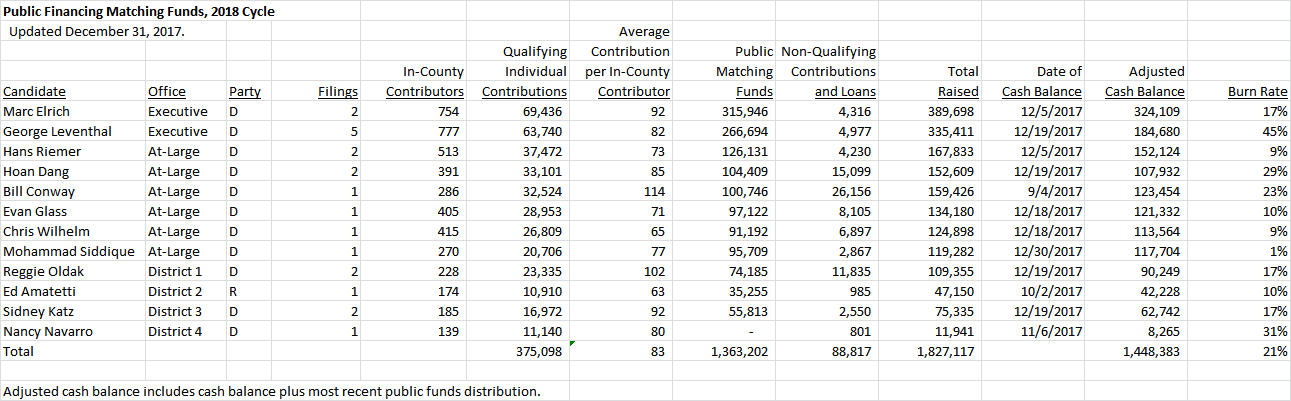
The candidates below have met the thresholds for matching funds and have applied for those funds from the state.

A few notes.  The column titled “Non-Qualifying Contributions and Loans” refers to loans from candidates and their spouses (up to $12,000 is allowed) and out-of-county contributions, which are allowed but not matched.  The column titled “Adjusted Cash Balance” includes the cash balance in the last report plus the most recent matching funds distribution requested but not yet received.  It is the closest we can approximate the financial position of each campaign at the time they filed their last report.  The column titled “Burn Rate” is the percentage of funds raised that has already been spent.  Generally speaking, candidates should strive to keep their burn rates low early on to save money for mail season.  Mohammad Siddique’s totals are preliminary as there are a few issues in his report that will have to be resolved with the Board of Elections.  And District 4 Council Member Nancy Navarro applied for $35,275 in matching funds but cannot receive them unless she gets an opponent.

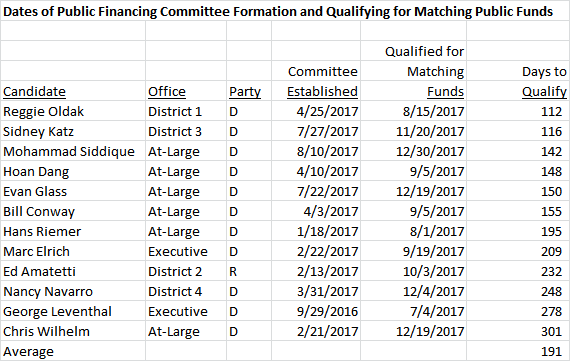
Below is the number of days each candidate took to qualify for matching funds.  Let’s remember that the thresholds are different: 500 in-county contributors with $40,000 for Executive candidates, 250 in-county contributors with $20,000 for at-large council candidates and 125 in-county contributors with $10,000 for district council candidates.

So what does it all mean?  Here are a few thoughts.

County Executive Race

Council Members Marc Elrich and George Leventhal, who are using public financing and running for Executive, have been active in county politics for a long time.  Elrich first joined the Takoma Park City Council in 1987 and has been on the county ballot in every election since.  He has been an elected official for thirty years.  Leventhal worked for U.S. Senator Barbara Mikulski and was the Chair of the county Democrats in the 1990s.  He played a key role in defeating a group of Republican Delegates in District 39 in the 1998 election.  Both of these fellows have built up large networks of supporters over many years and they have done well in public financing, raising similar amounts of money from similar numbers of people.

The difference between them is burn rate.  Leventhal is spending much more money than Elrich early, with some of it going to a three-person staff.  He had better hope this early spending is worth it because if this trend keeps up, Elrich could have almost twice as much money as Leventhal available for mailers in May and June.

At-Large Council Race

One of Council Member Hans Riemer’s advantages as the only incumbent in this race is the ability to raise money, and he has put it to good use in public financing.  Riemer leads in number of contributors and total raised.  He has also maintained a low burn rate.  This is Riemer’s fourth straight county campaign and he knows what he’s doing at election time.  His biggest problem is that his name will be buried near the end of a VERY long ballot.

The five non-incumbents who have qualified for matching funds have raised similar amounts of money so far.  As a group, they are not far behind Riemer.  The one who stands out here is Bill Conway.  Hoan Dang, Evan Glass, Chris Wilhelm and Mohammad Siddique all filed in December while Conway last filed in September.  Our bet is that when Conway files next month, he will show four months of additional fundraising that will put him close to Riemer’s total.

That said, the five non-incumbent qualifiers have so far separated themselves from the rest of the field.  Gabe Albornoz and Danielle Meitiv have said they have qualified but have not filed for matching funds with the state.  No other candidates have claimed to qualify.  Raising money in public financing takes a long time and raising a competitive amount (at least $250,000) takes a REALLY long time.  Those at-large candidates who do not qualify soon risk appearing non-viable.

Public Matching Funds Will Be Nowhere Close to $11 Million

The county has so far set aside $11 million to cover the cost of public matching funds.  That appears to be waaaaaay too much with only $1.4 million so far disbursed.  Our guess is that the ultimate total will be less than half what was allocated and will be even lower in the next election cycle with fewer seats open.

Incumbents Have Nothing to Fear From Public Financing

Five council incumbents are using public financing.  All five have qualified for matching funds and have done so fairly easily.  We will see how the challengers stack up, particularly in the at-large race, but so far the only at-large incumbent (Hans Riemer) is leading.  As we predicted last April, public financing is good for incumbents because it allows them to leverage their networks into lots of small individual contributions.  State legislators and other County Councils should take heed.

That’s it for now, folks.  Come back in a couple weeks when all reports, including those from traditional accounts, are due and we’ll put it all together for you!

Share

Riemer Property Tax Reversal Begins Council Presidency

How quickly times change.

Last week, Councilmember Roger Berliner (D-1) proposed allowing Montgomery County residents to prepay their property taxes in the hopes of shielding them from the new federal tax limit of $10,000 on state, local and property tax deductions coming into force in 2018.

In Montgomery County, a proposal that shows opposition to Trump and allows many to save money on their taxes is bound to be a political winner. Putting it bluntly, supporting this proposal didn’t take a smarter political nose than the Lord gave a gopher.

Apparently, that still left not just the gophers but also Roger well ahead of his colleagues, including newly minted Council President Hans Riemer. Facing his first major public test as Council President, he explained to Bethesda Beat lo these five days ago:

“I think a lot of people felt there are so many uncertainties and unknown impacts for us to rush into this,” Riemer said.

He noted that council members would have had to support the policy without holding a public hearing or debating the measure publicly. Riemer also said the plan may result in less income tax revenue for the county.

In a memo to County Executive Ike Leggett, Riemer summarized:

[W]e believe that the serious risks of hasty action over the next ten days, for both our taxpayers and the County itself, outweigh the possible benefits.

Councilmember George Leventhal (D-At Large) strongly supported Riemer’s inaction:

“Roger jumped in with both feet,” Leventhal said. “But a majority of council members said no. We have a lot of conflicting priorities now and we’re facing a budget crunch. We’d be causing confusion and distress right before the holidays.”

This may well be the first time anyone has described having to pay less in taxes as a source of “distress” (!) Leventhal has loudly touted his opposition to all things Trump but blinked when he had a chance to take meaningful action. Councilmember Marc Elrich (D-At Large) also backed Riemer:

[Elrich] said he didn’t want to support a proposal that is predicted to mostly benefit wealthy people who own expensive properties. If the county loses revenue as a result of the policy, it would likely result in cuts to county services for low-income residents, he said.

He described the policy as a “good political gimmick,” but added, “I wouldn’t want to run a government that way.”

An avalanche of opposition to this decision led to a Christmas miracle. The magic of constituent pressure caused the impossibility of a public hearing and the “serious risks of hasty action” highlighted by Riemer to melt like so much globally-warmed snow:

Riemer said the council will introduce a bill Tuesday, hold a public hearing and vote on it to allow the prepayments. . .

“If that’s what residents want, we’re going to make it possible for them to do it,” Riemer said Saturday.

“The urgency of this issue has really grown,” Riemer said. “We totally understand there are a lot of people that want to take advantage of this opportunity if we can create it.”

The Council had no idea the level of constituency anger – not to mention threat to political futures – over failure to act on this issue. Hence the growth in urgency over just a couple of days.

Despite having authored a post entitled “They Just Don’t Get It,” it was a still a forehead-hits-keyboard moment to discover that many councilmembers didn’t grasp that residents would prefer to save substantial sums on their federal taxes or thought that they woudn’t notice that other jurisdictions didn’t find the idea of collecting early property taxes too daunting.

Yesterday, Riemer explained the Council’s reversal to Bethesda Beat:

Council President Hans Riemer said that council members initially believed only the “most affluent” would benefit from prepayment, but later came to believe “it will benefit the middle class.”

He said council members heard from retirees, teachers and others who said the benefits would be significant enough for them to rush to put together the prepayment.

This explanation is more shocking than the reasons for his initial demurral. It means that Hans and his colleagues – the people who set our tax rates – don’t have much of a sense of how much their constituents earn or pay in taxes.

Adam Pagnucco outlined the effect of Republican tax proposals in Montgomery on December 4. I did the same on September 30. Neither post was exactly a revelation on this point, but Riemer says it was news to him.

Riemer was not alone in his inelegant pirouette. Leventhal and Elrich also reversed their positions, though Elrich continued to highlight concerns regarding budgetary impacts. Berliner’s County Executive Campaign is rather understandably touting his leadership on this issue in an email blast:

Aptly,“Bravo! You were the one that made it happen,” was one of the first constituent emails in Roger’s inbox today. As a result of his hard work, 40% of our county’s residents who itemize their property taxes can prepay and potentially save thousands of dollars before the $10,000 cap goes into effect in 2018. . .

Councilmember Craig Rice (D-2) was the only councilmember to stick to his guns and vote against the bill:

Rice said he opposed the bill because it will primarily benefit wealthy people. He said wealthy people already received tax breaks in the federal legislation and are going to be given another break by the county.

While probably a politically tough vote and somewhat unusual for the pro-business councilmember, Rice is at least saved from having to explain an abrupt change of heart. Moreover, Rice has a point. The people who itemize and will benefit from the deduction are unquestionably more towards the upper end of the spectrum. Those who pay higher rates will save even more by shielding income from taxation.

At the same time, that doesn’t mean that the great bulk of these people aren’t also middle class by local standards, especially when you consider the cost of living and the heaving mortgages that many people carry to buy a home here. Retirees who don’t have escrow accounts – and vote in large numbers – are also prone to notice the impact.

In the wake of the ignominious Council climb down, conservatives and business types can enjoy the spectacle of many progressive tribunes of the people, such as Councilmember Tom Hucker (D-5), loudly trumpeting how they saved you from higher taxes.

Share

How Catalonia’s Separatists Won the Election Despite Losing the Vote

Nothing on Maryland today because I’ve been riveted by the Catalan regional elections. Instead, I wrote a piece for The Monkey Cage blog in the Washington Post explaining why the separatist victory is a manufactured product of Catalonia’s electoral system.

Despite losing the popular vote, pro-independence leaders are still claiming a strong mandate. Looks like the standoff will continue, providing for more political instability and threatening Spain’s economic recovery.

The next question is whether Carles Puigdemont, the leader of the largest pro-independence party, will try to govern Catalonia from Brussells, where he fled to avoid arrest by Spanish police after the central government ousted him from the same post.

 
Share

CASA Endorses Elrich for Exec

From the press release issued jointly by CASA and the Elrich campaign:

SILVER SPRING, Md._ On December 21, CASA in Action announced its endorsement of Marc Elrich for Montgomery County Executive. CASA, a 96,000+ member immigrant advocacy organization, is the first civil rights group to weigh in on the county’s 2018 primary election.

“I am deeply honored to have the support of the CASA in Action community,” Marc Elrich said. “CASA in Action has been a leader on immigrant rights and economic justice issues and I have been humbled to have had the chance to work with them to move people to citizenship and achieve economic security for their families.”

In a crowded race, the CASA in Action board decided to endorse Elrich because of his outstanding commitment to immigrants and workers both during his time on the Takoma Park City Council and the Montgomery County Council. In the early 1990s, Elrich supported the establishment of the first day-laborer center in Takoma Park. He also strengthened Takoma Park’s rent stabilization law and directed city funding to community organizing efforts. Since Elrich has been on the County Council, he has taken leadership with CASA in Action members to pass legislation protecting domestic workers, improve legal protections for tenants, push back against master plans that eliminated existing affordable housing, and, most recently, raise Montgomery County’s minimum wage to $15 an hour.

“Time and again, Marc Elrich has stood shoulder to shoulder with our members to fight for a county where children can achieve, families can strive, and immigrants are woven into the fabric of every community,” said Gustavo Torres, President of CASA in Action.

During an election cycle that will bring vast change to leadership in the county, the CASA in Action board was able to consider many strong candidates, some whom – like Councilmember George Leventhal and Delegate Bill Frick – have long stood up for immigrant rights in their current roles.

“Elections require us to make choices about the communities we want to live in. This one comes at a time when the contrast between the lives of Montgomery County’s haves and have-nots could not be more stark,” said Mr. Torres. “Marc Elrich knows that a more equitable world is possible and is committed to make the necessary changes to achieve it.”

Share

Running Locally? Please Stop with the National Rhetoric

Based on their emails, many Democratic candidates for local office are none too interested in the bread and butter issues of local government. Why talk about snow plowing, property taxes, and sector plans when you can run against Donald Trump?

Roger Berliner is running for Montgomery County Executive to fight for net neutrality and against federal tax legislation:

At-Large Montgomery County Council Candidate Seth Grimes is running on a similar set of themes:

As it turns out, Montgomery County does not regulate the Internet.

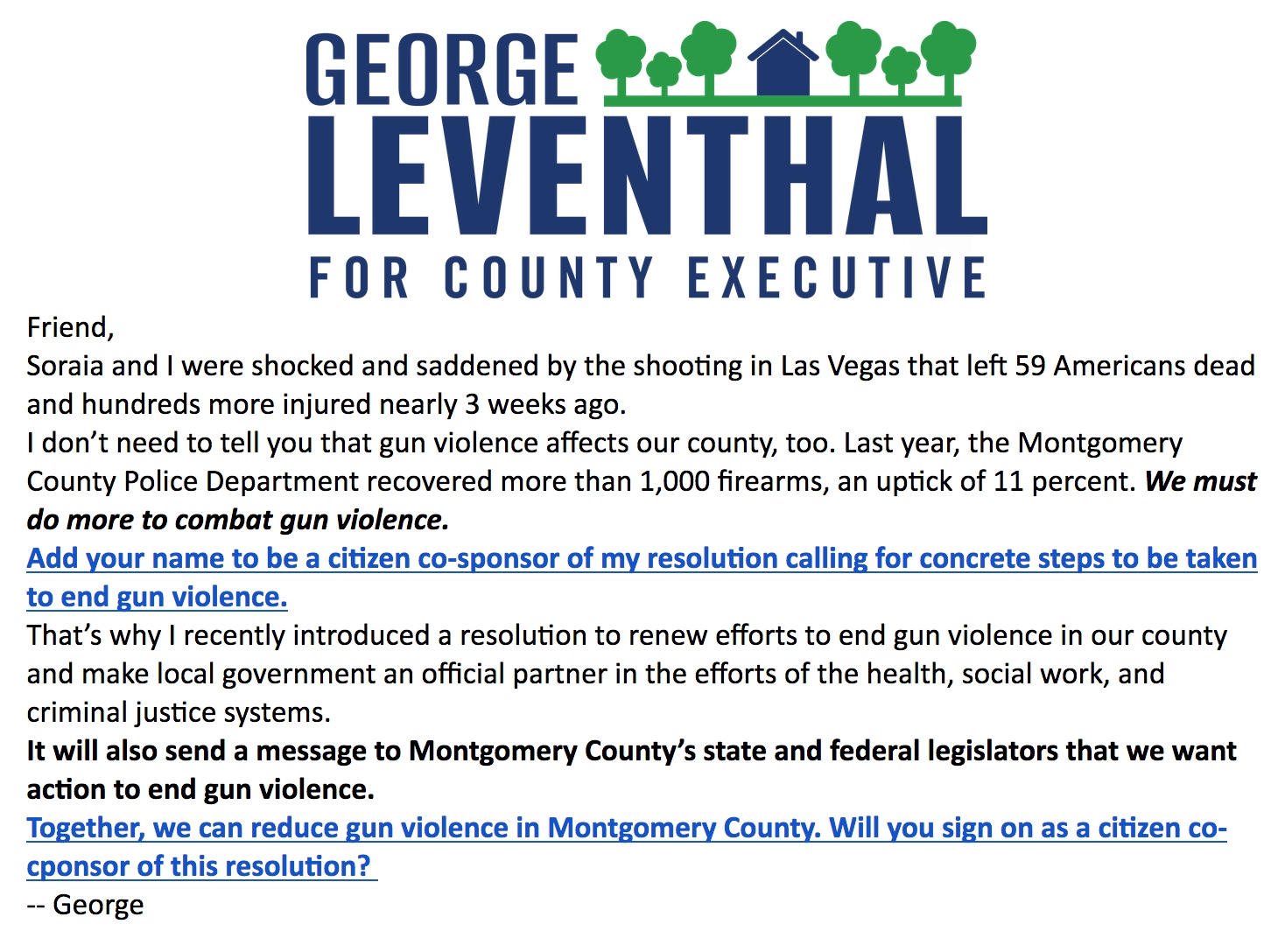
Similarly, George Leventhal is running for County Executive to fight for gun control:

Of course, the reason George’s “action” on the issue consists of a resolution that wouldn’t stop a BB gun is that the county cannot do anything on guns any more than it can regulate the Internet.

These three candidates are good examples but they are far from alone in talking non-local issues, so don’t think they’re remotely outliers. Voters are quite naturally fixated on the latest horrendous news to come out of Trump’s cauldron.

Among Democrats, there is no greater motivator than running against Trump and his works. My guess is that it works a lot better at getting people to open up their wallets than talking about the county’s budget shortfall or zoning.

However, as someone who writes about local and state politics (and Trump too), it grates. Democratic candidates agree on all of these issues, so it doesn’t distinguish them. Despite trying to gain points for standing up for “the resistance,” opposing Trump is truly the path of least resistance in scoring Democratic dollars or votes.

It’s all the more problematic because there are many pressing local and state concerns. I just don’t seem to hear much about them from many candidates who are busily trumpeting their opposition to all things Trump.

If you’re running for the Democratic nomination for Montgomery County office, tell voters what you’re going to do here. If you focus on core county issues and concerns, that would be even better. I’m even willing to stipulate that you are a fervent Trump opponent.

Share

Revenue Shortfall Undermines Hogan’s Claims on Jobs

By Adam Pagnucco.

In 2014, candidate Larry Hogan ran on three issues: jobs, taxes and reforming Annapolis.  From 2015 through the present, Governor Larry Hogan has based his agenda on three issues: jobs, taxes and reforming Annapolis.  It’s a smart and focused way to campaign and govern and has largely (although perhaps temporarily) neutralized Hogan’s disadvantage as a Republican in blue Maryland.  But now the state budget is suffering from a revenue shortfall.  That calls into question Hogan’s standing on perhaps his biggest issue: jobs.

Recent polls show that jobs and the economy are the second most important issue for Marylanders, trailing only public education.  Accordingly, Hogan relentlessly promotes his jobs record in the press and social media, not so subtly using it as justification for his reelection.  But if employment was really surging, state revenues should be booming.  They’re not.

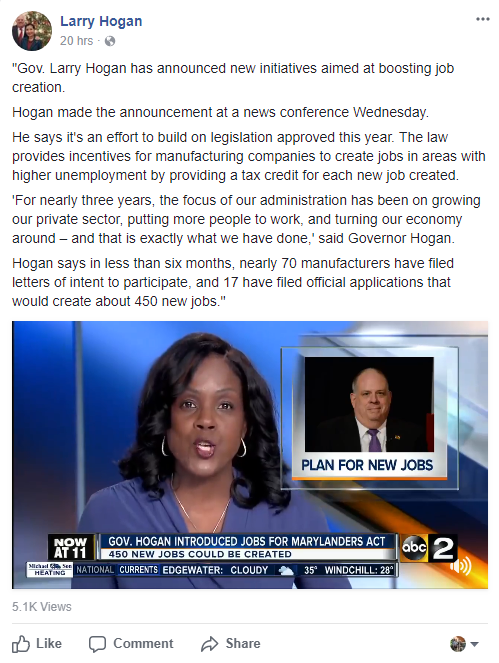
One of countless Facebook posts by the Governor on jobs.

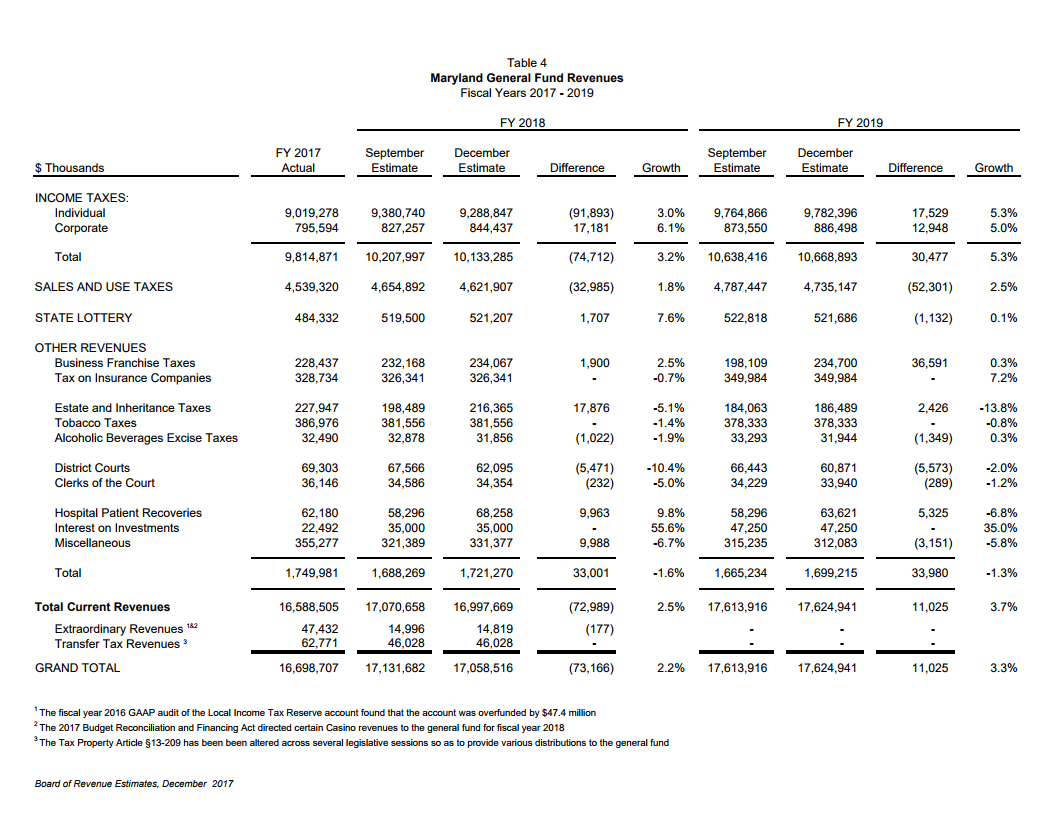
Last week, the Board of Revenue Estimates, comprised of the Comptroller, the Treasurer and the Secretary of Budget and Management, voted to reduce the state’s revenue projection for FY18 (the current fiscal year) by $73 million.  The reduction included shortfalls of $92 million in income taxes and $33 million in sales and use taxes, which were partially offset by increases of $18 million in estate taxes and $17 million in corporate income taxes.

A summary of the shortfall released by the Board of Revenue Estimates.

Given the fact that the November income tax distributions were down by 26% in Baltimore County, 29% in Montgomery County and 30% in Howard County, it’s not surprising that the state’s income tax projections would take a hit.  In those three counties, tax planning by the wealthy to take advantage of next year’s federal tax cuts was probably a factor in their shortfalls.  The fact that Maryland has the highest percentage of millionaire households of any state in the country leaves it vulnerable to these kinds of revenue swings.

But that’s not all.  The $33 million decline in projected sales and use taxes does not relate to tax planning by the rich.  That’s a similar situation to what MoCo is experiencing as half the county’s shortfall comes from taxes other than income taxes.  Hogan is dealing with the same problem as MoCo’s county elected officials: for all their claims that the economy is strong, healthy economies tend to not produce significant revenue shortfalls.  Recent employment estimates are often revised substantially soon after their release, but current year revenue declines are something that governments have to deal with in the near term.

Here’s what Comptroller Peter Franchot had to say about the state’s falling revenue projections:

The revenue projections that have been brought to this Board for approval were meticulously and carefully crafted based on what we know … and the trends we are seeing … and the data we are receiving. Once Congress approves a final version of the tax reform legislation, our experts here will work diligently to determine its impact on Marylanders’ income and our state’s fiscal future and propose revisions to our revenue estimates where appropriate.

In other words, we’re doing the best we can with the information we have. But, here’s what we do know and here’s what the numbers tell us. While we have undoubtedly made considerable progress after the crippling effects of the 2008 Recession, with an unemployment rate hovering around 4 percent and stock market trends that are headed in the right direction, the fact of the matter is that thousands of Maryland working families and small business owners who were affected the most by the economic crash nearly a decade ago haven’t fully recovered.

We continue to see that with declining sales and use tax revenue. With wages and salaries that are lackluster at best. Even those who are employed with good-paying jobs have – in more cases than not – elected to put their disposable incomes in their piggy banks instead of putting money back in our local economy. And who can blame them?

With all the uncertainty that’s being produced by Washington at an almost daily basis, coupled with the continued fiscal and economic challenges that our state and our communities face, it’s understandable why so many of our citizens remain hesitant and timid about how they spend their hard-earned incomes.

Let’s remember that Franchot has a famously cooperative relationship with Hogan.  Even so, Franchot is saying that the state’s economy has not fully recovered from the Great Recession – which is exactly what we wrote about MoCo before the revenue crash.

This is the opposite of Larry Hogan’s message that he has been great on jobs.  His opponents are sure to take notice.

Share

Maryland Politics Watch