Part II: Democrats Most Likely to Lose 1-2 Senate Seats

Part I looked at the relationship between Trump’s share of the vote and Democratic success in Virginia’s state house elections. Today, I look and see what the Virginia results indicate for Maryland Senate races.

Using a statistical technique called logit, I estimated the probability of Democratic victories in all 47 districts based on the relationship between the share of the vote won by Trump and election outcomes in Virginia.

I also controlled for the presence of Republican incumbents. The statistical model indicated that the relationship is not statistically significant, but the inclusion of this factor results in slightly lower probabilities of success in districts with GOP incumbents. (All Democratic incumbents won and represented seats Clinton won by 15 points, so I cannot similarly control for any advantage held by Democratic incumbents.)

The statistical model suggests that Democrats are most likely to lose 1 or 2 seats in the Senate. A more conservative estimate would be that the Democrats lose 0 to 3 seats. Even a loss of 3 seats would leave Democrats with more than enough to override a Hogan veto should he overcome tough political winds and win reelection.

Which seats are most likely to shift?

Most Vulnerable Democratic Seat

Sen. Jim Mathias defies political gravity in holding Eastern Shore District 38, which gave Trump 61% of the vote – a full 28 points higher than the share received by Clinton. But this former Ocean City Mayor earns it by out hustling his opponents in every way and is a born politician. He beat a delegate in 2014 and will likely face one-term Del. Mary Beth Carozza this year.

District 38 has three subdistricts so Carozza has represented just one-third of the district, including Mathias’s home in Ocean City. She has $114K in the bank compared to $250K for Mathias. Senate President Miller spent big to aid Mathias in 2014 and is prepared to do it again. Hogan and the Republicans have also promised to invest large sums, but the big question is whether Hogan will decide he needs to money for himself.

Despite in theory being a lock for Republicans, this race is a conundrum. Statistically. Mathias should be a dead duck. But the same was true in 2014. Why should Mathias now lose in 2018, expected to be a good Democratic year? Additionally, my model cannot control for any positive impact of Democratic incumbency. I rate it a toss-up.

Vulnerable Democrats?

Recall from Part I that seats that had the potential to go either way in Virginia fell into the range of giving Trump between 40.5% and 48.0% of the vote. Only five Maryland Senate seats fall into this range, all held by Democrats:
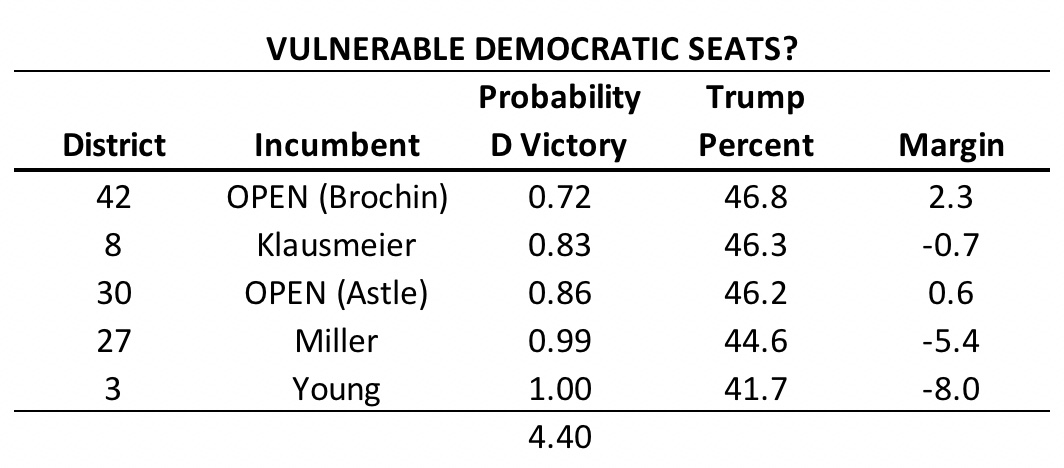
Individually, Democrats are likely to win each of the seats. None are particularly encouraging for Republicans. Collectively, the model indicates a 60% chance of losing one of these seats.

District 3: Frederick
As usual, Republicans plan on going after Sen. Ron Young in Frederick. Good luck with that. The model suggests he is a lock, and this ignores that Frederick has been trending Democratic or that Democrats thumped Republicans in last year’s City of Frederick elections to win control of the mayoralty and city council. Trump lost to Clinton by 8 points in this district. Not going to happen.

District 27: Anne Arundel, Calvert and Prince George’s
Similarly, taking down Senate President Mike Miller would be quite a prize for Republicans. The model gives Republicans a 1 percent shot in this district Trump lost by over 5 points. However, it’s virtually impossible to see how the always well-prepared Miller, the longest serving legislative leader in American history, goes down in territory he has won easily for decades.

District 30: Anne Arundel
The next three seats have Republicans salivating but the model indicates that they are underdogs in each. Sen. John Astle’s retirement from his Annapolis-based district, after losing the primary for city’s mayoralty, leaves a vacancy. Even so, Republicans have only a 14% shot at picking up this district.

Democrats are very pleased with their dynamic and politically experienced candidate, Sarah Elfreth. As in Frederick, Democrats gave Republicans a hiding in the 2017 Annapolis municipal elections. Former Del. Ron George has a clear path to the Republican nomination, as Del. Herb McMillan has given the race a pass. George ran for governor in 2014, losing Anne Arundel to Hogan in the primary by a 2-1 margin. However, George has a bank balance of $169K to $50K for Elfreth.

District 8: Baltimore
Republicans seem to think that they have a shot at taking out Sen. Kathy Klausmeier. The model indicates they have a 1 in 6 chance of victory but that doesn’t take into account any incumbency benefit held by Klausmeier. Their candidate, Del. Christian Miele, doesn’t seem too excited about his prospects, sensing that voter anger with Trump will dominate:

“It definitely gives you some heartburn as a Republican when you see what just happened,” said Republican Delegate Christian J. Miele, of Baltimore County, who is challenging Democratic state Sen. Katherine Klausmeier. “We’re all wondering if 2018 is going to be a continued referendum on the president.”

As Trump’s life goal is to be in the headlines, the answer seems clear. Miele has $87K in the bank compared to $194 for Klausmeier, who is well liked in her district but taking nothing for granted. There are rumors that Miele might just run for reelection for delegate.

District 42: Baltimore
Sen. Jim Brochin is retiring to run for county executive. The most conservative Democrat in the Senate, Brochin had both a tough primary and general last time around. The improved political climate suggests that Democrats have a 72% probability of holding the seat. Del. Chris West (42B) is running for the Republicans. Democrats have two candidates, Robbie Leonard and Gretchen Manavel. Sources tell me Leonard, a former county party chair, has the advantage with local activists but that Manavel has money and the energy – and would be a stronger candidate.

Not Vulnerable

District 32: Anne Arundel
Republicans think they have a good chance of picking up retiring moderate Sen. Ed DeGrange’s seat. Wrong. Clinton carried the district by 12 and it’s not going to happen barring a massive sea change in the political environment. Del. Pam Beidle is a very strong candidate and will win. Republicans are spinning their wheels here.

Vulnerable Republicans?

There are four seats where Democrats hope to play but will likely fall short.

District 9: Howard
Sen. Gail Bates is the most vulnerable Republican but still holds a seat Trump won by nearly 8. The Carroll County portion of her district will likely save her from going down to defeat, as Howard includes less favorable territory even if it is by far the more Republican portion of the county. Democrats have nevertheless recruited a strong candidate in Katie Hester ready to take advantage of any wave.

District 6: Baltimore
For Democrats, this was a real heartbreaker race in 2014 as Del. John Olszewski, Jr., known to one and all as Johnny O, lost by less than 3% to now Sen. Johnny Ray Salling. Democrats think that Salling didn’t so much win as became the accidental senator due to the hellacious political climate. Though Salling is seen as a lightweight who doesn’t work hard in office or at fundraising – he has just $30K in his campaign account – this was territory Trump carried by 15 points that shifted GOP across the board in 2014 and 2016.

Democrats have recruited a local activist and electrician, Bud Staigerwald, who fits the district well and is strongly backed by Comptroller Peter Franchot. Staigerwald lost a primary for Council District 7 in 2014.

District 34: Harford
Sen. Bob Cassilly represents the more Democratic turf in Harford but it’s still Republican and went for Trump by 11 points. Del. Mary-Dulany James, a strong and well-funded candidate, lost by 14.5% to now Sen. Bob Cassilly. Democrats think that they can take Casilly this time around but it will remain tough. Their ability to take advantage of opportunity will improve substantially if the locally deep-rooted James runs again.

Share

What Do the Virginia Results Suggest for Maryland? Part I

All 100 seats in the Virginia House were up for election in 2017. Looking at the results can give an idea of what might happen in Maryland’s state legislative elections later this year. Using a statistical technique known as logit, I created models to estimate the impact of various factors on the probability of a Democratic victory.

Analysis of the election results indicates, unsurprisingly, that the 2016 results are an extremely powerful predictor of which party won Virginia House seats. Adding other demographic factors to statistical models had little impact.

Looking at the raw results reveals why. In 2016, Clinton beat Trump by 49.7% to 44.4% with 5.9% going to other candidates. Virginia was gerrymandered for the Republicans, so it has a disproportionate share of Trump-leaning seats even taking into account the concentration of Democrats in urban areas.

Republicans won all 47 seats in Virginia where Trump won more than 48.0% of the vote. Clinton won 46.0% or less in these districts.

Democrats won all of the 39 seats where Trump won less than 40.5% of the vote. Clinton received at least 54.0% in these districts. These 39 districts include four Democratic pickups.

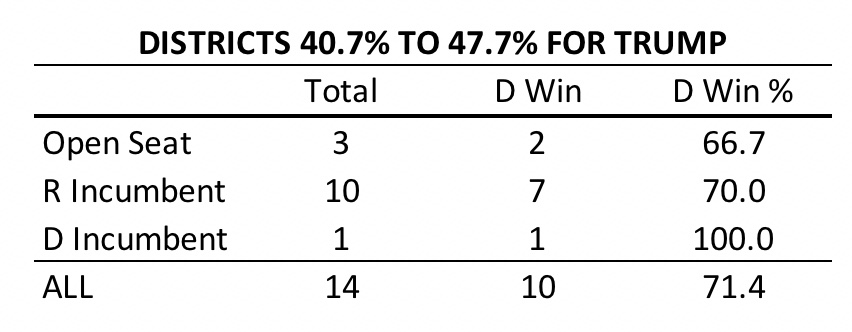
That leaves 14 districts where Trump won between 40.5% and 48.0% of the vote. Incumbency didn’t do a lot for Republicans according to either the statistical model or a look at the raw numbers. As the following table reveals, Democrats won roughly the same share of seats with Republicans seeking reelection as open seats.

The sole Democratic incumbent also won reelection. Indeed, no Democrat lost in 2017 but all represented districts that Clinton won with at least 56.0% and Trump received 41.0% or less. Overall, Democrats won 10 of the 14 seats in marginal range. It would have been eleven had the drawing in the tie race gone the other way.

Next up, what do the Virginia results indicate for Maryland Senate races?

Share

Democratic Socialists Endorse Elrich, Brooks, Meitiv and Wilhelm

By Adam Pagnucco.

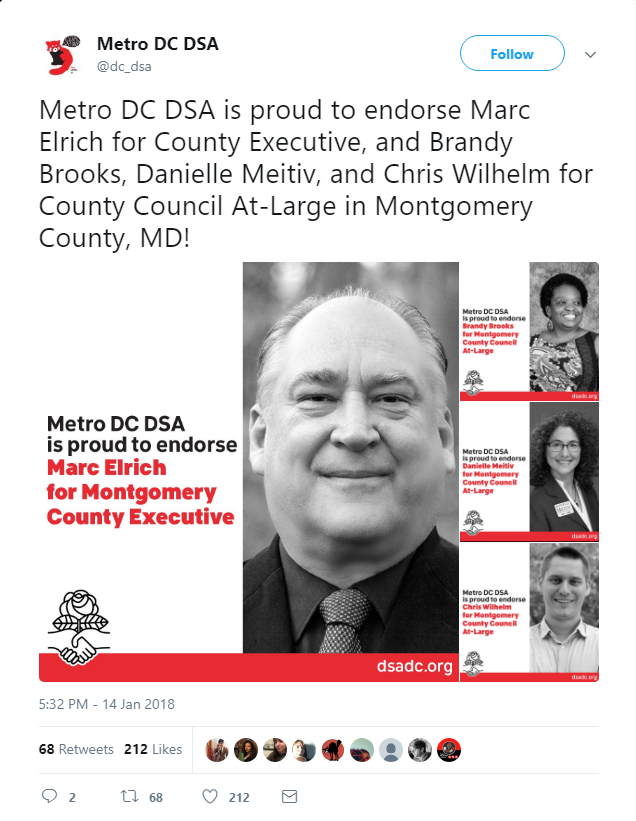
The Metro DC chapter of the Democratic Socialists of America (DSA) has endorsed Marc Elrich for County Executive and Brandy Brooks, Danielle Meitiv and Chris Wilhelm for Council At-Large.  DSA is the successor to socialist organizations once led by Eugene V. Debs and Norman Thomas.  It has grown to become the largest socialist group in America in the age of Trump.

DSA’s endorsement announcement on Twitter.

The Metro DC chapter has posted its questionnaire responses from Elrich, Brooks, Meitiv and Wilhelm on its website.  Pertinent information includes the following facts.

All four are members of DSA.  Brooks said she was not a member on her questionnaire but her campaign manager, Michelle Whittaker, informs us that she is.  Elrich joined decades ago.  Wilhelm joined in November 2017.  Meitiv said, “I am a DSA member. It would be personally disappointing for me if I did not get the organization’s endorsement.”

Elrich and Wilhelm oppose “privatization” of the liquor monopoly.  Wilhelm wrote, “I do not support privatizing the Department of Liquor Control because it provides good jobs for hundreds of county workers and it also generates tens of millions of dollars in revenue for the county. We cannot afford to eliminate this source of funding.”  Meitiv opposes most privatization, but supports it for the liquor monopoly, writing, “With regard to the County Liquor Department, I am of a different mind. I think that the liquor business is not an essential government service and is an artifact of temperance movements and pay for play corruption. I would favor allowing for locally owned and operated private liquor stores.”  Brooks’s position is unclear.

Elrich, Meitiv and Wilhelm favor decriminalization of sex work.  Brooks does not commit to decriminalization, citing the problems caused by human trafficking.

All four support having Montgomery County act as a sanctuary county for immigrants.  Currently, county officials do not consider the county to be a sanctuary jurisdiction.

All four believe undocumented immigrants should have the right to vote in elections.

All four support rent stabilization laws.

All four support tuition-free community college, though Elrich says, “However, we do not currently have resources at the county level (and probably not at the state level, either) to fund it. We should work towards lowering the cost of college, but our ability to do that is constrained by what resources we have.”

The Metro DC chapter of DSA’s logo.

DSA asked, “Do you identify as a democratic socialist?”

Elrich responded, “Democratic socialism doesn’t have a hard and fast definition; I see it as a philosophy that envisions a more democratic society. I believe in democracy in both the political and economic spheres. What does socialism mean now? We are living in the 21st century, and simply reducing political analysis to a debate between 18th century capitalism and 19th century Marxism doesn’t help us find solutions. There are ideas that have worked and have moved society forward that have evolved from both perspectives, as well as things that haven’t turned out so well from both. So a lot of the ideals of democratic socialism contribute to my thinking, but they don’t entirely define my thinking.”

Brooks responded, “I believe strongly in the ability of everyday people being able to ‘freely and democratically’ set the vision for their government and community. That is the essence of the participatory governing strategy I will bring to elected office. On core issues of economic, social, and racial justice, we must also recognize how capitalism and corporate influence on our policies and politics negatively impacts our people, our planet, and our communities. We must remove the influence of corporate money in our politics and policy to create systemic reform.”

Meitiv responded, “I joined DSA because I found a community of activists who share my values and policy goals. As for identifying as a democratic socialist, I am still exploring what that label means, to DSA members and to the public generally, as well as my own understanding. For example, I’m reading about distinctions being drawn by theorists regarding Social Democracy and Democratic Socialism. There should be no question about whether I share the ideals and concerns of the group, or whether I am concerned about publicly acknowledging DSA membership. I am a little hesitant to put myself in a box with a neat label, but I am absolutely comfortable with identifying as a member of DSA for those reasons.”

Wilhelm responded, “Yes.”

Share

SEIU Janitorial Local Endorses Elrich

This may be the first in a wave of labor organizations to endorse Marc Elrich. While not shocking, it provides further evidence that Elrich continues to lock down labor support. Here is the Elrich campaign press release:

32BJ SEIU Endorses Marc Elrich for Montgomery County Executive

SILVER SPRING, Md._ On January 22, 32BJ of the Service Employees International Union (SEIU) announced their endorsement of Marc Elrich for Montgomery County Executive. 32BJ represents 18,000 members in the D.C. Metropolitan Area, including office cleaners who work throughout Montgomery County, and is a major force in area politics. They are the first union to announce an endorsement in the County Executive race.

Elrich has stood with unions in their efforts to secure fairer workplaces for decades. During his tenure on the Montgomery County Council, he has fought for paid sick and family leave, various safeguards against worker exploitation, and two minimum wage increases. He orchestrated the unanimous vote in favor of the recently passed bill that will gradually raise the county’s minimum wage to $15 an hour.

“I have been proud to champion issues of economic justice and would look forward to partnering with 32BJ and other unions as the next County Executive,” Elrich said. “I have enjoyed working with them already to strengthen worker rights and have great respect for the role they’ve played in advancing our shared vision of how to build a more just society. We face many challenges as a county, and it is only through collaboration with 32BJ members and other workers who see those challenges every day that we will figure out the best way to meet them.”

Marc Elrich has been an at-large Montgomery County Councilmember since 2006. He chairs the Public Safety Committee, serves on the Education Committee, and is the County Council’s representative to the Metropolitan Washington Council of Governments Transportation Planning Board. Prior to his election to the County Council, he served on the Takoma Park City Council for 19 years and taught at Rolling Terrace Elementary School for 17 years. For more information, see www.marcelrich.org.

Media Contact:
Ben Spielberg, Campaign Manager
Ben@marcelrich.org
609-828-3783

Share

Campaign Finance Reports: District County Council, January 2018

By Adam Pagnucco.

In addition to the wild and woolly Executive and Council At-Large races, MoCo has two competitive District County Council elections.  Let’s have a look.

Council District 1

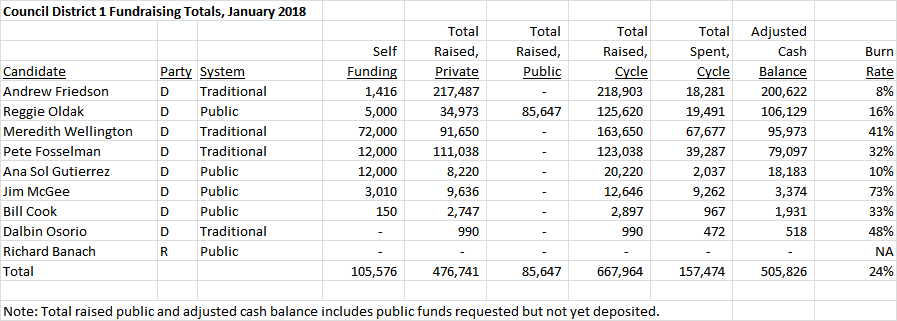
In District 1, which stretches from Kensington in the east to Poolesville in the west, nine candidates are vying to succeed incumbent Roger Berliner, who is term limited and is running for Executive.  But of these nine, only four look competitive at the moment and one stands out: former aide to the Comptroller Andrew Friedson.

Friedson’s lead in total raised and cash balance is as obvious as it is staggering.  But consider these three facts.  First, if Friedson were running in the Council At-Large race, his total raised for the cycle ($218,903) would be second only to Hans Riemer ($219,103), who is the only at-large incumbent running.  Friedson’s cash on hand ($200,622) would be second only to Delegate Charles Barkley ($232,428).  Second, Friedson’s lead is not in money alone.  We added up the number of individual contributors each of the top four fundraising candidates had in Bethesda, Chevy Chase, Potomac, Kensington, Cabin John, Glen Echo, Poolesville and zip codes 20852 (Rockville) and 20878 (Gaithersburg/North Potomac)  to approximate in-district contributors.  Friedson had 289 contributors in these locations, followed by Reggie Oldak (217), former Town of Kensington Mayor Pete Fosselman (195) and Meredith Wellington (92).  Third, Friedson has accomplished this in just five months.  Fosselman has been running for ten months, followed by Oldak (nine months) and Wellington (eight months).  We wonder how much Friedson would have raised if he had been campaigning longer.

The good news for Reggie Oldak is that she has done well in public financing and should have no problem hitting the $125,000 cap for public matching funds.  The bad news is that it’s probably impossible for her to catch Friedson because once she hits the cap, she will be limited to $150 individual checks.  Wellington has relied on self-financing more than the other candidates and has a high burn rate (41%).  Fosselman should have been the fundraising leader in this race.  He was Mayor of the Town of Kensington for a decade and is plugged into Ike Leggett’s network, the county developer network (he once worked for Rodgers Consulting) and what is left of the network of former Governor Martin O’Malley, who endorsed him and had his PAC max out to him.  But Fosselman is fourth in cash on hand and faces the risk that the business community will turn to Friedson as a better prospect to win.

Council District 3

In District 3, which is mostly comprised of Rockville, Gaithersburg, Aspen Hill, Leisure World, part of Norbeck and Washington Grove, former J Street Political Director Ben Shnider is taking on incumbent Council Member and former Gaithersburg Mayor Sidney Katz.  Shnider, who is in the traditional financing system, outraised the incumbent, who is taking public financing.

Shnider’s fundraising edge, along with his endorsement by SEIU Local 32BJ, gives his campaign credibility against Katz, who has been in county and municipal politics for decades.  A further look at the fundraising numbers reveals two things.  First, 76% of Shnider’s fundraising has come from out of state.  (Katz’s percentage is just 2%).  But second, and more worrisome for Katz, Shnider is starting to catch on in the district.  When we added up the number of individual contributors from Rockville, Gaithersburg, Washington Grove and zip code 20906 (Leisure World/Norbeck) to approximate in-district contributors, Katz had 99 and Shnider had 75.  Shnider is the underdog in this race, but Katz needs to start working harder to hold him off.

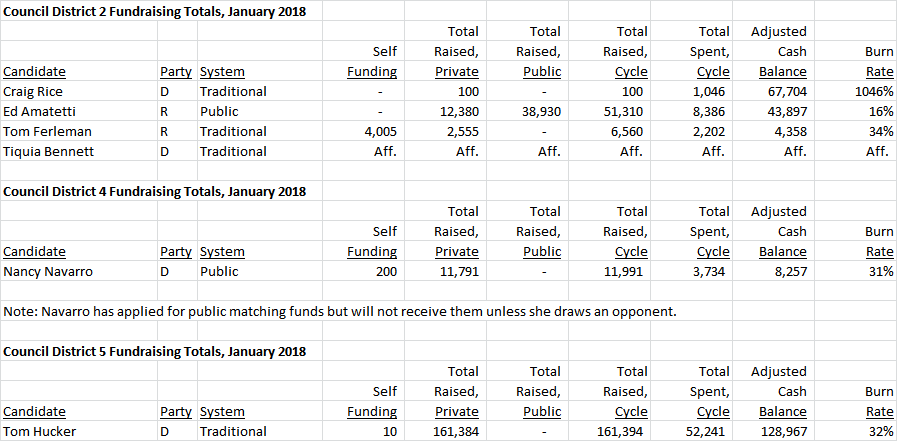
The other districts lack competition.  District 2 incumbent Craig Rice has not been raising money and is apparently unworried about his Republican rivals in the age of Trump.  District 4 Council Member Nancy Navarro and District 5 Council Member Tom Hucker have no opponents and are headed to reelection.

We will get to state legislative races soon, folks!

Share

Oprah Yes

By now, you’ve surely heard about Oprah Winfrey’s speech at the Golden Globes that has led to serious talk about Oprah making a bid for the White House. Take it seriously. A University of Maryland study concluded that Oprah’s 2008 endorsement of Barack Obama gained him more than 1 million votes in the Democratic primary.

I don’t know if Oprah should run for president. A true American success story, she has done so much in the private sector that it it would be a shame if she gave it up. Revealing incredible business acumen, she didn’t just become the most successful talk show host but the leader of a business empire.

As head of that empire, Oprah has been willing to use her power and influence for good in many ways. She has hired and promoted women, especially, minority women, to the top of her team. Smart business – why not grab talent others overlook – that helped create a new cohort of minority and female business leaders.

Oprah has also leveraged her wealth and power to present African-American women and stories in media from magazines to movies in a far more positive light. Most importantly, she does it in a way that is utterly normal and marketable, rather than forced tokenism. In other words, the way it should be.

At this point, there is a strong case to be made that the black community and America need more African-American business owners than more African-American politicians. Business brings money and influence – assets that make it far easier to exercise and to magnify political power.

The argument for Oprah for President is also clear. She is a great American communicator. Oprah has all the graciousness and dignity that Trump lacks. While Trump has empathy only for himself, Winfrey has deep compassion for others.

Trump slithers in the gutter appealing to dark impulses, but Oprah hearkens to the better angels of our nature. Trump excludes while Oprah includes. Even her strong advocacy for the “me too” movement and minority progress is inclusive and designed to raise people up rather than put others down.

Oprah grew up poor and created a business empire, while Trump inherited millions and prides himself on bilking people and treating others like garbage. Oprah has demonstrated an ability to delegate – she has to in such a large organization – even as she assimilates new information quickly.

Nevertheless, she lacks experience in politics and public policy. Obama had to pick up the economic and foreign policy wreckage of the Bush administration. The next president will face the arguably even greater challenge of restoring political norms and institutions as well as frayed foreign alliances.

We’ll see if Oprah chooses to take the plunge into politics. Her role as a powerful business leader, however, is not one to give up lightly and would be missed if she did.

Share

Campaign Finance Reports: Council At-Large, January 2018

By Adam Pagnucco.

Now to the swarming Council At-Large race, a fascinating contest with a cast of candidates exceeding the population of several small island nations.  In accordance with our prior post on the Executive candidates, let’s review our methodology.  First, we calculate total raised and total spent across the entire cycle and not just over the course of one report period.  Many candidates, particularly in other races we will discuss, have been campaigning for more than a year and we want to capture that.  Second, we separate self-funding from funds raised from others.  Self-funding includes money from spouses.  Total raised does not include in-kind contributions.  Third, for self-financed candidates, we include public matching fund distributions that have been requested but not deposited in raised money and in cash on hand (which we call adjusted cash balance).  That gives you a better idea of the true financial position of publicly financed campaigns.

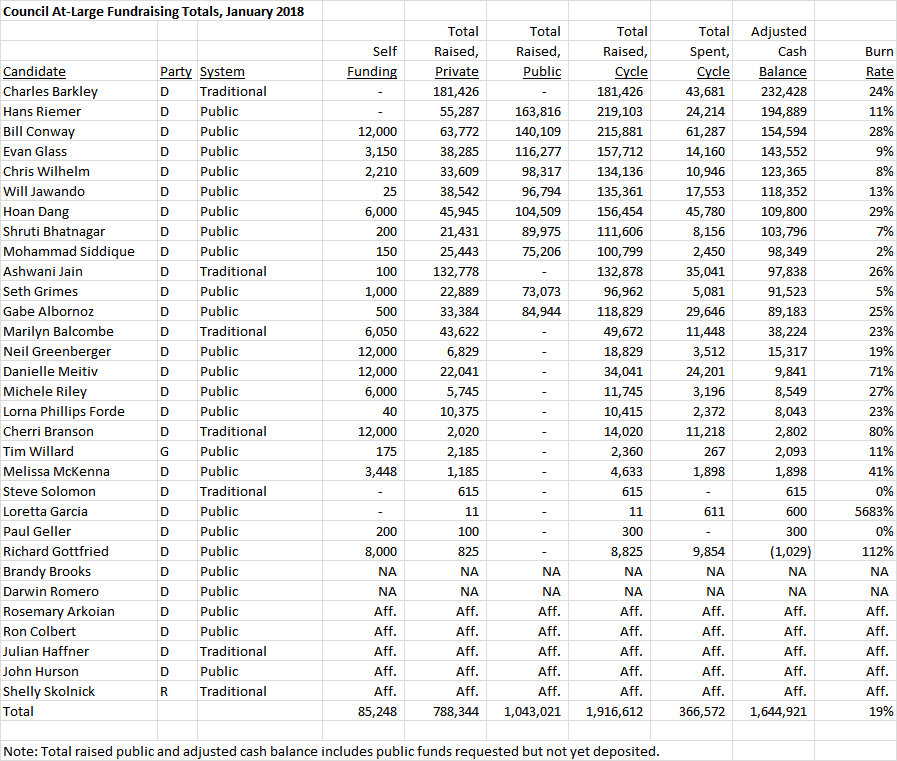
And now, on to the financial presentation.  (We hope this graphic can fit on your screen.)  Two candidates – Brandy Brooks and Darwin Romero – have not filed reports at this writing.

Delegate Charles Barkley (D-39) is a big winner here with the largest cash on hand in the race.  He has used his unique perch as the House’s point man on liquor issues to raise large amounts of money, adding to a war chest he has been accumulating for twenty years.  But the last time Barkley had a competitive election, Facebook did not exist and black and white mailers were still in use.  This is a big field full of hungry candidates and Barkley needs to do more than raise alcohol money to win.

Council Member Hans Riemer, the only incumbent in the race, continues to excel.  He has the highest amount raised ($219,103) and a low burn rate of 11%.  Add to that his two terms in office, his experience running countywide, his history of influential endorsements and his campaign skills and he looks like a safe bet to return.

Bill Conway has gone from being Diana Conway’s husband to being perhaps the one non-incumbent candidate that his rivals say is most likely to win.  Conway’s total raise ($215,881) is almost equal to Riemer’s and he actually collected more than Riemer from individuals.  The difference is that he has spent a lot more than Riemer by employing a campaign manager from the early days of his candidacy.  But since that campaign manager is former Raskin field staffer Doug Wallick, that was a good decision.  Conway combines a MoCo-targeted message of education, transportation and jobs with a likable personality and a staggering ability to learn quickly.  So far, so good.

The Council At-Large candidates pose for their Class of ’18 picture.

Next come the others who have qualified for public financing, most of whom have done so recently.  Evan Glass ran strong in District 5 last time, knows the county well and has a lot of fans from his service on more advisory boards and task forces than your author can count.  Chris Wilhelm is a progressive teacher who should appeal to his union, the powerhouse MCEA.  Will Jawando is a skilled candidate who would be in the House of Delegates now if it weren’t for Jamie Raskin’s 2014 slate.  Gabe Albornoz combines several networks – party, Leggett supporters and folks who have known him from his day job at the Recreation Department – and is liked by basically everyone who meets him.  A group of nine candidates – Glass, Wilhelm, Jawando, Albornoz, Hoan Dang, Seth Grimes, Shruti Bhatnagar, Mohammed Siddique and Ashwani Jain – are basically clustered together financially.  Danielle Meitiv will be right there too because she is close to qualifying for matching funds.

And then there are the rest.  Look folks – it’s popular to say that there are more than 30 candidates in this race.  But in all truth, the number of viable candidates is at most half that number.  To everyone who filed an affidavit or is not close to qualifying for matching funds: it’s not gonna happen for you, OK?  You’re the gazelle trying to run with a pack of hungry cheetahs.  You need to show some game or don’t show up at candidate forums asking for your ninety seconds of speaking time along with the folks that are busting their rear ends and getting several hundred residents to contribute.

We have a lot of questions about this data, such as: who is giving money?  Which candidates are drawing support from specific parts of the county?  And why aren’t the female candidates doing better?  (Of the top twelve fundraising candidates, only one – Shruti Bhatnagar – is a woman.)  All of that analysis will have to wait as we are done for now.

Next: the district council candidates.

Share

Campaign Finance Reports: County Executive, January 2018

By Adam Pagnucco.

Christmas morning is over and your blogger is done opening the presents – errrrr, campaign finance reports.  Now we get to share them with you!  And we will start by breaking down the Montgomery County Executive race.

Before we start playing with the toys, let’s clear away the wrapping and discuss a few data issues.  Our numbers are different from what you will read in other outlets.  That’s because Seventh State readers are special and we are going to give you only the best!  First, we calculate total raised and total spent across the entire cycle and not just over the course of one report period.  Many candidates, particularly in other races we will discuss, have been campaigning for more than a year and we want to capture that.  Second, we separate self-funding from funds raised from others.  Self-funding includes money from spouses.  Total raised does not include in-kind contributions.  Third, for self-financed candidates, we include public matching fund distributions that have been requested but not deposited in raised money and in cash on hand (which we call adjusted cash balance).  That gives you a better idea of the true financial position of publicly financed campaigns.

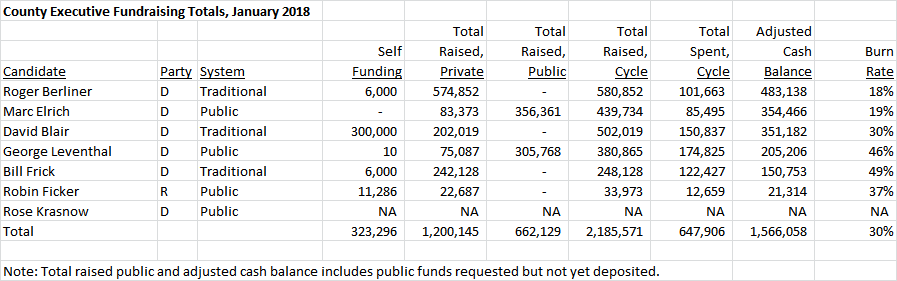
And now, we reveal the numbers you all have been craving: the first round of fundraising reports for the seven people running for County Executive.

This is exactly the kind of race Council Member Marc Elrich wants.  He is up against five other candidates, only one of whom has run countywide before, who are nothing like him and cannot steal votes from his progressive and anti-development base.  Better yet, because of public financing, he has the resources to be financially competitive.  (The thought of Elrich with money is almost as strange as the sight of Elrich wearing a suit and tie.)  Elrich has been building a grass roots base for thirty years and he will be able to combine it with substantial labor, progressive and environmental support.  This election is starting to turn into Elrich and a competition to become the non-Elrich alternative.

Council Member Roger Berliner has to feel good about his report.  He leads the field in total raised for the cycle and cash on hand, and also has the lowest burn rate.  Berliner can now start making the case to those who are not inclined to support Elrich that he is the most viable alternative to Elrich.  Doing that is essential for his path to victory.  (Disclosure: your author is a publicly-listed supporter of Berliner and has done work for him in the past.)

Businessman David Blair is sometimes compared to fellow businessman David Trone, but he is not using a Trone-like strategy.  When Trone entered the CD8 race last year, he staffed up rapidly and began spending millions on television within weeks.  Accordingly, some observers expected Blair to write himself a million dollar check, putting opponents on notice and perhaps intimidating one or two of them to withdraw.  But while Trone plays to win, Blair looks like he’s playing around.  He gave himself just enough money ($300,000) to equal the formerly penniless Elrich in cash on hand and trail Berliner.  As for private sector fundraising, Berliner has raked in almost three times as much as Blair.  Blair needs to sharpen his message, learn more about the county and show a hunger to win.

Council Member George Leventhal is plenty hungry.  He might be the hardest-working candidate in the race and he clearly believes he’s the best person for the job.  But Leventhal is killing his campaign with his sky-high burn rate (46%), which is more than double the burn rates of Elrich (19%) and Berliner (18%).  Like Berliner, Leventhal needs to show to non-Elrich folks that he is the most viable alternative to Elrich.  To do that, he needs to tighten up his spending and get some big endorsements – sooner rather than later.

Bill Frick, you know we love you.  We admire your heroism on the liquor monopoly and we appreciate all the great fodder you have given us over the years.  But you showed a cash balance of $150,753 – less than half what Berliner, Elrich and Blair reported.  Why are you doing this, Bill?  We want many more years of you in public office, so please take our advice: stay in the House and run to succeed Brian Frosh as Attorney General when the time comes.  We will help you do it!  We will even write dozens of blog posts just like this one.

Former Planning Department staffer and Rockville Mayor Rose Krasnow is an appealing, substantive and competent candidate with fans in both the business and smart growth communities.  The fact that she is the only female candidate running against five men in a Democratic primary electorate that is almost 60% female is a big plus.  Her numbers are not in yet, but she told Bethesda Magazine that she had raised $39,800 from small contributions in the public financing system.  If that’s true, it means she is on pace to qualify for public matching funds much faster than either Elrich or Leventhal did.  Still, we don’t understand why she entered public financing.  It takes a long time to raise money that way and it prevents her from tapping into what could be substantial business support.  Even if she qualifies for matching funds, she could very well trail all the other Democrats in fundraising except maybe Frick.

Republican Robin Ficker appears roughly halfway to qualifying for public matching funds.  That means the county’s most infamous anti-tax activist could wind up campaigning on the public dole.  And all of you MoCo residents will be paying for that!

Next up: the council at-large candidates.

Share

SEIU Local 32BJ Endorses Ben Shnider

By Adam Pagnucco.

SEIU Local 32BJ, the mammoth building services union that is one of the biggest and most powerful locals in SEIU, has endorsed insurgent candidate Ben Shnider in his challenge to District 3 Council Member Sidney Katz.  Shnider has been working hard to topple Katz from the left but it’s an uphill challenge.  An endorsement of this kind grants legitimacy to Shnider and will help him draw more progressive support.  We will have a lot more to say about this race, but for now, we reprint the union’s press release below.

*****

FOR IMMEDIATE RELEASE: Wednesday, January 17, 2018

FOR MORE INFORMATION: Julie Karant: jkarant@seiu32bj.org

32BJ SEIU ENDORSES BEN SHNIDER’S BID TO UNSEAT MONTGOMERY COUNTY COUNCIL INCUMBENT, SIDNEY KATZ

Shnider’s Unwavering Support for Working Families Sharply Contrasts Katz’s Record of Opposing the $15 Minimum Wage

Washington, D.C. – Janitors and security officers from 32BJ of the Service Employees International (SEIU), today announced their endorsement of Ben Shnider’s campaign to replace Montgomery County Council District 3 incumbent, Sidney Katz.

“Sidney Katz originally voted against the $15 minimum wage which delayed the effort to raise the wages for struggling workers,” said 32BJ SEIU Vice President Jaime Contreras. “Montgomery County deserves a reliable champion like Ben Shnider who will fight for working families not industry lobbyists.”

32BJ members will knock on doors and speak out within their communities towards the primary election scheduled for June 26th.

“I’m humbled and honored to have the backing of the incredible members of 32BJ. I’m running to ensure that every resident of Montgomery County can afford to live and thrive in this community that I love. I’m proud of the grassroots coalition we’re assembling to bring new leadership to District 3. I’ll work tirelessly on the County Council to provide the members of 32BJ — and all county residents — with the bold, progressive leadership they deserve,” said Shnider.

32BJ members are also inspired by Shnider’s leadership on immigrant rights and racial justice during his tenure with Bend the Arc.

With more than 163,000 members in 11 states, including 18,000 in the D.C. Metropolitan Area, 32BJ SEIU is the largest property service workers union in the country.

###

Share

Maryland Politics Watch