Joy Nurmi: Meitiv Flunks Science Test

By Joy Nurmi.

Danielle Meitiv frequently reminds us that she is a scientist. Then one should wonder why, when she accuses our County Executive of failing to endorse women candidates, she fails at one of science’s most basic tenets – sample size and probability of drawing a false‐positive conclusion when the sample is too small.

According to one of the country’s top science organizations – the National Institutes of Health (NIH) – sample size is important. In the NIH publication, “How sample size influences research outcomes,” NIH says: using a sample smaller than the ideal increases the chance of assuming as true a false premise.

So when Ms. Meitiv draws the conclusion that our County Executive is not interested in gender balance because of his endorsements in the Council at-large race, one might ask about how Mr. Leggett’s track record stacks up in a larger sample size. For example, when one looks at all the candidates he has endorsed in the current election, one sees that it includes four women: Aruna Miller, Lily Qi, Charlotte Crutchfield and Rebecca Smondrowski. Interestingly enough, that equals 50% of his total endorsements. And with his endorsement of Aruna Miller, he was out up front and early when many were hanging back.

Look carefully at Mr. Leggett’s endorsements. They are not only gender balanced, but they are rich in diversity as well. It is important to note that this County has never elected any Latino or Asian for an at-large seat. And, Mr. Leggett is the only African American ever elected to an at-large office.

Where has Ms. Meitiv been in furthering this goal of diversity, correcting these deficiencies? She criticizes Mr. Leggett only because it benefits her as a candidate. It gets her publicity.

Look also at the top tier of management in County government appointed by Mr. Leggett. Twenty-two of the 44 top managers/directors are women. Again, 50%.

He has been highly successful in advocating for gender balance and diversity on a number of fronts. He has advocated with our governors for a more diverse judiciary, including recommending many women for judgeships, who have since been appointed. He has endorsed many women for elected office in the past. The examples are too numerous to list. In fact, you will not find any leader anywhere who has such a track record of fostering diversity and gender balance in so many facets of public life to equal Mr. Leggett’s.

It is truly unfortunate that Ms. Meitiv lashed out without facts, and as a result, failed this science test.

Joy Nurmi is a Special Assistant to County Executive Ike Leggett and a former Chief of Staff at the County Council.

Share

Who Voted – and who Didn’t – in Maryland?

The participation of the seven Democratic gubernatorial candidates in Maryland elections varies widely. The table at the top of the post reveals not just whether but also how each voted since 1994, a period that includes 12 primary and general elections apiece with the number also evenly split between presidential and gubernatorial election years.

Rushern Baker, Kevin Kamenetz and Rich Madaleno

The three officials who currently hold elective office – Rushern Baker, Kevin Kamenetz and Rich Madaleno – have voted in every one of the 24 elections.

Krish Vignarajah

Despite registering to vote in Maryland in 2006, Krish Vignarajah has voted just once in Maryland. In 2016, she voted in the general after skipping the primary. She registered to vote in D.C. in 2010 and participated in four elections there from 2010 through 2014.

In order to remain eligible to run for governor, Vignarajah claims incredibly that she remained a legally registered voter in Maryland. Even as she cast ballots elsewhere and claimed a D.C. address on her voter registration application, she was never purged from the rolls in Maryland.

This presents a series of real problems for Vignarajah. To put it bluntly, if she really lived in Maryland all the time and her D.C. apartment was just a “crash pad” as she now says, why did she fraudulently claim that she lived in D.C. on her 2010 voter application? Alternatively, if she was honest on her application, how can she claim that she has always maintained her Maryland residency?

Additionally, if she was always a Maryland resident, why didn’t she just vote here? She says voting in D.C. was just a matter of convenience because she was so busy at her job working for Michelle Obama. But many other busy people manage to apply for absentee ballots and they’re not all Marshall Scholars who made law review at Yale. Why couldn’t she do the same? It doesn’t exactly exude commitment to the State.

Moreover, how can one be legally registered to vote in two places at the same time? Just because she wasn’t purged from the rolls, as she should have been after she registered in D.C., doesn’t mean that she remained someone who could legally cast a ballot here.

I’ve had personal experience with this issue. When I moved back to Maryland twenty years ago after four years teaching in South Carolina, I discovered I was still on the rolls. I had registered and voted in South Carolina but, until I moved back to Maryland, I didn’t have illusions that I could vote here or was still a resident despite frequent visits.

Vignarajah could advance her residency claim if she would release her tax returns. She already refused to answer where she filed when Tom Sherwood asked on WAMU. As he pointed out, that really answers it anyway. One imagines that Vignarajah would have said that she had filed in Maryland if she had done so.

We’ll get a chance to know for sure when Vignarajah releases her tax returns. Her campaign told the Baltimore Sun that she’d release her returns “if others do.” Jealous, Ross, Shea have said they will, and Madaleno has already done so,. Hopefully, we will know soon if she filed in the District or Maryland or both, assuming that this is not a Trump promise, which is an oxymoron.

Ben Jealous

Unlike Vignarah, Ben Jealous is unquestionably eligible to run. However, he has only voted four times in Maryland since 1994, which surprised me as his online bio certainly gives the appearance that he spent most of his life in Maryland.

His voter participation record suggests otherwise. Jealous first registered to vote in Maryland in 2012. Though he has participated in all general elections, he skipped both the 2012 and 2014 Democratic primaries. When Jealous casts his ballot in 2018, presumably for himself, it will be the first time that he has ever voted in a Maryland gubernatorial primary – something he has in common with Vignarajah!

Either Jealous has been voting elsewhere or not at all.

Jim Shea and Alec Ross

Jim Shea voted in all general elections but missed 5 of the 12 primaries, with four of the five that he missed occurring in presidential election years. None of these four primaries had a hotly contested presidential or senatorial primary.

Alec Ross did not vote in 7 of the 24 elections. Ross took a pass on his first opportunity to vote in 1994, but he would have just moved to Baltimore in the summer before the primary. However, he also missed both the primary and general in his second statewide elections. More recently, Ross skipped the 2010 and 2012 primaries.

Share

Female Candidates Accuse Leggett of Sexism

By Adam Pagnucco.

County Executive Ike Leggett’s decision to endorse four men in the Council At-Large race – incumbent Hans Riemer, Gabe Albornoz, Hoan Dang and Will Jawando – has provoked public accusations of sexism from two women who are running for office.

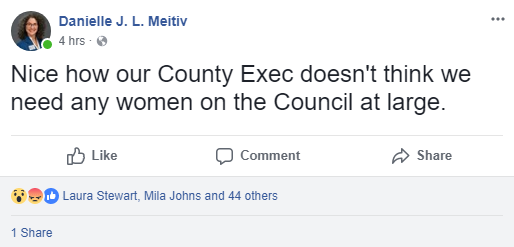
Council At-Large candidate Danielle Meitiv kicked things off on Facebook minutes after Leggett’s endorsement of Jawando was announced, writing, “Nice how our County Exec doesn’t think we need any women on the Council at large.”

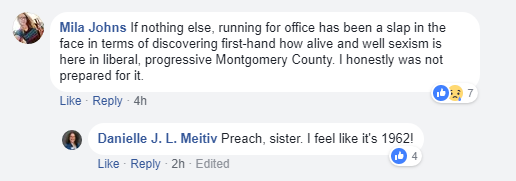
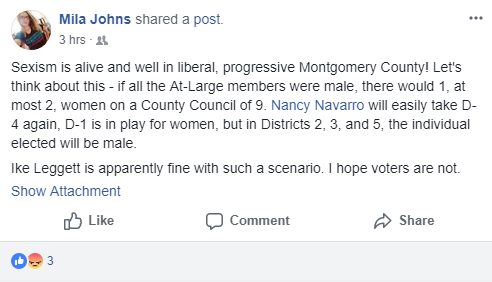
District 18 Delegate candidate Mila Johns followed up, directly accusing Leggett of “sexism, pure and simple,” and eventually shared Meitiv’s post on her own page.

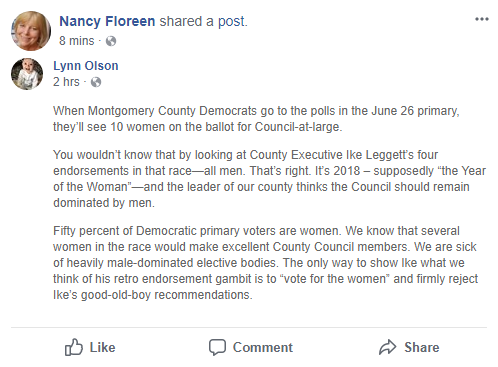
Council Member Nancy Floreen also weighed in on this, although somewhat indirectly.

The sentiment expressed by Meitiv and Johns is shared by other women running for office.  Several of them blasted Leggett to your author in scathing terms but would not go on the record.  That makes sense – most politicians want to avoid public disputes with a sitting County Executive at election time.  One candidate who was willing to comment on the record was Brandy Brooks, who is running for Council At-Large and co-wrote an essay about gender parity in politics with Meitiv.  Brooks told us:

For many, 2018 could be the year for women, people of color, and working people, but not if we aren’t actively changing our political system both internally and externally. Maryland has one of the worst records in the country on gender parity: we rank 38th on the gender parity index with a score of 12.1 (down from 21.2 in 2014) with few women in federal, state, or local office. To be clear, the four men who have been endorsed by the county executive are qualified candidates — that is not the question. However, not endorsing a single woman running at-large sends the wrong message about how our political and elected leaders view gender parity. Some will argue that more of the women running should have sought the endorsement. Unfortunately, this view continues to fault women instead of asking why our leaders aren’t being intentional to seek women to endorse as well. It continues a pattern that leaves many on the margins. Thankfully, there are many strong women candidates running for office in 2018 to change this status quo, and I’m excited to be one of them.

If Leggett’s choices win, it’s possible that the council might have just one female member in its next term: District 4 incumbent Nancy Navarro.  Since its current structure was established in 1990, the nine-member council has never had fewer than two female members and has sometimes had three or more.  Additionally, the issue of how women are treated in politics has erupted in Annapolis as the General Assembly grappled about how to deal with harassment in its most recent session.  One at-large candidate (Delegate Charles Barkley) has even been accused of inappropriate behavior with women.

Riemer, Albornoz, Dang and Jawando are not unusual choices for Leggett.  The Executive has had a cordial relationship with Riemer during their time in office together.  Albornoz is widely regarded as one of his best department directors.  Dang and Jawando are solid candidates and both would bring assets to the council if elected.  But surely Leggett and his team should have expected pushback on this in the wake of his criticism of the District 39 state legislators for accepting Lesley Lopez on their slate, a dispute in which gender was raised as an issue.

In Leggett’s defense, he has filled his administration with strong and competent women, including but not limited to Department of Permitting Services Director Diane Schwartz-Jones, Office of Management and Budget Director Jennifer Hughes, Health and Human Services Director Uma Ahluwalia, Assistant Chief Administrative Officer Lily Qi, former libraries director Parker Hamilton and Special Assistant Joy Nurmi.  (Some of these ladies have left multiple boot prints on your author’s rear end!)  Leggett’s wife, Catherine, is an admired player in county politics who chairs the Executive’s Ball and raises money for the arts.  We are sure that Leggett’s MANY female supporters will step up in his defense should they deem this criticism worthy of response.

So who’s right?  That’s for you, the readers, to decide.

Share

Leggett Endorses Jawando

County Executive Ike Leggett has endorsed Council At-Large candidate Will Jawando.  The Executive has previously endorsed Gabe Albornoz (his Recreation Director), Hoan Dang and incumbent Hans Riemer in the race.  We reprint Jawando’s press release below.

*****

April 18, 2018

Inquiries: info@willjawando.com

County Executive Isiah “Ike” Leggett Endorses Jawando

ROCKVILLE, Md. – In a statement released today, Montgomery County Executive Isiah “Ike” Leggett endorsed Will Jawando in his race for County Council At-Large, noting Jawando’s record of public service and progressive leadership.

“I am honored to endorse Will Jawando for County Council At-Large. Will is an exceptional leader with a lifelong record of public service to Montgomery County and the nation. He worked as a public policy attorney on Capitol Hill and for President Obama in the White House. I was proud to appoint Will to serve on the Montgomery County Commission on Juvenile Justice, and worked with him to provide support for Summer R.I.S.E, a summer career internship program for high school students that he spearheaded,” Leggett said. “As an active, progressive community leader, Will understands the needs of Montgomery County and is committed to making our outstanding county even greater. I’m voting for Will, and respectfully urge you to join me in electing him to the County Council.”

If Jawando wins his contest, he will be only the second person of color to be elected to a county-wide office in Montgomery County. Leggett was the first, and only to date. Jawando recognized that when he welcomed Leggett’s endorsement.

“I’m privileged to earn Ike’s support, and I’m honored to have the opportunity to continue his legacy of public service in Montgomery County,” Jawando said. “We’ve worked together on closing the opportunity-and-achievement gap in our public schools, addressing issues of juvenile justice, and engaging our underrepresented communities in the civic process. I’m dedicated to addressing those issues that matter most to our families — our schools, fair and affordable housing, reliable transit and jobs. That’s the promise of Montgomery County.”

Aside from creating and managing the first year of Summer R.I.S.E., and his work on the Montgomery County Commission on Juvenile Justice, Jawando co-chairs the African-American Student Achievement Action Group, and created a community-based non-profit called Our Voices Matter, which works with underrepresented populations to increase civic engagement, voter registration and leadership training.

To learn more about the Montgomery County Promise, please visit www.willjawando.com.

Share

Ortman-Fouse Files for Matching Funds in Record Time

By Adam Pagnucco.

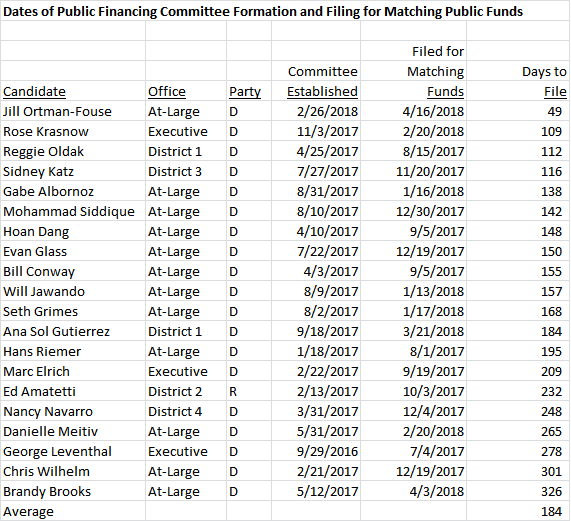
Board of Education member Jill Ortman-Fouse, who is running for Council At-Large, has filed for matching funds from the county’s public financing system.  Ortman-Fouse took 49 days from the date on which she established her campaign committee to apply for matching funds, a FAR shorter period of time than any other candidate.

Ortman-Fouse’s application, made on April 16, lists $23,466 in contributions from 368 county residents, exceeding the Council At-Large thresholds of $20,000 and 250 residents.  Below is the number of days between committee establishment and matching funds application for the twenty candidates in public financing who have applied for matching funds.  (Five other candidates submitted applications but were ruled ineligible by the State Board of Elections.)  Bear in mind as you read the stats below that the candidates have different qualification thresholds.  Executive candidates must collect $40,000 from 500 county residents.  District council candidates must collect $10,000 from 125 residents.

Ortman-Fouse totally smoked her competition in filing time, something that is going to turn heads among her competitors.  In just one term, she has become arguably the most popular school board member in the county since Blair Ewing, who left to run for County Council twenty years ago.  One reason for that status is her close attention to answering constituent questions and her constant social media interaction with them, something that is typical of the best elected officials in county and state governments but is unusual for school board members.  That has given her a network of supporters that approaches the level of incumbent County Council Members.  How far that penetrates into the rank-and-file voting public is unknown, however, as few voters can name their school board members.  And Ortman-Fouse has also been handicapped by her late start, missing out on the endorsement processes of many influential organizations.

That leaves us with a general observation.  It’s true that the top fundraisers in the Council At-Large race are men and that men have received most of the influential institutional endorsements (with some going to Brandy Brooks and Danielle Meitiv).  But the Democratic primary electorate is roughly 60% female and of the seven councils in the current structure since 1990, only one (the 1998-2002 council) lacked a female at-large member.  So don’t count out the women, dear readers – and especially not Jill Ortman-Fouse!

Share

Clash on the Issues, Part III: Blame It on the Alcohol

This is the third in a series about the issue positions of candidates in District 1 based on the debate hosted by Friends of White Flint. Today’s topic: what do the candidates think about the Montgomery County Department of Liquor Control’s alcohol monopoly?

Time to Get Off the Sauce: Candidates for Privatization

Bringing levity to the debate on several occasions, Pete Fosselman started by bluntly stating “I like my liquor” to laughter from the crowd. He proposes letting the county retain control of hard liquor but privatizing the sale of beer and wine, arguing that the change would boost in Montgomery restaurants. As an industry that makes most of their money on alcohol sales, they watch this aspect of the business carefully.

Andrew Friedson spoke passionately in favor of privatization. Fighting back against those concerned about the loss of revenue generated by the monopoly, Friedson stated “I believe government should be judged on how well it serves people, not how well it makes money.” Moreover, he argued that the monopoly costs Montgomery revenue, as it is hard to explain why alcohol sales are 41% lower here than elsewhere in the region unless you think Montgomery has “a secret temperance movement.”

Meredith Wellington agreed with Friedson, saying thoughtfully that the monopoly is a symptom of the county’s problematic approach. Arguing that government can’t do everything, Wellington said that we want entrepreneurial people in the county and need to work with them to help us market the county to businesses.

Though concerned about losing the union jobs, Reggie Oldak also thinks the county should not be in the liquor business, pointing out that $30 million is not much in a $5.5 billion budget. She shouldn’t worry so much. Private liquor distributors are also unionized. Why should the county should favor jobs with one union over another?

They Tried to Make Me Go to Rehab, I Said No, No, No: Candidates against Privatization

Bill Cook believes that privatizing the liquor industry would be a huge loss for the county because we’d lose $30 million and those “great paying union jobs.” Taking perhaps an unusual tack, he then proceeded to attack of his own potential constituents, Total Wine Co-Owner David Trone, who lives and has located the headquarters of his business in District 1.

Stating that there is “nothing wrong” with the county selling liquor and endorsed by UFCW 1994 MCGEO, Ana Sol Gutiérrez favors modernization, not privatization. She says that “significant steps have been taken” in terms of improvements. I wonder if she also thinks Metro escalators rarely break down. Gutiérrez likes that we can take on new debt by bonding the revenue stream. In other words, the county is fiscally hooked on alcohol.

Jim McGee opposes privatization but favors modernization. Unfortunately, that has been promised for years but is much like waiting for Godot. They say that it’s coming. But when is it coming? At the same time, McGee thinks it is too hard for microbreweries to distribute their product.

Share

Reznik Calls on Board of Public Works to Reject “Shadow Government” Highway Contract

By Adam Pagnucco.

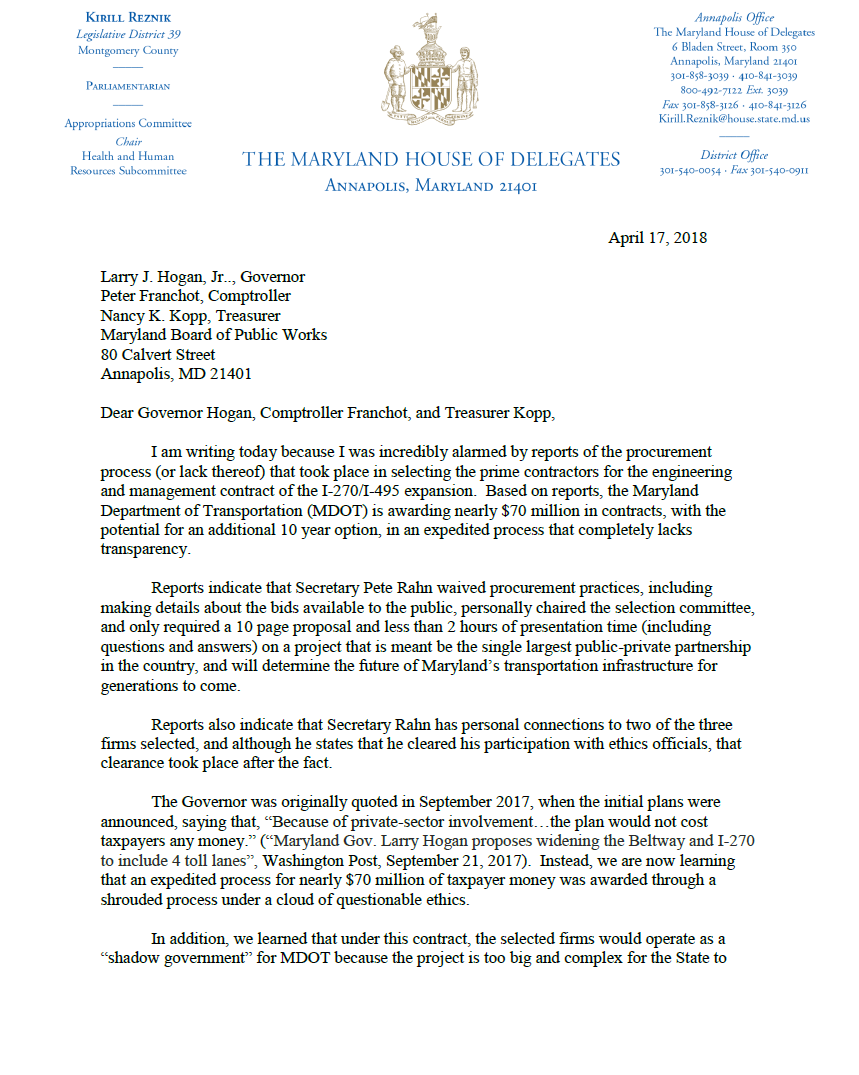
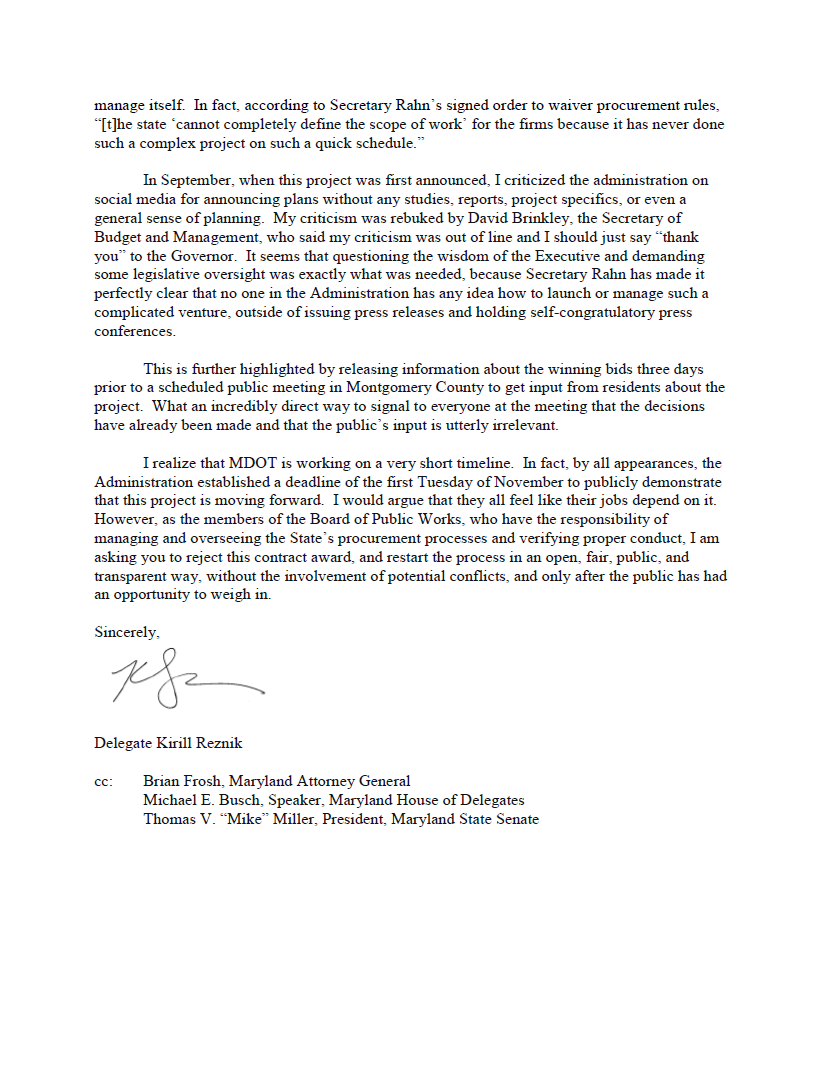
Delegate Kirill Reznik (D-39) has written to the Board of Public Works asking them to reject an engineering and management contract awarded by the Maryland Department of Transportation for its planned expansion of the Capital Beltway and I-270.  According to the Washington Post, the winning consortium included a former employer of the state’s Secretary of Transportation and was awarded the contract despite finishing second in its written proposal.  The Secretary did not vote directly on the contract, but he had dinner with a representative of his former employer and obtained an ethics clearance after the award was made.  Post reporter Michael Laris described the bidding process as “expedited and unusual” and wrote:

The winning firms, known collectively as the “general engineering consultant,” would act as something of a shadow government for the Maryland Department of Transportation, which says its plan to hire firms to build, finance and maintain toll lanes is too big and complex to govern itself.

Referring to much of the above, Delegate Reznik said he was “incredibly alarmed” and asked the Board of Public Works to “restart the process in an open, fair, public, and transparent way, without the involvement of potential conflicts, and only after the public has had an opportunity to weigh in.”  We reprint his letter below.

Share

Clash on the Issues, Part II: is Ballooning Debt a Problem?

This is the second in a series about the issue positions of candidates in District 1 based on the debate hosted by Friends of White Flint. Today’s post looks at whether the candidates are concerned about the share of the county budget going to service debt, which is approaching 20% according to the question.

Ana Sol Gutiérrez doesn’t see County debt as a problem and views it is analogous to a home mortgage, leaving me hoping that we don’t end up under water like so many home owners. She has confidence in analyses showing the county is financially stable but also expressed interest in finding “other funding streams,” which sounds like taxes. Throughout the debate, however, she referred to mysterious state-level funds that the county had left untapped, a perplexing claim from a this long-time delegate on the appropriations committee who should be well placed to direct funds to the County.

In a similar vein, Bill Cook commended the Council for its balanced budget and well-funded rainy day fund, and blamed “reckless” development without appropriate impact taxes for placing additional burdens on county residents.

Reggie Oldak took a more centrist position, arguing that too much debt is a burden and Montgomery needs to preserve its AAA bond rating. At the same time, she agreed it is shortsighted not to spend on the safety net, leaving me a bit concerned as debt should go to capital, not operating, expenses.

Noting a lot of agreement among the candidates, Jim McGee took a similar position. He views debt as an “investment in the future” but also says we need to see the return on the investment. He also noted aptly that interest rates are rising, so debt will cost more in the future. Economic growth is the real solution to this problem.

Meredith Wellington was the first to express directly that she is very concerned about the debt gobbling up more of our budget even as revenues have not bounced back and we’ve raised taxes. She supports the affordability guidelines, even though they constrain the county’s ability to borrow, and said we need to set priorities. In short, Wellington was the first to identify rightly that growing debt and flat revenues is not a sustainable fiscal path, and that the county will have to make real choices as a result.

Andrew Friedson concurred with Wellington. He countered Gutiérrez’s home mortgage analogy directly, arguing cogently that we cannot do the equivalent of taking out a bigger mortgage or taxing our way out of it. There is certainly little appetite for increased property or income taxes in Montgomery, especially in the wake of the County’s big tax hike.

Showing his expertise on the topic, Pete Fosselman noted the $375 million paid in interest last year and the $120 million hole in the current budget. He’s concerned about the County’s AAA bond rating, arguing that we need fiscal discipline and to work better to provide services through nonprofits even as we stop funding politically connected “sock puppet nonprofits.”

Once again, voters appear to have a real choice, as candidates expressed broad differences on both debt as a problem and the solutions. All should be concerned with the county bond rating because lower bond ratings mean we pay more in interest and can afford less. As Wellington identified, and Friedson and Fosselman agreed, we are not on a sustainable fiscal path, so debt should be a real concern. The era of difficult choices is far from over.

Share

Council At-Large Undervoting, Part Two

By Adam Pagnucco.

In Part One, we learned that even though voters can vote for up to four Council At-Large candidates, they vote for only three on average.  Today we examine whether that statistic varies based on geography.

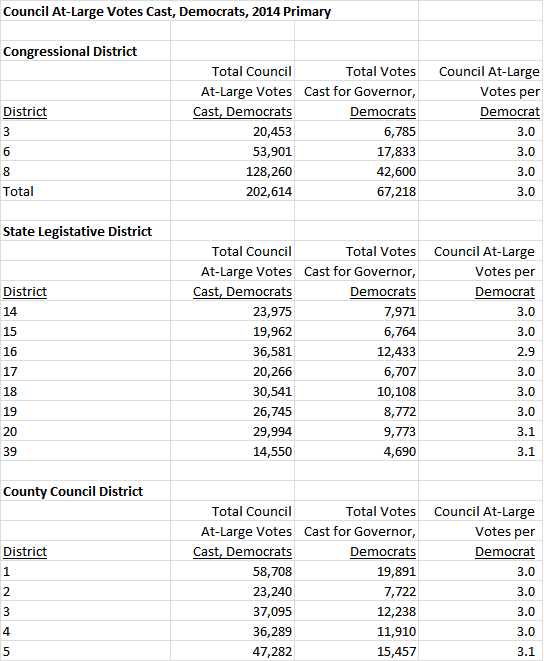
The chart below shows the total number of Council At-Large votes cast in the 2014 Democratic primary, the total number of Democratic votes for Governor and the ratio between the two from precinct votes on Election Day.  (Precinct-level turnout numbers from the state include early voters, absentee voters and provisional voters, distorting their use as a denominator, so we used votes for Governor as a proxy for Election Day voters by precinct.)  On average, each Democratic voter cast three votes for Council At-Large candidates.  That statistic varied very little between Congressional districts, state legislative districts and council districts.

Let’s take a deeper dive and look at local areas.  Again, there is minimal variation.  A mild outlier is Precinct 11-00 in Dickerson, home of at-large challenger Beth Daly.  Was there some undervoting there for Daly and her 2014 teammate, at-large incumbent Marc Elrich?  (The two finished first and second in that precinct and smoked everyone else.)  One note: the term Democratic Crescent refers to Cabin Branch, Bethesda, Chevy Chase, Kensington, Downtown Silver Spring and Takoma Park, areas which tend to exert disproportionate impact on Democratic primaries.

Over and over, we have seen that the average Democratic primary voter casts three votes for Council At-Large candidates.  That statistic has been stable over time and does not vary much by voting mode (early, election day, absentee or provisional), geography, presence of open seats or candidate count.  We see no reason why it would be significantly different in this election.  What does that mean?

One obvious implication relates to one of the hottest places to find votes in a MoCo primary: the Downcounty areas of Downtown Silver Spring, Takoma Park and nearby locations to the north and northeast.  Hans Riemer, Evan Glass, Will Jawando, Danielle Meitiv, Chris Wilhelm, Brandy Brooks, Seth Grimes, Cherri Branson, Jill Ortman-Fouse and Jarrett Smith are among the candidates who are from there and/or are running hard there.  If each voter is only voting for three at-large candidates, there simply are not enough votes to go around for all of the above candidates.  Who emerges from that scrum?

Riemer ought to finish first in that area.  He is not just the only incumbent in the race; he also finished second in Downtown Silver Spring, Takoma Park and Kensington to Marc Elrich in 2014, his best places of finish anywhere in the county.  The next tier might be Glass, Jawando, Ortman-Fouse and Grimes, all of whom have done well in prior races in that area.  How many votes are available there for anyone else?

One of the greatest challenges of running for Council At-Large is how to allocate scarce resources across a vast county-wide electorate in the face of lots of competition and other draws on voters’ attention.  Those candidates who successfully target the voters who align with their values, message, bio and (in some instances) demographic will have a leg up on their less strategic rivals.  With only three at-large votes per voter, the premium on strategic engagement is higher than ever.  It might just be decisive in an exciting and historic race.

Share

Glendening Endorses Milano

Former Governor Parris Glendening has endorsed District 18 House candidate Leslie Milano.  We reprint her press release below.

*****

Former Maryland Governor Parris Glendening Endorses Leslie Milano, D18 Delegate Candidate

For Immediate Release Contact: Janiene Bohannon, Communications Director

janiene@milanofordelegate.com

(Silver Spring, Md., April 14, 2018) – Former Maryland Governor Parris Glendening endorsed Leslie Milano for the House of Delegates, District 18 today.

Milano—a respected public health executive, human rights advocate, and mother of two—is running on a platform of socially-responsible economic growth, expanding the renewable energy sector, and addressing school overcrowding for Marylanders. Glendening served as the Governor of Maryland from 1995-2003, and was previously the County Executive of Prince George’s County from 1982-1994.

“For the last 15 years I have worked with advocates and elected officials around the country and the world on efforts to protect our environment,” said Glendening. “Leslie’s focus on transit, walkable, sustainable communities and solar energy will make her a leader in efforts to protect our environment and our planet. She understands good environmental policy is good for the economy. She knows Maryland can be a leader in making alternate energy an important part of our economy. That is why I am enthusiastically supporting Leslie Milano for election to the Maryland House of Delegates.”

Glendening added, “I’ve been involved in Maryland politics for four decades, and as governor, I worked closely with the Maryland House of Delegates to help working families. Leslie Milano brings strong Democratic values, business experience and an innovative approach that isn’t typical in today’s politics.” He continued, “In our current political climate, we need strong women at every level of government, and Leslie Milano is a bright, savvy emerging leader for Maryland.”

At the age of 25, Milano co-founded a nonprofit labor rights organization dedicated to improving conditions for factory workers abroad. She gave lectures on 300 college campuses and business schools focused on corporate social responsibility, and helped to end certain labor abuses affecting hundreds of thousands of women workers. For the past six years, Milano has been the executive director of a public health consulting organization dedicated to patient safety. She has negotiated multi-million-dollar contracts with state and federal agencies to successfully reduce healthcare-associated infections in U.S. hospitals and nursing homes.

“For District 18 and beyond—whether it be education, gun violence prevention, healthcare or workforce development—we can be the progressive leader that builds coalitions with other progressive states to move our country in the right direction,” said Milano. “An endorsement from Gov. Glendening is very meaningful given his long, successful career in public service for Maryland at the highest level of our state government.”

Milano has also received the candidate distinction from Moms Demand Action for Gun Sense in America, a leading gun violence prevention organization. Milano holds two master’s degrees in Theology/Ethics from Union Theological Seminary and International Public Policy from Johns Hopkins University, as well as a certificate of leadership from Harvard University’s Kennedy School of Government. For more information about Leslie Milano, visit www.milanofordelegate.com.

Currently eight Democratic candidates are running for three seats. The primary is June 26, and early voting starts June 14.

###

Share

Maryland Politics Watch