
Taxpayer Flight from MoCo, Part Two

By Adam Pagnucco.

As we stated in Part One, the IRS tracks the inflow and outflow of returns, exemptions and adjusted gross income (AGI) for all states and counties.  Comparable data starts in 1993 and continues through 2016.  Here is what that data looks like for Montgomery County.

First, let’s look at the inflow and outflow of tax returns, which approximate the number of households.
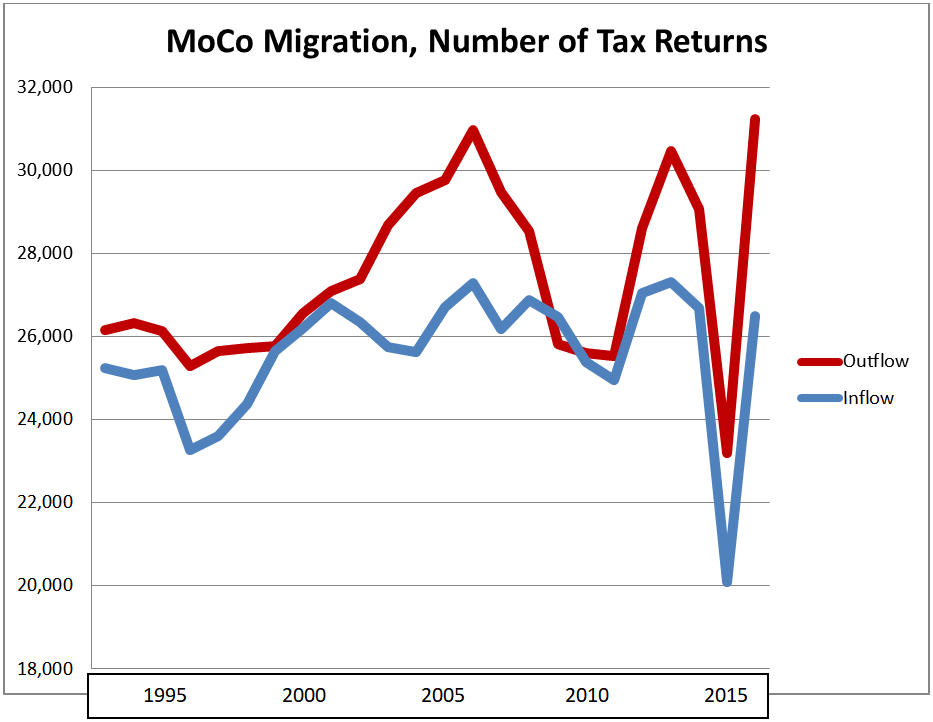
For most years, the number of tax returns leaving has exceeded the number of tax returns entering.  The chief exceptions have occurred during economic downturns, especially in the aftermath of the Great Recession.  We are skeptical of the data for 2015: there is no apparent explanation for the enormous drop in both inflow and outflow in that one year.  We saw those drops in every local jurisdiction we examined and they did not seem to produce huge swings in net changes, as we will see.

Below is the net change of tax returns (inflow minus outflow).

The net migration of tax returns – inflow minus outflow – tends to shrink during recessions but it is almost always negative.  Since 1993, there was only one year when inflow exceeded outflow – 2009, when tax return migration was +658.  In 2016, outflow exceeded inflow by 4,748 returns – the worst year on record.  The migration of exemptions, in and out, has followed similar patterns.

Now let’s look at the migration of adjusted gross income (AGI).  The chart below shows the total AGI of taxpayers migrating into Montgomery County and out of Montgomery County, adjusted for inflation and measured in millions of 2016 dollars.
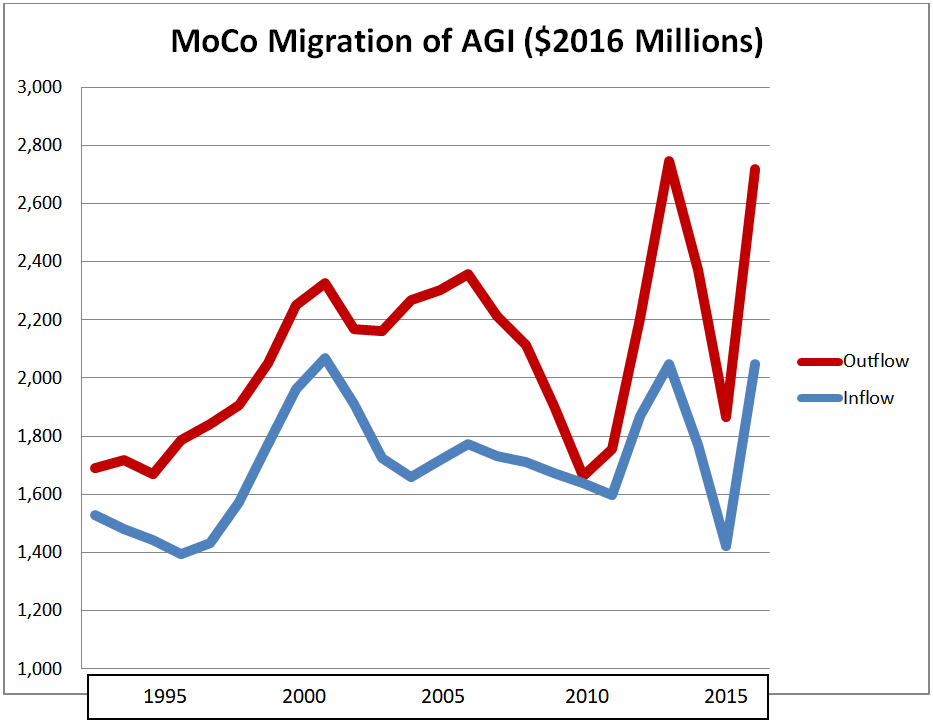
Outflow has exceeded inflow in every year.  Note, once again, the fluky data for 2015.  Below is the net change, adjusted for inflation, in millions of 2016 dollars.

Every year has seen a net loss of adjusted gross income.  The year which came closest to a wash was 2010, when $24 million was lost.  The worst losses on record were in 2004 ($608 million), 2013 ($697 million), 2014 ($601 million) and 2016 ($672 million).  Over the five-year period of 2011 through 2016, $2.75 billion of taxpayer income left Montgomery County on net.

The IRS data tells one more story.  Thousands of taxpayers enter MoCo and thousands leave MoCo every year.  But on average, those who enter have lower adjusted gross incomes than those who leave.  The chart below shows the average AGI of in-migrants and out-migrants in 2016 dollars.
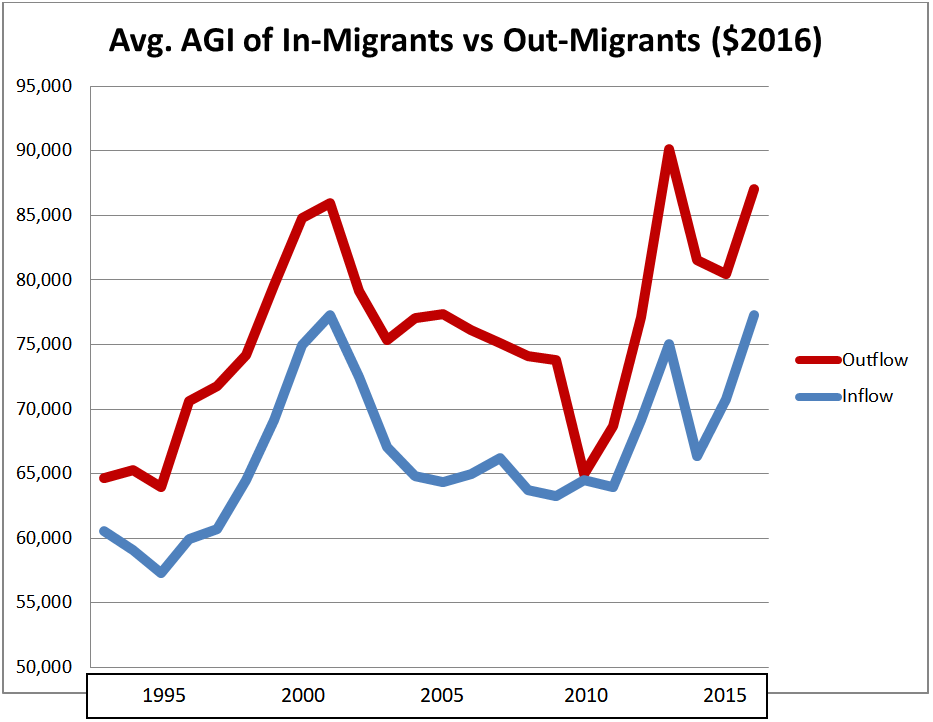
Since 1993, out-migrants have had greater adjusted gross incomes than in-migrants by an average of 14%.  In the 2011 to 2016 period, the average AGI of in-migrants was $71,707 in 2016 dollars while the average AGI of out-migrants was $83,262 – a gap of 16%.

One can only imagine the impact on the county’s budget when hundreds of millions of dollars in taxpayer income leave every year.

Montgomery County is not the only jurisdiction in the region to see a net exodus of taxpayer income.  We will examine how MoCo compares to its large neighbors in Part Three.

Share

SEIU Local 500 Endorses “Take a Hike Mike” Candidates

By Adam Pagnucco.

As part of its campaign against Senate President Mike Miller, SEIU Local 500 has endorsed eleven State Senate candidates whom it believes will “change the leadership in the State Senate and, most importantly, change the way things are done in the legislature.”  One of the candidates is Tommi Makila, Miller’s primary election opponent.  The union has previously announced its support for some of these candidates, like Dana Beyer in District 18 and its own member, Aletheia McCaskill, in District 44.  We reprint the union’s press release below.

*****

For Immediate Release
May 7, 2018
Contact: Christopher Honey
honeyc@seiu500.org,

SEIU Local 500 Endorses eleven “Take a Hike Mike” Candidates
Union is supporting candidates that support new leadership in Annapolis

(Gaithersburg, MD) Today, Service Employees International Union Local 500 announces it has selected its initial eleven candidates across the State of Maryland whom they believe will go to Annapolis and change the leadership in the State Senate and, most importantly, change the way things are done in the legislature.

“We need to elect people who will stand up against the status quo in the State Senate. That is why, today we are announcing our support for a team of Senate candidates who will do what it takes to get the people’s business done” said Merle Cuttitta, President of SEIU Local 500.

“We will be supporting this team of candidates with our trademark boots on the ground, digital, paid mail and earned media. We intend to send the message loud and clear that a vote for these candidates is a vote for progress in Annapolis,” added President Cuttitta.

The following candidates are being endorsed today:

District 10 (Baltimore County) – Rob Johnson

District 11 (Baltimore County) – Sheldon Laskin

District 18 (Montgomery County) – Dr. Dana Beyer

District 23 (Prince Georges County) – Tim Adams

District 25 (Prince Georges County) – Delegate Angela Angel

District 27 (Prince Georges, Calvert and Charles Counties) – Tommi Makila

District 40 (Baltimore City) – Delegate Antonio Hayes

District 41 (Baltimore CIty) Senator Jill Carter

District 43 (Baltimore City) Delegate Mary Washington

District 44 (Baltimore City and County) – Aletheia McCaskill

District 45 (Baltimore City) – Delegate Cory McCray

*   *   *

Share

The Progressives’ Big Gamble

By Adam Pagnucco.

One of the more remarkable things occurring in MoCo this cycle is the snowballing of progressive groups around District 3 County Council challenger Ben Shnider.  Just look at our latest endorsement chart.  Shnider, who was virtually unknown a year ago, has collected about as many progressive endorsements as much better known politicians like Council Members Hans Riemer and Nancy Navarro, Delegate Ana Sol Gutierrez (running for Council District 1) and Council At-Large candidate Will Jawando.  That’s a challenge for Shnider’s opponent, incumbent Council Member Sidney Katz, but it’s a challenge for the progressive groups too.

Sidney Katz is an odd target for progressives – and basically anyone else.  Consider this: he has been an elected official at the municipal or county levels for forty years and no one dislikes him.  Generations of Gaithersburg residents think of him as Dad, an uncle or Grandpa.  No one would paint him as a conservative – for Heaven’s sake, he voted for a nine percent property tax hike along with the rest of the council two years ago.  He has also voted for nearly every other progressive initiative passed by the council, including more school funding, more non-profit support, bills establishing sick leave and parental leave and almost everything else.

But there is one glaring exception: Katz was one of four Council Members who voted against the 2016 minimum wage bill which was then vetoed by County Executive Ike Leggett.  That bill had incredible symbolic importance for many of MoCo’s liberal groups, who viewed it as a litmus test for determining which elected officials were true progressives.  Katz’s efforts to forge a compromise and get a different version of the bill passed later did not mollify the left.  For them, the damage was done.  And someone’s head had to roll.  But whose?

Four Council Members – Katz, Roger Berliner, Nancy Floreen and Craig Rice – voted against the first bill and Leggett vetoed it.  Leggett and Floreen are term-limited and retiring.  Rice has only token opposition in his Democratic primary.  Berliner is running for Executive, an election in which progressive groups would be aligned with minimum wage lead-sponsor Marc Elrich regardless of the bill vote.  That left Katz, the only opponent of the original bill against whom the left had a clear shot.  And in Ben Shnider, the left has a challenger who is appealing, smart, hard-working, experienced in campaigns and an unquestioned progressive.

SEIU Local 500, a lead player in advocating for minimum wage hikes at the state and county levels, was the first major progressive group to endorse Shnider.  Many more followed, including SEIU Locals 32BJ (janitors) and 1199 (health care), Progressive Maryland, the Laborers, Casa in Action, the teachers and more.  The Sierra Club’s endorsement of Shnider was probably connected to another vote of Katz’s, this time against a bill banning pesticides.  Katz is supported by the police and fire fighters unions, the volunteer fire fighters and the apartment and office building owners.  MCGEO is the largest progressive group to not yet weigh in.

Shnider pressures Katz on the minimum wage bill.

Knocking off an incumbent is not easy.  Indeed, only one Democratic district council incumbent has been defeated since the County Council’s current structure was established in 1990 and that happened twenty years ago.  In the last six times that a Democratic district council incumbent was challenged, the incumbent won by 50 or more points five times.

Ben Shnider has nothing to lose by challenging Katz.  He is running a tremendous campaign and has built great relationships with the left and the smart growth community.  If he loses, he could very well come back to win another election as so many other MoCo politicians have.  Win or lose, Shnider will be just fine.

But what about these progressive groups?  The fact that so many of them have endorsed Shnider has MoCo’s political community watching this race – especially the county’s elected officials.  The left will have many priorities in the next term and some will cost serious money and political capital.  If these groups actually knock off Katz – or come close – then no one will want to run afoul of them in the future.  But if they do nothing other than allow Shnider to use their logos and Katz wins big, they will look weak.  Other elected officials will think, “They can’t hurt me so I can do what I want.”  Let’s remember that for most politicians, the main thing on their minds is ALWAYS whether a group can help them or hurt them.  If you can’t do either, you just don’t matter.

The progressives are making a big gamble by targeting Sidney Katz.  For their sake, it better pay off.

Share

Taxpayer Flight from MoCo, Part One

By Adam Pagnucco.

We have been printing a ton of posts about the economy on Seventh State, including discussions of our employment and income growth, our rate of business formation, our increasing reliance on corporate welfare to attract and retain employers, the role of economic growth in creating the county’s $120 million budget shortfall and reactions from County Executive candidates and gubernatorial candidate Kevin Kamenetz. Let’s be clear: as we wrote eleven years ago, without economic growth, we will not be able to meet our needs without more tax hikes in the future.  And today, we begin presenting the following facts.

More taxpayers have been leaving Montgomery County than entering it for a long time.

The taxpayers who are coming in make less money than the ones who are leaving.

And while this has been going on for decades, it is now worse than it has ever been.

Our basis for these statements is a data series on tax migration maintained by the Internal Revenue Service (IRS).  As the IRS explains:

Migration data for the United States are based on year-to-year address changes reported on individual income tax returns filed with the IRS. They present migration patterns by State or by county for the entire United States and are available for inflows—the number of new residents who moved to a State or county and where they migrated from, and outflows—the number of residents leaving a State or county and where they went. The data are available for Filing Years 1991 through 2016 and include:

  • Number of returns filed, which approximates the number of households that migrated

  • Number of personal exemptions claimed, which approximates the number of individuals

  • Total adjusted gross income, starting with Filing Year 1995

  • Aggregate migration flows at the State level, by the size of adjusted gross income (AGI) and age of the primary taxpayer, starting with Filing Year 2011.

For every state and county in the U.S., the IRS tracks both inflow and outflow of returns, exemptions and adjusted gross income.  But that’s not all: the IRS reports the origin and destination jurisdictions of these flows.  So data users can see a situation in which County X has a net inflow overall but has a net inflow from County Y and a net outflow to County Z.  The directions of these flows, in an out, become apparent when the data is downloaded and crunched.

Over the next few days, we will publish the following statistics.

Montgomery County’s inflows and outflows of returns and adjusted gross income from 1993 (the first year in which comparable data is available) to 2016.

Inflow and outflow statistics for MoCo and its large neighbors – D.C., Frederick, Howard, Prince George’s, Alexandria, Arlington, Fairfax, Loudoun and Prince William – to provide perspective.

A listing of destination and origin jurisdictions of taxpayer migration between MoCo and its neighbors.  This will identify MoCo’s comparative advantages and disadvantages in taxpayer flow across the region.

Tomorrow, we will proceed.

Share

“Ever Feel Like Montgomery County Government Doesn’t Listen?”

By Adam Pagnucco.

That’s the title of the mailer sent out by Council District 1 candidate Meredith Wellington this week, which we reprint below.  The remainder of Wellington’s message is clearly directed at opponents of development, an ancient political tradition in MoCo.  But here is the thing: whether it’s fair or not – and we could make a case either way – pretty much everyone we talk to, regardless of their ideology, doesn’t believe the county adequately listens to them.  That message, distilled of ideological connotation, will travel far and wide.


Share

MD NARAL Endorses Rich Madaleno for Governor

Along with Rep. Jamie Raskin’s (D-8) support, this is the biggest endorsement to date received by the Madaleno campaign.

Choice, access to contraception and women’s health care are big issues, especially in this #metoo election. Additionally, U.S. House Republicans made reducing access to women’s health care services integral to their failed plan to gut the Affordable Care Act. So these issues are more salient than four years ago and MD NARAL’s imprimatur, always nice to have, is more valuable than usual.

Why did NARAL Pro-Choice Maryland endorse Rich Madaleno over his Democratic competitors?

For a start, though women form close to 60% of Democratic primary voters and are a critical constituency for any candidate, County Executives Kevin Kamenetz (D-Baltimore County) and Rushern Baker (D-Prince George’s) surprisingly did not submit questionnaires to MD NARAL.

Four other candidates – Ben Jealous, Alec Ross, Jim Shea, and Krish Vignarajah – were rated 100% by MD NARAL on their questionnaire responses. They will understandably tout this rating as good evidence of their staunch pro-choice and pro-women credentials.

Apparently, MD NARAL chose Madaleno over these four candidates based on his established record of not just supporting MD NARAL’s viewpoint on these questions but having delivered concrete legislative gains on a wide range of issues. As the Madaleno campaign explains in its press release:

Madaleno was the Democrat who protected funding for Planned Parenthood when it was attacked by Republicans in Congress in 2017. He has also co-sponsored a number of laws: to make feminine products available to homeless girls and women; to expand services to victims of sexual assault; and to ensure insurance coverage in Maryland for prescription contraceptive drugs and devices.

The full press release is below.

Share

The View From 2007

By Adam Pagnucco.

A long time ago in a galaxy far, far away, a newish county blogger and professor named David Lublin reached out to a then-young civic activist who had just gotten involved in local politics to write about the county’s economy and budget.  The activist, who had only lived in the county for three and a half years and was already raising Cain about a new Metro entrance in Forest Glen, was still figuring out what was going on but – what the hell – he agreed.  This was the genesis of my second blog post ever, written in April 2007.  (The first was a piece on the Apple Ballot the year before.)

The county’s economic pressures, which have drawn substantial attention on Seventh State, were apparent more than a decade ago.  Then as now, the county was dealing with short-term budget issues.  But over the long term, I wrote that the end of the real estate boom – which would lead to the Great Recession – would result in three choices to balance the budget and preserve county services: large tax hikes, slowing the rate of budget growth or encouraging economic growth to fund the budget.  Many things happened over the ensuing decade: dramatic budget cuts, equally dramatic tax hikes, warfare with the school system and the state over education funding, breaking of union collective bargaining agreements and more.  But in the end, more a result of just muddling through rather than any strategy, the county picked options 1 and 2 – tax hikes and slower budget growth – and not option 3, which was encouragement of economic growth.  Indeed, because our economy has been so stagnant since the recession, we are now discussing pretty much the same things I wrote about eleven years ago.

Will the next decade be different from the last decade?  Folks, that is what this election is about.  It’s all up to you.

Here is the piece from 2007 reprinted.

*****

In Montgomery County local races, four issues regularly rise to the top: education, development, traffic congestion and the environment, in no particular order. In last year’s elections, all four issues were discussed by the candidates – especially development. But this spring a fifth issue has risen to surpass all of them: the county’s difficult choices on the budget. The budget is not only an unavoidable issue because it is central to the functioning of the government – it also affects the ability of county leaders to deal with each of the above four issues that are important to voters.

The county has a short-term problem and a long-term problem with its budget.

The short-term problem appeared in the first budget submitted by our new County Executive. While Ike Leggett’s proposal for $4.1 billion in county spending was 6.3% higher than last year’s budget, the increase was below the prior year’s rate of 9%. Leggett pronounced recent budget growth “unsustainable” and declared that no county agency, including the schools, would get its entire budget request. Despite an aggressive lobbying campaign by public sector unions – especially the Montgomery County Education Association – the County Council seems likely to uphold the broad outlines of the County Executive’s proposal.

Furthermore, Council President Marilyn Praisner has identified a $269 million budget deficit for the fiscal year starting in July 2008. The deficit margin is about 7% – which is close to the increase recommended for this year. The council may very well combine a small tax increase with careful maintenance of core spending to deal with this deficit. This may be enough to avoid modifying the county’s labor contracts with its employees as the Council President has recently discussed.

As serious as the short-term problem is, it does not compare to the county’s budget issues of 1991-92 when it suffered from an economic recession. At that time, 7,000 county employees were furloughed for four days. Public employees occupied the council chambers, teachers engaged in a work slowdown and some public school students walked out of classes to protest potential cuts. No one is predicting similar upheaval this time.

However, the long-term budget problem represents a significant challenge. Since 1990, the county’s population growth has averaged 1.4% per year while its budget has generally grown 5-10% per year. In recent years, the county has managed this by depending on big increases in property tax receipts driven by its real estate boom. That real estate boom has ended and property tax receipts will soon reflect that. The county faces three choices in the long run:

1. Large tax hikes to fund budget increases. The danger here is that those tax hikes may slow the county’s economic growth rate even further, worsening its fiscal problems in the future.

2. Slowing the rate of county budget growth to equal the rate of economic growth. This would mean county budget growth of 1-2% per year. This would be insufficient to meet the standards of service to which residents have become accustomed. School, fire, police and health care costs are all increasing at faster rates even if the size of the relevant county departments remains unchanged. This budget growth rate would also be insufficient to adequately compensate county employees, and that would gradually damage one of the nation’s best-educated, least-turnover-prone local government workforces.

3. Systematically encouraging enough economic growth to fund the county’s budget.

The third option reveals a naked truth that was not commonly discussed during the last campaign: budget policy and development policy are inter-related. Over the long run, limiting economic growth will limit the ability of local government to serve its residents. But as any resident of Phoenix or Las Vegas would observe, economic growth has consequences for quality of life. The question of the last campaign was, “Should we have development or not?” But the real question is, “How can we have enough economic growth to pay for government services we need without driving existing residents crazy?”

Economic growth comes from two sources: population growth and job creation. If one of these occurs without the other, or if they occur in different geographic locations, the result is traffic congestion. The two should occur together, at similar rates, and in nearby locations. This has direct implications for county development policy.

In general, the county has three kinds of developable areas: the agricultural reserve, the four downtowns (Bethesda, Rockville, Silver Spring and Wheaton), and the rest of the county. Most residents agree that the agricultural reserve should continue to be protected for cultural and environmental reasons. That leaves the other two areas for consideration.

The four downtowns are unique assets in the county because they each have residential density, concentrated office space and pedestrian-oriented retail space all within walking distance of each other. A resident of Bethesda’s central business district (CBD) who also works in the CBD does not have to use his or her car every day. That individual can walk to work and walk to the grocery store on the way home. The fact that all of the amenities of life are concentrated in a walkable radius cuts back on car use, which cuts down on energy usage, greenhouse gases and pollution. It also reduces the need for road maintenance.

But many residents may want to live in one CBD and work in another. This means that the CBDs should be connected, preferably through transit. Bethesda is connected to Rockville, and Silver Spring is connected to Wheaton through Metro’s Red Line. Bethesda could be connected to Silver Spring through the Purple Line. And a bus rapid transit route from Wheaton to Rockville is the county’s top transit study request of the state government. If both of those projects go through, the county will have four inter-connected downtowns.

How could the county encourage economic growth in downtowns rather than sprawl in non-transit-accessible suburbs? In the downtowns, the county could use zoning text amendments (or more ambitiously, coordinated and complementary updates to master plans) to encourage transit-oriented CBD growth. In non-CBD areas, project area transportation reviews and robust school capacity tests would limit development outside the downtowns. This combination of measures would channel economic growth to the CBDs while minimizing the consequences of traffic congestion and pollution. The side effect would be to encourage the creation of downtown entertainment districts, each customized to reflect the unique cultural identities of each CBD.

For those who are uneasy about growth in downtowns, keep in mind the other two budget options: large tax hikes or gradually deteriorating government services. No local area in this country – even Montgomery County – is immune to the negative long-run effects of either (or both).

Share

MCEA Endorses Council Incumbents

By Adam Pagnucco.

The Montgomery County Education Association (MCEA), which represents MCPS teachers, has endorsed four County Council Members running for reelection: Craig Rice (District 2), Nancy Navarro (District 4), Tom Hucker (District 5) and Hans Riemer (At-Large).  The only Council Member running for reelection this year who has not been endorsed by MCEA is Sidney Katz (District 3).  The union has previously endorsed Katz’s opponent, Ben Shnider.

Also, MCEA has not endorsed in the County Executive race and may ultimately not do so.  That would echo the 2006 Executive primary, when neither Ike Leggett nor Steve Silverman could reach the union’s 58% threshold for support in its Representative Assembly.

We reprint MCEA’s press release below.

*****

For Immediate Release:

May 3, 2018

Contact:  Nikki Woodward

Anzer.woodward@gmail.com

MONTGOMERY COUNTY EDUCATION ASSOCIATION ANNOUNCES NEW COUNTY ENDORSEMENTS

The Montgomery County Education Association (MCEA), which represents more than 14,000 classroom teachers, guidance counselors, speech pathologists, media specialists, and other non-supervisory certified educators in the Montgomery County Public Schools system, has endorsed several candidates for elected office in Montgomery County.  Endorsed candidates will appear on MCEA’s “Apple Ballot” for the 2018 primary and general elections.

COUNTY COUNCIL AT LARGE:

Hans Riemer (new), Brandy Brooks, Chris Wilhelm, Will Jawando

COUNTY COUNCIL (DISTRICT):

District 1: Ana Sol Gutierrez

District 2: Craig Rice (new)

District 3: Ben Shnider

District 4: Nancy Navarro (new)

District 5 Tom Hucker (new)

BOARD OF EDUCATION AT LARGE:

Karla Silvestre

BOARD OF EDUCATION (DISTRICT):

District 1:  Dr. Judith (Judy) Docca

District 2:  Patricia (Pat) O’Neill

District 5:  Brenda Wolf

MCEA has not yet endorsed a candidate for County Executive for the June primary.

-30-30-30-

Share

SEIU Local 32BJ Endorses in Maryland Races

By Adam Pagnucco.

SEIU Local 32BJ, a gigantic building services union stretching from New England to Florida, has announced endorsements in Maryland races.  The local is not to be confused with SEIU Local 500, which organizes MCPS support staff, adjunct faculty and child care workers, but the two locals share many progressive views and are both powerhouses.  We reprint 32BJ’s press release below.

FOR IMMEDIATE RELEASE:

Thursday May 3, 2018

FOR MORE INFORMATION:

Julie Karant: jkarant@seiu32bj.org

UNION REPRESENTING 18,000 WORKERS IN MARYLAND AND D.C. AREA ENDORSES MARYLAND STATE & COUNTY CANDIDATES

Silver Spring, MD – Commercial office cleaners and private security officers from the Service Employees International Union (SEIU) 32BJ today announced their endorsements in races for Maryland State Senate and Delegate as well as Prince George’s and Montgomery County Council. “These candidates are dedicated to improving life for Maryland’s immigrant and minority communities,” said 32BJ SEIU Vice President Jaime Contreras. “They also understand that low-wage workers need and deserve a $15 minimum wage to support their families.”

MD Statewide

Ben Jealous

Governor

Brian Frosh

Attorney General

MD Senate

Craig Zucker

MD State Senate District 14

Jeff Waldstreicher

MD State Senate District 18

Will Smith

MD State Senate District 20

Jim Rosapepe

MD State Senate District 21

Paul Pinsky

MD State Senate District 22

Joanne Benson

MD State Senate District 24

Angela Angel

MD State Senate District 25

Jamila Woods

MD State Senate District 26

Antonio Hayes

MD State Senate District 40

Alethia McCaskill

MD State Senate District 44

Mary Washington

MD State Senate District 43

Cory McCray

MD State Senate District 45

Bill Ferguson

MD State Senate District 46

MD House

Anne Kaiser

MD State Delegate District 14

Eric Luedtke

MD State Delegate District 14

Pamela Queen

MD State Delegate District 14

Ariana Kelly

MD State Delegate District 16

Emily Shetty

MD State Delegate District 18

Jared Solomon

MD State Delegate District 18

Bonnie Cullison

MD State Delegate District 19

Marlin Jenkins

MD State Delegate District 19

Marice Morales

MD State Delegate District 19

David Moon

MD State Delegate District 20

Jheanelle Wilkins

MD State Delegate District 20

Darian Unger

MD State Delegate District 20

Jocelyn Pena Melnick

MD State Delegate District 21

Matt Dernoga

MD State Delegate District 21

Mary Lehman

MD State Delegate District 21

Alonzo Washington

MD State Delegate District 22

Erek Barron

MD State Delegate District 24

Jazz Lewis

MD State Delegate District 24

Dereck Davis

MD State Delegate District 25

Wala Blegay

MD State Delegate District 25

David Sloan

MD State Delegate District 26

Veronica Turner

MD State Delegate District 26

Gabriel Acevero

MD State Delegate District 39

Terrell Boston Smith

MD State Delegate District 40

Melissa Wells

MD State Delegate District 40

Nick Mosby

MD State Delegate District 40

Maggie Mcintosh

MD State Delegate District 43

Cheryl Glenn

MD State Delegate District 45

Luke Clippinger

MD State Delegate District 46

Brooke Lierman

MD State Delegate District 46

Robbyn Lewis

MD State Delegate District 46

Wanika Fisher

MD State Delegate District 47B

Jimmy Tarlau

MD State Delegate District 47A

Julian Ivey

MD State Delegate District 47A

Montgomery County

Marc Elrich

County Executive

Craig Rice

County Council District 2

Ben Shnider

County Council District 3

Nancy Navarro

County Council District 4

Tom Hucker

County Council District 5

Hans Riemer

County Council At-Large

Will Jawando

County Council At-Large

Brandy Brooks

County Council At-Large

Gabe Albornoz

County Council At-Large

PG County

Donna Edwards

County Executive

Victor Ramirez

States Attorney

Tom Dernoga

County Council District 1

Deni Taveras

County Council District 2

Jolene Ivey

County Council District 5

Krystal Oriadha

County Council District 7

Gerron Levi

County Council At-Large

Karen Toles

County Council At-Large

With more than 163,000 members in 11 states, including 18,000 in the D.C. Metropolitan Area and throughout Maryland, 32BJ SEIU is the largest property service workers union in the country.

Share

The Future of Montgomery County’s Economy

Today, I am pleased to present a guest blog by Kevin Kamenetz.

Montgomery County’s role as an economic engine for Maryland is in danger. The recent Sage Consulting report indicates that the county’s private sector employment has declined, job growth has all but stopped, and a precipitous decline in the number of new businesses created in the county suggests that the worst may yet to come.

Despite these challenges, it is critical to acknowledge, as others have, that Montgomery County remains a strongly managed jurisdiction that has been able to maintain a triple-A bond rating from all three major rating agencies. And according to state and federal averages, the unemployment rate in Montgomery remains lower than both the state and federal data. These figures are important indicators of general economic health, but the warning signs presented by this new report cannot be ignored.

We must work together to build upon the county’s strong foundation, and reframe Maryland’s role in economic development, if we are serious about reversing such troubling trends.

Montgomery County has already accomplished so much with Transit Oriented Development (TOD) and communities with multi-model transportation options for its residents. As the Baltimore County Executive, I have long-admired Montgomery County’s progress here, and have attempted to emulate much of that success, attracting more than $5 billion in private investment and developing the Baltimore region’s first TODs. We also created Greenleigh, a Traditional Neighborhood Design project patterned after Kentlands. And my successful effort to lure $1 billion in private investment in downtown Towson caused one outlet to suggest I have “Bethesda envy.” In many ways I do.

What I have recognized, and what Montgomery County already knows, is the value of promoting projects like these will get residents out of their cars and into town centers for ease and convenience. This is how we will rebuild our older shopping centers and strip malls into the vibrant places where people want to work and live.

Much like Montgomery County, Baltimore County has also been able achieve the coveted “triple AAA” bond rating. In fact, we are two of only 46 counties across the country to do so.

Moreover, we have also dealt with many of the same issues that Montgomery County now faces. When confronted with an aging population, stagnant job growth, and the threat of private sector migration, we took a unique approach. We doubled-down on our own assets to attract new jobs, while focusing on employer needs to build a job-ready workforce.

Following the end of a century of steelmaking, I led the largest industrial redevelopment on the East Coast at Tradepoint Atlantic, which is now attracting “millennial-bait” companies such as Under Armour, Fed Ex and Amazon, as well as other port-related activity. Today, there are more people working at Sparrows Point than when the former Bethlehem Steel mill closed in 2012. These businesses are projected to add 17,000 new jobs when the global logistics hub is fully developed in the next five years.

Meanwhile, we opened a two-way dialogue with our existing employers and launched Job Connector, an innovative $2.5 million program that partners with companies, labor trades, schools and colleges to build a job-ready workforce. This employer-driven supply-and-demand strategy not only helps us keep our unemployment rate low, but it gives us a competitive advantage to retain key employers — and jobs they create — here in the state.

Together these approaches to economic development are transforming job prospects and economic opportunity for the entire region.

This progress has been bolstered by efforts to strengthen the foundation of any economy: a thriving educational system. Through Baltimore County’s unprecedented $1.3 billion program to build or rebuild 90 schools, as well as introduction of a Community College Promise program that will offer a debt-free education to qualified students, we are making the long-term investments to prepare a new generation for a 21st century workforce.

The kicker? We have accomplished all of this without ever once raising the property tax or income tax rates during my 8 years and Executive and 16 years as Councilman. In short, we’ve shown that we can be economically bold, while also being fiscally prudent.

Every one of Maryland’s 24 jurisdictions — including Montgomery and Baltimore Counties, and especially the independent jurisdiction of Baltimore City, face new and evolving challenges. Montgomery County cannot and should not be expected to face these challenges alone.  That is why Valerie Ervin and I want to work together as your next Governor and Lt. Governor to build upon these successes for the entire state of Maryland.

Together we can ensure that Montgomery County remains one of our state’s key economic drivers for generations to come.

Kevin Kamenetz is the Baltimore County Executive and a Democratic candidate for governor.

Share

Maryland Politics Watch