Marc Elrich Responds to Adam Pagnucco

Today, I am pleased to present a guest blog by Councilmember Marc Elrich (D-At Large), a candidate for county executive, that responds to a piece posted by Adam yesterday:

First of all, I’ve made my views pretty clear on “socialism.”  You would be hard-put to classify me, but I’ve been pretty clear that I think in terms of blending aspects of both major isms – which is pretty much what most European societies, which are largely democratic socialist, believe and what modern American society reflects, at least up to the present, with minimum wages, 40 hour weeks, social security, Medicare, child worker laws and health insurance.  My interest is in finding solutions that make sense – I’m not an idealogue. I have spent 12 years on the Montgomery County Council and I have yet to introduce a SINGLE piece of socialist legislation (whatever that is). I don’t think about my job that way.

 Most of what I’ve proposed over the years has been passed with 8-1 or 9-0 votes, so this fear of “socialism” is frankly nuts – I don’t have a socialist agenda that I’m trying bring here.  Now if socialism means expecting developers to adequately contribute to schools and transportation, I’ll point out that that’s not socialism, it’s simply not wanting to allow developers who substantially benefit from public decisions on zoning, to externalize the costs of providing infrastructure on to the public.  I do not believe in zero growth – I believe in responsible growth – and when I work with communities I’m pretty straight-forward about stating that change will come and my goal is to make sure that the people who live here participate in shaping that change. When there’s no viable plan for schools, or transportation, or other promised amenities in a Master or Sector Plan then, yes, I will and do vote against it.  Again, hardly socialism.

Second I never equated transit-oriented development with “ethnic cleansing”, I voted for the Purple Line which I wouldn’t have done if I thought that. I never said that TOD equates with “ethnic cleansing” and my BRT approach supports TOD.  I made a specific accusation about a specific planning board recommendation about a specific part of the plan that would have displaced thousands of people who would have had little to no chance of remaining in the area, let alone in the County.  The only nexus to the PL was that the plan was being done in response to it and, in this case, the Planning Board way over-reached. In a public session review of the plan, I said, “Couldn’t we for once just let the people who live here stay here after we fix a place up?” and no one responded or changed anything.  It was only when I dramatized it by calling it “ethnic cleansing”, in an onsite meeting with staff of the Council and PB, did anything get fixed: less than a week later the proposal was withdrawn; it was withdrawn on July 22, 2013 because of the possible implications of the zoning that had been proposed and its impacts on our affordable housing goals. The recommendation to remove was a 3-0 vote on committee, and it happened in a blink of the eye. Never seen so much land rezoned so fast. So in that particular instance, existing affordable housing was preserved because of my comments and involvement.   More broadly though, the PL will cause gentrification and almost everyone involved, except for a few who are uncomfortable with confronting anything that might taint their rosy scenario, knows it. The whole point of the Purple Line Compact was to create a multi-party agreement between the State and the Counties to have in place programs that would prevent, or at least minimize, the displacement of small businesses and existing residents. Everyone knew this was coming, and my saying it isn’t some stark new revelation.  But we all know that there is no compact because none of the parties would commit do anything to ameliorate what they know is coming down the road. So they changed the word “compact” to “agreement” which is toothless, devoid of funding or requirements to act; it is basically an agreement to worry about what might happen and to hope that someone comes up with a bright idea or two that, preferably, don’t have any costs attached.

Lastly, while I do favor a limited rent stabilization – one that would allow for larger rent increases for repairs or operating costs when they exceed the CPI, and it would not apply to new construction or buildings with existing MPDU’s or otherwise rent limited units – I never had the votes on the council to even discuss it and would expect the same from the next council. I would welcome an honest conversation about it, without any labels attached. I’ve always proposed that the County evaluate different strategies with an eye to what would result in the largest stock of affordable housing 20 or 30 years down the road.  And I’d be interested to hear how others would solve the problem of disappearing affordable housing: the recently approved Bethesda master plan would result in fewer affordable units than we have today. And we simply can’t build enough moderately priced dwelling units (MPDUs) to keep up. And we’re not building housing for the thousands who are too poor for MPDUs and spend 50-60% of their income on housing. By contrast, Takoma Park has had decades of rent stabilization, which has provided numerous families with stable housing. It’s not a perfect system but it has been an important tool to preserve affordable units as the area has grown in popularity and housing prices there have skyrocketed.  And Takoma Park has increased in desirability and popularity and is proud of its diversity of population.

So while the urban legends are amusing, they’re not who am and they don’t reflect what I do.

Share

Remembering Kevin Kamenetz and Valerie Ervin’s Decision

I spend a lot of time (too much time) watching candidates and talking with them. Being from Montgomery County, I didn’t really know much about Baltimore County Executive Kevin Kamenetz before he entered the race.

Remembering Kevin Kamenetz

I had a chance to sit down and talk with him and watched him in debates and forums and he kinda grew on me. He wasn’t the best public speaker in the race but he had a long record of political involvement and experience that meant he could talk easily and in detail about many of the key issues facing Maryland.

Even more critically, he had grappled with many of them. As a result of this experience and representing a swing county, Kamenetz understood that people have a wide range of views and issues are often complicated but also how to make progress on them.

But until I read an article recapping his career in the Baltimore Sun, I didn’t know about Kevin Kamenetz’s work on affordable housing:

Housing was also a battleground in the changing county. Many fought against a program in the 1990s to allow poor city residents to move to the county. The NAACP and other groups filed a federal housing complaint against the county in 2011 alleging discriminatory policies.

It was resolved in 2016 with an agreement signed by Kamenetz that calls for the county to spend millions of dollars to support the construction of affordable housing in neighborhoods lacking it.

“I think it was his leadership that brought the administration to the plate,” [NAACP County Branch President] Fugett said. The settlement “may not be a popular decision,” Fugett said, but Kamenetz “always tried to do the right thing.”

Affordable housing is one of the most unbelievably difficult issues. Localities will go to the mat and beyond to fight the placement of low-income housing in their area. It’s a difficult issue and powerful efforts to force acceptance of affordable housing have usually failed in the face of strong opposition.

In short, there was no political hay to be made on this issue. Nevertheless, Kamenetz got it done, and he got it done in a very low key manner. One of the secrets of politics is that the best accomplishments are often the ones that go unnoticed precisely because they were done carefully in a way that minimized opposition and thus allowed progress to be made.

In an era that celebrates newness, often derides political experience and increasingly celebrates radical change, this sort of politics is underappreciated. Unlike sweeping promises that die on the rocks of reality, getting this done will make a meaningful difference in real people’s lives.

Valerie Ervin’s Decision

In the wake of Kevin Kamenetz’s untimely and sad passing, many of us learned for the first time that Maryland law allows the surviving running mate of a gubernatorial candidate to choose a new running mate and even to switch positions on the ballot. Consequently, Valerie Ervin can now run for governor or lieutenant governor and select a new running mate.

She has to make a decision quickly. Speculation has naturally ensued about what she will decide. While Donna Edwards, Ervin’s longtime friend, has encouraged her, I’ve heard other voices that are more critical of an Ervin bid.

I say it’s up to Valerie Ervin and we should respect her decision whatever it is. Kamanetz and Ervin made a good team and seemed to work well together from what I could see. Beyond that the law clearly gives Ervin the right to run, I see nothing wrong with her choosing to do so.

I imagine she would consult with the Kamenetz-Ervin team, especially with the Kamenetz family. Ervin has already indicated she plans to speak with Jill Kamenetz but I think everyone also understands that this suddenly widowed mother of two kids is coping with an enormous and shocking personal loss.

I don’t know what the law will say about access to the funds that Kamenetz raised for his campaign – they are not in a joint account. I also don’t know how it will impact the race if Ervin runs. The Washington Post quoted speculation that it might hurt Ben Jealous and Rich Madaleno, my preferred candidate. But honestly, who knows at this point in a very fluid election.

Regardless, I think it’s Ervin’s decision. We should respect it and move on with the campaign. Of course, she would rightly face the same scrutiny as any other candidate. And that’s how it should be in any healthy democratic competition. But, her decision to run shouldn’t be the issue.

Share

These Public Financing Candidates Are Done

By Adam Pagnucco.

Update: Even though the deadline is May 12, the State Board of Elections said on March 30 that they will allow a candidate to file for matching funds as late as tomorrow (May 15) provided that all qualifying contributions were received by May 12.  We will see if any of the above candidates file reports by tomorrow night.

Original Post: According to Montgomery County’s public campaign financing law, candidates have until 45 days before the primary election to qualify for public matching funds.  Since the primary is on June 26, the qualifying period ended on Saturday, May 12.  According to filings with the State Board of Elections, the following candidates did not qualify for matching funds by then and will not be receiving them.

Rosemary Arkoian – At-Large

Richard Banach – District 1

Craig Carozza-Caviness – At-Large

Bill Cook – District 1

Robin Ficker – County Executive

Lorna Phillips Forde – At-Large

Richard Gottfried – At-Large

Neil Greenberger – At-Large

Kevin Harris – District 5

Kenge Malikidogo-Fludd – District 5

Jim McGee – District 1

Melissa McKenna – At-Large

Darwin Romero – At-Large

In addition, Bethesda Magazine reported that these candidates were ruled ineligible for matching funds because their submissions to the State Board of Elections did not meet the thresholds of either in-county contributors or in-county money received to qualify.

Shruti Bhatnagar – At-Large

Loretta Garcia – At-Large

Paul Geller – At-Large

Michele Riley – At-Large

Tim Willard – At-Large

These eighteen candidates represent almost half of the thirty-eight active candidates in public financing.  Starved of resources and unable to get their messages out, none of them will be elected.

Share

The Power of Traditional Gender Roles in Maryland Elections

The share of women among officeholders varies dramatically based on the office type. While my previous posts focused on Congress, I’m going to focus today on countywide offices because they vary nicely in terms of job responsibilities.

Below is a table showing the party (D = Democratic, R = Republican) and gender (M = Man, W = Woman) for four offices elected in 2014 in all 24 Maryland jurisdictions. County executive is also included for counties with that office.

Source: Maryland Manual.

Closer examination of the data reveals that women hold some of these offices far more often than others. Women are more far more likely to occupy positions as Circuit Court Clerk and Register of Wills than County Executive, Sheriff and State’s Attorney.

Traditional gender roles cast women as fairer and more process-oriented than men who are seen as having stronger leadership skills along with greater physical strength and a propensity for violence that lends itself to fighting off threats. The types of offices more often held by women reflect these roles. Women are much more likely to hold clerkship or process-oriented offices than executive leadership or crime-focused positions.

Circuit Court Clerks and Registers of Wills oversee the careful organization, administration, and collection of detailed important records as well as related taxes and fees. Fair process and administrative ability are central to each position. In Maryland, 67% of Registers of Wills and 42% of Circuit Court Clerks are women.

In contrast, while these same abilities are no doubt useful for County Executives, Sheriffs, and State’s Attorneys, people see them more as positions requiring leadership and crime fighting skills. Not a single Maryland Sheriff is a woman. Though women now form nearly one-half of attorneys and a majority of law students, only 17% of prosecutors, or State’s Attorneys, are women. Among Maryland’s nine county executives, 22% are women.

(Note: my reporting on the continued power of gender roles is neither meant as an endorsement of them nor a suggestion that many men and women do bot perform all of these offices well.)

Women form a higher share of Democratic than Republican officeholders. These differences may result from a variety of factors about which I can only speculate. Republicans are more likely to hold traditional values regarding gender norms while women form a higher share of Democratic primary voters. Democrats may also simply perform more strongly in areas more amenable to female officeholders but this may relate to the same factors.

These differences are similar to what I found in an article coauthored with Sarah Brewer, a former AU graduate student and now Ph.D., published in Social Science Quarterly that studied the election of women to county offices in the South in the 1990s.

Source: David Lublin and Sarah E. Brewer, “The Continuing Dominance of Traditional Gender Roles in Southern Elections,” Social Science Quarterly 84: 2(June 2003), pp. 386-7.

Untangling the causes of these differences is difficult. This sort of work cannot really speak to the extent that these differences result from electoral barriers or career choices stemming both from the environment or other gender differences.

Candidate Supply

Candidate supply is an easily overlooked factor that needs to be considered. Just as there may be more female Democratic officeholders because more women are Democrats, demographics relating to the gender composition of high-quality candidate pool also influence the probability that a woman holds an office. Sarah Brewer and I found that women are more likely to win in areas with large numbers of African Americans or senior citizens.

Why? At the time of our study, men tended to be better educated than women among whites, while the gender gap in education was reversed for African Americans. As a result, women formed a higher share of the high-quality candidate pool in counties with high African-American populations.

According to the 2016 American Community Survey (ACS), similar racial and gender differences in educational attainment exist in our state. Among whites, 42.6% of men and 41.9% of women hold a bachelor’s degree or higher. In the African-American community, 29.9% of women but only 25.2% of men have a B.A. degree or higher.

Though older voters are usually seen as more traditional than younger voters, women may perform better in counties with high concentrations of seniors for another depressing reason (at least from my end): women live longer than men. The 2016 ACS reports that 57.0% of Marylanders 65 and older are women compared to just 50.7% of under 65s.

Share

What the Post’s Endorsement of Blair Means

By Adam Pagnucco.

The Washington Post’s endorsement of businessman David Blair hit like a grenade this past weekend, blowing up the County Executive race.  What does it mean?

First, in reading the language of the Post’s endorsement, we are struck by how closely their views on the challenges facing the county resemble our own.  The majority of these opening three paragraphs mirror what we have been writing about the county economy for years.

These seem like boom times in Montgomery County, the mainly rich suburb that has absorbed roughly 100,000 new residents since 2010 to a population now approaching 1.1 million. Amazon (whose CEO, Jeffrey P. Bezos, owns The Post) has shortlisted the county for its second corporate headquarters; construction cranes tower over Bethesda and Silver Spring; and the public school system, one of the nation’s largest, includes some of the best high schools anywhere.

That’s why it’s easy to overlook some ominous signs of fiscal and economic trouble ahead. A burgeoning population of retirees, immigrants and other less affluent residents has strained local resources and budgets. Those moving into the county tend to be poorer than those leaving. The chasm between economically prosperous pockets (such as the ones dominated by cranes) and stagnant ones is widening. Most worrying, business and job growth are anemic.

That’s the unsettling backdrop for the June 26 Democratic primary, which is likely to determine who will run the county for the next four years. County Executive Isiah Leggett, a deft and capable manager, is retiring after 12 years in the job (and no Republican has won an election in Montgomery since 2002). The central question is which of the candidates for county executive is most capable of juicing a sluggish commercial environment — the only way to broaden the local tax base so it can sustain the county’s excellent schools and progressive services.

The Post framed the election’s central question correctly.  And their policy view, clearly established in the language above, will no doubt influence their choices for County Council.  That said, they do not share your author’s view that governing experience is useful for addressing these challenges.  So be it.

The Post has a pretty good record in top-tier MoCo Democratic primaries.  They endorsed Chris Van Hollen (CD-8) in 2002, Ike Leggett (County Executive) in 2006 and 2014 and John Delaney (CD-6) in 2012.  They also endorsed Kathleen Matthews (CD-8) in 2016, who finished third.

Even so, the Post is not a king-maker; one of the good things about MoCo politics is that we have no king-makers here.  But their endorsement matters, especially when five candidates are vying to be the chief rival for Marc Elrich.  Consider what Roger Berliner (your author’s choice), Bill Frick or Rose Krasnow would have said if they had gotten the Post endorsement.  If Berliner had received it, he would have told non-Elrich voters, “I am the one who combines the Sierra Club, moderates, District 1 voters and now the Post.  I’m the alternative to Elrich.”  Frick would have said something similar while substituting realtors for the Sierra Club.  If Krasnow had received it, she would have said, “I am the only woman in a primary in which sixty percent of voters will be women and now I have the Post.  I’m the alternative to Elrich.”  None of these things can be said now.  All three lose the opportunity to leverage the Post endorsement to expand outside their geographic bases.

It is sometimes said that Elrich has a ceiling.  Some voters will find a decades-long socialist who equates transit-oriented development with ethnic cleansing and favors rent control unappealing.  But Blair has a ceiling too.  That was expressed by a commenter on Seventh State’s Facebook page who wrote, “I don’t want a businessman political newcomer who is trying to buy the election.”  Fair or not, that is a common sentiment among Democratic activists, and those who feel this way are not persuadable on this point.  Blair can send them thirty mailers and they won’t budge.  How many rank-and-file voters have this view?  David Trone, who shares this handicap, received 22% of MoCo’s vote in the 2016 Congressional District 8 race.  That’s an imperfect analogy because CD8 omits some relatively moderate areas in MoCo’s Upcounty and Trone was not talking about the unpopular nine percent property tax hike in his campaign.  Still, Blair will need more than 22% to win.

Besides Blair, the other big winner from the Post’s endorsement is Elrich.  Elrich has been crusading against rival candidates who have been supported by wealthy businessmen for years; now he gets an ACTUAL wealthy businessman as perhaps his chief opponent.  Elrich is no doubt rubbing his hands together in glee as his progressive hordes gird for battle against plutocracy.  His field coordinator must be dizzy with joy.

Both the Elrich and Blair campaigns need to consider the following question.  Which group is larger in the Democratic primary electorate: the people who believe that taxes have gone up but their service quality has not or the people in Elrich’s base?  If the former outnumber the latter – not an impossible prospect considering that a majority of Democrats voted for term limits two years ago – then maybe an outsider has a shot.  It would be totally unprecedented given that every prior MoCo Executive has had governing experience before assuming office.  But Robin Ficker winning a charter amendment vote by forty points was also unprecedented.

Thanks to the Post, a wild election has gotten a little wilder.  There are only forty-three days to go before this story reaches its momentous conclusion!

Share

Realtors Endorse Frick, Council Candidates

By Adam Pagnucco.

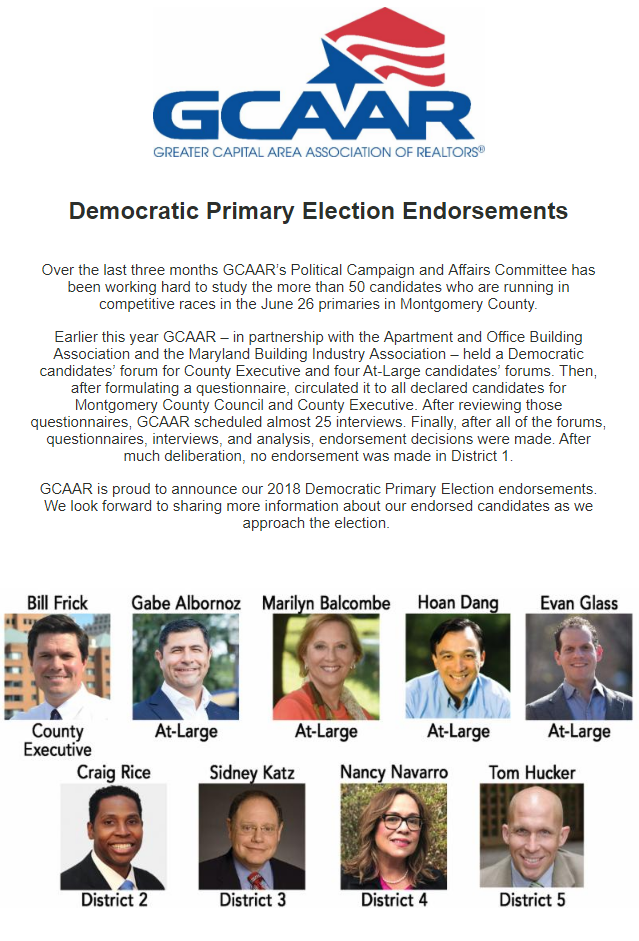
The Greater Capital Area Association of Realtors (GCAAR) has endorsed the following candidates in MoCo races:

Bill Frick – County Executive

Gabe Albornoz, Marilyn Balcombe, Hoan Dang, Evan Glass – Council At-Large

Craig Rice – Council District 2

Sidney Katz – Council District 3

Nancy Navarro – Council District 4

Tom Hucker – Council District 5

No endorsement was made in Council District 1.

The Realtors are the most influential endorsing organization in MoCo’s business community because of their volume of activity at election time.  In 2014, they spent well into six figures on independent mail and PAC contributions.  Despite every one of their county-level candidates winning except District 5’s Evan Glass (who came close), their reward was a recordation tax hike that they bitterly opposed two years later.  Rarely has a group done so much and gotten so little in MoCo politics!

This time around, when they had a chance to oppose an incumbent who voted for the recordation tax hike, they did.  Council Members Roger Berliner, Marc Elrich, George Leventhal and Hans Riemer, all of whom are in contested races, were left off their list.  Rice, Navarro and Hucker have nominal opposition and are sure to be reelected.  Sidney Katz’s opponent, Ben Shnider, is running to his left and was probably not a realistic option.  The selection of Delegate Bill Frick for Executive, who is running scorching Facebook ads against the County Council, sends a message of discontent.

The big question now is how much the Realtors will do to support their candidates.  We are a little more than a month away from early voting.  Albornoz, Dang, Glass, Katz and Navarro are in public financing and cannot accept PAC checks.  After getting burned last time, will the Realtors sink six figures into mail again?  We will find out.  Meanwhile, the Washington Post endorsement looms.

We reprint the Realtors’ email below.

Share

Taxpayer Flight from MoCo, Part Five

By Adam Pagnucco.

Today, we conclude looking at jurisdictions with whom MoCo has had inflows and outflows of tax returns and adjusted gross incomes.

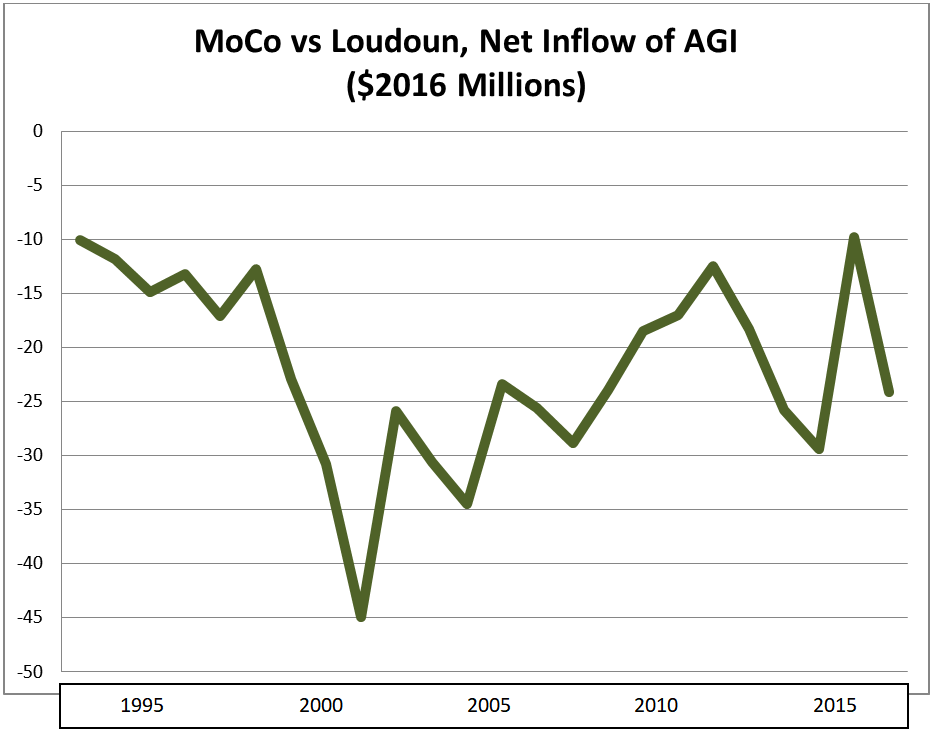
Loudoun County

Net change in tax returns, 2006-2016: -1,507 (outflow)

Net change in adjusted gross income ($2016), 2006-2016: -$208 million (outflow)

Adjusted gross income of in-migrants ($2016), 2006-2016: $76,287

Adjusted gross income of out-migrants ($2016), 2006-2016: $100,587

Migrant income gap: Out-migrants earned 32% more than in-migrants

Loudoun has been the fastest-growing large jurisdiction in the Washington region for a long time and was once one of the fastest-growing places in the country.  Much of its growth has come from people relocating from Fairfax but it has gained some folks from MoCo too.  As the wealthiest county in the nation, it’s no surprise that its migrants from MoCo skew to high earners.

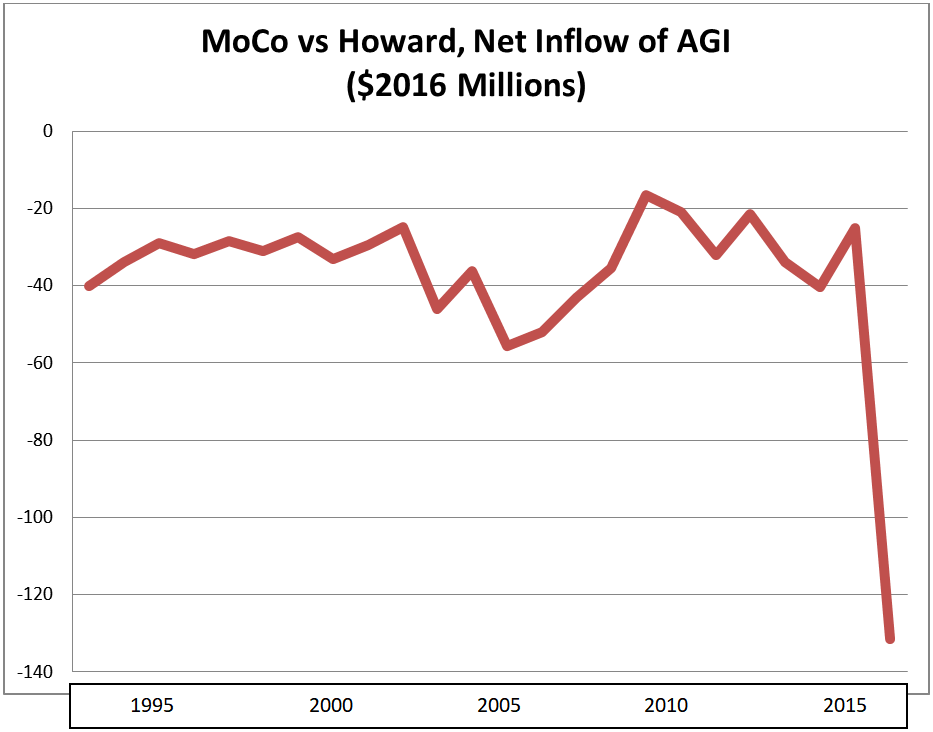
Howard County

Net change in tax returns, 2006-2016: -2,859 (outflow)

Net change in adjusted gross income ($2016), 2006-2016: -$400 million (outflow)

Adjusted gross income of in-migrants ($2016), 2006-2016: $72,231

Adjusted gross income of out-migrants ($2016), 2006-2016: $90,724

Migrant income gap: Out-migrants earned 26% more than in-migrants

Howard is MoCo’s smaller and wealthier neighbor to the northeast.  It gains relatively small amounts from MoCo every year but set a record in 2016, when $131 million of taxpayer income left MoCo for Howard.  Howard’s schools and quality of life are comparable to MoCo but its significant distance from D.C. has limited its ability to compete for people who work downtown.  Ironically, the joint bus rapid transit route on US-29 that MoCo is working on with Howard could help remedy that disadvantage. 

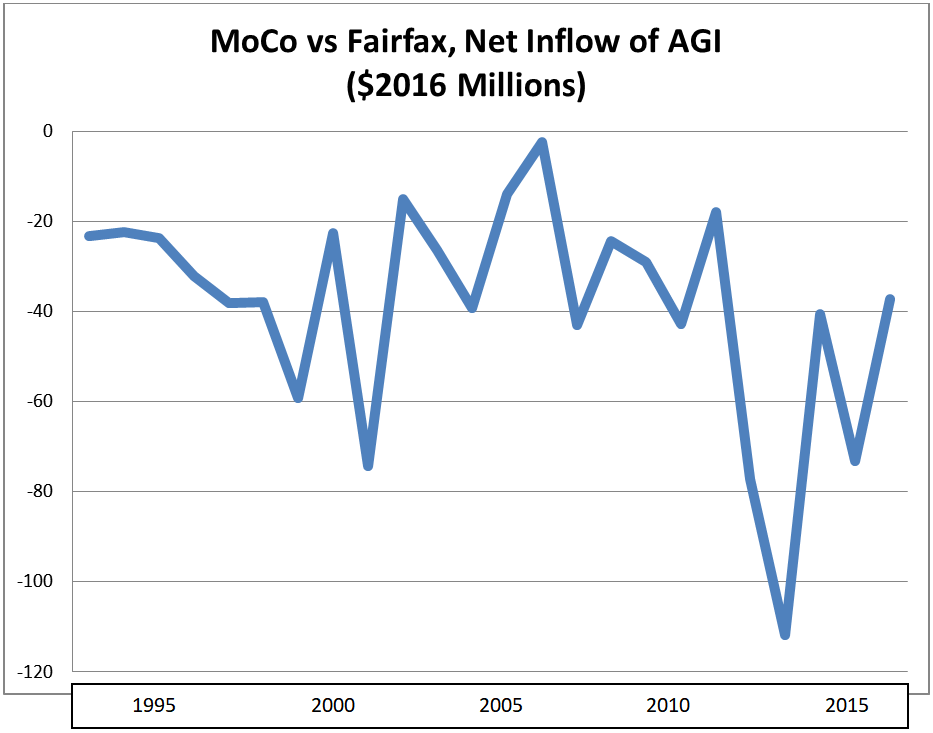
Fairfax County

Net change in tax returns, 2006-2016: -2,382 (outflow)

Net change in adjusted gross income ($2016), 2006-2016: -$497 million (outflow)

Adjusted gross income of in-migrants ($2016), 2006-2016: $70,796

Adjusted gross income of out-migrants ($2016), 2006-2016: $93,521

Migrant income gap: Out-migrants earned 32% more than in-migrants

Fairfax has had more taxpayer flight than MoCo overall and is losing a ton of income to Loudoun ($2.5 billion over the last decade).  But in head-to-head competition, Fairfax siphons millions in taxpayer income from MoCo every year, setting a record in 2013 with a net gain of $112 million.  A big reason for Fairfax’s gains is that the people who move from MoCo to Fairfax made 32% more money than those who moved in the opposite direction over the last decade. 

Frederick County

Net change in tax returns, 2006-2016: -7,170 (outflow)

Net change in adjusted gross income ($2016), 2006-2016: -$582 million (outflow)

Adjusted gross income of in-migrants ($2016), 2006-2016: $59,150

Adjusted gross income of out-migrants ($2016), 2006-2016: $69,017

Migrant income gap: Out-migrants earned 17% more than in-migrants

MoCo’s smaller neighbor to the north has been feeding off the county for years.  Frederick’s biggest gains from MoCo occurred from 2002 through 2007 during the latter’s housing price boom.  Frederick is not siphoning off anywhere near the amount of income that Loudoun is getting from Fairfax, but the inflow of people from MoCo has helped change its county seat’s downtown, its demographics  and its politics.

Virginia

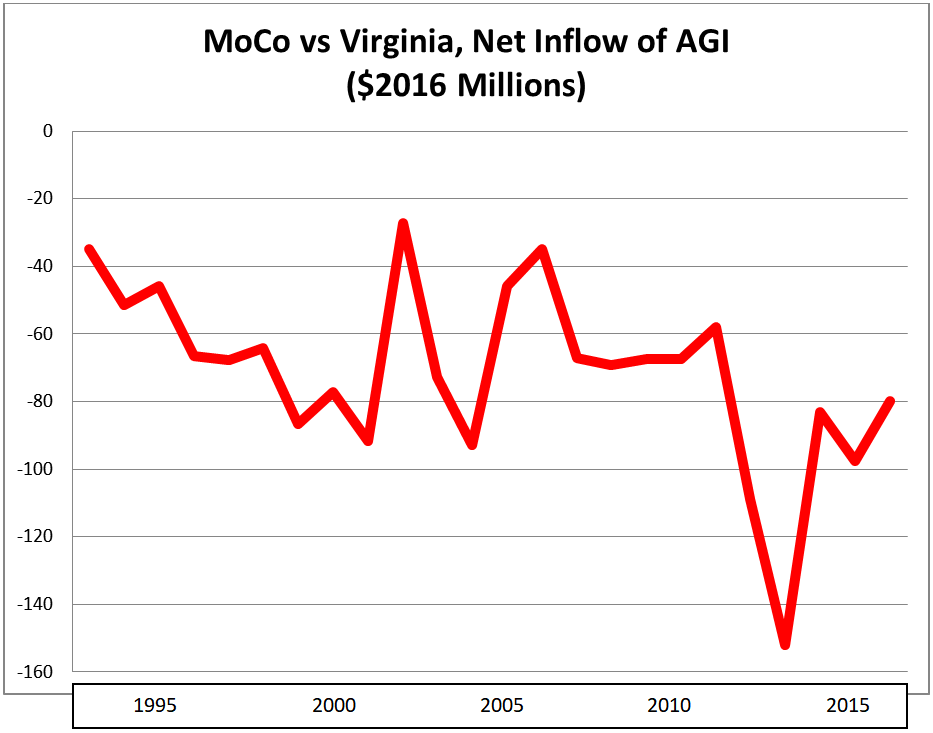
Net change in tax returns, 2006-2016: -5,638 (outflow)

Net change in adjusted gross income ($2016), 2006-2016: -$851 million (outflow)

Adjusted gross income of in-migrants ($2016), 2006-2016: $70,701

Adjusted gross income of out-migrants ($2016), 2006-2016: $83,010

Migrant income gap: Out-migrants earned 17% more than in-migrants

MoCo has lost significant amounts to Virginia over the years, with the biggest income losses occurring in 2013 ($152 million) and 2012 ($109 million).  Fairfax is the biggest culprit, followed by Loudoun and the rest of Northern Virginia.  The pace of income lost has picked up considerably since the early 1990s.

Florida

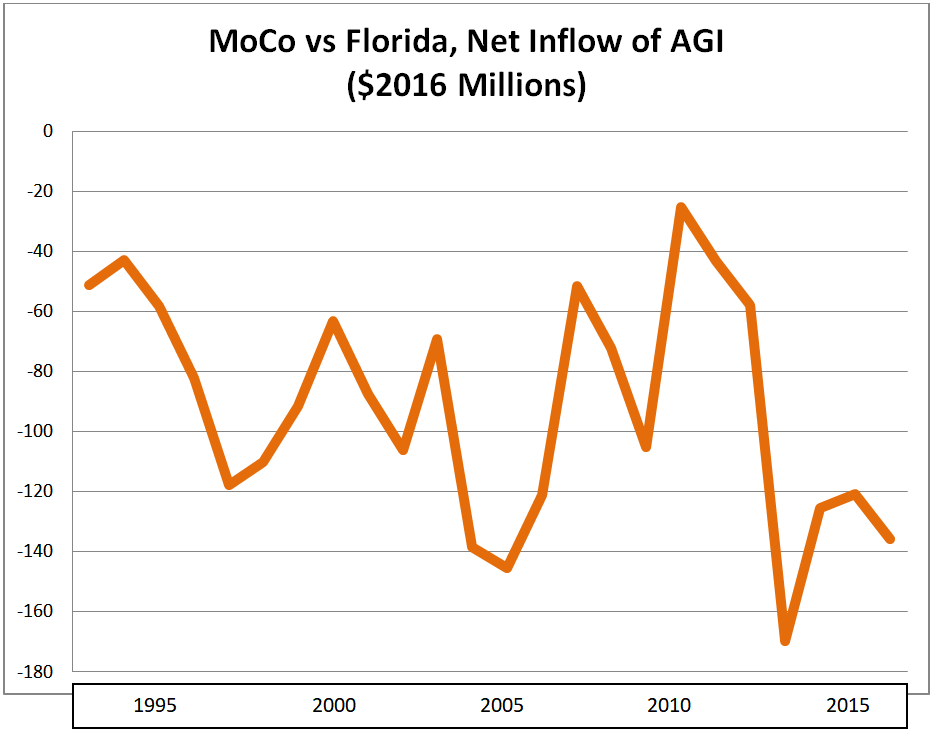
Net change in tax returns, 2006-2016: -2,769 (outflow)

Net change in adjusted gross income ($2016), 2006-2016: -$907 million (outflow)

Adjusted gross income of in-migrants ($2016), 2006-2016: $70,112

Adjusted gross income of out-migrants ($2016), 2006-2016: $132,459

Migrant income gap: Out-migrants earned 89% more than in-migrants

Everyone has heard the stories of rich people and/or retirees moving from MoCo to Florida.  Well, those stories might be true: more MoCo income has been lost to Florida than to Virginia over the last decade.  The number of people moving to Florida is less than those moving to Virginia.  But the average income of those moving from MoCo to Florida – $132,459 – is large in both absolute terms and when compared to those moving in reverse ($70,112).  One more thing: the last four years saw the biggest net loss of taxpayer income to Florida ($552 million) of any four-year period on record.

Share

Vignarajah’s Farcical Claims

Can we please stop pretending that Krish Viganarajah comes close to meeting the legal requirements to run for governor?

Candidates for governor of Maryland have to be registered in the State for five years. Yesterday, the Washington Post published three legal documents in which Krish Vignarajah claimed D.C. residency as recently as 2014 and 2016.

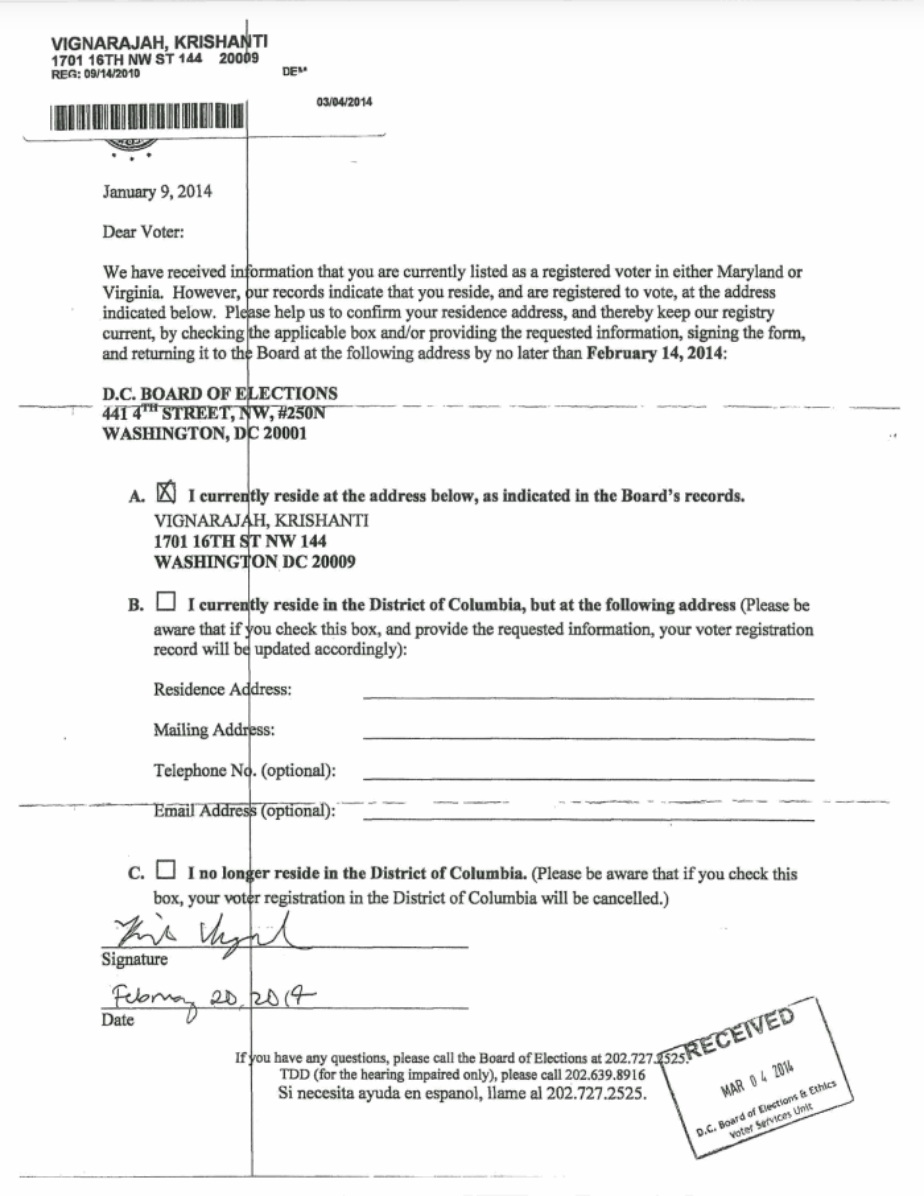
In response to a query from the D.C. Board of Elections, Vignarajah signed her name to confirm that she is a D.C. resident and should be able to vote there rather than Maryland:

The real kicker is in the first paragraph, which makes clear that they are asking her to confirm that she resides and should be registered in D.C. even though she is listed on the registry in Maryland. This form makes explicit that she intentionally abandoned her Maryland residency and registration.

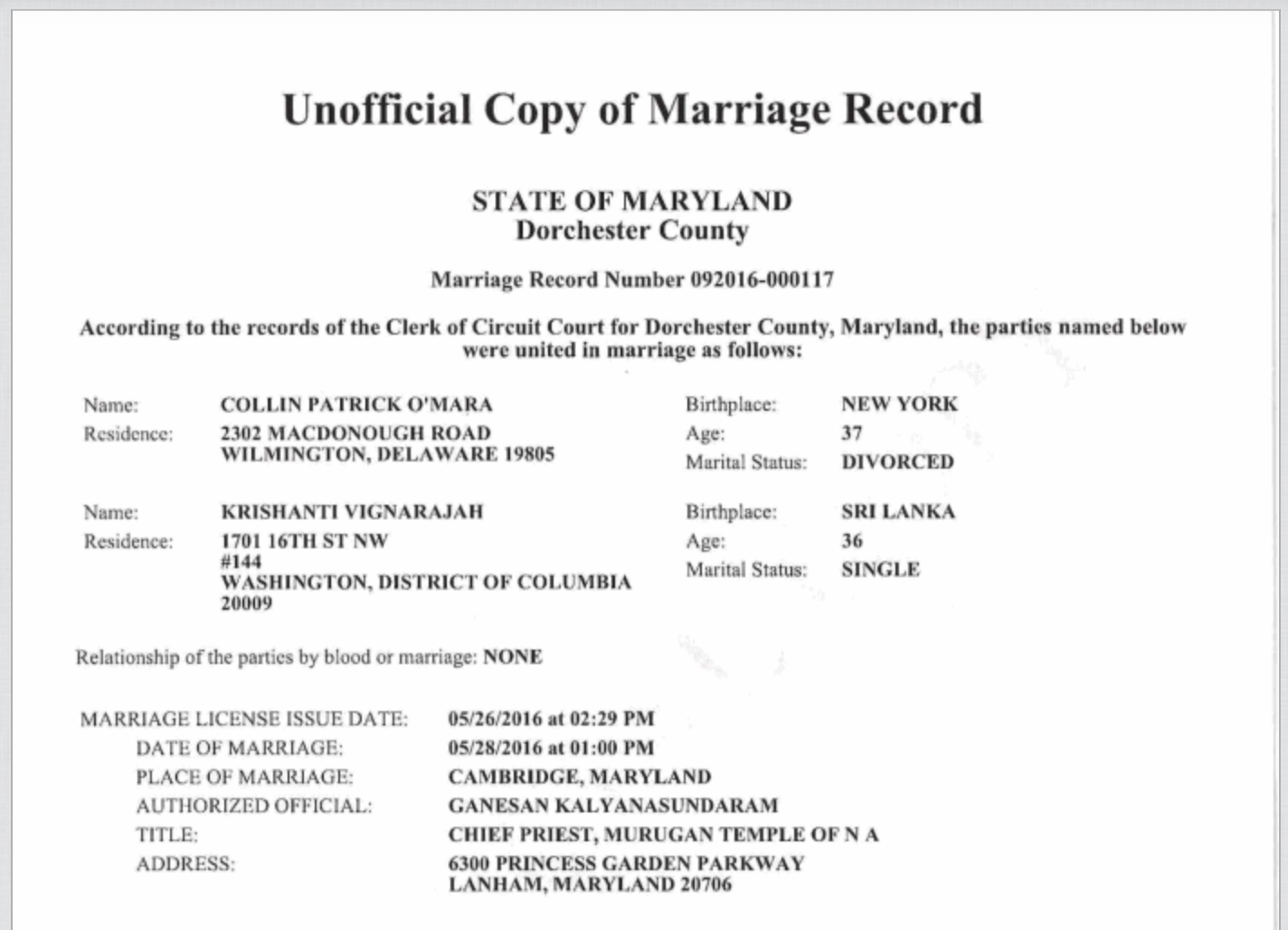
Vignarajah got married in 2016 in Dorchester County. Even though she now says that she was a Maryland resident and legally registered voter, she listed D.C. as her residence on her Maryland license application:

In other words, even though she got married in Maryland and had a marriage license in our state, she claimed residency elsewhere.

Of course, Vignarajah’s original voter registration application from 2010 also attests to her D.C. residency:

Remember that Vignarajah has only voted in Maryland once in her entire life.

Her response to this evidence is ridiculous:

Maryland is and always has been home. Temporarily residing outside of Maryland, whether it’s for school or work, does not change my permanent residence, as a matter of law or common sense.

I know Vignarajah is a trained attorney but it’s still impressive that she can say this with a straight face. Residing for years in another state or the District changes your permanent residence except under specific legal circumstances (e.g. being a student or in the military). Indeed, common sense wisdom is the exact opposite of her claim.

All the legal experience it takes to file taxes makes this even clearer. Incidentally, Vignarajah petulantly promised to release her taxes if other candidates do so. Rich Madaleno and Jim Shea have released theirs but we’re still waiting for hers, probably because they are yet further evidence of her D.C. residence.

It would be a disaster if Vignarajah won the nomination, as Republicans would challenge her eligibility and likely win:

A Hogan spokesman declined to comment. But other Republicans, including Del. Joe Cluster (Baltimore County), the former state GOP executive director, said someone in the party would surely attempt to challenge Vignarajah if she were the nominee.

“She shouldn’t be able to be on the ballot,” Cluster said. “If I was executive director of the Maryland Republican Party and she was the nominee for the Democrats, I would challenge her running for governor.”

Were such a challenge permitted, the government documents and Vignarajah’s voting history would be “a killer,” said Timothy Maloney, a lawyer and former Democratic state lawmaker who is not supporting anyone in the primary. “It would be almost impossible to overcome.”

Even if she somehow beat the challenge because it was too late to make it, Hogan’s team will make endless hay out of her five minute legal residence.

Krish Vignarajah should resign from the race.

Share

Why Women Hold Fewer Elective Offices

Yesterday, I reviewed political science research revealing that women who run for Congress do just as well as men and, contrary to public perception, do not face hostile press coverage that harps on their gender and appearance.

So why are there substantially fewer women than men in public office?

Today and in the next post, I focus on two key factors: First, women are less likely to run for public office than men. Second, the type of office greatly shapes who runs and wins.

My discussion today relies heavily on research by Jennifer Lawless and Richard Fox, particularly their articles in the American Journal of Political Science and American Political Science Review. The APSR is widely viewed as the top journal in political science and the AJPS is one of the top three venues to publish work in American politics.

Fewer Women Run

Lawless and Fox’s Citizen Political Ambition Study surveyed 3,765 people (1,969 men and 1,796 women) they considered highly eligible to run for office, largely people in the professions of law, business and education.

Among this group of potential candidates, 59% of men but just 43% of women said that they considered running for office. The probability that those who considered running actually sought office also revealed gender differences with 20% of men but only 15% of women taking the plunge to enter the political arena.

Interestingly, among those who did run, 63% of the women held public office as opposed to 59% of men. Unlike the gender differences mentioned in the previous paragraph, this one is not statistically significant. If we want more women in public office, we need to focus on the barriers that deter women from running.

Barriers to Women Running for Office

Fox and Lawless find that women are less likely than men to discuss the possibility of running for office with family and friends (22% of women v. 33% of men), community leaders (9% v. 15%), and party leaders (6% v. 12%) than their male counterparts. Improved outreach seems a straightforward way to overcome this barrier.

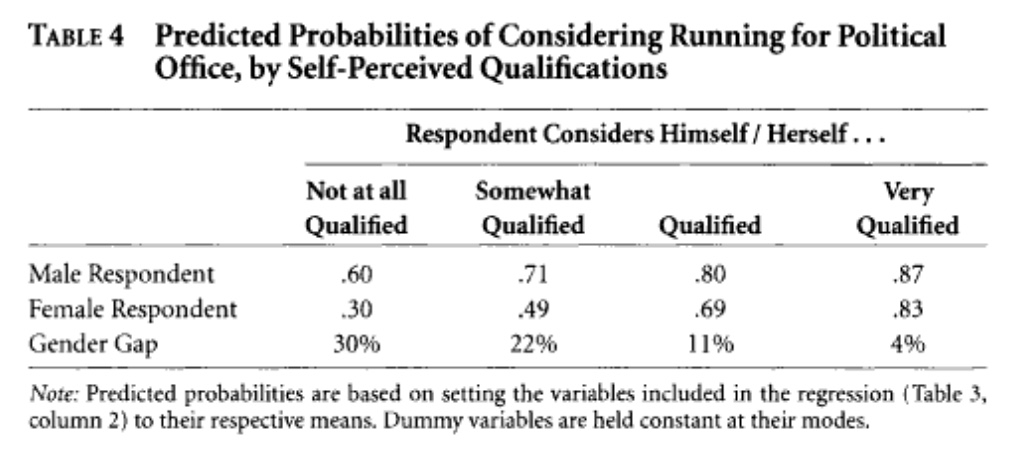
Next, Fox and Lawless showed that men are more likely than women to consider running for office even when they have similar perceptions of their qualifications:

Source: Richard L. Fox and Jennifer L. Lawless, “Entering the Arena? Gender and the Decision to Run for Office,” American Journal of Political Science 48: 2(April 2004), p. 273.

As the table shows, women who see themselves as “not at all” or “somewhat” qualified are far less likely than men who see themselves the same way to consider running for office. The yawning gap shrinks dramatically, but does not disappear, at higher qualification levels.

It’s really a double whammy.  Women are not only less likely to perceive themselves as qualified but also are less likely to run even when they have the same perception of their qualifications to run for office as men.

Interestingly, Fox and Lawless argue that two suspected culprits, family responsibilities and having a more traditional political cultural outlook (i.e. being more moralistic) do not shape the likelihood of running for office after controlling for other factors such as income, age, encouragement, and self-perceived qualifications.

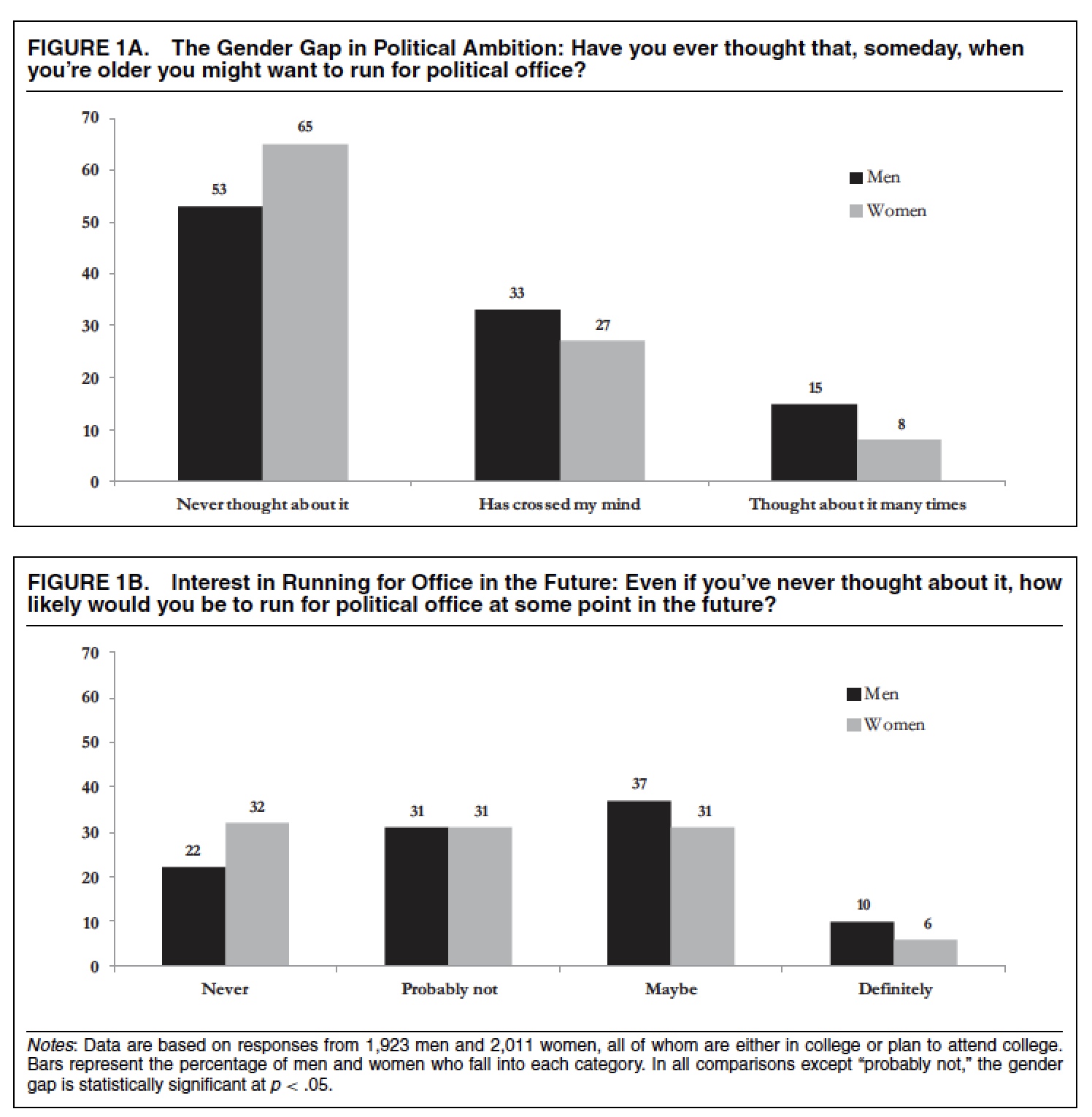
Going deeper into the subject matter, Fox and Lawless find that gender differences in political ambition surface in both high school and college students. Their survey revealed that young women are less likely than young men to think about running for office:

Source: Richard L. Fox and Jennifer L. Lawless, “Uncovering the Origins of the Gender Gap in Political Ambition,” American Political Science Review 108: 3(August 2014), p. 502.

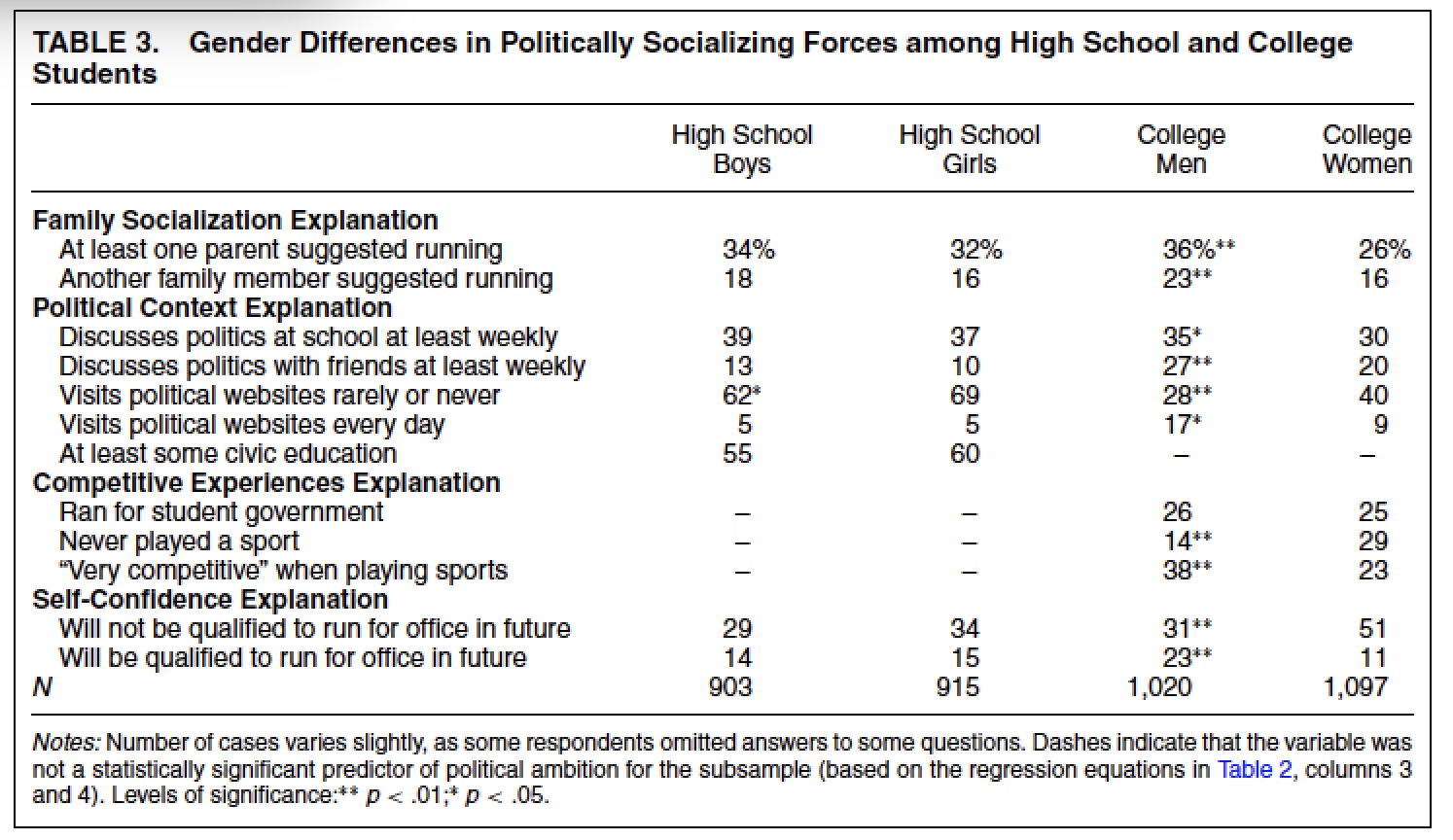
They find that gender differences that help drive these differences in political ambition are especially pronounced among college students:

Source: Richard L. Fox and Jennifer L. Lawless, “Uncovering the Origins of the Gender Gap in Political Ambition,” American Political Science Review 108: 3(August 2014), p. 510.

Family members are more likely to suggest to college men that they run for office. College women are less likely to discuss politics or visit political websites. Perhaps most jarringly, college women are less likely than college men to think they will be qualified to run for office in the future.

In the final part of this three-part series, I examine how the type of office also shapes whether women run or win.

Share

Maryland Politics Watch