Marc Elrich: “I Prefer to Put Jobs in Frederick”

By Adam Pagnucco.

Yesterday, Greater Greater Washington (GGW) wrote a long essay about Council Member Marc Elrich, who is running for Executive.  GGW has many disagreements with Elrich about smart growth and housing and mostly concentrated on those issues.  But the essay contained this quote from an interview with Elrich.

Broadly, Elrich isn’t convinced Montgomery County needs to add many new homes or residents, or jobs. Many people with jobs in Bethesda or DC are now living in Frederick County and other outlying areas and driving through Montgomery to get to work. We asked Elrich what he’d do for these folks, and his answer was, “I prefer to put jobs in Frederick.” He’d encourage the growth of both households and jobs to happen there, and in Prince George’s County, and elsewhere.

Elrich has disputed quotes before and we will see if he disputes this one.  But if the quote is accurate… well.

The chart below uses data from the U.S. Bureau of Labor Statistics (BLS) to compare growth in total employment in Frederick and MoCo from 2001 through 2016.

Frederick’s job creation record is clearly better than MoCo’s in both absolute and relative terms.

Now let’s use BLS data to compare growth in establishment counts in the two counties.
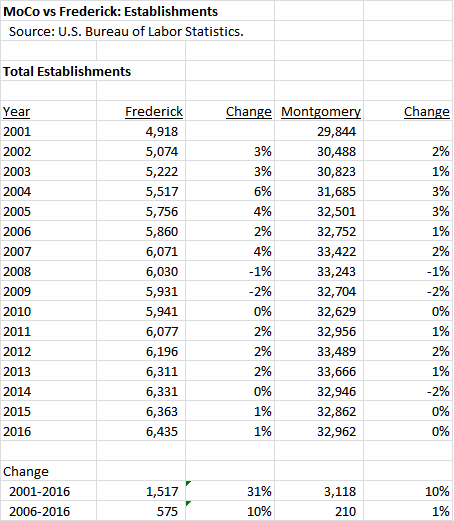
Frederick beats MoCo in growth rate and, over the last decade, in net new establishment count too.

Let’s bear in mind the relative size of the two counties.  Frederick has about a quarter of MoCo’s population.  Yet, Frederick has created a larger absolute number of jobs over the last fifteen years than MoCo and had a net gain since 2006 while MoCo had a net loss.  In terms of establishments, Frederick created more than double what MoCo did over the last decade despite being much smaller.

Now let’s recall the research we did three weeks ago on taxpayer migration.  MoCo is often compared to Fairfax, but the truth is that we have lost more taxpayer income to Frederick than to Fairfax over the last decade.

Between 2006 and 2016, MoCo had a net outmigration of $582 million in real adjusted gross income to Frederick.

The greatest losses to Frederick occurred during MoCo’s home price boom of 2002 through 2007.  MoCo home prices are rising again so let’s connect the economic dots.  Suppose we cut off housing construction in the ways Elrich described to Greater Greater Washington.  Unless there is a recession – which would bring a different set of problems – a housing shutdown in MoCo would cause more home price and rent hikes, exacerbating our already oppressive cost of living and pushing some folks into Frederick.  Once in Frederick, some of those people would start businesses, hire people and create more economic activity there.  That’s great for Frederick and it’s part of the explanation for the growth they have seen in the last fifteen years.  But what exactly does that do for us?

Look, folks – with surging needs in schools, transportation and everything else and with maxed out county debt, we have a lot of bills to pay.  There are two ways to do it.  Option one is to grow our commercial tax base and create jobs, thereby generating more tax revenue.  Option two is more big tax hikes which will further strain the cost of living.

If we have a County Executive who is fighting to put jobs in Frederick and NOT in MoCo, which option do you think our county will pick?

Disclosure: the author supports Roger Berliner for Executive.

Share

On “Those Good Union Jobs” at the Department of Liquor Control

MCGEO has done quite a number on county residents. When discussing the hot issue of privatization of Montgomery County’s liquor monopoly, politicians automatically express concern about the potential loss of those “good union jobs.”

People would be a lot less sympathetic to the idea of protecting liquor store or distributor employees. Why on earth should we maintain an antiquated, inefficient monopoly to protect their jobs but not spend money to protect the grocery store cashier or bank teller threatened by automation?

What makes all the angst about losing “good union jobs” even more galling is that private liquor distributors are unionized by the Teamsters – a little fact that never seems to get mentioned in all the handwringing.

Privatization doesn’t threaten union jobs. It threatens union jobs that pay dues to MCGEO. So MCGEO President Gino Renne, who was paid $196,700 by his local union and an additional $20,000 by his international union last year, is naturally quite concerned. As Gino likes to say, “Just keeping it real.”

Sadly, no one seems concerned about all these Teamsters Union jobs lost due to the monopoly depriving them of a livelihood. Not to mention the restaurant jobs lost because of extra costs that make it harder to turn a profit and frustration with the Department of Liquor Control that stops businesses from opening or expanding in Montgomery.

The other unasked question is why does the DLC perform so poorly if these jobs are so great? Service at DLC stores is variable at best and most employees are unfamiliar with their product. Beyond the stories about the DLC failing to deliver product at key moments, such as right before New Year’s, I’ve also heard about the DLC dumping shipments in the middle of the bar during happy hour.

It’s almost as if Ernestine left the phone company once Ma Bell was broken up and sought refuge at the DLC. “We’re the DLC, we don’t have to care.”

It’s not as if the DLC is understaffed. Somehow, Montgomery County-based Total Wine manages to keep in stock and much better organized a far greater range of product. They do it with fewer employees who yet also seem to know about the product that they’re selling and are more likely in my experience to provide good customer service. Other stores do the same.

Similarly, I’d like to know the share of DLC workers who live in Montgomery County. While some might argue that this is irrelevant, why must Montgomery County citizens keep in place a costly system to subsidize workers who don’t even live here? Even this question has totally lost the plot as government should not be a make-work program but should provide services to residents.

Councilmembers defend the DLC because it brings in money to the county. It would be a miracle if a monopoly on booze in the DC area did not. The sad truth is that it brings in far less than it might. The amount of beer and spirits sold per capita in Montgomery is lower than almost all other jurisdictions in Maryland as well as the Virginia suburbs. Does anyone seriously believe that we drink phenomenally less than people in Fairfax? Greater efficiency would also increase profit. Couldn’t we just tax alcohol and try to grow the economic pie instead of clinging desperately on to a stagnant unloved system?

None of this means that we shouldn’t pay county employees decent wages or we should just chuck the DLC workers out of a job. But nor should taxpayers be obligated to maintain a system that doesn’t work and myopically hurts the economy in perpetuity.

It’s time to call the question and end this outdated monopoly.

Share

Friedson: Ease the Squeeze

By Adam Pagnucco.

Council District 1 candidate Andrew Friedson has sent out a mailer discussing the need to “Ease the Squeeze” in Montgomery County.  Friedson writes:

We’ve all felt the Montgomery County Squeeze. It’s the squeeze on families facing higher living and childcare costs despite stagnant wages, on commuters stuck in the second worst traffic congestion in the country, and on parents whose kids are squeezed in overcrowded schools. It’s the squeeze on young workers and new families who can no longer afford to live here, and on seniors struggling to maintain a quality home and a dignified livelihood without the support they need to get by.

Montgomery County is a special place, but we can’t afford to ignore the change that’s happening all around us because it’s putting the squeeze on all of us.

I’m running for County Council to Ease the Montgomery County Squeeze with forward-focused leadership dedicated to growing a modern economy so we can make our community more attractive to move here and more affordable to stay here.

This is Friedson’s core campaign message.  Will it work?

Share

Ben Jealous’s Need to Claim Credit for Marriage Equality is Just so Wrong

It’s a strange day when a straight man takes credit for marriage equality in Maryland but Ben Jealous is that guy.

I’m certainly happy that the NAACP moved to endorse marriage equality on his watch. It was a good decision and showed leadership. But it is a far cry from claiming to be the critical guy who made marriage equality happen.

In debates and on twitter, Jealous and his campaign have repeatedly cited the Baltimore Sun editorial honoring him as Marylander of Year as evidence to back up his claim. Indeed, it’s a generous editorial:

“Maryland is a better state — and ours is a more perfect union — because of Ben Jealous and his commitment to justice, equality, and the dignity of every child’s home,” Governor O’Malley said. “Here in Maryland, he was an indispensable part of repealing the death penalty, passing the Maryland Dream Act, ensuring civil marriage equality and expanding access to voting.”

When it comes to his being “indispensable” on marriage equality, however, Jealous and his campaign have been categorically unable and unwilling to provide any evidence to back up the claims of the editorial.

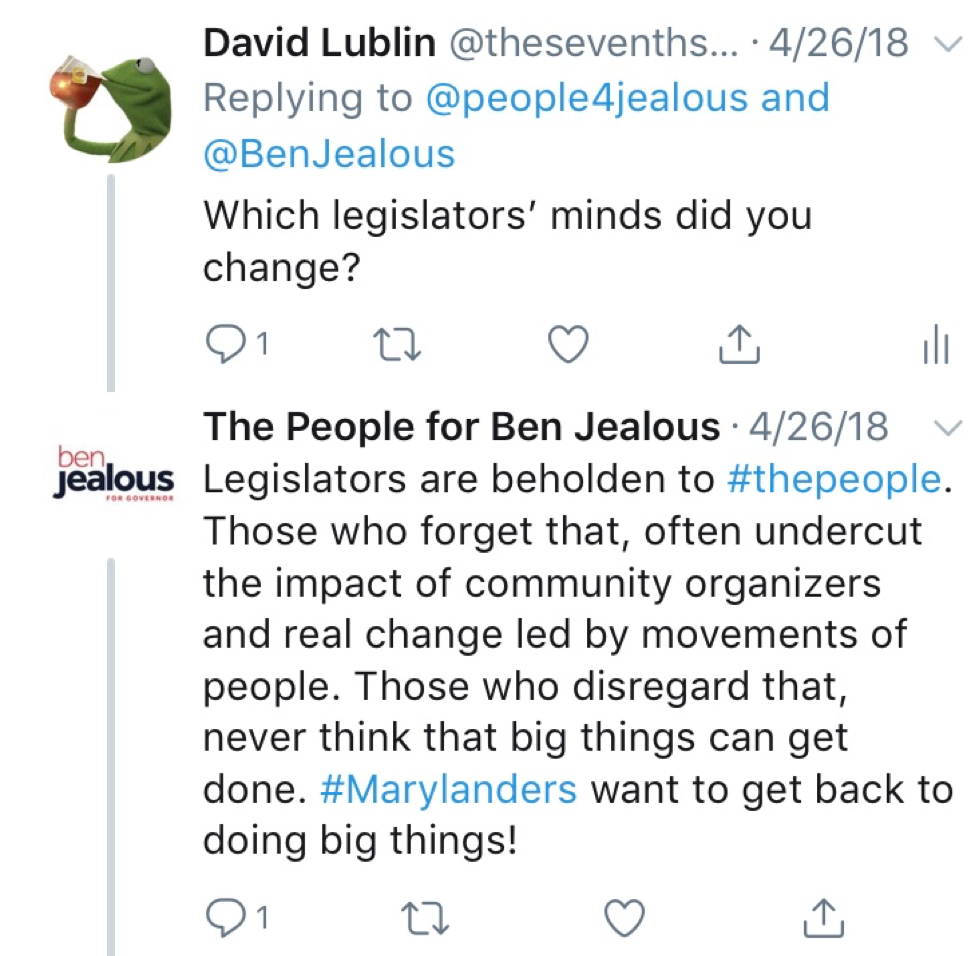
When the Jealous campaign tweeted a link to the editorial at me, I read it and then asked which legislators’ minds he had changed. The reply is revealing:

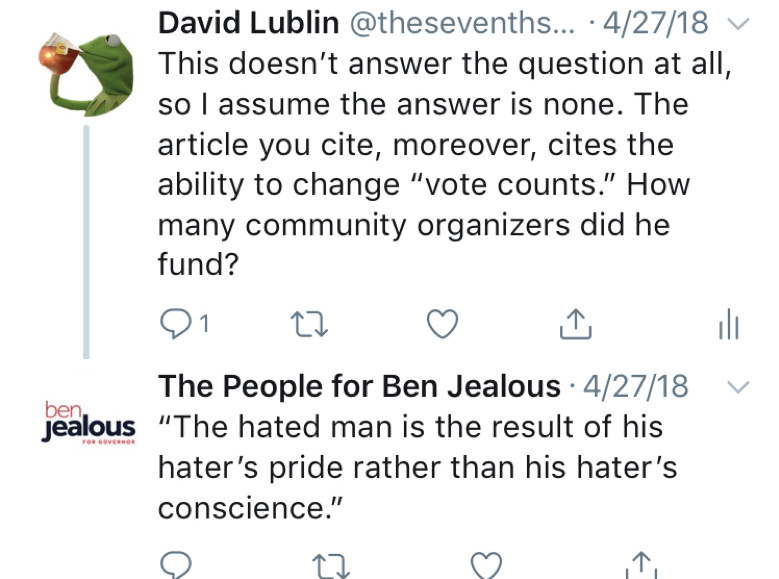
In other words, Jealous cannot identify a single legislator who changed their mind thanks to his efforts. I followed up by asking how many community organizers he had placed on the ground, as he claimed that had made the difference:

Personally, I preferred the Taylor Swift version of his reply. But again, it’s revealing. Rather than answer the hard-hitting question, he attacks the questioner. It takes a certain amount of chutzpah to accuse me of “pride” when he’s the guy claiming to have gotten marriage equality and numerous other legislative initiatives done.

So ultimately, beyond the editorial and the nice quote from Martin O’Malley of the sort that politicians tend to give when asked about someone receiving an award, we’re left with a whole lot of bupkis for evidence.

As someone who was actively part of Equality Maryland’s legislative lobbying team and Co-President of Equality Maryland during the referendum fight, I have some knowledge on the question. Jealous never showed up at any of the strategy sessions held with key legislators that I attended.

Jealous  was certainly never mentioned when it came to recruiting key votes on the issues. Carrie Evans, the Executive Director of Equality Maryland, played a key role in recruiting at least one Republican to a yes vote. Rep. Jamie Raskin, then a state senator, played a similar role in wooing the vote of a colleague on the fence.

Most importantly, I know that Sen. Rich Madaleno, who I support, spent years indefatigably working on this issue long before it was fashionable. As part of a long-term strategy, he built legislative capital and support to get the bill on the floor and passed. So many outsider candidates like to denigrate Annapolis politics, yet how do they think bills become laws and why then are they running for office?

Moreover, Rich Madaleno focused his energies so heavily on raising money for the marriage campaign that his own campaign account was sufficiently low to attract a challenge from deep pocketed Dana Beyer. (I should also mention that Ben Jealous’s running mate, Susie Turnbull, was very active in assisting the effort to win the 2012 referendum.)

None of the leaders of Equality Maryland, or any other incredibly kind and giving people who worked hard on the bill, have ever claimed to have been the key person in getting marriage equality accomplished. While I feel I did my bit, I also know that many were on the scene long before I arrived and also personally saw the self-effacing involvement of many good people.

One example I remember often is that of Del. Ben Barnes. He carried the bill for years in the House before it had a real chance of becoming law. Nevertheless, when asked to step aside for other sponsors in order to help advance the bill, he did so without any hesitation whatsoever. That’s someone who will never get much public credit but deserves it. The late Sen. Gwendolyn Britt similarly sponsored the bill in the Senate until she passed.

I do want to thank two straight African-American men for their incredibly helpful support: President Barack Obama and the late former NAACP President Julian Bond. President Obama’s timely evolution on the issue in advance of his own 2012 reelection bid created a critical and noticeable bump in the polls among African-American voters. When I asked Julian Bond if he’d be willing to appear in pro-marriage ads (he had the office next door to me at AU), he said yes immediately. I’ve also never seen anyone look so embarrassed when I thanked him in his office just before I got legally married.

Back to pride for a moment. If Ben Jealous wants to spout quotes on pride at me, he might think on another one before claiming credit for being the critical person in a long-term effort of someone else’s civil rights movement: “Pride goeth before a fall.”

Share

Asian Pacific American Dems Endorse Blair

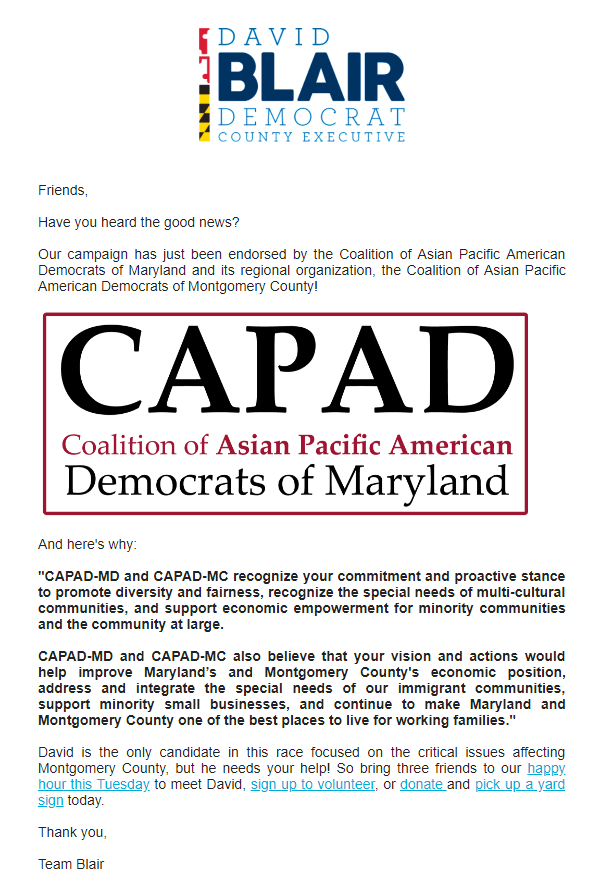
The Coalition of Asian Pacific American Democrats (CAPAD) has endorsed David Blair for County Executive.  Their endorsement statement emphasizes economic issues, including the need to “support minority small businesses.”  The county has thousands of businesses owned by people of East Asian and South Asian descent.  We reprint Blair’s email below.

Share

Leventhal Promises Tax Cut

By Adam Pagnucco.

In lengthy remarks on his County Executive Facebook page, Council Member George Leventhal has promised “a significant reduction in the energy tax” which he says “harms our competitiveness.”  He also took on critics of the county’s business climate, saying:

Relentless criticism of, and negativity about, our county’s business climate can itself be harmful to the business climate, since so much about consumer spending and investment decisions is psychological – the “animal spirits” of the marketplace.

We reprint his entire statement below.

*****

When I am elected County Executive, I will immediately take very seriously the concerns I have heard about the need to make it easier to do business in the county. I will appoint a blue-ribbon task force on business process reform. The group will include individuals who have established successful businesses in the county; those who understand any impediments to establishing or expanding businesses; and tax. legal, and county planning experts whom I will task with producing a series of recommendations within six months.

The first budget that I will submit to the County Council will contain a significant reduction in the energy tax (which harms our competitiveness). I will appoint new leadership in key departments that have been cited as impediments to business growth and formation, including the Department of Permitting Services and the Department of Environmental Protection (The Planning Department is not under the County Executive’s supervision, but it is also the source of many complaints, and also needs to be reviewed). I will meet personally with a wide range of employers, large and small, to conduct my own qualitative review, and commission an even wider range of focus groups to get input.

But let us remember: We remain a very wealthy county, and many of the business owners who most vociferously raise concerns are doing very well. Recently, one of my Democratic competitors told a group of about 40 local small businesses that he was surprised to find there were that many people still doing business here, who had not fled to other jurisdictions. I know he was joking, but that kind of talk is irresponsible.

Those who seek to lead the county must be positive forces for change – and must be careful not to spark a panic. Let’s remember President Franklin Roosevelt’s admonition that “we have nothing to fear but fear itself.” Whomever is elected County Executive will need to promote our county’s excellent attributes to attract jobs and investment. Relentless criticism of, and negativity about, our county’s business climate can itself be harmful to the business climate, since so much about consumer spending and investment decisions is psychological – the “animal spirits” of the marketplace.

I will never describe this affluent, attractive county as a bad place to do business. Indeed, the tradition of those successfully elected here has been optimism – it used to be a cliché to say that Montgomery County was a “great place to live, work and raise a family.” That’s still very true, but at least half the Democrats running for County Executive have adopted a different theme: “don’t invest here, it’s a disaster area.” Whomever is elected will find that turning a big ship is a slow process – that no matter who is Executive, altering a complex structure of taxes and regulations takes time, requires the assent of other elected leaders in the state legislature and County Council, and will encounter enormous push-back from unions, the PTAs, and other interest groups. I am more than ready for that challenge.

Some things are more important than winning an election. Let’s not burn the whole house down because we want to renovate some of it.

Share

Council At-Large Fundraising History

By Adam Pagnucco.

Last week, we wrote about fundraising in the Council At-Large race.  Today we put that in perspective.  How do today’s campaigns compare to the campaigns of the past?

There are two big differences between this year’s Council At-Large race and its three predecessors: 2006, 2010 and 2014.  The first is the presence of public financing.  The second is the number of open seats.  In 2006, there was one open seat vacated by Steve Silverman, who ran for County Executive.  In 2010 and 2014, all four incumbents ran again.  This year, there are three at-large vacancies – something that has never happened before.

One thing that all four cycles have in common is the importance of fundraising.  Public financing may have changed the mode by which fundraising occurs, but it did not reduce the centrality of fundraising to the prospect of winning.  Raising a lot of money doesn’t guarantee success, but it’s hard to win without it!

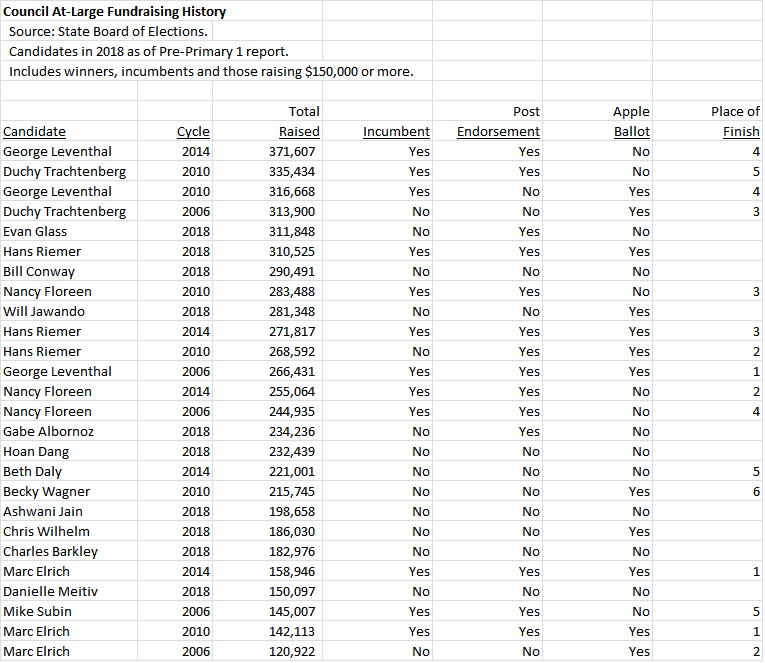
Below is a chart showing fundraising for Council At-Large candidates over the last four cycles.  Candidates shown include incumbents, winners and all others raising at least $150,000.  Contributions to 2018 candidates go through the Pre-Primary 1 report, which was due on May 22.  Incumbency, endorsements by the Washington Post and MCEA and place of finish are also shown.

Since 2006, all candidates who raised at least $240,000 won with one exception: Duchy Trachtenberg.  In 2010, Trachtenberg – then a first-term incumbent – committed one of the craziest decisions of all time by sitting on $146,000.  Rumor had it that she had polls showing her winning and had decided to save her money for a future race, perhaps for Executive.  Her fellow incumbent, George Leventhal, edged her out for the fourth spot by 3,981 votes.  If Trachtenberg had spent her full sum, she might have been able to send out at least another three mailers and history could have changed.

On the other side, no one raising less than $230,000 has won since 2006 with one exception: Marc Elrich.  Love him or hate him, Elrich is the exception to a lot of rules in MoCo politics and he has always vastly outperformed his fundraising.  Becky Wagner (2010) and Beth Daly (2014) were good candidates but they couldn’t quite raise enough money to break through, even with substantial self-financing.

This year, the folks whose fundraising is in the same ballpark as prior winners are Hans Riemer (the race’s sole incumbent), Evan Glass, Bill Conway and Will Jawando.  Gabe Albornoz and Hoan Dang are close.  The others on this chart are below Daly and Wagner.  All of this year’s candidates will raise a bit more money because these figures only go through a month before the primary.  But those in public financing – everyone except Delegate Charles Barkley and Ashwani Jain – have already raised most of their funds for this cycle.  Public financing does not allow for last-second $50,000 loans or bundled corporate checks to pay for a final mailer or two.

Money isn’t everything – just ask David Trone.  But it has a role and public financing has not changed that.  As we go down to the wire in the at-large race, money matters as much as ever.

Share

Maryland Politics Watch