Three Keys to School Board Races

By Adam Pagnucco.

Make no mistake: running for school board is TOUGH.  The MoCo school board has two at-large seats, five district seats and one seat elected by MCPS students.  Of the seven non-student seats, all of them – at-large and district – are subject to voting by the entire county electorate.  Three seats – one of the at-large seats plus Districts 2 and 4 – hold elections in presidential years, which attract tons more voters than gubernatorial years when elections for other state and county offices are held.  Since the school board seats are non-partisan, both primaries and generals can be real competitions.  Finally, Republicans, unaffiliated and third party voters can vote in school board primaries as well as generals.  So school board candidates have to communicate with waaaaaay more voters than county-level and state legislative candidates and they have a lot less money to do that.

Dear readers, think about all of the above before you decide to run for school board!

And so these races are distinguished by little money, large electorates and woefully inadequate press attention.  That’s why three factors are almost always key to deciding them.  They are:

1.  Incumbency.  This is an important advantage in most elections.  Incumbents have opportunities to learn the issues, assemble records, build relationships and accumulate name recognition.  School board races are no exception.

2.  The Apple Ballot.  The Montgomery County Education Association (MCEA) has long had the most advanced political program of any group that participates in MoCo elections.  Its centerpiece is the mighty Apple Ballot, an apple-shaped endorsement flyer that is widely distributed at election time.  Few if any groups care more about school board elections than MCEA since board members set policy, hire the superintendent and approve collective bargaining agreements.

A version of the Apple Ballot from 2006.  Note the placement of school board candidates at the top.

3.  The Washington Post endorsement.  The Post regularly endorses in school board races and the newspaper has a reach that extends beyond traditional Democratic voting constituencies.  The Post is also occasionally critical of MCEA although it sometimes supports the same candidates as the teachers.

Without the benefit of significant resources to communicate with vast numbers of voters, school board candidates with one or more of the above advantages are heavily dependent on them to differentiate themselves from the pack.  That’s why while all of the above advantages matter in any race, they may be especially critical to candidates for school board.

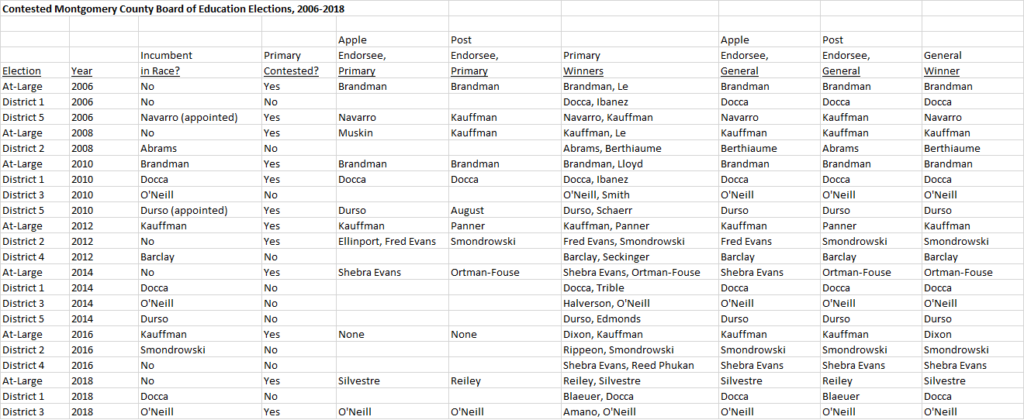
The table below shows candidates in contested school board races from 2006 through 2018 and the distribution of incumbency, the Apple Ballot and the Post endorsement.  In some cases, the primary was uncontested because there were two or fewer candidates while the general was contested.

A casual glance demonstrates the value of incumbency, the Apple and the Post endorsement but let’s be more explicit.  The table below shows win rates for all three, as well as combinations of some or all of them.

In every tabulation, candidates holding at least one of the above three advantages win at least 75% of the time.  Holders of more than one advantage often win more than 90% of the time.  Candidates holding both the Apple and the Post, whether or not they are incumbents, are nearly a lock.  The one recent exception was in 2016, when at-large incumbent Phil Kauffman had both the Apple and the Post and was still defeated by former Paint Branch High School Principal Jeanette Dixon.  In that race, Kauffman earned the Apple Ballot after the primary and the Post did not endorse him until October, possibly weakening the value of those endorsements.

These three factors don’t explain everything, but they explain a lot.  While it’s possible to win without any of these advantages, as Dixon demonstrated, it’s very difficult.  Keep an eye on these keys as this year’s school board races move forward.

Share

How is MoCo Doing on Pedestrian Safety?

By Adam Pagnucco.

Pedestrian safety is arguably THE hottest issue in MoCo government right now.  With several recent high profile pedestrian deaths and residents swarming a county council meeting on the subject, alarmed elected officials are terming pedestrian crashes a “public health crisis” and demanding action.  The county has responded by hiring a full-time pedestrian safety coordinator and is promising more to come.

Pedestrian safety has been a challenge in Montgomery County for decades.  How well is the county doing on this issue?

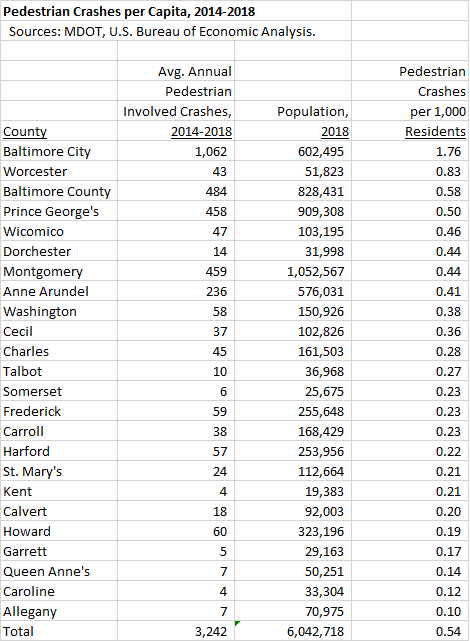
First, let’s look at MoCo’s rate of pedestrian involved crashes in comparison to the rest of the state.  The table below, sourced from data provided by the Maryland Department of Transportation, compares the average annual number of pedestrian crashes by county to county populations.

Three of the top four counties on a per capita basis – Baltimore City, Baltimore County and Prince George’s County – are among the most urbanized jurisdictions in the state.  The other county in the top four – Worcester – has an unusual amount of pedestrian activity on the Ocean City boardwalk.  MoCo ranks 7th of 24 counties on crash rate but its average annual crash rate per 1,000 residents (0.44) is below the state average (0.54).  Admittedly, the state average is skewed upwards by Baltimore City.

It’s interesting that MoCo’s pedestrian crash rate is similar to less urbanized jurisdictions like Wicomico, Dorchester and Washington Counties.  Urbanized counties should have greater volumes of pedestrian activity because of a greater abundance of walkable districts.  MoCo certainly has more of those than Wicomico, Dorchester and Washington Counties.  That suggests that MoCo isn’t a relatively bad performer on this measure given its substantial (and increasing) urbanization.

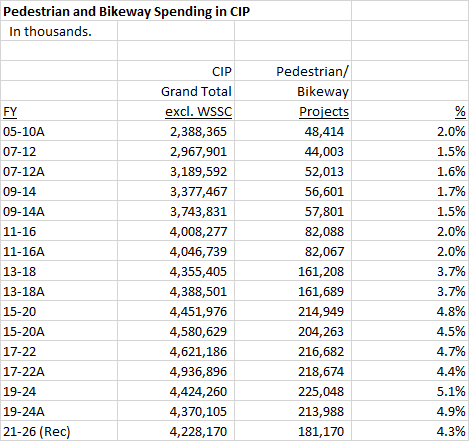
One thing MoCo does is spend significant amounts of capital money on pedestrian projects.  The table below compares capital budget spending on pedestrian and bikeway projects (the two are one category) to total capital spending excluding the Washington Suburban Sanitary Commission in the last 16 Capital Improvements Program (CIP) budgets. 

MoCo’s spending on pedestrian and bikeway projects steadily accelerated from $44 million in the FY7-12 CIP to $225 million in the FY19-24 CIP.  Major projects like the Metropolitan Branch Trail, the MD-355 BRAC crossing and the Capital Crescent Trail are partially responsible for these increases.  However, the FY21-26 executive recommended budget is a step back.  The six-year total pedestrian and bikeway spending of $181 million is the lowest since the FY13-18 amended budget.  So is the percentage of the total capital budget accounted for by pedestrian and bikeway projects.

All of this gives rise to two questions.

1.  MoCo spends a lot of money on pedestrian projects, but is the county getting a good return?  A 2007 county council press release states that the county averaged 430 pedestrian collisions per year from 2003 through 2006.  The Maryland Department of Transportation estimates that the county averaged 459 pedestrian crashes from 2014 through 2018.  Between the two periods, the county’s population rose by 13% while its pedestrian crashes rose by 7%.  Is that a sufficiently positive result from the enormous sums the county has spent in recent years?  Given the significant needs in this area and the limited resources in the capital budget, the county may wish to study the most cost-effective ways of promoting pedestrian safety and direct its funding accordingly.

2.  As noted above, the executive’s new recommended capital budget decreases pedestrian and bikeway spending to its lowest level in seven years.  One reason for that is that the overall level of capital spending is declining.  (That’s a subject for a future series.)  With all areas of the capital budget under stress and the looming possibility that school construction delays will trigger residential moratoriums, it’s extremely difficult to add or even maintain funding for any program, not just pedestrian and bikeway projects.  That said, county elected officials will look terrible if they declare pedestrian safety to be a “public health crisis” but then cut funding for pedestrian and bikeway capital projects.

Overall, MoCo’s record on pedestrian safety is not a bad one when compared to the rest of Maryland.  But funding constraints could hinder its prospects for improvement.

Share

MoCo’s Moratorium Madness

By Adam Pagnucco.

The Montgomery County government is currently plagued by a $100 million operating budget shortfall and a shrinking capital budget.  So what is the county doing to revitalize its economy and earn more revenue?

Potentially, imposing more moratoriums on housing construction!

County development rules require moratoriums on housing construction inside school clusters or individual school service areas when projected public school enrollment accounts for 120% or more of capacity five years into the future.  Additionally, elementary schools must be 110 students over capacity and middle schools must be 180 students over capacity to trigger moratoriums.  Projects that are already approved are not halted by moratoriums but new project approvals are not granted.

Last year, the county imposed moratoriums on four high school clusters and 13 individual elementary school service areas.  Those areas accounted for roughly 12% of the county and included high-profile markets in Downtown Silver Spring and North Bethesda, thereby directly thwarting the county’s transit-oriented development strategy.

The problem with stopping residential development is that school impact taxes collected from new units can be a major source of revenue for school construction.  As recently as the FY15-20 amended capital budget, school impact taxes accounted for 15% of MCPS’s school construction budget.  Unfortunately, that is no longer the case.

In a memo to the Montgomery County Planning Board, planning staff noted that the county executive’s new recommended FY21-26 capital budget underfunds MCPS’s construction request by $61 million in FY21, $93 million in FY22, $93 million in FY23 and $57 million in FY24.  One of the biggest reasons for the underfunding is that school impact tax receipts have fallen by more than half since FY14.  The planning staff indicates that if the underfunding results in delayed projects, nine elementary school service areas (Bethesda, Clarksburg, JoAnn Leleck, Rachel Carson, Strawberry Knoll, Summit Hall, McNair, Page and Burnt Mills), one middle school service area (Parkland) and seven high school clusters (Quince Orchard, Richard Montgomery, Albert Einstein, Montgomery Blair, Blake, Northwood, Walter Johnson) may be at risk of moratoriums.  For the Blake, Blair, Einstein and Walter Johnson clusters, this would be the second straight year of moratorium, threatening projects in North Bethesda and Downtown Silver Spring.

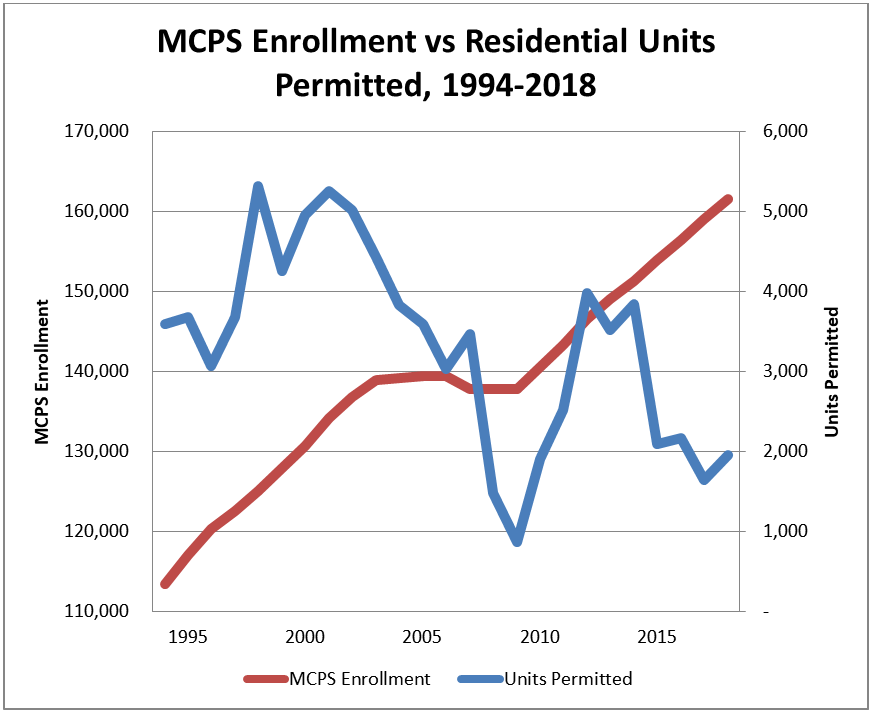
The cruel fact here is that reducing residential construction has historically had little if any impact on MCPS enrollment increases.  The chart below shows MCPS enrollment (red line and left axis) and residential units permitted in Montgomery County (blue line and right axis) from 1994 through 2018.  MCPS enrollment comes from the county executive’s recommended budget while permitted units comes from the U.S. Census Bureau.  Over this 24 year period, housing construction has been falling while MCPS enrollment has been rising.  The contrast between the two trends has been most pronounced in recent years.  Housing units permitted has fallen from 3,981 in 2012 to 1,947 in 2018 while MCPS enrollment has grown from 146,497 to 161,470.  It defies logic to blame school crowding on housing construction when homebuilding is in an era of decline.

And so here is the effect of MoCo’s moratorium policy.  Housing construction drops, causing school impact tax payments to plummet and depriving school construction of needed funding.  The county reacts by delaying school projects, triggering moratoriums.  That causes housing construction to decline further and the cycle continues.  None of this helps more schools get built but it definitely constrains housing supply, thereby driving up home prices and making the county even more unaffordable to live in than it already is.  Another effect is that it makes the county radioactive to the real estate and investment communities, thereby pushing them into competing jurisdictions.  It’s no wonder that Prince George’s County Executive Angela Alsobrooks is celebrating her county’s passing of Montgomery County in job creation.

Using residential moratoriums to prevent school crowding is like treating lung cancer by amputating the patient’s legs.  The treatment does nothing to solve the original problem but it definitely causes new problems to arise!

If you wanted to stop economic growth and make it harder for people to live here, it would be difficult to devise something more attuned to such goals than MoCo’s insane moratorium policy.  The county must bring it to an end.

Share

Affordable Housing Spat: Who’s Right?

By Adam Pagnucco.

County Executive Marc Elrich and his biggest critic, Council Member Hans Riemer, are feuding once again.  This time, the subject is affordable housing.  Elrich says his new recommended capital budget includes a record sum for affordable housing.  Riemer says there are in fact no new resources.

Who is right?

Let’s consider the statements from each of them.  First, here is Elrich.

Affordable housing is one of my top priorities. It is vital to our County’s future success. We must maintain and expand our stock of affordable housing and we are taking this critical issue head on in the capital budget. That is why I am recommending we add $132 million for affordable housing to the capital budget over the next six years.

This is a record level of funding for affordable housing projects for our capital budget. These funds will be used by the Affordable Housing Acquisition and Preservation Project to facilitate efforts to preserve existing stock and increase the number of affordable housing units in the County. But that is not all.

In this Capital budget, I am proposing a new Affordable Housing Opportunity Fund to leverage funding from other partners that will support short-term financing while affordable housing developers arrange for permanent project financing.

Here is Riemer’s response.

On affordable housing, I was initially encouraged by the Executive’s speech about increasing funding levels. Indeed, I am intrigued by his proposal to create a new housing preservation fund. However, while he claims to have added more than $132 million in the affordable housing fund, after further examination it became clear that the annual amount is unchanged at $22 million. Under the last Executive, affordable housing funding was only programmed for the first two years of the six year budget, but additional funding was always added in the subsequent years. We need to increase our affordable housing fund to at least $100 million annually. This change in accounting will not result in increased resources. In combination with his resistance to the Council’s affordable housing goals, developed with and agreed upon by all the local governments in Washington region, the County Executive’s housing policy continues to be a matter of serious concern.

These two like each other about as much as Popeye and Bluto.  (Which one is Popeye depends on your point of view!)  But how can their statements be reconciled?

Since Fiscal Year 2001, the county’s primary affordable housing vehicle has been its Affordable Housing Acquisition and Preservation program, which appears in the county’s capital budget.  The program enables the county to buy or renovate, or assist other entities to buy or renovate, affordable housing.  It is financed by several sources including but not limited to loan repayments and the county’s Housing Investment Fund (which is mostly supported by recordation taxes).

The capital budget, which includes the Affordable Housing Acquisition and Preservation program, is a six-year budget.  In even years (like 2020), it is written anew and in odd years, it is amended.  Projects in the capital budget can have up to six different years of funding in them (with more scheduled outside of the budget’s six year horizon).  In the past, the affordable housing program has only shown funding for the first two years of the capital budget with zero money programmed in the last four years.  But since the capital budget is rewritten every two years with affordable housing money renewed in each successive budget, that has not mattered.

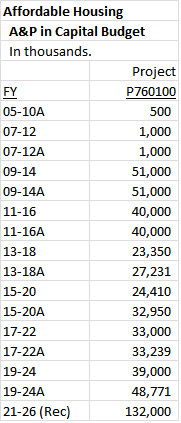
The table below shows funding for the Affordable Housing Acquisition and Preservation program in the last 16 capital budgets.  Each budget covers six years.  Budgets labeled with an “A” are amended budgets programmed in off years.

At first glance, Elrich appears to be right.  His new recommended capital budget includes $132 million for Affordable Housing Acquisition and Preservation, which is far higher than any previous capital budget.  But let’s remember what Riemer said about the annual amount of spending.  All the previous six-year budgets included funding during the first two years only.  Elrich’s new capital budget shows funding for the Affordable Housing Acquisition and Preservation program in all six years.  Riemer is correct: an accounting change caused the apparent increase in this program.

But the story doesn’t end there.  Elrich created a new program in the capital budget called the Affordable Housing Opportunity Fund.  This program is dedicated to acquiring affordable housing in areas at risk of rent escalation, such as those near the Purple Line and other transit corridors, and is intended to use public funds to leverage private funds in acquiring and preserving affordable housing.  This new program provides $10 million in each of the new capital budget’s first two years for this purpose.  That money comes from recordation tax premiums which are normally used to finance transportation projects, so it’s not “free” money.  But it is more money for affordable housing.

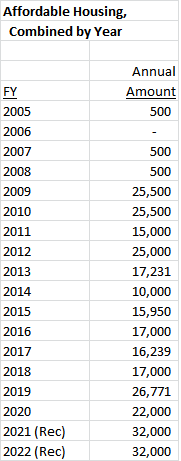
Combining the existing Affordable Housing Acquisition and Preservation program and Elrich’s new Affordable Housing Opportunity Fund, the table below shows the annual expenditures for affordable housing in the capital budget since FY05.  Annual expenditures are drawn from the first two years of every amended capital budget with FY21 and FY22 drawn from the executive’s new recommended capital budget.

Combining the two programs, Elrich recommends spending more capital money for affordable housing in FY21 and FY22 than any annual expenditure in the preceding published budgets.  When adjusting for inflation, Elrich’s FY21 and FY22 spending amounts are roughly equal to the Leggett administration’s peak affordable housing years of FY09 and FY10, so one can quibble about whether Elrich’s spending is truly a record.  But when Elrich’s new Affordable Housing Opportunity Fund is included, the first two years of his new budget definitely show an annual increase for affordable housing over the prior budget.

The county’s capital budget has been shrinking due to cutbacks in general obligation bond issuances and declining projected school impact tax receipts.  That’s a dire subject for another time.  But given the county’s budget difficulties, Elrich’s financial commitment to affordable housing is meaningful.  Friends and foes alike should give him credit for it.

Share

Alsobrooks Brags About Beating MoCo

By Adam Pagnucco.

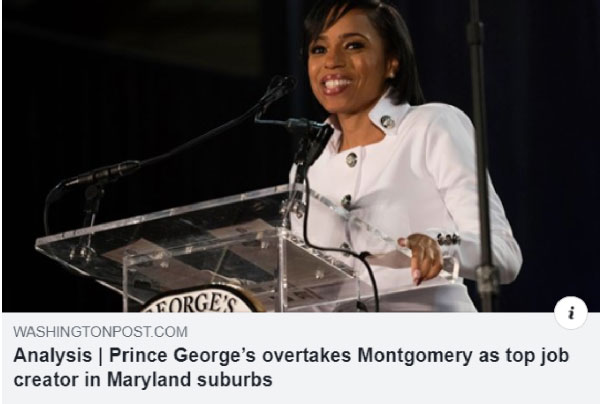
In a blast email sent today, Prince George’s County Executive Angela Alsobrooks bragged about a recent Washington Post story showing her county pulling ahead of Montgomery County in job creation. The email is reprinted below.

*****

Prince George’s Overtakes Montgomery as Top Job Creator in Maryland Suburbs

Dear Prince Georgians:

In case you missed it, an article published Monday in the Washington Post showed that our County has officially overtaken Montgomery County in terms of job creation for Maryland.

From 2013 to 2018, we added 21,236 jobs in our County, growing by 7.1%.  That growth secures our County’s spot as the top job creator for the entire State of Maryland.  I am Prince George’s Proud to say that these numbers confirm what we have been saying, which is that we are the economic engine for our State.

As the article states, our job growth is due in part to honest and effective political leadership in our County over the past several years.  In addition, our County has aggressively courted businesses by making key investments over several budget cycles.  We are not just waiting for businesses to come, but instead going out and beating the bushes to tell the story of Prince George’s.  These factors, plus the strong working relationship that we have with our colleagues on the County Council, have contributed to a very business-friendly environment in our County.

As we maintain the spot as the top job creator for the State of Maryland, we will not rest on our laurels.  Over the next several years, we plan to continue making investments to incentivize businesses to locate to Prince George’s County.  Some of our top priorities include high-quality dining and amenities, technology companies, and even federal government facilities that are looking to relocate.

We also plan to invest in creating what we call the Downtowns of Prince George’s.  These are areas where we will focus on mixed-use, transit-oriented development to continue attracting new businesses and growing our commercial tax base.  In the past year alone, we have seen several successes with these projects and the investments we have already made.

For example, in the area around the New Carrollton metro, Kaiser Permanente opened its new regional headquarters last year, and we learned that WMATA plans to move its regional headquarters there as well.  Construction will soon begin on the Carillon Project in Largo, which will revitalize the former Boulevard at Capital Centre.

Finally, we broke ground on the Hampton Park Project, which will replace the former Hampton Park Mall in Capitol Heights.  We’ve already secured several commitments from businesses to open in this location when construction is done, including the award-winning Ivy City Smokehouse restaurant and a Market Fresh Gourmet grocery store.

Those are just a few of the accomplishments we had in 2019 in terms of attracting new businesses and job creation.  You have my commitment that my administration will continue telling our story, making critical investments and attracting new businesses to create even more jobs over the next several years.

The best is truly yet to come for Prince George’s, and I know that by working together, we’ll have an even better story to tell in the coming months.

Yours in service,

Angela Alsobrooks

Prince George’s County Executive

Additional Coverage: The Economy is Booming in Prince George’s County

Following the Washington Post article, WJLA ran a story discussing the booming economy in Prince George’s County.  We have thousands of job openings in the County, and engineering firms like ATCS are excited to be here and hiring now. In case you missed the story from WJLA, watch it online by clicking here.

Share

Grading the County Council

By Adam Pagnucco.

Regular readers know my views on the administration of County Executive Marc Elrich by now, but let’s turn to an equally important entity: the Montgomery County Council. The county’s charter gives the council enormous powers, especially over land use, legislation and the budget, and its decisions are at least as important to the county’s direction as the activities of the executive.

The current council has four freshmen, the most at any one time since the council of 2006-2010. The freshmen include a former county department head, a former senior state government official, a former Obama White House official and one of the county’s most seasoned civic activists, so they came well-prepared to serve. In fact, they have become so ensconced at the council that they don’t seem like true freshmen any more. Overall, while the council has some internal rivalries that occasionally can be seen, it has been devoid of the open infighting that plagued many prior councils. Like them or not, they have mostly stuck together during the trials of governing.

The council’s portfolio is vast and it has made dozens of decisions in its first year. In my view, eight consequential events rise above the others. The council’s performance on these events is the determinant of its overall grade, which appears at the end. Let’s get to it.

Mid-year savings plan (January)

The new council members had hardly adjusted their dais seats when they were confronted with a $41 million budget hole, prompting a mid-year savings plan from the executive. The council – and especially the new members – could have complained, delayed and otherwise squirmed. But instead they got down to business and made the cuts in short order.

Grade: A

MCGEO agreement (March through May)

After Elrich negotiated a set of raises with the largest county employee union that included a peak raise of 9.4%, the council had to decide on their affordability. This was not easy as the union had a long history of torturing defiant politicians. But the council stuck together and unanimously forced Elrich to negotiate slightly lower raises. Expect this issue to return if Elrich negotiates more mega-raises in the face of the county’s financial problems.

Grade: A

MCPS and Montgomery College funding (March through May)

When Elrich released his first recommended budget in March, two of the losers were MCPS and Montgomery College. MCPS received a stingy 0.9% local dollar increase while the college got an absolute cut. Council Member Craig Rice, who chairs the council’s Education and Culture committee, called the budget “an education last budget.” But the council didn’t do a lot better. Yes, it cashed a big state check containing Kirwan money to help MCPS. But local funding for MCPS went up by just 1.2% and the college still took a cut.

Grade: C

OPEB raid (March through May)

One of the biggest problems with Elrich’s budget was that it relied on a $90 million raid on the county’s OPEB fund, which pays for retiree health benefits. The council grumbled about it, but approved the raid on an 8-1 vote with only Council Member Andrew Friedson dissenting. The result was a comment from Wall Street credit agency Moody’s labeling the move “a credit negative.”

Grade: D

Accessory dwelling unit legislation (January through July)

Council Member Hans Riemer’s zoning text amendment to liberalize county restrictions on accessory dwelling units (ADUs) provoked fierce opposition from Elrich and some civic activists. In other years, the legislation would have been either killed or watered down into oblivion. But this time, the council tweaked it and passed it unanimously. The legislation probably won’t result in huge waves of new ADUs, but the council took an important stand on the need to build more affordable units. The issue of affordable housing will come back over and over again during this term.

Grade: A

Public safety communications project (May through July)

When Elrich vacillated on placing the final two towers for the county’s long-standing public safety communications project even after a crippling outage, the council sprang into action. After the council threatened to override Elrich and write the towers directly into the capital project, Elrich ultimately conceded. The council would have received a better grade on this if it had not had its own history of delaying this project, but the council did the right thing in the end.

Grade: B+

Police chief search (July through September)

After the retirement of long-time police chief Tom Manger, Elrich nominated former Portsmouth police chief Tonya Chapman to succeed him. Chapman had more baggage than an airport terminal. Once the council made clear that Chapman did not have the votes for confirmation, the administration considered another nominee who had a pension benefit issue that probably required a legislative fix. That nominee did not fly either, so Elrich ultimately nominated an acceptable choice to many on the council, acting chief Marcus Jones, whom Elrich had previously rejected. This was truly historic stuff. Never before has any council imposed its will like this on an executive to ensure a high caliber nomination for one of the county’s most important positions.

Grade: A+

Fox subsidy (November)

I have written about this again and again. It could take a while, but this decision is going to come back to haunt the council.

Grade: F

Overall

Setting aside OPEB and corporate welfare for Fox, the council’s record is pretty decent on a number of issues. And the council was magnificent in forcing Elrich to hire a competent police chief. Year two should be more challenging, especially if the county’s lackluster economic performance forces tough choices on the budget.

Overall grade: B

Share

MoCo Political Awards 2019

By Adam Pagnucco.

The year 2019 is in the books and it’s time for some political awards, both good and bad.  Buckle up!

Best Freshman Elected Official (County): District 1 Council Member Andrew “Real Deal” Friedson

Let’s go to the lab and create the perfect politician.  We shall start with brains and policy experience.  The person has to be a life-long district resident who roams it constantly, addressing issues large and small.  The person has to hire good staff.  The person has to have the guts to vote no when everyone else votes yes.  Fiscal expertise counts too.  Add it all up and we just created Andrew “Real Deal” Friedson, the new star of the county council.  As a freshman, Friedson is still at the beginning of his elected career.  But his ability is off the charts and the Real Deal has just begun living up to his nickname.

Best Freshman Elected Official (State): District 18 Delegate Jared Solomon

True story: when candidate Jared Solomon was running for a seat in the statehouse, he was one of the very few politicians ever who mailed me a hand-written thank-you letter after our introductory interview.  Since then, he has become an energetic and conscientious Delegate who jumped feet-first into his district’s two biggest issues: the Beltway project and school construction.  Solomon is both one of the smartest people in the room and one of the nicest.  That’s hard to pull off for anyone not named Jamie Raskin.

Reporter of the Year: Caitlynn Peetz, Bethesda Beat

You might think that news on public schools is boring.  If so, you have never read Caitlynn Peetz’s riveting stories on the rapes at Damascus High School and parental clashes over MCPS’s boundary study.  Peetz loves her vocation and it shows.  She digs deeper and works harder than just about anyone else in local media.  She also happens to be a kind, generous and funny person.  How does someone like that wind up in the press?

Will Not Fade Away Award: Brandy Brooks

Most of the county council candidates who did not win in 2018 have faded from the public eye, at least for now.  Not Brandy Brooks.  She maintained her profile with a strong, though unsuccessful, run for planning board and has retained a loyal following among many county progressives.  Last year, I predicted that Brooks would have a great chance to win if she ever runs again and I am now more confident of that than ever.

Most Meaningless New Law of the Year: Liquor Monopoly Name Change

As of July, the county’s Department of Liquor Control was renamed Alcohol Beverage Services.  Does anyone care?  Aside from whatever companies were paid to change the name on the signs and business cards, the answer is a big fat NO.

Whiplash Award #1

In November, the council voted in favor of a bill mandating 30-hour work weeks for some janitors that its own staff predicted would “likely” kill building services jobs.  Two weeks later, the council passed a resolution calling for a renewed commitment to economic development.

Whiplash Award #2

Also in November, the council unanimously passed a new law mandating consideration of racial equity in all county activities.  A week later, the council voted to give $500,000 in tax money to a subsidiary of Rupert Murdoch’s Fox Corporation.

Labor Union of the Year: MCGEO

How do you get a 6% raise?  You jump up and down and demand a 9% raise, and then when you get 6%, you grudgingly accept it and resolve to come back for the rest later.  2019 will go down as yet another year when MCGEO proved its immense value to its members.

Activists of the Year: YIMBYs

In most years, Council Member Hans Riemer’s bill to liberalize restrictions on accessory dwelling units would have encountered rough sledding and maybe outright defeat.  Not in 2019, as MoCo’s YIMBYs – the acronym stands for “yes in my backyard” – sprang into action and helped get the bill passed.  YIMBYs, unlike NIMBYs, believe MoCo needs more housing and they have emerged as one of the county’s more effective, albeit loosely organized, issue groups.  Additionally, the YIMBY MoCo Facebook page has become one of the most interesting venues for policy and political discussions in the county.  If the YIMBYs get more numerous and better organized, they could have a real impact on the next county election.

Do Not Mess with Me Award: Bob Dorfman

When Council Member Hans Riemer released information showing that county liquor stores were losing money, Alcohol Beverage Services Director Bob Dorfman blew him to smithereens.  Read this quote from WUSA Channel 9 but hide the children first!

“We have an ill-informed councilmember who has got a politically motivated campaign that’s taking something purely out of context because he as a councilmember should have been smart enough to know that a plan had already been put in place almost a year ago that addresses each of the components of the loss,” Alcohol Beverage Services Director Robert Dorfman said.

Dorfman said the county has already cut the stores’ losses by $2-million a year, and hopes they’ll turn a $5-million dollar profit within a few years.

He said Riemer was needlessly panicking employees who work at the stores. “Mr. Riemer, by putting out all this stuff to the press, is causing those employees, hard-working, good, county employees, that he supposedly represents, obviously he’s not doing it very well, obviously he doesn’t care much, those employees are getting calls from customers and family members asking them whether they’re going to have jobs,” Dorfman said.

This is not the first time Dorfman has slammed a liquor monopoly critic.  He once went after Seventh State founder David Lublin too.  All of this has me feeling jealous.  I’m one of the fiercest opponents of the liquor monopoly around and I have written countless columns denouncing it.  What do I have to do to get you to spank me, Bob?

Retirement of the Year: Glenn Orlin

Former county council deputy staff director Glenn Orlin is one of the great heroes of county government who is unknown by much of the general public.  In a decades-long career in both the state and county governments, Glenn has become one of the foremost experts on capital budgets and transportation in all of Maryland.  The council relied on his incredible institutional knowledge, his expertise and his good judgment as much as any other single staff member.  What makes Glenn truly great is not just his competence and experience, but his patience, generosity and ability to teach others.  His legacy includes a huge portfolio of transportation projects, including his beloved Purple Line, as well as generations of folks who have learned from him – including me.  Glenn is still doing contract work for the council, but whoever eventually succeeds him will have very big shoes to fill.

That’s all until next year!

Share

Vaping and Social Justice

Councilmember Gabe Albornoz (D-At Large) has sponsored an excellent piece of legislation designed to curtail the sale of vape materials, especially to kids, within Montgomery County.

The bill would prohibit the sale of e-cigarettes within a half mile of any middle or high school, eliminating sales at 19 of the 22 existing shops as well as preventing many of the other 600 retailers who sell vape materials from easily picking up the slack in sales to minors. Albornoz’s proposal would also sensibly prohibit the distribution of flavored e-cigarettes to any stores within a mile of a middle or high school.

I’m pleased that the bill has strong support from County Executive Marc Elrich and the entire Montgomery County Council. This is one business we don’t need. I only hope the prohibitions on conventional cigarettes are equally strong.

Racial Equity and Social Justice Analysis

The Council is also about to give final approval to Council President Nancy Navarro’s racial equity and social justice legislation. It’s not yet in effect, so I imagine no racial equity and social justice analysis of Albornoz’s bill has been performed. But it nevertheless provides a salutary example of why Navarro’s bill will not do much to advance its laudable goals.

Let’s imagine that the racial equity and social justice analysis indicates that whites and Asians vape at greater rates than blacks and Latinos in Montgomery, perhaps because they can, on average, better afford the habit. The correlation between education and smoking renders this unlikely. But should the Council kill the legislation if it would widen the economic and racial health gap if its positive effects fall disproportionately on whites and Asians?

On the other hand, economically disadvantaged African Americans and Latinos who enjoy the legal, adult pleasure of vaping might not appreciate the creation of vaping deserts in their areas. I envision the vaping industry, already working hard to blackwash vaping, will try to ride this argument combining freedom and minority rights hard. Though I find it self-serving and unpersuasive, vapers might not agree. Equity can prove a tricky concept.

The clampdown on vape stores and sales might disproportionately impact poor and working-class people who work in vape stores and small minority-owned businesses that make a nice profit off of selling vaping supplies. The Council has oft utilized the latter argument for why we need to protect the alcohol monopoly.

Would the Council really change its mind on vaping and protect these employees and businesses in the name of racial equity and social justice? Alternatively, would the Council appropriate funds to aid workers and businesses transition away from their economic addiction to vape sales instead of, say, school construction?

Any racial equity and social analysis impact of this legislation will require a considerable amount of time to gather and to analyze hard data. Navarro’s bill applies to all new proposed legislation as well as existing programs and expenditures, so her well-intended legislation will shift county employees away from their normal duties to address this requirement even if its impact, as with Albornoz’s legislation, is irrelevant, mixed, or unclear.

Racial equity and social justice remain laudable goals. But Navarro’s bill will unintentionally shift resources away from accomplishing them. Instead, allow county employees to focus on doing their jobs well, which already often involves accomplishing these goals. Any money saved could go to Montgomery College. The education and skills that it imparts do a tremendous amount to allow people to move up the ladder. That’s racial equity and social justice.

Share

Yes to Racial Equity and Social Justice. No on this Legislation.

Montgomery County has decided to tackle racial equity and social justice with legislation sponsored by Council President Nancy Navarro and supported by the entire County Council and County Executive. As Bethesda Beat reported:

The bill would establish a countywide racial equity and social justice program, according to language introduced Tuesday in a council session. It also calls for a separate Office of Racial Equity and Social Justice.

It would require a countywide equity action plan and individual plans for each of the more than 30 executive departments and offices, including Montgomery County Public Libraries and the county’s police department.

The act would require a racial equity and social justice impact statement at the end of every bill, program, or master plan submitted before the council.

Unfortunately, this bill will do little to address either racial equity or social justice in any meaningful way. But it will create a new county office and take up many hours of time by county bureaucrats in other offices that could be better spent on county services, including existing policies that promote the goals of the legislation.

What Will Happen

Bureaucrats will respond to the requirement for action plans by deploying personnel to writing plans that demonstrate (surprise!) that their current approach promotes racial equity and social justice. These numerous new reports will be more produced than read but will satisfy the new mandate from their political masters.

Similarly, all new bills, programs and master plans will have racial equity and social justice impact statements arguing for their positive impact. It’s hard to imagine that the people who write the impact statements on new bills or new master plans will write negative reviews of proposals by the people who employ and supervise them.

What is Racial Equity and Social Justice?

Debates over the nature of racial equity and social justice give the writers of these many new required plans and impact statements more flexibility than Gumby. Consider the following examples:

Raises for County Employees. As I pointed out not too long ago, the County Council voted to give delayed pay increases to all county unions except MCGEO–the only majority female and majority minority union in the county. Yet Navarro still took umbrage at the idea that she had overlooked racial equity.

Ironically, Navarro focused on the budget as a primary reason to pass her racial equity legislation: “Budgetary decisions are where the rubber meets the road.” The bill’s primary sponsor failed her own blue chip test for racial equity. Or else the idea is so malleable as to lack real meaning.

Purple Line. The new light rail line is touted as making it easier for poorer people to travel to work. Except that transportation access raises property values, making it harder for poorer people to continue to afford rents around light-rail stops. It also encourages property owners and developers to redo or to tear down existing apartments to attract higher paying tenants, rendering existing residents homeless.

The Purple Line has already created pressure to rezone areas populated by low income residents and businesses. The County Planning Board rejected a proposal to rezone the light industry area in Greater Lyttonsville along the Purple Line to a CR (commercial-residential zone) on a 4-1 vote. This highly diverse area (see pp. 12-13) is home to many small businesses owned by African Americans and Latinos that would have been displaced by the zoning change. The sole vote in favor was Planning Board Chair Casey Anderson, who was recently unanimously reappointed by the same Council that sponsored the racial equity and social justice bill.

Casey can reasonably argue that the decision will reduce the county tax base over the long term, giving it less money to spend on racial equity and social justice. Possibly true but cold comfort for the immigrant and minority-owned businesses that would have been ejected. In any case, arguments can be marshaled for or against policies like the Purple Line and zoning changes on racial equity and social justice grounds. The required reports will likely often be political documents rather than objective analyses.

Won’t Address the Problems Cited by Councilmembers

Here are some of the rationales for the legislation reported in Bethesda Beat:

Council member Will Jawando said he experienced racism for the first time in fourth grade — a lobbed slur as he brushed past an older white women [sic] on the street.

Unemployment is three times higher in District 5, a diverse region with a majority black population, than in the rest of Montgomery County, Council member Tom Hucker said.

Council member Craig Rice raised two daughters who thought people didn’t see skin color, he said, until one of them was the target of a racist taunt on the school bus last week.

“It’s a reminder that there’s a systemic issue here and we need to make sure we’re doing everything we possibly can to change things,” Council member Sidney Katz said at the council session.

Churning out more reports isn’t going to stop racists from calling people ugly and awful racist slurs or prevent children from learning them. I wish it would. I would love for Will Jawando not to experience them, and Craig Rice not to have to explain them to his beautiful daughters.

Most of the county budget goes to schools and basic services like police and fire, so the county’s ability to tackle larger problems like the unemployment rate gap is somewhat limited beyond its very smart decision to continue investing heavily in Montgomery College. In any case, systemic reports won’t do anything about it.

Our Past and Ongoing Commitment

If one views our county’s budget as a moral document, it reflects the county’s long-term commitment to racial equity and social justice.

We dedicate roughly one-half of our spending to the public schools, as part of our effort to assure that every kid has an opportunity. The county schools continue to include more kids of color and more from poorer backgrounds (often not the same). Moreover, MCPS directs substantially more funding to the schools with poorer kids who tend to have greater needs and parents with less means to meet them.

In short, the wealthier areas of the county pay a disproportionate share of taxes, but a disproportionate share of funding goes to schools outside their neighborhoods. That’s entirely as it should be. It’s makes me proud to live in Montgomery. This is not new policy but a very long-term commitment.

In a similar vein, we pay county employees well and give them good pensions. The county works hard to make sure that pensions are fully funded, a commitment that Ike Leggett worked mightily hard to keep as the county coped with the economic downturn’s enormous budget crunch and newfound demands from rating agencies for higher funding. It goes without saying that the county supports and works with unions.

If all of this isn’t social justice, then what is?

I also have little doubt of the concern of each and every councilmember in this area. I don’t think that Nancy Navarro believes that she or other longtime councilmembers, like Craig Rice or Hans Riemer, have failed this test year after year. Marc Elrich became county executive on a platform to combat exactly these sorts of problems.

Did past councils, who put the progressive structure of our county government in place, really ignore these questions? I may often disagree with this or that Montgomery politician, but I’d be hard pressed to name one who doesn’t care. Did Ike Leggett in his long tenure on the county council or three terms as county executive ignore these problems? How about Howie Denis? Or was it Roger Berliner, Nancy Floreen, and George Leventhal?

I’ll take the county council at its word that the proposed bill comes out of a sincere desire to represent the support of Montgomery voters to continue to move forward on these issues. But instead of passing a bill that will mainly generate mounds of reports, it should spend more time engaging with the tough work on issues from affordable housing to making sure students from all backgrounds have the skills and support they need.

Nevertheless, I have no doubt that the proposal will pass easily. The chances of the Montgomery County Council voting this down are about as likely the Montgomery County Republican Party sending me an email in support of undocumented immigrants. No Democrat wants to be seen opposing racial equity or social justice. It is just not worth the ire from progressives attacking one as a racist or insufficiently committed to stamping it out.

That’s a pity. We need fewer totems of our commitment and more of the hard and sadly often not headline-grabbing work of delving into policy that making real change on these difficult issues entails.

Share

Jealous’s Latest Float Vaporizes

Ben Jealous had invited speculation that he’d run for mayor of Baltimore but pulled out as the race picked up. In the wake of Rep. Elijah Cummings’s sad passing, history has repeated itself at a faster pace around the open seat:

Jealous said in a text that his attention is “on running the kids to baseball and rowing practices, keeping door open to run for governor.”

Weird how the kids don’t need to attend practice in gubernatorial election years. Of course, it’s no stranger than the Democrat who got blown away with just 43.5% in a stellar Democratic year thinking that he should run again. That’s a lower share than received by any Democratic nominee in the last 50 years.

Regardless, Jealous would have been an odd successor to Cummings. While Jealous is a Juul consultant , Cummings broke ground in the fight against big tobacco:

In the Maryland House of Delegates, where Mr. Cummings served from 1983 to 1996, he championed a ban on alcohol and tobacco ads on inner-city billboards in Baltimore — the first prohibition of its kind in a major U.S. city.

The 1980s were the glory days when you could still smoke on airplanes and Joe Camel marketed smoking as cool to kids. Ben Jealous’s client, Juul, has been accused of similarly targeting teenagers.

The sales campaigns for Juuls — now hugely popular with teenagers across the nation — are at the heart of a federal investigation into whether the company intentionally marketed its devices to youth. The attorney general of Massachusetts, also investigating the company, contends that Juul has been luring teenagers to try the product and has introduced many to nicotine.

“From our perspective, this is not about getting adults to stop smoking,” the Massachusetts attorney general, Maura Healey, said in an interview. “This is about getting kids to start vaping, and make money and have them as customers for life.”

Elijah Cummings took the battle for kids against big tobacco to Annapolis. “Progressive” Ben Jealous just took the money.

Share

Maryland Politics Watch