Mais Oui, You Can Testify on the Budget! Insta Council Irony

From the Montgomery County Council Instagram Account on April 14th.

Yesterday, the Montgomery County Council gave notice of budget hearings on Instagram. Ironically, though first posted in English at 6pm, residents who wanted to testify needed to have signed up by 3pm.

Good news, however. They posted it in French on April 9th!

From the Montgomery County Council Instagram on April 9th.

If you follow Council actions but don’t speak the language of Voltaire yet wanted to testify, you better have followed them on Twitter where the same graphic was posted last week.

Or maybe Council President Sidney Katz made a TikTok. But I’m too old to know.

Share

Commercial Property Removed from Rent Control Bill

By Adam Pagnucco.

In another twist to MoCo’s rent control saga, commercial property has been removed from Council Member Will Jawando’s rent control bill.

The original draft of the bill posted on the council’s website did not distinguish between property types, but because it added language to a section of law covering housing, it did not cover commercial property.

Yesterday, a new draft of the bill showed up online explicitly including commercial property. I took a screenshot of that version proving commercial property’s inclusion.

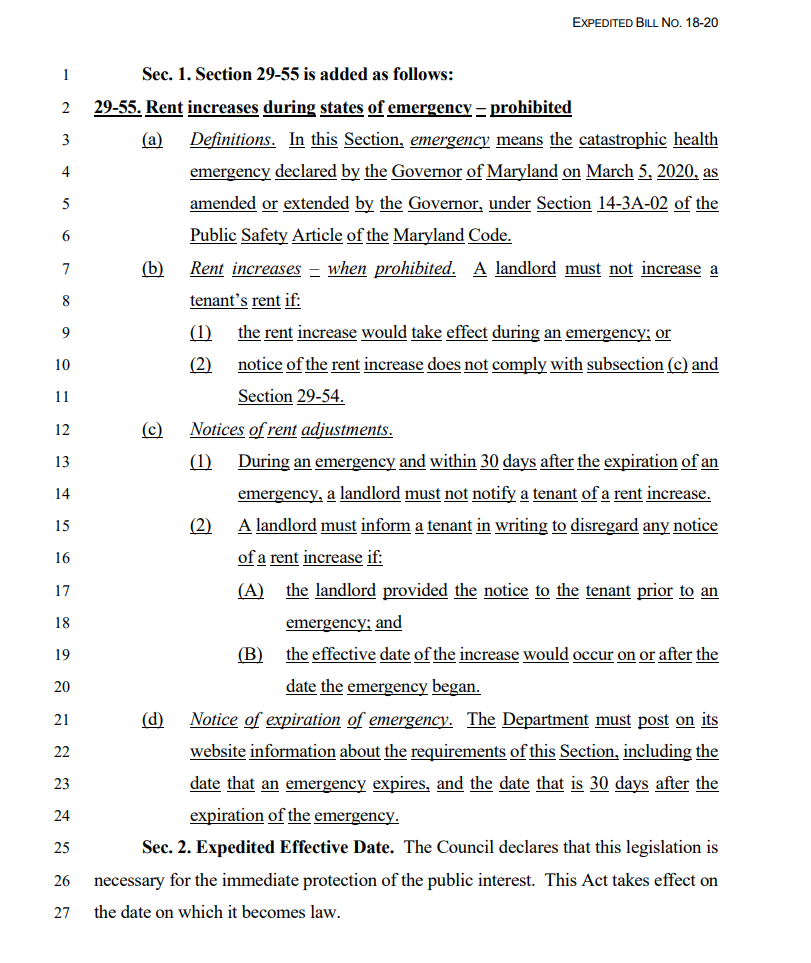
Today, a third version of the bill now excludes commercial property. It also narrows the definition of public emergency to just a “catastrophic health emergency,” a change sought by Council Member Nancy Navarro and made in the second version of the bill. The third version language below has removed all mentions of commercial property. In his verbal comments on introduction, Jawando confirmed that it now applies only to residential property.

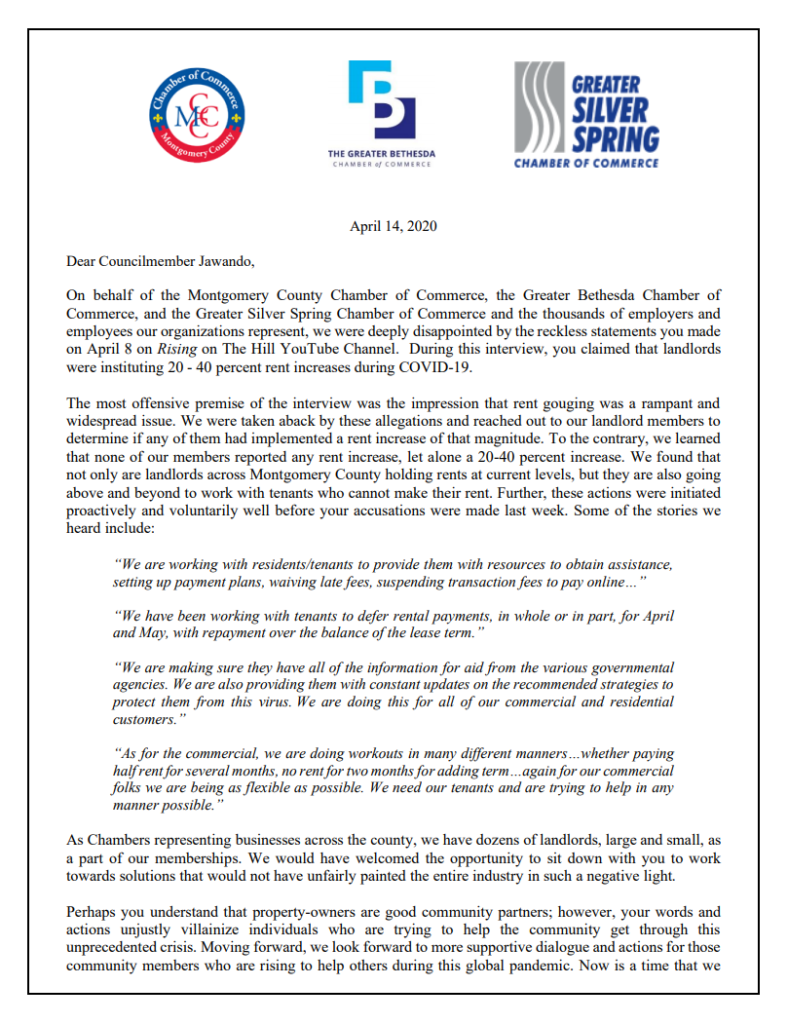
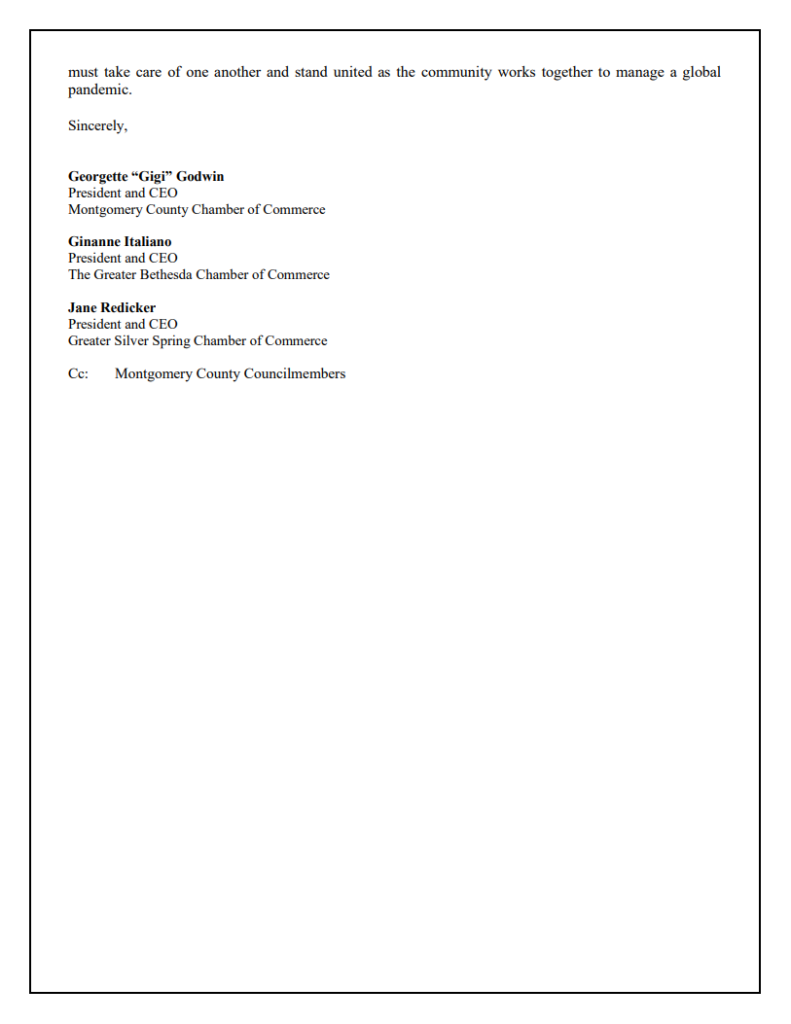
So what happened? After the second version showed explicit coverage of commercial property, the business community erupted in outrage. The chambers of commerce representing the county, Silver Spring and Bethesda sent the letter below regarding statements made by Jawando about the bill.

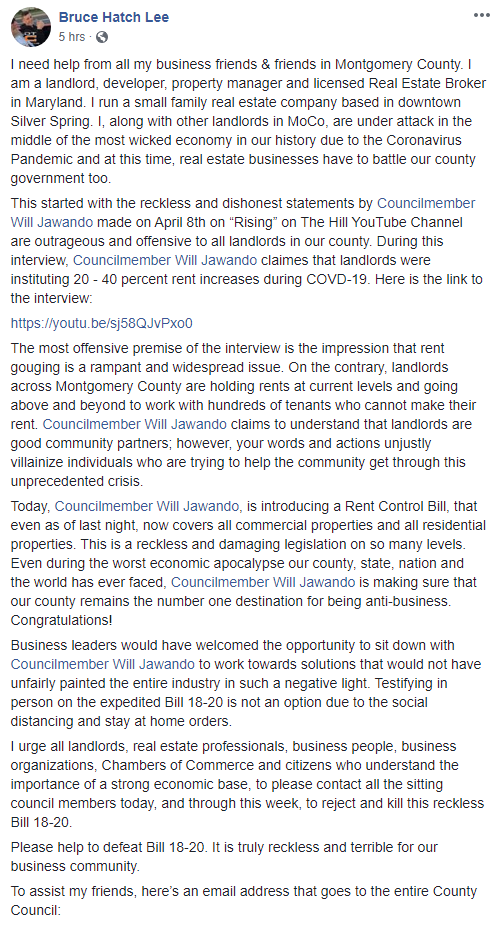
Bruce Lee, President and CEO of commercial property owner Lee Development Group, made the statement on Facebook below. Lee is a member of the boards of the county and Silver Spring chambers.

What has the chambers, Lee and others in the business community upset are Jawando’s claims made in this video that he has received multiple reports of rent increases of 20%, 30% and 40%. In his remarks at the bill’s introduction, Jawando alleged that tenants in the following properties had been notified of the following increases.

The Gallery in Bethesda: 35% rent increase
Quebec Terrace in Long Branch: 9% rent increase plus late fees
The Grand in North Bethesda: 14-60% rent increases

Jawando will no doubt be called on to prove the existence of these increases.

Jawando said the Department of Housing and Community Affairs is hearing about this “every day.” He also offered praise for other landlords such as Southern Management and Wilco for working with tenants rather than imposing large rent increases.

It’s typical for bills to go through multiple drafts before introduction. That’s the result of feedback and the gathering of co-sponsors and is a normal part of the legislative process. But that usually goes on before a bill is published on the council’s website. In this case, because the bill addresses an issue that the lead sponsor believes is urgent, the bill has been changed in real-time online. I have been writing about county politics off and on for 14 years and I don’t remember the last time I saw the same hyperlink leading to three different versions of the same bill over three days prior to formal introduction. That means that, depending on when one viewed the council’s website, a person could have seen one of three versions of the bill and drawn very different conclusions about it. That confusion has stirred even more controversy than this bill might normally generate.

With four council members listed as sponsors (Jawando, Navarro, Craig Rice and Sidney Katz), only one more vote will be required for passage. Expect amendments to be considered.

Share

Elrich Says Riemer Alcohol Proposal Unsound and Unlawful

County Executive Marc Elrich has written Councilmember Hans Riemer to explain why Riemer’s proposal to allow restaurants to defer payments to ABS, the county alcohol monopoly, would violate the law and is a bad idea:

After reviewing your suggestion, we have determined that your proposal would violate federal law. The TTB, formerly the Department of Alcohol, Tobacco and Firearms, would consider the payment terms as a consignment sale, which is prohibited. Even providing different payment terms to different classes of customers is discriminatory. This is not to say that we can’t look at some reasonable extended terms for all of our licensees that may, in the shot term, be acceptable to the county, and meets all allowable legal criteria. As we consider these terms, we will balance that with the higher risk of potential payment defaults by those businesses that may have to close permanently.

Even if the proposal were legal, it would not be sound business or fiscal practice and could jeopardize county revenues and projects. ABS is run as a business, which means that it needs continued revenues to continue operating. If payments were deferred for 12 months, that could create a cash-flow problem for ABS, which needs to pay for inventory, supplies, wages, and leases on retail stores. Without sufficient revenue, the county would have to supplement ABS, reversing the current situation where ABS generates significant revenue for the county and remains self-funding, allowing it to pay for its own operating expenses. Those revenues are used to bond certain county projects. Deferring payments for many licensees for a year would cause a default on loans and would make it difficult – if not impossible – for ABS to operate in the black and continue to produce the surplus funds that go to the county treasury.

Much of the rest of the letter, printed in full below, explains how the county is otherwise working to aid restaurants and thanking the county council for their efforts during the COVID-19 crisis.

Elrich and Riemer have clashed frequently, so the disagreement here isn’t exactly surprising. It’s well known that Riemer plans to challenge Elrich for county executive and attacks him at every opportunity. Riemer’s proposal make him look like he worked fast to help businesses and forces Elrich to play the bad guy and shoot it down.

At the same time, that his idea is illegal and unworkable reinforces the perception that Riemer simply doesn’t think his ideas through and is looking to score quick political points rather than accomplish anything, even in a time of crisis.

Riemer’s lack of attention to the bond issue is especially strange. Defenders of the liquor monopoly, like both Elrich and Riemer, have repeatedly used the link between the bonds and alcohol revenues as a reason that the county liquor monopoly cannot be abolished.

It’s especially damning since Riemer prides himself on being an expert on the alcohol issue and having chaired the Council’s Ad Hoc Committee on Liquor Control back in 2015. Even the long-term politics are questionable as progressive Elrich has now positioned himself as the fiscally responsible alternative to Riemer–quite a feat.

Share

D.C. Leads MoCo on COVID-19 Grants

By Adam Pagnucco.

As complaints mount on MoCo’s not-yet-functioning process for distributing COVID-19 grants to small businesses, let’s contrast our performance to the District of Columbia.

The D.C. City Council passed a bill creating a $25 million grant program for small businesses impacted by the COVID-19 crisis on March 17. The bill also contains a number of delays on taxes and regulations that were not part of Montgomery County’s relief package, although some similar measures have been adopted by other counties in Maryland.

The D.C. government opened the applications process for the grants on March 24. The applications were closed on April 1.

That means 7 days elapsed between the creation of the program and the start of applications. The total time between creation of the program and the closing of applications was 15 days.

The Montgomery County Council passed a bill creating a $20 million grant program on March 31. On April 8, 8 days later, 7 council members wrote a letter complaining to the county executive that the grant process was nowhere close to being ready. That same day, the county published a document list for the grant process but had no application available.

Today is April 14. D.C. opened its applications within 7 days of its council creating its grant fund. MoCo has gone 14 days since creating its fund and, as of this writing, no applications are online. It has been almost two weeks since D.C. closed its application process and we don’t even have one yet. Small businesses in D.C. had a chance to apply for assistance in time to pay rent and bills due on April 1. Small businesses in MoCo did not have that chance.

What is going on, MoCo government?

Share

New Version of Jawando Rent Control Bill Covers Commercial Properties

By Adam Pagnucco.

A few days ago, I reported on a bill to be introduced by Council Member Will Jawando that would prohibit rent increases during public emergencies. There has been some discussion about whether Jawando’s bill covers commercial properties. The short answer is: it may not have originally, but it does now.

In my original post on April 9, I described the bill’s provisions. It prohibits rent increases during public emergencies and also prohibits notices of rent increases extending to 30 days after the end of emergencies. I also said, “The bill does not distinguish between residential and commercial properties.”

On April 11, it was brought to my attention that while the bill does not mention property types, it adds language to a section of county law that regulates housing. I updated the original post with this statement:

Update: The bill adds language to Section 29 of the county code, which regulates landlords and tenants in the context of housing. Sec. 29-3(b)(1) states that the purpose of Section 29 is “to simplify and clarify the law governing the rental of dwelling units.”

Just an hour ago, I heard that a new version of the bill was online explicitly extending its provisions to commercial properties. That is apparent from the language in its transmission memo, which now states, “Expedited Bill 18-20 would prohibit the increase of residential and commercial rents during and after the current catastrophic health emergency declared by the Governor, prohibit certain notices of rent increases, and require certain notices to tenants.”

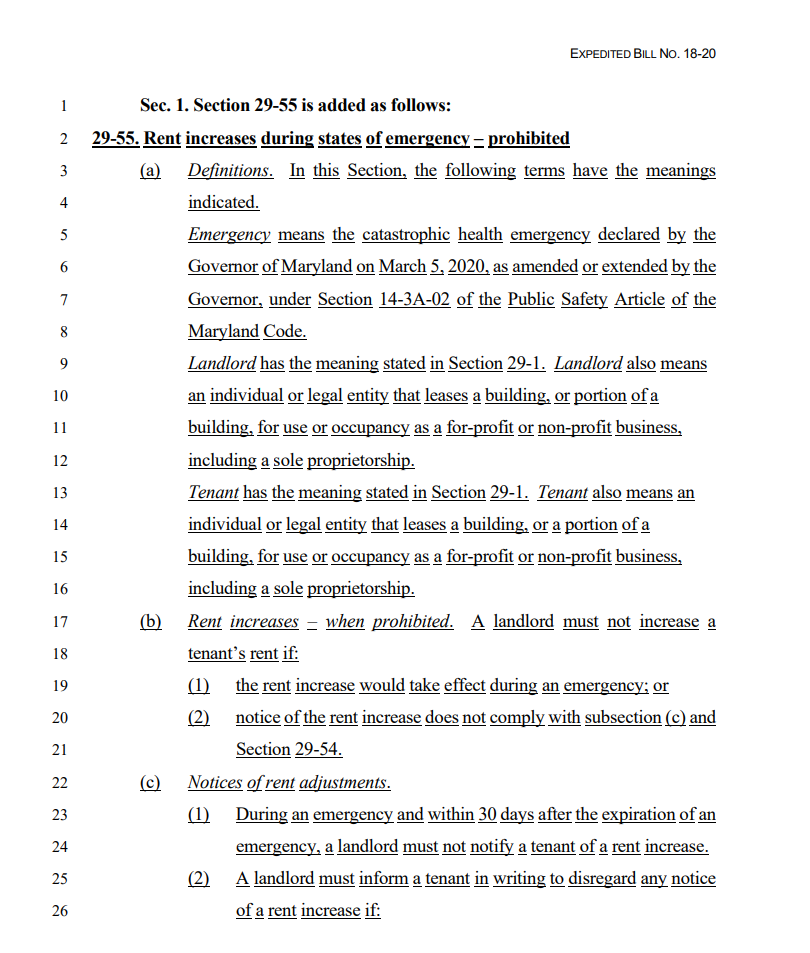
The change is also apparent from the language in the new draft of the bill which is now online. The bill now expands its definition of covered landlords and tenants to include “an individual or legal entity that leases a building, or portion of a building, for use or occupancy as a for-profit or non-profit business, including a sole proprietorship.” The relevant language is reprinted below.

Another change is that Council Member Nancy Navarro has been added as a co-sponsor, joining lead sponsor Jawando and original co-sponsors Sidney Katz and Craig Rice.

The bill refers to itself as a “rent stabilization” bill but by conventional definitions that is inaccurate. Rent stabilization ordinances typically allow rent increases but limit them to set percentages. This bill prohibits rent increases, at least during public emergencies. That is typical of rent control, which provides for hard limits on rent. Accordingly, from this point forward, I will be describing this as a rent control bill.

Expect a fight over this legislation.

Share

Yes, Virginia, You Do Pay More in Taxes, Part II

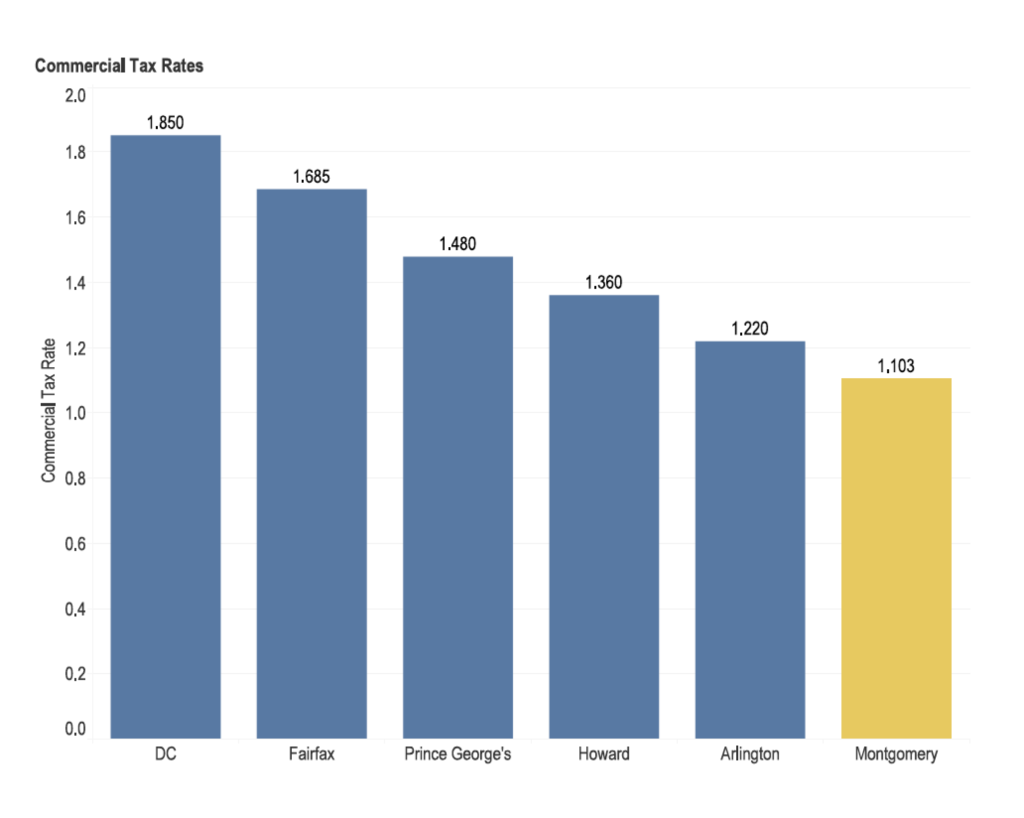
Source: County Executive Budget Presentation

Continuing my occasional series, today, I look at commercial tax rates. Considering the bellyaching by business over the difficult climate in Montgomery, especially compared to Fairfax, you’d think we really dun them on taxes.

Turns out that’s not the case. Our commercial tax rates are lower than all of our major regional competitors in Virginia, DC and Maryland. Commercial taxes in both Fairfax and DC are over 50% higher than in Montgomery.

Thinking about not only this chart but other available information, I draw two conclusions that may seem opposed but are utterly compatible.

It’s Never Enough

No matter what Montgomery does, it will never been good enough for the business community. A case in point is the reaction to the major zoning changes adopted by the previous County Council. These changes greatly simplified the code and made it much easier and quicker for developers to move forward with projects in Montgomery.

Based on the chatter today, you’d never know this occurred. The major complaint of Empower Montgomery’s action plan to improve the business climate last year was to ease further limits on development without demanding any further contributions by developers.

These complaints continue even as the County continues to take a very friendly attitude towards development. For example, after adopting a zoning plan that increased the value of land around White Flint tremendously, we are dropping millions to build a new Metro access tunnel.

Yes, the new tunnel will make it easier for pedestrians to access Metro safely but it will also increase the value of properties in the area. Perhaps the developers should kick in for it?

All of this is just the business community acting sensibly in its own interest. I am no more surprised by it than I am that unions want higher salaries with more benefits. It doesn’t make them evil, but it also doesn’t mean that we have to swallow their narrative whole.

Other Real Barriers Exist

Like all good narratives, the Montgomery is hostile to business narrative mixes up fact and fiction. The fact remains that commercial business growth remains very poor in Montgomery, as Adam Pagnucco has explained in-depth previously.

Montgomery faces real challenges when it comes to business. They just aren’t necessarily the ones we hear about related to taxes and development that seem to attract the loudest moans because of developer muscle in the county.

I hope to explore some of these in the future. Some are easier to solve than others. We could do more to make the county bureaucracy nimbler, market the county, and support local small businesses. The County Council could spend less time on sideshows and more on our major challenges. It’ll be a harder lift to move Montgomery closer to a major airport.

In response to the first post in this series, I heard a lot about the impact of income taxes in the county. I plan to take a look at our overall tax burden including income taxes in Part III.

Share

Elrich Agrees to Give Unions COVID-19 Differential Pay

By Adam Pagnucco.

County Executive Marc Elrich has reached agreement with the three county employee unions (MCGEO, the fire fighters and the police) to provide additional pay related to the COVID-19 crisis to their members. The additional pay will range up to $10 per hour, is retroactive to March 29 and will last for at least six pay periods. Elrich’s press release appears below.

*****

County and Labor Representatives Reach Agreement on Recognizing the Risks of On-site Employees

For Immediate Release: Friday, April 10, 2020

County Executive Marc Elrich is pleased to announce that the County has completed its negotiations with all three County unions and agreed upon COVID-19 differential pay to recognize the unusual risks employees now face in leaving their homes and delivering vital services to the public. These agreements are significant because the union representatives worked with management during this crisis time to achieve an agreement that ensures that critical services are maintained, employees are taken care of and fiscal realities are addressed. The three unions are the International Association of Fire Fighters, Local 1664; the Fraternal Order of Police, Lodge 35; and, the United Food and Commercial Workers, Local 1994 (MCGEO).

“I appreciate the work and the willingness of our union representatives to join with us in a collaborative approach to bargaining, to achieve an agreement that respects the increased risk for our workers who are continuing to do their jobs and respects our budgetary obligations,” County Executive Elrich said.

This agreement recognizes the increased risk of the work done by our first responders – firefighters and police officers during this pandemic. It also recognizes that other employees are doing work that requires public interaction – and therefore increased risk, including work by corrections officers, bus drivers, nurses, and social workers.

The County Executive noted that under provisions of existing county bargaining agreements (which were negotiated years ago), the unions could have insisted on much larger benefits, but they understood the importance of the ongoing fiscal health of the county. The County Executive also noted the progressive nature of the agreement, which gave dollar, rather than percentage, differential payments.

The County Executive acknowledged that the County has nonprofit partners serving on the front lines of the Corona-19 response and will work with them to find possible ways to help them maintain necessary staffing.

After teams of management, in close coordination with union representatives, identified the critical core services that would need to continue for the next eight weeks, the likely minimum duration of the COVID-19 crisis. This COVID-19 differential pay would apply to those front-facing and back-office onsite employees who are required to come to work to respond to COVID-19 or provide County’s selected critical core services. Those who must work onsite are in the following two categories:

Front Facing Onsite: work that cannot be performed by telework, involves physical interaction with the public and cannot be performed with appropriate social distancing.

Back Office Onsite: work that cannot be performed by telework and does not involve regular physical interaction with the public.
The broad details of the COVID-19 pay differential are as follows:

The differential pay will be uniform for FOP and IAFF members. For MCGEO-represented and GSS employees, the differential will distinguish between front-facing onsite and back office onsite work. The differential pay for all impacted employees are retroactive to March 29, the beginning of the current pay period.

The front-facing onsite employees will receive an additional $10/hr and the back-office onsite will receive $3/hr.

Additionally, this week masks will be distributed to employees who do not have them, and administrative leave will be given to high risk employees who cannot telework and do not feel safe working on site.

The agreements cover six pay periods, which started on March 29, or until the Maryland State of Emergency is lifted. If the State of Emergency is still in effect at the end of the six pay periods, the agreements will be revisited.

Share

D.C., Maryland Jurisdictions Start Deferring Taxes, Fees and Regulations

By Adam Pagnucco.

The District of Columbia and several local jurisdictions in Maryland have begun deferring a variety of taxes, fees and regulations during the coronavirus crisis. Taken together, these deferrals provide a useful menu of options for local policy makers.

The District has been the most aggressive local jurisdiction in deferring tax payments. D.C. has extended its filing deadline for individual and fiduciary income tax returns, partnership tax returns and franchise tax returns to July 15. (This matches the income tax filing extensions of the federal government and the State of Maryland.) D.C. has also extended deadlines for filing sales and use tax returns and paying hotel property taxes.

Baltimore County Executive John Olszewski Jr. issued an executive order “providing an extension of all County licenses, permits, registrations and other authorizations until 30 days following the end of the local state of emergency. The order also authorizes the head of each government agency to suspend the effect of any legal or procedural deadline, due date, time of default, time expiration, period of time or other statute, rule or regulation that it administers. This applies to suspensions concerning payments of late fees owed to Baltimore County.” The county also suspended all parking citations.

Garrett County deferred three scheduled payments of its accommodation tax by more than two months each. The deferrals followed closures of rental properties. Vacation rentals are a big business in Garrett County so this is not an insignificant act by the county.

Carroll County postponed its annual tax sale and froze penalties on unpaid tax accounts.

Charles County closed its government buildings but agreed to waive online transaction fees for payment of taxes and utilities.

The City of Frederick suspended daytime parking meter enforcement and extended due dates for city bills, permits, licensures and citations until 30 days after the state of emergency ends.

The City of Annapolis delayed its liquor license renewal requirement for 90 days and left open the possibility of further delays.

WSSC announced it would “suspend all water service shutoffs for those facing financial difficulties until further notice.”

None of these deferrals are earth shattering but they are helpful to residents and businesses in small ways. Policy makers in Montgomery County and beyond should consider if any of them, or perhaps others, are feasible and appropriate in their own jurisdictions.

Share

Jawando to Introduce Emergency Rent Stabilization Bill (Updated)

By Adam Pagnucco.

Council Member Will Jawando plans to introduce a bill on Tuesday providing for rent stabilization during states of emergency. The bill would take effect during a state of emergency or a catastrophic health emergency declared by the governor or a state of emergency declared by the county executive. Once the relevant emergency is active, landlords would be prohibited from enacting rent increases. Further, landlords are prohibited from notifying tenants of rent increases during the emergency and within 30 days of the expiration of the emergency. The bill does not distinguish between residential and commercial properties.

Council President Sidney Katz and Council Member Craig Rice are listed as co-sponsors.

It’s worth noting that evictions are temporarily suspended in both Montgomery County and the State of Maryland. But those suspensions say nothing about rent.

The text of Jawando’s bill can be found here.

Update: The bill adds language to Section 29 of the county code, which regulates landlords and tenants in the context of housing. Sec. 29-3(b)(1) states that the purpose of Section 29 is “to simplify and clarify the law governing the rental of dwelling units.”

Share

Will County Bureaucracy Strangle Small Business Assistance?

By Adam Pagnucco.

On March 31, the county council passed Bill 16-20E, which established a $20 million Public Health Emergency Grant Program to assist businesses and non-profits with 100 or fewer employees that have been damaged by the coronavirus crisis. The idea behind the bill was to get relief to small businesses quickly before they go under.

Unfortunately, the county bureaucracy may have other ideas.

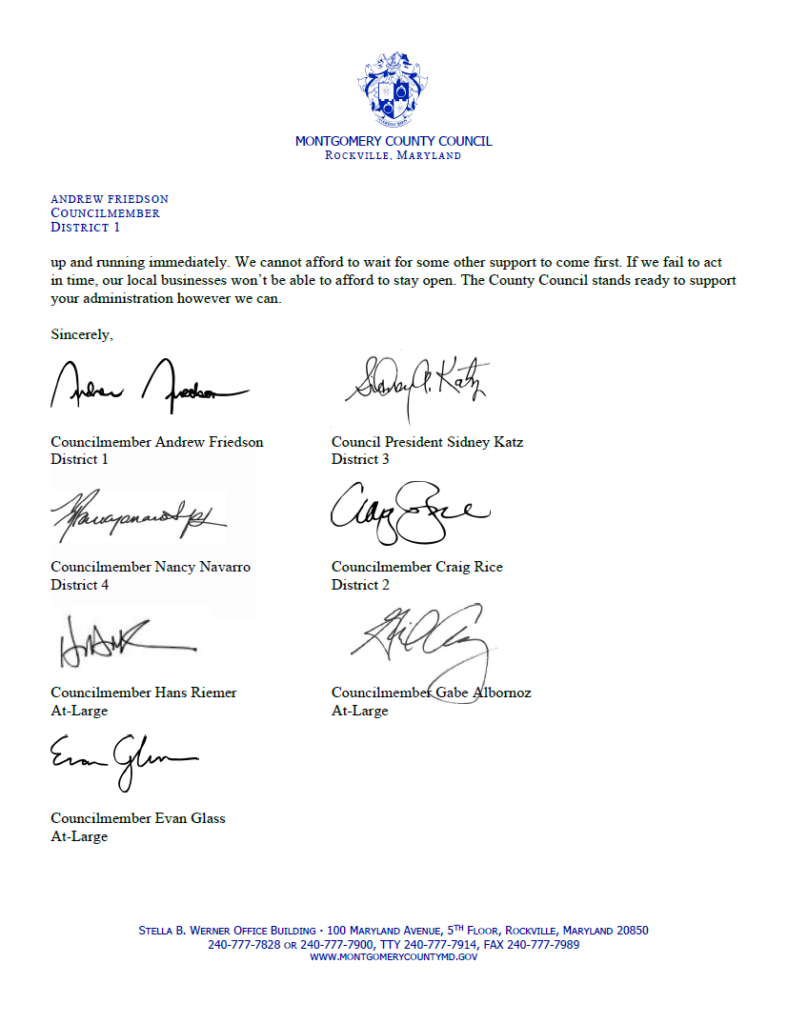
Yesterday, seven council members released a blistering letter to the county executive slamming the administration for taking too long to implement the grant program. The letter stated in part:

This lack of urgency is beyond disappointing and directly contradicts the Council’s clear intent to get this funding to our local employers as quickly as possible. While the County’s capacity to help may be limited, our ability to move quickly should not be, especially as the level of government closest to our residents and employers. For the businesses struggling to keep their lights on and for the employees who depend on them, this program is only effective if it can get funds out in time to provide help when it’s desperately needed. Without question, that time is now.

We must move with the urgency that this moment requires because our small businesses and nonprofits are counting on us. The only thing that will help businesses right now is getting them the relief money already approved and appropriated by the Council. We urge you to get the Public Health Emergency Grant Program up and running immediately. We cannot afford to wait for some other support to come first. If we fail to act in time, our local businesses won’t be able to afford to stay open. The County Council stands ready to support your administration however we can.

We reprint the letter below.

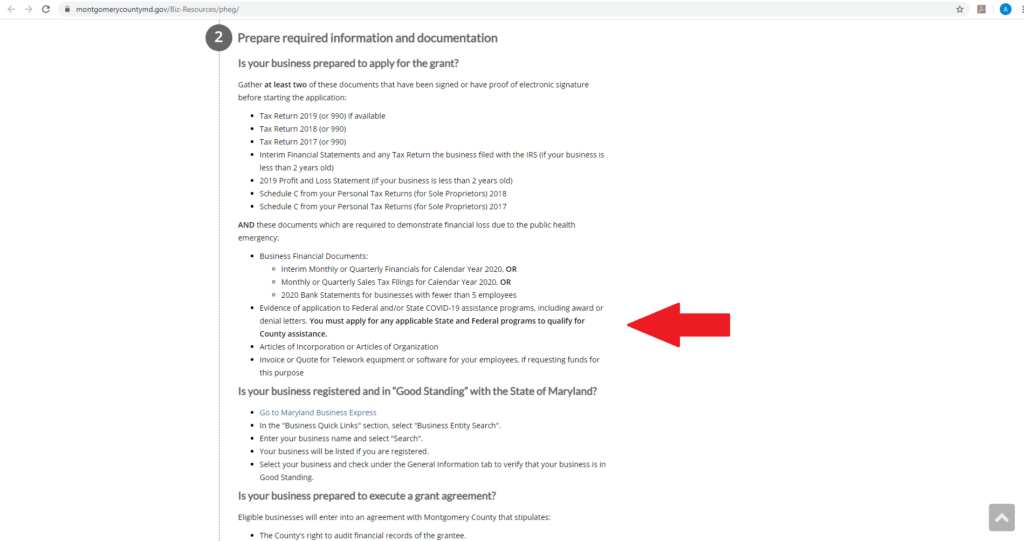
Shortly after the letter was written, the administration published a required document list for businesses applying for assistance. (As of this writing, the application itself is not finalized.) The documents include a dizzying array of tax statements, bank statements, interim monthly or quarterly financial statements, corporate articles and invoices and quotes for telework software (if applicable) as well as a requirement that businesses verify their good standing on a state website. Most crucially, the document list states in bold: “You must apply for any applicable State and Federal programs to qualify for County assistance.” It then requires applicants to submit “evidence of application to Federal and/or State COVID-19 assistance programs, including award or denial letters.”

There is no requirement in the legislation passed by the council that applicants for county assistance must first apply for state or federal assistance. The council considered an amendment making county assistance “secondary” to state and federal assistance and allowing it to be used as a “supplement” to such aid but decided against it. This requirement has been added by the administration in direct contradiction of the will of the council.

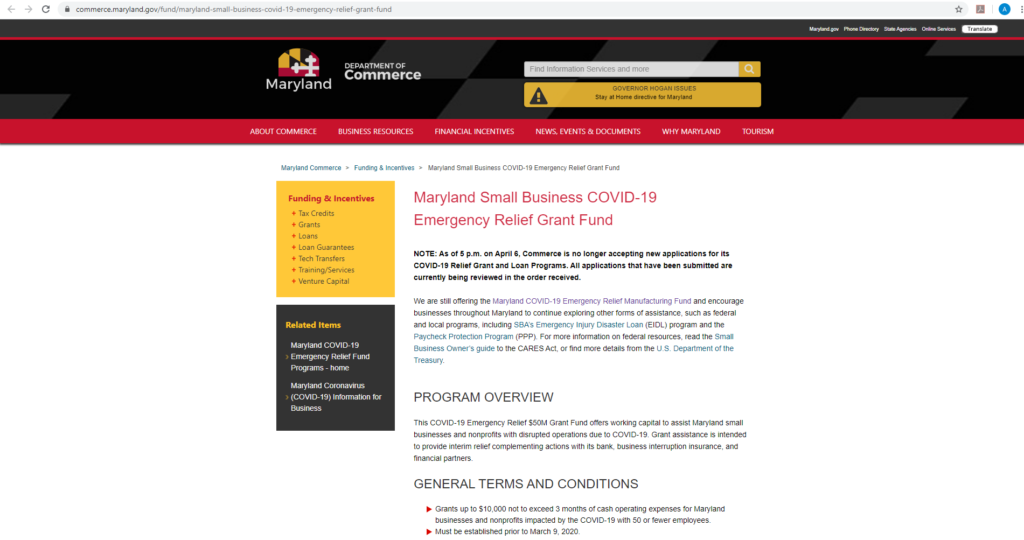
This requirement is of great consequence. When following the links provided by the executive branch, one quickly sees that two of the state’s assistance programs – the Maryland Small Business COVID-19 Emergency Relief Grant Fund and the Maryland Small Business COVID-19 Emergency Relief Loan Fund – stopped accepting applications on April 6, two days before the administration published its document list. So by the executive branch’s criteria, if a MoCo small business missed the state application window, which was only open for about two weeks, it is disqualified from seeking county assistance.

The county is requiring business assistance applicants to apply to these two state funds but both are shut down.

As for the federal assistance programs, the U.S. Small Business Administration (SBA) is under heavy criticism for not getting money out quickly. Some small businesses report that they have not heard anything from SBA after applying, not even a confirmation email. One of the SBA programs relies on private financial institutions to process applications, and some of them are either not taking applications or limiting them to existing clients. One community bank president even said, “What I thought was a brilliant plan is turning into a quagmire of quicksand.”

MoCo is insisting that its businesses jump down these bottomless state and federal rabbit holes to get county assistance. Again, this requirement simply does not appear in the legislation that the executive branch is charged with implementing.

So which businesses will be best able to navigate the process set up by the administration? Naturally, they will be the ones who are the most financially sophisticated, have the best accountants and have the most familiarity with government business assistance programs. Those who lack those assets – especially those with limited English language skills and less entrepreneurial experience – will be left behind. And so a county that prides itself on progressive values might actually wind up directing assistance disproportionately to the most privileged elements of the business community while the others will face extinction.

It’s not too late for the county to streamline its process. But it has to act fast. As in, NOW.

Share

Maryland Politics Watch