MoCo’s Most Influential, Part Seven

By Adam Pagnucco.

Part One of this series laid out the rules and methodology for how we determined MoCo’s most influential people. These lists were developed by adding together the nominations of 85 people who are themselves extremely knowledgeable and influential. Today, we present the mind-bending conclusion!

5 (tied). Jill Ortman-Fouse, Former Member, Board of Education – 16 votes

Source: Love her or loathe her, she’s taken center stage in the most controversial topic in county politics right now.

Source: Even though no longer in an elected position her past actions on the BOE had influence over what is happening with the BOE/MCPS now. She regularly stirs the pot online and offline and isn’t scared to go head to head with her opponents.

AP: It’s amazing to think that JOF’s influence is even greater now than during her time on the school board, but it is. Even her opponents in the school boundary war concede her influence with their relentless and often personal attacks. JOF’s lasting mark will be in her mentorship of the next wave of MCPS activists, many of whom idolize her and have vowed to carry on her agenda of diversity and equity for years to come.

5 (tied). DeRionne Pollard, President, Montgomery College – 16 votes

Source: Not only has she done tremendous work with the college, partnered with corporate and community leaders as well as electeds across the county, but she’s also led strategic conversations on race as she tries to address those barriers not only for her students, but for the future of the county.

Source: Holy moly, what a dynamo of leadership! She is inspiring, bold and always on! She shoots for the moon and rarely misses. Just look at her track record of budget successes for the college.

AP: It’s easy to forget what a mess Dr. Pollard’s predecessor, former Montgomery College President Brian Johnson, made of the college. The college’s professor union discovered through public information act requests that Johnson was frequently absent from the office, “routinely censored” information, prevented employees from talking to trustees and ran up outrageous expenses. Later, it was revealed that Johnson was wanted for arrest in Maricopa County, Arizona for failure to pay child support and the sheriff even said, “We’d be happy to put him in jail.” Thankfully, that’s ancient history. Montgomery College has rebounded nicely under Dr. Pollard’s leadership and is now one of the highest-ranking colleges in Maryland. That’s one reason why she has been at the college for ten years, an unusually long tenure for a person in her position.

4. Gino Renne, President, MCGEO – 17 votes

Source: Still one of the gorillas in MoCo politics, always at the table.

Source: Manages to be influential despite MCGEO’s pathetic track record in actually getting candidates elected. Remember the Duchy vs. Berliner showdown? OK, Gino lucked out when Marc Elrich squeaked out a win in a crowded primary, but I have no idea why so many elected officials get so concerned about what MCGEO thinks – yet there it is.

AP: The Godfather has been stomping on politicians and getting contract results far exceeding the private sector for a looooooong time. But with a budget crisis looming, he is about to go up against the only force more powerful than he is: a bad economy.

3. Jack Smith, Superintendent, MCPS – 24 votes

Source: Schools are still the number one issue.

AP: This being Montgomery County, the MCPS Superintendent will always be on this list. However, none of Jack Smith’s predecessors have had to do what he is doing now: designing and implementing a distance learning program for the entire student population in a matter of weeks. If he pulls it off well, it will be a huge success story for the entire school system.

2. Adam Pagnucco, Co-Author, Seventh State – 28 votes

AP: Two words. Sample bias! Let’s move on to number one.

1. Casey Anderson, Chairman, Montgomery County Planning Board – 31 votes

Source: Chair of the planning board, an incredibly influential position that even people in-the-know underestimate, and perhaps the only official (elected or otherwise) who has a vision for where he wants the county to go. Together, they’re a dangerous combination.

Source: His views on housing, schools, and transportation are respected in both Rockville and Annapolis.

Source: Perhaps the most activist planning board chair ever, tied in closely to smart growth/YIMBY movements and will play the central role in the upcoming General Plan, which will set the stage for 50 years of land use planning and subdivision staging which is top of mind for the here and now.

Source: With incredible data to back him up, he is changing the conversation around development/moratorium/etc.

Source: Has made many strategic moves with planning. Innovative visionary.

Source: His post gives him huge power over land use. He wields his power effectively to satisfy his overlords on the council. As a regular on the Democratic Party circuit, his interest in partisan politics suggests Casey is jockeying for a run at elective office.

Source: Someone has to stand up to Marc Elrich.

Source: Land use is political in this County. Has overseen numerous policies and plans that will shape this County for years to come. Surprisingly laid back guy when not in his official capacity. Last term on the Planning Board – what will he do next?

AP: Casey is my choice for the most influential non-elected person in MoCo. He is not only the most prominent smart growth leader in the county today; he has become one of the greatest planning board chairs ever. His stewardship of the upcoming general plan as well as his role in crafting many other master plans over the years will put his stamp on the look and feel of this county for the next 50 years.

That’s it! Thanks for reading!

Share

Time to Bag Jawando’s Rent Control Bill?

Montgomery County Councilmember Will Jawando (D-At Large) introduced legislation to temporarily suspend the county bag tax and enact rent control to respond to the COVID-19 crisis. The first has already bit the dust and it looks increasingly like the second should too.

Bag Bill Bagged

Councilmember Jawando introduced a bill to suspend the county bag tax during the health crisis. Though cosponsored by all of his colleagues, except Councilmembers Evan Glass (D-At Large) and Tom Hucker (D-District 5), the bill received a lot of pushback.

Much like Councilmember Hans Riemer’s (D-At-Large) bill to allow businesses to suspend payments for alcohol to the county monopoly, it faced the problem that bonds are tied to the revenues. Additionally, the environmentally-focused Sierra Club was not happy.

In a rare story for a bill sponsored by seven of nine members, it was on the fast track to defeat instead of passage. Most would have let the bill die quietly at this point. Mystifyingly, Jawando chose instead to announce a full retreat by declaring victory:

Councilmember Will Jawando plans to withdraw Expedited Bill 17-20, Carryout Bag Tax Suspension after working collaboratively with members of the community. . .

County Health Officer Dr. Travis Gayles recommends “a number of strategies for using reusable bags including washing them between use, customers packing their own reusable bags at check out and frequently cleaning surfaces in baggage areas.”

In addition, the Department of Environmental Protection has agreed to work on a campaign and resources to remind consumers to wash their reusable bags that can be posted at grocery stores and retail establishments.

Jawando can trumpet his success in finding an “alternative solution” but it sure sounds suspiciously like the status quo.

Rent Control: A Solution in Search of a Problem?

Now, Councilmember Jawando is pressing ahead with a rent control bill that is scheduled to have a hearing on April 21 (tomorrow) and a full council vote on April 23 (Thursday).

Jawando has explained to the media that his office has received “multiple reports” of rent going up 20, 30, 40 percent. He also expressed concern that at the end of the crisis that “You’re going to see people try to raise rents to get out people who can’t pay. And then you’re going to see a spike in evictions and then you’re going to try to bring people in at higher rents to recoup the loss.”

As Adam Pagnucco previously reported, the chambers of commerce have pushed back very hard on these claims:

We were deeply disappointed by the reckless statements you made. . . claim[ing] that landlords were instituting 20 – 40 percent rent increases during COVID-19.

The most offensive premise of the interview was the impression that rent gouging was a rampant and widespread issue. We were taken aback by these allegations and reached out to our landlord members to determine if any of them had implemented of that magnitude. To the contrary, we learned that none of our members reported any rent increase, let alone a 20 – 40 percent increase.

The claim that widespread rent hikes are now happening makes no sense.

No landlord wants to lose a regularly paying tenant now even if they have to make some adjustments and take some losses. There is no guarantee you can fill the vacancy and you certainly won’t be able to do so until this crisis ends.

If anything, rents may fall as demand declines due to mass unemployment. So much for recouping losses by jacking up rents, which is just not how rental markets work. Landlords can only charge what the market will pay.

If a landlord tries to raise rents now, tenants can just not pay due to the moratorium. Such a mean and stupid landlord may well be out even more rent as well as all of the time and expense of evicting someone once that is again legal. The landlord then also loses yet more rent due to the time it takes to fix the place up again, if needed, and to find a new tenant.

Jawando’s specific claim that landlords will raise rents in order to evict non-paying tenants makes even less sense as that will not allow a landlord to evict their tenant any more quickly. If anything, the tenant will appear even more sympathetic to landlord-tenant court judges who will be very disinclined to evict anyone during the immediate aftermath of this crisis anyway. Remember that evictions are a lengthy legal process.

In short, if it doesn’t make any sense even from an amoral greed perspective, is this really happening on a widespread basis? It might be better to explore specific situations and address any bad actors on an individual basis. I wouldn’t think landlords would want to be publicly exposed as raising rents right now.

In an email response to my request for specific information, Jawando stated that his bill “supports” landlords and tenants alike:

Some landlords have thankfully already decided not to impose the burden of a rent increase on their tenants during this time . . . The intention of Bill 18-20 supports the action of these landlords while protecting other tenants whose landlords have not made a similar decision.

The idea that his bill “supports” the vast majority of landlords who have not increased rent is bizarre in light of the response of the chambers of commerce pushing back on this bill as a broad smear of how landlords have responded to the crisis.

Despite repeated requests, Jawando has not produced an iota of concrete evidence that this has occurred let alone a widespread problem that requires fast-track legislation:

Some of the tenants who have contacted our office are nervous about coming forward to the media as you might imagine, however when I introduced the bill, I did share several cases with increases ranging from 9% – 60%.  

Except big claims and major legislation require hard evidence that should be made public. At the very least, Jawando could have by now produced redacted letters if such notices of rent increases are being distributed widely in some buildings. Regardless, any documents he has are public as he received them in his capacity as a councilmember.

Jawando’s bill has already been through several iterations, first excluding then including then excluding again commercial properties from the bill. These changes further suggest that the facts regarding the problem it is intended to solve are not known. At the very least, they aren’t being made public. Right now, all we have are unsupported anecdotes from the bill sponsor.

If this is a widespread problem, Jawando’s bill may be an appropriate response. If not, the Council should move along to address may of the other pressing problems that the county will face during and after this crisis.

The Council’s unanimous effort to fund the production of cloth masks to make sure all county residents have access to them is a much better example of good use of their time. My applause to all councilmembers for supporting this effort. More please.

Share

Top Seventh State Stories, March 2020

By Adam Pagnucco.

These were the top stories on Seventh State in March ranked by page views.

1. What’s More Important? The Liquor Monopoly or a Thousand Bartenders?
2. Liquor Monopoly Ends Takeout Cocktail Ban
3. Montgomery Leads Maryland in Social Distancing
4. MoCo’s Most Influential, Part Two
5. Is This the Worst Communications Debacle in County History?
6. Is This Moving into the 21st Century?
7. In MoCo, Public Media are Replacing Private Media
8. Everyone Can Vote Absentee
9. MoCo’s Most Influential, Part One
10. The County Budget is in Crisis. What Now?

Of interest is the fact that three of these stories concern the liquor monopoly. The top post – What’s More Important? The Liquor Monopoly or a Thousand Bartenders? – is, as of this writing, one of the top ten most-viewed posts in the history of Seventh State.

Most MoCo politicians don’t like talking about the liquor monopoly. Many of them admit that it is inefficient and archaic in private, but they don’t want to give up its revenues and they worry about offending the union that represents its employees. Our site traffic indicates that Seventh State readers care a lot about this topic and some of our liquor monopoly posts really pop. Politicians who get out front on this will benefit.

More top posts are coming next month!

Share

Good News on Maryland Coronavirus Projections

On April 6th, I posted the University of Washington coronavirus projections for our state They have updated their projections and the news, as throughout the country, is very good in terms of reduced cases and demands on our resources. Today, April 18th, was the day they projected to be our peak resource day back on April 6th, so now seems a good time to revisit.

All ICU beds needed and available:

The total number of ICU beds still exceeds the state’s normal capacity based on the pre-corona number of beds and their use. The good news is that the state has expanded the number of beds and the projected peak need has declined from 1224 beds to 430 beds. Still a high rate of use but more manageable.

All hospital beds needed and available:

On April 6th, UW projected that we’d need a maximum of 6443 hospital beds, way more than the state’s normal availability of 3961. The projection has now declined to 2405, which is within the state’s capacity.

All ventilators needed and available.

UW expected that we’d need 1040 ventilators in their April 6th projections. Now, Maryland should need 373.

Projected deaths per day:

The maximum projected deaths per day has declined to 46 pm April 20th, two days from now. Previously, UW had projected a maximum of 138 that on April 19th, tomorrow.

Projected total deaths:

The new projected total of 914 COVID-19 deaths in Maryland is a 61% drop from the projection on April 6th of 2326.

An increasingly vocal minority believes that the much improved projections mean that COVID-19 was much ado about nothing. Except that as epidemiologists have tried to explain, the better the outcome, the less it will appear it was necessary because an improved job will have been done at stopping the infection in its track. The improved projections are due to extensive social distancing, not a random event.

Share

MoCo’s Most Influential, Part Six

By Adam Pagnucco.

Part One of this series laid out the rules and methodology for how we determined MoCo’s most influential people. These lists were developed by adding together the nominations of 85 people who are themselves extremely knowledgeable and influential. Today, we continue the list of the most influential non-elected people in MoCo.

12. Steve Hull, Editor-in-Chief and Publisher, Bethesda Magazine/Bethesda Beat – 9 votes

Source: While Bethesda Magazine / Bethesda Beat is not a political publication it has become one of the main local sources of news which means which stories are run and what information they present have influence. Just avoid the comment section!

AP: Let’s just state the obvious. Without Steve, MoCo would be close to a news desert. Steve would do just fine if all he had was Bethesda Magazine, but thank God he also runs Bethesda Beat. It is essential reading for anyone who cares about the community.

11. Josh Kurtz, Co-Founder and Editor, Maryland Matters – 10 votes

AP: As if being the best political writer in the state wasn’t enough, Josh had to go and found Maryland Matters, which is now the single best place to read about state politics. Political junkies all over the state are grateful!

10. Gustavo Torres, Founder and Executive Director, CASA – 11 votes

Source: Head of CASA only grows as a force to reckon with.

AP: From a church basement to the pinnacle of state and local politics, Gustavo is arguably the most powerful immigrant advocate in the entire Mid-Atlantic region. As CASA gets bigger along with the immigrant population, there is no end in sight to its influence.

9. Robin Ficker, Attorney, Former Delegate and Political Heckler – 12 votes

Source: His ballot measures have passed and upended things. He’s a fool of great consequence.

Source: Ficker knows how to craft winning ballot petitions and campaigns behind them. Ficker’s smarts are masked by his nutty personality, which causes people to underestimate him.

Source: Has accomplished more than some elected officials.

Source: May be obnoxious and annoying but his referendum drives influence the county.

Source: Crazy, but holds outsized influence.

AP: Ficker doesn’t get much love from my sources but one could make the case that he is actually the most influential non-elected person in the county. Who else has nearly single-handedly passed two charter amendments in the last twelve years with another possibly on the way? He has far more influence now than he ever did in his one term as a Delegate, and if his new anti-tax charter amendment passes, it will have a huge impact on county government for a loooooooong time.

7 (tied). Diana Conway, President, Women’s Democratic Club – 14 votes

Source: President of the Women’s Democratic Club, energizer bunny energy, often found walking the halls of Annapolis or e-mailing Councilmembers, throws a who’s who holiday party.

Source: Extremely connected, a force. Strong voice and everyone knows where she stands. Unafraid to go against the tide.

Source: Diana Conway is the president of the Women’s Democratic Club which was a pretty sleepy affair until Linda Kolko’s presidency and continuing through the presidency of Fran Rothstein. Now, they co-sponsor all sorts of events with “Do the Most Good,” and “J Walkers” and “Resist” and some others who I hope would forgive me for not having their names on the tip of my keyboard.

AP: Her nickname is Madam Kickass and that is the double truth, Ruth! Few people in the county can match Diana’s brains, tenacity and sheer capacity to do anything she decides to do. Her presidency of WDC is only the latest sign of her growing influence. PS – I feel sorry for the bureaucrats who have to answer her emails about artificial turf fields!

7 (tied). Rich Madaleno, Director, Montgomery County Office of Management and Budget and Former State Senator – 14 votes

Source: The budget whisperer. He plays a critical role in explaining how the county budget works to, well, everybody but especially Marc Elrich. Retains great Annapolis contacts.

Source: He’s become one of the county executive’s top defenders and surrogates while continuing to be an idea machine.

AP: The budget director is always important, but Rich’s experience at the state level and his status as a long-time (and effective!) former elected official make him even more influential than his position warrants. The budget crisis resulting from COVID-19 makes his role more critical than ever.

Part Seven will contain the much-awaited, soul-searing conclusion!

Share

Magic Asterisk in Elrich Budget Blows Open $10 Million Hole

By Adam Pagnucco.

There are many reasons to read government budgets. They illuminate the structure, function and priority of governments. They reflect what politicians actually do vs what they say. They lend themselves to making marvelous spreadsheets. And once in a while, you find something a little odd. Maybe something weird. And on rare occasions, something wilder than a jungle full of battling predators.

This is one of those rare occasions!

The item at hand is a non-departmental account (NDA) buried on page 70-28 in the county executive’s recommended budget. NDAs are expenditures that fall outside individual departments or apply across multiple departments. (Here’s a secret: these are some of the most fascinating items in the entire budget!) One new NDA recommended by the executive is called “Productivity Improvements.” Here is how the executive’s budget describes it.

This NDA recognizes cost efficiencies identified by Montgomery County Government staff through the evaluation of service delivery models, supervisory/management and workforce structures, relevant tools, equipment, and technologies, operating budgets, and contracts with outside vendors. The critical assessment of these factors and formulation of strategies to maintain, increase, or improve service delivery at a lower cost is a pillar of good government, especially in a fiscally challenging environment. The productivity and performance improvement effort is a collaborative initiative that involves County leadership, management, and represented employees.

The appropriation amount for this NDA is negative $10 million. You read that correctly. It’s not $10 million. It’s negative $10 million. That’s because the administration thinks it can save $10 million through “cost efficiencies.” What are these efficiencies exactly?

It’s not clear.

These “cost efficiencies” are definitely not achieved through government restructuring that saves a lot of money, a major campaign promise by the executive that has not been kept. Neither are they achieved through trimming employees since the executive’s budget adds 184 full-time-equivalent positions.

Council Member Hans Riemer called it a “$10 million magic asterisk funding item” and compared it to the deficit-exploding budget chicanery of the Reagan administration. Council Member Andrew Friedson called it a “phantom negative appropriation” and added, “Hoping for cuts is not a strategy. Asking for cuts to be made at a later date, for efficiencies to be found at a future time is not an appropriate way to pass a budget… We can’t just rhetoric our way out of this. We need results to get our way out of this. And we need reality to be part of this. And a $10 million phantom possibility to be named at a later date is not reality. It’s fantasy.”

When asked what this “magic asterisk” actually was, Council Staff Director Marlene Michaelson replied that it was “anticipated efficiencies that may be identified.” Michaelson added, “So from our perspective it means that there is a $10 million hole that the council needs to now fill either through additional reductions or additional resources. And given the signal that the council has already sent us about not wanting to try and increase taxes, it really is going to be additional reductions that need to be identified.”

Why does the magic asterisk create a $10 million hole? It turns out that it violates the county’s charter. Back in May 2008, the council resolved a disagreement over a property tax hike by reducing its size and passing a budget resolution calling on the executive to trim $13 million through unspecified efficiencies. Council staff uncovered a 2009 memo from County Attorney Marc Hansen concluding that such a negative appropriation violated the county’s charter. Hansen wrote:

A negative appropriation is not consistent with the Charter. A negative appropriation acts as a general command to the Executive to reduce appropriations made elsewhere in the budget. This is not consistent with the Charter, because the Charter requires the Council to adopt a budget that includes appropriations of specific amounts for specific purposes for the ensuing fiscal year.

Hansen remains the County Attorney today. It is unknown why the executive branch apparently did not know of this legal determination when formulating its budget.

Productivity improvements are great things when they are REAL. And when they are real, they can be booked inside departmental budgets. Is there new technology in the libraries that increases productivity? Great, then you can ask for $42 million for the libraries instead of $43 million. Is there new scheduling software in the fire department that can control overtime? Great, then you can ask for $227 million for fire services instead of $229 million. (OK, maybe we should not discuss fire department overtime.) The point is that there is a big difference between REAL productivity improvements and “anticipated efficiencies that may be identified.”

And so the magic asterisk has created a $10 million hole in the budget that the council must now close. The coronavirus crisis ensured that this year’s budget was going to be very tough. Now it’s a little bit tougher.

Share

Huge Demand for COVID-19 Applications

By Adam Pagnucco.

Montgomery County’s COVID-19 assistance application went live today around 3 PM and demand was both immediate and heavy.

One applicant who completed the county’s form described the process to me as lasting less than 10 minutes. She encountered no problems and said she was “very impressed.”

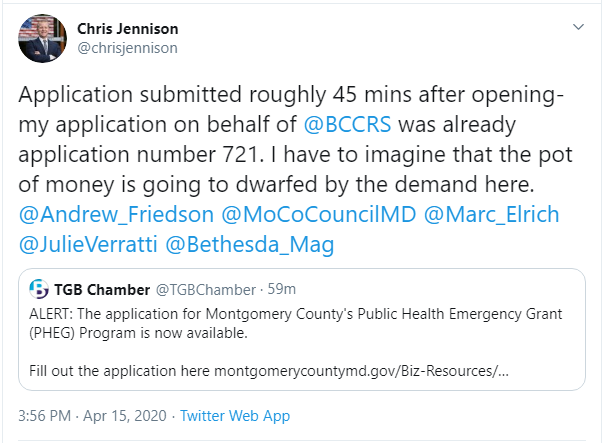
Another applicant tweeted that he applied roughly 45 minutes after the application went live and was assigned application number 721.

That’s important because, according to the county’s regulations, the first tranche of $10 million will include individual awards of $10,000 each. That implies that only the first qualifying 1,000 applicants will get initial assistance awards. Conceivably, the county could get 1,000 qualifying applications in just a couple hours – or less.

One glitch in the rollout involved an email signup shown on an earlier version of the website. (It’s no longer available.) I signed up a couple days ago and received notification of the application at 4:30 PM. By that point, the queue may have filled up.

Intense interest in assistance will result in the county’s initial funding being claimed RAPIDLY. Those who waited for email notification or other official notice from the county will no doubt raise process protests if they indeed lose out because of application timing.

The process has been far from perfect as I have previously written. But let’s also acknowledge that even with a perfect process, this was going to be very tough sledding.

Expect more of the same!

Share

Elrich Requests That Planning Board Limit Work to “Noncontroversial” Issues

By Adam Pagnucco.

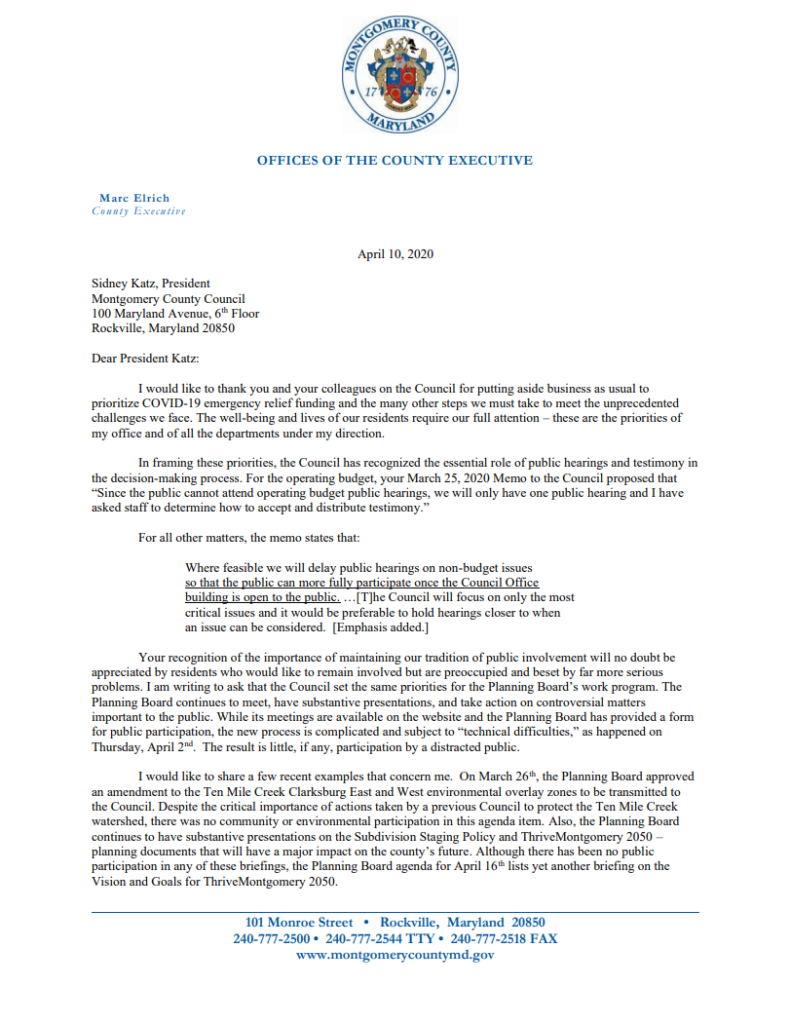
In a letter to Council President Sidney Katz, County Executive Marc Elrich has asked the council to limit the work of the Planning Board to “noncontroversial” issues during the COVID-19 crisis.

Elrich begins his letter by noting that the council has delayed some hearings on non-budget issues due to problems of public participation stemming from social distancing. Elrich contrasts that with the planning board’s policies. He writes:

The Planning Board continues to meet, have substantive presentations, and take action on controversial matters important to the public. While its meetings are available on the website and the Planning Board has provided a form for public participation, the new process is complicated and subject to ‘technical difficulties,’ as happened on Thursday, April 2nd. The result is little, if any, participation by a distracted public.

After noting two issues of public interest before the board – an amendment to environmental overlay zones in Ten Mile Creek and ongoing work on the Subdivision Staging Policy – Elrich writes:

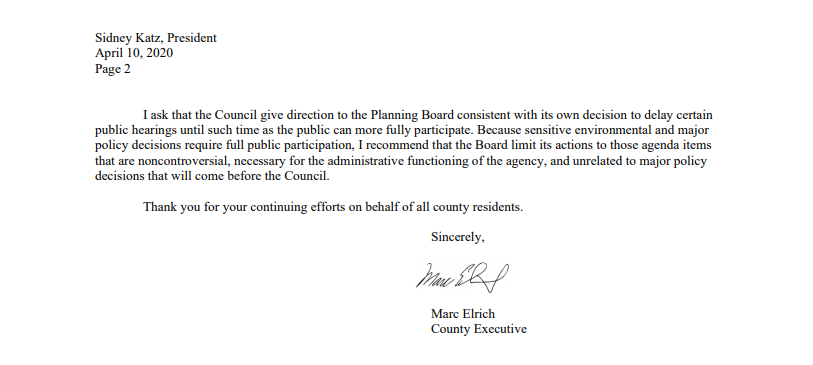
I ask that the Council give direction to the Planning Board consistent with its own decision to delay certain public hearings until such time as the public can more fully participate. Because sensitive environmental and major policy decisions require full public participation, I recommend that the Board limit its actions to those agenda items that are noncontroversial, necessary for the administrative functioning of the agency, and unrelated to major policy decisions that will come before the Council.

It’s unclear whether the council has the specific authority to direct the Planning Board in how to perform its work. The council does fund the agency and it appoints Planning Board Members. Complicating the issue is Elrich’s barely veiled contempt for Planning Board Chair Casey Anderson. Last year, Elrich told Bethesda Beat that he was “not a fan” of Anderson but the council unanimously reappointed him as chair anyway.

We reprint Elrich’s letter below.

Share

Elrich Administration Releases COVID-19 Small Business Assistance Regs

By Adam Pagnucco.

At 9:09 PM last night, I published a post on the county’s $20 million COVID-19 small business assistance program noting that no regulations governing its disbursements had yet been sent to the county council or published for the public. Roughly 20 minutes later, the regulations were sent to the council and forwarded to me by multiple sources almost immediately. The regulations appear below.

There are many details of interest to applicants, who should read every word of these regulations. The provisions that stand out to me are the ones setting aside $10 million for near-term disbursement and reserving $10 million for later. Consider these specific provisions.

Section 4 (b). $10,000,000.00 of funds appropriated for this Program are reserved for businesses or nonprofit organizations that demonstrate Significant Financial Loss. The initial grant award disbursed under this component of the Program is $10,000. The remaining amount of Significant Financial Loss demonstrated by these businesses and non-profit organizations may be disbursed subsequently, subject to the availability of funds.

Section 5(e)(B)(6). Business that have suffered Significant Financial Loss will be eligible for an immediate disbursement of up to $10,000. If the Percentage Decline is 50% or greater, Subtract the Adjusted PHE Revenue from the relevant historical average (Monthly Historical Average for monthly Adjusted PHE Revenue, Quarterly Historical Average for quarterly Adjusted PHE Revenue) to get the Recommended Grant Amount, up to a maximum of $10,000.

Section 5(e)(B)(7). Subtract the Adjusted PHE Revenue from the relevant historical average (Monthly Historical Average for monthly Adjusted PHE Revenue, Quarterly Historical Average for quarterly Adjusted PHE Revenue) to get the Recommended Grant Amount, up to a maximum of $75,000.

Section 5(e)(B)(8). Subject to the availability of funds, once the initial $10,000,000 reserve has been committed, applicants who qualified for more than an initial disbursement of $10,000 and applicants who qualify for a grant that have not received funding will be evaluated and the remaining balance will be disbursed.

And so $10 million will be disbursed sooner and $10 million will be disbursed later. Instead of the full $75,000 maximum grant provided in the legislation passed by the council, applicants will get a maximum of $10,000 in the first round and may get a chance for more money later. When will the second $10 million go out? That’s not clear, but the caveat of “subject to the availability of funds” in Sections 4(b) and 5(e)(B)(8) is not encouraging. Given the volume of paperwork required in the application process, it could take a while.

None of this appears in the legislation creating the program. The council prioritized speed in disbursing the full $20 million it allocated for assistance. The executive branch took twice as long as the District of Columbia to get its assistance program going and now plans to hold back half the money. The council just introduced a new appropriation of $5 million for restaurants and retailers. Given these regulations, what will happen to that money?

The executive branch is not implementing this program in accordance with the legislative intent of the council. The council must take additional action to enforce its will. NOW.

The regulations appear below.

Share

Fact, Rumor and Chaos on COVID-19 Assistance

By Adam Pagnucco.

The county has announced via press release that COVID-19 assistance for small businesses will be open for application tomorrow (April 15). But questions arise both from the release and what is not in the release.

1. The application process is supposed to open in the “mid-afternoon.” No exact time is given in the press release. Will business owners be refreshing their browsers for hours waiting for the application to go live?

2. According to the press release, “The County will host webinars to answer questions and provide updates on the PHEG program starting at 9 a.m. Mondays through Saturdays. The first webinar will be held on Thursday, April 16.” In other words, the first Q&A webinar will not take place until THE DAY AFTER applications open.

3. As of this writing, multiple sources in the council building report that the council does not have final regulations governing the disbursement of the money. How is the administration going to make decisions on who gets the money? Why have these criteria, in the form of a regulation or otherwise, not been publicly released – or at least sent to the council – prior to the start of applications?

4. The legislation passed by the council authorized grants of up to $75,000. At the time of passage, council members stressed their interest in rapid disbursement. Today, a phone call was held by representatives of the executive branch with representatives of the business community in which some details were shared about the administration’s plans. According to an individual present on the call, “We heard that the 1st wave was the first 1,000 qualified recipients would receive $10,000 as a start. They may receive more later TBD.” Furthermore, only losses in March will be considered and priority will go to businesses with losses of more than $50,000. An earlier requirement that applicants apply for federal and state assistance first has been dropped. So it appears that $10 million will be disbursed first and that $10 million will wait for later – at least as of this writing. If there is indeed a hold on part of the money, why is that? What will happen to it and when will it get released?

This would be a lot easier to figure out if the administration simply released its regulations on how they are making these decisions, or even a simple guidance document. Instead, in the absence of published documentation, rumor rules the day.

Let’s be clear: the executive branch is in a tough spot here. They had to stand up a $20 million assistance program on short notice (although D.C. did the same in half the time). If they disburse small checks to lots of businesses, the money may not be enough to help any of them. If they disburse large checks that might be helpful, MANY businesses will be left out. So there are choices to make.

The problems are that the executive branch is diverging widely from the intent for speed of the legislation passed by the council, is forcing applicants to sit next to a browser and refresh it potentially for hours, is not offering aid for completing the application until the day after it goes live and has not published details of how it intends to spend $20 million.

This process is in need of improvement.

The press release is reprinted below.


For Immediate Release: Tuesday, April 14, 2020

Montgomery County Public Health Emergency Grant (PHEG) Program Applications Will Be Accepted Starting Mid-Afternoon on Wednesday, April 15

Montgomery County will begin accepting applications to its Public Health Emergency Grant (PHEG) program beginning mid-afternoon on Wednesday, April 15. The PHEG initiative is designed to help for profit and nonprofit businesses with 100 employees or fewer during the current public health crisis.

A sample of the application is now available in English and Spanish on the PHEG program web page. The website provides information for businesses on how to prepare their grant applications. The sample applications will guide businesses in pulling together the information and documents required to file their applications.

A fact sheet describing eligibility and document requirements also will be available in Spanish, Amharic, French, Korean, Mandarin and Vietnamese.

The $20 million PHEG initiative is a collaborative effort between County Executive Marc Elrich and the Montgomery County Council. In addition to for-profit and nonprofit businesses, the program is open to businesses with no employees including sole proprietors and independent contractors.

Montgomery County’s PHEG program is intended to provide financial assistance to establishments that have experienced a significant reduction in revenue as a result of the current public health emergency. The County is encouraging businesses and nonprofit organizations to review other assistance programs and apply to those for which they are eligible.

The County will host webinars to answer questions and provide updates on the PHEG program starting at 9 a.m. Mondays through Saturdays. The first webinar will be held on Thursday, April 16. For links and instructions, visit www.montgomerycountymd.gov/biz-resources/pheg.

More information on the PHEG program is available at www.montgomerycountymd.gov/Biz Resources/pheg/. Questions about the program should be directed to BizinfoCovid19@montgomerycountymd.gov.

For the latest updates, visit the County’s COVID-19 website and follow Montgomery County on Facebook @MontgomeryCountyInfo and Twitter @MontgomeryCoMD.

#

Share

Maryland Politics Watch