MoCo’s Nasty School Board Race, Part One

By Adam Pagnucco.

Negative campaigning has a long and brutal history in Montgomery County but this year’s school board election is emerging as one of the most contentious contests in decades. The arguments contain echoes of the titanic school board election battles of the early 1980s, in which a conservative faction led by Marian Greenblatt was eventually toppled. Then as now, race, school boundaries, accusations of busing and the shadow of national politics mixed in a bubbling witches’ brew that no cauldron could hold. There is nothing new here. Rather, skeletons emerge from the grave to refight battles that seem as eternal as they are ancient.

The immediate impetus of the current dispute is a change made to MCPS’s facility planning policy in September 2018. Prior to the change, four factors were weighted equally in picking sites for new schools and changing school boundaries: demographic characteristics of student population, geography, stability of school assignments over time and facility utilization. The new policy was revised to contain this sentence on demographics: “Options should especially strive to create a diverse student body in each of the affected schools in alignment with Board Policy ACD, Quality Integrated Education.” Jill Ortman-Fouse, who at that time was on the school board and helped lead the effort to change the policy, justified it by saying, “Diversity matters. Let’s weight that a little bit more.” MCPS followed up by hiring a contractor to study school boundaries and implementing a redistricting in Germantown and Clarksburg that spawned a lawsuit.

Now supporters and opponents of the new facilities policy and the boundary analysis are at war. The leader of the opposition is Stephen Austin, a newcomer to MoCo politics who set up a Facebook group last winter that now has almost 8,000 members. It’s unusual in the county for such a large group to form so quickly without external organization and funding, but schools are a hot issue here for folks with all kinds of perspectives. The other side is a group of MCPS activists favoring the boundary analysis, many of whom have been active on school issues for a long time. Their spiritual leader is Ortman-Fouse, who has made diversity her signature issue both during and after her tenure on the school board. Austin is one of 13 candidates running for an at-large school board seat in a field with varying views on school boundaries. Strong feelings run high on both sides.

My personal sympathies lie with those who favor diverse schools. My upstate New York elementary school was roughly 90% white. When I moved to MoCo, I deliberately chose to live near a diverse public elementary school so that my kid could benefit from being around others with different races, cultures and life experiences. My choice paid off in a BIG way. My kid has experienced both diversity and superb academic instruction at the same time. He is much better prepared for the modern world than I was at his age. So I won’t be voting for any candidate who opposes diversity.

But there is more going on here than just that one issue.

I read the posts in Austin’s Facebook group almost every day. There are statements on there with which I disagree. There is some nastiness directed at the other side (and the press). But there are also participants who express a mixture of curiosity, concern and skepticism. Some distrust what they see as a centralized school bureaucracy that does not communicate very well. (This is one sentiment they share with some on the other side!) There are plenty of folks there who are not white. There has also been discussion of issues other than the boundary analysis. It’s a more complicated place than Austin’s opponents might admit. However, some of the blame for that goes to the moderators who have kicked out people who disagree, causing the exiles to assume the worst since they can’t view the content themselves. Inflammatory tidbits sometimes leak anyway.

I’m not all that worried about the pugilists in the ring. In politics, anyone who throws a punch should be ready to take a punch. But I do wonder about the people in Austin’s group, as well as on other social media threads, who read all of this material and say nothing. What are they thinking? I bet more than a few believe there is no point in saying anything because if they do, and if they vary from the orthodoxy of either side, they will be subject to bitter, public personal attacks. How many folks who have something to contribute will never run for school board or get involved with school issues at all for fear of being hurled into the mud?

Here is a great irony. Austin’s supporters believe that the school board does not do enough to oversee or challenge MCPS management – a view shared by some on the left. It’s a common perception that some school board members get assimilated into the system after winning office (with the notable exception of the 2015 revolt against then-Superintendent Josh Starr). Bereft of a sizeable, independent staff of analysts reporting exclusively to them, the board risks being at the mercy of a management that can control information and set tight boundaries for policy decisions. One school board member who resisted that tendency was none other than Ortman-Fouse, who never backed down from management, regularly demanded (and released) data and engaged in actual constituent service – just like elected officials are supposed to do. Put aside their ideological disagreements and Ortman-Fouse could provide a model of independent-minded school board service that even Austin and his folks could appreciate were it not for their mutual loathing.

At this point, tribal politics has taken over this race. Each tribe fears what the other one will do if it wins. Non-tribe members are barely acknowledged even though at least 99% of the county has no idea what is going on in this election. The disengagement of so many voters and the sheer oddities of present times make this a hard race to divine.

In Part Two, I’ll assess the tactical environment in what might be MoCo’s strangest election ever.

And in Part Three, I’ll talk about a few issues that have been largely undiscussed so far but collectively will determine at least as much of MCPS’s future as any boundary analysis.

Share

How Can You Help? Webinar on Charitable Giving Tomorrow

Title: The COVID Crisis: Where and How You Can Help Our Community
Date & Time: Friday, May 8th, 11:30 AM – 12:30 PM

Participants:

  • Mark Bergel, Founder and Executive Director, A Wider Circle
  • Diego Uriburu, Executive Director & Co-Founder, Identity, Inc
  • Jackie DeCarlo, Chief Executive Officer, Manna Food Center
  • George Escobar, Chief of Programs and Services, CASA
  • Councilmember Gabe Albornoz – Update on County Emergency Assistance

If you’re interested in volunteering or looking for places to donate? The webinar will provide information on food assistance efforts, mask making opportunities, virtual tutoring, diaper and formula drives, grocery card collections, virtual job training, and future volunteer opportunities.

To Register: https://bit.ly/HelpingOurCommunity

h/t: @jaredssolomon.

Share

Help Fight Hunger

Normally, I avoid making my blog a place to make charitable appeals, but these aren’t normal times.

Even at the best of times, too many people in America wonder how they will pay for their next meal. The mass unemployment resulting from the COVID-19 crisis, exacerbated by the federal government’s poor, dithering response, has only made matters worse.

State and local authorities in Maryland are working to rise to the occasion. Here in Montgomery, I know our local government is doing its best to protect the most vulnerable in this nerve wracking time.

But it’s not enough when faced with such overwhelming need.

If you want to help bring just a little more peace of mind to parents trying to figure out how to feed their children or themselves, consider donating to a local food pantry.

In Montgomery County, Manna Food Center has long done outstanding work feeding the hungry. To combat rising hunger during the crisis, for example, they have set up 11 sites around the county where people can pickup food bags to help people stay put and fed. They are also providing meals for children at more than 40 sites around the county.

If you’re fortunate enough to still have your job or riding out the stay-at-home order in relative comfort, I hope you’ll consider a gift to Manna or another organization doing similar work.

Share

The State Must Produce Precinct Election Results

It’s tempting to dispense with precinct election results when a jurisdiction switches to vote by mail (VBM). But Maryland shouldn’t do it.

Voting Rights Act Compliance

The most important reason by far is to assure that redistricting plans around the state comply with the federal Voting Rights Act (VRA). Some mistakenly think that the VRA is longer in force since the Supreme Court’s decision in Shelby v Holder (2013) suspended federal preclearance of new voting and election laws previously required under Section 5 of the VRA for covered jurisdictions.

Section 2 nevertheless remains in force and continues to prohibit discriminatory redistricting practices. In any case, Maryland has never been a covered jurisdiction that had to submit its election practices to federal scrutiny under Section 5.

Precinct election results are critical evidence for both bringing and defending redistricting cases under Section 2 of the VRA. Matching race and ethicity data with precincts election results allows the application of statistical methods to estimate turnout rates and candidate support levels by race and ethnicity. These estimates are critical for both bringing and defending challenges under Section 2.

There is really no substitute for this approach. Polling data is unavailable for all but statewide contests and even then it cannot be broken down reliably to legislative or county council district levels. Consequently, precinct election data remains vital to make it possible for courts to adjudicate Section 2 cases properly.

In order to win a redistricting challenge under Section 2, plaintiffs must satisfy a three-prong test outlined by the U.S. Supreme Court in Thornburg v Gingles (1986). The minority must be: (1) sufficiently large and geographically compact to constitute a majority in a single-member district; (2) politically cohesive; and (3) racial-bloc voting usually defeats the minority’s preferred candidate.

The last two prongs rely on having estimates of voting behavior by race. In the absence of precinct election results, these will be impossible to generate. While results from earlier years will remain available, results from the most recent elections are considered the most valuable since they are closest to the current situation.

State defense attorneys might welcome making it more difficult to bring voting rights challenges. But it hardly seems the right approach for a state committed to racial equality and compliance with federal law. Choosing not to produce precinct election results for this reason could even become evidence of racially discriminatory intent.

Fortunately, VBM is not a barrier to producing precinct election results. It is little different than distributing early vote back to precincts. Undoubtedly, it takes more effort but longstanding VBM states do it. Maryland can look to these models for guidance as they continue to prepare for a different Fall election than expected.

The state claims that it cannot produce them for June – a claim that deserves close scrutiny. Lawmakers must continue to press them to change this decision for June and November and to make sure that our elections remain safe and top notch.

Preventing and Finding Fraud

Beyond the Voting Rights Act issues, precinct election results remain extremely valuable for fraud detection. Political scientists and statisticians have developed methods to sniff out outcomes that are highly unlikely absent fraud. They are equally useful for undercutting irresponsible and baseless fraud claims from the Left or the Right.

Share

Council Questions Elrich on COVID-19 Strategy

By Adam Pagnucco.

On April 27, the county council sent a memo with a lengthy list of questions on the county’s COVID-19 strategy to County Executive Marc Elrich, Chief Administrative Officer Andrew Kleine and Chief Health Officer Dr. Travis Gayles. Council Member Hans Riemer drafted the memo and all nine council members signed it. As of this writing, the council has not yet received a response. We reprint the memo below.

*****

Testing and tracing are crucial elements of any plan to defeat the novel coronavirus. Answers to the following questions will help the County Council to gain a better understanding of the state of testing and tracing in order to inform the Council’s appropriate oversight. Please respond at your earliest convenience, and please note the requests for regular reporting.

Testing for Coronavirus

How many molecular (PCR) tests per day / week does Montgomery County have access to currently?

Does Montgomery County have access to sufficient tests to meet the Priority 3 recommendations of the Centers for Disease Control and Prevention (CDC) Interim Guidance: Healthcare Professionals 2019-nCoV?

Specific components in this guidance include the recommendation that health care workers and first responders should have access to PCR tests even if they do not (yet) have symptoms. For whom is that the case today?

If we do not have sufficient tests to meet the CDC guidance, what is the earliest date by which that capacity can be achieved?

What are the county’s projections of needed PCR tests per week?

What sources and volumes of tests has the county procured already?

What sources are being considered?

How many tests per day will be sent to GeneDx / BioReliance?

What are the next planned sites for collecting test samples? How many sites will be needed to meet the Harvard Global Health Institute recommended goal of at least tripling the amount of daily tests?

Does the County government plan to conduct outreach into vulnerable communities to conduct molecular tests where people lack health insurance and may not seek medical referrals for testing?

What additional targeted interventions are planned in the highest reporting zip codes, 20902, 20904, 20906?

Are community healthcare providers aware of current testing options available for their patients?

Please provide us with copies of County communications which update these options available to them.

How are we engaging our primary care clinics, particularly those service multicultural communities, and what is the strategy to engage them moving forward?

Are group homes and similar facilities required to isolate residents who are awaiting test results for COVID-19?

Please explain differences in how testing capacity is administered if it is secured by the County or State government as opposed to capacity available from private labs (Labcorp and Quest).

Please state your vision for using antibody testing to assess community level of past infection.

Are there particular communities where this would be valuable?

When would be the appropriate time to conduct that testing?

Who would conduct that testing?

How would the results be reviewed?

Are you working on this approach now and if so please provide an update.

Tracing and Isolation

What is the County’s plan to identify at-risk individuals so that tracing can be an effective tool to limit the spread of coronavirus?

Who is conducting tracing for Montgomery County today? Please describe all personnel (staff or volunteers or partners) involved and their level of work on the program.

What partnerships are being organized to expand tracing capacity? What is the timeline for those partnerships?

What are the goals and timeline for the County’s tracing program?

The governor has stated that the state’s contract with NOCR will enable 1,000 cases per day to be traced. What is the agreement between the County and the State for tracing Montgomery County cases?

What database does the County use for tracing? Is the County using the State’s COVID Link database?

Whether through COVID Link or another database, do you know for a given case:

  1. How many secondary contacts are then contacted?
  2. Are secondary contacts tested?
  3. Requested to self-isolate?
  4. If so, are they doing that?
  5. This information is requested for a daily report.

In how many hours after a positive test result will the patient, the county, facilities, and family be notified?

Starting with April 20 (if not earlier), please prepare a report showing tracing for all new cases and outcomes of tracing for those contacts.

Please provide a daily updated tracing report from the database (redacted for privacy as necessary) to the Council so that we may monitor the progress of the tracing and isolation initiative.

Share

Coronavirus Mortality Severely Underestimated in Maryland.

The New York Times has the data and the story. Bottom line is that from March 8 through April, 207 people were reported to have died of COVID-19 in the state. But the total death rate for the same period was 700 in excess of normal, suggesting that roughly an additional net 500 people died of COVID-19 or as a result of changes due to the pandemic.

The response to the pandemic has a mixed impact on mortality. After all, fewer people on the roads has resulted in fewer road deaths. On the other hand, some have likely died because they avoided going to the hospital out of fear of catching COVID-19.

The additional 500 deaths includes all of these sorts of effects as well as COVID-19. Nevertheless, it also reflects many unreported COVID-19 deaths of people who were never tested and gives a good rough gauge of its real impact beyond that in the reported deaths statistics.

Share

Delegates Call on Governor to Cancel Rent, Mortgage Payments (Updated)

By Adam Pagnucco.

District 20 Delegate Jheanelle Wilkins has organized a joint letter to Governor Larry Hogan signed by 48 Delegates asking him to cancel rent and mortgage payments for businesses and residents affected by the COVID-19 crisis. The delegates also write:

In addition to rent and mortgage cancellation, we urge you to take executive action to require renewal of expiring leases, prohibit rent increases and late fees, and require that landlords negotiate reasonable, long-term payment plans. Finally, the undersigned urge the creation of a robust housing relief fund for renters and homeowners alike.

Half of MoCo’s house delegation signed the letter, including Delegates Gabe Acevero (D-39), Lorig Charkoudian (D-20), Charlotte Crutchfield (D-19), Bonnie Cullison (D-19), Lesley Lopez (D-39), David Moon (D-20), Julie Palakovich Carr (D-17), Kirill Reznik (D-39), Emily Shetty (D-18), Jared Solomon (D-18), Vaughn Stewart (D-19) and Wilkins.

We reprint the letter below.

Update: Two more delegates – Dalya Attar (District 41 in Baltimore City) and Al Carr (District 18 in Montgomery County) have signed the letter after we posted it. That means 50 delegates have signed. The updated version appears below.

Share

Union Files Unfair Labor Practice Charge Against MCM

By Adam Pagnucco.

NABET-CWA Local 31 has filed an unfair labor practice charge against MCM (Montgomery Community Media) alleging that MCM is refusing to bargain a new collective bargaining agreement. MCM is a non-profit that acts as a vendor for Montgomery County Government by operating a cable access channel and covering county events. In the year ended 6/30/18, MCM reported revenues of $3,567,892, net assets of $1,332,862 and positive net income of $151,566. The county reported giving MCM $2,608,164 in FY18, meaning that 73% of the non-profit’s budget came from the county.

The union, which represents production employees but not other classifications, is alleging that MCM is refusing to negotiate a new contract after its prior one expired on 6/30/18. The union claims that its members have not received a raise since a 3% increase in 2015. (This is waaaaay below the regular wage increases received by county employees.) The union also claims that MCM is using the pandemic as an excuse to avoid bargaining by refusing to discuss the contract in person, by video, by phone or by email. The union filed an unfair labor practice charge against MCM on April 24 and appealed to the county council for help last week.

Given the fact that the county funds nearly three-quarters of MCM’s budget, the council has enormous leverage to end this labor dispute.

We reprint the letter written to the council below and follow with a copy of the unfair labor practice charge.

*****

Dear Council President Katz,

My name is Barbara Krieger. I hope you are well. I am an employee, and the NABET-CWA Contract negotiator at Montgomery Community Television. (d/b/a: MCM) As the County begins to hand out money to businesses because of the pandemic, please read what is happening at MCT. When a Company doesn’t take care of its people before a pandemic, how can you expect them to disperse money to these “Essential” employees because of this present health tragedy!!

The NABET-CWA Union has been attempting to negotiate a Contract with MCT since it expired June 1, 2018. For nearly two years MCT’s CEO, Nanette Hobson has insisted there’s no money for wage increases for the Union-represented employees, who have not had a raise in almost five years!! Yet MCT has received money for “staff” in every County approved budget in the last five years; and moreover, MCT provided a 3% raise to every non-union employee early last summer.

Now, MCT is shifting the blame for not bargaining over employee wages to the County Council and yourself!! According to the Company lawyer… “the pandemic, and resulting uncertainty on the budget, renders my client unable to confidently commit to any wage-related proposal.” The reference to the “budget” is of course the County’s approval of this year’s fiscal budget.

Secondly, MCT has refused to continue the negotiations claiming that parties need to meet in person. Such an argument is frivolous because it ignores the fact that negotiations can still take place by video conference, telephone conference or even email. For these reasons of refusal to bargain, the Union has today filed an Unfair Labor Practice with the NLRB.

Please contact Ms. Nanette Hobson, CEO/MCT. Please inquire as to what’s been happening to the money the County Council has been approving every year for the organization. How can any Company expect employees to live in this wonderful County without at least a Cost of Living raise each year?? These Union employees are “Essential Employees,” who continue to work during this despairing time of the pandemic!

Thank you in advance for your assistance with this egregious problem.
Barbara Krieger
Assistant to the President
NABET-CWA, Local 31

Share

Why Would Anyone Want to Build Rental Units in MoCo?

By Adam Pagnucco.

Left largely undiscussed during the debate over MoCo’s recently passed rent stabilization bill was the overall condition of the county’s rental market. Yes, Council Member Andrew Friedson brought up our recently published data showing that rents are declining in MoCo and are projected to continue falling for the rest of the year. But there’s a lot more to this issue, especially when considering the long-term needs of tenants and the associated implications for the county’s economy.

The bottom line is that MoCo is emerging as one of the most unattractive places in the D.C. area to build rental units.

Put yourself in the shoes of a regional developer, real estate investor or creditor and consider the following facts.

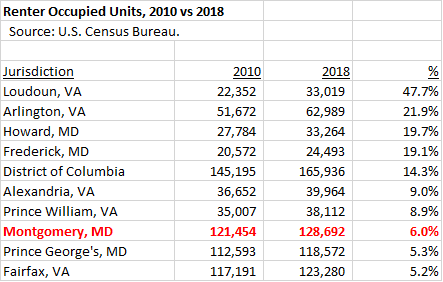
1. MoCo’s rental market is one of the slowest growing in the region.

This is the first sign that not all is right in the county. MoCo has a relatively affluent population, 11 Metrorail stations, a nationally recognized school system, a new light rail route (the Purple Line) under construction and is planning several bus rapid transit routes. Developers should want to build here, but disproportionately, they are not. If Downtown Bethesda were removed from the county’s unit statistics, one wonders how poorly the rest of the county would rank in the D.C. region.

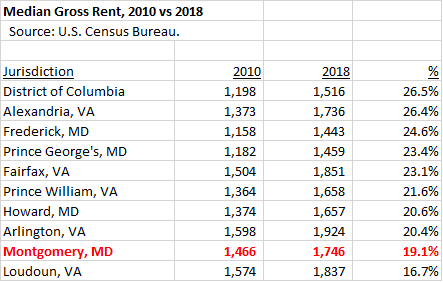
2. Rents in MoCo are also growing slowly.

With the exception of Loudoun County, every other major jurisdiction in the region has seen more growth in average rent than MoCo. That’s good for tenants but not so good for investors looking for an adequate return. That is especially the case given the level of uncertainty in MoCo’s real estate market, which would normally demand higher returns to compensate investors for dealing with it. More on that in a bit.

Here is an interesting fact. Loudoun, Arlington and Howard have been the three fastest-growing large jurisdictions in the area in terms of renter occupied units. They are also three of the four slowest-growing jurisdictions in terms of rents. That’s how a market should work – rapidly expanding supply should keep prices down even with substantial demand, and Loudoun has been one of the fastest growing counties in the nation. But MoCo has seen slow growth in both construction and rents, making it an outlier.

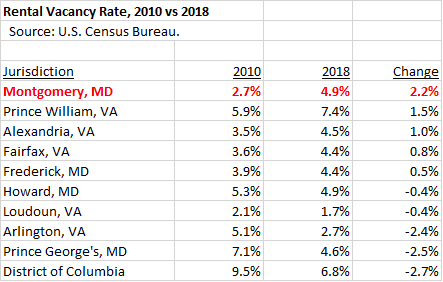
3. No other major jurisdiction in the area has experienced a larger increase in rental vacancy since 2010 than MoCo.

You might think that with MoCo’s relatively stagnant construction demand for housing would push vacancy down. Instead, it’s gone up – by more than any other jurisdiction in the region. In 2010, MoCo’s rental vacancy rate was 2.7%, the second-lowest of 10 large area jurisdictions. In 2018, MoCo’s rental vacancy rate was 4.9%, tied for the third-highest rate. The vacancy rate gain (2.2 points) was the largest in the area. This is going to get worse as vacancy rates for Class A and Class B units are projected to approach 7% in coming years.

4. Evictions in MoCo are time consuming and expensive.

In 2018, the county’s Office of Legislative Oversight (OLO) studied evictions in MoCo and stated, “The Montgomery County Sheriff’s Office reports that on average it takes 12-13 weeks to evict a tenant for nonpayment of rent, though the process can sometimes be significantly longer.” OLO also found that the cost to evict a tenant can range from $5,700 to $16,600, landlords “are often unable to recover lost rent” and “costs and process delays discourage small property landlords from renting out.”

Landlords with lots of units and market power might be able to spread these costs to other tenants in the form of higher rents. Other landlords might choose to avoid the county altogether if they believe its procedures are more onerous than its neighbors.

5. The county executive is an open housing skeptic.

Before becoming executive, Marc Elrich built his political career by opposing development, voting against seven different master plans (six centered near transit stations) and famously comparing growth to a tumor. He has not changed much since then. Over the last three years, he has compared gentrification to ethnic cleansing, said he doesn’t believe in missing middle housing, said he doesn’t want to lose affordable units “to build housing for millennials” and opposed regional targets for housing construction. His opposition to accessory dwelling units even attracted criticism from his fellow socialists. The executive doesn’t control county land use policy, but he does control the Department of Housing and Community Affairs, the county’s principal regulator of landlords.

6. The county’s moratorium policy is a major source of uncertainty for residential builders.

MoCo stops new applications for housing development in school clusters that exceed certain capacity thresholds. Last year, the county imposed moratoriums on four high school clusters and 13 individual elementary school service areas that accounted for roughly 12% of the county and included parts of high-profile housing markets like Downtown Silver Spring and North Bethesda. This year, more areas could be at risk. The moratoriums do nothing to stop school crowding but they do create serious uncertainty for the real estate industry. Who wants to spend millions on design, architecture, planning reviews, public outreach and land use attorneys only to see a project stopped dead in its tracks by an arbitrary moratorium?

7. The county just passed temporary rent stabilization.

The council made major changes to Council Member Will Jawando’s rent control bill, allowing rent increases up to the county’s voluntary guidelines and extending the bill’s duration to 90 days after a catastrophic health emergency. The direct economic impact of the bill may be mild because it is temporary, allows small increases and takes effect in an environment in which rents are declining. But it could be extended at a later time, a possibility that adds to the uncertainty of investing in MoCo. It also has tremendous symbolic importance. Let’s remember that Takoma Park has had rent stabilization for decades and has suffered absolute losses of rental units.

Consider this. It’s hard to find two terms that are more hated by the residential rental industry than “moratoriums” and “rent stabilization.” At this moment, MoCo is the only jurisdiction in the Washington region that has both of them.

MoCo is still seeing residential construction from projects that were approved before the current downturn, before the current round of moratoriums, before the approval of rent stabilization and before the current executive took office. But after that wave (a rather small wave) of construction wraps up, what will come next?

Imagine that you are a regional developer, real estate investor or creditor and you are evaluating a jurisdiction that has had slow rent growth (and now falling rents), slow unit growth, rising vacancy, expensive and time consuming evictions, a moratorium policy, temporary rent stabilization that could be extended and a county executive who is an open skeptic of housing construction. Right next to that jurisdiction are several others with fewer or none of those drawbacks.

Given all of the above, why would anyone want to build rental units in MoCo?

Share

Liquor Monopoly Truck Crashes in Aspen Hill (Updated)

By Adam Pagnucco.

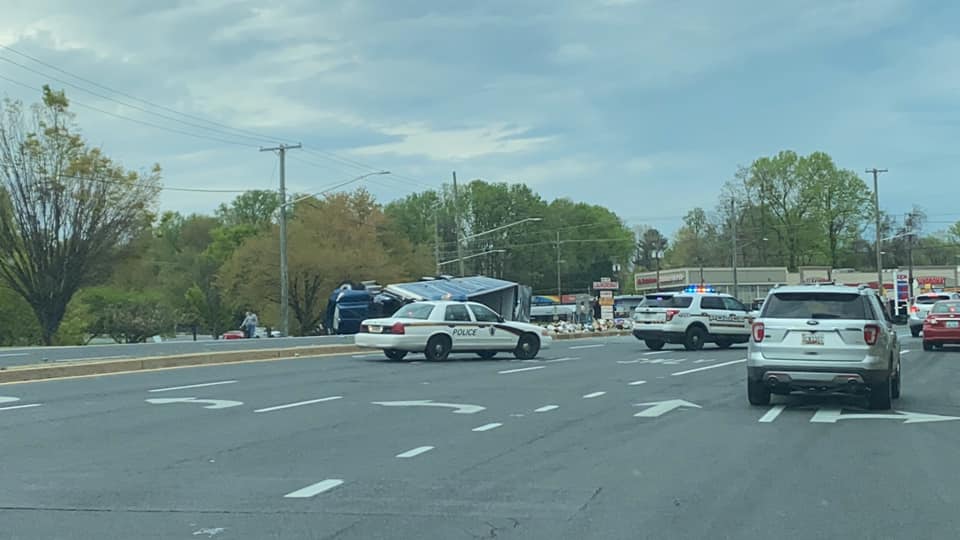
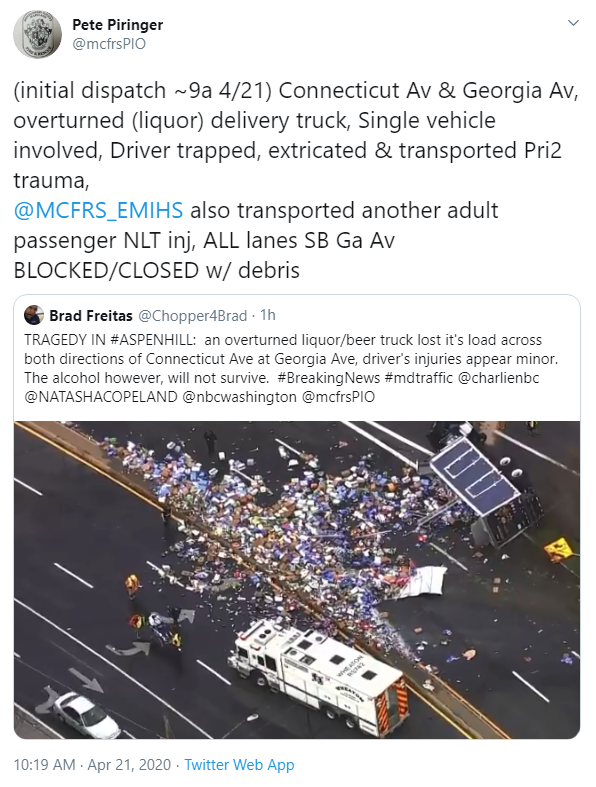
This morning, a delivery truck operated by MoCo’s liquor monopoly crashed in Aspen Hill. The crash occurred on Connecticut Avenue near the intersection with Georgia Avenue, shutting down southbound traffic and sending countless cases of liquor splattering across multiple road lanes.

The first indication of the crash was this set of pictures posted on Facebook by a person who came across the crash scene.

Montgomery County Fire and Rescue Spokesman Pete Piringer tweeted three times about the crash.

Here are close-ups of the four pictures tweeted by Piringer.

NBC Chopper 4 reporter Brad Freitas posted video of the aftermath on Twitter.

From Piringer’s reporting, what is known right now is that there were two occupants of the truck, both of whom were transported away by ambulance, and that the driver was trapped and had to be extricated from the truck. Traffic was completely shut down on southbound Connecticut Avenue and limited to one lane northbound. The mess will take some time to clear.

At this time, the cause of the accident is unknown.

Update: NBC4 has video of how this crash affected seven lanes of traffic.

Share

Maryland Politics Watch