Crash!

By Adam Pagnucco.

You heard that deafening noise, yeah? It came from Rockville, specifically from Monroe Street. It was the sound of the county budget being blown to smithereens. And it probably won’t be the last loud noise heard echoing from the county seat.

Why the explosion? That’s what it sounds like when the county writes down half a billion dollars over two years.

A dryly titled document known as “Update on County Tax Revenue Estimates” will be reviewed by the county council tomorrow. Budget writers tend not to be very dramatic people. That’s one reason why summer blockbusters tend not to be centered on budget analyses. But this blockbuster contains more exploding ordinance than a World War II battlefield. Ground zero is MoCo.

The COVID-19 crisis is now blowing up budget after budget all over the world and we are not immune. In FY21 (the current fiscal year), the county was supposed to receive roughly $4 billion in locally generated tax revenues. (The county gets another $2 billion in intergovernmental aid, grants and non-tax revenues). Of the $4 billion or so in local taxes, here are the projected writedowns as of last week.

FY20 (last year): $47.7 million
FY21 (this year): $192.0 million
FY22 (next year): $282.0 million
FY23: $275.9 million
FY24: $272.8 million
FY25: $225.2 million
FY26: $173.9 million

There is bound to be variation in the out years because economic forecasting is about as certain an art as selecting number one draft picks. But when combining last year, this year and next year, the total writedown is $522 million. That’s the biggest writedown since the Great Recession.

The biggest contributor by far to the shortfall is income taxes, which have been written down through FY22 by $357 million, or 68% of the total writedown. The county’s finance department reported that income tax receipts were down $19 million from their estimate in May and $20 million from their estimate in June. Finance expects personal income, wage and salary income and income from dividends, interest and rent to fall in calendar year 2020 and then rise by a fraction of their prior annual growth over the last decade in calendar year 2021. Finance also expects resident employment to fall by 1.82% in 2020 and a further 0.05% in 2021. All of these declines will hit income taxes.

Relative to their immense size, property taxes are not written down by very much (just $41 million from FY20 through FY22). The reason is because the county’s charter limit allows property tax collections (aside from new construction and a few other categories) to rise at the rate of inflation regardless of what happens to assessments. There are two wild cards here. First, what if the rate of inflation goes to zero or even goes negative because of the collapsing world economy? And second, what if massive failures to pay rent cause property owners to file more tax appeals? If the real estate market fails, that will just add to the wreckage.

Two other wild cards might be thrown the county’s way. First is Governor Larry Hogan’s plan to shift and shaft the counties, which was defeated at the Board of Public Works but may yet return at a later date. Second is the fate of additional federal aid for counties, which is backed by Democrats in Congress but draws a wary eye from Republicans (including U.S. Senate Majority Leader Mitch McConnell). The federal government has so far allocated $183 million of aid to MoCo, but it is targeted to expenses directly attributable to COVID-19. The county needs money to cover its plummeting local revenues. If Hogan and McConnell get their way, all MoCo will get is more shrapnel.

So what does all this mean? The loud noises might not be over, folks. Could we someday hear the wailing squeals of sacred cows, prodded by unforgiving steel as they are dragged away to slaughter?

Share

Barve, Stein Call for Extension of Eviction Moratorium and More Rental Assistance

By Adam Pagnucco.

Delegates Kumar Barve and Dana Stein, the Chair and Vice Chair of the House Environment and Transportation Committee respectively, have written the state’s Secretary of Housing and Community Development requesting an extension of the state’s eviction moratorium to January 31, more state funds for rental assistance and more transparency around the spending of those funds. The eviction moratorium is particularly pressing because Maryland’s courts could conceivably start hearing eviction cases as early as September. We reprint the letter from Delegates Barve and Stein below.

*****

The Honorable Kenneth C. Holt
Secretary, Department of Housing and Community Development
7800 Harkins Rd.
Lanham, Maryland 20706

Dear Secretary Holt:

In our respective capacities as the Chairman and Vice Chairman of the House Environment and Transportation Committee, we would like to thank DHCD for its participation in the committee briefing held on June 29, 2020 entitled “The Effects of Covid–19 on Housing.” It was an enlightening experience and a solid first step in addressing this important issue which has affected many thousands of Marylanders.

The phrase “tsunami of evictions” was used throughout the briefing, and it serves as a poignant prospect of what may occur without immediate action by the State. Our local governments have acted swiftly to stem the tide, but they can only do so much. In the interest of partnership and given the committee’s background on these issues, we offer the following recommendations for further action by your department:

1) Work with Governor Hogan to extend the State’s Eviction Moratorium through January 31, 2021

Currently, the 120 day eviction moratorium for covered properties under the Coronavirus Aid, Relief and Economic Security (CARES) Act officially ends as of July 25, 2020. We understand that certain federal agencies have acted in a discretionary capacity to extend this moratorium until the end of August of this year. As for the State, Governor Hogan’s March 16, 2020 Executive Order prohibits Maryland courts from ordering the eviction of any tenant who can demonstrate, through objectively verifiable means, that the tenant suffered a substantial loss of income resulting from Covid–19 or the related proclamation of a state of emergency and catastrophic health emergency. This prohibition extends until the State of Emergency is lifted. The Judiciary of Maryland has also acted to phase reopening of Maryland’s courts. The effect of this means that district courts will not begin to hear “failure to pay rent” cases until August 31, 2020.

While we applaud the early action taken by the Hogan administration, the uncertainty surrounding the proliferation of this virus and the need to keep individuals housed for their health and safety suggest a longer limitation on evictions is needed. An extension until January 31, 2021 will allow time for (1) appropriate planning to prevent a flood of new eviction proceedings as a result of Covid–19; (2) recovery of the State job market, thus allowing Maryland citizens to return to work and continue to pay their rents and address any overdue rent; and (3) the General Assembly and the Hogan administration to meet and consider emergency legislation meant to address the Covid–19 crisis.

2) Work with Governor Hogan to identify additional funds for rental assistance programs beyond the $30 million in CARES Act funds identified, and establish a plan for oversight of these funds

Again, while we recognize the actions taken by the Hogan administration to dedicate $30 million in CARES Act funds for rental assistance and funding for certain housing providers, this amount seemingly pales in comparison to the need stated by both tenant advocates and representatives of property owners and managers. At the briefing, we heard testimony that a single large housing provider in the State has lost rent payments equal to approximately 8.7% ($2.6 million) of this amount since March. Another large housing provider has an uncollected rent balance for May 2020 of approximately $1.8 million, or 5.7 times its uncollected balance for the same month in 2019.

Our counties have taken the initiative to directly address the housing crisis, but many programs lack sufficient funds to address the need and will be ineffective without significant State assistance. As an example, in Phase 1 of Baltimore County’s Covid–19 Eviction Prevention Program, it was estimated that $1 million would help approximately 300 households; however, the program received 1,500 applications totaling over $6 million in requests for assistance. Baltimore City, in its individual capacity, has committed $13 million in CARES Act Community Development Block Grant funds to its Temporary Rental Assistance program. Finally, we heard testimony that the level of support required by nonprofit housing providers in Montgomery County between now and December is estimated at $40 million; this figure does not account for funds to support commercial landlords who are losing rent owed to them.

We anticipate things will only get worse. As mentioned by several participants, including DHCD, the increased unemployment payments under the CARES Act and federal stimulus payments may have helped limit the number of individuals facing rental hardships during the early stages of this crisis. However, as these fall away in the coming weeks, renters impacted by Covid–19 will find themselves with even less available support and at greater risk of eviction due to nonpayment of rent.

While we are adamant that more State support is needed, we do not ask the Hogan administration to take steps that it would deem detrimental to the State budget; rather we ask that the Administration identify all available sources of funds which may be used to support local rental assistance programs and commit additional funds to support renters and the rental housing industry, especially funds received pursuant to the CARES Act. We advocate for objective, fact–based decision making in light of the economic realities foisted upon us by this crisis.

The lack of firm details, transparency and accountability measures around the $30 million in announced rental relief spending is alarming. While awarding the funds directly to large rental managers may be the most efficient method, we have significant concerns that some of those funds will not end up providing renters with relief. We cannot afford to waste a single dollar of taxpayer funding in this crisis. Please provide our committee with the plan by which it intends to administer these funds, including any application requirements, plans and conditions for their distribution and limitations which will be placed on their use. We expect this information to be made public before you begin to distribute funds. Finally, we ask that your department and the Hogan administration continue to provide updates as this response develops.

Thank you for your attention to this matter.

Yours truly,

Kumar Barve, Chairman
Environment and Transportation Committee

Dana Stein, Vice Chairman
Environment and Transportation Committee

cc:
Speaker Adrienne A. Jones
Keiffer Mitchell

Share

MoCo’s Book Club

By Adam Pagnucco.

You might think of Montgomery County Government as an entity that finances schools, deploys police and fire fighters, maintains roads, administers social services, operates libraries and more. Yes, it is all of those things. But under the Elrich administration, it became one more thing:

A book club.

Imagine that you write a book. You think it’s a great book. It’s all about how to run a local government. And then you get a dream job actually running a local government. And it’s not just any local government – it’s a very prestigious one, with more than 8,000 employees who will now be working for you. You think this government is doing OK, but it could do a lot better if it was run in accordance with what your book says. So what are you going to do?

Encourage as many of your employees to read that book as possible.

That is one of the biggest themes pervading the bombshell report written by the ethics commission and the inspector general (IG) about Chief Administrative Officer (CAO) Andrew Kleine, the top manager in county government. Ethics complaints made by county employees last year resulted in Kleine admitting to breaking two provisions of county ethics law over issues related to his book, City on the Line, and his participation in getting two of his private business partners county contracts.

Kleine is not the star of the report. His book is. Over and over, it’s about the book.

The IG noted many details about the promotion of Kleine’s book inside county government. Consider the following excerpts from the report.

*****

Multiple County employees reported to the IG that Mr. Kleine often spoke about his book to County employees and that they felt they needed to read it. OMB [the Office of Management and Budget] referred to City on the Line in its budget training sessions, after which County employees from various departments emailed that they needed a copy.

On December 10, 2018, Mr. Kleine retweeted a tweet from the program director of the political science program at UMBC at Shady Grove that stated, “#MoCo agency bosses are reading/having staff read incoming Chief Administrative Officer’s @awkleine’s book City on the Line. You should too. Available at Amazon for $35 http://a.co./d/hf7xUtV @UMBCpolisci @MarcElrich”

On December 18, 2018, a County Department Director emailed that City on the Line was “assigned to him as mandatory reading.” The CAO supervises County department directors and would be the person who could require certain work assignments from Department Directors.

On April 29, 2019, the Director of OMB emailed staff, “To help the office plan for outcome budgeting and the Turn the Curve initiative, we have five copies of the books City on the Line and Trying Hard is Not Good Enough. Please see me or Darlene if you want to borrow one. I also have coupons if you want to purchase your own copy of City.”

On June 6, 2019, an OMB employee emailed a telework plan that included reading City on the Line.

On July 1, 2019, the Director of OMB emailed his staff a compilation of takeaways from City on the Line.

On August 6, 2019, an OMB employee asked an OMB staff member and a Recreation Department budget specialist to draft a presentation for the Training Implementation Workgroup. “You can use City on the Line, Chapter 3… as a reference.”

A speaker note on the OMB & Training Implementation Workgroup September 2019 presentation, “Outcome Based Budgeting FY21 Operating Budget” stated that, “We can use the example – from City on the Line Pg 58/59.”

On August 14, 2019, an OMB employee emailed other staff, “As a suggestion, it may be advantageous to read the following materials to gain a better understanding of Outcome Based Budgeting and Turn the Curve thinking: City on the Line and Trying Hard is Not Good Enough.”

On August 19, 2019, a Recreation Department emailed, “Could you please order me a copy of City on the Line… we are discussing it in our work sessions and I am the only person in the group who does not have a copy. Plus we are receiving work assignments related to the information in the book.”

On August 19, 2019, a Department of Permitting Services employee emailed a request for City on the Line via 2-day shipping from Amazon and wrote, “I normally wouldn’t pay this, but we need this book to reference for outcome budgeting, which is a new way of budgeting this year.”

On August 23, 2019, a Department of Police employee emailed, “In the budget meetings I am going to they keep referring to a book ‘City on the Line.’”

*****

And so the book was integrated into the operations of county government. Employees were being encouraged to read it and some felt left in the dark if they didn’t. That means books had to be acquired and someone had to pay for them. According to the report, the county spent approximately $3,000 to buy 89 copies of Kleine’s book. Kleine earned total royalties from all purchases of $3,157 on the book through the end of 2018. Royalties paid in 2019 and 2020 are not mentioned in the IG report.

Even this guy thinks all this book stuff is getting out of hand.

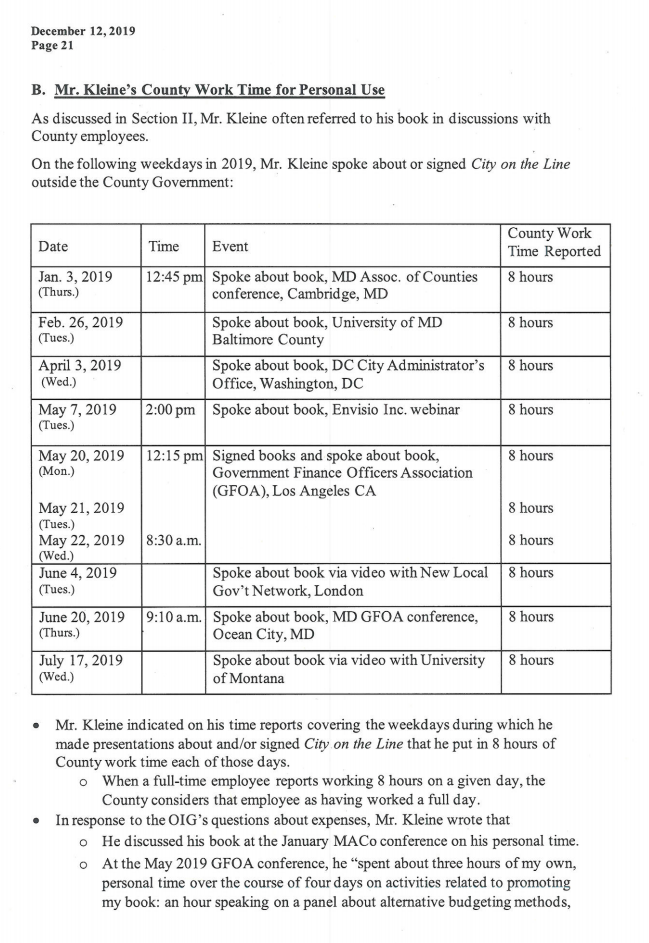
Kleine also promoted the book at events outside the county government while on work time. The screen shot below from the IG’s report details how 80 hours of Kleine’s official work time – charged to taxpayers – included book promotion.

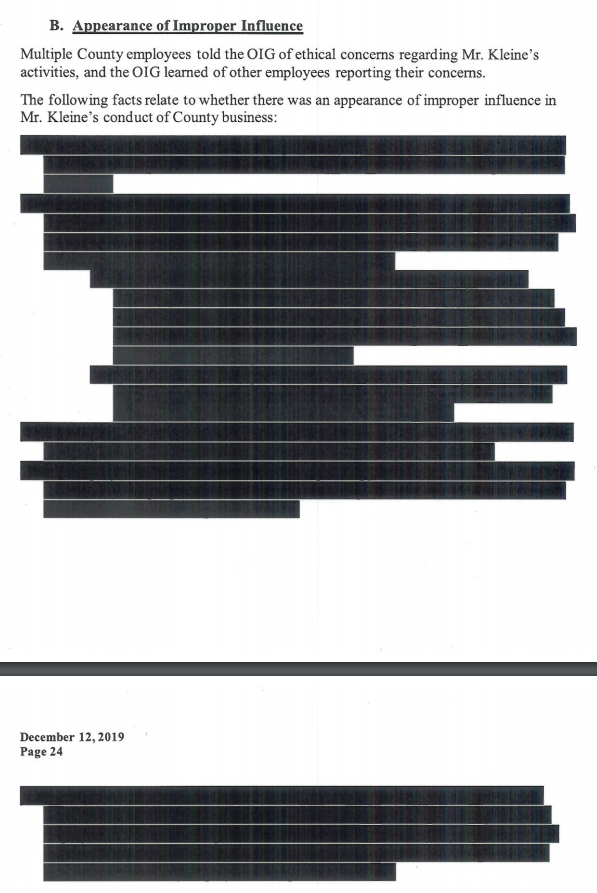
Did Kleine’s activities create an appearance of improper influence? Here is what the IG’s report had to say about that:

Redactions like the ones above are made to protect witnesses. Because Kleine is still the CAO, these witnesses presumably remain Kleine’s subordinates if they are still employed by the county.

What should we make of all this?

Throughout the report, Kleine comes across as a man who wants to be a celebrity, a public management guru, who preaches things like “Turn the Curve” to build his brand, sell books, make speeches and get consultant contracts. There’s nothing inherently wrong with that but that’s not why taxpayers are paying him $280,000 a year. We need a nuts-and-bolts operations manager in this role, someone who makes the trains run on time and works on behalf of the taxpayers with no other agenda at play.

It’s incredible that this needs to be said, but the CAO should be running county government, not converting it into a royalty-generating book club.

Share

Hogan Decides on Regular Election

By Adam Pagnucco.

Governor Larry Hogan has decided not to repeat the state’s use of a mail-predominant election that was adopted for the primary. Instead, citing the problems with mail ballots and long lines on election day, Hogan has opted to hold a regular general election with all early voting centers and all precinct polling locations open. He has directed the State Board of Elections to send an absentee ballot application to every eligible voter and to promote early voting, absentee voting and off-peak voting as “safe and efficient options.”

Hogan’s letter to the State Board of Elections appears below.

Share

Council Puts Elrich on the Spot Over Kleine

By Adam Pagnucco.

The Montgomery County Council has issued the statement below about Chief Administrative Officer (CAO) Andrew Kleine. Kleine, who is the highest ranking manager in county government and is answerable only to County Executive Marc Elrich, has admitted to two ethics violations related to promoting his book and helping two of his business partners get county contracts. The council says that it is “disappointed and troubled by the actions” of Kleine and intends to hold an “oversight meeting” on the matter. That said, only Elrich can decide what happens to Kleine.

The council’s statement appears below.

*****

Montgomery County Council statement on July 1 Ethics Commission agreement with Chief Administrative Officer Kleine

ROCKVILLE, Md., July 7, 2020–Council President Sidney Katz made the following statement on behalf of the Montgomery County Council about the July 1 Ethics Commission agreement with Chief Administrative Officer Andrew Kleine.

Our system of representative government depends on the people maintaining the highest trust in their elected officials and government employees. All Montgomery County residents expect and deserve public employees who are impartial and use independent and sound judgment when making decisions that impact more than one million community members.

The Council is disappointed and troubled by the actions of Chief Administrative Officer Kleine. We greatly appreciate the Montgomery County Ethics Commission and the Office of the Inspector General for investigating Mr. Kleine’s actions and bringing these issues to light. Montgomery County’s ethics law applies to all County government employees and elected officials and has standards in place to guard against conflicts of interest and improper influence and includes comprehensive ethical standards for conducting County business.

The Montgomery County Charter provides that Mr. Kleine serves at the pleasure of County Executive Elrich. As one of the highest-ranking employees in Montgomery County, Mr. Kleine has a heightened responsibility to instill trust among the public, employees and government leaders. While we acknowledge that Mr. Kleine has taken responsibility for his actions, we also encourage him to do everything in his power to work on rebuilding the community’s trust. Moreover, the Council will conduct an oversight meeting on this matter in July.

#

Share

Restaurant: My Staff Will Not Wear Face Masks

By Adam Pagnucco.

Last night, The Grille at Flower Hill, a restaurant in Gaithersburg, posted a complaint on Facebook about the county’s health department enforcing the county’s social distancing and mask rules. Specifically, the post said, “Let me be very clear…my staff will not wear face masks while working here at the Grille. If that bothers you then please dine elsewhere and please try to find something more important to occupy your time such as volunteer at a nursing home or soup kitchen. Whoever you are that filed the complaint, you need to take a good look in the mirror and try to find some real meaning in your life.”

In response to huge pushback, the restaurant doubled down. “You are all missing the very premise of my post. Look at it this way, if you don’t like what is on TV or the radio…change the channel. You all act like i am physically forcing people to come into my restaurant. Every single person that has dined here had a choice and they all chose to eat here knowing full well the staff was not wearing masks.”

Here is just a small sample of the reaction this post generated.

*****

Never, ever giving you or any other firm owned by you my business again.

You’re gonna do a good job at burying your business with this post. It would’ve been better for you to keep quiet about your stance on facemasks rather than post your ignorance for all of Facebook to see and share. Good luck in the coming months.

Publicly, I’d like to thank the health department for doing their jobs. You should be shut down.

Sorry to hear you are making this decision. We used to eat there every week. Not anymore.

Every major media outlet in the area knows about this post. Hope you love bankruptcy!

Will never eat here ever. Ever. EVER. That is if you keep your license.

Besides the total disregard for human lives, this message is totally unprofessional.

Thanks for being candid on how you don’t care about the well being of your staff and patrons.

You just lost my business and I will try to spread the word to any one who will listen regarding your lack of safety for your customers and staff!

Wow. Beyond irresponsible and inconsiderate. What is wrong with you folks?

You need science in your life.

I feel so sad for your employees.

I would not eat at a place that doesn’t care about my health.

I’ll let some investor friends know that a discounted restaurant space will be on the market soon. They’ve already built in disinfecting costs.

I hope we get a Chipotle in that spot instead.

*****

Even if the Facebook post is deleted, the damage has been done on Yelp.

Want to bet where the county’s health department will be today?

Share

County’s Top Manager Admits Violating Ethics Law

By Adam Pagnucco.

Andrew Kleine, the county’s Chief Administrative Officer and the highest-ranking non-elected employee of the county, has admitted to violating two provisions of the county’s ethics law and has offered to cure those violations in part through a $5,000 payment to the county. Bethesda Beat reported that Kleine was the subject of an ethics investigation in September 2019.

The document released today by the county’s Ethics Commission contains a summary of the violations and other related matters, the content of Kleine’s proposal to cure the violations, and a redacted investigatory report by the county’s inspector general with more detail.

The issues with Kleine involve two private companies – Healthy Outcomes Inc. (aka Balancing Act) and Clear Impact LLC. Kleine worked with the two companies when he was Baltimore City’s budget director. When Kleine left his position at Baltimore City, he formed his own company (Andrew Kleine Consulting LLC) and wrote a book. Kleine’s company entered into formal contracts with Balancing Act and had an “informal, mutually beneficial arrangement” with Clear Impact before he joined the county government. Kleine subsequently was appointed by County Executive Marc Elrich and confirmed by the county council as the county’s Chief Administrative Officer, the top manager in county government, in December 2018.

Balancing Act

Kleine’s contracts with Balancing Act, which allowed the company to claim some of his book revenues, were terminated on January 24, 2019. Neither side derived any revenues from the book. Kleine “was involved in establishing the relationship between the County and Balancing Act” which led to a one-year county contract with the company for $9,880 on 12/21/18, while Kleine’s own contracts with Balancing Act were in effect. The commission wrote:

Mr. Kleine understands that the ethics law prohibits him from participating in any matter with a business that he has a contract with, if the contract could reasonably result in a conflict between private interests and public duties. (19A-11(a)(2)(E)). Although Mr. Kleine never received any funds from Balancing Act, Mr. Kleine acknowledges that he violated this provision of the Ethics Law.

In May 2019, Balancing Act – now a county contractor but no longer in a contractual relationship with Kleine – sponsored a signing for Kleine’s book which earned him $42 in royalties for 20 books. The commission wrote, “While having the book signing was Balancing Act’s idea and the gain was very small, Mr. Kleine further realizes there has to be a complete severance of his private business activities and his official duties.”

Clear Impact LLC

Clear Impact paid $5,000 to Kleine for book promotion expenses on July 1, 2018 in return for having its logo printed on the back of Kleine’s book. The commission wrote, “At Mr. Kleine’s request, the Leggett administration engaged Clear Impact in a $10,000 non-competitive contract to facilitate the work of the Elrich Transition Team, starting the day after the election.” In May of 2019, Clear Impact won a $99,000 competitively bid contract to which Kleine remained at arm’s length.

Book Promotion

The commission wrote, “As of September 30, 2019, the County and its employees had purchased 89 copies of the Book, although Mr. Kleine was unaware at the time that County funds were used to buy those books.” The commission went on:

Mr. Kleine was invited on a few occasions to discuss the Book and his strategy for budgeting while he was at conferences or meetings he was attending in connection with his County work. Where these activities required use of County resources or of Mr. Kleine’s title, or otherwise appeared to be conducted as part of Mr. Kleine’s official duties, Mr. Kleine recognizes such activities constituted a misuse of County resources and/or a misuse of the prestige of Mr. Kleine’s office.

The commission noted that Kleine did not seek advice from the County Attorney or the Ethics Commission on the ethics implications of his relationships with Balancing Act and Clear Impact or his book promotion.

Outside Employment Approval

The commission wrote:

Mr. Kleine did seek outside employment approval from the Ethics Commission in late April of 2019 to engage in consulting and promotion of the Book through the Company [ed. – Kleine’s own company]. While the Commission approved the request on June 6, 2019, the Commission had not been informed of the relationships between Mr. Kleine, the Company, and Balancing Act, of Mr. Kleine and Clear Impact, the Book’s relevance to the budget strategy being implemented in Montgomery County, and the lack of separation between promotional activities associated with the Book and Mr. Kleine’s official position. In addition, Mr. Kleine recognizes that he should not have been engaged in any activity resulting in earned income (no matter how minimal) prior to receiving outside employment approval in accordance with requirements in the ethics law. Mr. Kleine acknowledges that his doing so violated 19A-12 of the Ethics Law.

Kleine’s Proposed Cure

Kleine had already terminated his contracts with Balancing Act and removed references to Balancing Act and Clear Impact from his professional website. Kleine proposed to cure the ethics violations through the following additional measures.

Forfeit his approval of outside employment.

Stop promoting the book to county employees and others.

Remove references to his occupation and to Clear Impact from the book’s website.

Not be involved with any matters concerning Balancing Act or Clear Impact without obtaining advice or a waiver from the Ethics Commission.

Direct the county’s chief procurement officer to ensure that no further county funds are spent purchasing his book.

Pay the county $5,000 within 30 days of his proposal to cure the violations.

The commission’s website indicates that it has accepted Kleine’s proposed cure, thereby making its report a public document.

Share

Top Seventh State Stories, June 2020

By Adam Pagnucco.

These were the top stories on Seventh State in June ranked by page views.

1. Repeal the Linda Lamone for Life Law
2. Baltimore City’s Election Has a Problem
3. Will Talbot County Choose Tourism or Slavery?
4. Judge Candidate on Floyd Cops: “Lock Em Up”
5. Elrich Asks MCPS for Cuts
6. Jawando Ignored Public Information Act, Had Scant Evidence Before Filing Rent Control Bill
7. First School Board Results Favor Harris
8. MCPS Survey Responses on Distance Learning
9. Elrich’s Police Union Contract
10. It’s the CIP, Stupid! (Guest blog by Gus Bauman)

Congratulations to former Planning Board Chair Gus Bauman for making our top ten!

The break-out story of the month was the one about the Talbot Boys statue, which was shared dozens of times across the Eastern Shore. Now that Mississippi has removed the confederate battle flag from its state flag, there is no longer any excuse for Talbot County leaders to continue honoring the Confederacy.

Share

Acevero Claims MCGEO Fired Him Over Police Reform Legislation

By Adam Pagnucco.

Delegate Gabriel Acevero (D-39) has told the New York Times that he was fired from his position at MCGEO, the union that represents most non-MCPS county employees, because of his legislative work on reforming police departments. According to the Times:

When Gabriel Acevero, a Maryland state legislator employed by a union local, introduced a bill last year to roll back protections for police accused of misconduct, he was stepping on a potential fault line. His union, Local 1994 of the United Food and Commercial Workers, represents thousands of Black and Latino workers in food services and at a variety of government agencies. It also includes a small portion of workers in law enforcement.

That fault line turned out to be a chasm that could swallow him up. In mid-June, Mr. Acevero filed a formal charge with the National Labor Relations Board accusing the union of illegally firing him because of his reform advocacy.

“The reason why I was terminated,” Mr. Acevero said, “was about legislation.”

MCGEO President Gino Renne was also interviewed by the Times. Read the entire article here.

Share

The Upcounty Doesn’t Vote and Nobody Seems to Care

By Marilyn Balcombe.

The premise of the petition drive by Nine Districts for MoCo is that the current structure of the Montgomery County Council does not allow for fair representation for residents in the Upcounty because seven of the nine Councilmembers live Downcounty. As it has been since 2006, all four At-Large Councilmembers live south/southeast of Rockville. The problem isn’t gerrymandered districts. The problem is voter apathy. The Upcounty simply does not vote at the same percentage as the County overall.

First the data.

The source of this data is the 2018 Gubernatorial Democratic Primary. For better or worse, local elections are decided in the Democratic primary and have been since 2006. Given the current party affiliations of registered voters in the county, changing the make-up of the County Council to nine district seats will not change that. If the reason behind the push for 9 district seats is geographic representation, we have to look at the Democratic primary to see why we are where we are and what we can do to change it. Focusing on the primary also underscores why it has been so difficult to change the paradigm.

Every 10 years councilmanic districts are redrawn to provide an equal number of residents for each district. Theoretically Upcounty Districts 2 and 3 should have as much say in any given election as Downcounty districts, such as District 1 in Bethesda or District 5 in Silver Spring and Takoma Park.

Granted, while each district starts off with the same number of residents, there are differences in the number of registered voters in each district. Regardless of the number of residents, the number and percentage of registered voters is lower in the Upcounty than in other areas of the County. There are also more Republicans and Independent voters in the Upcounty. The disparity in the total number of registered Democrats in the Upcounty makes a difference in the number of votes cast, but the fatal discrepancy is in the percentage of eligible Democrats who vote. Looking solely at turnout of Democratic voters, Council District 2 lags behind the rest of the County by 7 percentage points and significantly falls short of District 1 (Bethesda / Potomac) by 17 points.

The concept of Upcounty / Downcounty is an informal distinction with no true definition. As an Upcounty activist, I define the area to be North-Northwest of Rockville to include all of Council District 2, parts of D3 (Gaithersburg) and parts of D1 (Darnestown and Poolesville). The total Upcounty results are very similar to the D2 results with 29% of registered Democrats voting in the 2018 Gubernatorial Primary. Of course, the Upcounty isn’t monolithic. We have Poolesville and Darnestown areas voting at roughly 38% and the areas of Germantown and Montgomery Village with 28% voter participation rate. [NOTE: Election results are not reported by geographical area. The Upcounty breakdown data is based on individual precinct data aggregated for each of the areas identified.]

The same pattern is seen when looking at the State Legislative Districts. Upcounty District 39 continues to be the lowest voter turnout in the County, election after election. Historically, District 15 also had low voter turnout. However, in 2018 there was a contentious battle for an open Congressional seat and we saw a significant increase in voter participation in the district.

The Upcounty doesn’t vote and nobody cares.

I understand that is an inflammatory statement. However, the lack of voter turnout in the Upcounty is not new by any stretch. Council District 2 has had the lowest voter turnout, as has State District 39, as far back as I remember looking at the data. Every so often someone – myself included – will become outraged and try to light a fire of activism that quickly peters out. Unfortunately, there hasn’t been a systemic get out the vote (GOTV) effort in the Upcounty for the Democratic primary. There are 3 basic reasons why:

1. The current system works for everyone in power so there is no impetus for change. For candidates, including incumbents, it doesn’t really matter how many people vote. It just matters that you get the most votes. In every election I’ve ever seen, there is never enough time or money to reach every registered voter, let alone every potential voter. The most effective strategy is for candidates to reach out to the people who are most likely to vote – the “Super Dems” – which does not expand the voter base. In fact it perpetuates a small sliver of voters being responsible for determining our local elected body.

2. Similarly, candidates, including incumbents, go where the votes are. The first thing a candidate learns in How to Run for Office 101 is to know your number. How many votes do you need to win and where are you going to get the votes? If a higher percent of residents vote in the Downcounty, a candidate running At-Large will focus time and money in the geographic areas that turn out the most voters.

3. Another important factor is the role of the Democratic Party. Of course they want to increase voter participation, but their ultimate goal is to get Democrats elected in the general election. Because the primaries are partisan by design, the various democratic clubs don’t often actively engage in the primaries. While there may be some GOTV activity for the primary, the major push is for the general.

Does it really matter where the At-Large Councilmembers live if they still represent the whole County?

Yes. It’s a matter of representation which boils down to familiarity and exposure. As an active member of the community, a Councilmember is going to have a fluent knowledge of their own community much better than they do in other parts of the County – the schools, roads, parks, public safety, community structure, etc. In discussing transportation funding, it is so much easier for a Councilmember living in Silver Spring to understand the issues impacting Colesville Road than it is to fully understand the need for a road like M-83 – and if you had to look up what M-83 is, you proved my point. An At-Large Councilmember will continue to become more entrenched in their own community just by the nature of the geography. If there are a number of community events on a Saturday afternoon, it is much easier for a Councilmember who lives in Downcounty to hit three events in Silver Spring than come to events in Germantown. It’s also much easier for them to stop by an event on their way home from Rockville or drop by an event close to home between an early dinner and putting their kids to bed.

I’ve been working with At-Large members of the County Council for over 20 years in my job and in my community work. Through the years, some have done a much better job than others in being present and representing the Upcounty. I believe in the important role and function of the At-Large members of the County Council and do not advocate abolishing the At-Large seats, although I am intrigued by Adam Pagnucco’s recent blog post on increasing the number of geographic districts.

What’s the solution?

If the incumbents, candidates, and the party aren’t going to increase voter participation in the Upcounty, we need to take individual responsibility for our own representation and do what we can to get out the vote. Imagine if the time, effort and funding of the Nine Districts for MoCo initiative was spent registering Upcounty voters, educating those already registered about the importance of the gubernatorial primary in Montgomery County, and then working – as hard as they are working now – to actually Get Out The Vote on primary election day. If every person who signed the Nine Districts petition made it a personal goal to increase voter participation in the Upcounty, we could make it happen.

Looking again to the 2018 primary, if the Upcounty turnout was the same as the County’s overall average, we would have had 6,000 more votes in the Upcounty. That most likely wouldn’t have changed the results of the At-Large race. However, if the Upcounty turnout was the same as the average turnout for District 1, we would have had almost 16,000 more votes which most likely would have. At the very least it would tell future candidates that the Upcounty matters.

Marilyn Balcombe is a resident of Germantown who ran for County Council At-Large in 2018.

Share

Maryland Politics Watch