MCEA: MCPS Reopening Plan “Wholly Inadequate” to Protect Students and Staff

By Adam Pagnuccco.

Last night, the Montgomery County Education Association (MCEA) held a town hall with its members to share its recent discussions with MCPS on a range of issues, including MCPS’s plan to reopen schools. MCEA just put out the press release below summarizing its views on the reopening plan.

*****

MONTGOMERY COUNTY EDUCATORS CORRECT MISINFORMATION REGARDING PROPOSED SCHOOL REOPENINGS WITH SERIOUS CONCERNS OVER STUDENT AND COMMUNITY SAFETY

Summary of MCEA Position on Reopening

ROCKVILLE — The Montgomery County Public Schools (MCPS) plan to reopen schools is wholly inadequate to protect the health and safety of students and staff. Many questions about how to safely implement the plan remain unanswered and there are discrepancies between what MCPS leaders told the public during a July 15 virtual town hall, and what they are telling the teachers from the Montgomery County Education Association (MCEA) who are trying to work with MCPS to come up with a way to ensure student and staff safety.

Masking, social distancing, and enhanced cleaning are the three pillars on which the MCPS plan rests, and it fails in all three areas.

For example, MCPS is proposing supplying students and staff with two cloth masks for the entire school year. Disposable masks will be available if students or staff forget their mask or soil it, but only as long as supplies are available. The cloth masks must be cleaned after each use, but there is no way for teachers to determine whether a mask has been washed.

Mask wearing will be mandatory, but educators have no recourse beyond moral persuasion to enforce this requirement. MCPS says mask-wearing is a “wellness” issue and that teachers should stress to students that wearing a mask keeps everyone safer. If a child cannot be persuaded, MCPS suggests the teacher ask the school nurse or counselor for help, if one is available. MCPS has made clear this is not a “discipline” issue and that teachers should not send students to building administrators.

Students will eat lunch in their classrooms–unmasked. It is unclear who will monitor students during lunch, and teachers/students will be responsible for “sanitizing” the space after eating.

For social distancing, MCPS is requiring six feet between student desks in classrooms. MCPS has posted videos showing adults pretending to be students sitting in classrooms and lining up when they arrive at school, but MCEA representatives who have visited elementary schools to look at classroom set ups have yet to find one large enough to safely accommodate students, even if class sizes are halved, as MCPS proposes. Limited bus seating means schools will have to stagger arrival and departure times, further complicating social distancing. It is unclear how schools will safely conduct mandatory drills, including fire drills and those required for active shooter threats and inclement weather.

Enhanced cleaning and frequent hand washing also fall far short. Contrary to what MCPS has told the public, free-standing, hands-free sanitizer stations will not be available at school entrances because of their difficulty to obtain. Because no additional funds have been designated to beef up custodial staffing, teachers and students will be primarily responsible for wiping down surfaces between classes. This assumes adequate cleaning supplies will be available. Building services staff will clean “high contacts” areas, but given limited time, it is likely places like bathrooms will be cleaned just twice a day. A weekly “deep clean” on Wednesday does little to protect students and staff throughout the school day on Monday and Tuesday, or Thursday and Friday.

A plan replete with shortcomings cannot ensure the health and safety of students or staff. If MCPS leaders persist with this terribly flawed reopening, they will do so, leaving educators with an untenable choice: our jobs or our health and the health of the people we love.

#

Share

Distance Learning May be Plan C, but it is the Best Option Right Now

By Sunil Dasgupta, candidate for Montgomery County Board of Education, At-large.

Students, families, and school staff are waiting anxiously as MCPS debates what school will look like in the fall. Who will return to school buildings, and when? How will transportation work? Will students and staff be able to choose virtual learning and instruction? There are infinite questions and no great options.

Plan A for the fall was to bring all students back into classrooms. Under normal circumstances, this would of course be the optimal plan, and the American Academy of Pediatrics (AAP) argued for the physical presence of students in schools as necessary for child development. But CDC’s 6-feet social distancing guidance requires each student and teacher have 36 sq ft of exclusive space while in school. Even using Parks and Recreation facilities, tented outdoors classrooms, or small self-contained pods, MCPS cannot make full time in-person instruction possible for all students.

Plan B is the hybrid model—part in-person and part online with shift attendance—which is reflected in the draft plan that MCPS released this week. This plan attempts to bring students and staff back into buildings while meeting CDC guidelines, but it raises questions about safety, risk, and reward. One high school English teacher pointed out that, under the draft plan, he would meet with his students in-person only six times in the fall. The potential benefit of the hybrid model does not seem worth the risk, and with a substantial number of students and staff opting for online instruction, a great deal of the burden of carrying forward instruction would remain online.

That leaves us with Plan C: online, virtual, distance learning only, at least for the fall semester. The last few months have shown that it is very difficult to provide high-quality distance learning. Even in a large, wealthy jurisdiction like Montgomery County, we see noticeable gaps in access, engagement, and continuity of learning. While online learning has been more manageable and accessible for some, many families are reporting confusion over scheduling, technology problems, lack of student engagement, and absence of learning. When combined with serious equity and access issues, the results have been far from satisfactory.

None of the plans are perfect. But only one plan is safe: Plan C. MCPS should stick with distance learning for the fall semester, and the school system should make the announcement as soon as possible so we can create the best Plan C possible.

We can provide additional training for teachers, set higher expectations for students, and create more engaging curricula. We can make concrete plans for technology troubleshooting and meeting the needs of students with special learning needs and English Language Learners. And we can give families time to plan for how to manage life once classes resume.

But we can only begin preparing for more equitable, better organized, and ultimately more powerful online learning experiences for our young people once the school system makes the call to go with the imperfect, yet safe Plan C. Waiting longer risks losing the vital prep and training time needed to get this right.

Share

Navarro Demands Respect and Then She and Rice Attack Constituents

As Adam Pagnucco showed today, councilmembers are in high dudgeon over County Executive Marc Elrich’s hot mic comments. Councilmember Nancy Navarro blasted Elrich, ending her Facebook post with a demand for respect and stating (in Spanish) “Enough already! What a shame!”

Our diverse community has unsurprisingly had a diverse response. Navarro received supportive comments from people who were also appalled at Elrich’s remarks and appreciate Navarro’s efforts. Others were more temperate but also thought Elrich needs to apologize. But, as they are wont to do, some constituents were critical.

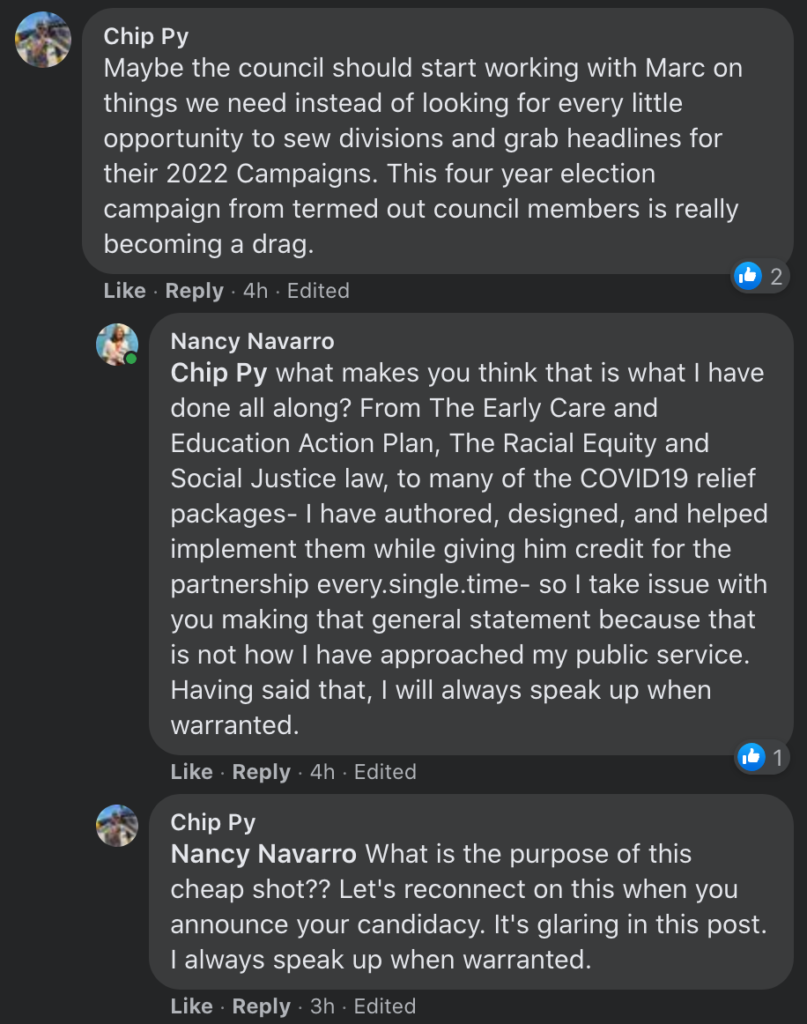
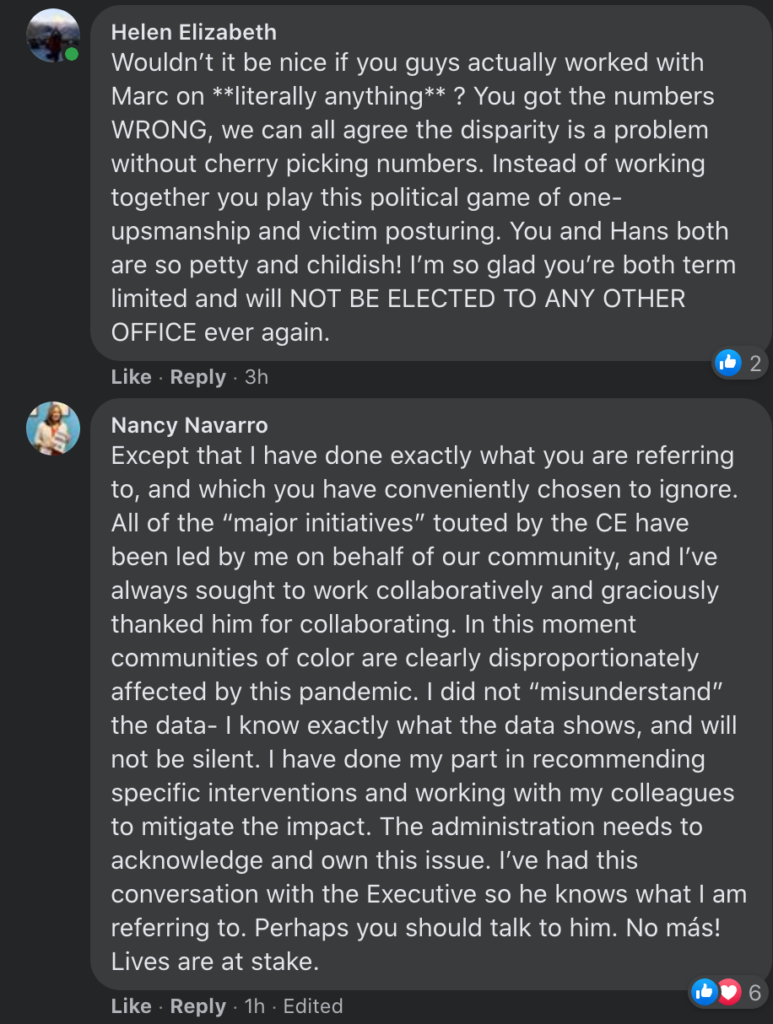
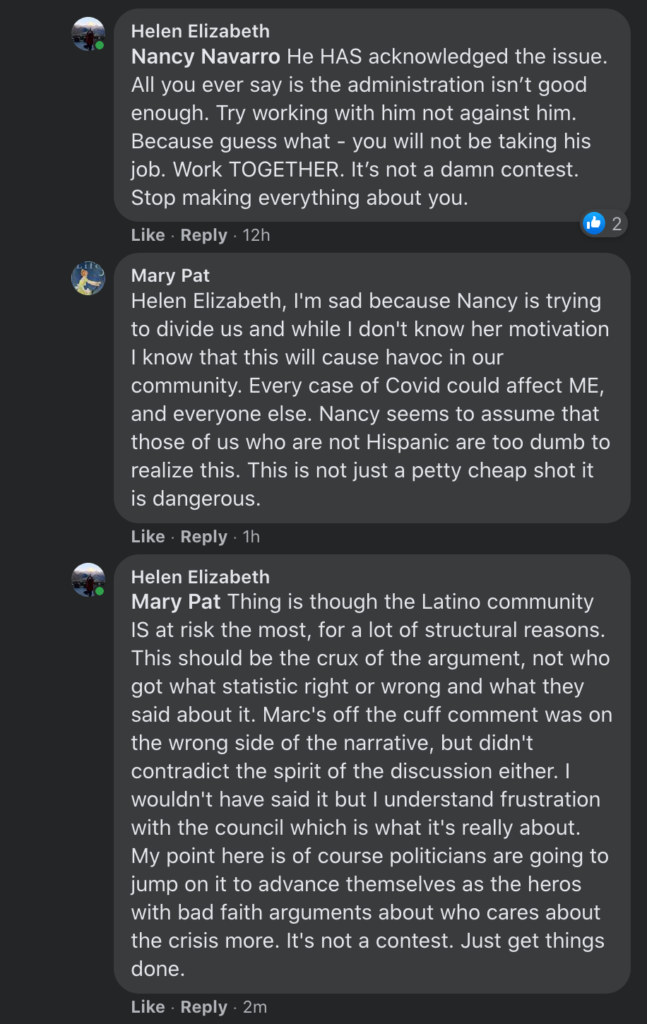
A critical comment quickly degenerated into the sort of Facebook discussion that didn’t exactly cover anyone with glory. Attacks by Navarro and Councilmember Craig Rice juxtapose incongruously with Navarro’s call for respect in the original post and her criticism of Elrich for a lack of it. (Screenshots of the exchange are at the bottom of the post so you can judge for yourselves.)

Two constituents, Chip Py and Helen Elizabeth, express a desire for the Council and the Executive to work better together. This is a common thought from constituents even if some tension between the two bodies can be healthy. During the current crisis, impressions of squabbling by either the Executive or the Council play very poorly.

Navarro’s response presenting concrete facts about how she tries to work with Elrich is basically a good one. Except then she and Rice go after their constituents, which is almost never a good look on a politician. Just ask George Leventhal who became infamous for attacking constituents (often more strongly than either Navarro or Rice here). His campaign for county executive suffered greatly from this well-earned reputation.

A big part of the job of all elected officials is to listen respectfully to their constituents, regardless of what they think of their views. Navarro and Rice know this as I have lauded them for it on other occasions. But here, there isn’t a lot of respect for the constituents despite the original post being about the executive not showing respect to constituents.

Both councilmembers get obviously annoyed at the idea that they are acting politically. It can be frustrating, as constituents tend to think everything is political. At the same time, the idea that both of these term-limited officials might want to run for higher office is far from bizarre.

It’s also well-known that there is quite a bit of tension between the Exec and the Council. Navarro’s original statement that “some of use have been working around the clock” (but implying Elrich has not) along with her literally claiming credit here for all major initiatives on this issue by the CE certainly does nothing to dispel it.

The idea that Navarro or Rice might want to run for higher office is not only perfectly fine but normal–no one owns their elected office and ambition is as natural in politics as any other profession. Consequently, the notion that there might be a weensy bit of political hay making going on here hardly shocks. I doubt that any councilmember’s office is a snark-free environment–if only because Adam Pagnucco used to work there!

That doesn’t really matter because it is the public presentation that counts, which is why Elrich landed in the soup here. It’s also why Navarro and Rice haven’t helped themselves on Facebook.

Navarro’s most unfortunate statement is her claim that “As a woman of color, I don’t owe you or anyone an explanation, my record speaks for itself.” The idea that she is a strong and proud Latina, who sees an important role for herself in standing up for the needs of the Latino community, is great. But all councilmembers are accountable to their constituents who have every right to criticize them regardless of their gender or ethnicity.

This sort of argument makes all involved look smaller. Councilmembers who have said the least have probably gained the most, demonstrating that saying nothing publicly can often be the best option. County Executive Ike Leggett won a record-tying three terms in part because he was better than anyone at exercising this self-discipline.

Councilmember Gabe Albornoz’s statement works somewhat better than Navarro’s because the emphasis is less on credit claiming, though it’s there, but more about problems and working with others. Which at the end of the day is what we all need.

My bottom line: Elrich should apologize because it’s the right and gracious thing to do. The Council should accept and express that we can all do better to serve our community. A little humility can go a long way. Most important, this fight to protect everyone is our community is far from over. Doing our collective best is owed to everyone, including more focus on helping the disproportionately hit Black and Brown communities.

Share

Navarro, Albornoz React to Elrich Hot Mic Joke

By Adam Pagnucco.

Council Members Nancy Navarro and Gabe Albornoz have issued statements on Facebook regarding County Executive Marc Elrich’s hot mic joke about the council being “fact proof” while he was discussing Latino COVID-19 infection rates.

Navarro went first with the following.

*****

Wow! This is no laughing matter. These are not just numbers, these are people. The fact is that this pandemic has disproportionately affected our Black and Latino community. At this moment we know that the Latino community is particularly disproportionally affected, they admit this in this video. Some of us have been working around the clock from the early days of this pandemic, pointing this out and offering solutions that have not been implemented by this administration. I take issue with the cavalier attitude and the disrespectful manner in which the Council and this community is addressed in these comments. Ya basta! Que vergüenza!

*****

Editor’s note: Ya basta roughly translates as “enough is enough.” Que vergüenza roughly translates as “what a disgrace” or “what a shame.”

This is Albornoz’s statement.

*****

I did not find the County Executive’s comments on this video funny or amusing. In fact, I found them deeply troubling and the reaction of his senior officials disappointing. It’s also disappointing that the County Executive does not have a better understanding or command of this situation.

These are the facts:

• Over 70% of positive test cases in the month of July are Hispanic, continuing a trend upward, when all other demographics of test positive cases are trending down.

• The community and the Council did not see a comprehensive written testing plan until July 13, more than five months after our first test positive case in our County.

• The rapid response teams that were intended to support communities in high impacted zip codes and sectors were disbanded weeks ago and have not been replaced.

• There has not been a comprehensive plan to address the outrageous disparity in positive test cases in the Hispanic community articulated. Worse, there appears to be no urgency to address it. Worst still, based on this video a clear disinterest and condescending attitude.

• The phone number to secure a test in Montgomery County was down for several days last week. That number has been recently overwhelmed with residents leaving repeated messages with no call back.

• We lack a sufficient number of bi-lingual and Spanish speaking operators and contact tracers.

• Our community clinics have not been sufficiently accessed as a resource and activated in communities. The Mary’s Center has repeatedly offered to help to enhance reach in the Hispanic community. Those offers have fallen on deaf ears.

There is no question that we have made progress since the beginning of this pandemic and we are in a much better position than we were before. There is also no question that our public health officials are working hard to address these issues. That being said, these numbers are alarming and must be taken more seriously than it appears this administration is taking them. It is morally imperative that we support our most vulnerable communities, it’s also a public health imperative that we contain the virus in all communities.

I am proud to be working with Councilmember Nancy Navarro and key stakeholders in the community to develop and execute a plan that is desperately needed in the Hispanic community at this moment. I am also proud to have worked with Councilmember Hans Reimer and all of my colleagues to introduce a resolution as the Board of Health to establish key testing bench marks.

I worked for a high functioning Executive branch and a fully engaged County Executive so I know what it looks like. It does not look like the lack of leadership we see in this video.

Share

Why Marc Elrich Might Think the Council is Fact Proof

Yesterday, County Executive Marc Elrich got dinged by Adam Pagnucco and the Montgomery County Council for joking snarkily that the County Council is “fact proof” on a hot mic. However, Councilmember Hans Riemer has been busy proving him right by trumpeting terribly inaccurate information regarding positive test rates among Latinos in Montgomery on Facebook:

Except that it’s not true. Riemer later put out an update to explain that it is incorrect that 70% of Latinos test positive. Instead, 70% of new cases in June were of Latinos. Oops.

As Adam Pagnucco correctly documented, Latinos unquestionably disproportionately suffer from COVID-19. But this gross error on a very basic fact undercuts Riemer’s ability to take offense at the impolitique remarks by the county executive he regularly criticizes and plans to challenge in the Democratic primary in 2022.

Share

Elrich on Hot Mic: “Can I Say the Council is Fact Proof?”

By Adam Pagnucco.

It’s no secret that the relationship between the executive branch and the county council is not one of roses and chocolates. After rejecting County Executive Marc Elrich’s tax hike and rewriting his recommended budget, the council decided that his strategy for COVID-19 testing was inadequate and decided to create one of its own. But such things are positively amorous compared to the council’s likely reaction to Elrich’s joke – recorded on a hot mic – that the council is “fact proof.”

The joke was made during a Facebook video of Elrich and some of his top staffers preparing for a media briefing earlier today. The preparatory discussion should not have been shown, but it was – and eyeballs were on it. Elrich, county health officer Travis Gayles and county emergency management director Earl Stoddard were talking about how to discuss COVID-19 infection rates among Latinos in the wake of a Washington Post article on disproportionate cases in that community. So far, so good – public health data has multiple layers and is not always easily conveyed in casual discussion, especially in the press.

But then Elrich’s delightfully snarky sense of humor kicked in as Facebook viewers watched. At 3:15, Elrich cracked, “Can I say the council is fact proof?” Gayles laughed and replied, “You’re welcome to say whatever you want to say!” Stoddard followed with, “I’m not sure how helpful it is, but you could say it!” As of this writing, the video has been removed – but not before it was recorded.

Elrich is a funny character when he wants to be and he has to be frustrated with the council. But I guarantee that no one on the council is amused. Given the immense powers the council possesses under the charter and its demonstrated willingness to use them against the executive, the council might just get the last laugh.

Share

Maryland Latinos Hit Hard by COVID-19

By Adam Pagnucco.

While the COVID-19 crisis has affected virtually everyone in the nation, it has not affected everyone equally. In a project for the Council for Advocacy and Policy Solutions, I analyzed COVID-19 infection rates by Maryland zip code to determine which demographic and economic factors were most associated with the spread of the virus. Many factors had some correlation, but none of the ones I examined had more of a correlation with COVID-19 than the Latino percentage of population.

For each of the more than 400 zip codes in Maryland, I collected the following data:

COVID-19 cases on 6/18/20
Average total income per tax return
Population per square mile
Median age
Percent Hispanic (any race)
Percent white non-Hispanic
Percent black
Percent Asian
Percent of population age 25 and older with less than high school graduate level of education
Percent of population age 25 and older with graduate and/or professional degree
Percent of population age 5 and older who speak a language other than English at home

I then used four techniques to identify correlations between each of these factors and the number of COVID-19 cases per 1,000 residents.

5 category comparison
For each factor, five categories ranging from low to high were measured. For example, for median age, COVID-19 cases per 1,000 residents were estimated for median ages of under 35, 35-39.9, 40-44.9, 45-49.9 and 50 or older.

Correlation coefficient
A correlation coefficient measures the correlation between two variables. A coefficient of 1.0 means that the two are perfectly and positively correlated. A coefficient of -1.0 means that the two are perfectly and negatively correlated. A coefficient of 0.0 means that the two are uncorrelated.

R-squared
R-squared measures the percentage of variation in one variable explained by the variation of a second variable. An R-squared of 100% means that 100% of the variation in one variable is explained by variation of a second variable. An R-squared of 0% means that 0% of the variation in one variable is explained by variation of a second variable. Unlike the correlation coefficient, R-squared cannot be negative and therefore does not indicate whether the correlation between two variables is positive or negative.

X-Y chart
Each data point is plotted on a chart with the x-axis representing one variable and the y-axis representing another. A line of best fit is also shown summarizing the correlation between the two variables.

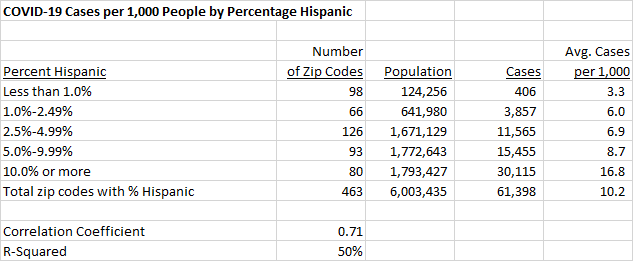
Among the factors I studied, none had a stronger correlation with infection rate by zip code than the Hispanic/Latino percentage of the population. The summary table appears below.

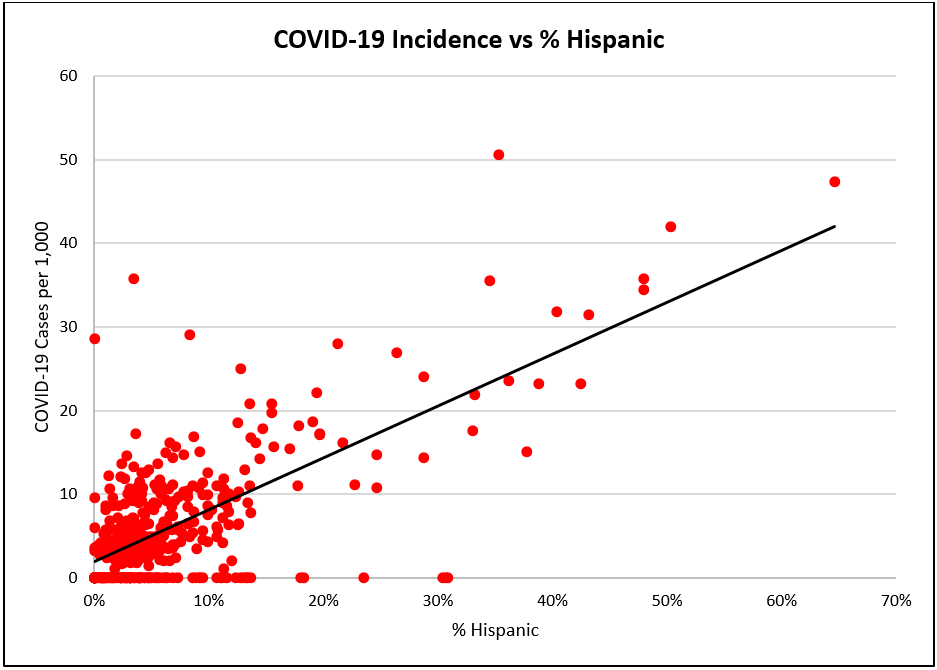
As the Hispanic percentage of the population rises, so too does the infection rate. Maryland zip codes in which Hispanics account for 10% or more of the population had infection rates roughly five times greater than zip codes in which Hispanics accounted for less than 1% of the population. Overall, roughly half of the variation in infection rates among Maryland zip codes was explained by Hispanic percentage alone.

The chart below shows the distribution of zip code data points. The vertical axis plots the number of COVID-19 cases per thousand residents as of 6/18/20. The horizontal axis plots the Hispanic percentage of each zip code’s population. The association is not perfectly linear but the trend is plain.

The data do not demonstrate why this association exists. A possible reason might be heavy Latino presence in essential sectors like agriculture, food manufacturing, grocery stores, warehouses and delivery, all of which have heightened risks of virus exposure. Relatively low health insurance coverage exacerbates the issue.

The second highest correlation I found with infection rates was the percent of population age 5 and older who speak a language other than English at home. This factor is closely associated with the Hispanic population percentage.

Many of the other factors I examined had some correlation with infection rates although none of them were quite as strong as percentage Hispanic. This has a clear implication for policy makers: dealing with COVID-19 requires special attention to this demographic. If the virus spreads unchecked in this community, no other community will be safe.

The entire study, including results for other factors, can be found here.

Share

Teachers Unions, State PTA Call for Virtual Learning at Start of School Year

By Adam Pagnucco.

Maryland’s two teachers unions – the Maryland State Education Association and the Baltimore Teachers Union – have signed a joint letter with the Maryland PTA to Governor Larry Hogan and the state superintendent of schools requesting that the next school year begin with virtual learning for at least the first semester. The joint letter is reprinted below.

*****

Dear Governor Hogan and Superintendent Salmon:

Maryland’s educators and students are eager to return to our classrooms and schools. Educators miss their students, and students miss their teachers and friends. We all miss our school communities, especially as we have come together in incredible ways during the challenging months of this pandemic. Additionally, we know that the inequities facing our Black and Brown students have deepened and widened during the pandemic. There is much work to do to make up for the learning that has been lost and to address the trauma experienced by so many in our school communities.

While we are eager to return to school, we are not blind to the challenges of doing so during this pandemic. Any return to in-person learning must prioritize and guarantee the highest standards for health and safety. Any return must be guided by science and the expertise of educators. Any return to in-person learning also must have renewed commitments to funding and supports so schools are not just ready to open on the first day of school but are safe places to learn and work for the entire school year.

As states have reopened parts of their economies, we have seen infection rates climb. While Maryland has thankfully not experienced the recent spike that other states have, the virus remains an ever-present threat and impediment to normalcy. Maryland is still in a declared state of emergency and the reopening of limited services has rightfully been done with caution. It should not be lost on anyone that physically reopening schools would be, by several orders of magnitude, a much more ambitious—and dangerous—undertaking than any other reopening step we have taken thus far. We are all familiar with the risks:

• bringing together high numbers of people in enclosed, inconsistently ventilated, indoor spaces for hours at a time;
• the significant numbers of educators who are particularly susceptible to the virus (24% of all teachers according to a July 10 Kaiser Family Foundation analysis);
• the significant numbers of Black and Brown students (who make up more than 50% of our student body statewide) and their families who unjustly face healthcare disparities that have made them more likely to be infected and killed by the coronavirus; these students also disproportionately rely on public transportation to get to school, compounding risk before arriving at school facilities that may lack necessary ventilation and a safe learning environment;
• the lack of widely available personal protective equipment (PPE) and testing for educators and students;
• the challenges in ensuring that all students and staff are wearing masks, washing hands, and maintaining social distance at all times; and,
• so much that we do not know or understand about the virus and that is seemingly constantly updated by new scientific studies.

For these reasons and more, we are calling for the 2020-2021 school year to begin with virtual learning and instruction for at least the first semester. Protecting the safety of Maryland educators, students, and families requires this action. We believe it is the right approach and will allow time for further evaluation of health matrices, stakeholder input, and the educational needs of students on a district-by-district basis to allow for a transition to a hybrid learning model after the year begins and possibly a mostly in-person model later in the school year if and when it is safe.

Making this decision now would give every district at least a full six weeks to plan and troubleshoot around one known and understood model of learning. Exceptions to this should be possible only in districts with the very lowest levels of infection and community spread, and with the strong educator and family support necessary in those jurisdictions. Provided they are able to do so at the highest levels of safety, districts should explore whether a limited hybrid model with very small groups of students is feasible with limited student populations for whom equity concerns around extended virtual learning are greatest. Educators who feel comfortable working with these students or working in school buildings should be able to do so.

When districts can have a laser focus on one model, they can better concentrate their resources and work with educators and stakeholders to be successful with virtual learning for all students. This reopening model would allow districts to resolve the inequities of the digital divide that were laid bare this spring. Additionally, focusing on a completely virtual model would allow districts to be better prepared if the state must reverse course and move back into Phase I or a complete quarantine again at some point during the school year.

We agree with Governor Hogan that we will not be bullied by political pressure from Washington, DC. We will not succumb to politics that would place Maryland educators, students, or families in harm’s way and have them participate in a potentially deadly experiment. There is an inhuman callousness that attempts to use the lower transmission rates and mortality rates for people under the age of 18 as justification for reopening schools. Not only does this completely ignore the adults in schools who would undoubtedly have a higher rate of transmission and death, but it also presupposes that there is a number of deaths of students and educators that is acceptable. There is not.

This is not an over-reaction; indeed, we believe this is the tough but responsible action. Opening schools safely takes resources. That is an inconvenient truth for some, especially considering that many people demanding to fully reopen our school buildings for in-person instruction have never advocated for fully funding our schools to begin with. While we see professional sports leagues aiming to provide daily tests to 100% of their athletes, there does not seem to be a single school reopening plan that attempts to commit to provide testing for students or school employees who want it. We have seen the federal government send billions of dollars to airlines and huge corporations in the wake of the pandemic, but we have seen far less urgency and far, far less funding directed to helping our public schools weather this time of crisis.

We should not accept lower safety standards in our schools than we do in our stores, our restaurants, and our barber shops and salons. Many schools do not have the resources or physical capacity to maintain basic protective steps, such as adequate physical distancing, appropriate supplies of PPE, rapid testing for staff and students, sufficient cleaning supplies, and high-quality ventilation systems to avoid the recirculation of air. We need to face reality: too many schools in Maryland have restrooms that lacked soap or paper towels on a normal day before the pandemic. In the face of no additional funding at the federal, state, or local level—let alone threatened budget cuts—it is not realistic to believe that all schools will be equipped with additional and more expensive necessities to stay safe on a daily basis.

The federal funds provided through the CARES Act have largely back-filled unanticipated expenses incurred to close out the last school year. Well-intentioned plans for hybrid learning would require levels of new funding that are not even being contemplated and are impossible to imagine being available for the start of the coming school year. Instead of demanding school systems do more with less, we should continue to unite in our advocacy for additional federal aid and bold state action.

We strongly believe that students gain the most academically, socially, and emotionally when they can learn in-person with their peers, but that learning must take place in a healthy and safe environment. Unfortunately, the facts and science do not support the notion that returning educators and students to schools is safe. Starting the school year unsafely would not be good for our students, especially if another abrupt closure and shift to distance learning becomes necessary. Moreover, seeing their teachers, peers, or family members become ill due to a school-based spread of coronavirus would be traumatizing. Starting the school year unsafely will likely only postpone when we can fully return to safe in-person learning. Loss of learning can be made up. Loss of life cannot.

There are no perfect solutions. Clearly, reopening schools without a thorough understanding of the resources, protocols, and costs to ensure and protect public health would be irresponsible. In light of this, demanding 100% in-person instruction under the circumstances is unsafe and unwise. An adequate hybrid plan requires all the safety protocols of in-person learning as well as addressing all the technology divides of virtual learning. Each of these would require more staff members. Without significant emergency federal or state funds, such an undertaking would be prohibitively expensive. We certainly saw tremendous inequities and learning loss when forced into crisis virtual learning at the end of the last school year. We now better understand the flaws of virtual learning and have a better sense of how to fix them. Virtual learning will not be perfect, but it will save lives.

The most prudent course of action now is to focus on how we can provide the highest possible quality of virtual learning during the first semester of the school year, during which time we hope that the virus is mitigated to a level that will allow for a subsequent expansion of in-person learning. To do that, we must focus our plans and resources to:

• reach a 1:1 student to device ratio as soon as possible;
• increase internet access to students and educators who lack it at home;
• continue to run school-based meal services;
• expand professional development for educators and training and resources for students and families to increase virtual learning fluency;
• engage in trauma-informed practices; and,
• deploy crisis intervention teams where needed.

These are the immediate needs that must be addressed with the limited time and resources districts have before the school year begins. We must concurrently build long-term plans for how we will address the learning gaps and inequities that we have always known to exist and combat the structural factors that prevent Black and Brown students from receiving an equitable education and opportunity.

We are well aware that prolonged virtual learning is challenging for parents as well as for educators and students, as is a hybrid model. We urge state and county leaders and employers to be accommodating to their employees who are parents with flexible or remote work policies and state-facilitated childcare similar to what was done for healthcare workers. We must be in this together and have empathy for one another.

We must rise above politics and focus on the reality and complexities of safely reopening schools. If we open our schools too quickly and without adequate safety precautions, the result will be that some educators, students, and their family members will contract the coronavirus. Some will recover, some will face debilitating health consequences or healthcare bills that they cannot pay, and some will die. These are stubborn facts. And they are costs and consequences that we must refuse to accept.

A perfect solution does not exist. A safe one does. We urge you to support this course. We stand ready to work with you to ensure that the coming school year is as safe and successful as possible for all of Maryland’s students and educators.

Sincerely,

Cheryl Bost, President, MSEA
Diamonté Brown, President, BTU
Dr. Edna Harvin Battle, President, Maryland PTA

Share

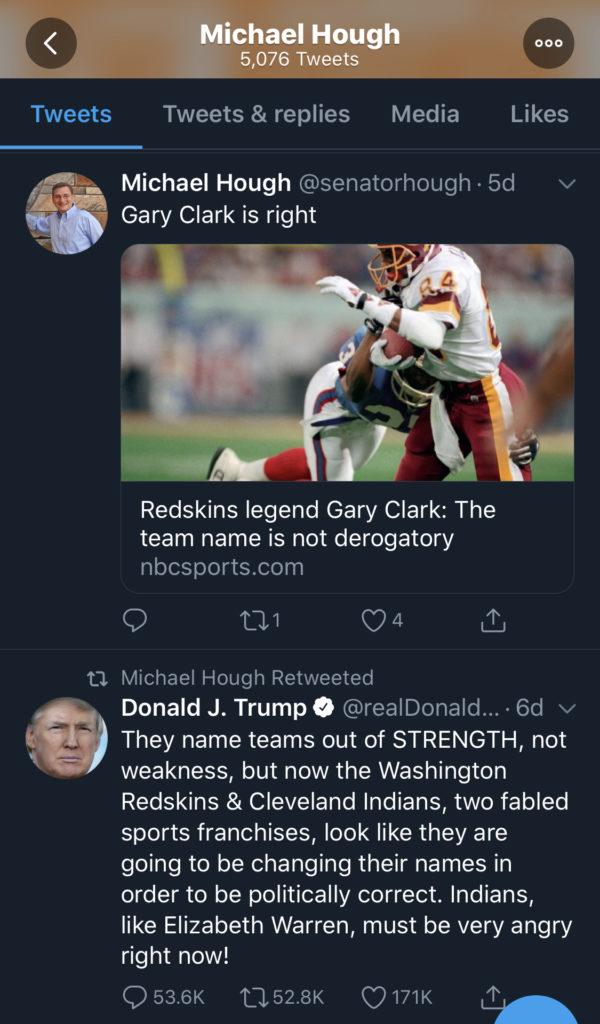
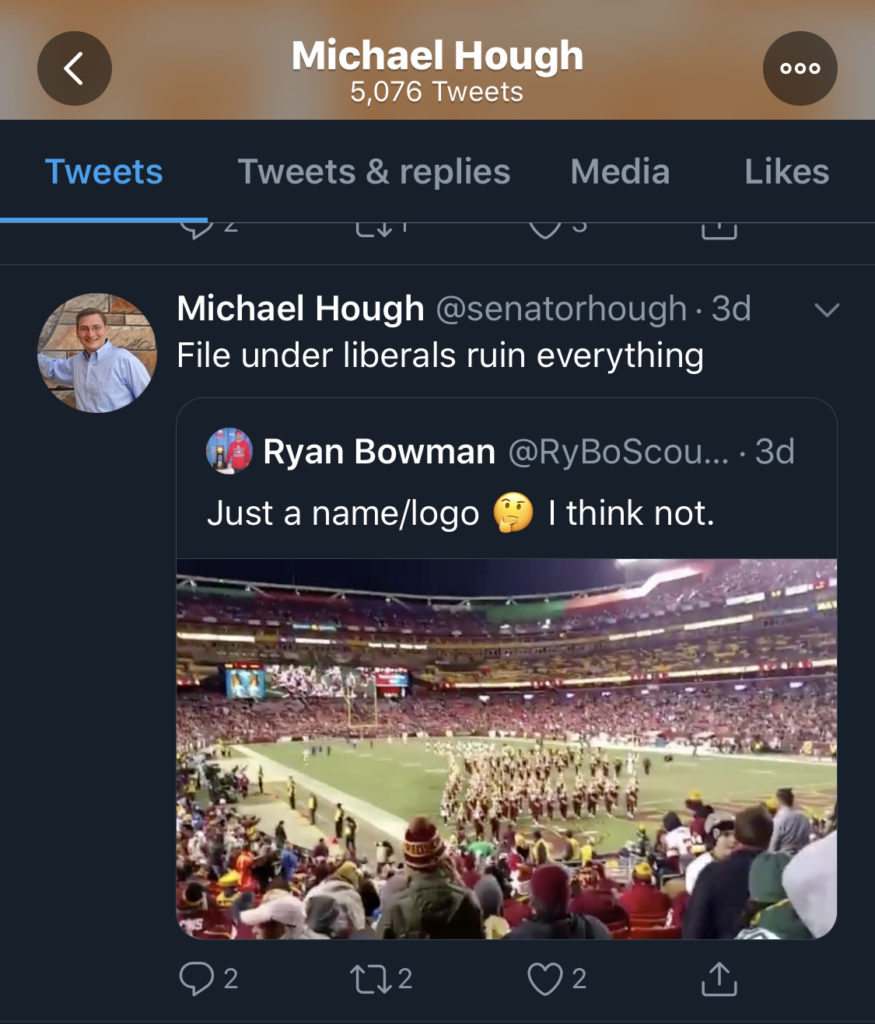
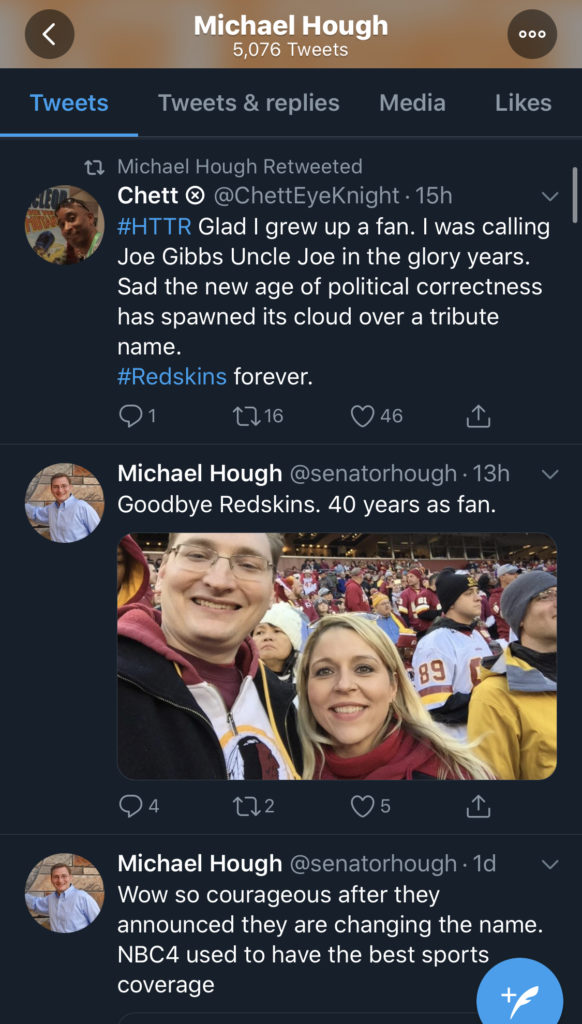
Hough Rails Against Renaming DC’s Football Team

Sen. Michael Hough (R-Frederick and Carroll) has gone on a Twitter tear on the decision to rename the Washington Redskins something else. I guess it goes with his repeated Trumpian bashing of Montgomery and Frederick Counties for not opening more quickly. He also derides NBC4 for no longer using the former team name.

Notwithstanding his ritualized attack on liberals, I don’t see anything especially conservative in choosing to follow a leader who believes against all evidence that he can will the pandemic away and who embraces racist white identity politics as part of his desperate attempt to change the subject. One shouldn’t confuse a personality cult with ideology.

Share

Elrich Charter Amendment Would Make Tax Hikes Easier

By Adam Pagnucco.

A document written by a special assistant to County Executive Marc Elrich lays out the administration’s views on the county’s charter limit on property taxes. And its approach is a simple one: make tax hikes easier.

The county’s charter limit on property taxes was approved by voters in 1990. In simple terms, it allows the county’s total volume of property tax collections to rise annually at the rate of inflation (with a few exceptions like new construction) unless the county council votes to override the limit. Under the original 1990 law, the limit could be overridden with a vote by seven council members. In 2008, tax activist Robin Ficker passed a charter amendment raising the override requirement to nine council votes. Two years ago, voters passed another amendment changing the override requirement to a unanimous vote of all current council members, a change designed to deal with council vacancies. Ficker has qualified another amendment to the charter this year which would revoke all overrides of the limit if approved by voters.

Elrich made his dislike of the current charter limit structure plain in his most recent recommended budget. In his budget message, Elrich wrote:

When the County Council proposed to the voters our current Charter limit on property taxes in 1990, few people could have foreseen the dramatic changes that would take place in Montgomery County and around the globe. In the past 30 years, our school population has grown by 65 percent and our overall population has grown by 40 percent. The services we provide are now more complex and seek to address a range of challenges, from traffic congestion and climate change to health care disparities and linguistic diversity. And over the past four decades, our property tax rate has declined by 35 percent.

We have all witnessed other local governments regionally and nationally experience generational decline due to conflicting, irreconcilable fiscal policies. Montgomery County is at the precipice of such a decline if we cannot get ourselves out of this cycle of self-enforced structural deficits and inequitable, unpredictable revenue caps. Therefore, I will be sending the Council a proposal for a Charter amendment that will revise our revenue cap to provide certainty to homeowners. This proposal will eliminate our old, cumbersome revenue cap and replace it with a three percent cap on the increase in any homeowner’s taxable assessment. This will give our taxpayers real protection from unexpected increases in property values. It will also provide the County Government with a higher degree of predictable tax revenues like every other jurisdiction in our region.

Without such a change in the Charter, our community could be facing a situation in FY21 where a recession and deflation cripple our ability to provide emergency services and a quality public education system. This perfect storm would threaten lives and diminish the value of properties in our County. I will not stand by and let our community be harmed by the ghosts of voters from four decades ago.

An internal document written by one of Elrich’s special assistants, Debbie Spielberg, lays out the administration’s specific objections to the current charter limit. (Spielberg is the Hand of Elrich. No one in the administration is closer to the boss.) Among Spielberg’s criticisms are that the current charter limit structure does not capture growth in the tax base, is vulnerable to underestimates that affect the taxable base subject to the limit forever and leaves open the possibility of having a zero inflation rate stop increases in collections. Spielberg is right on all of these points. She also alleges that the charter limit has caused MoCo to have a lower property tax rate than most of its neighbors. This point is more complicated. MoCo’s property tax rate was in the middle of the pack for Maryland counties in FY20 and is lower than much of Northern Virginia because those localities do not charge income taxes. Spielberg’s memo is reproduced below.

The administration is fearful of what would happen if voters pass the new Ficker amendment, which would remove the county council’s ability to break the charter limit. Spielberg’s memo proposes an alternative charter amendment that would do three things.

  1. It would apply the charter limit to the property tax rate, not the volume of collections.
  2. It would allow six council votes to raise the tax rate. The current override requirement is a unanimous vote by all current council members.
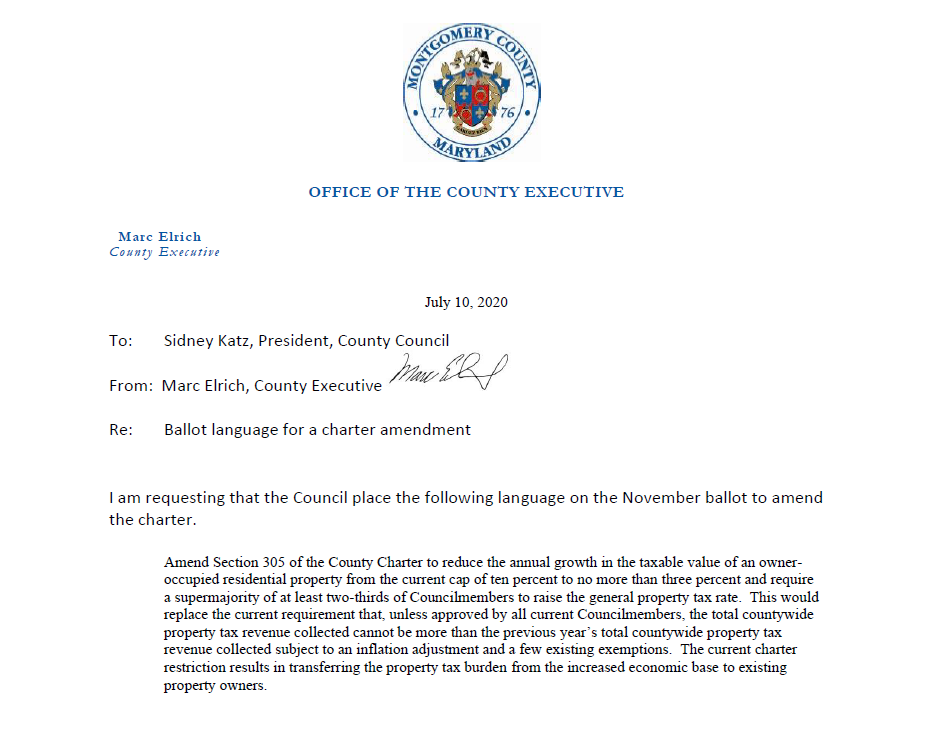
  3. It would limit the growth in the taxable value of an owner-occupied residential property to 3% per year.

Elrich’s official charter amendment request to the council appears below. The council and the voters – but not the executive directly – can place charter amendments on the ballot.

The obvious impact of this proposal would be to make property tax hikes easier. Instead of one council member being able to block an increase, now four would be required to obstruct it.

The less obvious impact has to do with the distribution of future tax increases. Right now, the county limits the annual increase of taxable assessments on principal residences to 10%. The administration’s proposal would lower that to 3%. That looks good for homeowners but let’s think about the properties that are not principal residences: commercial properties and residential rental properties. If homeowners are shielded from tax hikes, commercial entities and residential renters will pay more. This is a significant policy shift with two consequences. First, it would impede the county’s commercial sector from recovering from the COVID-19 economic crisis. (Let’s remember that MoCo had major competitiveness issues before the virus arrived.) Second, renters – especially low-income residents and small businesses – have been dramatically affected by the current economic downturn. How much more can they pay? Policy makers should think carefully about having them assume more of future tax burdens.

The looming prospect of a new Ficker amendment has generated both this concept as well as another amendment on property taxes now before the county council. (The council’s version would require a unanimous council vote to raise the tax rate and contains no redistribution of the tax burden.) If one or both alternatives to Ficker make it to the ballot, voters will face complicated choices on tax policy. And they will do it during one of the worst recessions ever.

Share

Maryland Politics Watch