The Voting Wars Come to Maryland

Where Matters Stand Now

Maryland has been in quite a ferment over whether to mail out ballots to everyone as opposed to sending out mail-ballot applications to everyone. Gov. Larry Hogan (R) insisted on the latter and got his way. But Democrats vehemently want the former and mail-ballot applications have yet to hit mailboxes.

Originally, the Governor wanted all polling places to open too but has now bowed to the reality that there are not enough people to staff them and reluctantly allowed the State Board of Elections (SBOE) to combine them into many fewer. Let’s hope the remaining polling places have more voting kiosks than usual, so they can process more people than a standard polling place.

Early voting should continue relatively normally. I’d anticipate high demand not just due to interest in the election but also to concern about mail ballot delivery and voting on election day.

We will also have many more drop off boxes. According to the WaPo, Montgomery County plans to go from two or three to forty this year. Prince George’s plans on adding an additional thirty-six boxes. Sen. Cheryl Kagan, who has been very active on election issues, tells me we should have even more than anticipated. The more, the better.

How Are We Doing on that Shift to Mail Voting?

Not so good. The adjustment to much higher rates of mail voting has been far from glitch free. Some of our ballots for the all-mail primary got sent to South Carolina. Those of us who applied for mail ballots did not receive them initially even though people who had not requested them had.

In general, ballots arrived later than they should’ve with delays especially long in some areas of the state. It’s a good thing we opened up polling places, after a lawsuit, but the lines were too long and the state should have known they were required without being sued.

We don’t seem off to a roaring start for the general in which mail voting is heavily encouraged but not every voter will be sent a ballot. Again, the state has failed so far to send mail ballot applications. The Governor can blame the State Board of Elections but surely should have some responsibility for making sure that they can implement a plan before mandating it.

Will It Matter?

The switch from away from all-mail might depress turnout as voters won’t have the ballot sent directly to their home unless they request it. The State Board of Elections has very belatedly made the online application less intimidating. Speaker Adrienne Jones was quite right to highlight that issue.

At the same time, polling places will be open both for early voting and election day voting, so the overall impact of the switch is hard to assess. The chances for any impact on contests seems low because there just aren’t a lot of hot races.

Compared to many other states, we’re not voting for much in Maryland this year. No state legislative elections and few local elections. We don’t even have a U.S. Senate race. I can call the winners of Maryland’s ten presidential electors and eight congressional races now.

The few partisan local races don’t look very exciting. My knowledge of Baltimore City and Cecil County politics is relatively slim. But I do know that Democrats are usually a lock in Baltimore and Republicans the same in Cecil. I’m afraid I can’t speak to the contest for a seat on the Wicomico County Council.

I suppose the change in voting might have an impact if some of the nonpartisan school board and judicial races turn out very close. Judicial contests operate below the radar for most people. Several challengers, however, upset incumbents in the primary, so these contests are more heated than usual. Still, while I’m sure the cognoscenti are interested, Maryland’s judicial races lack the partisan juice of Wisconsin.

If the switch away from all-mail depresses turnout, the main concern might be that it somewhat lightens the weight of Maryland’s contribution to Joe Biden’s national vote margin. That’s of more interest than usual since Donald Trump seems intent on doing his tinpot dictator impression by casting doubt on any ballots that are not cast for him.

On the other hand, if more people vote in person out of concern over the mail, it will also lead to fewer invalidated votes. Unlike at polling places, mail-ballot voters who make a mistake, such as failing to sign the ballot oath, have no chance to correct their errors and the ballot gets tossed.

Problems with Both Mail and All-Mail Voting

We don’t have signature checks in Maryland to make sure that the person who voted and mailed the ballot was the voter. In fact, they are illegal under Maryland law. As a result, even if we shifted to all mail, we could not implement them in the manner of every state that normally does all-mail voting (and California) unless the General Assembly changed the law. Interestingly, this seems to have eluded both sides in the debate over the Governor’s election plan.

This hasn’t been much of an issue in the past as Maryland usually has a lot of early voters but comparatively few mail voters.

We have the signatures on file, so we could do signature checks if the General Assembly changed the law. Some argue against them as unnecessary because there are few problematic ballots in states with checks. But this type of fraud seems a lot less likely when people are checking up on it. Absentee ballot manipulation is exactly how Republicans attempted to steal a 2018 North Carolina congressional election. (In person fraud is different and extremely rare notwithstanding vehement Republican partisan demands for voter ID to solve a non-problem.)

If you have signature checks, you also must find a way to give voters a chance to cure (i.e. validate) any questionable ballots to avoid disfranchising voters. This isn’t always easy and needs improvement. But it’s vital because checking signatures is not an exact science and we want to protect against disfranchisement.

Precinct Reporting

In Maryland during the all-mail primary, the Board of Elections did not attribute ballots cast by mail back to the precinct. The ballots didn’t have codes on them that made that easy. Local county boards can still do if they’re willing. Many won’t because it’s a lot of work but I was pleased to learn that the Montgomery County Board of Elections is going to do it.

For the general, the SBOE tells me that the ballots will have precinct codes, but the proof is in the pudding. Precinct results are very nice to have not just for political researchers and junkies like me but because they are a critical tool in detecting fraud or other problems.

Two Bright Spots

During the primary, the State allowed jurisdictions to count mail-in ballots when they were received but not to release the vote totals until after the polls closed on election day. This allowed for faster reporting of initial results. The same is planned for the general election.

The Governor’s election plan to encourage mail voting by sending ballot applications but not mailing ballots is much more expensive and places real burdens on county boards to process applications. Originally, the Governor and SBOE wanted counties to foot one-half of the bill for the postage paid return envelope. Thanks to efforts by Sen. Kagan along with the Maryland Association of Counties (MACO) and Montgomery County, SBOE has now agreed to cover the substantial cost of this unfunded mandate.

Final Note: Stop Playing Trump’s Game

As Law Professor Richard Pildes explained, disagreement between Donald Trump and Democrats over mail and all-mail voting has no point. Excepting Nevada, the only states using all-mail voting are the same ones that always use it. Democrats would be better served by emphasizing that all the swing states are using absentee voting (the same as mail voting in Maryland), which Trump has declared okele-dokele. Use his own argument against him to fight very doubt he’s manufacturing. In other words, don’t have an argument to no purpose that benefits him instead of Democrats even if he’s wrong.

The post office, however, bears watching. I can’t regard the lack of mail service at my home yesterday as an encouraging sign. The claims that all is well are belied by Trump’s blunt statements that he doesn’t want funding for USPS because it would aid in mail voting, which he sees as bad for him. Dismantling sorting machines also seems unlikely to increase postal efficiency. It’s also a terrible issue for Republicans.

Share

Why Republicans Want Nine Districts, Part Two

By Adam Pagnucco.

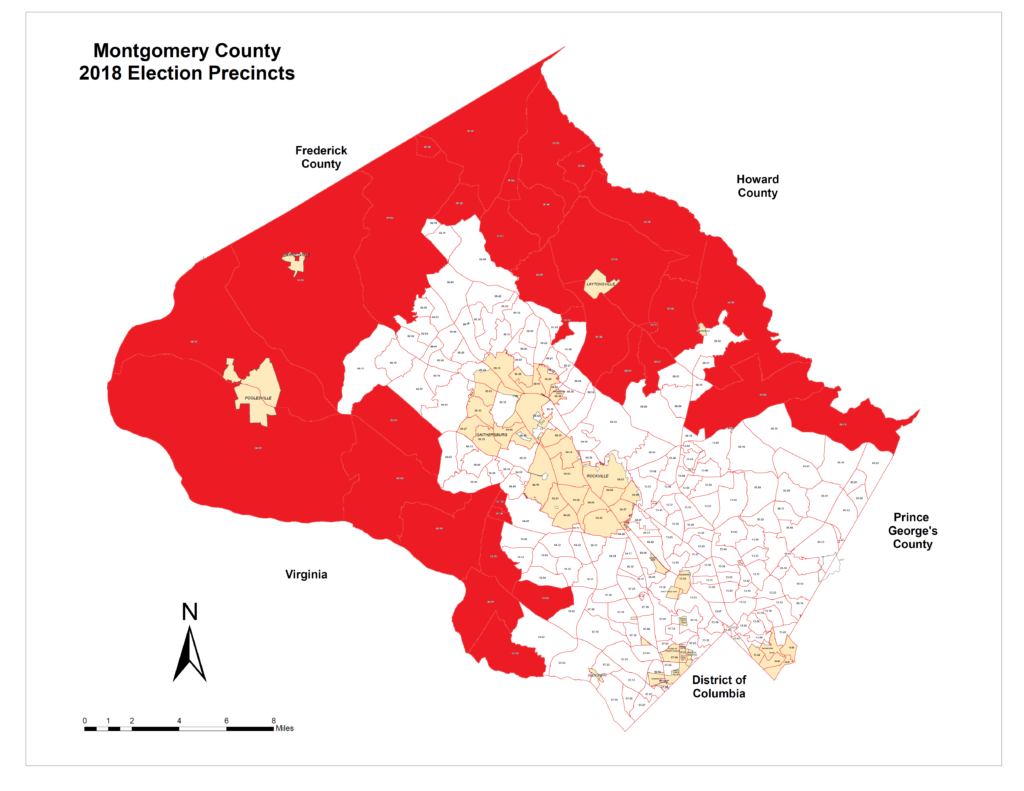
In Part One, I explained the primary reason why the county’s Republican Party leadership supports Nine Districts, even going so far as to use the party’s official website to raise money for the group. The Republicans believe that having nine county council districts instead of five could produce one (or more) districts in which Republicans could compete. Using 2018 general election data, I built a 32-precinct district that accounts for one-ninth of the county’s registered voters and maximized Republican electoral participation while minimizing Democratic participation. (I used registered voters as an admittedly imperfect proxy for population.) Here is what my so-called Red District looks like on a precinct map.

The Red District has the strongest presence of Republicans and the weakest presence of Democrats of any contiguous district I can construct. But could it actually elect a Republican to the county council? Let’s find out.

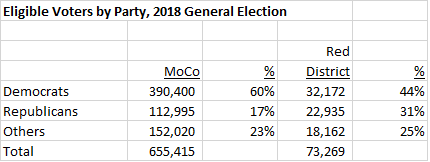
First, let’s compare the eligible voters by party as of the 2018 general election between the county as a whole and the Red District.

In the county as a whole, Democrats had a 43-point advantage over Republicans in eligible voters. In the Red District, the Democratic advantage shrank to 13 points. Democrats still held a plurality in the Red District, but with 44% of eligible voters, they were not a majority.

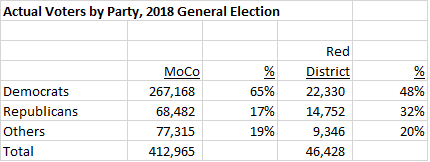
Now let’s look at actual voters.

Among actual voters, Democrats had a 48-point advantage over Republicans countywide. (2018 was a year in which Democrats were highly motivated to vote by the current occupant of the White House.) But in the Red District, the Democratic advantage shrank to 16 points. Once again, Democrats were a plurality but not a majority of Red District voters.

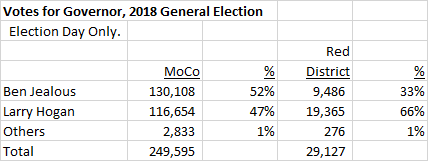
The table below shows the performance of the two major-party gubernatorial candidates, Democrat Ben Jealous and Republican Larry Hogan, in the county as a whole and in the Red District. Only election day votes are shown because precinct data does not include other voting modes.

Jealous won the election day vote countywide by 5 points. (Counting all voting modes, Jealous won MoCo by 11 points.) But in the Red District, Hogan blew out Jealous by 33 points on election day. Clearly, the Red District is VERY different from the rest of the county in its preference for governor.

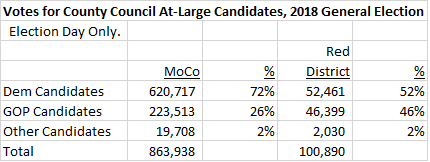
But Hogan is an unusual Republican whose popularity extends well into the Democratic voting base. Judging a propensity to favor the GOP by looking at Hogan’s vote tallies alone is problematic. And so, as a proxy for hypothetical support for a generic Republican, I calculated the combined votes for the Democratic council at-large candidates (Gabe Albornoz, Evan Glass, Will Jawando and Hans Riemer) and the Republican council at-large candidates (Robert Dyer, Chris Fiotes, Penny Musser and Shelly Skolnick) for both the county as a whole and the Red District. Those results are shown in the table below.

In the county as a whole, the Democratic council at-large candidates totally blew out the Republicans by 72-26%. That’s why the Republican leadership hates the at-large seats as much as they do – Democrats can roll up their vote totals in Silver Spring, Takoma Park, Chevy Chase, Bethesda and Kensington and Republicans can’t pick up enough votes elsewhere to win. But in the Red District, the Democratic council at-large candidates only had a 6-point edge. Compared to the rest of the county, that’s a narrow margin.

Let’s remember that 2018 saw massive Democratic turnout in reaction to the individual in the Oval Office. That makes it an unusual year. Given that fact, the above data suggests that in a more normal year, a strong Republican council candidate could defeat a weak Democrat in the Red District. That’s the dream of MoCo Republicans. And that’s why they support Nine Districts.

Now, would something like the Red District actually be created in a nine district system? That’s hard to know. Redistricting is nominally within the purview of a commission appointed by the council every ten years, but the council can substitute its own map if they wish. That means if Nine Districts passes, council Democrats will effectively design the districts directly or indirectly. They could scatter rural Republicans around two or three districts (perhaps one based in Potomac, another based in Clarksburg and maybe a third based in Damascus). Doing that would create two or three competitive general elections. Or they could do what state-level Democrats did in designing the current congressional districts, which was to pack Republicans in one district (Congressman Andy Harris’s District 1). If they elected to go that route, they would design something very close to my Red District.

One thing is for sure: the Republican Party would be jumping up and down to get a chance to compete. They don’t have that in the current system. But they might have it if voters approve nine districts.

Share

Nine Districts Appears Headed to the Ballot

By Adam Pagnucco.

Multiple sources confirm that Kevin Karpinski, counsel to the Montgomery County Board of Elections, told the board yesterday that the charter amendment petition to convert the Montgomery County Council to a nine district configuration has received enough valid signatures to qualify for the ballot. The threshold is 10,000 signatures or 20% of the registered voters of the county. Nine Districts for MoCo submitted 16,448 signatures on August 3.

Margaret Jurgensen, the county’s election director, told me, “Mr. Karpinski did confirm that it appears that the Petition has succeeded garnering the number of valid petitions.”

The board still needs to complete its verification process and release a formal determination, which should occur later in the week. Once it does so, the county attorney must draft language for the ballot. At that point, only one thing could stop the question from appearing on the ballot: litigation, which has happened before. In 2016, a group opposing Robin Ficker’s term limits petition tried to get it thrown out in court over signature issues but was unsuccessful. I have heard of no such entity willing to challenge Nine Districts’ signatures.

That means Nine Districts could be officially headed to the ballot within days.

Share

MoCo Terminates AdvaGenix COVID Testing Contract

By Adam Pagnucco.

Montgomery County Government has announced that it is terminating its contract with AdvaGenix, a Rockville lab, to provide COVID-19 testing. When the county signed the contract in May, County Executive Marc Elrich called it “a game changer” and the company was expected to provide up to one million tests over the course of a year. Instead, the county has stated that about 19,000 tests were provided under the contract and has advised residents and county employees who received them to get retested.

The company is pushing back hard. Its founder, Dr. William Kearns, told WJLA-7, “We are being slandered… I think there’s a lot more going on here than meets the eye.” Kearns further said, “Our tests are very accurate… Saying anything otherwise is nonsense.”

AdvaGenix was a major player in the county government’s testing program, although the private sector has supplied many more tests than the county. It’s unclear what the county’s plan to resume ongoing testing will look like going forward. There are also MANY more questions to be asked about this and, so far, few answers.

The county’s press release appears below.

*****

Montgomery County Announces Termination of AdvaGenix Contract
For Immediate Release: Tuesday, Aug. 18, 2020

Montgomery County announced today that it has terminated its contract with AdvaGenix, the Rockville-based company that had been providing and processing tests for the County Government’s free COVID-19 test clinics. This action was taken following the cease and desist directive and order issued by the Maryland Department of Health on Aug. 14, 2020, prohibiting AdvaGenix from processing COVID-19 tests.

In response to the State’s announcement last week, the County has been working to restore its testing capacity and reopen testing sites. The Maryland Department of Health has committed to replace the weekly supply of tests for the next four weeks. County officials are working to identify additional test sources to support the County Government’s effort to offer broadly available free tests.

On Thursday, Aug. 13, the County announced it was temporarily suspending tests at County-sponsored clinics. Testing at these clinics was designed primarily to serve asymptomatic individuals. The County continues to provide testing to symptomatic individuals using existing partnerships with other labs. Since the beginning of the COVID-19 pandemic, more than 265,000 COVID-19 tests have been administered to County residents. Tests provided by AdvaGenix were approximately 8 percent of these tests.

Share

Why Republicans Want Nine Districts, Part One

By Adam Pagnucco.

In a prior column, I noted the participation of many county Republican Party leaders in the Nine Districts group. These leaders even went so far as to use the party’s official website to raise money for the Nine Districts campaign fund. Why is the GOP’s local leadership so interested in eliminating at-large county council seats and replacing them with nine districts?

The answer is simple: nine districts might be the only way they can get a Republican elected to the county council.

It’s important to remember that the council has not always been unanimously Democratic. District 1 (Bethesda-Chevy Chase-Potomac) elected two Republican council members: Betty Ann Krahnke (1990-2000) and Howard Denis (2000-2006). District 2 (Upcounty) was represented by Republican Nancy Dacek from 1990 through 2002. Those were the days when Republican Congresswoman Connie Morella represented most of MoCo – a much less partisan time. District 2, which represents much of Upcounty, is the most Republican-heavy council district in the county. Its current seat holder, Council Member Craig Rice, has won his last three general elections with 59% of the vote in 2010, 60% of the vote in 2014 and 71% of the vote in 2018. The shift of the GOP from being the party of Morella to the party of Donald Trump has brought hard times to local Republicans.

Nine districts could resuscitate the party. That’s because a change from five districts to nine districts could allow enough Republicans and independents to congregate into one district to make it competitive in a general election. That is clearly what the county’s Republican leadership is hoping for. But could it actually happen? Could dark blue MoCo – even the reddest one-ninth of it – ever elect a Republican again?

To test that hypothesis, I pulled precinct-level data from the 2018 general election. I used the following criteria to select precincts that would form the most Republican-intensive district possible in the county:

Lowest percentage of registered Democrats
Highest percentage of registered Republicans
Lowest percentage of actual voting Democrats
Highest percentage of actual voting Republicans
Lowest percentage of votes going to Democratic council at-large candidates
Highest percentage of votes going to Republican council at-large candidates

There were two additional requirements. First, the precincts had to be geographically contiguous. (No random splatters of territory like Maryland’s Third Congressional District!) And second, the precincts had to contain one-ninth of the county’s registered voters, which I used as a proxy for population.

In practice, this turned out to be pretty easy since 23 precincts met all six of the above criteria. Two more met five criteria, three more met four criteria and two more met two criteria. Two precincts met none of the criteria but they had to be included to make the district contiguous. A few others did well on qualifying criteria too but were either non-contiguous or created difficulty in keeping the district at the appropriate size. All of this reinforces a central fact: in MoCo, partisanship is heavily geographic.

And so here it is: 32 precincts containing 73,269 eligible voters as of the 2018 general election, almost exactly one-ninth of the total registered voters in the county. (Again, I’m using registered voters as an admittedly imperfect proxy for population.)

Let’s call this the Red District. Here is what it looks like on a map.

The Red District has the shape of a jagged “C” and hugs the western Potomac River, the Frederick County border and the Howard County border. Its largest communities are Clarksburg, Damascus, Poolesville and part of Potomac. It is not geographically compact, but it does have a community of interest because it includes the least dense, and most rural, parts of the county. Its shape was inevitable. These are the areas where Republicans are strongest and Democrats are weakest.

How would the Red District have voted in the 2018 general election? We will find out in Part Two.

Share

Nine Districts Might Have a Problem with Some Petition Signatures

By Adam Pagnucco.

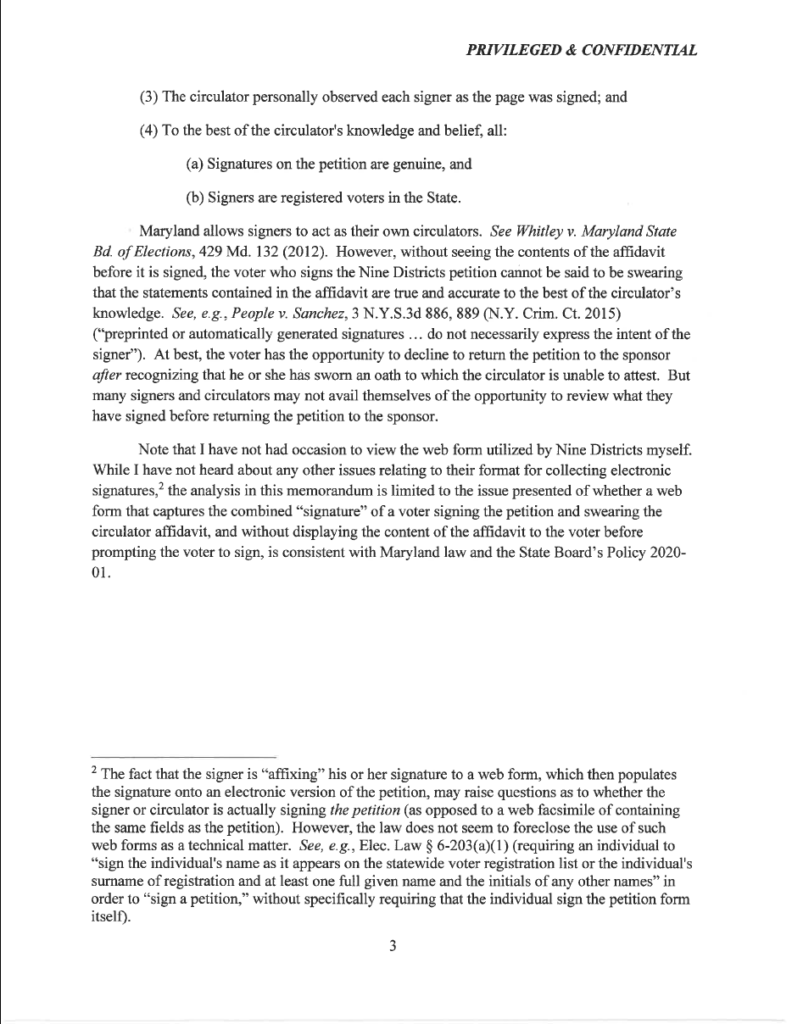
A June opinion from the office of Maryland’s Attorney General indicates that the Nine Districts for MoCo group may have collected some electronic signatures in a manner that was inconsistent with state law and policy established by the State Board of Elections. Whether this impacts the group’s ability to qualify for the ballot remains to be seen.

Maryland law requires that both petition signers and petition circulators sign a ballot question or charter amendment petition. The signer and the circulator may be the same person. The circulator must sign and date an affidavit that states:

Under penalties of perjury, I swear (or affirm) that: (a) I was at least 18 years old when each signature was obtained; (b) the information given to the left identifying me is true and correct; (c) I personally observed each signer as he or she signed this page; and (d) to the best of my knowledge and belief: (i) all signatures on this page are genuine; and (ii) all signers are registered voters of Maryland.

The circulator must also provide his or her name, residence address and telephone number.

On April 22, the State Board of Elections established a temporary policy (SBE Policy 2020-01) allowing electronic signatures on petitions due to the COVID-19 crisis. The policy states: “For an electronic signature to be valid under this policy, in addition to meeting the requirements of Elec. Law § 1-101(y), the signature must reflect an affirmative action by the signer to type or electronically sign or affix the signer’s name on to the signature page.”

The key phrase here is “affirmative action.”

According to Assistant Attorney General Andrea W. Trento, who was asked to provide an opinion on Nine Districts’ system for gathering electronic signatures, the group’s website through June asked voters to “fill in [their] information by typing the info to populate the signature page… It then ‘asks if you want to accept,’ and if the voter does so, it ‘states that you successfully signed the petition.’… The signature and accompanying information are then populated both into the signature field and the circulator field. The voter does not see the circulator oath before signing, nor does the voter take any affirmative action to sign the circulator affidavit as distinct from the petition.”

Accordingly, Trento opined that “these features are clearly inconsistent with Maryland law” and “the format as described to me is not consistent with Policy 2020-01.” Trento’s opinion was shared with the Nine Districts group on June 8.

Does this mean that Nine Districts’ petition will be thrown out? Not necessarily. The Attorney General’s opinion states that the group “may have changed its web form” after discussions with the county board of elections. The group also gathered MANY physical signatures prior to the onset of COVID-19. But these are the kinds of technicalities that result in petitions being rejected. Even Robin Ficker, the undisputed master of charter amendment signature gathering, had a term limits petition thrown out in 2010. (Six years later, Ficker got term limits on the ballot and passed it with 70% of the vote.)

Trento’s opinion is reprinted below. (The home address for Nine Districts’ chairwoman has been redacted.)

Share

Is Talbot County Killing its Golden Goose?

By Adam Pagnucco.

Last week, the Talbot County Council voted to keep the Confederacy-memorializing Talbot Boys statue on the grounds of its county courthouse. The vote prompted a protest and charges of “systemic racism” from the county NAACP. Ominously, the vote has received coverage in media markets outside the Eastern Shore, including Washington, Baltimore, New York City, Philadelphia, Long Island and North Carolina. All of this is happening as confederate statues are coming down all over the country and nearby Wicomico County took down a confederate sign in Salisbury.

By sticking with the Confederacy over its own economy and tax base, the Talbot County Council has taken an enormous risk.

Here is why. The table below shows the percentage of total employment accounted for by the leisure and hospitality sector, defined as hotels, motels, restaurants, bars, museums, performing arts, spectator sports, recreation, gambling and related industries in 2019. This sector accounted for 10% of Maryland’s total employment that year. It accounted for 17% of Talbot County’s employment, third in the state behind Worcester County (37%) and Queen Anne’s County (22%).

This sector is extremely vulnerable to the economic crisis caused by COVID-19 and Talbot is extremely dependent on it. It would also be vulnerable to any potential boycott caused by the county leaders’ embrace of the Confederacy. If both the COVID-19 crisis and a boycott hit Talbot County at the same time, it would be an unbearable double whammy to the county’s crucial leisure and hospitality businesses. Lacking an impregnable anchor like a large military base (as Harford, St. Mary’s and Prince George’s Counties have) or a sizeable federal government presence (as Montgomery and Prince George’s Counties have), Talbot’s economy has no way to deal with a big hit on its tourism industry.

But there is more. Talbot County is not an everyday tourist destination. It offers a range of high-end amenities along with beautiful bayfront and riverfront property that attracts the wealthy, both as tourists and as full- or part-time residents. That brings sky-high property values to the county, an immense asset. Talbot County had the second-highest assessable base per capita ($231,388) in Maryland in FY20, behind only Worcester County and far surpassing the state average ($131,325). High property values enable Talbot County to have the lowest real property tax rate in the state as well as the second lowest income tax rate.

Not many places in Maryland have $5 million homes for sale like this one in Oxford.

The huge majority of counties on the East Coast would be jealous of Talbot County’s mix of high-end tourism and steep property values. But what happens if a progressive boycott is launched against the white supremacist preferences of its county leadership? The effects on the county’s tourism industry are obvious but what if property values are also affected because wealthy home purchasers choose to buy elsewhere? Commercial property values may already be at risk because of COVID-related economic losses and that is even before any potential boycott. If home price appreciation tapers off too, the county government could face very tough budget choices. Service cuts and tax increases are not unthinkable.

Because of its industry structure, Talbot County’s economy is exceedingly vulnerable to the effects of COVID-19. The county’s leaders must do everything possible to protect the golden egg that delivers its prosperity – its leisure and hospitality sector. Instead, the county council’s loyalty to the Confederacy has greatly increased the county’s economic peril by risking an anti-racism boycott. Talbot County residents and businesses could pay the ultimate price.

Share

MoCo to County Employees: Get Retested

By Adam Pagnucco.

Montgomery County Government has sent the email below to county employees regarding the suspension of COVID testing by county vendor AdvaGenix. County employees, particularly first responders and essential workers, were among the first people to receive the tests. The email tells employees, “Although the data we have reviewed does not suggest that the test results were affected by the apparent flaws in AdvaGenix’s lab process, we encourage you to take advantage of one of the other COVID-19 testing resources to be re-tested.”

*****

From: “MCG.Postmaster” MCG.Postmaster@montgomerycountymd.gov
Date: August 14, 2020
To: #MCG_All <#MCG_All@montgomerycountymd.gov>
Subject: COVID-19 Testing Update

On May 21, 2020, the County announced the signing of an agreement with County-based testing firm, AdvaGenix, to provide COVID-19 testing to County employees and the general public. Since that date, the County has been working to expand free testing for asymptomatic residents and employees using the AdvaGenix tests, with more than 19,000 tests administered in the last 2 months. Unfortunately, yesterday that momentum came to a halt. As you may have seen, the County has suspended the AdvaGenix testing program after learning that the Maryland Department of Health had issued an order formally halting testing at their lab.

Your health and safety are our top priority. Therefore, we want to provide you with some guidance as to what this situation means to you. In the interim, County officials are working rigorously to determine an alternative source of test analysis so the testing program can resume.

First, all Department testing schedules are suspended until further notice. We are identifying new testing options so that we can have an employee testing program back up and running as soon as possible. There are a multitude of free testing options that remain available to anyone who needs or wants to be tested, including local urgent care centers, CVS locations, hospitals, etc. For additional testing sites, visit the State of Maryland’s Testing Locator page, which can be found at https://coronavirus.maryland.gov/pages/symptoms-testing#siteapp, or call the County’s Testing Helpline at 240-777-1755.

Second, for those of you who were tested by AdvaGenix, you should receive an e-mail from AdvaGenix informing you of what has happened. Although the data we have reviewed does not suggest that the test results were affected by the apparent flaws in AdvaGenix’s lab process, we encourage you to take advantage of one of the other COVID-19 testing resources to be re-tested.

Third, the County’s asymptomatic individual testing program using the oral swab or saliva method has been temporarily paused. However, the County will continue to offer free public testing using a variety of nasal tests. In fact, the state has already committed to provide us with 20,000 nasal kits while we transition to a new self-administered test.

Finally, the County’s testing program through AdvaGenix was only a very small piece of the overall available market for tests in Montgomery County. To date, more than 261,000 COVID-19 tests have been administered to County residents. The AdvaGenix test only accounted for 8 percent of the total. Once again, there are a multitude of free testing options that remain available to anyone who needs or wants to be tested, including local urgent care centers, CVS locations, hospitals, etc. For additional testing sites, visit the state’s Testing Locator page, which can be found at https://coronavirus.maryland.gov/pages/symptoms-testing#siteapp, or call the County’s Testing Helpline at (240) 777-1755.

If you have any additional questions, please contact Don Scheuerman at Don.Scheuerman@montgomerycountymd.gov.

Everyone involved in our testing effort is deeply disappointed with this development. It is so very frustrating that communities across our country are having to invent and reinvent testing programs since the federal government refuses to take responsibility for a national strategy.

Yet, in these difficult times, we have no choice but to pull together as a community to survive the pandemic. Together, we will overcome this newest obstacle. Together we will beat this frustrating virus.

Share

How Big of a Problem is MoCo’s COVID Testing Failure?

By Adam Pagnucco.

Yesterday, the county announced that it has suspended COVID testing by AdvaGenix, a Rockville-based lab with whom the county contracted in May. At that time, County Executive Marc Elrich called the contract “a game changer,” saying, “This greatly increases our ability to get more testing.”

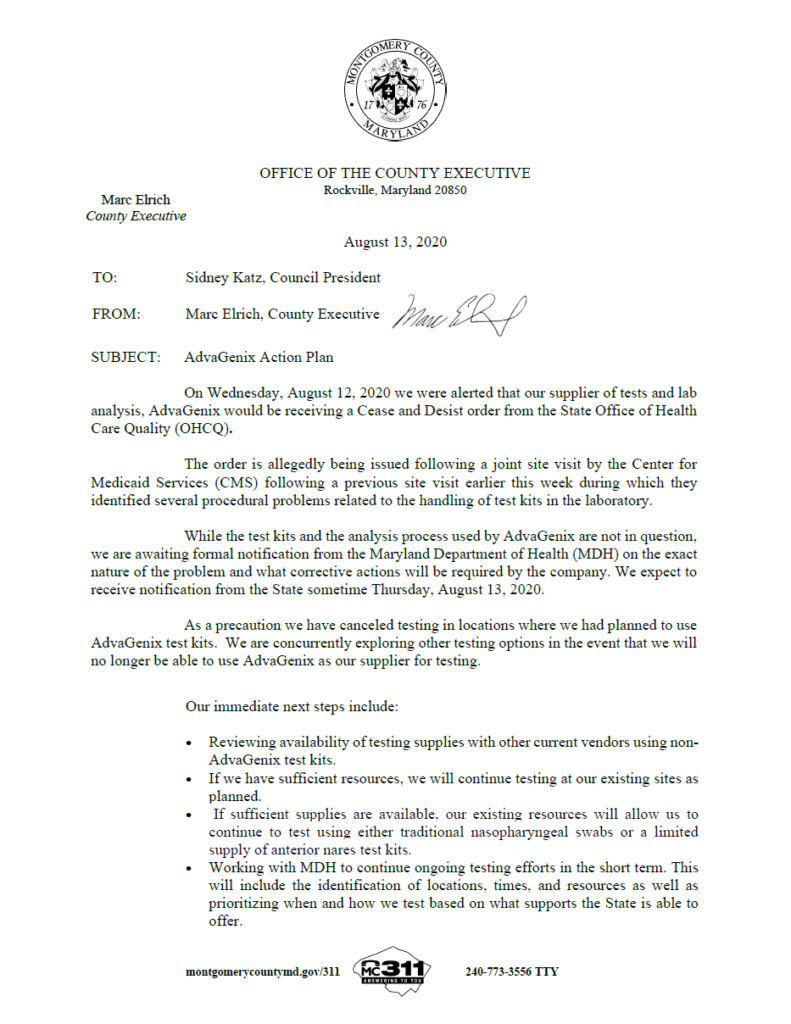
The county’s press release provided no reasons on why the testing was suspended. However, yesterday afternoon, Elrich sent a memo to the county council elaborating a little more on the issue. Elrich wrote:

On Wednesday, August 12, 2020 we were alerted that our supplier of tests and lab analysis, AdvaGenix would be receiving a Cease and Desist order from the State Office of Health Care Quality (OHCQ).

The order is allegedly being issued following a joint site visit by the Center for Medicaid Services (CMS) following a previous site visit earlier this week during which they identified several procedural problems related to the handling of test kits in the laboratory.

While the test kits and the analysis process used by AdvaGenix are not in question, we are awaiting formal notification from the Maryland Department of Health (MDH) on the exact nature of the problem and what corrective actions will be required by the company. We expect to receive notification from the State sometime Thursday, August 13, 2020.

As a precaution we have canceled testing in locations where we had planned to use AdvaGenix test kits. We are concurrently exploring other testing options in the event that we will no longer be able to use AdvaGenix as our supplier for testing.

Multiple sources agree on the following: the situation is developing, there are many more questions than answers at the moment and the issue is serious. One source said, “It’s a complete mess.” Because the state and the feds are involved, the county lacks both complete information and complete control over the matter.

All of this gives rise to many, many questions. Here are a few that need to be answered.

Is there an accuracy issue with the tests?

Specifically, have they generated false positives or false negatives, and if so, how many? Will we ever know?

Is there an impact on county health data?

County health data on cases and test positivity rates have been used to guide decisions on business reopenings. Given the issues with the tests, is this data accurate? If not, what happens then?

Are the issues with the tests correctible?

This question can’t be fully answered until the problems with the tests, and their effects, are fully understood.

How long will it take to rebuild county testing capacity?

If the issues with AdvaGenix can be fixed easily, it could happen quickly. Otherwise no one knows.

Is there a disproportionate impact on first responders and essential workers?

Back in May, when the contract with AdvaGenix was first signed, LocalDVM.com reported:

In the first phase of the contract, which is underway, the County will receive a minimum of 7,500 tests per week. Priority groups to be tested initially will be first responders; nursing home and long-term facility staff and residents; and employees of the County’s Department of Correction and Rehabilitation. The second phase of the testing plan will begin the week of May 31 and will test County employees who are essential workers, and hospital workers and health care providers. Phase three begins June 8; and at that point, the County will begin receiving 20,000 tests per week. By then, testing is scheduled to begin at sites such as grocery stores and other essential businesses for their employees; and testing will also be available for the general public.

This means a lot of county employees have been administered these tests. The county employee unions will be intensely interested in how this issue proceeds. Health and safety is a mandatory subject of bargaining and is subject to grievance procedures and arbitration. This comes in a context of strained labor relations between the unions and the executive branch.

What about the public?

AdvaGenix tests were available to the public at the Silver Spring Civic Building, the White Oak Community Recreation Center and other sites. The county has shut down nearly all its testing sites and county health officer Travis Gayles has recommended that residents using AdvaGenix tests in the last two weeks get retested. This raises the possibility that residents have used flawed tests provided by a county vendor. Does that create legal liability for the county? And what about the impact on public health?

What are the legal implications?

Speaking of legal issues, there could be a whole lot of them associated with the AdvaGenix contract. How much has the county paid AdvaGenix? When did the issues with the tests begin? What recourse is available for the taxpayers? Legal issues are generally not discussed in public but they can have millions of dollars of implications.

What role will the state play?

The fact that the state issued a cease and desist order on AdvaGenix is an interesting development. Elrich and Governor Larry Hogan have a terrible relationship that was exacerbated by their dispute over closing private schools. (Predictably, the state won that battle.) Elrich’s new Chief Administrative Officer, Rich Madaleno, ran for governor in 2018 and spent much of his time on the campaign trail (and even before) blasting Hogan at every opportunity. There is no love lost on Team Hogan for either Elrich or Madaleno. If this issue turns political, then it will get truly complicated.

The full dimensions of this problem are currently unknown. It may take a while for it to be worked out and the legal questions alone will probably prevent some information from being made public, at least for now.

Elrich’s memo to the council is reprinted below.

Share

MoCo Suspends Some COVID Testing

By Adam Pagnucco.

Montgomery County Executive Marc Elrich and county health officer Travis Gayles have announced that the county has suspended COVID testing performed by AdvaGenix, a Rockville lab. When the county announced its agreement with AdvaGenix in May, it said that the company’s tests would first be used by first responders and eventually would be used by a million people over the next year. (The county’s population was estimated at 1,050,688 in 2019 by the U.S. Census Bureau.)

In May, Elrich said, “This is a game-changer for us. This greatly increases our ability to get more testing… Testing is an essential part of the road to reopening. It is great that we are doing this and that we are able to partner with a local company on this important step.”

The county has now suspended its testing through AdvaGenix but did not state exactly why in its press release, which is reprinted below.

*****

Montgomery County Announces Suspension of COVID-19 Testing Amid Concerns with AdvaGenix’s Testing Process
For Immediate Release: Thursday, Aug. 13, 2020

Montgomery County Executive Marc Elrich and County Health Officer Dr. Travis Gayles announced today that the portion of the Montgomery County-administered COVID-19 testing program processed through Rockville-based AdvaGenix is suspended immediately pending a thorough review of the AdvaGenix testing and lab process. The clinic scheduled for tomorrow at the Wheaton Library and Community Recreation Center will continue, using tests provided through the State.

Dr. Gayles recommends that residents who have been tested in the past two weeks at County Government-sponsored clinics using the AdvaGenix test kits should be retested at one of the 30-plus other locations across the County.

More than 19,000 AdvaGenix tests have been used over the past two months. This represents roughly 8 percent of the more than 251,000 COVID-19 tests that have been administered to County residents. Residents with confirmed appointments at upcoming testing clinics are being notified of the cancellations.

County officials are working to determine an alternative source of test analysis so the testing program can resume as quickly as possible and to develop a revised plan for County-sponsored testing.

The County’s contract with AdvaGenix provided self-administered tests for primarily asymptomatic individuals. County residents will be informed when additional County-sponsored COVID-19 test options are made available. For additional testing sites, visit the State of Maryland’s Testing Locator page.

If you are symptomatic and need help in finding testing, please call the Testing Helpline at 240-777-1755.

Share

Maryland Politics Watch