Transit Cuts are Just Starting: They’re Going to Get Much Deeper

The League of Conservation Voters (LCV) has authored an open sign-on letter (posted below) to Gov. Larry Hogan vehemently protesting major cuts in transit service and calling for more capital expenditures on transit.

The reality is that these cuts are just the start.

Due the economic devastation wrecked by the pandemic, revenues are down substantially. The federal government has shown no inclination thus far to help bail out the states, viewed as a “blue state” bailout by President Trump, so no money is coming from that source. The Maryland Constitution requires a balanced budget, requiring substantial cuts ahead. Gov. Hogan will not support a tax hike and there is little enthusiasm among Assembly Democrats either.

The drastically higher than expected costs for the Purple Line to the tune of over $750 million are about to suck even more funds away from other projects. The State has already indicated that the funds will come from other transit projects, like MARC. Even without the pandemic hit, the transit budget was set to take an enormous hit. The Washington Metro, unmentioned in the LCV letter, has already seen its funding cut.

The signatories to the open letter are notably a Baltimore heavy group. The absence of either Purple Line Now or the Action Committee for Transit, both staunch Purple Line supporters, from the letter signatories is perhaps telling. Both are normally easy gets for these sorts of letters but it tacitly recognizes the reality that the Purple Line will not be finished unless major cuts are made elsewhere.

Here is the LCV letter:

AN OPEN LETTER TO GOVERNOR LARRY HOGAN, MARYLAND TRANSPORTATION SECRETARY GREG SLATER, AND MARYLAND TRANSIT ADMINISTRATOR KEVIN QUINN:

Last week, the Maryland Department of Transportation and Maryland Transit Administration announced major cuts to the MTA system, including cutting bus service by 20%, reducing MARC, commuter local bus, and paratransit service, and cutting the MTA’s already strained six year capital budget for critical safety needs by $150 million. We, the undersigned, urge rejection of these cuts, which would be devastating to many Marylanders that live in low-income communities, communities of color, and people with disabilities.

Rather than take steps to relieve the strain of a veritable tsunami of challenges to Maryland’s most vulnerable communities, MTA’s plan would exacerbate residents’ difficulties and hobble the state’s recovery. TransitCenter found that 40% of transit commuters in Baltimore City and 35% of transit riders in the state work in essential job sectors, with hospital and health care workers being the largest share of riders. A large number of essential workers – nurses, grocery store workers, child care professionals, nursing care staff, and so many more – rely on public transit to get to their jobs. The proposed cuts would make it harder for these vital workers to get to their jobs, which would threaten their employment and exacerbate the devastation the pandemic has wrought to our economy. A shortage of these critical workers will also add strain to a healthcare system that is already spread too thin.

Maryland should be investing in more public transportation, not less. We should be increasing access to job centers from the communities most in need, not cutting it. We should be prioritizing cleaner transportation alternatives that reduce pollution and the health conditions that make marginalized communities especially vulnerable to the impacts of coronavirus and other respiratory illnesses like asthma. Vehicle emissions also create NOx that ultimately contributes roughly one-third of the nitrogen pollution to the region’s rivers, streams, and the Chesapeake Bay.

Among the problematic cuts to service, the proposed changes eliminate any route from Baltimore City (the jurisdiction with the highest reliance on public transportation) to Annapolis. Even in its current state, public transit to Annapolis is extremely limited, but at least it was available and provided mobility services. With the cuts, Annapolis would become inaccessible by public transportation, limiting the ability of many Marylanders to participate in our state’s Democracy. Public participation is always essential to a free and fair government, but never more so than in a crisis.

In reference to Maryland’s essential workers, the Maryland Transit Caucus has stated in their letter to the administration following the proposed cuts: We rely on them. They rely on MTA. We call on the administration to take immediate action. Funding from the Transportation Trust Fund should be allocated to public transit that benefits all Marylanders, rather than to highway expansion and construction projects that benefit only the wealthiest.

Signed,

  1. Maryland League of Conservation Voters
  2. Maryland Sierra Club
  3. Common Cause Maryland
  4. Clean Water Action
  5. Climate Law & Policy Project
  6. Safe Skies Maryland
  7. Maryland Legislative Coalition
  8. Maryland Consumer Rights Coalition
  9. Maryland Campaign for Human Rights
  10. Coalition for Smarter Growth
  11. Baltimore Transit Equity Coalition
  12. Transit Choices
  13. Central Maryland Transportation Alliance
  14. Maryland United for Peace and Justice
  15. Sunrise Movement Baltimore
  16. League of Women Voters Maryland
  17. Maryland Nonprofits
  18. Nuclear Information and Resource Service
  19. Labor Network for Sustainability
  20. Family League of Baltimore
  21. Bikemore
  22. Eastern Shore Land Conservancy
  23. Maryland Center on Economic Policy
  24. Job Opportunities Task Force
  25. NAACP Maryland State Conference
  26. Public Justice Center
  27. Our Revolution Maryland
  28. Indivisible Baltimore
  29. Indivisible Howard County
  30. Chesapeake Physicians for Social Responsibility
  31. Echotopia, LLC
  32. Maryland Conservation Council
  33. Ji’Aire’s Workgroup
  34. Indivisible Towson
  35. ATU Local 1300
  36. Food and Water Watch Action
  37. Chesapeake Bay Foundation
  38. Disability Rights Maryland
  39. Consumer Advocates for Ride Services
  40. Progressive Maryland
  41. Unitarian Universalist Legislative Ministry of Mary
  42. Showing Up for Racial Justice (SURJ) – Baltimore
  43. WISE Maryland
  44. Maryland Climate Justice WIng
  45. Takoma Park Mobilization Environment Committee
  46. Interfaith Partners for the Chesapeake
  47. Accessible Resources for Independence
  48. League for People with Disabilities
  49. Climate X-Change Maryland
  50. The Nature Conservancy – Maryland/DC Chapter
  51. Saltzberg Consulting
  52. Chesapeake Climate Action Network
  53. Sunrise Howard County
  54. Baltimore 350
  55. The Parent and Community Advisory Board, Baltimore City Public Schools
  56. Sunrise Rockville
  57. Marylanders for Patient Rights
  58. Bus Workgroup 14
  59. South Baltimore Community Land Trust
  60. Free Your Voice
  61. Represent Maryland
  62. Green Team at St. Vincent de Paul Church, Baltimore
  63. Baltimore People’s Climate Movement
  64. The Climate Reality Project: Baltimore Chapter
Share

MoCo Republicans Attack Jawando Over Police Reform

By Adam Pagnucco.

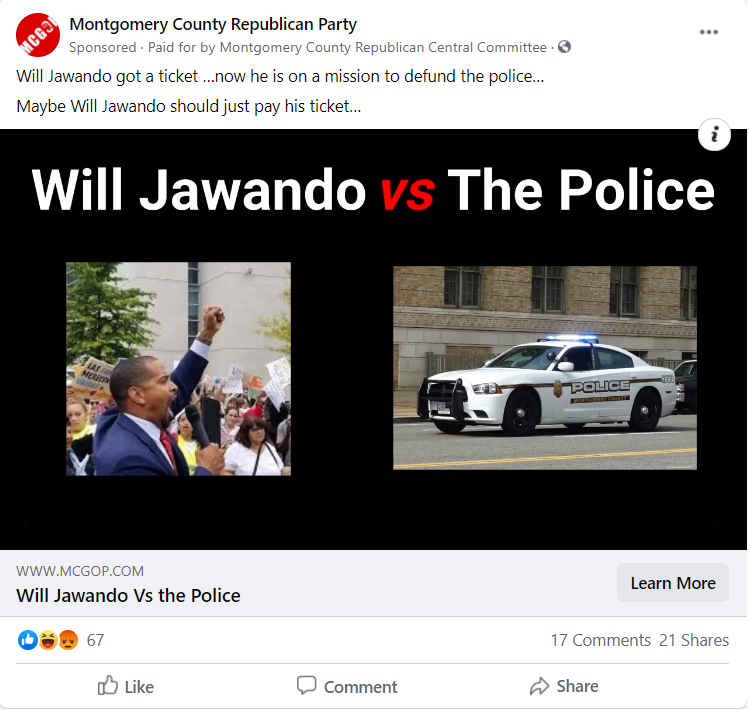
The Montgomery County Republican Party is now running this video attacking Council Member Will Jawando over his efforts to reform the police department.

The GOP is even running a Facebook ad to promote the video.

Not everyone is supportive of the county’s efforts to reform, reimagine and/or defund the police. Our post on the subject, “Free-For-All,” is on track to be the most-viewed post on Seventh State for this month. But getting attacked by Republicans is great for Jawando in building his prestige inside the county’s progressive Democratic base. Jawando should consider offering a subsidy to help the GOP run the ad in Takoma Park and the rest of the Democratic Crescent!

Share

Turnout by County: 2020 Primary, Part One

By Adam Pagnucco.

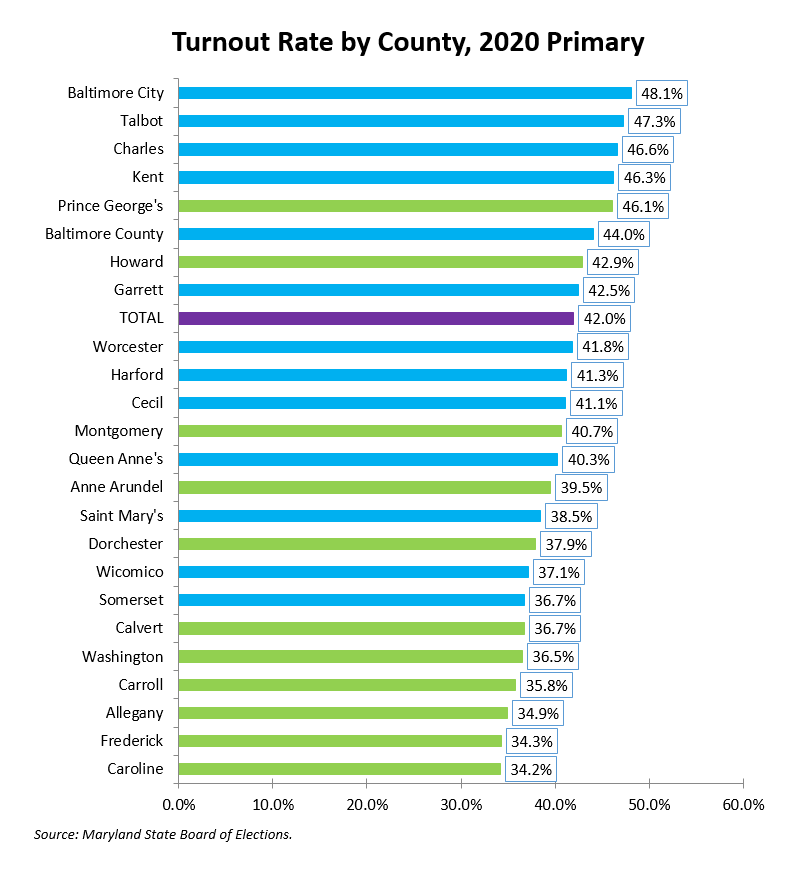
The 2020 primary is behind us and the ballots will go out soon for the general election. With few local races going on in the state but a historic presidential election coming, how did Maryland counties do on turnout?

First, let’s look at the final turnout percentage by county in the 2020 presidential primary. Jurisdictions in green had races on the ballot for which unaffiliated people could vote while jurisdictions in blue did not.

It’s not a coincidence that the bottom six counties had non-partisan races on the ballot for which unaffiliated voters could vote. Unaffiliated voters turn out at lower rates than party members, so when they are included in a voting population, the overall turnout rate is skewed downward. Baltimore City’s status as number one is due to the fact that it elects its mayor, comptroller and city council members in presidential years, an unusual practice for local jurisdictions in Maryland.

In Part Two, we will look at turnout by party.

Share

Why Progressives Should Support the Friedson Amendment

By Adam Pagnucco.

MoCo voters will see two charter amendments on property taxes on their ballots this fall. One of them was submitted by long-time anti-tax activist Robin Ficker, who delivered his petition signatures in February. The other was authored by Council Member Andrew Friedson and placed on the ballot by the county council. The Washington Post editorial board dislikes both, but for progressives, the choice is clear: the Friedson amendment is superior in providing adequate funding for government.

The first reason why progressives should support the Friedson amendment over the Ficker amendment is due to the nature of how they allow revenue increases. The Ficker amendment uses the methodology of the current charter limit on property taxes, which dates back to 1990. Currently, MoCo’s charter allows the volume of real property tax collections to rise at the rate of inflation with a few relatively minor exceptions. Friedson’s charter amendment would cap the weighted average tax rate on real property and allow collections to rise with assessments. So to compare their revenue generation over time, we need to compare the growth in price inflation (which is relied upon by the Ficker amendment) to the growth in assessments (which is relied upon by the Friedson amendment).

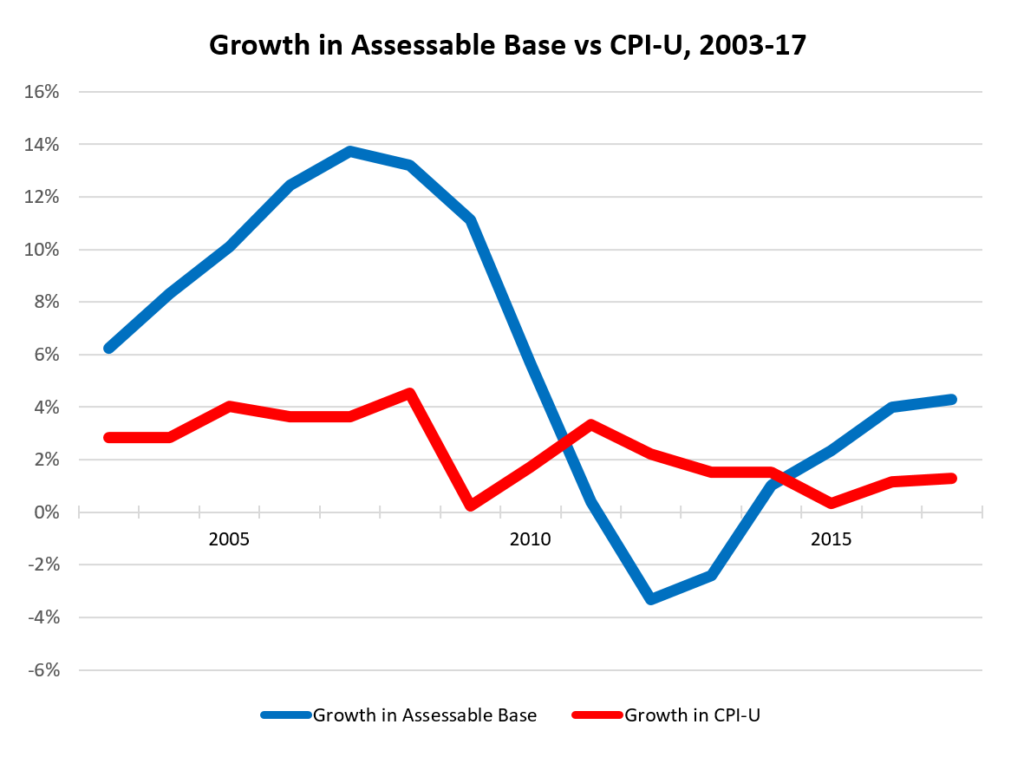
The chart below compares the growth in the county’s assessed value of real property to the growth in the Washington-Baltimore Consumer Price Index (CPI) from 2003 through 2017.

This period contained three distinct economic phases. The 2003-2010 period saw robust economic growth throughout the Washington region, causing assessment growth (115%) to far outpace price inflation (26%). Then came the Great Recession years of 2010 to 2013, during which assessments fell (5% over three years) while prices rose modestly (7%). In the slow recovery through 2017, assessments went up by 12% while prices rose by 4%. For the entire period, assessments increased by 129% while price inflation was 41%, suggesting that Friedson’s approach would have yielded MUCH more property tax revenue growth than Ficker’s. (The exact difference would have depended on other factors such as the application of tax credits, especially the homestead tax credit.)

That said, in four of these sixteen years – the period of the Great Recession – Ficker’s approach would have raised more than Friedson’s because real estate values tend to decline during prolonged economic downturns. That leads us to the second major difference between the Friedson and Ficker amendments. Friedson’s amendment allows a unanimous council vote to break the charter limit on property taxes, which continues current practice. Ficker’s amendment eliminates the ability of the council to break the limit, thereby instituting a hard cap on property tax collections. (There is an important exception to this in state law which will be the subject of a future post.) If property tax collections collapse during a recession, Friedson would allow the council to intervene in case of an emergency while Ficker would not. That’s another big reason why progressives should support the Friedson amendment.

Some progressives were disappointed because they wanted the council to adopt County Executive Marc Elrich’s proposed charter amendment, which would have made property tax hikes easier. Good luck getting MoCo voters whose wallets are getting slammed by COVID-19 to support anything opening the door to tax hikes. The Friedson and Ficker amendments both limit property tax increases, but since the Friedson amendment raises more money over time, it deserves the support of the left.

Update: An earlier version of this post was based on changes in the national CPI. This version is based on the Washington-Baltimore CPI. The two measures change at similar rates so the conclusions here are unaffected.

Share

Pierre Responds to Bush

By Adam Pagnucco.

Circuit court judge candidate Marylin Pierre, who is backed by a number of progressive groups, has responded to an article by former county GOP chairman Alexander A. Bush describing her efforts to court Republicans. Pierre’s response appears below.

*****

Thank you, Mr. Pagnucco, for the opportunity to comment on this article. I am proud to be a candidate for judge in the Montgomery County Circuit Court in the 2020 Presidential election. As you know, the election for Judge of the Circuit Court is non-partisan, and I have and will, continue to seek the support of all voters — Democrats, Republicans, third-party voters, and independents.

My conversations with the MCGOP members were about me appearing on the Republican primary ballot. I was reaching out to voters in both parties because I am running for a position where I would appear on both the Republican and the Democratic ballot in the primary. I paid to attend some events that were sponsored by the Republican party. I also paid to attend some events that were sponsored by the Democratic party.

As a United States Army veteran with more than 28 years of legal experience practicing civil and criminal law in Montgomery County, past President of the J. Franklyn Bourne Bar Association, and former Chair of the Montgomery County Criminal Justice Coordinating Commission, I have been recognized for my work by the Montgomery County Bar Association, the Montgomery County Bar Foundation, the Daily Record, and the Montgomery County Democratic Central Committee. Let me be clear, I am committed to excellence, dignity, and justice for members of all parties who would come before me as a judge.

Marylin

Share

Post Editorial: Vote Against All Charter Amendments

By Adam Pagnucco.

The Washington Post’s editorial board has weighed in on MoCo’s competing charter amendments and recommends voting against all of them. The Post wrote that both citizens’ initiatives – Robin Ficker’s amendment on taxes and the nine council district proposal – were bad ideas. But the Post also said, “Yet neither of the council’s competing proposals is preferable to the status quo.” The Post’s verdict is to vote against all of the amendments and stick with the county’s current property tax system and council structure.

You can read the Post’s editorial here.

Share

Progressive-Backed Judge Candidate Courted, Donated to Republicans

By Adam Pagnucco.

Marylin Pierre, whose insurgent campaign for circuit court judge is backed by some progressive groups, has courted the county Republican Party for support. At least that’s what the former chairman of the MoCo GOP is claiming. And he has a picture and campaign finance records to prove it.

Maryland judicial elections are strange birds. In most elections, candidates run in partisan primaries to get their party nominations. The party nominees then face off against each other along with any write-in or unaffiliated petition candidates in a general election. In elections for circuit court or orphan’s court judges, candidates may run in any party primaries, including more than one party at a time, and whoever wins those primaries appears on the ballot in a non-partisan general election. For the most part, judicial candidates are those who emerge from a rigorous vetting process by judicial nominating commissions and receive temporary appointments to the bench pending election. However, other candidates who are age 30 or older, have been a state resident for 5 years and are a member of the Maryland bar may also run for judge.

Pierre has tried but failed to make it through the state’s vetting process before. Nevertheless, she has run for circuit court judge as is her right under state law. This year, four seats are on the ballot, each occupied by a vetted appointee (a sitting judge) seeking election. In the Republican primary, all four slots were won by the four sitting judges. In the Democratic primary, Pierre won one of the slots with three of the four sitting judges taking the others. Pierre is now facing the four sitting judges in a contentious general election. The top four vote-getters will win.

This is not the first time Pierre has run for judge. She ran in both the Democratic and Republican primaries in 2018 too, losing both and failing to advance to the general election. In evaluating Pierre’s current campaign, former MoCo GOP chairman and current central committee member Alexander A. Bush wrote an article on the party’s website recalling Pierre’s 2018 campaign. Bush wrote:

For a judicial candidate to get their name on the November General Election ballot, they must win in either the Republican or Democratic Primary election. Historically, insurgent candidates have focused on trying to win in the Republican Primary, because our primary has only about 15% as many voters as the Democratic Primary. It’s simple math: the campaigning necessary to win among 12,000 Republicans is a lot easier than the campaigning necessary to convince 75,000 Democrats.

And in 2018, that is exactly what Marylin Pierre attempted to do.

In January that year, Mrs. Pierre and her treasurer came to our candidate training event and assured those running the event that she would be a strongly conservative judge and asked for the party’s support in the 2018 Primary. Mrs. Pierre came to one of our fundraising dinners in early February to ask for our votes again, as campaign finance records will show. And later that month she came to our yearly convention, and proudly posed for a photo with the current county chairwoman for the Trump for President Campaign.

Bush ran this photo as proof.

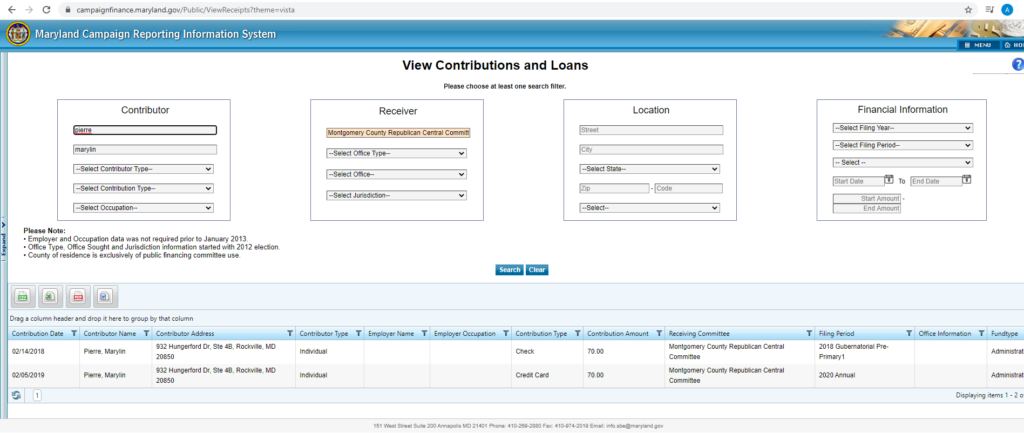
State Board of Elections records also support Bush’s account, showing Pierre making two $70 contributions to the county Republican Party. One of those contributions (on 2/14/18) was made during the 2018 cycle. The other (on 2/5/19) was made after the 2018 election and occurred during this cycle.

Bush’s reaction to all this is scathing. He wrote:

Mrs. Pierre lost in both parties’ primaries in 2018. In fact, she did worse in the Republican Primary. Obviously, she has decided to change her strategy, and has remade herself into whatever she thinks will help her win.

If this doesn’t convince you, regardless of your political views, not to vote for Marylin Pierre, then nothing will.

After writing his article, Bush later told me directly, “At the candidate training, she asked for MCGOP’s support, claiming she would be a ‘law and order’ judge who would be tough on bail.”

This time around, Pierre is running as anything but a Republican. She has participated in Progressive Maryland’s candidate training program and has been endorsed by Progressive Neighbors, Our Revolution and Town of Somerset Mayor Jeffrey Slavin, one of the most progressive elected officials on Planet Earth. What would they have thought if they knew that she had been courting and donating to Republicans?

There is more. In a video on Facebook, Pierre criticized her opponents because a Trump supporter sat on one of their nominating commissions. Showing the person at a pro-Trump rally, Pierre said, “This woman was on the commission that recommended almost half of the Montgomery County judges to the governor. Does she share your values? Will the judges she recommended take Montgomery County in the direction you want to go?”

And so Pierre goes after her opponents because a Trump supporter sat on one of their nominating commissions after she herself gave money to the county GOP – twice.

I have asked Pierre for comment on Bush’s story and I will print it when I receive it.

Share

Anti-Ficker, 9 Districts Charter Amendments Group to Speak on Monday

By Adam Pagnucco.

A new group formed by former County Executive Ike Leggett, former Congresswoman Connie Morella, businessman and former county executive candidate David Blair and business owner Carmen Ortiz Larsen is holding a press event on Monday to discuss their plans to oppose charter amendments by Robin Ficker and Nine Districts for MoCo. Maryland Matters discussed the group in broad terms today but did not name its leaders. The group’s news advisory (listing Leggett’s former public information officer Patrick Lacefield as contact) appears below.

*****

COUNTY LEADERS LEGGETT, MORELLA, BLAIR, LARSEN TO ANNOUNCE LAUNCH OF “NO ON QUESTIONS B & D COMMITTEE”

Former County Executive Isiah Leggett, former Congresswoman Connie Morella, non-profit leader David Blair, and Latina tech business owner Carmen Ortiz Larsen will speak out against November Montgomery County ballot questions B and D and urge a “NO” vote on both. Question B would put an inflexible cap on County property taxes, on top of already existing limitations on increases, severely hampering the County from responding to crises such as COVID-19 and sustaining critical services such as education and public safety. Question D would eliminate the County’s four at-large Council seats and replace it with nine individual districts. The impact would reduce the number of Councilmembers each voter can vote for from five to one.

WHEN: Monday, September 14 at 10:15 AM
WHERE: Outside of the Dennis Avenue Health Center, 2000 Dennis Avenue in Silver Spring
CONTACT: Patrick Lacefield

Share

Complaints to Inspector General Up 92% in FY20

By Adam Pagnucco.

MoCo Inspector General (IG) Megan Davey Limarzi has released her office’s annual report for Fiscal Year 2020 and it’s a doozy. The prior year was a very busy one for her and her staff!

The headline from her report is an obvious one – the phenomenal rise in complaints in FY20, the first full year of the new administration. The IG wrote, “We received 165 complaints in FY2020. This represents a 92% increase from FY2019.” The IG noted that her office’s authority was extended to the Housing Opportunities Commission and Montgomery College in October 2019 but she does not credit that for the rise in complaints. Instead, she said, “We attribute the increase in complaints to expanded outreach efforts and the perceived effectiveness of our reviews and investigations.”

This chart in the IG’s report shows skyrocketing complaints in the most recent fiscal year.

The report summarizes numerous IG reports, including some that have already attracted press coverage: the overtime “scam” in the fire department, the report on former Chief Administrative Officer Andrew Kleine’s ethics violations and the report about MCPS’s bus camera contract.

Two additional reports stand out. The first concerns the county’s Office of Human Resources (OHR). The IG wrote:

We initiated a review based on numerous complaints alleging improper practices within the Office of Human Resources (OHR), including internal hiring processes, assignment of employee salaries and use of contractors.

We found that OHR did not follow normal competitive procurement processes when they awarded four contracts to one individual in an apparent attempt at splitting purchases to avoid contracting thresholds. In total, OHR made $184,900 in payments to the individual or a company they controlled. To facilitate some of the payments, OHR inappropriately used the “exempt” commodity code associated with collective bargaining, falsely indicating that County procurement requirements did not apply.

The second concerns the Department of Health and Human Services. The IG wrote:

The OIG conducted an investigation based on a complaint alleging a Montgomery County Department of Health and Human Services (DHHS) manager misused Recovery Oriented Systems of Care (ROSC) grant funds resulting in a referral to the State’s Attorney’s Office. Through our investigation, we found evidence that the County DHHS manager engaged in a clear pattern of mismanagement and violations of County procurement regulations regarding the management of ROSC funds.

Was anyone disciplined for these violations?

The IG’s office, part of the legacy of former Council Member and former County Executive Ike Leggett, is one of the most valuable offices in MoCo government. With ten thousand people working for the county, there is bound to be some mischief going on and taxpayers deserve to know about it. That said, since the office has been around for more than 20 years and is therefore known to many county employees, it’s an open question as to whether expanded outreach alone is responsible for the astounding eruption in complaints last year. The county council should ask the executive branch why complaints to the IG have exploded under its watch.

Share

Maryland Politics Watch