MoCo’s Hero

By Adam Pagnucco.

We are living in historic times. After the sack of the U.S. Capitol, America approaches a day of reckoning with the only president to incite an insurrection against our democracy. At the center of this moment is Congressman Jamie Raskin, who has been named the lead impeachment manager in the trial of Donald Trump. It’s a huge moment. It’s Jamie’s moment, yes, but it’s also ours. All of the nation will be watching.

I have met a lot of politicians, many of them good ones, but there was always something special about Jamie. He first ran for office in 2006 against incumbent District 20 Senator Ida Ruben, who had been in office for more than 30 years and had gradually lost touch with many of her constituents. Jamie didn’t so much run a campaign as he established a grass-roots movement for progressive values and attentive representation. Ruben didn’t stand a chance.

MoCo is full of smart people. Most of them want you to know they’re smart sooooo badly. Jamie is as smart as anyone but he has no need to show off. He is charming, witty, quirky and sometimes even a little goofy. He is so full of eagerness when discussing something he cares about, like constitutional law. Who can make constitutional law interesting and cool? Jamie can because he gets so excited about it and he knows so much about it. He never talks down to you. He draws you in. He had that effect on people even outside his district, which is a big reason why he ascended to Congress.

Lots of people have a Jamie story. Here’s mine. About ten years ago, I had a potential legal problem that was keeping me up at night. It had a First Amendment dimension to it, and knowing Jamie is a national expert on that subject, I called him on the spur of the moment. I’m a District 18 resident so Jamie was not my State Senator. I didn’t know him well back then. Nevertheless, he invited me to his home at 10 at night, listened to me, educated me and supported me. Maybe it was no big deal for him but it was a huge deal for me. My problem turned out to be a non-issue but I never forgot how he helped me. I’m not the only one. I have heard countless stories of Jamie’s generosity and kindness over the years.

And now we come to the hard part. Perhaps the cruelest fate a human being can suffer is to lose a child. For parents, children are not just our favorite people – they are our contribution to the world. When they do well, we feel a sense of accomplishment because we feel that we are leaving something positive behind when we go. I have a son. If he were to pass away in my lifetime, I’m not sure I could find purpose and meaning in continuing to live. When that horrible tragedy happened to Jamie, what did he do? He went back to work. And for him, that meant leading a crusade to rid us of the most destructive political scourge in the last 160 years of U.S. history, the Emperor of Lies, Donald Trump. How much strength and sense of duty does that take? I am far from the only one who marveled at Jamie’s ability to rise from the depths of devastation to the heights of greatness.
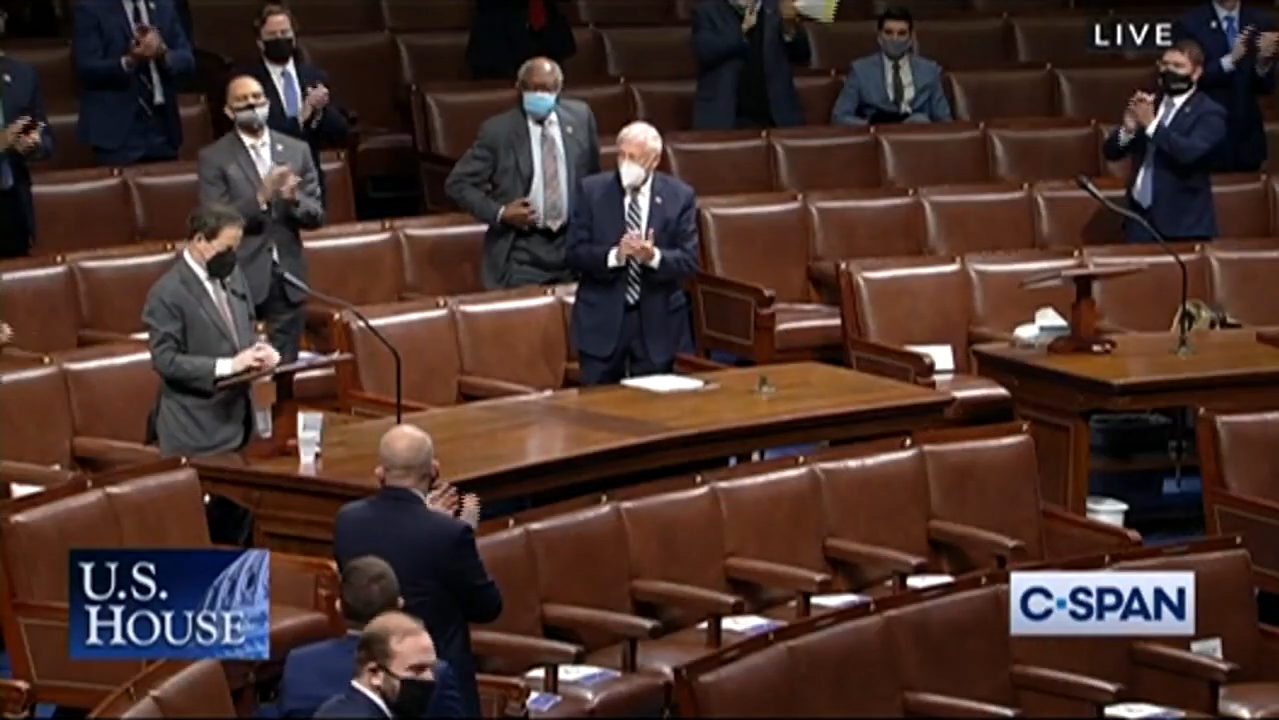
Members of Congress from both parties applaud Jamie after he thanks them for their support during his family tragedy.

In a war against evil – and make no mistake, evil is what rampaged through the U.S. Capitol weeks ago – people of good will need heroes. For folks around the country, Jamie has joined a pantheon of great leaders seeking to restore America’s highest aspirations. But here in MoCo, Jamie is more than that. He is one of us, a favored son in our civic and political family. He’s ours. He is MoCo’s hero. And whatever happens in years to come, we are never going to forget this moment.

Thanks, Jamie.

Share

Mizeur is Getting Fired Up to Take On Harris

By Adam Pagnucco.

Former Delegate Heather Mizeur, who lives on the Eastern Shore, issued the following statement on Facebook this morning about Congressman Andy Harris.

*****

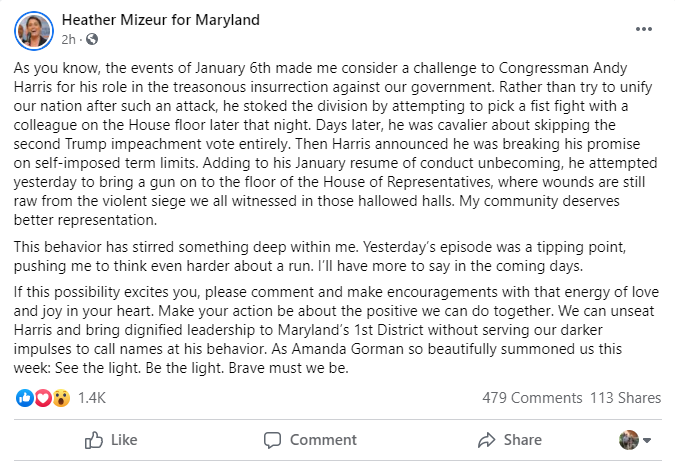
As you know, the events of January 6th made me consider a challenge to Congressman Andy Harris for his role in the treasonous insurrection against our government. Rather than try to unify our nation after such an attack, he stoked the division by attempting to pick a fist fight with a colleague on the House floor later that night. Days later, he was cavalier about skipping the second Trump impeachment vote entirely. Then Harris announced he was breaking his promise on self-imposed term limits. Adding to his January resume of conduct unbecoming, he attempted yesterday to bring a gun on to the floor of the House of Representatives, where wounds are still raw from the violent siege we all witnessed in those hallowed halls. My community deserves better representation.

This behavior has stirred something deep within me. Yesterday’s episode was a tipping point, pushing me to think even harder about a run. I’ll have more to say in the coming days.

If this possibility excites you, please comment and make encouragements with that energy of love and joy in your heart. Make your action be about the positive we can do together. We can unseat Harris and bring dignified leadership to Maryland’s 1st District without serving our darker impulses to call names at his behavior. As Amanda Gorman so beautifully summoned us this week: See the light. Be the light. Brave must we be.

Share

Untangling vaccine confusion

As we roll out the big effort to vaccinate everyone, there has been some confusion. Here’s some information that will hopefully help you sort out what’s going on and why.

State Announcement Jumped the Gun

Governor Larry Hogan announced that people 75 and older in Priority Group 1B would be eligible to receive the vaccine beginning this past Monday. Hogan notified the counties around two hours before the announcement.

The problem, however, is that many counties have not finished vaccinating the people in Priority Group 1A, which includes healthcare providers who could easily become vectors of spreading the virus. As Adam detailed yesterday, Montgomery has received comparatively little vaccine but been vaccinating at a high rate.

Each group is also divided into three tiers. In 1B, Tier 1 includes people 75 and over. Some thought that everyone in Tier 1B would become eligible at once but the county is starting with Tier 1. If you are a Montgomery resident in this tier, you can now preregister for an appointment.

The Governor’s announcement has preceded availability here in Montgomery. This naturally created confusion and unhappiness among some that residents over 75 who thought that they could get the vaccine or even cannot be legally barred from receiving it.

Appointment Software SNAFU

The State has mandated that all county governments use the same appointment software, which was originally designed for the flu vaccine. Flu vaccine is usually plentiful, but we unfortunately have to ration COVID-19 vaccine and have eligibility requirements.

Designed for a situation with plenty of vaccine and the desire to vaccinate as fast as possible, the state-mandated software spits out offers for appointments as soon as they are available and doesn’t take into account eligibility.

This has resulted in people in 1B who thought they were eligible making appointments and then getting turned away because they weren’t. Even though Montgomery is still trying to finish vaccinating 1A, the county began on Thursday to allow anyone who is 75 and over (i.e. Tier 1 of 1B) and showed up for an appointment to get the vaccine.

Councilmember Email Blasts Exacerbated Confusion

Email blasts from some county councilmembers compounded the problem created by the Governor’s announcement by indicating that the county was moving to 1B now and urging people to sign up in all tiers.

Hospitals v. County Vaccination Centers

For whatever reason, 40-50% of people working in hospitals have decided not to get the vaccine. As a result, hospitals have extra. Rather than let it go to waste, they have sensibly been vaccinating people 75 and over, so hospitals have operated differently from county centers.

Ready for More Vaccine

I have heard that vaccination centers have far more people ready to do the vaccinations than people to receive it. While this may seem bizarre, it’s good news because it means that Montgomery may be better prepared for mass vaccinations as more vaccine becomes available.

Share

Are Maryland Vaccine Deliveries Fair?

By Adam Pagnucco.

COVID vaccine distribution is a hot issue in Maryland. COVID case rates have spiked since October and death rates are at their highest levels since the spring. Elected officials’ inboxes are filling up with inquiries from residents and the press is paying attention. Lots of folks are looking to their local governments but the vaccines are delivered by the state. How is the state doing?

Vaccine distribution in the U.S. is a multi-tier process. Pfizer and Moderna manufacture the vaccines. The federal government determines their allocations to states. (You can see open data on distribution of both the Pfizer and Moderna vaccines by state.) State governments then distribute the vaccines they receive to their local jurisdictions.

Maryland has established a three-phase hierarchy for determining the order in which groups receive vaccines. The state has progressed through Phase 1A (health care workers, residents and staff of nursing homes and first responders, public safety, and corrections staff) and is now in Phase 1B (assisted living, independent living, behavioral health and developmentally disabled group homes, and other congregate facilities; adults age 75 and older; and education and continuity of government). Further phases will expand to larger populations.

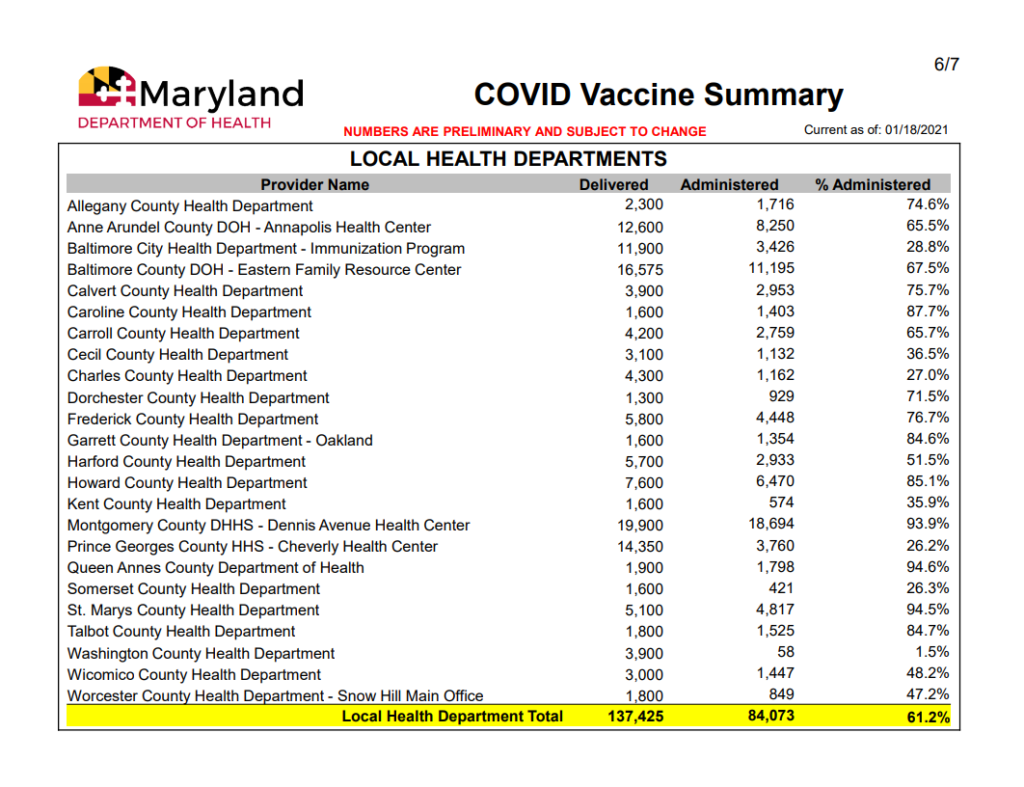
The state is currently distributing vaccines primarily to three different kinds of entities. Hospitals, who are expected to vaccinate their own staff members and associates, received 320,200 vaccines as of 1/18/21. Pharmacies, including CVS and Walgreens, are responsible for vaccinating nursing homes and received 73,125 vaccines as of 1/18/21. Local health departments are responsible for vaccinating other people in Phases 1A and 1B, especially health workers and first responders, and received 137,425 vaccines as of 1/18/21. Other agencies, including the National Institutes of Health, the D.C. Department of Health and a few state agencies, received another 20,950 vaccines.

And so the counties, hospitals and pharmacies don’t control how many vaccines they get. They do control the rates at which they administer vaccines to residents. As of 1/18/21, vaccine administration percentages were 61% for local health departments, 40% for hospitals, 39% for pharmacies and 69% for other agencies.

The table below shows administration rates by county health department. Queen Anne’s, St. Mary’s and Montgomery counties have all administered more than 90% of the vaccines they received from the state as of 1/18/21, the best in Maryland. Baltimore City and Charles, Prince George’s, Somerset and Washington counties have administered less than 30% of the vaccines they received as of 1/18/21.

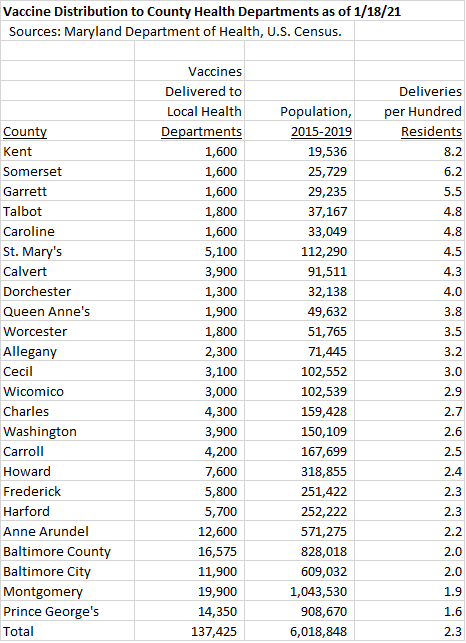
Administration rate is one factor in vaccinating a population. The other factor is deliveries relative to population. It’s hard to know the location of residents being vaccinated by hospitals and pharmacies. However, local health departments are presumably vaccinating residents who live (or at least work) mostly within their jurisdictional boundaries. The table below compares vaccination deliveries to local health departments with U.S. Census estimates of their populations in 2015-2019.

There are large discrepancies in the state’s delivery of vaccines to local health departments on a per capita basis. Relative to their populations, Kent, Somerset, Garrett, Talbot and Caroline counties – each having less than 40,000 residents – received the most vaccines, varying from 4.5 to 8.2 per hundred residents. Montgomery County (1.9 vaccines per hundred residents) and Prince George’s County (1.6 vaccines per hundred residents) are at the bottom. Baltimore County and Baltimore City are also below the state average delivery rate per capita.

A county with an excellent vaccine administration percentage but a low delivery rate from the state could wind up with a low vaccination percentage of its population. In fact, that’s what the table below shows for Montgomery County. Despite having one of the best administration percentages in the state, MoCo is below average on the percentage of its population receiving a first and second shot because of its low per capita delivery rate.

It’s still an early moment in the state’s vaccination program. There is time to improve. But there is also a role for elected officials who represent counties with low vaccine delivery rates and their constituents to press the state to do better.

Share

Collective Sloppiness

By Adam Pagnucco.

Yesterday, the county council’s Office of Legislative Oversight (OLO) released a stunning report on collective bargaining between the county and Fraternal Order of Police (FOP) Lodge 35. The report shows incredible sloppiness by the county in administering labor relations with the police that likely goes back far before the current county executive was in office.

The FOP is one of three unions representing employees of the Montgomery County Government. The other two are the International Association of Fire Fighters Local 1664 and MCGEO. Since 1982, the county has negotiated collective bargaining agreements (CBAs) with the FOP, including many provisions on wages, benefits and working conditions. The OLO report examines bargaining between the county and FOP but does not include the other two unions.

OLO makes many findings of concern, including on issues of transparency. Two major findings leap out of the report.

The county and the FOP did not agree on what their agreement actually was.

OLO wrote:

First, the Executive Branch and the FOP use different versions of the primary agreement and do not agree on a singular document as the primary CBA. Second, the parties also do not agree on which side letters and MOAs [memorandums of agreement] are part of the current agreement and which are not. OLO was told by representatives both in the Executive Branch and from the FOP that the County Government and the FOP have not had a signed collective bargaining agreement for over a decade. OLO has also been told by the Executive Branch that an agreement is in place and the Office of Labor Relations and the FOP are working towards a unified, written document. OLO notes that despite the state of the documents, the parties report that they work together to implement the collective bargaining agreement on a day-to-day basis and use an agreed-upon arbitration process to resolve disagreements, when necessary.

OLO’s primary finding is that it is impossible for a third-party reader to identify the terms and provisions of the collective bargaining agreement between the County and FOP Lodge 35 because the parties do not agree on the primary document. In addition, while the County and the FOP agree that certain side letters and MOAs are in effect, they do not agree on the current status/effect of all side letters and MOAs. This disagreement adds to the inability of a third-party to know or understand all the provisions that make up the collective bargaining agreement.

In other words, MoCo voters have no idea what they’re paying for and, as of the writing of the report, have no way to find out.

An aside. When I was working in the labor movement, I worked with an old, wily jurisdictional director from Brooklyn named Stan. Stan was responsible for negotiating international union agreements with our contractors. Stan had seen every trick in the book over his decades of negotiating. One trick was when company attorneys made changes to agreements that were not negotiated and tried to sneak them in. For example, if the union and the company agreed to changing Articles 12, 15 and 28, the company attorney might insert those changes but also make a change to Article 30. If that change went unnoticed and the union president signed it, that became part of the new agreement.

To stop that kind of thing, Stan would summon me into his office and give me a copy of his version of the agreement. Then he would read aloud from the company’s version – every single word in that New Yawk accent of his – including the sections that had not been renegotiated. If we found one punctuation mark that was out of place, BAM! Stan would be on the phone with the company lawyer, demanding to know how that happened. That’s how much we cared about making sure the agreement was exactly what we agreed to, every single word.

And that’s why I am surprised by the county’s sloppiness here. From my own experience in the labor movement, when the parties don’t agree on what their agreement is, that “agreement” can be hard to administer.

The agreement that expired on June 30, 2020 provided benefit levels that exceeded maximum amounts set in county law.

OLO identified the following examples of benefits in the agreement that exceeded what is allowable under county law.

Agreement: Most current employees contribute 4.75% of salary for retirement.

County law: Employee contributions are set at 6.75% of salary for service after June 30, 2012.

Agreement: The pension cost of living adjustment is tied to the consumer price index with a cap of 7.5%.

County law: The pension cost of living adjustment is tied to the consumer price index with a cap of 2.5%.

Agreement: The minimum pension for a service-connected disability is set at 66.6% of final earnings.

County law: The minimum pension for a service-connected disability is set at 52.5% of final earnings.

Agreement: The health insurance premium split is set at 80% County / 20% employee.

County law: The health insurance premium split is set at 75% County / 25% employee.

The county council made several changes to benefit levels through legislation passed during the Great Recession. The legislation preempts any contents of collective bargaining agreements. It may be that subsequent agreements were not updated to reflect these changes because of the kind of sloppiness seen above. The OLO report authors told me, “FOP members received benefits as stipulated in law and Council resolutions (not what is written in the contracts).”

In responding to the report, Chief Administrative Officer Rich Madaleno wrote, “…The draft report notes that the County and the Fraternal Order of Police (FOP) have been unable to agree upon a unified collective bargaining agreement. This is no longer accurate. OLR [Office of Labor Relations] and the FOP have been engaged in a year-long project to reconcile those differences and have agreed to a single version of the collective bargaining agreement. Attached for your information is the unsigned agreement. The signed version will be forwarded to you next week.”

Unfortunately, the new agreement received by OLO contains the same benefit levels that exceed the maximums contained in county law. That issue has not been cleaned up. Neither have a host of issues I identified last June, the most disturbing of which requires the county to fight certain Maryland Public Information Act (MPIA) requests in court. OLO identified the latter issue as well, writing that that provision appears to conflict with state law.

OLO recommends that all collective bargaining documents, including supplementary ones, be posted on the county’s website for public view; that outdated and/or moot language be purged; that the county council be notified of changes; and that the agreements be consistent with federal, state and county law. Given the county’s past mistakes, these are hard recommendations to argue against.

Share

Two Negotiating Strategies, Two Outcomes

By Adam Pagnucco.

In justifying the county’s creation of a $4 million per pay period emergency pay liability, representatives of county government depict it as a good deal for taxpayers. They say that the county’s collective bargaining agreements set much higher levels of emergency pay than the amount the county is now paying, so $4 million a pay period is actually a bargain. Setting aside whether the county’s existing emergency pay provisions actually apply to a pandemic – there is some doubt about that – the county’s claim is called into question by the emergency compensation program of one of its sister agencies, the Maryland-National Capital Park and Planning Commission, commonly referred to as Park and Planning.

MCGEO is the largest county employee union of both Montgomery County Government and Park and Planning. It is led by the fearsome Gino Renne, who has a long and famous history of playing hardball with politicians. The union’s prior collective bargaining agreements with both the county and Park and Planning had preexisting emergency pay provisions which the county cited in providing COVID pay. Unlike MCGEO’s preexisting agreement with the county, its preexisting agreement with Park and Planning has an emergency pay provision explicitly referring to “epidemics.” Despite that fact, negotiations between MCGEO and the two agencies yielded outcomes that were worlds apart.

MCGEO’s agreement with the county

Signed on April 3, the agreement gives employees in “front facing onsite work” an extra $10 per hour and employees in “back office onsite work” an extra $3 per hour. Teleworking employees do not receive extra pay. The differential counts for the purpose of calculating overtime pay.

The agreement is indefinite. Here is its language on duration:

This Agreement may re-open on June 20, 2020. However, if the declared Maryland State of Emergency related to COVID-19 extends beyond that time, the terms of this Agreement shall continue, or after collectively bargaining with MCGEO, will be modified based upon the circumstances at the time. In the event that the declared Maryland State of Emergency related to COVID-19 is rescinded before June 20, 2020, the date of the Declaration’s rescission shall be considered the last day of this Agreement, notwithstanding the pay periods indicated above defining when the COVID-19 Differential will be paid.

The county could renegotiate the agreement if MCGEO agrees to do it. Otherwise, the agreement lasts as long as the state’s declared emergency does. As of this writing, the emergency continues and so does the agreement. County council staff has previously noted that it provides by far the most generous COVID pay of any jurisdiction in the region.

MCGEO’s agreements with Park and Planning

MCGEO has had two memorandums of understanding and six agreements on the COVID emergency with Park and Planning through late January. Their effective dates are:

MOU signed 3/15/20
Agreement 1: 5/4/20 – 6/30/20
MOU signed 7/2/20
Agreement 2: 7/10/20 – 8/8/30
Agreement 3: 8/5/20 – 8/29/20
Agreement 4: 9/8/20 – 10/3/20
Agreement 5: 10/5/20 – 11/28/20
Agreement 6: 11/25/20 – 1/30/21

Of the agreements, only the first (lasting through June 30) contained extra pay. That agreement gave an extra $2.75 per hour for “onsite work” and an extra $4.50 per hour for child care aides performing “front facing onsite work.” Unlike the county’s agreement, emergency pay was not included in the calculation of overtime pay. The later agreements provided varying levels of leave and paid time off and have other language on health and safety, teleworking and scheduling but they do not provide emergency pay. Let’s note that time away from work does more to protect employee health than requiring them to report on-site with a pay differential.

No one will ever accuse MCGEO President Gino Renne of being an ineffective negotiator. He has delivered outstanding value to his members for many years. The difference here is in the negotiating strategies taken by the two agencies. Park and Planning utilized a series of short, time-limited agreements to adjust its compensation to changing circumstances. The county signed one open-ended agreement that locked in extra pay negotiated during the height of COVID’s first wave. Gino signed the agreements with both agencies despite their vast differences.

That’s not all. The county’s agreements with the police and fire fighters both provide indefinite emergency pay of $10 per hour for onsite work, with the extra pay counting for calculations of overtime. Of Park and Planning’s five agreements with its police union through late November, only one – lasting through June 30 – provided emergency pay and that was for $4.50 an hour. Once again, Park and Planning got a different result with a different negotiating strategy.

The results of these differing agreements are two-fold. First, there is a huge gap in the costs faced by the agencies. The county has about 9 times the employees of Park and Planning. The county has paid $4 million per pay period since April, which translates to $78 million as of last week. Park and Planning paid a total of $400,917.

Second, there is a tremendous inequity between county employees (many of whom are receiving an extra $3 or $10 per hour) and Park and Planning employees (who are getting paid time off and leave but not extra pay since June 30). That inequity extends to employees of MCPS and Montgomery College, who are not getting anything resembling the county’s pay. Expect these employees to ask – with justification – why they aren’t getting the same extra money as county workers.

The question of how to pay for the county’s huge new liability – one that was avoided by Park and Planning – will be a big factor in writing the next operating budget. We shall find out the consequences of all this when it arrives on March 15.

Share

Did Andy Harris Commit Voter Fraud?

Republican Rep. Andy Harris endorsed serious allegations regarding fraud in the presidential election. But by his own standards, his own election was far more fraud prone than the presidential contest in either Georgia or Pennsylvania.

Applying the Harris standard, it is clear that there are grave questions surrounding his election.

  • Mail ballots applications were mailed out statewide in Maryland but neither in Georgia nor Pennsylvania.
  • There were signature checks on all mail ballots in Georgia and Pennsylvania but none in Maryland, where the law prohibits this ballot-security measure.
  • The election in the First District was overseen by partisan Republican county governments. Though there is no evidence of bias and vote rigging, Harris didn’t provide any when he cast suspicion on vote counting in Philadelphia.
  • Maryland accepted mail-in ballots after election day—and not just from the armed forces or people living abroad.
  • Maryland took a very long time to finalize its count.

Harris needs to step down until a lengthy investigation can take place and we review the process. No matter how many recounts we conduct, I know he understands that we cannot trust the results based on his stance on the Georgia electoral votes. The voters deserve answers. We can hold a special election sometime late in 2022.

Or we could just acknowledge that this is all hogwash. Rather like Harris’s specious challenges to the legitimacy of Joe Biden’s victory that attacked our democracy and stoked violence at the Capitol resulting in the death of five people, including the murder of a police officer.

Share

Mike Miller Has Passed Away

Statement from the Miller Family

At 4:25PM this afternoon, Maryland Senate President Emeritus Thomas V. Mike Miller, Jr. passed away peacefully at his home, surrounded by loved ones. He was 78 years old. 

He’s survived by his wife, Patti, son Tommy, daughters, Amanda, Michelle, Melissa, and Melanie, sisters Susan, Cynthia, Melinda, Nancy, and Kim, brothers, Jonathan, David, and Mark, and his fifteen grandchildren, and was predeceased by his sister Judith.

Share

How Does MoCo’s Vaccination Rate Compare to the Rest of Maryland?

By Adam Pagnucco.

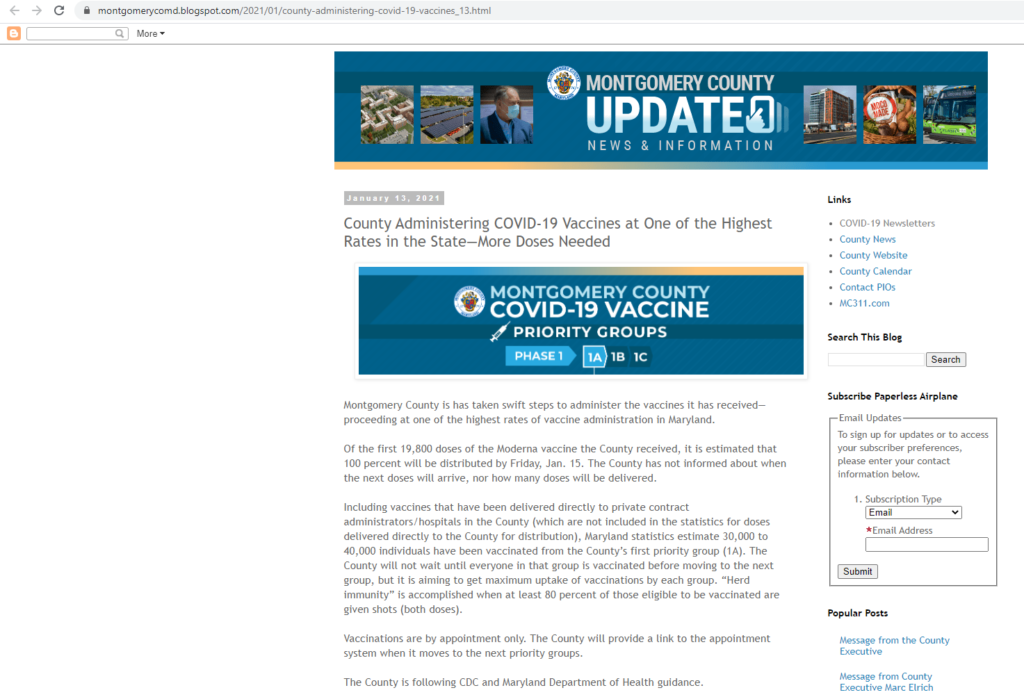
Last night, Montgomery County Government sent out a blast email claiming, “Montgomery County is has [sic] taken swift steps to administer the vaccines it has received—proceeding at one of the highest rates of vaccine administration in Maryland.” The same claim is repeated on the county’s website.

Is this true?

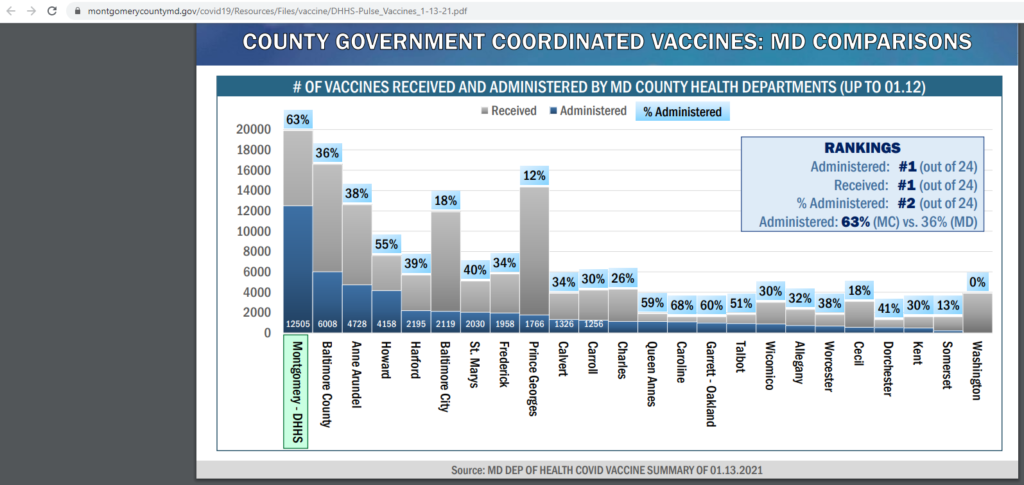
The county doesn’t elaborate on this claim in great detail but it has support from the slide below from its Department of Health and Human Services. The slide shows the percentage of received vaccines that has been administered by each county in the state. As of January 13, MoCo administered 63% of the vaccines it has received, trailing only Caroline County (68%) and far above the state average (36%).

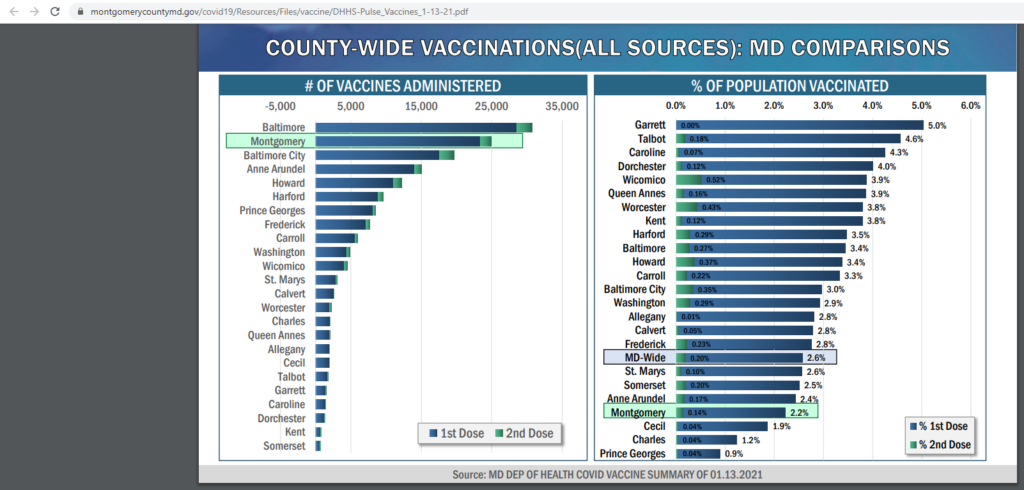
However, the county trails badly on another key measure: the percentage of population vaccinated. Another slide from the same presentation shows that just 2.2% of MoCo’s population has been vaccinated with at least one dose, a rate that trails 20 of the state’s 24 jurisdictions.

To be fair, MoCo doesn’t have full control of its population vaccination rate because the state allocates vaccines by county. At this point, Baltimore County has received more vaccines than MoCo even though its population is smaller.

County Executive Marc Elrich has posted a good explanation of the complications in distributing vaccines, especially the role played by the need to vaccinate people twice. It’s very informative for folks who would like to understand how the process works and what bottlenecks lie within.

In any event, by one measure, the county is exceeding the state’s vaccination rate and by another, it is falling short. The story is a complex one and, at this point, not reducible to emailed success stories.

Share

Superintendent Jack Smith Announces Retirement from MCPS

By Adam Pagnucco.

MCPS Superintendent Jack Smith has announced his retirement. Smith, who once worked in the State Department of Education and is a former superintendent in Calvert County, was hired by MCPS in 2016 and had his contract renewed last year. Smith’s announcement is reprinted below.

Superintendent Jack R. Smith Announces Retirement

Dear Colleagues,

I write to you with very mixed emotions today. After much consideration, I have shared with the Board of Education that I will be retiring as superintendent of schools this spring. I have tentatively set my retirement date as June 1, 2021.

As I have shared with some of you, my two-year old grandson had significant open heart surgery in May 2019 to reconstruct his malformed heart. While the surgery was successful, my wife, Gayle, relocated to Maine to help my daughter and son-in-law care for him. Her stay in Maine to support our grandson was extended with the COVID-19 pandemic.

Given his health needs, our family’s circumstances are not going to change for at least the next few years. I need to join Gayle in Maine as I find I can no longer tolerate living most of the time separately.

I have loved my time in Montgomery County Public Schools and have no desire to leave. The staff in the school system is among the most talented and dedicated in this country. The work we have done together around the equity accountability framework, the allocation of resources, student well-being, upgrades to current technology, our expansion of pre-K and language programs are among a host of system improvements that I am so happy to have been involved with.

I will greatly miss being a part of this organization. The 17 school board members I have worked with here have been committed, dedicated professionals, and they consistently have made decisions with the best interest of students in mind, as well as a very real desire to maintain the excellence of the system, while increasing the access and opportunity to provide a truly equitable experience for every child we serve.

I’ve truly been fortunate to work with these school board members, the staff, our elected officials and the community in Montgomery County.

I am confident that MCPS will continue to do great work on behalf of our 160,000 students—it always has. I am also confident that working together, we can and will implement a comprehensive recovery of education plan that will get students back in school buildings and address the significant learning loss as a result of the COVID-19 pandemic.

This is a wonderful community, a strong public school system and a great place to live. I wish only the very best for Montgomery County Public Schools going forward.

Dr. Jack R. Smith
Superintendent

Share

Maryland Politics Watch