Over the past two weeks, we’ve seen how Republicans fear and loathe America’s diverse future, while Democrats embrace it. Four years ago, the Republicans issued a report arguing that they needed to make their peace with immigrants or continue riding the waves to political oblivion. Bad news for the Republicans: the future is now.
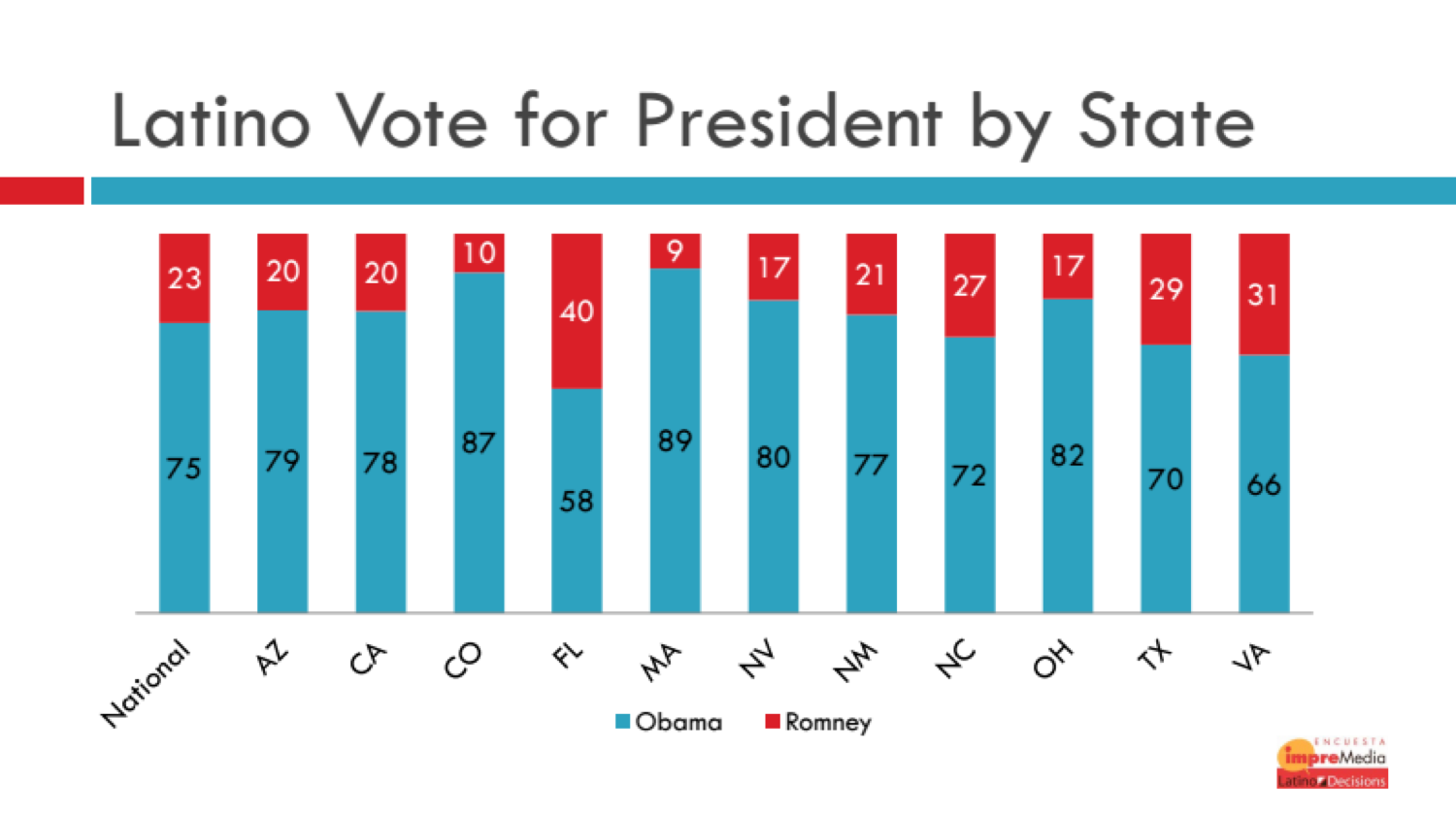
Here is the estimated Latino vote for President nationally and in selected states in 2012. The source is an election eve poll from Latino Decisions, the nation’s premier pollster of Latino voters:
Pew reports that the Latino electorate will by 17% bigger in 2016 than in 2012. In concrete terms, this means that there will be 3.97 million more eligible Latino voters. This exceeds the 3.22 million increase in the much larger white population. So the Republican political imperative to grab a higher share of the Latino vote only continues to grow.
Just in case you missed it, Trump went after immigrants not just from Mexico, source of roughly 60% of Latino immigrants, but also all of Latin America in his opening announcement:
Again, he has not shied away from demonizing immigrants throughout the campaign. His infamous wall that Mexico will pay for (does he know we already have walls along much of the border?) is his one concrete policy proposal. Trump’s speech at the RNC despicably singled out the highly vulnerable population of 11 million undocumented immigrants as the source of American crime:
Nearly 180,000 illegal immigrants with criminal records, ordered deported from our country, are tonight roaming free to threaten peaceful citizens. . . .
One such border-crosser was released and made his way to Nebraska. There, he ended the life of an innocent young girl named Sarah Root. She was 21 years-old, and was killed the day after graduating from college with a 4.0 Grade Point Average. Her killer was then released a second time, and he is now a fugitive from the law.
I’ve met Sarah’s beautiful family. But to this Administration, their amazing daughter was just one more American life that wasn’t worth protecting. One more child to sacrifice on the altar of open borders. What about our economy?
As it turns out, immigrants commit crimes at lower rates than other Americans. For some reason, undocumented immigrants would rather avoid the authorities. Go figure.
These attacks on immigrants are particularly damaging because so many Latinos live in mixed status families. Even Latinos who don’t see these tactics as demonization of them as a group. We’ve seen the political effect of this in the past.
The Pete Wilson Effect
When Republican California Gov. Pete Wilson ran this ad attacking immigrants sneaking over the border and supported anti-immigrant Proposition 187, the share of Latinos newly registering as Republicans dropped dramatically:
For those who don’t remember the days of yore, California voted Republican in every presidential election from 1968 through 1988. Now, it is a safe Democratic state and Republicans don’t even bother. Pete Wilson’s tactics rendered the largest state in the Union a noncompetitive Democratic bastion.
The Power of the Latino Vote
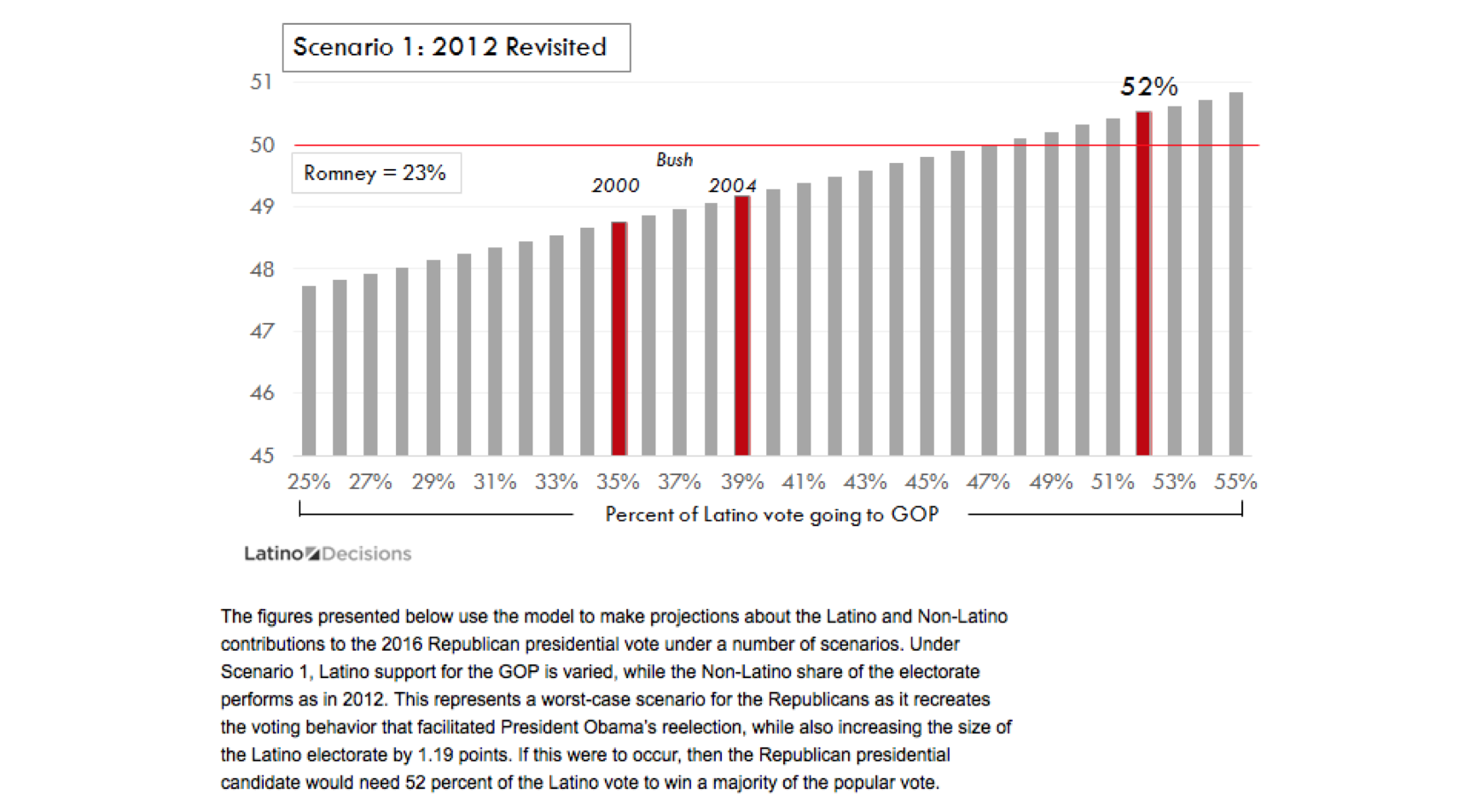
Latino Decisions has helpfully outlined just how bleak the demographics are for Republicans in a series of figures that estimate the share of the Latino vote that Trump would need to win in 2016. The first shows the worst case for the Republicans, as it assumes that turnout rates among all demographic groups remain unchanged from 2012 and that support rates among non-Latino groups for the Republicans also remain the same.
Trump would need 52% of the Latino vote–far higher than the share of the Latino vote than George W. Bush, who was pro-immigration reform and spoke positively of Latinos, received. In the words of George H.W. Bush and Dana Carvey, he’s not gonna do it:
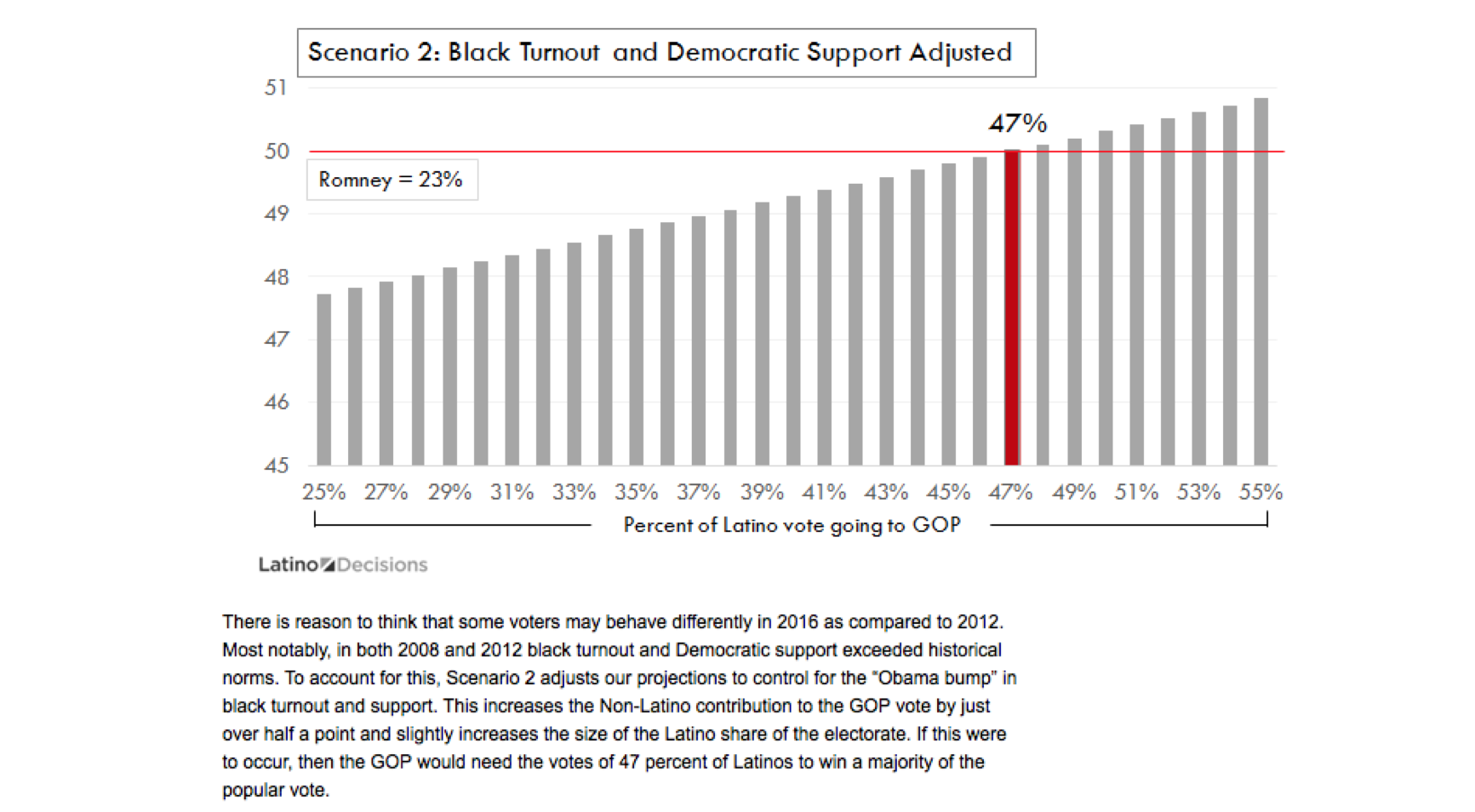
Republicans, however, have hopes that the electorate will vote differently than 2012. In Scenario 2, Latino Decisions looks at the share of the Latino vote that Trump will need assuming that African-American turnout and Democratic support declines to pre-Obama levels:
Trump would still need 47% of the Latino vote. Cue laugh track.
Latino Decisions Scenario 3 is the most hopeful for Trumpistas. In addition to a decline in black turnout and Democratic support, it assumes that the Latino vote grows at a slower rate than expected and that whites vote as solidly for Trump in 2016 as they did for Republicans in the banner midterm election of 2014:
Even under this optimistic scenario, Republicans still need 42% of the vote. Mitt Romney got just 23%. Anyone wanna bet that Tweety McOrange is going to do better than Mittens?
Unlike Asian Americans, so many pixels have already been spilled on the hate-hate relationship between Trump and Latinos. Today’s post attempts to take a deeper dive into why Trump’s total alienation from Latinos dooms his presidential bid in Florida.
Florida was long viewed as very safe Republican turf before it morphed into the ultimate swing state in 2000. Long term trends combined with Trump’s anti-Latino vitriol will heave the state more strongly towards Team Blue.
Cuban Americans
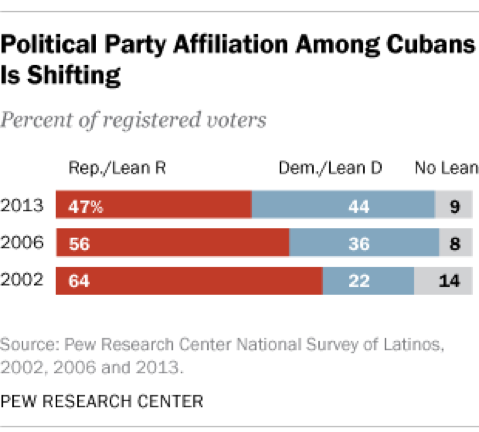
Anti-Communist Cuban voters have long provided crucial support to Florida’s Republican Party. Those days, however, are rapidly coming to an end, as this chart from Pew shows:
Why is this happening? For a start, young Cuban Americans are much more Democratic than their elders. In contrast to those who fled the Castro dictatorship in the 1960s, young people and more recent arrivals take a more nuanced view of relations with Cuba. Two-thirds under age 49 now oppose the American embargo and Obama’s decision to normalize relations with Cuba has net support of +20 among Cuban Americans of all ages.
Trump is also incredibly unpopular among Cuban Americans:
Donald Trump is the catalyst who could force a decisive break between Miami-Dade County’s influential Cuban-American voters and the Republican Party, a new poll has found.
Local Cuban Americans dislike Trump so much — and are increasingly so accepting of renewed U.S.-Cuba ties pushed by Democratic President Barack Obama — that Trump’s likely presidential nomination might accentuate the voters’ political shift away from the GOP, according to the survey shared with the Miami Herald and conducted by Dario Moreno, a Coral Gables pollster and a Florida International University associate politics professor.
Thirty-seven percent of respondents supported Trump, a number that is still higher than the 31 percent who backed Clinton — but also “the lowest in history that any potential Republican candidate polls among this traditionally loyal demographic,” according to Moreno.
By the way, Moreno is the demographic–he’s a Republican Cuban American who won’t vote for Trump.
Puerto Ricans
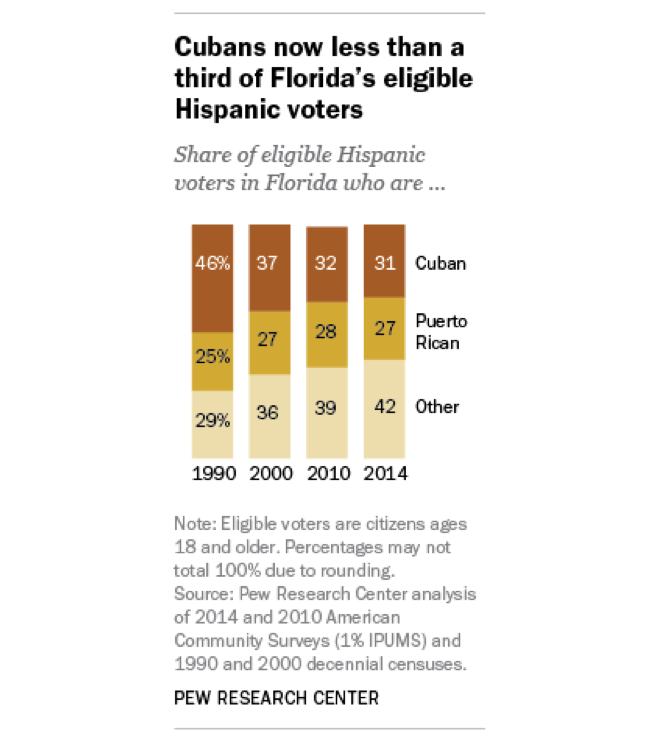
Beyond the strong Democratic trend among Cuban Americans, the share of Cuban Americans among all Latinos has been declining at the expense of much more Democratic Latino groups. Indeed, Cuban Americans now form less than one-third of Florida Latinos:
The share of Puerto Ricans has risen rapidly with many settling in the Orlando area. Due to the economic crisis on the island, a stunning 9.1% of its residents have left for the mainland from 2005 to 2015. Florida’s Puerto Rican population now rivals New York’s.
Puerto Ricans are American citizens and can vote in presidential elections the moment they move to the mainland. And they are an extremely Democratic constituency, as are the other non-Cuban Latinos in Florida.
The Overall Impact
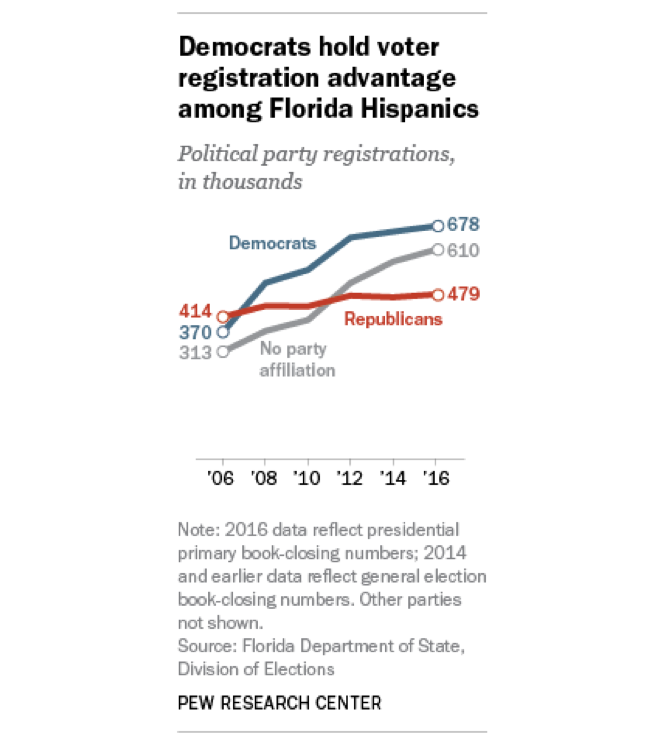
Pew’s statistics also reveal that share of Democrats has been rising more broadly due to the shift among Cuban Americans and the rise of other Democratic-leaning Latino constituencies:
On the whole, Florida Latinos really don’t like Donald Trump. Among the entire group, Latino Decisions reports that 84% have an unfavorable view of the Donald, as compared to just 12% who like the orange guy with the club in Palm Beach.
Overall Impact
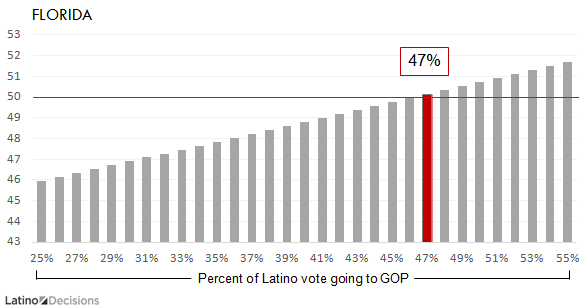
Latino Decisions estimates that Trump needs 47% of the Latino vote to carry Florida:
Does anyone think Trump is going to get anywhere near this figure? Even if his share of the white vote rises, strong Latino support gives Clinton a nice cushion.
Right now, the world is headed into full panic mode because the four post-Republican Convention polls released today show Trump up by an average of 2.5 points. I can’t say I blame people for panicking. The very idea that Trump could become president is a manifest danger to the country.
Democrats are nonetheless well-positioned to win this election based on fundamental trends that Trump shows no sign of defying despite his unconventional campaign of fear and outright lies via Twitter and the free media.
Today, I focus on Asian American voters, who receive little media attention despite being a very fast growing part of the electorate and dramatic shifts in their partisan preferences.
While Trump focuses on Latinos crossing the Rio Grande, even though more now head south than north, Asian Americans became the largest immigrant group in America around 2009, as this graph from the Pew Research Center shows:
Due to starting from a small base, Asian Americans are a very fast growing component of the electorate. Despite the barriers of citizenship and low turnout rates, Asian Americans are quickly becoming a electoral “force,” as this graph from polling firm Asian American Decisions (part of the Latino Decisions group) reveals:
The other fast-growing portion of the electorate is Latino voters, while the share of whites shrink in each presidential election.
It has attracted almost virtually no public notice but Asian Americans have shifted their voting behavior dramatically since 1992. Asian Americans voted strongly Republican 24 years ago but have voted more Democratic in every election since, shifting from roughly 30% to over 70% Democratic.
No one thinks this election will alter the trend. Indeed, it will reinforce it. The same virulent anti-immigrant rhetoric that is now the hallmark of the Trump campaign and the Republican Party alienates Asian Americans just like it does Latinos. Recall Jeb Bush’s infamous explanation that his attack on “anchor babies” was directed at Asians, not Latinos:
It’s hardly limited to Jeb Bush with Trump’s attacks on China and Japan accompanied by his imitations of devious, broken English speaking Asian businessmen:
Trump likes to attack Indian call centers as part of his anti-Asian spiel, which contrasts directly with President Obama’s deepening of American relations with India, a large and rising power:
Trump has also attacked South Korea on trade and for freeloading off of America’s military:
As we now know, these aren’t oopsy-daisies but part of Trump’s longstanding pattern and deliberate campaign choice.
Weak support for Trump among college-educated Americans will only reinforce this trend. While education levels vary dramatically among Asian American individuals and by national origin, Pew reported in 2010 that a higher share of Asian Americans were either in college or had received a college degree than for any other racial group.
Conclusion
1. Asian Americans will once again make up a higher share of the electorate than in the last presidential election. Pew reports that the share of Asian American voters will be up by 16% compared to 2012, as compared to just 2% for whites.
2. The unrelenting Republican attacks on immigrants and trade with Asian countries will likely result in record Democratic support, the continuation of a steady trend over the past two decades.
Ex-Felons and Members of the Community Demand the Immediate Removal of Sr. Director, Armistead Jones.
Baltimore, Md. – Communities United chapter of Ex-Felons are holding a press conference and rally to call for the immediate dismissal of Sr. Director, Armistead Jones. Under the leadership of Mr. Armistead Jones, the Baltimore City Board of Elections has made a mockery of the voting process, which can be viewed as voter suppression. Numerous errors have occurred under the leadership of Mr. Jones; enough for him to be called before a special hearing in the Maryland Senate to explain the debacle of the most recent Primary Election. Even at that time, Sr. Director Jones has repeatedly failed the members of his staff, while never taking any personal accountability or ownership of the failings in his role as Sr. Director of the Baltimore Office of the Board of Elections. Mr. Jones’ position of leadership requires that personal accountability for the proper execution of all tasks be solely his. Perry Hopkins, a Field Organizer for Communities United and Ex-Felon states, “Voting is the bedrock of our democracy and as such, we must have absolute faith in the process and be able to rely on those entrusted to handle our votes, accurately count our votes and accurately report the results in an orderly and timely manner.” As a direct result of mismanagement by the current leadership of Sr. Director, Armistead Jones, this was clearly not the case across Baltimore City in the last and most recent Primary Election cycle.
Sr. Director Jones has repeatedly faulted the members of his staff, while never taking any personal accountability or ownership of the failings in his role as the head administrator and Sr. Director of the Baltimore Office of the Board of Elections. Mr. Jones’ position of leadership requires that personal accountability for the proper execution of all tasks be solely his. Kimberly Haven, an Ex-Felon and advocate stated, “It is our contention, that the actions of Mr. Jones (and his office) not only violated the basic tenet of trust in the execution of our voting process, but in our Democracy as well.”
“I think it’s a personal matter of how he feels. He doesn’t want to look at the Ex-Felons who want to vote, because he’s not concerned about our rights,” says Reginald Smith.
All of the problems listed below, happened on Sr. Director, Armistead Jones’ watch:
1. Several polls did not open or close on time, thereby suppressing the vote, as voters were turned away.
2. Unlawful letters were sent to numerous newly enfranchised Ex-Felon Voters, discouraging them to register to vote, which is an act of voter suppression.
3. There were not sufficient numbers of functionally trained judges to service voters at polling sites.
4. Of his own volition, the Sr. Director certified election results before all votes were accurately counted.
5. Votes and voting ballots were improperly handled and miscounted. Provisional ballots were scanned, over 1000 more votes were erroneously cast than were checked in, and boxes of ballots were missing only to be found at a later date.
6. His current actions have now breached the public trust in the proper and accurate execution of the voting process and his continued tenure also serves as an act of voter suppression.
7. Reasons supporting the termination of Mr. Jones’ tenure clearly outweigh reasons to retain him, as indicated by his recent performance in the service of Baltimore City Voters.
During his public career, Pence has been an outspoken opponent of equal rights for lesbian, gay, bisexual and transgender citizens. In Congress, he opposed efforts to encourage foreign governments to decriminalize homosexuality and sought to block the repeal of the military’s “don’t ask, don’t tell” policy. As a governor, he stood against not only marriage equality, but civil unions as well. He also opposed a law prohibiting discrimination against LGBT people in the workplace and signed one opening the door to wide-ranging discrimination against these residents of his own state under the guise of religious liberty.
On their own, such actions would signal that Pence would work to reverse the progress that has been made and stand in the way of efforts to advance the equal dignity and opportunity of all Americans, efforts which so many other Republicans fully support. But it is his past support for, and failure to repudiate, the heinous practice of conversion, or reparative, “therapy” that raises an even more disturbing concern: Pence doesn’t just seem to disagree with advocates for equal rights on issues of law. His record suggests that he personally believes LGBT people are abnormal and unworthy of the equal protection of the law.
As a candidate for Congress, Pence went so far as to endorse a proposal to divert money from a program to help those with HIV/AIDS to organizations “which provide assistance to those seeking to change their sexual behavior.”
Bravely, Kefalas explains why he knows how bad conversion “therapy” can be:
For almost nine months before my 30th birthday, I had the relationships that I most valued questioned and my life demeaned by the use of techniques, including shock therapy, with no basis in science or medicine.
Kefalas is not some liberal bringing the news. Beyond working in the Ehrlich administration and for the National Association of Manufacturers, he just finished a highly credible, if unsuccessful, bid for the Republican U.S. Senate nomination. In his own words, he supports the “conservative principles that make America exceptional: free enterprise, personal freedom, equal opportunity and fiscal responsibility.”
Indeed, Chrys is typically American is so many ways. Being gay is a normal, integrated part of his life. On an average Facebook day, Chrys is likely to tout his family’s restaurant, his pride in his Greek heritage (My Big Fat Greek Wedding has nothing on Chrys) and what’s going on at work. And yes, he may well mention the guy he loves too. Why any of this is a threat to America escapes a fast growing majority of Americans.
Republicans need to listen to this guy if they want any hope of saving their party. From a purely practical political perspective, Pence is way behind the curve. A majority of Americans now support marriage equality. For that matter, a majority of young Republicans support marriage equality. Never mind conversion therapy, the “go ahead an hate your neighbor” agenda just doesn’t work anymore.
More importantly, any effort to reconstruct a new positive and moral agenda from the wreckage that is the formerly Grand Old Party will require a focus on freedom. Accepting that government should not legislate against LGBT Americans would be a good start.
The first Purple Line associated development project is going up and –surprise–is about development rather than transit-oriented development. At Chevy Chase Lake, EYA is building “62 stately” “luxury elevator townhomes” that start at $1.5 million. All will have two car garages.
Why the two car garages if everyone is going to be riding the Purple Line? Unless you think elevators count, that sure doesn’t sound like transit-oriented development, and surely places into question claims that ridership of people who live near Purple Line stations will be unusually high.
Despite the claims that the Purple Line would increase affordable housing in Chevy Chase, even as quite a few existing affordable housing units get knocked down, this development is not about that goal either. I suppose one can make the trickle-down development argument that increasing supply will lower the price–not one usually associated with progressives who support the project. But we could have done that without billions on the Purple Line.
What is this really about? Thanks to our public subsidy, the owners and developers of the land can build more and make a tidy profit on the roughly $100 million for which they intend to sell the units, which will be valued for their close-in location to DC, proximity to Bethesda and Silver Spring and good school district more than the pricey Purple Line. Accompanied by some shops, I imagine it will be a very nice place to live.
Attracting more wealthy taxpayers and raising the value of the land will also increase the County tax base–good for the County and its economic health. The irony, of course, is that in the future many of the same people who supported the Purple Line as a “social justice” measure will use undoubtedly use this development as an example of the growing economic divide in the County even though the policies they supported made this happen.
On the election front, the Free State promises to be virtually news free between now and November.
Maryland elects all state and county officials during the midterm election. True, Baltimore City is holding its mayoral and city council elections but I can’t say that the suspense is exactly killing me in this all Democratic town. All quiet on the local front.
At the federal level, we have an open U.S. Senate seat where all the drama was in the primary. It is the only open seat rated as “solid Democratic” by the Cook Political Report. No one is waiting with baited breath to see if state Sen. Kathy Szeliga, a Trump supporter, beats out Rep. Chris Van Hollen in a state that FiveThirtyEight says in the second most likely in the nation to vote for Hillary Clinton (polls-only forecast).
Maryland will also elect its eight federal representatives. Again, the excitement was in the primary for two open seats. The Fourth Congressional District saw former Lt. Gov. Anthony Brown make his political comeback. In the Eighth, state Sen. Jamie Raskin beat out a record-setting self-funded candidate.
But the general election should be a yawner. Charlie Cook rates six districts as “Solid Democratic” and one as “Solid Republican.” Rep. Delaney’s Sixth District gains marginal attention as “Likely Democratic.” It seems unlikely that Delaney will be caught napping twice or that he’ll lose in 2016 — the Sixth lists Democratic in presidential elections — when he didn’t in the Republican banner year of 2014.
If contested Virginia did not share the DC media market,. Maryland could be almost free of TV ads in the presidential campaign. Garrett is in the Pittsburgh media market, so it can also expect to share in Pennsylvania’s inundation.
Even the General Assembly is out of session and Gov. Larry Hogan is doing his expedient best to do his disappearing act during the presidential campaign.
Move along, nothing to see here.
UPDATE: The Cecil Times informs me that Cecil County has a race for county executive this year. Two commissioner seats are also up but unopposed since the Democrats didn’t put up candidates.
On Monday night, July 11, some MoCo residents received the following robocall.
I’m Tara Huber. I live in Montgomery County and I’m a county worker in child protective services. My job is to protect the vulnerable children in the county and can be very stressful. My job is made even more stressful by the fact that the County under the leadership of Council President Nancy Floreen has failed time and again to give me and my co-workers the right tools to effectively do our jobs. Floreen has mismanaged the county budget to such an extreme that we don’t have enough staff or tools to manage the high case loads. Protect your Montgomery. Call President Floreen at 240-777-7959 and tell her you expect better management of our tax dollars. Paid for by UFCW Local 1994, 600 South Frederick Avenue Gaithersburg Maryland 20877.
This is a new shot fired by MCGEO, the county employee union, in its on-again, off-again conflict with the County Council. But it’s a risky one that could backfire.
First, some background. MCGEO has a number of problems with the council, including:
The council’s trimming of employee benefits during the Great Recession.
The council’s vote to end effects bargaining for the police union, which was later upheld by voters.
The introduction of legislation by Council President Nancy Floreen that would change collective bargaining procedures in ways that the union claims would weaken its ability to negotiate.
These events and more have caused MCGEO President Gino Renne to tell the Post that his union might support Robin Ficker’s term limits amendment. And on the night before the hearing on Floreen’s collective bargaining bill, the above robocall went out. None of this is a coincidence. Indeed, the union is gearing up for battle. And no one, whether friend or foe of MCGEO and its fearsome President, has ever claimed that the union backs down when it is under threat.
The problem is that the robocall has little merit and such tactics may provoke the council to do even more against the union’s interest.
Montgomery County has a gigantic Health and Human Services (HHS) budget. In FY16, HHS had an approved budget of $289 million, with 1,359 full-time positions and 327 part-time positions. Children, Youth and Family Services, for which the robocall speaker (a MCGEO Vice-President) works, had an FY16 approved budget of $79 million with 525 full-time equivalent positions.
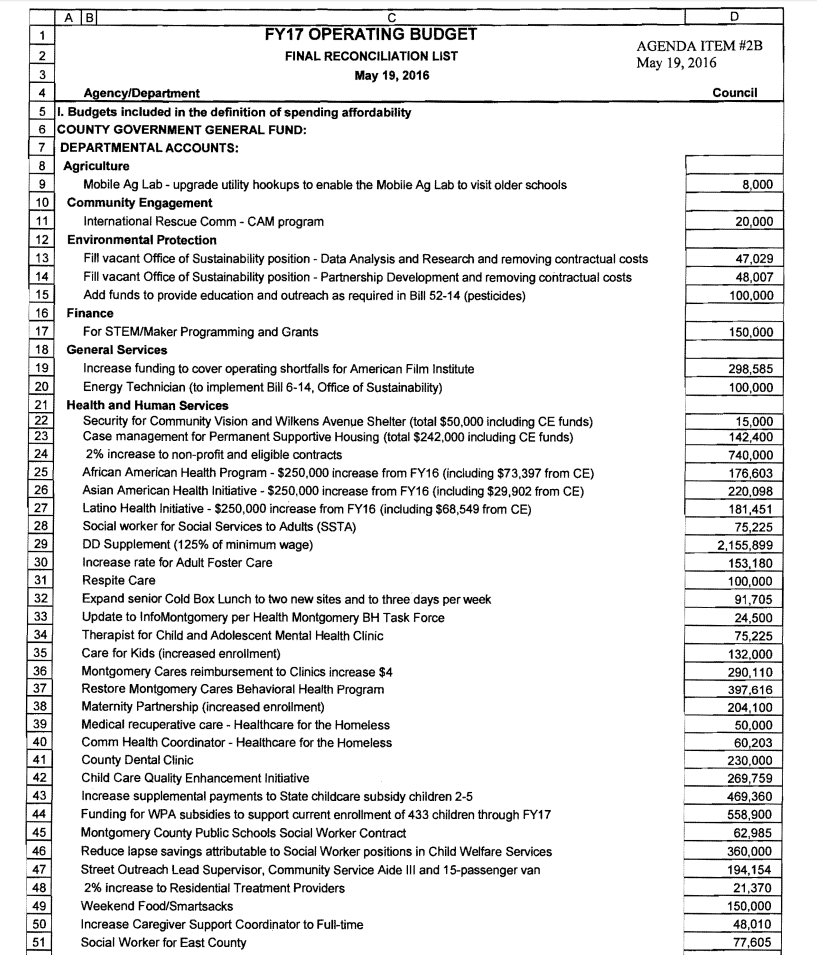
Using FY09 data, your author found that Montgomery County had the biggest HHS budget (along with housing) of any local jurisdiction in Maryland. On a per capita basis, MoCo spent more than double the state average and lagged only the City of Baltimore. MoCo spent more than 8 times on HHS and housing than did Prince George’s County. From FY10 (the peak year prior to the recession) through FY16, MoCo’s HHS budget grew by 13%. And as for the County Council specifically, it adds millions of dollars on top of the Executive’s recommended budget for HHS every year. Below is a list of the HHS items added by the council to the Executive’s budget this year, financed with a nine percent increase in property taxes.
It’s hard to argue that the council pinches pennies on HHS. MCGEO has pooh-poohed the tax hike on its website. What would the union like to see? Does the council need to raise property taxes by 20% to get its approval?
There is more. MCGEO is considering supporting term limits for county elected officials. Fair enough. The union has some legitimate grievances and any union would fight against a breaking of its collective bargaining agreement. But let’s remember that the collective bargaining bill detested by MCGEO only had two sponsors at introduction, Nancy Floreen and Craig Rice. That doesn’t speak well of the bill’s chances under normal circumstances. But if MCGEO amps up its tactics and really does come out for term limits, could it actually help to recruit votes for Floreen’s bill? After all, what do term-limited Council Members have to lose? And let’s not forget that this council will decide on funding two more MCGEO annual compensation packages before the next council is seated.
In May 2011, when the County Council met to pass a budget that included cuts to employee benefits, a group of nine clowns appeared in the audience. One of them wore a name tag with the first name of the Council President. The police union refused to admit responsibility but was widely blamed. Less than two months later, the council voted unanimously to repeal the police union’s right to bargain the effects of management decisions.
The Washington Post’s legendary editorial from 1988 says it all: Anyone But Robin Ficker. The only problem with it is that it’s nearly thirty years old. And the scourge of Montgomery County has been plenty busy since then!
Robin Ficker is well known to elected officials and veteran activists because of his forty-year rampage through the county. But for those who have not yet encountered him, or have been exposed to him only through his most recent attempt to pass term limits, here are Four Facts about the man local politicians hate the most.
He is a World-Class Heckler
If there is ever a Heckler Hall of Fame, Robin Ficker would be a charter member. He has all the tools of heckling: a booming voice, boundless energy, a rapacious hunger for attention of any kind and absolutely no fear. For many years, he was indisputably the Number One heckler in the NBA, harassing opponents of his beloved Washington Bullets from directly behind their bench. Ficker once explained the key to his heckling technique to ESPN.
It’s important to really read up on the opposing team and follow the game very closely, so that you’re conversant with the psychological weaknesses of the other team,” advises Robin Ficker, the Bethesda-based attorney who was once the NBA’s preeminent heckler.
Ficker has been continually running for office for more than 40 years. The list of offices is nearly endless: U.S. Senate, U.S. House, Maryland Senate and House, MoCo Executive, County Council and school board. (Does anyone know if Ficker has run for President?) He once considered running for Governor and sought out a running mate through a classified ad that said, “Prefer female who is tax-cutting Republican, ambitious, intelligent, fearless, adventurous, hardworking and young (age 30 by 01/07) with flexible schedule to traverse Maryland.”
His campaign style is sadly familiar to wincing voters: thousands of illegal signs placed in public rights-of-way and self-funded illegal mailerslacking authority lines. District residency requirements mean little to him. Former Gazette columnist Blair Lee wrote in 2008, “In one election, he circumvented the ban against posting his orange ‘My Friend Ficker’ election signs on utility poles by hanging them 20 feet high on every other pole. We’re talking about a guy who, in the dead of night, climbs hundreds and hundreds of utility poles nailing up his lawn signs.”
Ficker’s electoral taint applies not only to himself, but to others. The Post once reported that “he started a write-in campaign for Edward M. Kennedy in New Hampshire in 1972 only to learn his funding had come from the Nixon White House, which wanted to discredit Edmund Muskie, then considered a threat to Nixon.”
His One Term in the House of Delegates was an Epic Disaster
Early in his political career, Ficker actually got elected to the House of Delegates as a Republican from District 15. Annapolis quickly regretted it. His colleagues said, “they have never met anyone who lives for publicity the way Ficker does.” His “long, protracted questions, sometimes about the most minor issues” provoked “a considerable amount of exasperation at times.” The Post noted that his “gadfly politics and long speeches often emptied the House chamber in Annapolis.” Speaker Ben Cardin said this of Ficker: “I would be glad to make a contribution to Robin’s campaign… As long as he runs for the Senate or Congress or anything but the House of Delegates, I stand ready to help.” Possibly his only meaningful accomplishment was to help kill D.C. voting rights.
Ficker’s name on a bill was regarded as the kiss of death. Even his support could kill a bill. One lawmaker moaned, “The bill is dead…. I mean, if I had a bill I wanted killed the first thing I’d do is persuade Robin Ficker to speak for it.” On another occasion, a Delegate begged Ficker not to speak on behalf of his bill. Ficker did it anyway. The Delegate retaliated by breaking his microphone.
There were many stories about Ficker during his four years in the statehouse. Here is one from the Post.
Ficker shares a suite of offices with fellow Montgomery Republicans Constance A. Morella and [Luiz] Simmons. When the three moved in, Morella’s name, as the top vote-getter, was on top. Ficker switched the names. Somebody switched them back (Morella says she knows nothing about the incident.) Ficker switched them again. When they were switched one more time, Ficker had the final word–he bought a tube of Krazy Glue and glued his nameplate in on top.
Ficker was unperturbed by his notoriety. “At least I know I’m noticed. There are a lot of people in Annapolis who would like some recognition.”
Ficker was defeated in 1982 by Democrat Gene Counihan, much to the relief of Annapolis. To this day, Counihan proudly embraces the nickname he was given by his grateful colleagues:
The Ficker Kicker.
Ficker running for Montgomery County Council in 2009.
He is Frequently in Trouble
Ficker has been in trouble repeatedly ever since he was expelled from West Point in 1963, in part for “speaking abusively to hospital personnel while being treated for a broken leg.”
It’s hard to track all the Ficker Incidents. Most of them have to do with his misconduct as an attorney. Should we begin with 1988, when Maryland’s Attorney Grievance Commission accused Ficker of an ethics violation for advertising his expertise in palimony suits even though the state does not allow palimony? (He was later cleared, but a judge said the ads were in “bad taste.”) Or how about 1990, when the Court of Appeals reprimanded him for failing to show up at the trials of two clients? In 1995, the Attorney Grievance Commission slammed him when he “allegedly left clients stranded without representation in court and in one case sent a novice lawyer who was unfamiliar with the case into the courtroom.” There is also Ficker’s 1996 conviction of battery and malicious destruction of property in connection with a traffic accident involving a pregnant woman. The woman testified that Ficker “exploded in anger,” “was out of control,” and broke her sunglasses after he bumped her car and she tried to get contact information from him. After Ficker appealed, he was acquitted of destruction of property and the battery charge was dropped.
Ficker’s law license was suspended in 1998 and 2007 for violations of competence and diligence. Here’s what the Court of Appeals wrote after the second suspension.
As we observed initially, this is the fifth time that Ficker has run afoul of his obligation to manage his office in a proper manner. He was warned twice by this Court, in 1990 and in 1998, and, despite his claimed improvements, seems not to have learned enough from those warnings. As the result of his cavalier attention to proper office management (1) one client (Robertshaw), facing incarceration, was virtually abandoned until the eve of trial and then was represented by an associate who had not read the entire file, who was unaware that his client had two prior convictions, and who first presented the available options to her in the lobby of the courthouse on the day of trial, (2) another client (Paulk), facing criminal charges that could have resulted in incarceration, was abandoned on what she assumed would be a trial date and which, only by fortuitous circumstance unknown to her or Ficker, had been limited to an advice of rights proceeding, and (3) a third client (Ponto) ended up having an arrest warrant issued against him. We see in these violations an inexcusable lack of concern on Ficker’s part for the welfare of his clients, an unwillingness, after four warnings, to make the necessary improvements to his office management. Accordingly, we believe that the appropriate sanction is an indefinite suspension from the practice of law, with the right to reapply for admission no earlier than one year from the effective date of the suspension.
Would you want to be represented by this man?
A Ficker mailer from his recent campaign in Congressional District 6.
So given all of the above, why did Ficker’s anti-tax charter amendment pass in 2008, and why is his latest term limits amendment favored to pass? The answer is that MoCo’s elected leaders overreach, especially on the issue of raising taxes. By and large, the county’s electorate appreciates the role of government in solving problems and maintaining a high quality of life. But county leaders have approved six major tax increases in the last fifteen fiscal years and voters are getting tired of it. That’s why they voted to limit property tax hikes in 2008, and the County Council responded with a nine-percent increase this year. It’s almost impossible to give someone like Ficker the political high ground, but that’s what has happened. And it appears that elected officials will pay the price.
But as for Robin Ficker himself? The voters have made their decision on his many runs for office over the course of decades, and it’s not going to change now:

 Pew reports that the Latino electorate will by 17% bigger in 2016 than in 2012. In concrete terms, this means that there will be 3.97 million more eligible Latino voters. This exceeds the 3.22 million increase in the much larger white population. So the Republican political imperative to grab a higher share of the Latino vote only continues to grow.
 Trump would need 52% of the Latino vote–far higher than the share of the Latino vote than George W. Bush, who was pro-immigration reform and spoke positively of Latinos, received. In the words of George H.W. Bush and Dana Carvey, he’s not gonna do it:
 Trump would still need 47% of the Latino vote. Cue laugh track.
 Even under this optimistic scenario, Republicans still need 42% of the vote. Mitt Romney got just 23%. Anyone wanna bet that Tweety McOrange is going to do better than Mittens?