Group of Elected Democrats Agrees to Withhold Gubernatorial Endorsements

By Adam Pagnucco.

A group of elected Democrats from around the state has issued a joint statement that they will not endorse in the upcoming gubernatorial primary until the filing deadline has passed and one or more debates have occurred.  Following is their press release.

*****

For Immediate Release

May 27, 2017

Contact: Delegate David Moon – david@davidmoon.us

Maryland Elected Democrats Commit to Delay

Endorsements in 2018 Gubernatorial Primary

16 Democratic Officials Agree to Wait Until Debates Happen & Filing Deadline Passes

TAKOMA PARK, MD – Today sixteen Maryland Democratic elected officials announced an agreement to delay endorsing candidates in the 2018 gubernatorial primary until: 1) the February 2018 filing deadline has passed, and 2) one or more debates have occurred. The diverse group of Democrats were elected to serve in federal, state, county, and city government and come from a range of communities throughout Maryland.

Every Democratic official who signed the letter has a different reason for joining the effort. Some are available for comment:

Mayor Jacob Day (Salisbury) – jday@salisbury.md

Delegate Kathleen Dumais (Montgomery) – kathleen.dumais@house.state.md.us

Delegate Robbyn Lewis (Baltimore) – robbyn.lewis@house.state.md.us

City Councilmember Robert Wu (Gaithersburg) – rwu@gaithersburgmd.gov

City Councilmember Ryan Dorsey (Baltimore) – ryan.dorsey@baltimorecity.gov

The full text of the letter and list of signers appears below:

Grassroots Democracy Commitment for Maryland Governor

We the undersigned elected Democrats in Maryland, commit not to make an endorsement in the 2018 race for Governor until the candidate filing deadline has passed and there have been one or more debates between the filed candidates.

We are in a period of dramatic grassroots expansion of our party, and we believe it would be wise to provide all rank and file Maryland Democrats — including those who are engaging for the first time — the opportunity to help shape the future of the party.  At this early stage in the nomination battle, endorsements may create a primary among insiders that reduces voter input and unnecessarily keeps potential candidates out of the race.

Moreover, delaying endorsements will push those who seek to lead Maryland Democrats to articulate a broad and compelling vision and agenda for our party, debate the issues in detail, and compete effectively for support throughout the state.

In short, we think an open and competitive gubernatorial primary will help us win in November and will encourage candidates to develop strategies that harness grassroots energy to strengthen the Maryland Democratic Party.

Let’s use our resources now to strengthen the organizing base and structure of our Party so we can make the best possible choice for a standard-bearer in next year’s critical primary election.

Signed,

Mayor Jacob Day (Salisbury)

County Councilmember Dannielle Glaros (Prince George’s)

City Councilmember Ryan Dorsey (Baltimore)

City Councilmember Robert Wu (Gaithersburg)

Delegate Erek Barron (Prince George’s)

Delegate Luke Clippinger (Baltimore)

Delegate Kathleen Dumais (Montgomery)

Delegate Sheila Hixson (Montgomery)

Delegate Ariana Kelly (Montgomery)

Delegate Brooke Lierman (Baltimore)

Delegate Jazz Lewis (Prince George’s)

Delegate Robbyn Lewis (Baltimore)

Delegate David Moon (Montgomery)

Delegate Jheanelle Wilkins (Montgomery)

State Senator Will Smith (Montgomery)

Congressman Jamie Raskin (Montgomery)

Share

Hucker, Riemer Targeted by Enviros

By Adam Pagnucco.

The Chesapeake Climate Action Network (CCAN), one of Maryland’s major environmental organizations, is targeting County Council Members Tom Hucker (D-5) and Hans Riemer (At-Large) for not supporting a bill that would have required the county’s benefits funds to divest their holdings of fossil fuel company stocks.  The bill, lead-sponsored by Council Members Roger Berliner (D-1) and Nancy Navarro (D-4) and co-sponsored by Council Member Marc Elrich (At-Large), was converted into a non-binding resolution because it could not gather five affirmative votes.  The resolution was passed today.

Hucker has received numerous environmental endorsements during his history as a candidate.  The Maryland League of Conservation Voters gave him a 99% lifetime score when he was in the House of Delegates.  Riemer was endorsed by the Sierra Club in 2010 but not in 2014.

Following is the text of the blast email from CCAN Executive Director Mike Tidwell.  CCAN is also asking its supporters to email Hucker.

*****

Subject Line: Time to keep up the divestment fight.

Dear ,

First, the good news: We made real progress today in divesting our county’s massive pension funds from dirty fossil fuels. The Montgomery County Council just passed a resolution encouraging the employee pension boards to finally STOP buying and holding stocks in companies like ExxonMobil and Arch Coal. This is a positive step.

However, it’s only a resolution. It’s not the stronger legislation – an actual bill – that CCAN and many of you had asked for.

By a vote of 8-to-1, the Council approved today the carbon divestment resolution sponsored by Council President Roger Berliner (thank you, Roger!). It asks the county pension boards to report in six months (and every 12 months after that) on efforts to divest from the 200 biggest global warming polluters. With record high temperatures, rising seas, and ExxonMobil basically running our nation’s foreign policy, it is outrageous that our county pension funds hold over $70 million in mega-pollution stock. It’s YOUR county money, after all.

Please thank your Councilmember Tom Hucker for voting for the divestment resolution. But remind Tom he’s pledged to get real results from this resolution. We need action, not delay, on dirty energy investments.

Over the past several months, many of you have attended town hall meetings and contacted the MoCo Council on this issue. You demanded that actual legislation – not just a resolution – be passed to move our county toward divestment. Thank you for your citizen activism! And big thanks to Councilmembers Roger Berliner, Nancy Navarro, and Marc Elrich for sponsoring and supporting this legislation!

But Councilmembers Tom Hucker (D-Silver Spring) and Hans Riemer (D-at large) never supported the stronger bill. And because they were swing votes, the bill died. Instead, Councilmember Hucker repeatedly told CCAN and other advocates that a nonbinding resolution was his preference. He pledged to use the resolution as leverage and then lead the fight to demand that the county’s two pension boards actually divest in the coming months.

Our message to Tom Hucker: Thank you for your efforts and we look forward to the real results you’ve said could come from your preferred resolution approach. We now want to invite Councilmember Hucker to a countywide town hall meeting exactly six months from now, where he and Hans Reimer will have the opportunity to update citizens on their efforts to persuade the pension boards to voluntarily divest from high-polluting companies.

Please thank your Councilmember Tom Hucker for voting for the divestment resolution. But remind Tom he’s pledged to get real results from this resolution. We need action, not delay, on dirty energy investments!

A little background now. For too long, our county has sought to lead on climate change policy while also investing tens of millions of dollars in the very companies whose business plans and actions are causing the climate crisis. It’s wrong to profit from these companies – and we don’t need to. The evidence is clear that properly diversified funds perform as well or better without fossil fuel companies. We don’t need to invest in ExxonMobil to have a healthy pension system.

The good news is that pension divestment can be accomplished, as we have seen from just a few miles away. The D.C. Retirement Board eliminated direct investments in the 200 most harmful fossil fuel companies shortly after a divestment resolution passed the D.C. Council in 2014.

But we’ll need real commitment from Montgomery leaders like Hucker and Riemer – and pressure from citizens like you – to replicate the D.C. success here.

So, on we go. Change is never easy, even in a progressive county like ours. We’ll be in touch in the coming months to update you on the next phase of the divestment fight in Montgomery County. And in November we’ll invite you to the big town hall meeting where we hope our leaders can confirm the real progress they’ve said is possible in the coming months.

And thanks again for all you do!

Best,

Mike Tidwell

Executive Director

Share

Montgomery County Land Use 101

Today, I am pleased to present a guest post by Del. Marc Korman about former Planning Board Chair Royce Hanson’s new book on the history of planning in Montgomery County.

Rumors abound that there could be more than 50 candidates running for the Montgomery County Council in the next election cycle (after attending the recent Montgomery County Democratic Party Spring ball, I think that could be an under-estimate).  I would recommend that each of them dive into Suburb: Planning Politics and the Public Interest, by Royce Hanson.

Royce Hanson is a legendary figure in Montgomery County.  He chaired the Planning Board from 1972 to 1980 and was brought back in as something of an elder statesman from 2006 to 2010 to clean-up improprieties fond related to development in Clarksburg.  His most lauded accomplishment is the establishment of the Agricultural Reserve which covers about one-third of Montgomery County although he oversaw numerous sector and master plans during his two tenures.  Mr. Hanson has had less success as a political candidate in the County.

Suburb is closely related to a series of speeches Mr. Hanson gave at the Planning Board Department in 2014 and 2015, which can be watched online and may be more accessible for some than the book.  Hanson’s book—like the lectures—tells the story of planning in Montgomery County essentially from the establishment of the bicounty agencies Washington Suburban Sanitation Commission and Maryland-National Capital Park and Planning Commission (the Planning Board) in the 1910s virtually up until the present.  Hanson sees County land use through three lenses.

First, land use decisions are usually the outcome of the back and forth between what he calls the “Miniature Republic”—homeowners, taxpayers–and the “Commercial Republic”—major land owners and developers.  At different times and in different locations, the power rests more heavily with one than the other.

Second, he traces land use decisions through several political regimes in the County’s history, which will be of particular interest to many local readers: The [Blair] Lee regime dominated by an insider political machine; the builders and the bar regime in which land use attorneys controlled the planning process; the progressive regime that emerged from the new Executive form of government in the 1970s, which he views himself as a product of; and the current “pure political” regime which Hanson views as lacking a cohesive vision for County land use.

Third, Hanson sees ultimate planning decisions as the place where the logic of consequentiality—the more technical and planning-based logic of bureaucrats–meets the logic of appropriateness—the politician’s changes to satisfy certain parties and make planning decisions more palatable.

The book marches through a number of “case studies” beginning with the 1964 General Plan, known as Wedges and Corridors; reimagining Bethesda and Friendship Heights for Metro; the resurgence of Silver Spring; updating White Flint for the 21st century; development of corridor cities such as Gaithersburg, Rockville, Montgomery Village, and Germantown; the huge and scandalous errors with Clarksburg development; the creation of the Agricultural Reserve; and the growth policy regularly updated by the Planning Board and County Council and now called the Subdivision Staging Policy.  Each of these chapters is rich with detail, but at times it feels as though you are just reading a series of facts and events as opposed to any type of analysis.  There are insights about what political and planning compromises worked (and sometimes didn’t work) in specific locations in Montgomery County at particular times, but broader conclusions about planning and process are hard to discern.

Indeed, Hanson even recognizes this late in the book when he concedes that it “is hazardous to overgeneralize from the experience of Montgomery County”, although he goes on to say that examples, analogies, insights, and more can be drawn and applied elsewhere, which is true in the broad sense that another place could redevelop a suburban strip mall near transit, come up with transferable development rights, or target specific neighborhoods through sector plans.  As someone more interested in the Montgomery County story, this approach helped focused on facts and events suited me fine but may be seen as a shortcoming to others.  Indeed, while as I said I think this book is important to read for County Council candidates, I’m not sure who else besides them, other local elected officials, and committed local activists would really appreciate this book.  I certainly did, but I’m in one of those relatively narrow buckets.

Hanson may have been torn between writing a history of Montgomery County planning politics and case studies that could potentially be used to teach planners anywhere and sometimes he did not find the balance he was looking for.  Those interested in the history will want to know who the unnamed councilmembers were who voted against appointing Norman Christellar Planning Board Chair and planning students will probably want to know why the failed plan to build another Mall of America in Silver Spring is relevant to their studies.  I, of course, understand why a pure Montgomery County history book was not written, as it would clearly have a small audience.  It has also been pointed out to me that the history of the County’s actions over race are almost entirely omitted.  I am sure others who lived through some of these planning efforts will note their own omissions.

Still, for you local history buffs there are plenty of interesting facts.  For example, County Executives used to control some appointments to the Planning Board and, for a time under County Executive Kramer, they could revise plans before they went to the Council.  Neil Potter devolved these powers back to the Council after defeating Kramer.  Hanson is also open with his criticism of some local County players and even relies on Adam Pagnucco research in making his attacks.  Former Councilwoman Idamae Garrott comes off as particularly responsive to the current mood of the best organized voters.

If you sit in lots of meetings about sector plans, dream about being on the County Council, or read blogs like this one, then this book is for you.  It covers interesting history and can be a good reference regarding particular parts of the County.   But for those not fitting that description, this book and its detailed history of Montgomery County land use may be more of a slog.  For the right audience, this book can provide a useful baseline of how Montgomery County developed over the last century and why.

Share

Khan Claims Endorsements Without Permission

By Adam Pagnucco.

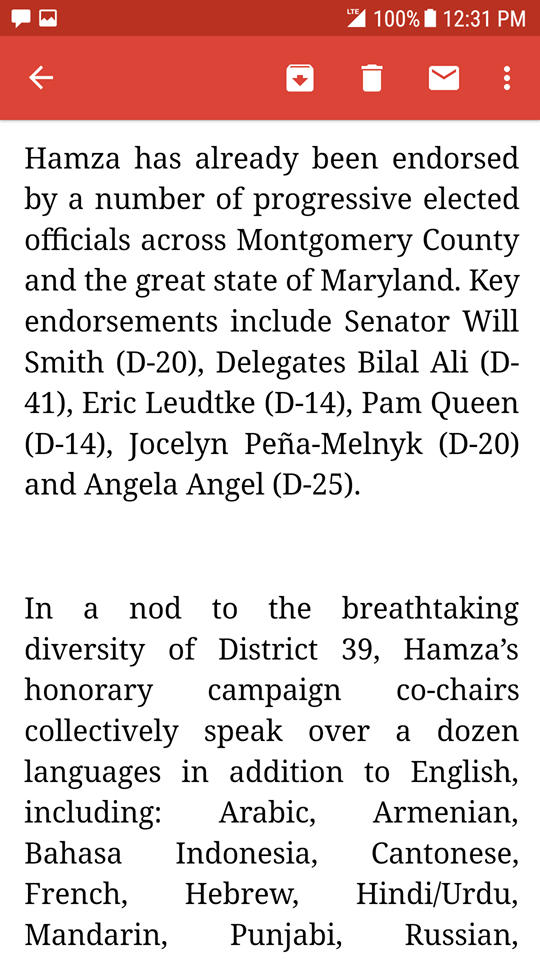
In his emailed announcement of candidacy for a House seat in District 39, Hamza Khan claimed several endorsements from elected officials.  But there’s a problem: at least two of them were cited without permission.

An excerpt from Khan’s announcement email.

Senator Will Smith (D-20), who was listed as an endorser, told us, “I wish Hamza well in his endeavor. However, I did not know about the email and I was not asked to have my name included.  I have not endorsed anyone in that race.”

Delegate Eric Luedtke (D-14), who was also listed as an endorser, said, “I like Hamza a lot, I think he’s a passionate and effective advocate for the community, and I think he would make a great Delegate. He and I have had conversations in the past about an endorsement but we haven’t reached that point yet. The inclusion of my name was a simple error at this point.”

We contacted the other elected officials listed in the announcement asking whether they had endorsed Khan.  To this point, none of them have replied.

This has happened before in Montgomery County.  Lord knows that candidates have made more serious mistakes than this in the past.  But it’s also an easy issue to avoid.  If you are running for office and looking to release a list of endorsers, just contact them and ask, “May I list you as endorsing my candidacy in my announcement?”  Better yet, do it in writing so that there is no dispute over the answer.

UPDATE

We received this note from Hamza Khan:

Thank you for publishing my campaign announcement. As embarrassing as this is: I have to inform you that it turns out two of my endorsements from elected officials are incorrect. At this time, Senator Will Smith, Delegate Eric Luedtke and Delegate Bilal Ali have not formally endorsed me. I was out of the office most of today, and so it took me until now to write to you and issue this retraction. I regret the error, and am thankful that Eric, Will and Bilal contacted me to clear up this matter.

As Adam pointed out in his blog post earlier about “endorsements without permission” — this was an avoidable mistake, and mistakes do happen. But they shouldn’t happen to someone who’s been involved in politics as long as I have. I apologize to you and your readers for this error. Being forthright and honest in the aftermath is all I can do to rectify the error, and I appreciate your willingness as bloggers to allow me the chance to try and rectify the mistake.

With Great Respect,

Hamza Khan

Editor’s Note (i.e. David Lublin): We all make mistakes. How one deals with them says a lot about a person. In this case, while the errors were regrettable, I applaud Hamza’s taking responsibility and look forward to seeing the campaign as it moves forward.

Share

Hamza Khan Running for Delegate

Hamza is perhaps best known locally as a founder of the Muslim Democratic Club but he has also be active in many different ways. Here is the press release:

Hamza Khan Announces Campaign for Maryland State Delegate in District 39

GERMANTOWN, MD: Long-time community activist Hamza Khan will run for state delegate in Maryland’s District 39. Hamza will be seeking the vacancy created by long-time public servant Delegate Charlie Barkley, who has decided to run for the Montgomery County Council. “I have decided to run for public office because the challenges we are facing today as a state and country require us to build bridges and seek to bring together our entire community to achieve a progressive future for our children and generations to come”, said Hamza.

Hamza has already been endorsed by a number of progressive elected officials across Montgomery County and the great state of Maryland. Key endorsements include Senator Will Smith (D-20), Delegates Bilal Ali (D-41), Pam Queen (D-14), Joseline Peña-Melnyk (D-20) and Angela Angel (D-25).

In a nod to the breathtaking diversity of District 39, Hamza’s honorary campaign co-chairs collectively speak over a dozen languages in addition to English, including: Arabic, Armenian, Bahasa Indonesia, Cantonese, French, Hebrew, Hindi/Urdu, Mandarin, Punjabi, Russian, Spanish, Turkish, Vietnamese and Wolof. All are spoken in District 39, which is one of the state’s most diverse legislative districts to live by population. “Hamza is a warm person with a warm heart. He has an obvious devotion to strengthening and maintaining good relations between all faiths and ethnicities in our diverse community,” said Montgomery Village community interfaith activist Keleigh Arian (D39).

Hamza’s platform includes: funding and protecting Maryland’s commitment to K-12 public education; fighting for what’s best for our public school teachers, support staff, and students; working to close the achievement gap; fighting for free tuition at all Maryland community colleges; special needs and disability advocacy; investing in public transit options for Maryland commuters, such as Bus Rapid Transit and expanding access to MARC trains; protecting our environment and continuing to restore the Chesapeake Bay and its tributaries; protecting a woman’s right to choose; fighting for an end to gender-pay discrimination; fighting for an increased minimum wage; fighting for the rights and protections of Maryland workers; advocating for, listening to, and including organized labor in the battle for social justice in our state; working to improve access to affordable childcare for Maryland families; and investing in Maryland’s small and family-owned businesses.

“Hamza is committed to fighting for progressive values and empowering underrepresented communities. He would be a great leader in the Maryland General Assembly,” said Amy Frieder, an UpCounty Democratic Party activist.

Hamza’s campaign website will launch by early summer. In the meantime, you can follow him on Twitter @HamzaSKhan or like his Facebook page (http://www.facebook.com/hamzapolitics) to get updates about his campaign!

Share

A Critical Moment for MoCo’s Smart Growth Movement

By Adam Pagnucco.

2018 is shaping up to be a big year in MoCo politics.  The Executive seat and four seats on the County Council have opened up due to term limits.  Dozens of people are considering running for county office and some are already doing so.  Discussions are underway among both business and progressive groups on how to prepare for the elections.  But one critical group is so far conspicuously absent:

MoCo’s smart growth community.

Smart growth advocates have some big asks of county elected officials.  They want the county to finance a bus-rapid transit network that will cost hundreds of millions of dollars.  That is at the same time that the county is trying hard to pay for what could be billions in school construction costs.  Smart growth groups are also seeking to terminate M-83, a planned Upcounty highway with significant support among its prospective users.  The current County Council is dealing with the Bethesda master plan and the next one will be deciding a host of others.  And at the state level, smart growth advocates are trying to convince the Governor and the General Assembly to support dedicated funding for WMATA.  Any one of these issues would be serious asks, but together they comprise an agenda that is expensive, difficult and costly in political capital.

When other groups have similar hard asks, they participate in the electoral process to enhance their prospects.  Business entities contribute money.  Labor unions contribute money, make endorsements and run direct actions by their members.  Other groups like the Sierra Club, NARAL, the volunteer Fire Fighters, the League of Conservation Voters, NOW and Casa in Action play too.  The smart growth movement does none of this.  That’s turning into a serious problem.

Many of the pieces are in place for the smart growth community to be politically potent.  They have a coherent, well-developed ideology with potential appeal to many.  They have a flagship blog, Greater Greater Washington, with a vast readership around the region.  They have several effective advocacy groups like the Coalition for Smarter Growth, Purple Line NOW and Action Committee for Transit.  They have formed issue-based alliances with others including some parts of the business community, environmental groups and the anti-M-83 group TAME.  And they have substantial support for some of their priorities.

What they don’t do is direct political action.  There is no smart growth organization that makes endorsements, raises and contributes money and finances independent expenditure campaigns advocating for and against candidates.  The closest thing they have to a political tool is Action Committee for Transit’s scorecards, which are handed out sporadically and not mass emailed or mass mailed.  For politicians who take risks in supporting the smart growth agenda, there is no assurance of offsetting electoral rewards.  That is one reason why M-83 continues to survive despite the alleged opposition of six Council Members plus the County Executive.

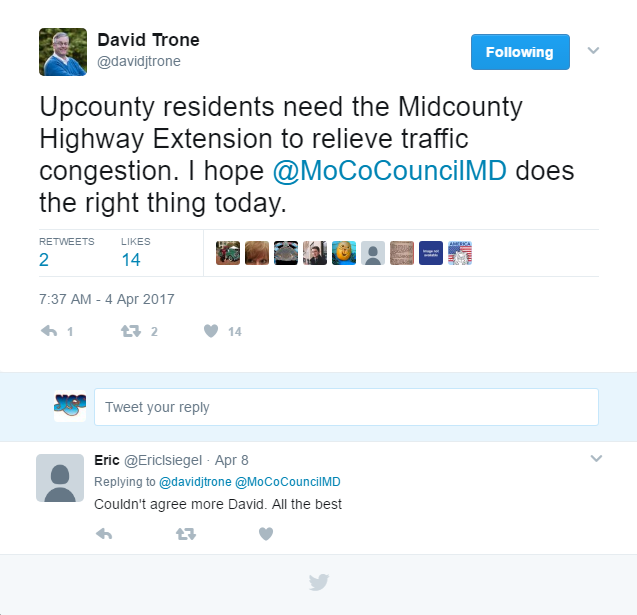
Now consider the stakes.  The leading vote-getter in recent at-large elections is Council Member Marc Elrich, who has voted against three transit-oriented master plans along the Purple Line route and is a top-tier candidate for Executive.  Total Wine co-owner David Trone, who could potentially spend over $10 million if he runs for Executive, is an open M-83 supporter.  (See his tweet below.)  The views of many council candidates on smart growth issues are totally unknown.  One thing is sure: all of these candidates will hear from citizens who oppose the Purple Line, transit-oriented development, bus-rapid transit lines and any potential tax hike that will be needed to fix WMATA.  How much will they hear from supporters?

Because of the sheer number of open seats in the county, 2018 will be a watershed year in the history of MoCo politics.  Will it be a watershed year for the smart growth movement?  Or will it be a year in which candidates who pay lip service to smart growth priorities get elected and then water them down once in office, not fearing any consequences?

Smart growthers, that depends on you.  The time to step up is now.

Share

More Recent Muni Election Results from Around the State

La Plata

La Plata holds a nonpartisan primary for its single seat elections if more than two candidates run. The top two candidates continue on to the general election In 2017, there was a primary just in Ward II, which was held in March. The general elections were held on May 2. You can find a map of La Plata’s four wards online.

Voters turfed out incumbents in three council seats, and elected a newcomer to the vacant fourth seat in Ward III. All of the winning candidates were part of the New Day for La Plata slate sponsored by the La Plata Business Association.

Council Ward II Primary
Clyde Keith Black (incumbent), 119
Brent Finagin, 110
Jon W. Norris, 52

Mayor
Lynn D. Gilroy (former Ward III councilmember), 440
Jeannine Elizabeth James, 563

Council Ward I
Matthew Timothy Simpson, 621
Ralph Wayne Winkler (incumbent), 369

Council Ward II
Clyde Keith Back (incumbent), 415
Brent Finagin, 567

Council Ward III
Timothy Giles, 353
Emily Mudd Hendricks, 622

Council Ward IV
Paddy Mudd, 548
Joseph W. Norris (incumbent), 448

Port Deposit

There were three seats up for election but only two candidates filed. As a result, the Council will have to fill the vacancy, assuming that they can find someone willing to do the job. Turnout was just 3.3% in this uncontested election.

Council
Tom Knight (incumbent), 9
Bob Kuhs (incumbent), 10

Perryville

Reich and Linkey were the only candidates on the ballot for the two open seats. Turnout was 3%.

Commission
Everett “Pete” Reich, 54
Michelle Linkey (incumbent), 41
Write-Ins, 4

Havre de Grace

Mayor
Bill Martin (incumbent), 1523
Wayne Dougherty (former mayor), 874

Council
Monica Worrell (incumbent), 1860
Jason Robertson, 1692
David Martin (incumbent), 1459
Fred Cullum (former councilmember), 1001

New Market

More contests with no opposition. Turnout was 8.9%.

Mayor
Winslow F. Burhans (incumbent), 73.

Council
Shane Rossman, 68
Mike Davies, 68
Jake Romanell, 59
Scott Robertson, 57
Dennis Kimble, 51.

Mount Airy

Mount Airy held municipal election on May 1. Both incumbents who sought reelection won.

Mayor
Patrick Rockinberg (incumbent), 1226
Benjamin Greenstein, 646
Joseph Muise, 40

Council
Larry Hushour, 1203
Scott Strong (incumbent), 1096

Leslie Dickinson, 838
Karl Munder, 229

Pocomoke City

An election occurred only in for the District 3 Council seat. At least they didn’t have to rerun the election like in 2016 after there were problems with the voting equipment and balloting.

Council District 3
R. Dale Trotter, 86
Monna VanEss, 67

Snow Hill

Since candidates faced no opposition, Snow Hill didn’t even hold an election.

Mayor
John C. Dorm (incumbent)

Council Eastern District
Alison Cook (incumbent)

Lonaconing

Online reports only give the names of the winners.

Mayor
John W. “Jack” Coburn (incumbent)

Council
Warren “Whiz” Foote (incumbent)
Charles F. “Fred” Sloan, III (incumbent)
Julie Hoffman
Robert Eakin


Share

Very Quiet in Chevy Chase View

The election for the three seats on the Chevy Chase View Town Council was uncontested. Incumbent Ron Sherrow retained his seat. Newcomers Tom Brown and Nancy Kehne will join the Council. While the elections are nonpartisan, Brown and Sherrow are Republicans while Kehne is a Democrat.

Share

Incumbents Reelected in Close Race in Village of Martin’s Additions

Three people competed for two seats yesterday on the Village of Martin’s Additions Council. Here are the results:

Richard Krajeck (incumbent), 148
Katja Hill (incumbent), 147
Katie Filipczyk Howard, 122
Write-Ins, 17

Former Town Manager Jean Sperling received four of the write-in votes. The Election Committee reported a creepy twist during the nominations process:

In a bizarre nominations twist this year, the Election Committee received seven anonymous envelopes in the mail, all with the same block printing on the front. Inside were typed lists, nominating a total of 41 people as candidates for the VMA Council. There was no signature from the unknown sender, and it looked like the names were drawn at random from the VMA directory, but the Election Committee dutifully contacted all 41 people. The startled “nominees” thanked the Committee for checking with them, said no, they did not wish to run for election, and said they had not given anyone permission to submit their names. No one on the list told us that he or she intended to be a candidate this year.
Share

Maryland Politics Watch