Hucker Files for Reelection in District 5

By Adam Pagnucco.

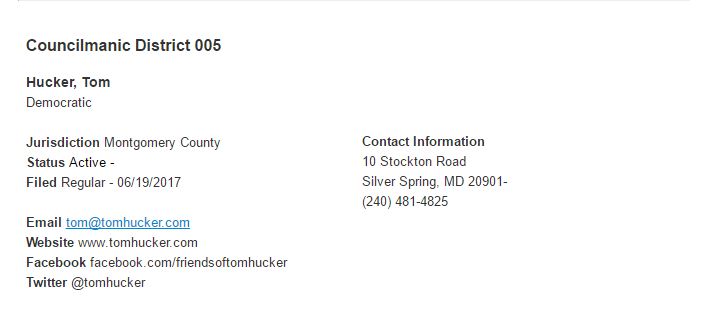
District 5 County Council Member Tom Hucker filed for reelection to his current seat on June 19.  Hucker’s decision ends speculation that he was considering the at-large race, in which he would have been a formidable contender.  It may also lead 2014 District 5 candidate Evan Glass, who came very close to winning, to run at-large.  What is currently unknown is whether Hucker will have any challengers.  Below is his filing from the state’s candidate list.

Share

A Troublesome Situation

By Adam Pagnucco.

By running for an at-large County Council seat and retaining his position as the council’s spokesman, Neil Greenberger is creating a troublesome situation for both the council and the public.  That situation is rooted in the significant conflicts that Greenberger will now have between his two roles.

As we have previously written, the position of spokesperson for an elected official – or in Greenberger’s case, nine of them – is a position of trust.  Elected officials must believe that their communications personnel will represent their positions and actions fairly towards members of the public, who after all will determine if those officials are reelected.  That’s hard to believe when the spokesperson is a candidate who is running for the same office held by the elected officials he is supposed to represent.  In at least one case – incumbent Council Member Hans Riemer – Greenberger is running in the exact same contest.  (Disclosure: your author is Riemer’s former Chief of Staff and regularly worked with Greenberger.)  That means Greenberger is supposed to be trusted to represent Riemer fairly during his day job while he could very well criticize him or his positions on the campaign trail after hours.  The same situation could apply to District 5 Council Member Tom Hucker, who may run at-large.

This is not a hypothetical scenario.  Greenberger is already running against last year’s tax hikes, telling MCM, “This county cannot take another property tax hike… I will guarantee no budget in the four years I’m in office will exceed the charter limit. That’s a guarantee.”  He also told the Sentinel, “The number one thing is, no matter what their incomes, people are still feeling the pain of the big tax increases – actually the two tax increases of last year… And I don’t think they need any more tax increases in the next four years.”  Your author has some sympathy for Greenberger’s opinions.  But the fact is that all nine of the Council Members Greenberger represents in his day job voted for the tax hikes and those who are running again will be defending them on the campaign trail.  And yet their own spokesman is contradicting them.

There is more.  Greenberger runs the council side of the county government’s cable channel, County Cable Montgomery (CCM).  He even hosts his own county TV show.  He is also a liaison between the council and Montgomery Community Media (MCM), a non-profit that covers the county and receives county funding.  In those capacities, Greenberger will be in a position to influence the coverage his opponents – including those who employ him – receive.  It’s a huge conflict.  But Greenberger ignores that.  According to the Sentinel, “Greenberger said he plans to continue to work his job while he campaigns for County Council, saying there is not a conflict of interest because his job is not political nor is he required by law to quit.”  That’s a questionable contention at best.  Many communications from elected officials to the public have a political dimension to them.  Elected officials who issue communications making themselves look bad may not be elected for long!

Neil Greenberger interviews one of his nine employers – and future political rival – Hans Riemer on his county television show in 2011.

The natural reaction of elected officials who face the prospect of their own spokesperson publicly critiquing them is to stop using the spokesperson altogether.  Think about it – who on Earth would want to employ a critic or outright opponent to write press releases about them?  Here’s where the situation becomes problematic for taxpayers.  Greenberger was paid $148,091 in 2016.  If Council Members stop going through him and start relying exclusively on their own personal staff for communications, there is a possibility that his ability to perform his day job would be impaired.

These are not garden-variety conflicts, folks.  Greenberger’s compensation as well as the media outlets he influences directly and indirectly are publicly funded.  That leads us to ask what safeguards will be put in place to prevent any potential use of public resources to benefit a specific candidate, especially if it comes at the expense of others.

Greenberger has as much right to run for office as anyone else.  He is also a merit staffer and can’t be fired for political activity after hours.  But given the above facts, Greenberger should request a transfer to a less politically sensitive position and the job of council spokesperson should be converted to an at-will appointment.  Should he fail to act accordingly, voters should consider his sense of judgment on this issue when they decide how to cast their votes.

Share

Delaney Continues to Raise Money for Congress

By Adam Pagnucco.

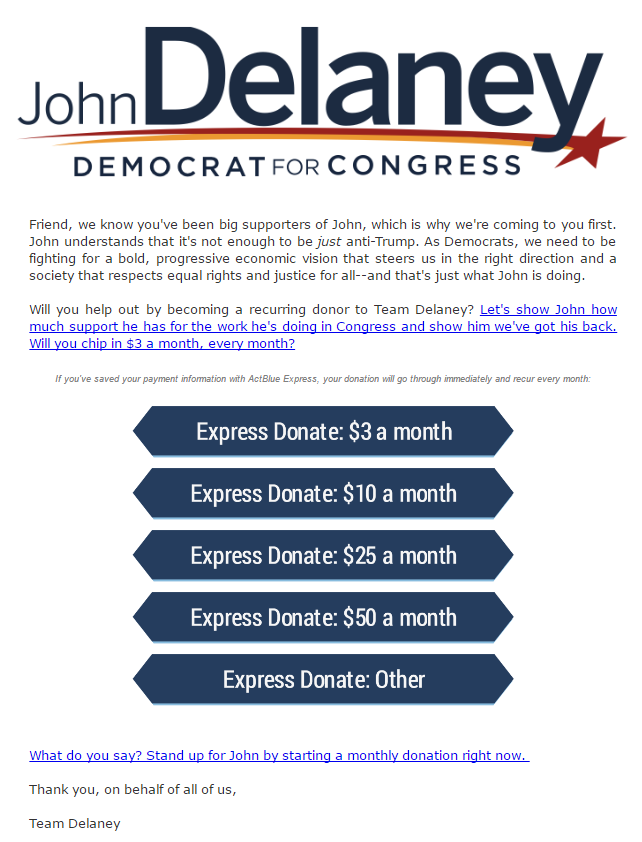
Congressman John Delaney, who is mulling a run for Governor, is continuing to raise money for Congress.  On June 15, he sent out the email below asking donors to contribute $3 or more per month to his federal account.  As of this writing, Delaney has not yet opened a state account.  This comes on top of three recent federal fundraisers for Delaney, including one held at his home in Rehoboth Beach.

The obvious question is: if Delaney indeed plans to run for Governor, why is he still raising money for his federal account?

Share

Lessons from the Virginia Primaries

On the Democratic side, we saw a hotly contested gubernatorial primary between Lt. Gov. Ralph Northam and former U.S. Rep. Tom Perriello. Both ran as strong progressives with Northam beating Perriello by the more comfortable than expected margin of 56-44.

Perriello did best in his old southside congressional district and in normally Republican low turnout counties in the western part of the State. Northam carried urban Democratic strongholds like Alexandria and Arlington and did even better in places like Virginia Beach and Norfolk.

While billed as the Sanders insurgency versus the establishment, this geography doesn’t support that voters especially saw it that way, since Northam carried urban progressive strongholds. I suspect that was inside baseball to most voters who took their cues off of snapshots of the candidates. Something for people still fighting the Bernie v. Hillary wars to remember.

We did learn that there is no such thing as criticizing Donald Trump too much in a Democratic primary. Both candidates were strident in their critiques. Northam managed to get a lot of earned media for calling Trump “a narcissistic maniac.”

Both candidates ran good campaigns and either would have been a fine general election candidate. Kudos to Tom Perriello for conceding quickly once the results became clear and for unequivocally endorsing Ralph Northam. Another good lesson for Democrats everywhere.

The Republicans had a much more problematic night that almost ended in total disaster. Former RNC Chair Ed Gillespie, who nearly upset U.S. Mark Warner in 2014, ran a campaign in which he advocated standard Republican calls for massive tax cuts and did his best to avoid controversy or commentary on Trump.

In contrast, Prince William Board of Supervisors Chair Corey Stewart, known in the past for his staunch anti-immigrant efforts and being fired as Trump’s state campaign chair, ran an incendiary campaign in which ran as Trumpier than Trump, embracing Confederate monuments and getting lots of free media.

Despite huge financial advantages and near universal establishment support, Gillespie eked out a victory over Stewart of 43.7 to 42.5. Trump remains popular among the diehards who tend to vote in low turnout Republican primaries.

This does not bode well for people who would like to see the party steered away from extreme right-wing populist Trump-style politics. Probably very bad for Republicans but even worse for Americans who need two responsible, viable parties.

Though Republicans just avoided the nightmare scenario of Stewart as their nominee, Gillespie’s narrow win when a blowout was anticipated takes the wind out of their sails, which doesn’t help as he was already trailing either Northam or Perriello in the polls. It doesn’t demonstrate strong support for the nominee and, contrary to his near upset of Warner, weakens confidence that he knows how to run a good campaign in tough terrain.

Share

The Jealous Campaign Responds

Today, I am pleased to present a response to yesterday’s post by Adam Pagnucco from Travis Tazelaar, the campaign manager for Ben Jealous’ Campaign for Governor and the former Executive Director of the Maryland Democratic Party.

I was a little disappointed today to read Adam Pagnucco’s Post on the Seventh State, “Is Jealous Claiming Credit for the Achievements of Others?” The post claims that Ben Jealous was not a “key player” in passing “the DREAM Act, marriage equality, death penalty repeal, voting reform and gun safety.” Adam’s post gives credit where credit is most certainly due: to the long list of legislators and other elected officials who fought, and passed legislation. Adam’s characterization that Ben Jealous is either taking credit for the achievement of others, or that he didn’t play a big enough role worth talking about, is false and misleading to Seventh State’s readers and to the progressive community.

Many people played a role in all the progressive victories outlined in the post, including Ben Jealous. I’d point special attention to former Governor Martin O’Malley, whose role in all these victories is unequivocal, who said of Ben Jealous in the Baltimore Sun:

Maryland is a better state — and ours is a more perfect union — because of Ben Jealous and his commitment to justice, equality, and the dignity of every child’s home… Here in Maryland, he was an indispensable part of repealing the death penalty, passing the Maryland Dream Act, ensuring civil marriage equality and expanding access to voting.

The Sun has also written:

The effort to end capital punishment in America epitomizes Mr. Jealous’ ability to combine on-the-ground organizing with strategic thinking. A year ago, the effort to ban the death penalty in Maryland appeared out of steam. Gov. Martin O’Malley‘s passionate advocacy on the issue had failed to sway the state Senate, and all indications were that Mr. O’Malley would not put the issue on his agenda again. Then he met with Mr. Jealous, who assured the governor he could provide vote counts showing majority support for a repeal in both chambers of the legislature. He did, and a month later, Mr. O’Malley stood by Mr. Jealous’ side to announce he would make another all-out push for a repeal. This time, he would succeed.

As the campaign manager for the DREAM Act referendum in 2012, I can express to you unequivocally Ben Jealous’ assistance in winning that campaign too. Were many others involved? Absolutely. Would he claim sole credit? Never. Nor has he tried to do so.

I could walk through the other victories too. I could go point, counterpoint as to what he did, when he did it, and who else was involved. I could pull more quotes from people on the ground thanking Ben Jealous for bringing the NAACP into the Maryland fights when he was President and CEO. But our energy right now shouldn’t be pointed inward, progressives on progressives, in the manner in which Adam is attempting. What Ben Jealous’ message is about, and is clearly written in the email referenced in Adam’s post, is about Maryland coming together. Adam is correct when he says the operative word here is “we.” WE should be coming together as progressives to do big things in this state again, we should be focused on what we can do for the next generation, not tearing down fellow progressives with misleading arguments about the past, especially when he’s clearly going to support another potential candidate.

Adam asks at the end of the post: “Here’s a question for the veterans of all these progressive wins: how do you feel about that?” As a veteran involved in many of these fights myself, especially once they reach the ballot, I can tell you that I’ve always been grateful to have Ben Jealous right there on the front lines with so many of us, and it’s one reason I’m enthusiastically running his campaign now. I would challenge Adam to discard divisive rhetoric and replace it with words affirming our progressive conviction for a brighter future in Maryland, especially when we all work together.

Share

Is Jealous Claiming Credit for the Achievements of Others?

By Adam Pagnucco.

Former NAACP President and CEO Ben Jealous is running for Governor on a progressive message.  That’s a good thing for both the Democratic Party and the state.  But part of his message appears to be a claim that he was a big player in progressive achievements that were actually accomplished by others.  That’s a problem.

In a blast email dated May 31 and titled “Unlocking the American Dream,” Jealous recites his history as a community organizer, his ties to the City of Baltimore and his parents’ efforts to desegregate the city’s schools and downtown business district.  Jealous has a compelling story that deserves respect and consideration, especially by progressives.

After discussing his parents’ civil rights activism, he wrote this.

It was that tradition of fighting for a better life for your neighbors and yourself that motivated this campaign.

In 2012, Maryland had a bounty of civil rights ambitions; we were going to pass the DREAM Act, abolish the death penalty, pass marriage equality, expand voting rights and pass sensible gun safety reform. It was quite the undertaking, but that didn’t stop Maryland.

We went for it, and we won all of them. Because we know our individual movements are stronger together.

That’s the spirit this state needs. A spirit to make our existing movements stronger by combining efforts, to defend our communities, our healthcare, our environment, our working families, students, and seniors.

The operative pronoun here is “we.”  Readers of this email might think that Jealous was a key player in passing the DREAM Act, marriage equality, death penalty repeal, voting reform and gun safety.  But he wasn’t.  Jealous was head of the national NAACP at the time.  He was not a leader in state politics.  In fact, other than residency and family history, Jealous has few ties to politics and government in Maryland.

Many, many people worked together to accomplish the progressive victories listed in this email.  Most of these wins took years to get done.  Elected leaders who worked hard on these issues include former Senator and now Congressman Jamie Raskin (marriage equality and the death penalty), former Senator and now Attorney General Brian Frosh (guns), Senators Victor Ramirez and Paul Pinsky (the DREAM Act), Senator Joan Carter Conway (voting rights), Delegate Kathleen Dumais (guns and the death penalty), Delegate Luke Clippinger (marriage equality and guns), Delegates Maggie McIntosh, Anne Kaiser, Kumar Barve and former Delegate Keiffer Mitchell (marriage equality), Delegate Sheila Hixson (the DREAM Act and voting rights), former Senator Lisa Gladden and Delegate Sandy Rosenberg (the death penalty) and former Governor Martin O’Malley, Speaker Mike Busch and Senate President Mike Miller (all of the above).  Lots of others in elected office and in progressive advocacy groups played critical roles.  One key leader on many of these issues, Senator Rich Madaleno (D-18), is planning on running for Governor.  (Disclosure: if Madaleno declares, your author will support him.)  None of these people did it alone.  Politics is a team sport, as everyone who did the nuts-and-bolts work on all of these issues knows.

Jealous could have written, “Progressives in Maryland passed the DREAM ACT, marriage equality and gun safety.  They did the right thing and I applaud them.  Our campaign is about returning our state to a progressive path.  Join us.”  But he didn’t.

Here’s a question for the veterans of all these progressive wins: how do you feel about that?

Share

Apology for Technical Problem

Dear Readers:

Today, I have been working to fix a problem with the automatic posting of blog posts to Seventh State’s Facebook and Twitter feeds. Somehow, this resulted in bombarding your email inboxes with lots of old posts if you’re signed up to receive them.

My apologies for the annoying intrusion. I hope it will stop soon.

David

Share

Hogan Abuses Constituents on Facebook

By Adam Pagnucco.

Evidently frustrated by having his message eclipsed by the stunning behavior of President Donald Trump, thin-skinned Governor Larry Hogan is now lashing out at constituents on Facebook.

Hogan, who has blocked constituents from his Facebook page in the past, put up a post on redistricting on June 3.  The post linked to an article blasting General Assembly Democrats on a website run by right-wing radio host Laura Ingraham.  But some folks weren’t buying what Hogan was selling and that set the Governor off.

One person posted – politely – on President Trump’s decision to withdraw from the Paris climate treaty.

Hogan accused her of “spouting off.”

Hogan wasn’t done, saying, “You obviously have no idea what you are talking about” and referring to her comments as an “off topic, incorrect rant.”

Another constituent expressed support for the General Assembly’s bill providing for multi-state redistricting, which Hogan vetoed.  Hogan said she was part of a “tiny minority” and encouraged her to “stop liking our page.”

And that wasn’t enough.  Hogan came back for more even as outraged constituents pushed back.

When another constituent asked about the Paris climate treaty, Hogan responded, “You are not only off topic but ill informed.”

When asked about the climate treaty again, Hogan said, “Yes. We are leading the nation on this subject. Pay attention.”

Facebook can be an unruly environment for political discussion.  Constituents are real, live people and don’t always restrict their remarks to the topics favored by politicians.  Elected officials and candidates have a right to ban racist, anti-Semitic, bigoted, sexist, profane or libelous commentary from their pages.  But none of the above comments fall into those categories.  None of them warrant the rude responses written under the Governor’s name.

Hogan owes these folks an apology.

Share

Rodriguez Ousted, Crimmins and Bartram Elected in Tight Race

Conor Crimmins
Darin Bartram

From a trusted correspondent in Kensington:

Kensington voters last night ousted a Town Council incumbent while reelecting another in a nonpartisan election that drew a robust turnout, at least by recent local standards.

The leading vote-getter in the field of three candidates was Conor D. Crimmins, a newcomer to Town politics who polled 233 votes. Trailing Crimmins, who moved to Kensington just three years ago, was Darin R. Bartram, a two-term Council member, who won 210 votes.

Tom Rodriguez

The losing candidate, Tom H. Rodriguez, received 207 votes — confirming expectations that the outcome would be close. Observers figured that at least 200 votes would be necessary to win election, given the intensity of the campaign that had preceded the voting.

In all, 358 paper ballots were marked in the election that spanned three hours and even produced short lines of waiting voters at Town Hall.

In Kensington’s most recent contested Town election, in 2015, 244 votes were cast. Rodriguez and Bartram were elected then, with 158 and 157 votes, respectively. Both men are registered Republicans.

Crimmins, chief operating officer at Spider Strategies, a technology and consulting firm in Washington, had stumped vigorously for votes, spending weeks going door-to-door across the town of 2,300 people. He maintained that the Town government should move more swiftly to address such issues as traffic congestion, parking restrictions, and the appearance of Kensington’s commercial district.

Crimmins, a registered Democrat, also pledged courtesy and respect in dealings with townspeople, some of whom have grumbled that Council members can be prickly in responding to complaints and suggestions.

Bartram, a partner at Baker Hostetler who works on the conservative side in environmental and constitutional law, advocated status quo in Town governance. He endorsed Rodriguez’s reelection bid, for example. And speaking at a candidates’ forum two weeks before the election, Bartram praised “the very good dynamic” on Town Council, the four members of which serve staggered two-years terms. Kensington also elects a mayor to two-year terms. The Town’s day-to-day affairs are run by a town manager and an assistant town manager.

Rodriguez, who is a project director for Luntz Global, a research firm run by Republican pollster Frank Luntz, conducted an extensive door-to-door campaign. He emphasized his role in chairing the Town’s Greenscape Committee, which has overseen the recent installation of a fountain and brick walkway at a park across from Kensington’s post office.

Rodriguez also was host at a picnic for Townspeople two days before the voting.

In some ways, the election was as much social event as political exercise. During the hours of voting, townspeople mingled outside of Town Hall, chatting with each other, with the candidates, and with other elected officials, who included state delegates and former and incumbent Kensington mayors.

Share

Maryland Democrats’ White Problem

In the above table, I’ve collected exit polls from past presidential, senatorial, and gubernatorial elections in Maryland. If exit polls were unavailable, I used pre-election surveys.

Mac Mathias was the last Republican to win a U.S. Senate race in Maryland in 1980. No Republican presidential candidate has carried Maryland since George H.W. Bush in 1988. On the other hand, Republicans managed to win the governor’s mansion twice since 2000. Bob Ehrlich’s 2002 victory broke the long Democratic streak since Spiro Agnew’s fluke election in 1966.

No Democratic winner fell below the 39% gained by Ben Cardin in his successful 2012 reelection bid. In both gubernatorial elections won by Republicans, the Democratic share of the white vote fell dramatically. In 2002, Kathleen Kennedy Townsend won an estimated 34% of white voters.

Anthony Brown performed even more poorly with just 31% in 2014. Towards the close of the 2014 campaign, I estimated that Brown realistically needed a maximum of 37% white support in order to capture the governor’s office.

Lower levels of white support result from two factors: defection and abstention. Put another way, some normally Democratic white voters switched to the Republican in these races. Additionally, others either didn’t vote or sat out these contests.

Since the 2016 election, much of the discussion has focused on the need to increase Democratic turnout, especially non-white turnout and especially in midterm elections. For Democrats, these are good goals, if only because the share of the white vote needed to win declines if more non-white, primarily African American but also Asian and Latino, Democrats vote.

At the same time, the 2016 elections also show the limits of relying solely on non-white voters. Turnout nationally among Latinos and Asians rose and by more than white turnout. African-American turnout declined from the historic levels seen when Barack Obama was at the top of the ticket.

Nevertheless, the task of winning the governor’s mansion would be a lot easier if Democrats can win back a higher share of the white vote by preventing both defections and abstentions. Even with higher minority turnout, it would have been hard for Anthony Brown to win without increasing white support.

The implications extend beyond gubernatorial elections. The retention of not so much control but dominant majorities in the General Assembly depends on receiving enough white voters. Losing more white votes means, for example, losing Senate seats that are critical to invoking cloture for legislation favored by Democrats and their ability to override Gov. Hogan’s veto.

I’m not saying that Democrats should take minority voters for granted. No political party should ever take anyone’s vote for granted, and I expect Hogan to look to increase his non-white support in 2018. But Maryland Democrats cannot repeat their 2014 hemorrhage in white support if they want to defeat Hogan.

Share

Maryland Politics Watch