M-NCPPC Violating Ethics Laws and its own Lobbying Policy

Maryland Public Ethics Law mandates that the Maryland National Capital Park and Planning Commission (M-NCPPC), a bi-county agency which includes the Montgomery and Prince George’s Planning Boards and other departments, require disclosure by lobbyists.

Towards that end, M-NCPPC adopted a policy on lobbying disclosure in 1983, which was amended in 1985. The policy requires lobbyists to register with M-NCPPC and to file a report annually with the Commission. Paid lobbyists should be reporting expenditures on meals, entertainment and gifts to Commissioners or their employees in addition to their compensation and monies spent on lobbying materials and research subject to certain regulations and thresholds.

The current Commission does none of this.

That means that lobbyists before the Planning Boards, which handle decisions with incredible monetary impact, aren’t registering or filing reports. A recent evaluation in by the Office of the General Counsel in response to a citizen complaint, reveals that even the old policy doesn’t fully comply with current law.

You can read M-NCPPC’s Office of the General Counsel’s recent report and review the 1985 policy below. Even their own counsel says that M-NCPPC is way out of compliance: “no lobbying registrations had apparently been filed in recent memory.”

Montgomery and Prince George’s need to wake up. Montgomery has always prided itself on being a squeaky-clean reform county, but its own Planning Board has failed to enforce any of its own or Maryland’s ethics requirements even though its decisions and recommendations can provide many millions in benefits to people invested and involved in property development.

This raises serious questions. Why hasn’t the Commission or either Planning Board done anything to enforce ethics regulations related to lobbying? Why has Planning Board Staff failed to carry out the Board’s adopted policy? Why didn’t the Office of the General Counsel make sure that M-NCPPC was in compliance up until now?

At the end of its report, the Office of the General Council states:

OGC recommends that the Commission promptly complete the process for a substantial overhaul of its lobbying regulations. The Commission’s executive team has made a commitment to revise and adopt new, clarifying lobbying regulations before the end of the 2021 calendar year, and to launch an energetic campaign of public education to introduce them after adoption.

None of that has happened.

The report was supposed to be discussed finally at the December 2021 M-NCPPC Board meeting but was yanked from the agenda at the last minute. In other words, M-NCPPC has already failed to honor its “commitment” to clean up this ethics mess by the end of 2021.

The Montgomery and Prince George’s County Councils, which fund and appoint each county’s Planning Board, need to investigate quickly and ensure that a new, cleaner regime arrives at the Planning Board’s new Wheaton headquarters with officials and planners willing to abide by and to enforce the law.

Share

Prominent Latinos are Burying Latinx. BIPOC Should Go Too.

To the extent that Latinx ever took off, it was primarily at universities like where I teach. That’s no surprise, as surveys reveal it to be more popular among the young, educated, and Democratic, which practically defines my students.

But it never gained real traction outside of the academic arena–only 2 to 5 percent of Latinos preferred it. For that matter, Hispanic is preferred to Latino by 57 to 37 percent. Many Latinos prefer to identify by national origin. New York has a Dominican but not a Latinx parade for a reason.

Latinx gained traction after the horrendous mass shooting at the Pulse nightclub in Orlando. Several transgender and non-binary people injured in the attack preferred Latinx to express their identity over the gendered Latino and Latina. That’s a fine personal expression of their identities. But the progressive elite quickly picked it up as a general gender-neutral and transgender inclusive term, even though Latinx never was adopted by the broader Latino community.

Perhaps Rita Moreno’s character in the remake of One Day at a Time captured it best, when she asked “What the hell is a Latinx? Is it a Cuban Kleenex?”

One can imagine how the imposition of Latinx, which really does not work in Spanish, and was never embraced by the community might grate. Axios reports that Latinx is now being given a very public funeral by prominent Latinos as part of the backlash against the imposition of Latinx:

Rep. Ruben Gallego (D-Ariz.), head of the Congressional Hispanic Caucus’ campaign arm, announced last month his congressional staff is not allowed to use “Latinx” in official communications. “When Latino politicos use the term it is largely to appease white rich progressives who think that is the term we use. It is a vicious circle of confirmation bias,” he tweeted.

Days after Gallego’s tweet, Domingo García, president of the League of United Latin American Citizens, instructed staff and board members to drop the word “Latinx” from the group’s official communications, NBC Latino’s Suzanne Gamboa reported. “The reality is, there is very little to no support for its use, and it’s sort of seen as something used inside the Beltway or in Ivy League tower settings,” García told NBC News.

The Miami Herald, in an editorial, also denounced the term and urged left-leaning activists to “just drop it” while pointing to polls that the word wasn’t even popular among Latinos. “’Latinx’ has failed to gain buy-in from the people it’s supposed to empower. It’s time to retire it from official use,” the editorial board wrote.

Politics is about reaching people where they are. Hard to see how Democrats reach the Latino community, which appears to be trending Republican at a rate that ought to scare the bejeezus out of them, by using elite argot instead of terms used in everyday conversation.

When transgender people identify as Latinx, that is an authentic expression of their identity. When progressives use it for the entire community, it comes across as elite pretentiousness: I’m part of the enlightened who know better.

Dump BIPOC Too

While we’re at it, progressives should dump BIPOC too.

BIPOC stands for Black Indigenous People of Color. It was created as part of an effort to “center the voices of Black and Indigenous communities” lost in People of Color, especially when Blacks are the major victims of police violence.

In the New York Times Prof. Cynthia Frisby explained that “I think the major purpose of that was for including voices that hadn’t originally been heard that they wanted to include in the narrative, darker skin, blacks and Indigenous groups, so that they could make sure that all the skin shades are being represented.”

It’s hard to see how focusing on two groups is simultaneously more inclusive of all skin shades.

BIPOC has also been attacked for conflating the very different suffering of Black and Indigenous people under colonialism. McGill Prof. Charmaine Nelson told the Times  “To conflate everything in one is to erase, which is the very nature of genocidal practice.”

Far more important than these very academic debates is that the term is simply not widely used by ordinary people. Yet left-wing elites will nonetheless insist on using this elitist argot in the name of respecting people who, as with Latinx, not only don’t use the term but literally have no idea what they are talking about.

Montgomery County climate activist Jim Driscoll sent me an email on December 4th that led with “Over 50 BIPOC and other Montgomery County (MOCO) youth and their allies…”

Unraveling this phrase practically requires math. BIPOC and other youth is presumably the same as BIPOC and White youth since BIPOC nominally includes everyone but White people even as it focuses on Black and Indigenous people. Of course, that also means that BIPOC and White youth could just be written as youth. Adding “their allies” means that both youth and non-youth—people—were there.

I don’t know Jim Driscoll or his intent here. I’m sure it wasn’t to talk down to people. He probably was just doing his best to use what he thought is the correct inclusive terminology among Montgomery progressives as he pressed his climate agenda.

But that’s the problem. When progressives use language like this, intentionally or not, they come across to the average citizen as somewhat ridiculous elitist snobs. It’s not inclusive to use obscure language used primarily among educated elites.

It’s definitely not the way to win supporters–or elections. And it’s a lot more fun to win than to wrap yourself up in moral superiority.

Share

Remembering January 6th

Last year, Adam Pagnucco published a first-hand account of what it was like to be inside the Capitol on January 6th. I think it is a more eloquent commentary than anything I could write and reprint it here:

Julie Tagen, who is the Chief of Staff to Congressman Jamie Raskin, wrote the following account of her experience during the attack on the U.S. Capitol this week. We are reprinting it with her permission.

*****

Friends, here is my story of what happened to me yesterday. I am writing this because the process is cathartic for me, and I don’t want to EVER forget the details of January 6, 2021. Forgive me, it’s a long read.

As most of you know, I am Chief of Staff to Representative Jamie Raskin, who had an unbearable family tragedy on December 31 when he lost his beloved son Tommy. You may also know that Jamie is a constitutional scholar, and Speaker Pelosi gave him the high honor of being one of the four key players during the electoral college vote on the House floor.

The day started out normal. I picked up Jamie and drove him to work (masks on, windows down). We live near each other, and pre-COVID, were daily commuting partners. As we drove on 3rd Street NW in front of the Capitol, we could see people with Trump, QAnon and Confederate flags milling around and heading toward the White House (or so it seemed).

We went up to our office in the Rayburn House Office Building, where Jamie worked on his speech in preparation for his big day. Jamie’s family wanted to be with him and see him in action on the floor, so they decided that his daughter, Tabitha, and his son-in-law, Hank, would come to the Capitol. Jamie’s other daughter, Hannah, and Tabitha’s boyfriend, Ryan, would watch the proceedings at home with Jamie’s wife, Sarah. At around noon, Jamie and I walked to the Capitol through the tunnels, the only direction that Capitol Police had ever given us for this momentous day, to meet Tabitha and Hank in a ceremonial room off the House floor. The wonderful staff of Majority Leader Steny Hoyer gave us the Hoyer ceremonial office (H-219) for the week so Jamie could have privacy in his time of mourning and be closer to the House floor.

This is when things began to get crazy; a lot is still hazy to me. The Joint Session started at 1 p.m. The plan was that shortly before Jamie was to speak on the floor, at around 1:30 p.m., Tabitha and Hank would be taken to one of the viewing galleries by security (this was a special privilege, as only Members of Congress were permitted in these galleries during the Joint Session). Jamie left for the floor, which was around 50 feet from our door, and Tabitha, Hank and I started looking out of the large office window at what was taking place outside.

Our windows faced the West Front of the Capitol, in the direction of the Washington Monument. All of the major news channels were showing the activities on the floor, so we only received information about outside activities through Twitter and information other friends and staffers were sending us. Tabitha, Hank and I knew something was very wrong. Our view was slightly obstructed by the inaugural scaffolding and platform, but it was clear that the crowd was getting bigger and more aggressive and there definitely were not enough Capitol Police officers. We could see them taking one or two people away in handcuffs, and smoke, likely tear gas, covering the growing crowd.

After everything the Raskin family had been through over the course of the last week, it became my goal to keep Tabitha and Hank as calm as possible. I told them that we were very safe, that we would be protected, and that there was absolutely no way that anyone could get into the Capitol. I said that because I truly believed it. I was on the Hill in 2010, when the ACA passed and loonies were roaming the halls of the House office buildings since they were open to the public. I figured since the buildings were closed due to COVID, we would be safe. It never once entered my mind that something bad could happen.

I had my laptop on my desk and started getting large pop-up alerts on my screen. I first saw that the Madison Building of the Library of Congress was evacuated. This was concerning, but it seemed like things were under control. Although the floor activities were on the office’s large TV, Tabitha, Hank and I could not stop looking out the window at the chaos outside. At this point, it began to look like mayhem. Scores of angry white men with Trump and Confederate flags stomped around, clad in camouflage and flak jackets.

Despite the mobs outside, Jamie was scheduled to speak on the floor around 1:30pm. Jason Gandolph, a member of Capitol Police Security, came by and said that he could take Tabitha and Hank one floor up to the viewing gallery. They left just as I got an alert that the Cannon House Office Building, where Member’s offices were located, was being evacuated. Jason came back and said, very calmly, that the Capitol was about to go into lockdown. They would have to lock us in the room once Tabitha and Hank returned from the gallery.

Once they came back, Tabitha, Hank and I looked out the window again. We could see that the rioters had gotten onto the inaugural platform and were climbing the scaffolding. The police, who did not have riot gear on, remained below. At one point, it looked like they were trying to move forward, and then it looked like they were retreating; one thing was clear –they were not handling or controlling the mob. We watched as one of the barriers was broken down or opened by police and a rush of rioters headed on West plaza toward the Senate side of the building. I assumed by letting them rush the Senate side that it was a strategy to arrest or disperse them. There was a strong line of police holding off the mob from the plaza’s House side. On TV, the electoral proceedings were still taking place, so I figured things couldn’t be that bad.

Suddenly, we started getting alerts on the computer and our phones. Calls and texts from team members came pouring in: the Capitol had been BREACHED!! The House floor was quickly adjourned. The alerts told us to turn off all sounds in our offices and to take cover. Tabitha and Hank crammed under Steny Hoyer’s desk, and I took the chairs in the room and barricaded the door.

I was looking out of the side window at the chaos. I began to panic inside at the thought of the Raskin kids being traumatized again and what was happening to them after everything they’d been through. Outwardly, I was calm. I told Tabitha and Hank that we would be okay. Inwardly, I wanted to crawl up in a ball and hide. I was scared.

Perhaps it was the adrenaline or the reality of the moment, but I had an epiphany, for lack of a better word. I was trapped in a room with a giant photograph of John Lewis on the wall and a bust of Abraham Lincoln on the fireplace mantel. I said to myself, and perhaps out loud, “These people are TERRORISTS, They cannot win.” Some who know me might say that at that moment, I got my “Philly On!!” I gathered anything in the room that I could use as a weapon and put them by the door: a fireplace stocker, busts, a bronze award of a buck with large and pointy horns.

By then, the terrorists had made their way into the Capitol. We could hear their heavy footsteps outside our door as they tried to breach the House floor. We could hear them chanting, “USA, USA!” and “We want Trump!” and “Stop the steal!” We could hear them trying to ram the door of the House Chamber just a few feet away. There were bangs all over the place. Someone jangled our door handle. I picked up the heaviest item I could find (not sure why), the bronze buck bust, and stood in front of the door, waiting for them to arrive.

I started receiving texts from Jamie, who had been evacuated from the House floor, asking if we were okay. I lied and told him we were fine, because I didn’t want to worry him too. I also started getting calls from Pelosi’s floor staff, who were trying to locate and evacuate us. Texts started arriving from friends all around the country, asking if I was okay. I only told a few close buddies how terrified I was. I talked to my wife, De, very quickly, and told her that we were safe and fine. I asked Hank if it was convincing enough.

After what felt like 30 minutes, the chants began to die down. I could hear police in the hallway. They knocked on our door and told us they were there to help. Tabitha and Hank got out from under the desk. We all looked at each other and said nothing. There was a delay to get us out as a result of being locked in – and I hadn’t remembered that I had locked the 3 inside locks too. Five Capitol police officers opened the door. It was clear they were amped up. The said “Let’s Roll!!” and whisked us through the tight stairwells of the Capitol and we finally made it to the “secure location” where we were joyously joined by a super-relieved and grateful Jamie. In the secure location, everyone was exhausted and there was little food or water. Little by little small food items were handed out: Goldfish crackers, berry gummies, Skittles. After four hours, pizza and drinks arrived. I pretty much survived that night on candy and Diet Coke.

At around 9:15 p.m., I was able to get Tabitha and Hank a ride home to Maryland. I stayed with Jamie until the end until 4:00 AM. It was an honor and a privilege to be in the Capitol when Joe Biden and Kamala Harris were declared winners, and the next President and Vice President of the United States. I arrived back home a little past four in the morning.

I am still processing all of this but I could never imagine this happening to the US Congress.

There is a long list of people that helped me through the day. I hope you know who you are, and I thank you from the very bottom of my heart. More formal thanks will come later.

Share

Waldstreicher Challenger Gets Prominent Grassroots Support

Max Socol is running as a progressive challenger to incumbent Sen. Jeff Waldstreicher who is seeking reelection to the Maryland Senate after having also served three terms in the House of Delegates. That Socol is holding a fundraiser is hardly news.

The names on the invitation, however, grabbed my attention. All are well known in Montgomery County politics. Many are exactly the sort of people you’d think would be supporting an incumbent who touts himself as a “proud progressive” and “champion for justice” but are instead lined up squarely behind his challenger.

Former Del. Ana Sol Gutierrez, who served with Waldstreicher for three terms in the House and ran on a ticket with him twice (!) is now working to defeat her former slate-mate. Always an alliance of convenience, I can’t say I find this shocking.

Brandy Brooks is making her second bid for an at-large seat on the Montgomery County Council. Like Socol, she is positioning herself as a progressive activist outsider. Brooks is considered one of the leading candidates in her own race.

Michelle Whittaker is a communications and campaign strategist. She is the former Communications Manager for Manna Foods and the former Director of Communications for FairVote among other organizations. She has testified for removing police officers from public schools and ranked choice voting. (She is also Brandy Brooks’s sister.)

Fran Rothstein, Diana Conway and Beth Tomasello are Past Presidents of the Women’s Democratic Club of Montgomery County. An informant tells me Conway has previously hosted an event for Waldstreicher. An environmentalist, Conway has been very active in the fight against synthetic turf playing fields. Tomasello is an attorney who has advocated on criminal justice reform.

Laura Stewart is currently the First Vice President of the Women’s Democratic Club of Montgomery County but probably better known as a PTA leader, an active supporter of County Executive Marc Elrich in 2018 and many other progressive causes.

Zola Shaw serves on Montgomery County’s Racial Equity and Social Justice Advisory Committee and is a member of the Board of the Montgomery County Chapter of Our Revolution Maryland. Michael Tardif was named Democrat of the Year by the Montgomery County Democratic Party in 2021.

Bottom Line

Whether Socol can build the coalition and the campaign needed to unseat Waldstreicher, a reelection-focused incumbent if there ever was one, remains to be seen. But the early strength indicates that Waldstreicher hasn’t nailed down his base even after sixteen year in the General Assembly.

Share

Does the Frederick Donut Violate the Constitution?

Proposed Frederick County Legislative Districts

Maryland Matters reports that one Republican legislator has raised questions regarding whether the legislative districts proposed for Frederick County would pass constitutional muster:

Del. Jason C. Buckel (R-Allegany), the House minority leader and a member of the Legislative Redistricting Advisory Commission, questioned whether the new proposed District 4 would pass muster for compactness. The proposed District 4 would encompass much of Frederick County around the city of Frederick, which is contained within District 3, creating what Buckel described as a “donut effect.”

Del. Buckel is almost certainly wrong. The donut does not exist in spite of the Maryland Constitution but to comply with it. Ironically, this is for the same reason that I expressed concern in yesterday’s post about whether District 17 can survive a constitutional challenge: the requirement of “due regard” for “the boundaries of political subdivisions.”

This same provision indicates that the City of Frederick ought to be kept in a single legislative district if possible unless it conflicts with other requirements. At this point, the population of the City and its surrounding suburbs is sufficiently high as to easily meet the population for a legislative district, resulting in a more compact shape than the existing plan in which District 3 extends to the Virginia border.

Putting most of the rest of Frederick County into a surrounding legislative district is the logical consequence of same provision requiring “due regard” of administrative divsions as it avoids unnecessarily extending District 4 into another county.

Del. Buckel’s point reflects that the Maryland Constitution also says that legislative districts should “be compact in form.” But it’s not clear that extending District 3 to the Montgomery County line would improve the compactness of either Districts 3 or 4. It might lengthen the perimeters of both Districts 3 and 4 and reduce compactness according to measures that have been commonly used in past redistricting litigation. One would have to look to be sure either way but I doubt it would be nearly enough to cause a court to second guess the legislature’s approach.

Bear in mind also that District 3 is not an independent enclave trapped by its neighbor. It’s not Lesotho. Enclosing District 3 in District 4 doesn’t make it impossible to leave District 3 without a passport. The City of Frederick isn’t being deprived of a seaport.

Others might wonder about why a bit of District 2 extends into Frederick County.

Proposed Western Maryland Legislative Districts

That’s easily explainable by the State’s geography and population changes. District 1 must start in Garrett County, take in all of Allegany County and then the western part of Washington County to pick up enough population.

Currently, District 2 neatly comprises the remainder of Washington County with the Washington-Frederick border serving as its eastern boundary. That’s no longer possible. The western three counties continue to lose population relative to the rest of the state, so the districts encompassing them move east with each redistricting cycle. At this point, they must extend into Frederick.

The good news is that Frederick has grown sufficiently that the ripple effect stops there. Unlike under the existing plan, none of the proposed districts traverse Frederick’s border with Carroll County.

Share

Does the Gaither-Split Violate the Constitution?

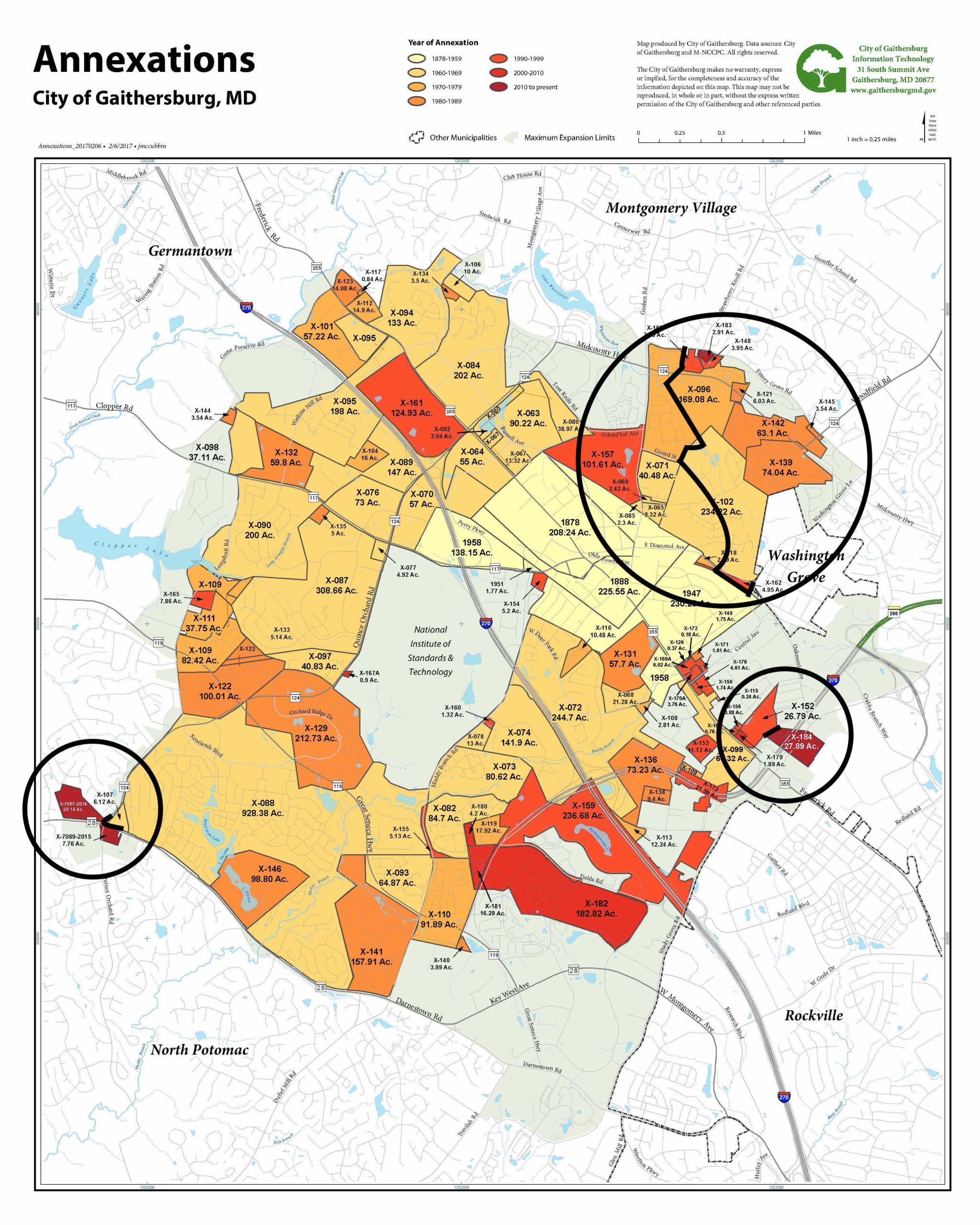
Where the Proposed Legislative Map Divides Gaithersburg

The portion of the Legislative Redistricting Plan for Montgomery County takes a status quo approach. However, it still might violate the Maryland Constitution.

What’s Not a Problem

The major change from the current arrangement is that district 9A, centered in Howard County, now takes in a portion of northern Montgomery County around Damascus. This inclusion of a portion of a ninth (!) legislative district reflects Montgomery’s growth.

It also not so coincidentally happens to aid Democratic Sen. Katie Fry Hester who exchanges a bit of very Republican Carroll County for this bit of Montgomery County. Damascus may be among the more Republican areas of Montgomery, but it is probably friendlier turf for her than the portion of Carroll she lost.

None of this should pose a problem for the plan.

What is a Problem

Instead, the potential problem centers on the new version of District 17. When drawn after the 2010 Census, the district included all of Rockville and Gaithersburg. The new version doesn’t. The dark black lines on the above map show my rough look at where the proposed legislative district boundaries cut into the City of Gaithersburg.

Over the past decade, Gaithersburg annexed areas around Quince Orchard and Shady Grove North that are not in the new D17. Larger areas of northeast Gaithersburg just west of Washington Grove are also outside D17. Most of the excised portions are in D39 but the Shady Grove North bit is in D19.

This invites a constitutional challenge because Article III, Section 4 of the Maryland Constitution states that that legislative district boundaries must give “due regard” to “the boundaries of political subdivisions.”

The Maryland Court of Appeals gave life to this provision when it invalidated the 2001 map, in part for violating too many boundaries. In particular, more districts straddled the Baltimore City and County boundary than necessary.

The Court made clear the importance of this requirement in its decision, writing: “Non-compliance with a state constitutional requirement is permitted only when it conflicts with a federal requirement or another more important Maryland constitutional requirement.”

The State might argue that hiving off part of Gaithersburg was needed so that the district was not overpopulated. But this feels like a dud. After all, the state could have just split Rockville and Gaithersburg into separate districts that included all of each municipality.

The Legislature has a couple of options short of completely redrawing the plan. First, it could redraw the map to include the currently excluded parts of Gaithersburg. Except that this change might well make the district exceed the acceptable population deviation of +/- 5%. The district is already 2.5% larger than ideal.

If this doesn’t make D17 too large, it would solve the problem and make it difficult to challenge the map on this basis. My guess is that the district would end up overpopulated, as the line drawers would otherwise have done this in the first place.

If it does make it too large, the State could try to justify the deviation as desirable to adhere to municipal boundaries. But this faces the same problem as the proposed map in that one could have just put the two big municipalities into separate districts instead.

The State could roll the dice with the proposed map as it stands. Beyond explaining that the portions sliced off Gaithersburg are small and partially not in the current districts, the State could argue that this change was needed to preserve the cores of current districts. The Special Master argued that this was one reason that the 1992 Plan, which was upheld by the Court, did not violate the Maryland Constitution.

This argument seems unlikely to fly, however, because the Court of Appeals explicitly rejected it in 2001, stating: “The premise on which the Special Master proceeded, that the due regard requirement may be subordinated to achieve a ‘rational goal,’ and the State’s argument that the provision must give way to ‘more important considerations,’ also are wrong.”

The Court goes out of its way to make clear that this provision of the Maryland Constitution limits the state’s power even though the “due regard” provision is less strongly worded than similar provisions in other states. In short, it’s there for good reason, such as limiting partisan gerrymandering, and the State cannot ride roughshod over it.

The Court might still uphold it as a de minimis (i.e. trivial) violation of the provision. It could also rule that violations of municipal boundaries are less serious than the violations of county boundaries. Baltimore City is unusual in that it is the only municipality that is also a county equivalent, so the Court could distinguish these questions about due regard for political boundaries from those at issue in its 2001 decision.

Still, it’ll make the inevitable legal challenge to the Legislative Redistricting Plan a lot more interesting if this remains in the final plan. As in 2001, a victory for plan opponents could result in a court-drawn plan because time is short before the primary.

Share

Did Baltimore County Violate the Voting Rights Act? My Guess is Yes.

Baltimore County approved its new councilmanic district map on Monday. Here it is:


And here are the existing districts:

The ACLU of Maryland tweeted that it plans to file a lawsuit challenging the new plan under the Voting Rights Act (VRA). The Baltimore NAACP has already done so. Do they have a case? My educated guess is yes, though one would need to a more thorough analysis of the jurisdiction to be sure and to gather evidence needed for a successful VRA lawsuit.

The Supreme Court established a three-prong test in Thornburg v. Gingles (1986) that still sets the key conditions for proving a violation of Section 2 of the VRA.

First, plaintiffs need to prove that you could draw a “sufficiently large and geographically compact to constitute a majority in a single-member district.” The Baltimore Sun reports that map opponents have already shown that either the First or Second Districts, which are around 30% Black, could be converted into a Black majority district. The Fourth District is 72% Black; it could shed several predominantly Black communities and remain majority Black.

Second, plaintiffs must show that the minority group is “politically cohesive,” which just means that they need to show that Blacks in Baltimore County tend to vote together. This can usually be easily shown through analysis of election returns.

Third, and most crucially, plaintiffs must show that racial bloc voting usually defeats the minority group’s preferred candidate, usually referred to as a “candidate of choice.” Preferred candidates are those who win the vote in the Black community with candidates of the same race considered most probative evidence in a VRA lawsuit. However, non-Black candidates who defeat a Black candidate with the support of Black voters are also considered useful to examine for the purposes of a lawsuit.

In Baltimore County, no Black candidate has been elected to the Council except from the sole majority Black district. In the last state legislative elections, two Black state senators won in Baltimore County—both in majority Black districts. Four Black delegates also won election from majority Black districts. Excluding the district that is mostly in Howard County, the only Black Baltimore County state legislator who represents a non-Black majority district is Del. Carl Jackson but he was appointed in 2019, not elected.

Again, one would need to look more closely and further back to do a proper analysis, but all Black councilmembers and state legislators elected in 2018 won in Black majority districts (excluding Del. Terri Hill who represents the district predominantly in Howard).

In a lawsuit, Baltimore County might well argue that the new version of the First District is a second majority-minority district. In order to win on this basis, the defendants would need to show that the First District provides meaningful opportunity to elect the Black community’s preferred candidate. While it lacks a White majority, Whites form a strong plurality.

Even if plaintiffs win a VRA lawsuit, Baltimore County might not need to draw a second new Black majority district. Just because you need to show that you can draw a Black-majority district to bring a Section 2 lawsuit doesn’t mean that a new Black-majority district must be drawn to satisfy the VRA.

The standard is whether the district provides a meaningful opportunity to elect the minority’s preferred candidate. Since Black voters cast ballots disproportionately in the Democratic primary, they often comprise a majority of Democratic primary voters even when they do not in the voting-age population. This can allow a Black candidate to win the primary even without any White support.

If a Black candidate supported by the Black community can win the Democratic nomination in such a district, and the district is sufficiently Democratic that the nominee would win the general election, that district would still satisfy the VRA even though it is not a Black-majority district.

[Sidenote: If most Blacks voted for a Republican, then the Republican candidate would be the minority preferred candidate. I refer to the Democrats here because the reality is that the Democratic Party usually gets the great majority of the Black vote in Baltimore County and Maryland. But it’s all about the preferences of the voters.]

So why didn’t Baltimore County draw a second district that provides an opportunity for Black voters to elect their preferred candidate? That’s a story for another day.

Share

A Modest Pandemic Proposal

Folks, I like to think all of my readers understand that being fully vaccinated is the way to go to protect themselves, their loved ones, and their community. But graphs like these from the New York Times don’t get nearly enough attention amid the daily reports of new infections and deaths.

Source: New York Times.

A Modest Proposal

At this point, beliefs on vaccination have become like religion. Unfortunately, too many are being led by false prophets promoting cures like ivermectin, Vitamin C, and hydroxychloroquine. They don’t work and many seem to believe that COVID-19 is all a hoax. People may not be immune to the virus but they are to evidence.

David Frum suggested one solution on Twitter:

Another approach might be to open Trump Wellness Centers (don’t call them hospitals) where people can receive the latest unproven, likely harmful quack “cures” from medical professionals like Dr. Oz and Rep. Andy Harris, who seem happy to promote them.

We can set up Dr. Oz’s clinic in Altoona. The surrounding county voted 72% for Trump–more than any other in Pennsylvania–so it should be fertile territory. Lord knows, Oz loves attention and this should be a great way to get lots of it and promote his Senate bid.

The most Trumpy county in Maryland is Garrett (76%) but it’s small and outside Harris’s district, so I suggest instead either Elkton in Cecil or Centreville in Queen Anne’s– for his clinic. Both went 62% for Trump and are in Harris’s district.

It’ll save at least some doctors from having to deal with physical attacks or abuse from people who get refused horse dewormer as a cure. (And yet, they still go to the hospital, suggesting that deep down they know it’s all a flim-flam. Doublethink is real.)

One suspects that the death rates might discourage patients after awhile from attending these right-wing wellness center. Of course, Drs. Oz and Harris might be not so keen to deal with the consequences of their media recommendations. Killing your voting base doesn’t seem smart politics. But it’s worked for the tobacco industry all these years, so why not give it a go?

Share

Competing Vaccination Stats

People who are fully vaccinated, including a booster, are best positioned to avoid getting or to fight off the highly contagious Omicron variant of COVID-19 that is fast becoming the Grinch that Stole Christmas.

The CDC and MD Department of Health each produce estimates of vaccination rates by county. Here are the CDC stats for the share of the population five and older that is vaccinated:

Source: Centers for Disease Control (December 20, 2021).

The CDC should have the best statistics because, unlike the MD Department of Health, the federal agency has the addresses of everyone who got vaccinated around the country. As a result, unlike the state health department, their statistics include people who got vaccinated out of state–likely plentiful in Maryland.

Nevertheless, the St. Mary’s and Somerset statistics just seem odd–the former seems far too high (compare to Calvert) and the latter far too low (compared to anywhere). They also don’t jibe with the MD Department of Health Statistics, which you can see here:

Source: Maryland Department of Health (December 20, 2021).

This is not an apples-to-apples comparison. The CDC statistics include only people 5 and older while the MD DOH statistics include everyone. The CDC looks at who is “fully vaccinated” as opposed to the stats from MD DOH showing the share with a second dose.

Either way, Montgomery and Howard are the places to be in terms of safety with the highest vaccination rates in the state. Garrett and Somerset, at either ends of the state, are at the bottom of the scale. Also at the low end by either the CDC or MD DOH measure are Allegany, Caroline, Cecil, Dorchester, Washington, and Wicomico–all counties on the Eastern Shore or Western MD.

Though Republicans perform well in all of these counties, politics isn’t destiny. Carroll County–arguably the most right-wing county in the state–has comparatively high vaccination rates. Whatever they’re doing right, we should find out and replicate.

Montgomery’s high vaccination rates similarly indicate real success in reaching out to nonwhite communities. Though Whites are the largest group, there is no racial majority with large populations of Blacks, Hispanics and Asians calling the county home. Kudos to Montgomery for its results that should also be mined and copied.

Share

Where are the Republicans?

The geographic nature of partisan polarization in Maryland results in radically different distributions of Democratic and Republican primary voters. On Friday, I took a look at the Democrats. Today, it’s the turn of the Republicans.

While only a desultory 7.7% of Democratic primary voters in 2018 lived on either the Eastern Shore or in the Western 3 (Garrett, Allegany and Washington Counties), 19.2% of Republican primary voters lived in the same areas. That looks to increase in 2022 as the share of eligible Republicans in the two regions has grown to 20.8% from 19.4%.

This pattern reflects a continuation of Republican growth in rural areas that characterized shifts generated by Donald Trump’s two White House bids. So does the shift away from Republicans in more urban parts of the state, especially in the educated and racially diverse Washington suburbs. Montgomery was home to 20.0% of Democratic primary voters in 2018 but only 11.2% of Republicans.

That gap looks to grow as the Montgomery’s share of eligible Democrats has grown 0.3% but its share of Republicans has dropped by 1.2%. Differences are even starker in neighboring Prince George’s, which is now home to 20.8% of Democratic eligible voters but only 3.8% of Republicans. Put another way, Prince George’s casts fewer Republican primary votes than Washington County despite being home to six times as many total residents.

Driven by the weight of suburban Republican populations, the Baltimore metro area punches harder in Republican than Democratic primaries. Baltimore County increasingly tilts Democratic but it has a strong Republican presence and Gov. Larry Hogan carried it handily in his two gubernatorial wins. It is home to 14.0% of eligible Republican voters, the highest share in the state.

Anne Arundel is next with 13.2% of all Republicans. Meanwhile, the considerably smaller but ultra Republican exurbs of Carroll and Harford Counties together are home to 14.4% of Republicans. Carroll is the arguably the most right-wing area of the state and Trumper Del. Dan Cox will hope to do well there. Both Cox and his main challenger, Kelly Schulz hail from Frederick, which has 6.8% of Republican voters.

In short, while Democratic candidates will need to spend most of their time camped out in the most densely populated portions of the State, Republicans must get travel more because their voters are far less concentrated. It may also help explain partisan differences in the regional focus of priority transportation projects.

Share

Maryland Politics Watch