Andy Harris Votes to Increase Deficit $1.5 Trillion

Republican Rep. Andy Harris (MD 1) voted to allow tax cuts of $1.5 trillion dollars without requiring any offsetting spending, increasing the deficit and debt dramatically.

The proposal is particularly anti-Maryland as it would “doom the current deduction for state and local taxes,” which benefits Marylanders disproportionately, as it does residents in New York and New Jersey. Other tax deductions up for elimination that might spread the pain more evenly, such as the home mortgage interest deduction, or closing corporate loopholes, have been ruled out by tweet or as sacred cows. Nevertheless, unlike the bulk of Republicans from those states, Harris still voted yes.

Harris has undergone a Damascene conversion on the deficit and national debt since the Obama years:

His budget never solves the deficit problem, much less begins to pay down the exploding national debt we will leave to our grandchildren. . . . Once again, the House will have to take leadership on reining in the debt and deficit by proposing a budget that makes the tough choices that are necessary to head off a Greek-style federal bankruptcy.

Harris logic says that ballooning the debt by much less than the Republican budget is madness that will cause rack and ruin associated through “a Greek-style federal bankruptcy” when it’s proposed by Obama but not when Trump-Ryan want it.

Even leaving aside the unfunded giveaway to the wealthy that is done in a way that limits benefits to Marylanders, especially more middle-income residents who still deduct, the complete shift on the debt and importance of balancing the books shows the situational ethics and moral bankruptcy of Andy Harris–and the many other Republicans who said more or less the same thing.

Share

MoCo’s Mighty Seven Zip Codes

By Adam Pagnucco.

For a long time, Montgomery County has been thought of as a wealthy jurisdiction.  It has long appeared in lists of the nation’s richest counties (although it is about to drop out of the top twenty).  Politicians elsewhere in Maryland view it as a gold mine, with Senate President Mike Miller famously saying, “It’s like Never Neverland for other legislators of the state.”  The county is regularly shorted by state wealth formulas which disproportionately distribute state aid, especially for public schools, to other parts of Maryland.

But most of Montgomery County is not particularly rich.  Its wealth is concentrated in seven zip codes which skew its mean household income upward and make the county as a whole appear richer than it really is.

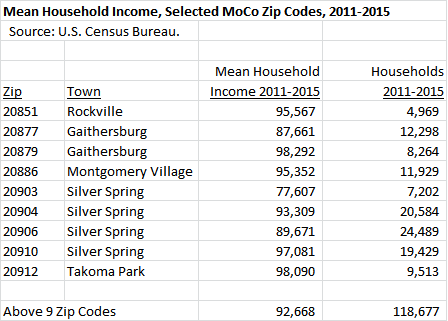
All residents of MoCo understand that there are huge differences between areas in the county even though many outsiders do not.  According to the U.S. Census Bureau, the county’s mean household income was $133,543 over the 2011-2015 period, just barely squeaking past Howard County ($132,751) for tops in the state.  But that conceals big variations.  MoCo has nine zip codes in which mean household incomes were under $100,000.  The combined mean household income of these areas ($92,668) is roughly equal to the mean household income of Prince George’s County ($90,268).

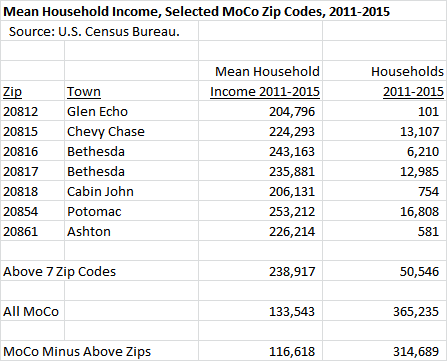
MoCo has seven zip codes in which mean household incomes were over $200,000 in the 2011-2015 period.  These zip codes, mostly located northwest of D.C., account for 14% of the county’s households and 25% of its household income.  If these zip codes were regarded as a separate jurisdiction, their combined mean household income would be $238,917.  The combined mean household income of the rest of Montgomery County is $116,618 – about half the income of the Mighty Seven.

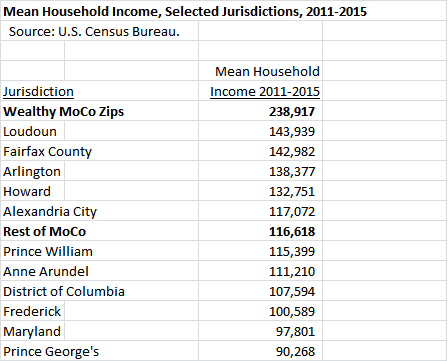
How do the mean incomes of the Mighty Seven and the rest of the county compare to the rest of the region?  We show the mean household incomes of those two parts of the county along with the other large jurisdictions in the region below.  The Mighty Seven as a group are easily at the top although we suspect that extracts of the wealthiest parts of Loudoun, Fairfax, Howard and D.C. would also be in that range.  As for the rest of the county, its income is average compared to the rest of the region.

That’s right, folks – with the exception of its wealthiest zip codes, MoCo is a middle-income jurisdiction by the (admittedly high) standards of the Washington region.

This reality has interesting implications for policy makers and candidates.  The issue of equity between different parts of Montgomery County is getting traction as a political issue in the upcoming election.  But in terms of who pays the county government’s bills, there is no question that county revenues are hugely dependent on a limited number of wealthy neighborhoods, especially in the absence of robust economic growth.  If those residents decide that they can get a better deal by living somewhere else, that would be a huge threat to the county’s tax base.

As for the state level, there’s a tendency to look at differing incomes and wealth BETWEEN counties but not INSIDE counties.  That’s how state wealth formulas work – they compare counties to each other but not local areas to each other.  How many state policy makers have understood prior to reading this blog post that there is a large part of Montgomery County that is economically comparable to Prince George’s?  It’s time for a serious examination of how to direct state aid to local areas in need regardless of which county borders they happen to occupy.

Share

Why Does the Capital Publish this Guy?

Normally, I view the Annapolis Capital as a good paper with often a fine bead on state politics due to its location. But after reading Brian Griffiths’ column, you have to wonder about their judgement.

Griffiths, the editor-in-chief of the Republican blog Red Maryland, writes regular columns published in the Capital. In his latest oeuvre, he argues that Gov. Larry Hogan is unbeatable. OK, so far. That’s a matter of opinion–I happen to disagree–but a perfectly legitimate position.

The way Griffiths goes about making his case through a series of ad hominum attacks and utter falsehoods is not.

Regarding Ben Jealous, Griffiths writes the following:

Former NAACP President Ben Jealous, darling of Bernie Sanders supporters, who has yet to propose a policy that would not be fully endorsed by the Communist Party.

It’s like Griffiths feels bad that that he missed out on the Red Scare of the 1950s or has watched Red Dawn far, far too many times. Reviving McCarthyism, however, is not a serious attack but a smear. Surprise, surprise but Jealous is not a Commie pinko who hates America and does not advocate for Leninism or gulags.

Instead of making a serious attack based on Jealous’s advocacy for policies he views as failed, reheated old-style liberalism, Griffiths goes for the reheated, old-style smear. No editor at the Capital saw this and said this is unserious and over the top?

Griffiths goes on to do the same to Rich Madaleno:

Ultra-left-wing state Sen. Rich Madaleno, infamous for being a flip-flopping fabulist — but most famous for personally insulting first lady Yumi Hogan.

The idea that Madaleno insulted Yumi Hogan is practically the definition of fake news. Madaleno wrote the Governor a letter asking him to ban travel to Indiana because of its endorsement of rank discrimination in its so-called Religious Freedom law. In the letter, Madaleno had the audacity to compare the Hogan’s family to his own by pointing out that the law would allow discrimination against Hogan’s family because of the First Lady’s divorce and against his own because he is married to man.

Griffiths can only think this an insult if he thinks either divorce is shameful and unmentionable in polite society or that Madaleno had no right to compare his own marriage to that of the Governor’s. In other words, Griffiths and others who mindlessly mouth this ridiculous, false attack are really just smearing Madaleno for being an uppity gay guy who thinks that he’s normal.

And I haven’t even gotten to “ultra” and “flip-flopping fabulist.” Again, why does the Capital turn itself into a smear machine?

Good debate and strong views are healthy in opinion columns. But what value is the Capital adding through publication of regurgitated smears? Are there no Republicans available who can make a positive argument for Republican policies and critique those of Democrats without basing it in lies and smears?

If you want a serious analysis of the unworkability and upper-class bias of Jealous’ free college proposal, go check out Barry Rascover because you won’t find it–or anything else that passes for thoughtful analysis–in Griffith’s column in the Capital.

If Griffiths wants to keep publishing this dreck on his blog, he should feel free. I suppose the Capital can too but they can do better and should be held to account for publishing lies and smears.

Share

District 18 Senate Battle by the Numbers

By Adam Pagnucco.

Last week, David Lublin broke the news that former District 18 candidate Dana Beyer is planning to run for Senate against Delegate Jeff Waldstreicher.  Both Beyer and Waldstreicher have run three times in the district.  Let’s see how their past performances stack up.

Electoral Results  

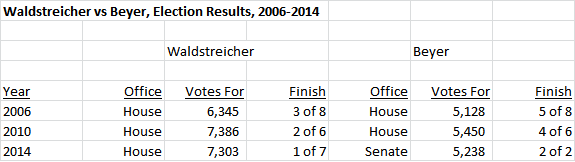
Beyer and Waldstreicher first ran for office in 2006 when both ran for the House.  Waldstreicher, aided greatly by the Apple Ballot, won a close contest with attorney Dan Farrington to claim the open seat vacated by Rich Madaleno.  Beyer ran a credible campaign but finished fifth of eight candidates.  Waldstreicher would never be seriously threatened in his two reelection contests while Beyer lost another House race in 2010 and a Senate challenge to Madaleno in 2014.  One fact apparent in the electoral data is that Waldstreicher’s performance has improved over the years while Beyer has consistently received between 5,000 and 5,500 votes.

Fundraising

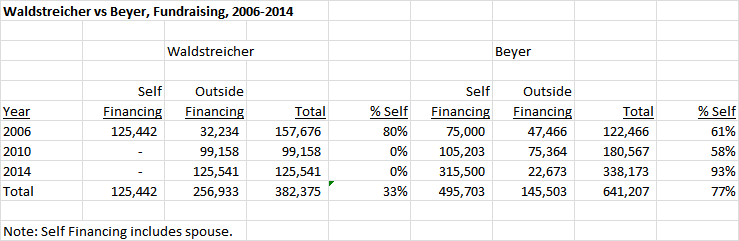
In 2006, both Waldstreicher and Beyer were primarily self-financed candidates.  Since then, Waldstreicher has successfully raised outside money while Beyer has continued to mostly self-fund.  Beyer’s loans to her 2014 campaign against Madaleno constituted one of the largest self-financing performances in the history of MoCo General Assembly elections.  Drawing on her own money, she is easily capable of matching Waldstreicher dollar for dollar.

Major Endorsements

Waldstreicher has been endorsed by virtually every major progressive group over the course of his career as well as by the Washington Post in 2014 and the Gazette in 2010 and 2014.  Beyer was endorsed by the Post, the Gazette and Equality Maryland in 2010 and by MCGEO in 2010 and 2014.

Beyer vs Madaleno for Senate

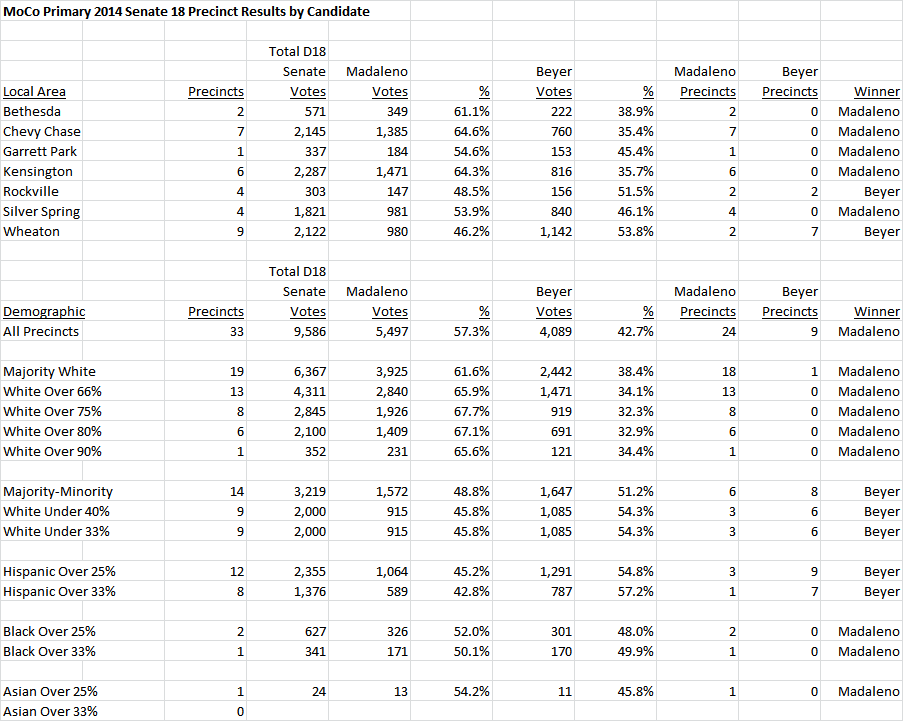
In 2014, Beyer ran against incumbent Rich Madaleno for Senate.  It was a steep uphill climb.  Madaleno is beloved by nearly all District 18 activists and is arguably the most prominent Senator in the district’s history other than the immortal Chris Van Hollen.  Despite all of that, Beyer lost by a 58-42% margin, coming closer to winning than many people believed she would.  She outraised the incumbent by more than 2-1 (if you count her epic self-financing), won the precincts in Rockville and Wheaton and was competitive in Silver Spring and Garrett Park.  Her loss was due to Madaleno running up margins of close to 30 points along Connecticut Avenue.  Still, this was a loss and not a disaster.

So what does all of this mean?  Your author agrees with David Lublin and sees Jeff Waldstreicher as the favorite in this race.  He owns most of the advantages that come with incumbency: fundraising capability in Annapolis (especially with those who have business before his powerful House Economic Matters committee), relationships in the district built through constituent service and relationships with many influential progressive groups who have endorsed him in the past.  He is also a hardworking, adept campaigner who has survived three straight competitive elections.

But Dana Beyer will present a real challenge.  She could wind up spending more than Waldstreicher due to her self-funding capacity.  She has shown some strength in the less wealthy parts of District 18.  And she is more than willing to get tough to win, burying Madaleno in waves of negative mail in 2014.  She is definitely going to bring it against Waldstreicher.

This is gonna be one hell of a race!

Share

63 Legislators Ask Hogan Not to Implement Trump Coal Pollution Standards

Trump’s effort to weaken clear water protections from coal are coming home to Maryland. At issue are three coal-fired power plants that would dump toxic waste into the Chesapeake Bay. Under President Obama’s proposed rules, the plants would have had to make improvements to better protect the environment to renew their permits. Trump has ended those protections. Will Hogan go with Trump or the Bay on this one?

Maryland Coal Letter by David Lublin on Scribd

Share

BREAKING: Dana Beyer Running for Senate

Looks like Jeff Waldstreicher isn’t going to waltz into the Democratic nomination for the open seat being vacated by Sen. Rich Madaleno, who is running for governor. Dana Beyer let it be known last night that she’s running.

A former eye surgeon and aide to one-term Councilmember Duchy Trachtenberg, Dana has sought election unsuccessfully before in District 18, twice for delegate and last time challenging Rich for Senate. She’s built name recognition, is independently wealthy and willing to spend it on a serious campaign. There is no love lost between Dana and Jeff, so expect this to be tough-fought contest at the very least.

Jeff will expect interest groups to go with him as the established incumbent legislator and work aggressively to persuade them that he will win so they should back him, Dana’s entry provides interesting opportunities for groups that feel Jeff has been insufficiently supportive or doesn’t have their back when push comes to shove and want to send a warning.

Dana has been working hard to organize a slate with candidates for delegate. It will be interesting to see if Jeff does the same and whether and how candidates for delegates choose to plump. I’m sure many will be watching Del. Al Carr, who has built a constituency the district’s municipalities–he was formerly a Kensington Councilman–as well as neighborhood associations and civil activists. There are dangers in joining either camp but also in remaining unaligned.

Fasten your seatbelts District 18, it’s going to be a wild ride!

Share

BREAKING: Prince George’s Teachers Walk Out on Rushern Baker at MSEA

At the Maryland State Education Association (MSEA) Convention, Rushern Baker’s camp teachers from Prince George’s County, Rushern Baker’s home county, walked out when he was called to the podium. According to its website, MSEA is the largest union in the state and represents over 75,000 public school employees.

That’s all the information I have for now.

Share

Correction: Raskin Did Not Endorse Waldstreicher

In an analysis earlier this week, I stated mistakenly that Rep. Jamie Raskin (MD 08) had endorsed Del. Jeff Waldstreicher in his effort to win the open District 18 Senate seat. Since then, I’ve learned that Rep. Raskin has told numerous candidates that he not endorsing, at least for now, in open seat races.

I contacted Jamie to confirm this. He explained that he had attended Del. Waldstreicher’s event, organized originally when Jeff was running for reelection to the House, and said some nice things about him but had not endorsed him or any other open-seat candidates at this time. I apologize to Rep. Raskin for the error.

The reason I thought Jeff had been endorsed was a multiplicity of Facebook posts and emails like this:

Del. Waldstricher did not contact me to correct the record after I posted that he had been endorsed by Rep. Raskin. Jeff is certainly not the first candidate to use quotations that make it easy for voters to infer stronger support than exists. But it does feed into criticisms of Jeff voiced by his General Assembly colleagues.

Share

They Just Don’t Get It

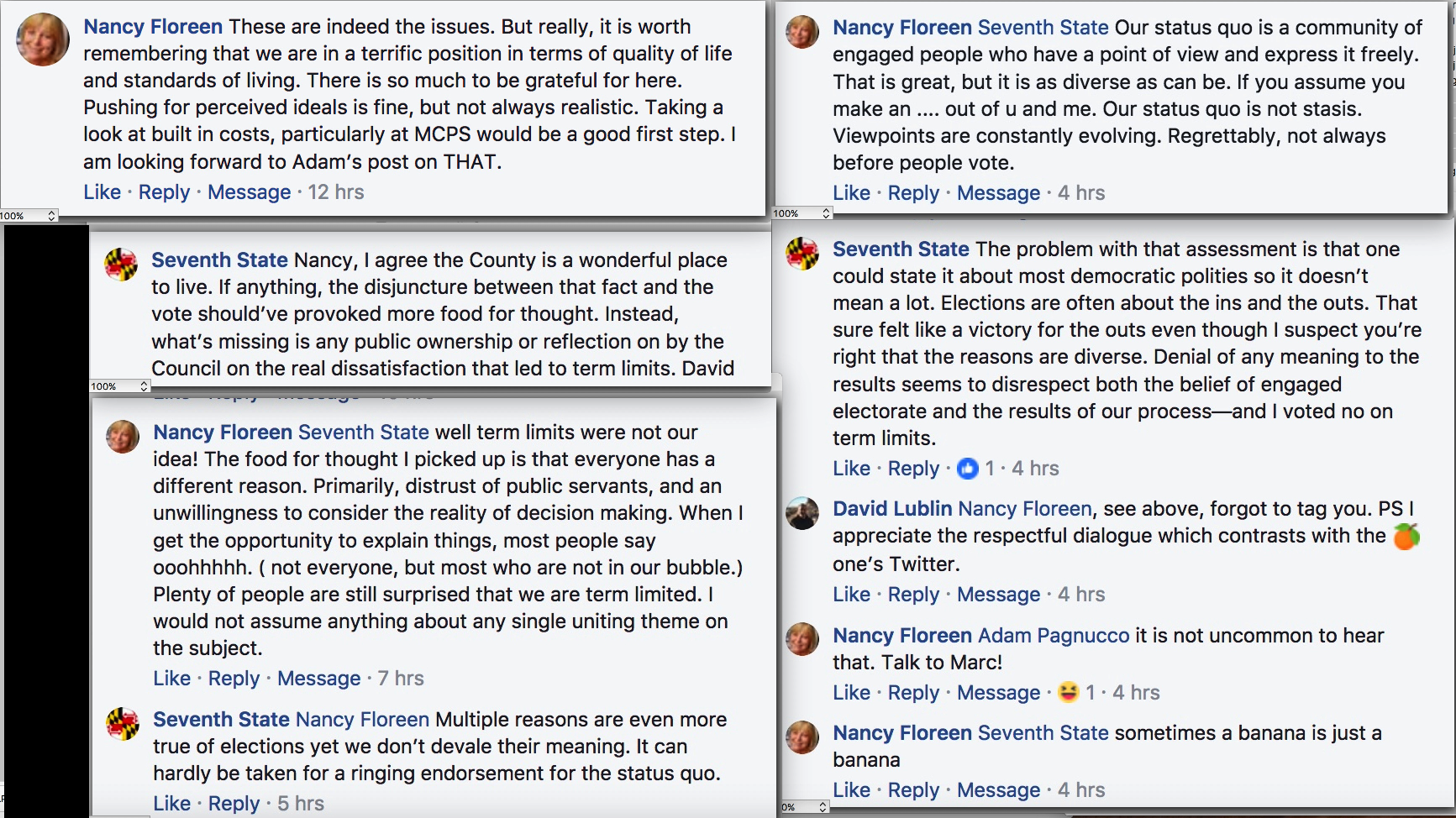
After Adam Pagnucco’s terrific and thought-provoking post from yesterday, I had an interesting conversation with Councilmember Nancy Floreen on Facebook. A very smart and knowledgeable former Council President who is happy to defend her record, the conversation was inadvertently helpful to me in understanding why term limits passed so overwhelmingly.

They Don’t Get It. At All.

Voters didn’t quite say “You have sat too long for any good you have been doing lately. . . Depart, I say; and let us have done with you. In the name of God, go!” in the manner of Oliver Cromwell to the Rump Parliament (repeated famously by a Conservative MP to Neville Chamberlain). But a 70% vote in favor of term limits is pretty darn close.

Yet, reflecting a common view on the Council, Nancy Floreen ascribes no meaning to the vote whatsoever, including viewing it as a vote against the status quo (see full Facebook exchange here). In short, there is now a yawning gap between how councilmembers see their work and the County government, and how voters see them.

This ostrich-like response on term limits–and even though I voted against them and really like and respect Nancy, I don’t know what else to call it–vividly demonstrates this distance and why voters supported them.

The Divorce

On reflection, I realized that something fundamental has changed about how voters see the County government. When I was a more of whippersnapper, people had a much more positive view of the County government. Yes, people paid a lot in taxes but the results were visible in terms of quality services from excellent schools to parks to libraries that made it a great place to raise kids.

People are now much more divorced from their County government–and not just because our population has doubled. Traffic, always bad, is now far worse. We’ve gone through a long period in which taxes have gone up but visible outputs in terms of those excellent services, such as libraries, are going down.

People even worry increasingly about the quality of our beloved school system and whether they’re getting value for money. Metro is no longer spanking new but decaying and dysfunctional. Other infrastructure from electric wires to gas lines to water mains needs replacement.

Why Did Voters Want to Throw the Bums Out?

Many of the problems that the County faces have little to do with its current membership. At least part of the term limits vote stems from having gone through a tough period when difficult, unpopular choices had to be made. And yet, the reasons that voters decided to make the psychological trial separation from the County a full-scale divorce via term limits go beyond that.

The Bubble

County Councilmembers are insulated from the public unless they make a strong effort. The highly symbolic locked door that prevents the plebeian masses from even entering their offices is just the start of it. Staff insulates councilmembers from the public, both by fielding calls and answering email.

Besides naturally supportive staff, councilmembers get a lot of positive feedback from visitors. After all, people lobbying for something tend not to want to alienate the Council. After 12 or 16 years, who wouldn’t be changed by that?

Two Electorates

Roughly 10% of eligible voters participate in the Democratic primaries that elect our local officials. Turnout in Montgomery has been stagnant, so politicians focus on the increasingly small share of people who participate in these contests.

The focus on the odd few of us who vote consistently in Democratic primaries leaves the rest feeling disengaged from politics, as politicians sensibly don’t reach out to them at election time because it won’t help them win.

It also leaves politicians with a pretty warped sense of what the average voter wants because the few who participate in primaries of either party tend to be more extreme than not just the average voter but also the average member of their party.

Term limits was one of the few ways that the other 90% could express dissatisfaction with local officials in a meaningful way other than casting a symbolic vote for a Republican, a brand tarnished by national Republicans that mostly fields weak or even nutty candidates here.

Confusing Congress and Local Government

Too many members of the Council seem to want to be national legislators and opine on the great national issues of the day. Increasingly, this creeps into legislation with more time spent on issues away from core functions.

I miss those wonderful ads with Doug Duncan taking out a voter’s trash. To voters, this said that he got it. One reason County Executive Ike Leggett was able to turn back challenges to his leadership despite being the man in charge at a difficult time was that (1) he showed an unusual capacity for listening at events around the county, and (2) he responded to voters with not just deep fluency on local issues but also a respect for voter concerns. At a town hall meeting with Ike, voters always felt heard.

Property Taxes

Most people’s salaries have been stagnant. Nonetheless, the County raised taxes by over 9%. At a time when many voters find it hard to live within their means, the County made it harder by increasing taxes. As it turns out, berating voters that they don’t care about schools or social justice if they feel this way doesn’t work.

In other words, it is time for the County to start to figure out how to live within its means. Maybe this means tax reform of some sort–no, not in the guise of a massive tax cut like federal Republicans–such as eliminating loopholes that help some but not most of us. Councilmember and County Executive Candidate Marc Elrich made a good start by highlighting an old post by Adam on a tax break for country clubs. But it may also mean taking on labor to rein in costs, actions Councilmember Roger Berliner or Del. Bill Frick, also running for executive, are more likely to do.

The tax argument for term limits was made especially effective by the 28.1% pay increase that the Council voted to award itself in 2013. The Citizens Commission report had recommended a 17.5% increase in one year plus COLAs. That would’ve given the Council a 17.8% increase through 2016 based on the CPI for the Washington-Baltimore region. Comparing annual wages per employee in Montgomery County from 2013 and 2016 reveals that private sector wages have risen just 7.6% in current dollars.

The People v. The Powerful

Monied interests are way better at working Rockville than the rest of us. While members of civic associations are part-time volunteers who are not always up on the latest in ZTAs (zoning text amendments), developers and other powerful interests have expensive lawyers who know how to work the process.

This critique is very different than rich v. poor because the problem affects neighborhoods across the County. Developers and other interests can afford lawyers who can navigate them through the process and leave neighborhoods feeling powerless.

Social Engineering

This intersects with the social engineering tendencies of both the Council and the Planning Board. Personally, I think smart growth is generally a great thing that builds urban nodes like Silver Spring, Rockville and Bethesda where many people want to live or to spend time.

At the same time, it needs to be done with sensitivity and awareness of existing neighborhoods. Most people moved out here for the suburban lifestyle of a house and a yard. They don’t appreciate being told that they’re outdated and even being demonized for caring about their neighborhoods and worrying about whether the infrastructure can handle the growth.

Moreover, those who have lived here a long time have a healthy suspicion of urban planners. In the 1970s and 1980s, these are the same people who told us that elevated urban plazas behind office buildings were the wave of the future. Total disaster.

I think they’ve got it more right this time with smart growth. But carrying it out in such an ideological manner that dismisses neighborhood concerns alienates the people who are supposed to be served. Downcounty residents are mighty tired of hearing patronizing talk of how much they’ll like that new 30-story building looming across the street from their home. Or that traffic is good because it will force us to ride the decaying Metro that doesn’t take us to the supermarket.

Upcounty residents really do want some of those promised roads built and are real tired of begging. If you don’t believe me, check out the hundreds of petition signatures submitted by upcounty citizens (see below) who are deeply unhappy that Councilmember Hans Riemer’s proposed resolution on traffic solutions for the area drops the M-83 extension of the Midcounty Highway.

Put another way, start treating smart growth like a very good idea to be pursued in concert with residents rather than a new religion desperate to burn some heretics. The Council made a good start with the Bethesda Master Plan. It wasn’t perfect but it was a good process so kudos, especially to Councilmembers Roger Berliner, Marc Elrich and Hans Riemer. But concerns have already arisen that development will go beyond what is in the plan, as developers and their lawyers are already working the process.

Ferment in the Land

So yes, it’s definitely “a time for a change” election. Yet, we may end up with a crowd that has much the same views as the previous one but voters will welcome the change of faces. And, who knows, new faces may bring some good new ideas and approaches.

Here’s hoping.

M-83 Petition Signatories 101717 by David Lublin on Scribd

Share

Where Are We Going?

By Adam Pagnucco.

Your author has written over a thousand posts over the last decade about state and local politics.  Some of those posts were tough.  Some called out elected officials by name and others took strong positions on issues that were unpopular with some.  But none of them provoked a more negative reaction from the political establishment in Rockville than our three recent posts on the history of MCPS funding.

Those posts did not contain ad hominem attacks.  They relied on budget data to make a point: the county restricted local funding for public schools for seven straight years and relied on state aid to fund the school system until property taxes were raised last year.  We then recommended that the school system get small, steady per pupil increases to deal with their needs financed by restraint in the rest of the budget.  This was not enjoyed by the officialdom in Rockville.  Terms were used like “misleading,” “distortions,” and “over the top.”  But in the end, the response from Council Member Nancy Floreen wound up confirming, not refuting, much of what we wrote.  There is no real disagreement over the facts of the matter; the budget data tells the same story no matter how it is read.  There is only disagreement over how those facts are characterized.

All of this provokes a thought.  Everyone reading this post has suffered a huge defeat at some point in their lives.  What does one do?  Well, after regaining consciousness and asking, “What the hell happened?” many people try to reconstruct what led to the defeat and assess the various factors that contributed to it, including self-inflicted wounds.  Then a resolution is made to avoid repeating those mistakes in the future.  Sure, we often mess up again.  But sometimes we learn and improve.

For the Rockville political establishment, the 40-point passage of term limits was that moment of huge defeat.  It was the biggest voter revolt since two consecutive County Councils were thrown out in the 1960s.  Where is the self-reflection and soul searching in the wake of that moment?  We’d like to see someone in government say, “Here’s what we learned from term limits.  Here’s what will be different going forward.”  Anyone who does that would deserve great respect.

Your author speaks regularly to candidates who knock on doors.  There is considerable diversity in the views of the voters.  Development is one issue provoking different opinions.  “We need more jobs.”  “We are overdeveloped.”  “We need more affordable housing which is why we need to stop all this building!”  (Yes folks, that was an actual quote from a MoCo voter!)  But there is also a bit of unease.  “My kid’s school is crowded.”  “I pay more in taxes but I’m not getting more in return.”  “I’m having problems affording the cost of living here and I’m worried that my kids won’t be able to afford to live here.”  “The county doesn’t listen to me.”  These are not tea partiers or Trump supporters; these are Democrats who regularly vote.  This isn’t hatred of incumbents.  But lots of folks are asking the same question.  Where are we going?

The interest groups in the county are asking the same thing.  None of them feels content.  The business community, the labor folks, the PTAs, the Realtors, the civic community and the rest of them are all uneasy and some are downright unhappy.  They have more in common than they believe.  What happens when they start talking to each other?

The 2018 election will not be a normal event.  It occurs in the context of a stagnant economy, a school system in desperate need, a tight budget, abject failures in the White House and Capitol Hill and voter rejection of the status quo.  We haven’t seen anything like this in decades.  The good news is that the candidate field is outstanding.  Some of the incumbents have tremendous experience and substantial achievements in their records.  All of them who were in office in 2010 can claim credit for saving the county from complete fiscal disaster.  The non-incumbents are smart, energetic, diverse and gifted in life experience.  Many of them would make great elected officials.

But we need something more.  We need to ask: where are we going?  And where should we be going?  To do that, we have to honestly assess where we’ve been – even if it means breaking a few eggs – and then figure out how to move forward.  It’s not easy.  As the incumbents will tell you, the constraints are real.  Do you want to give more money to the public schools?  Fine – then understand the state’s maintenance of effort law and be prepared to raise taxes or control spending elsewhere in the budget.  Do you want to improve the economy?  Fine – then avoid increasing the difficulty of doing business in the county, especially when it comes to employer costs and predictability.  Do you want to increase incomes?  Fine – that involves a discussion of rebuilding the working and middle classes through encouraging collective bargaining.  Do you want to increase funding for school construction?  Fine – then you need to find new revenue or be prepared to restrain the rest of the capital budget.  Do you want to help immigrants and people of color?  Fine – then be attentive to the needs of small businesses, which in this county are dominated by owners who are immigrants and people of color.  Do you want to close the achievement gap?  Fine – get ready for some difficult discussions about housing policy.  We could go on and on.

These discussions are necessary for us to move forward.  They must be honest.  They must be driven by data, not ideology.  And they must not spare political sacred cows.  Because if we don’t figure out where we are going, we will wind up in one place.

Nowhere.  Nowhere at all.

Share

Maryland Politics Watch