Susan Turnbull is Running for Office. Is it Lt. Gov. with Ben Jealous?

Former national DNC member and Maryland Democratic Party Chair Susan Turnbull established a state-level campaign committee on November 22.  Her committee filing does not list the office for which she is running.  Her campaign chair is former Montgomery County Democratic Central Committee Chair Karen Britto and her treasurer is federal lobbyist Matthew R. Schneider.

It may not be a coincidence that gubernatorial candidate Ben Jealous just sent out a blast email stating that he will announce his pick for Lieutenant Governor tomorrow. Indeed, private reports indicate that Turnbull has agreed to be Jealous’s running mate.

We have asked Turnbull about the office for which she is running.  When (if?) she replies, we will update this post.

If nominated, Jealous-Turnbull would be the first Democratic ticket with no white male on it. I imagine Jealous is hoping that Turnbull will help in Montgomery County, Turnbull’s home. She also has a lot of connections as a former state party chair that could prove useful in raising money and building support around the state.

At the same time, Turnbull’s status as a party insider cuts against Jealous’s effort to campaign as an outside challenger to the establishment. In that sense, opponents can easily cast Turnbull as the ultimate insider despite her lack of experience in public office.

Share

County Executive Candidates on the Liquor Monopoly

Question: The county’s liquor monopoly has come under heavy criticism–not least from Seventh State. If at all, how would you reform or change, or press the state legislature to change, the Department of Liquor Control?

Roger Berliner

At the county level, I have been the chief advocate for ending our unique – and counterproductive – liquor monopoly.  As someone who has fought monopolies most of my professional life, I know in my bones that monopolies are rarely, if ever, in the public interest.  Government monopolies are generally even less efficient.  And a government monopoly that tries to do a job that the private sector does in the rest of the country is almost always less efficient.  That is true in MoCo.  As a result, our residents vote with their feet.  Almost one-third of our purchases of liquor are made outside Montgomery County.  Our restaurants hate it.  Top flight restaurants have said that they would never come here. Bottom line: our monopoly needlessly perpetuates the reputation of our county being anti-business and anti-consumer and stunts our economy.

However, the state is a critical partner in this conversation.  It is state law that created our monopoly, and state law must be passed to change it.  The positive side of this dynamic is that the state would be the principal, direct beneficiary of increased liquor sales.  I would work with the Governor and our legislature to split the savings that the state would derive and hold the county harmless as it weans itself from this monopoly.  The dollars are not that significant given that our retail operations should continue to do well – assuming that they can compete!  And in the long run, our county will prosper more without the monopoly than with it.

Marc Elrich

Any discussion of the Department of Liquor Control (DLC) must acknowledge that the Montgomery County budget relies on over $30 million in liquor revenue per year.  That is no small amount of money, and it supports critical county services, including almost $11 million for bond payments.  Nobody who has proposed privatizing the county’s liquor supply has a workable plan to fill the budget hole privatization would create, likely because there is no way to do so that doesn’t create other problems for the state.

Privatization proposals thus should not be taken seriously; instead, we should continue to look for ways to make the DLC more efficient and effective than it has been in the past, and to increase sales so that we can increase the revenue that the DLC generates.

We’ve already changed the way the DLC is run by bringing in industry professionals, including the director and the warehouse manager, who have improved the operations of the liquor system and brought in a philosophy of continuous improvement.  I’ve also encouraged introducing lower markups for more expensive items, which they did, and I’ve supported and will continue to support efforts to help local breweries and wineries sell and distribute their goods.  Both the new director and I want to hear and consider other ideas for helping transition the DLC from something that the county has long taken for granted into a professionally run system.

In fact, if a private-sector business had a division that produced a substantial profit but was identified as having management problems and customer service issues that prevented it from being more profitable, its most likely course of action would be to change management, work to improve services, and strive for greater profits.  That is exactly what we have been doing with the DLC.

Bill Frick

I have been the state’s leader on fixing this abysmal broken system.  My “end the monopoly” effort, helped immensely by the Seventh State’s Adam Pagnucco, fell short in 2016 in large part because of vigorous opposition from the Council and County Executive.  We agreed to let the Executive lead a work group on the issue, but that work group served no real purpose other than to push the issue onto the desk of the next Executive.

This is a great opportunity.  The DLC has value, and I have proposed to ensure that the value stays with Montgomery County by selling off the DLC’s assets, such as its franchise rights to beer distribution, its stores and warehouse, to generate millions in capital dollars that can be spent on school construction.  Because the elimination of the DLC will generate millions in repatriated sales and excise tax dollars, I would work with my colleagues in the legislative leadership to help return some of those revenues to the County.  Finally, we all know that the work of alcohol distribution will not disappear with the end of the DLC, rather, those jobs will migrate to the private sector and will likely grow in the County as our consumers come home to buy their beer, wine and spirits here.  I will work with the private sector distributors and unions to find the best outcomes for current DLC employees as we get the County out of the liquor business.

George Leventhal

I am willing to entertain serious negotiations with parties who are willing to make a serious offer to purchase the right to distribute beer, wine and spirits in Montgomery County. In FY 2018, that enterprise generated more than $33 million in surplus revenue over expenses to the county’s general fund, of which $11 million was spent on debt service for approximately $100 million in Liquor Control Revenue Bonds, which were issued more than a decade ago to pay for transportation improvements, including the Montrose Parkway. I think we should commission an independent economic analysis of the present value of a guaranteed revenue stream of more than $30 million each year. My understanding is that it would come to hundreds of millions of dollars – more than enough to retire the bonds. I do not think the county should simply give away these valuable rights, which belong to the people of the county. However, serious offers from serious buyers should be considered. Simply giving the rights (and the associated revenues) away would require that the bonds be retired or refinanced through other means. If general obligation bonds were used to refinance the Liquor Control Revenue Bonds, it would reduce the county’s ability to construct new schools and other capital projects by $100 million.

In the absence of a serious offer to buy the rights to the entire enterprise, I continue to support the County Council’s 2015 proposal to privatize special order sales of beer and wine. Problems with delivery of special orders comprise the vast majority of complaints from restaurants, but the Montgomery County delegation to Annapolis declined to take up the County Council’s proposal in the 2016 session after County Executive Leggett asked for more time for study.

The Montgomery County delegation also declined to take up proposals for immediate privatization or for a voter referendum. Candidates for County Executive who have concerns about the Department of Liquor Control’s shortcomings should remember that liquor laws are made in Annapolis, not in Rockville. I would also support action by the state legislature to allow sales of beer and wine in grocery stores. Beer and wine stores will soon be able to sell spirits under legislation that passed in the 2017 session, which I supported.

Share

Should There Be Rent Control Near the Purple Line?

By Adam Pagnucco.

Council Member Marc Elrich, who recently equated potential gentrification near the Purple Line with “ethnic cleansing,” is taking flak for his remarks and is not backing down.  We will leave it to others to judge his choice of words.  But what interests us is the policy proposal he has made: specifically, Elrich would like to see rent control imposed near Purple Line stations.  That’s worth discussing.

Economists tend to disagree on many issues but a huge majority of them oppose rent control.  Liberal New York Times columnist Paul Krugman has written, “Almost every freshman-level textbook contains a case study on rent control, using its known adverse side effects to illustrate the principles of supply and demand.”  A massive review of economic research on rent control found evidence that it encourages conversions of rental units into condos and leads to higher rents in non-controlled units.  Rent control repeal in Cambridge, Massachusetts led to a surge in property values in both controlled and non-controlled units and a 20% increase in housing investment.  Even Communists denounce rent control.  In 1989, Vietnamese Foreign Minister Nguyen Co Thach told a news conference that rent control did more damage to his capital city than American bombs.  “The Americans couldn’t destroy Hanoi, but we have destroyed our city by very low rents. We realized it was stupid and that we must change policy.”

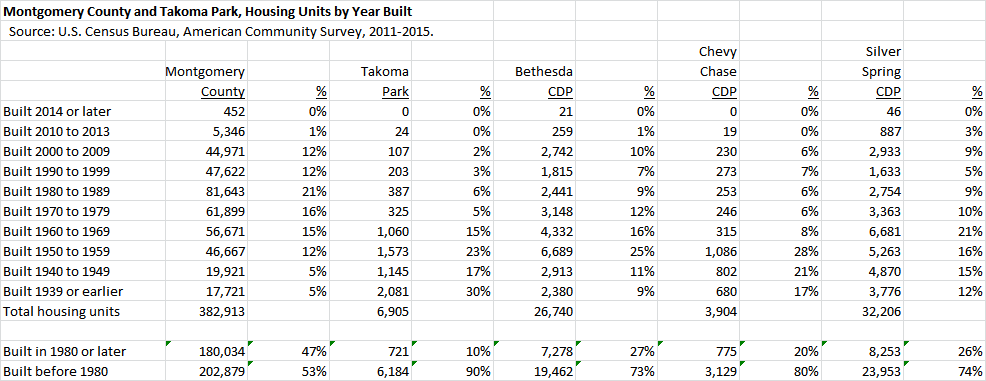
One need not go to a Communist nation to observe the effects of rent control.  MoCo has a good example of that policy right here at home: the City of Takoma Park, which passed a rent control law in 1981.  We examined U.S. Census data to analyze how the city’s housing stock compares to the county’s.  Below we show that just 10% of the city’s housing was built in 1980 or later, much lower than the county’s percentage of 47%.  That’s not a fair comparison since the city is much older than the vast majority of areas in the county.  However, other older areas inside the Beltway like Downtown Bethesda (27%), Chevy Chase (20%) and Downtown Silver Spring (26%) have much higher percentages of their housing built in 1980 or later than Takoma Park.

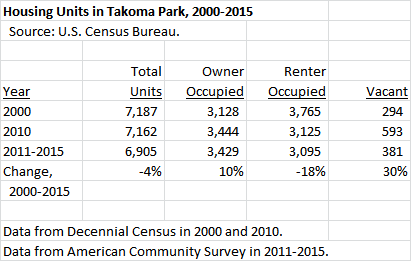
It gets worse.  Takoma Park has been losing rental housing units for years.  Below we show the city’s total, owner-occupied and renter-occupied housing units in 2000, 2010 and the five year period of 2011-2015.  During that time, the city’s total housing units fell by 4% and its renter-occupied units fell by 18%.  Owner-occupied units increased by 10% and vacancies rose by 30%.  No housing policy that produces double-digit losses in rental units can be described as good for renters.

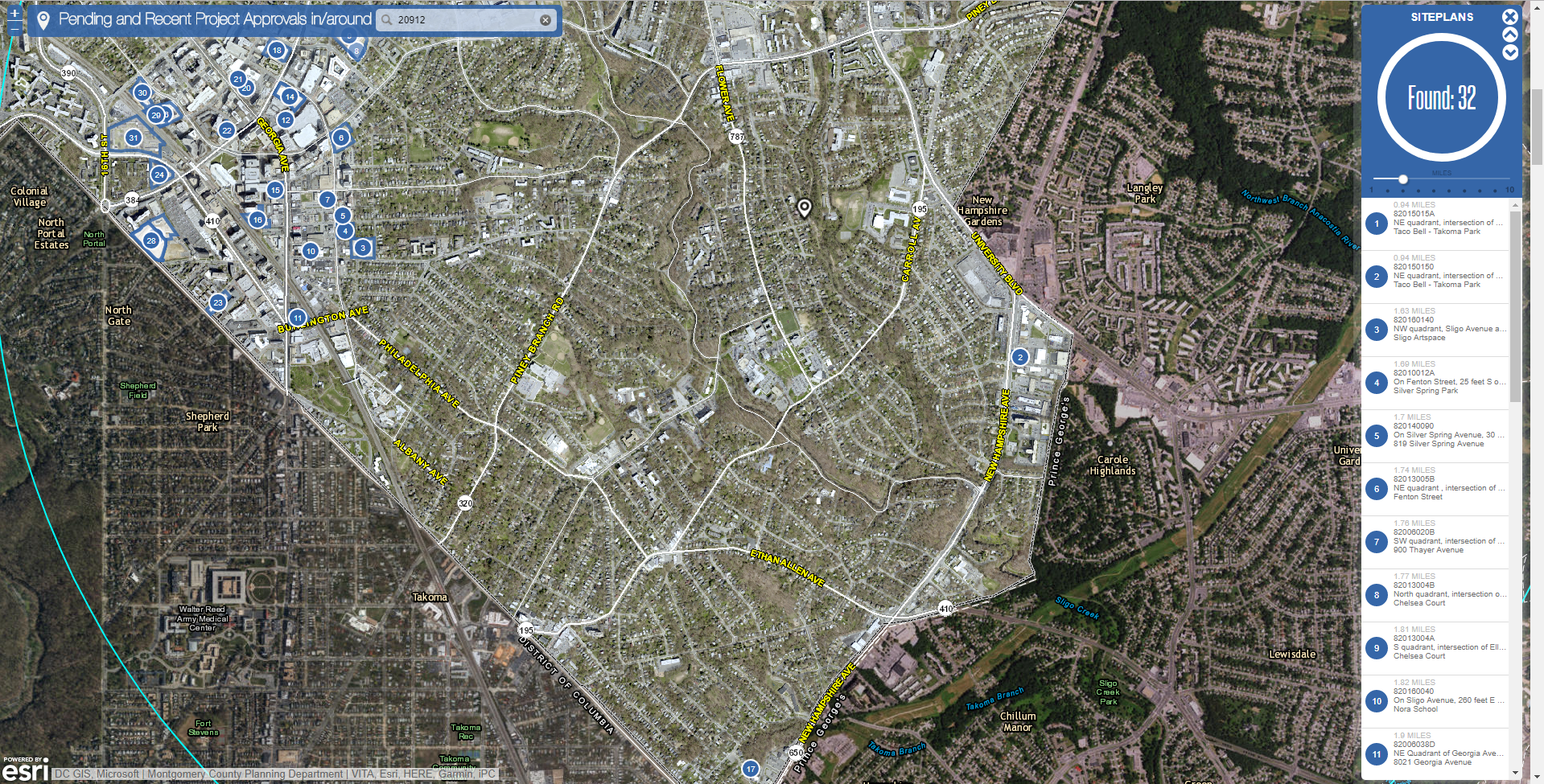
Takoma Park’s housing decline is not going to turn around soon.  According to the site plans, preliminary plans and sketch plans listed on the MoCo Planning Department’s development tracking map, only two housing projects with a combined seven units are pending in Takoma Park.  Those units are all single family, which are exempt from the city’s rent control law.

This extract from the Planning Department’s site plan map shows the huge contrast in development plans between Takoma Park and Downtown Silver Spring.

The implication of all this is clear: housing developers are steering clear of Takoma Park’s rent control law.  These folks are not going to be any more enthusiastic about rent control near Purple Line stations.  Why does that matter?  When it comes to building new housing, there are basically three options.  First, you can build it near transit.  Second, you can build it away from transit, thereby incurring the associated congestion and environmental costs.  Or third, you can try to block it from being built, and that’s one probable effect of rent control.  But that won’t stop population growth – instead, it will result in overcrowded housing, unsafe living conditions and code violations.  (Such phenomena are not unknown in some areas of the county.)  Rent control near the Purple Line just encourages options two and three.

Finally, the Purple Line is a huge investment, costing at least $2.65 billion to construct.  Only an insane society would pour billions of dollars into a transit project and then stop new housing from being built next to it.  Even Vietnamese Communists would agree.

Disclosure: Your author is a long-time supporter of the Purple Line and is a publicly listed supporter of Council Member Roger Berliner for Executive.

Share

Giving Thanks

By Adam Pagnucco.

Today is Thanksgiving, an occasion for celebrating with friends and family and giving thanks.  And we here at Seventh State have many thanks to give.

We are thankful for the reporters, bloggers, troublemakers, rascals, rogues and scalawags who keep our government honest.  And we are thankful to this nation’s founders who created the First Amendment to protect them.

We are thankful for Facebook, which gives us online tirades by politicians available for screen shots.

We are thankful for the liquor monopoly, which gives us a rare county service to complain about.  (Snow plowing season hasn’t started yet.)

We are thankful for public campaign financing, which has helped give us more candidates than can fit in RFK Stadium.

A recent day at the County Board of Elections’ candidate counter.

We are thankful to all the County Council candidates who will shortly be filling out our 72-question questionnaire.  (We are kidding – or so they hope.)

We are thankful to our guest bloggers.  After all, someone has to come up with good content for this site!

We are thankful to David Trone, who has promised to give Total Wine coupons to everyone who votes for him.  (OK, this hasn’t happened, but we are entitled to our fantasies!)

We are thankful to Comptroller Peter Franchot, who is doing everything in his power to help Maryland craft beer connoisseurs.  (His occasional entertaining spats with Senate President Mike Miller are a bonus.)

We are thankful to Council Member Hans Riemer for having the best pair of pants in county politics.  (Not to mention one of the best-looking families of all time!)

We are thankful to everyone who signed the petition to deport Justin Bieber and we hope there is another one.  Perhaps the current President will take action!

We are thankful for Roger Goodell, who might be the only person in pro football worse than Dan Snyder.

We are thankful for Baltimore City State Senator Nathaniel Oaks, who brought back fond memories of Senator Clay Davis.

We are thankful to our many off-the-record sources without whom it would be impossible to understand what the government is doing.  Keep it coming, folks!

We are thankful to the government employees who educate our kids, protect us from crime and provide us with professional, top-notch services every day.  And we are thankful to the private sector employees and business owners who pay for them.

We are thankful for our families and friends, who knock us down when we deserve it and pick us up when we need it.

And most of all, we are thankful to Seventh State readers, who tolerate our dreck and inexplicably come back for more.

Happy Thanksgiving!

Share

Bill Frick: Name One Program You Would Cut

Name one program in the county budget that is not working and can be cut.  Tell us how much in annual savings that would yield.

For too long, Council members have used the County budget as a piggy bank to fund their pet projects and ideas, often ones that could not survive a serious cost/benefit review.

As we reorient County government to be a constituent-consumer focused organization, we can find savings.  For example, the county employs nearly 40 personnel in its 311 call center, despite the dramatic shift in technology away from phone calls and towards electronic communications.  If Montgomery County complemented this with a constituent service app, as exists in neighboring jurisdictions, many constituent services would be routed directly to the relevant agencies instead of going first through bureaucratic call centers, and we could save taxpayer money.

Finally, the County should not be a leader in corporate welfare.  I would end our tax credits for investors, money that goes from everyday taxpayers straight to the pockets of wealthy investors, often to reward them for making investments they would have made regardless.  This is a fight I led at the state level as the architect of the Tax Credit Evaluation Act, legislation to spotlight and reform our runaway subsidies, and by going toe-to-toe with Hollywood to make sure our tax dollars were being spent productively.

Share

Roger Berliner: Name One Program You Would Cut

Name one program in the county budget that is not working and can be cut.  Tell us how much in annual savings that would yield.

I have been a leading proponent of trying to find ways that our county could operate more efficiently.  Working with the County Executive, I was the lead sponsor of legislation that created the Organizational Reform Commission, led by a diverse and talented group of citizens to identify ways we could make our county government more efficient.  However, at the end of the day, while there were steps we were able to take that made our county government more efficient, direct dollar savings were not significant.

I have for years argued that the County Executive should move to what is known as “zero based budgeting”.  What is zero based budgeting?  “Zero-based budgeting is a repeatable process that organizations use to rigorously review every dollar in the annual budget, manage financial performance on a monthly basis, and build a culture of cost management among all employees.”  That would be my goal as County Executive.

In addition to rigorous scrutiny of costs, there are initiatives that you don’t readily think of that can produce cost savings – initiatives like having our county buy 100% renewable power and putting solar on our county rooftops.  Those initiatives alone will save many millions of dollars going forward.  Sometimes doing the right thing actually can save taxpayer dollars!

Share

Raising Money in Public Financing Takes a Long Time

By Adam Pagnucco.

Former Council Member Phil Andrews’s public financing system is in use for the first time during this election cycle.  It has already changed MoCo’s political landscape, with 33 county candidates – a majority of those running – so far enrolled.  It’s a bit early to say exactly how it will impact specific races, but two facts about the system are starting to become clear.

It’s cumbersome to use.  And candidates who use it need a long time to raise money.

We have already written about the burdensome administrative aspects of the system, especially in demonstrating residency of contributors.  (The system only provides matching public funds for in-county individual contributions of up to $150 each.)  An additional difficulty is meeting the thresholds for triggering eligibility for matching funds.  In order to collect matching funds, Executive candidates must receive contributions from 500 in-county residents totaling at least $40,000; at-large council candidates must receive contributions from 250 in-county residents totaling at least $20,000; and district council candidates must receive contributions from 125 in-county residents totaling at least $10,000.

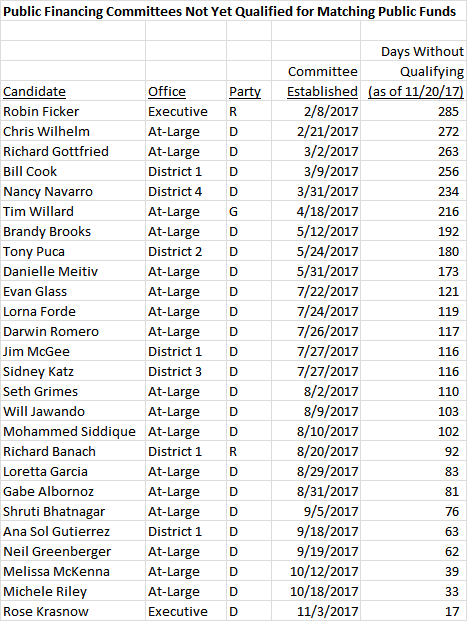
So far, just seven of 33 participating candidates have reached the thresholds for public matching funds.  Council District 1 candidate Reggie Oldak was the fastest to qualify, hitting the threshold in 112 days.  But Oldak is a district candidate, meaning that her threshold is the lowest, and her district is the county’s wealthiest with the greatest concentration of political contributors.  At-large council candidate Hoan Dang hit his threshold in 148 days, barely beating out Bill Conway (155 days).  Council Members Marc Elrich and George Leventhal, who are running for Executive, needed more than 200 days each to qualify despite having large donor bases going back many years.

Then there are the other 26 candidates who have not yet qualified.  Six of them have been running for more than 200 days.  (District 4 incumbent Nancy Navarro will only be eligible to receive matching public funds if she gets an opponent.)  Eleven more have been running for at least 100 days.  Many of the non-qualifiers have been working hard for months.  It’s just tough to meet the thresholds.

Why is it taking so long to get matching funds?  One reason is that Andrews, the system’s architect, did not design the system to be easy.  He explicitly intended that public dollars only go to candidates who were viable in the sense that they had actual grass-roots support.  Another reason is the nature of fundraising itself.  Candidates who raise money turn to families and close friends first; past contributors next (if they have run before); then extended networks of professional connections, acquaintances and supporters’ networks; and finally complete strangers.  As each network gets further away from the candidate, the marginal difficulty of raising dollars increases.  In a public financing context, the first fifty contributions are easier than the next fifty, which in turn are easier than the fifty after that.  The last few contributions to reach the threshold are the hardest to get.

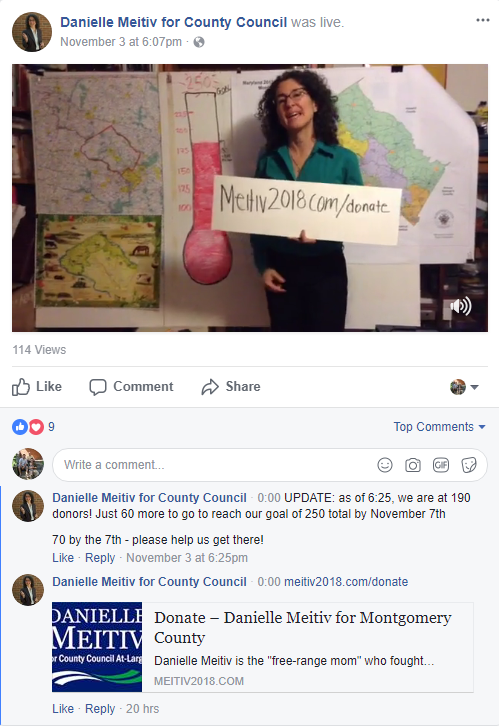
At-large candidate Danielle Meitiv has been working to hit the threshold with a video on Facebook.

Similar observations can be made about traditional fundraising with this exception: the private system has no single trigger that activates a stream of cash all at once.  The candidates in public financing will be weeded into two groups: the ones who get matching funds and the ones who don’t.  The latter group will be doomed to failure.

There’s one more lesson here for candidates: don’t get into a race late and expect to raise lots of money quickly through public financing.  Even if you have a history of donors going back more than a decade like Elrich and Leventhal, the public system is not built for speed.  If you are a late starter, chances are you will need either traditional fundraising or self-financing to close the gap and have a chance to win.

Share

Committee for Montgomery Breakfast to Feature Candidates for Governor

Following is the press release from Committee for Montgomery.

Politics for Breakfast

Maryland Candidates for Governor to Serve Up Buffet of Answers

Media Contacts:
Adam Pagnucco
acp1629@hotmail.com
Jim Neustadt
neustadtjim@gmail.com

Bethesda – November 16, 2017 – It’s time for the Maryland 2018 Governor’s race to start cooking. On December 14th, 2017 the state’s candidates for Governor will dine and then digest many of the controversial issues of the day at the Committee for Montgomery’s (CfM) Annual Legislative Breakfast at the Bethesda North Marriott Conference Center.

Who:  Candidates for Governor
What: One-Hour Panel Discussion
When: December 14, 2017, 7am-10am
Where: Bethesda North Marriott Conference Center, 5701 Marinelli Rd, North Bethesda, MD 20852

Moderator: Josh Kurtz, Founder and Editor of Maryland Matters

Confirmed Participants:

  • Rushern Baker, Prince George’s County Executive
  • Maya Rockeymoore Cummings, Founder, Global Policy Solutions
  • Ben Jealous, Former President/CEO, NAACP
  • Kevin Kamenetz, Baltimore County Executive
  • Rich Madaleno, State Senator, Montgomery County (District 18)
  • Alec Ross, Former Senior Adviser, U.S. State Department
  • Jim Shea, Former Chair, Venable LLP
  • Krishanti Vignarajah, Former Policy Director, First Lady Michelle Obama

Invited Participant:

  • Larry Hogan, Governor

With a board made up of leaders from business, non-profit, labor, education and civic organizations, Committee for Montgomery formed more than twenty five years ago to encourage recognition that all residents of the County share common interests and needs that can be met through sound public policy. CfM works with elected officials at the State level of government to enact those policies. “This forum provides an early look at the candidates as the election is now just seven months away,” says CfM’s Chair, Marilyn Balcombe.  “This is a great opportunity to see all of the candidates in one setting.”

Josh Kurtz, the Founder and Editor of the fast growing political website, Maryland Matters, is the moderator. “The Committee for Montgomery Annual Legislative Breakfast is a powerhouse event, so it’s not surprising that the candidates for Governor want to be there, says Kurtz.  “It’s early in the campaign and they’re refining their messages, so it ought to be illuminating and fun.”

Members of the media are invited. Details regarding credentials, parking, access to candidates and other logistics will be relayed to you in the week prior to the event.

Share

George Leventhal: Name One Program You Would Cut

Name one program in the county budget that is not working and can be cut.  Tell us how much in annual savings that would yield.

I will work diligently with the Office of Management and Budget, and with every department, to find savings and process improvements if I am elected to lead this government. I understand the mission of every county department. I have low tolerance for redundancy. I am prepared to prioritize, and to say no to additional spending where saying no is warranted. One place we could start is by looking at how the county provides health care to its employees.

Montgomery County will spend $245 million in FY2018 on employee health coverage. In 2011, I commissioned a Task Force on Employee Wellness and Agency Consolidation, which recommended adoption of an employee wellness program. It took the Leggett administration until 2015 to get the program fully up and running. Between 2017 and 2018, health claims dropped by $3 million, although it is not clear this is statistically significant, or directly caused by participation in employee wellness programs. I am confident that continued implementation of employee wellness efforts will lead to continued reduction in utilization of health benefits, and increased savings.

The task force also recommended consolidating procurement of employee health coverage between county government, the school system and Montgomery College. The school system and the college have declined to adopt this recommendation. School employee unions feared their members might lose their more favorable benefits. However, the county’s Office of Human Resources already administers health benefits among different bargaining units, and could easily administer health benefits for school system and college employees, resulting in substantial overhead savings, and savings from group purchasing. I will continue to advocate for unified administration of health benefits among all three agencies.

Additional overhead savings, and efficiencies from volume purchasing, could also be achieved by consolidating procurement of all goods and services for county government, MCPS and Montgomery College in a single office.

Share

Maryland Politics Watch