Moon Explains Failure of Country Club Tax Break Bill

By Adam Pagnucco.

In the wake of the failure of his bill that would have phased out a special property tax break for MoCo country clubs, the Facebook page of Delegate David Moon (D-20) saw an eruption of commenters expressing outrage, disbelief and mockery.  (Some raised the prospect of starting country clubs in their back yards to get similar tax breaks.)  In response to repeated requests, Moon analyzed the arguments against his bill and told the story of how it died.  Moon’s account contains references to a well-intended amendment by Delegate Eric Luedtke (D-14), who tried to narrow the bill to allow it to pass.  But he also describes the tactics used by a lobbyist hired by the clubs to kill the bill which demonstrate just how far some special interests will go to protect what they have been granted by government.  We intend to find out what that lobbyist was paid when reports come due.

We reprint Moon’s breakdown of the arguments against his bill below.

*****

Let me finally try and add some detail to this bill.

Argument 1 – Treating MoCo Differently Than Other Counties: The bill as originally introduced repealed these tax breaks for all of Montgomery County’s golf courses. State law doesn’t allow counties to asses property differently from one another, so the bill needed a constitutional amendment (subject to approval by voters), to give MoCo permission to repeal the Country Club tax breaks. Some people (including Ike Leggett) argued that MoCo shouldn’t be taxing country clubs differently from other counties. I found that argument unpersuasive, as MoCo has a majority of the state’s country clubs receiving this tax break. Additionally, MoCo loses far more money from this tax break than other counties. This is because in 2002, state law created a flat fee for country club assessments at $1,000 an acre. The problem with that is that in MoCo, many of our country clubs are sitting on land worth between $300,000 and $1 million per acre. You will not find that scenario in any other county, as their land is worth far less. So the flat fee seriously harms counties with valuable land. I offered one amendment to change the bill to simply say the county should decide the country club tax assessments, since they are the ones losing money from this. That amendment failed narrowly. But even still, some people simply had a problem with amending the state constitution to fix this problem. I honestly don’t care what the mechanism is to address the issue (we inserted slot machines into our state constitution, for example). I also have a statewide bill (HB 1340) that addresses this issue by changing the $1,000/acre assessment to 1% of market value, to account for the different land values in Maryland. A few of my colleagues suggested this issue should be taken up as a statewide measure and didn’t think it made sense as a local bill. But to be honest, one of the reasons I did both a local bill and a statewide bill is that it will likely be far more difficult to persuade lawmakers from around the state to fix this broken system. It now remains to be seen whether lawmakers who opposed my MoCo bill on the grounds of treating all the counties the same will now support the statewide bill. I will forward the state bill to the County Executive to see if it now addresses his stated concerns.

Argument 2 – Some Country Clubs Are In Poor Financial Shape: A common argument made against my bill is that of the 15 or 16 MoCo golf courses receiving this tax break, not all had wealthy members. Some argued that they were teetering on the brink of closure and would shut down if this bill passed. The country club lobbyist got all the janitors and service staff from the clubs to come to Annapolis and tell lawmakers they would all be fired if the bill passed. It was a true spectacle. I tried to counter this argument with amendments to make the bill more need-based. I proposed that we cap the tax discount at the first $400,000 per acre of market value, so that almost all of the clubs would be unaffected except for the super wealthy ones that charge huge initiation fees ($40,000 to $70,000 just to join). The country club lobbyist opposed this and other amendments. Basically, they were saying this would put courses out of business, but when we proposed amendments to make that not the case, the lobbyist opposed those fixes, too. Nice move! To be fair to my House colleagues, they never had an opportunity to vote for this version of the bill, because we didn’t adopt the narrowing amendments in subcommittee.

Argument 3 – Country Clubs Provide Jobs & Do Charitable Work: Another routine argument during this debate was that the country clubs employ people and let charities use their facilities. My response here is that plenty of entities employ people and do charitable work AND pay their taxes. But what this argument really turns on, is the idea that passing this bill would put the clubs out of business. As I noted above, I had an amendment to address that issue, but the country club lobbyist (who was formerly a State Senator who sponsored the bill for country club tax cuts) opposed the amendment. Come on now.

Argument 4 – Open Space & Those Evil Developers!: Yet another frequently cited argument against my bill was that the country clubs would close and lead to rampant development. The Sierra Club ought to go do a membership drive at country clubs, because apparently there are hundreds of open space conservation activists at country clubs, and we didn’t know it! Kidding aside, there are a number of reasons why this is a flawed argument. First, it assumes that country clubs will close BECAUSE OF this bill. As I noted above, I offered to amend the bill to exclude clubs that are not wealthy. Second, you would have to believe that a wealthy club with hundreds of acres of land worth $1 million/acre and waiting list to join would shut the entire club over a tax bill increase in the thousands. As some have noted, the wealthy clubs could simply add some members or sell a tiny piece of their land IF this was really an issue (and I doubt it is, with the amendments I offered). Moreover, the teetering country clubs are in trouble because there is a generational shift away from golf being a popular hobby. We didn’t throw money at Blockbuster or Tower Records to keep those businesses open when the market shifted on them, but then again, their customers were not wealthy and politically influential people. Additionally, nothing would stop the county from exercising its zoning and staging authority over a failed country club, and I would be willing to bet that’s exactly what would happen if one of these clubs failed. Let’s also be clear that even if you don’t like development, only ONE of these clubs was in the Ag Reserve, and Eric Luedtke offered an amendment which I supported to exclude that club (it was rejected). Many of the clubs inside the beltway are in areas of the county that are zoned for development (not open space), per the master plans that guide county development. If people have a problem with that, they should argue for extending the Ag Reserve to the DC border, near highway exits and transit (an absurd policy proposition). Given that many of these inside-the-beltway clubs are located in highly desirable school districts, this amounts to an argument for residents who are privileged enough to live in the W cluster keeping out others who also want the privilege to live there. The tax implications of this de facto development moratorium are far greater than $10 million a year for the county. Moreover, a supermajority of MoCo lawmakers also cosponsored the bill to drop 50,000 Amazon workers onto the county without worrying about the development implications. But remember once again, that there were amendments offered to take this development issue off the table.

When I first embarked on this effort to rein in country club tax breaks, I thought this would be a simple bill. Boy was I wrong! I now know more than I could’ve imagined about this issue, and the more I learn the more I’m convinced that this situation is seriously messed up. I’ll be back with more legislation on this issue next year, including looking at how we enforce the anti-discrimination provisions regarding country clubs and pesticide restrictions for clubs receiving these tax breaks (since the environmental, open space argument is being made!).

In the meantime, I encourage everyone to listen to Malcolm Gladwell’s fascinating podcast on this topic.


Share

Madaleno Announces Running Mate

Luwanda Jenkins and Rich Madaleno

Here is the press release from the Madaleno campaign:

Democratic Gubernatorial Candidate Rich Madaleno Selects Baltimore Native, Luwanda Jenkins, as Running Mate

BALTIMORE, Md.—Democratic gubernatorial candidate Sen. Richard Madaleno announced today his selection of Baltimore native Luwanda Walker Jenkins as his running mate.

Jenkins, 55, has a record of results from her extensive work in the public and private sectors to expand opportunity for all Marylanders, especially women and minorities.

“Luwanda and I are committed to making Maryland the state that will be known for its high quality of life, progressive values and wider access to opportunity for all,” Madaleno said. “Luwanda shares my values and sensible vision for Maryland’s future and will strengthen my administration’s ability to achieve my goals, especially in the areas of economic development and expanding small business development for minorities and women.”

The announcement was held at Western High School in Baltimore, the city’s all-girls public high school that she attended. “Western set the foundation for my support for a strong public education system and to do whatever I can to help families achieve the American dream,” Jenkins said.

“I’m thrilled to join Rich. My entire career has been about leveraging opportunity to make a better quality of life for Marylanders. I’m excited to travel across the state and share our ticket’s plan for action and engage Marylanders in how to make our state better,” she said.

Jenkins said she would focus on four main areas: improving K-12 public education, especially for high-poverty communities, and ensuring more college affordability and access; reducing wealth inequities; growing women- and minority-owned small businesses; and ensuring gender equity to increase Maryland’s competitiveness.

“Between our shared progressive vision for Maryland, my budget and finance mastery, and Luwanda’s economic development and community relations expertise, we’ve got a winning team,” Madaleno said.

A Madaleno-Jenkins vision for Maryland presents a stark contrast to Gov. Larry Hogan’s agenda.

“Our vision focuses on improving the quality of life for all Marylanders and making sure that people and communities with the most needs actually get the help they need to succeed. We will work to strengthen communities—from urban centers like Baltimore to rural areas on the Eastern Shore and in western Maryland—and make wise budgetary decisions that will make positive change but won’t break the state treasury,” Madaleno said.

Jenkins has wide experience in the public and private sectors. Most recently, Jenkins has been the chief operating officer of the LEADERship program, a Baltimore-based leadership development program. From 2016-17, Jenkins was vice president of community relations and diversity at The Cordish Companies. During her 2012-15 tenure at Coppin State University in Baltimore, she was involved in implementing the “Coppin State University Review Plan” that addressed the university’s performance, fiscal accountability, enrollment and graduation rates to put the university on a course for future growth. As former Gov. Martin O’Malley’s special secretary of the Office of Minority Affairs from 2007-12, Jenkins created programs to provide opportunities for small and minority-owned firms in the state.

As a way to give back to her hometown of Baltimore, Jenkins coordinated the Baltimore Sun’s “Reading by 9” program to help strengthen Baltimore City school children’s reading achievement. The program included community book distributions to low-income children, summer reading programs and grants to non-profit literary organizations. The program won national and local awards.

# # #

Madaleno bio – http://madalenoformaryland.com/meet-rich/

Jenkins bio – http://madalenoformaryland.com/meet-luwanda/


Share

Licensees Complain of Ordering Outage at Liquor Monopoly

By Adam Pagnucco.

The Montgomery County Licensed Beverage Association, which was founded by licensees as “a voice for Montgomery County retailers and restaurants against unjust DLC practices,” is complaining about a maintenance outage in the liquor monopoly’s iStore and iSupplier ordering systems.  This is the second complaint about the monopoly this week after the co-owner of a closing Silver Spring restaurant blasted it as having a “bloated and antiquated bureaucracy.”  We reprint the association’s Facebook post, which contains DLC’s notice, below.

Share

Hogan Cheerleader Blog Continues MD GOP Fear Mongering Campaign


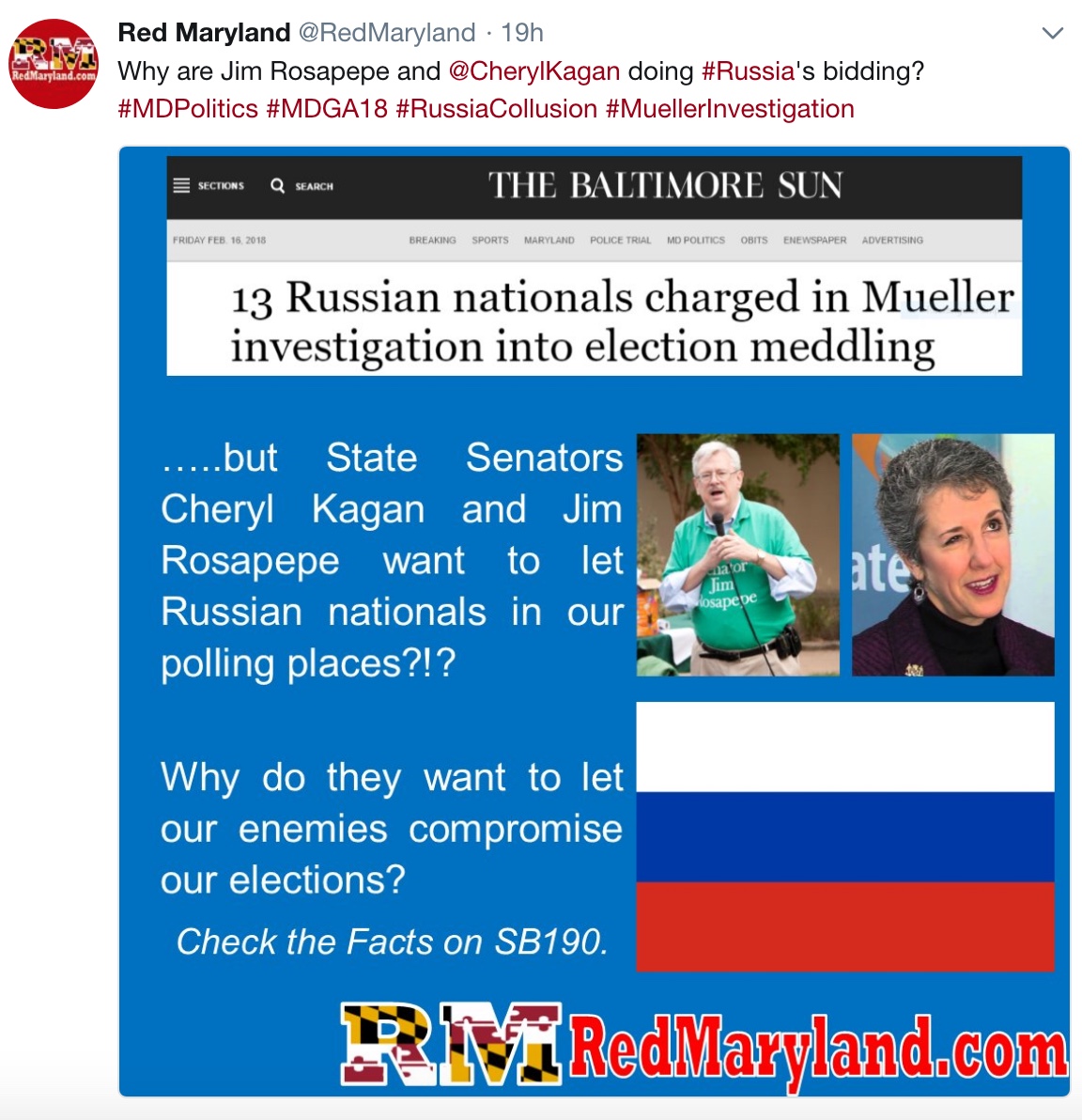
There they go again. Building on the Maryland Republican Party’s  fear mongering mass email over foreign election observers, Hogan Cheerleader Blog Red Maryland continues the scam by implying that election observers would be Russian and this is how the Russians interfere in our elections.

Of course, anyone who reads a newspaper should know this isn’t how the Russians tampered in 2016 and that fighting off observers is playing into Trump’s “fake news” scam by fighting off efforts to improve and to secure our elections.

The could have also bothered to search the web and found the 2016 OSCE election report. Among the over 400 observers were exactly two from the Russian Federation. In contrast, the United Kingdom and Spain, to take just a couple of examples, sent 25 apiece. You can read their final report, including recommendations, here.

Red Maryland bloggers may not say they don’t like Trump and Hogan is different. But they sure are his – and Larry Hogan’s – “useful idiots” as Lenin might say. Needless to say, Governor Hogan has remained #HoganSilent on MD GOP Trump tactics.

Share

MoCo Delegates Kill Moon Country Club Bill

By Adam Pagnucco.

Montgomery County’s Delegates have killed a local bill proposed by Delegate David Moon (D-20) that would have eliminated a special tax break for country clubs contained in state law.  Seventeen Delegates voted to kill the bill while seven voted in its favor.

Under current state law, the State Department of Assessments and Taxation (SDAT) is permitted to enter into agreements with country clubs possessing golf courses that would set the assessed value of their land at $1,000 per acre.  Moon’s bill would have phased out these agreements in Montgomery County subject to approval by voters.  The fiscal note on the bill indicated that the state government would have received an extra $1 million a year in tax revenue and the county government would have received an extra $10 million a year once the agreements were ended.  Despite the fact that the county just reported a $120 million shortfall, neither the County Executive nor the County Council supported the bill.

Since it was a local bill, the bill needed to clear Montgomery County’s House delegation before advancing to further votes by the county’s Senators and the full General Assembly.  That vote took place this morning.  After two unsuccessful attempts were made to amend the bill, Delegate Kathleen Dumais (D-15) made an unfavorable motion on it, which is tantamount to a no vote.  Delegate Sheila Hixson (D-20) seconded the motion.  Seventeen Delegates voted in favor of that motion and seven voted against.  The seven Delegates who voted in support of Moon’s bill were Moon, Ana Sol Gutierrez (D-18), Aruna Miller (D-15), Andrew Platt (D-17), Jeff Waldstreicher (D-18), Shane Robinson (D-39) and Jheanelle Wilkins (D-20).  We reprint the vote tally below.  In reading it, remember that a “Yea” vote is a vote to kill the bill.

Share

Co-Owner of Closing Restaurant Blasts Liquor Monopoly (Updated)

By Adam Pagnucco.

A co-owner of The Classics Restaurant, a Silver Spring steakhouse, has issued a statement placing part of the blame for his decision to close on the county’s liquor monopoly.  Co-owner Elliott Rattley said in part:

After some eleven and a half years, the Montgomery County Government has yet to show any support for the independent businessman in this area. Along with the onerous burden that the ineffective Montgomery County Department of Liquor Control places on an independent operator by their over the normal, for every local jurisdiction, pricing structure to support a bloated and antiquated bureaucracy, and the unfriendly business climate that Montgomery County in general creates, the continuance of this business is untenable. Of course, the loss of a Fortune 500 company directly across the street hastened this decision. (Discovery Channel)

Source of the Spring has the full statement.

In 2015, Delegate Bill Frick (D-16) introduced a bill that would have allowed MoCo voters to decide whether to end the monopoly.  An online petition initiated by your author gained more than 2,000 signatures from consumers, retailers and restaurant operators in favor of Frick’s bill.  County Executive Ike Leggett and the entire County Council except for Council Member Roger Berliner fought the bill and the delegation declined to pass it.  Seventh State asked Frick, Berliner, Council Member Marc Elrich and Council Member George Leventhal, all of whom are running for Executive, for their positions on the monopoly.  You can read their responses here.

Update: Patrick Lacefield, the county’s Director of Public Information, gave us the following on-the-record statement: “Our records indicate A single complaint ever (December 29, 2015 about an item not delivered).  Plus a $1000 fine for serving an underage person on December 5, 2013.  That’s pretty slim evidence.”

Share

Hogan Republicans Run Trump’s Playbook on Russia and Election Fraud

Can we please stop pretending that Larry Hogan is some sort of goo-goo Republican reformer?

Yesterday, the Maryland GOP sent out a hysterical email railing against – gasp – foreign election observers of American elections:

Do you think foreign nationals should be openly invited into our polling places on election day? Democratic Senators Kagan and Rosapepe think so.

For all the complaints about potential foreign involvement in U.S. elections, Maryland Democrats sure are trying to invite outside influences into our elections…

Now, they have introduced SB 190 that would give an international election observers the same rights as a U.S. citizen to watch over our elections for any polling place in the state that they see fit.

This bill gives foreign nationals the right to:

  • Go to polls unsupervised and move from poll-to-poll
  • Enter the polling place one-half hour before the polls open
  • Enter or be present at the polling pace at any time when the polls are open
  • Remain in the polling place until the completion of all tasks associated with the close of the polls
  • A police officer who is on duty at a polling place shall protect an international election observer in the discharge of the duties of the international election observe
  • The election judge shall designate reasonable times for international election observers to examine polling lists

SIGN AND SHARE the petition if you believe the Maryland Senate should vote AGAINST SB 190! 

I don’t know who came up with this unhinged horror at a piece of legislation that should be so uncontroversial as to verge on banal. Foreign election observers are common in elections around the world. The U.S. sends observers to countries around the world as part of observation missions.

Indeed, the American government plays a major role in funding these initiatives through the International Foundation for Electoral Systems (IFES), the International Republican Institute (IRI), National Democratic Institute (NDI), Organization of American States (OAS), and Organization for Security and Cooperation in Europe (OSCE). All but the last are based in Washington.

Beyond the creepy weirdness of attempting to whip voters up over people observing – a word that specifically excludes any participatory role  – our elections, this is right out of the Trump playbook because of (1) its xenophobic attack on foreigners as somehow inherently nefarious, and (2) being resistant to any effort to improve the electoral process whatsoever.

Trump is impervious to protecting our elections from proven Russian interference in our elections because it helps Republicans. (Ronald Reagan must be rolling over in his grave.) Under Larry Hogan, the Maryland GOP shows similar hostility to the most mild effort to improve our democracy in their effort to whip up hate about a bunch of foreign election experts who will come here, observe elections, and write a tempered report with a few suggestions for improvement.

The Governor has just lost what little credibility as a reformer he had. He is willing to speak out against redistricting in Maryland, because he thinks it will benefit his party, but totally silent on Republican efforts to protect it north of the Mason-Dixon and south of the Potomac.

Yet he found time to travel to Virginia to support the odious Ed Gillespie in his effort to become governor using hateful rhetoric and scaremongering. Despite Gillespie’s flop, Hogan apparently decided to import Gillespie-type tactics.

If Larry Hogan’s Republicans were remotely reasonable, they would never publish something like this. The Governor needs to repudiate it immediately and replace the people in the Maryland GOP who came up with this piece of tripe.

Share

MoCo Endorsements: February 15, 2018

By Adam Pagnucco.

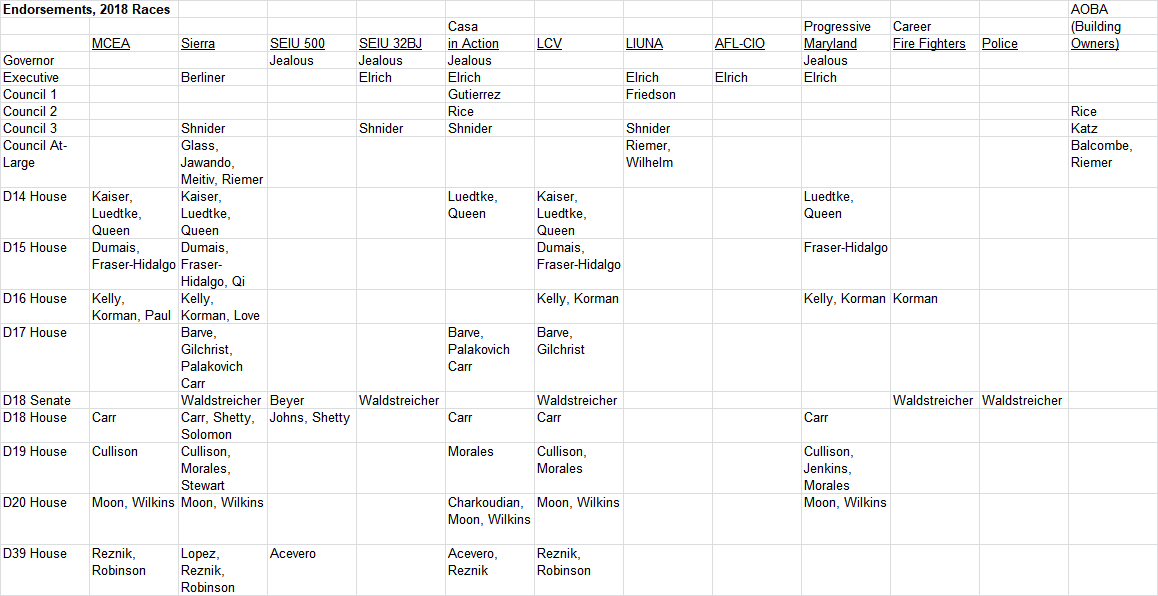
Below, we present a preliminary list of institutional endorsements for MoCo candidates in contested races.  These lists are incomplete for two reasons: first, several influential players (like MCGEO, the Washington Post, the Volunteer Fire Fighters and the Realtors) have not concluded their endorsement processes and second, many of those who have endorsed have decided on some races but not yet others.  That is particularly true of MCEA, holder of the mighty Apple Ballot, which has issued one round of endorsements and will be issuing another round shortly.

A few notes.

First, incumbents are cleaning up as usual.  Challengers, we know you think you can do a better job than them.  But the incumbents have cast real live votes and have relationships you don’t have.  Deal with it!

Second, a handful of non-incumbents are starting to rack up progressive endorsements.  In MoCo, the two who stand out are Council Member Marc Elrich, who is running for Executive, and District 3 County Council candidate Ben Shnider, who is challenging incumbent Sidney Katz.  If Shnider’s endorsements keep snowballing can he pull off the unthinkable?  Delegate Jeff Waldstreicher, who is running for Senate, has now claimed five major institutional endorsements against one claimed by his opponent, Dana Beyer.

And third, there are so many big endorsements that have not yet come down.  It’s still early so don’t carve anyone’s tombstone yet.  That is particularly true of the Council At-Large race, where only incumbent Hans Riemer is building a big stack of them.  The coming endorsements could act as a critical differentiator in a historically huge field.

We will be updating this list periodically.  We will not be including individual endorsements from elected officials or other prominent muckety-mucks.  (OK, maybe if Barack Obama gets involved, we will make an exception.)  And we will not be listing endorsements from tiny, piddly-squit groups that have never shown any game here.  That means if the Wheaton Beer-Drinking Bass Guitarists Political Club issues an endorsement list, tough beans! – we will not be running it.

To be continued.

Share

Deportation Legal Defense is the Montgomery Way

By Seth Grimes.

Someone asked me earlier this week, “What is Montgomery County doing really well?”

My answer: We are a welcoming, compassionate, and inclusive community. That’s the Montgomery Way.

The Montgomery Way: Our $312 million Health & Human Services budget funds an array of programs that assist our most vulnerable neighbors. Our “inclusionary zoning” approach to land use has made the County an affordable housing leader. And we stand with our immigrant neighbors, including undocumented individuals, in the face of Trump Administration attacks and Republican congressional complicity.

Let’s credit County Executive Ike Leggett with shaping this ethos, which includes a policy of public-safety non-cooperation with federal immigration authorities. Yet attacks on immigrants are intensifying, nationally and here in the Washington DC area. We must respond. Let’s consider two ways we can strengthen local protections.

Montgomery County should fund deportation legal defense and pass a Community Trust Act that formalizes ICE non-cooperation as County law, a step promoted by CASA de Maryland.

Momentum toward these local steps has been building over the course of Donald Trump’s year in office. A start: I recall a productive Takoma Park Mobilization meeting with County Councilmembers Marc Elrich and George Leventhal last February at my office, to broach both ideas. (I’m a Mobilization co-founder; the Mobilization grew out of a November 11, 2016 Rally for Community, taking place the Friday after Trump’s election, that I initiated to show solidarity with immigrant and Muslim neighbors.)

Progress can take time, however; in the last year, the threat to undocumented neighbors has only grown. It’s time to act.

A Montgomery County Deportation Defense Coalition is pushing for action, for funding in the County’s FY19 budget. The Coalition’s argument: “Immigrants in deportation proceedings are not entitled to court-appointed counsel. This means that immigrants who cannot afford to hire an attorney must represent themselves. Per a nationwide study by the University of Pennsylvania School of Law, represented immigrants are 5.5 times more likely to win their case than non-represented immigrants.” Implicit is that it is our collective duty to stand with and support our neighbors facing deportation.

Public deportation legal defense funding could support and expand the work done by organizations such as Kids In Need of Defense (KIND), which seeks to ensure that every child in the immigration system has a lawyer. Ayuda and the Capital Area Immigrants’ Rights (CAIR) Coalition also provide legal services to individuals facing deportation. We’re not talking about a new assignment for the County Attorney.

There’s more we can do. A new Maryland Legislative Coalition, working closely with ACLU PeoplePower, is backing the Maryland SAFE Act, currently before the General Assembly. SAFE stands for Supporting All Families Everywhere; PeoplePower is an initiative dedicated to grassroots action in defense of civil liberties. The SAFE Act, HB 1461, was introduced Delegate Ana Sol Gutierrez. It would limit Immigration cooperation by state authorities and provide immunity and indemnification for officials who do not cooperate. SAFE is another form of deportation legal defense. I testified for 2017’s failed Maryland Law Enforcement and Governmental Trust Act, and I support this year’s very similar SAFE Act in addition to local, Montgomery County action.

Deportation legal defense is the Montgomery Way, a set of concrete steps we can and should take to ensure that ours remains a welcoming, compassionate, and inclusive community. The Trump Administration is targeting our immigrant neighbors. Deportation legal defense is an important way we can stand up and fight back.

Seth Grimes is a candidate for County Council At-Large.

Share

Backlash Builds Against Baker Endorsement of Trone

Prince George’s County Executive Rushern Baker is experiencing a rapid backlash against his endorsement of wealthy businessman David Trone in his bid for the Democratic nomination for the Sixth Congressional District.

Baker announced his support for Trone two days ago. Today, the Washington Post reported that Trone, his family members and company have donated a total of $39,000 to Baker’s gubernatorial campaign. My own quick scan of Rushern Baker’s latest campaign finance filing revealed the following donations:

David Trone, $6000, 10/5/17;
Julia Trone, $2000, 11/16/17;
June Trone, $6000, 10/5/17;
Michelle Trone, $6000, 11/5/17;
Natalie Trone, $2000, 11/16/17;
Natalie Trone, $3000, 11/16/17;
Robert Trone, $2000, 11/16/17;
Anna-Marie Parisi-Trone, $6000, 11/16/17;
Anna-Marie Parisi-Trone, $6000, 11/16/17.

While David, June, and Robert Trone are described as affiliated with Total Wine, Natalie Trone is listed as a student and Michelle Trone with The Boston Consulting Group (BCG). All of the donations were made in October or November of last year.

Problems for Baker

There is certainly no proof of pay-to-play or corruption. Indeed, Baker has been a welcome breath of fresh air on that front in Prince George’s after the disastrous Johnson years. However, Baker’s decision to endorse in a race outside of Prince George’s has raised eyebrows.

In particular, I heard that senior women in the General Assembly are especially annoyed at Baker’s decision to endorse in the race when there was an experienced, talented and respected female legislator, Del. Aruna Miller, in the race. Baker’s wading into the race surprised many, as the Sixth does not overlap with Prince George’s.

Today, that frustration emerged more publicly in the form of a wave of endorsements of Miller’s campaign by her colleagues, especially many senior women. Miller’s campaign issued a press release (see below) touting support from:

Speaker Michael Busch,
Speaker Pro Tem Adrienne Jones,
Chair Emerita Sheila Hixson,
Appropriations Committee Chair Maggie McIntosh,
Environment and Transportation Committee Chair Kumar Barve, Ways and Means Committee Chair Anne Kaiser,
Health and Government Committee Chair Shane Pendergrass, Judiciary Committee Chair Joe Vallario,
Judiciary Committee Vice-Chair Kathleen Dumais,
Appropriations Committee Vice-Chair Tawanna Gaines,
Women’s Caucus Chair Ariana Kelly

It will be interesting to see if this backlash impedes Baker’s efforts to reach further outside the County. Similarly, I’m curious to see if Montgomery County Executive Ike Leggett, a strong Baker supporter, endorses a candidate in the Sixth District. Unlike Baker, Leggett has long had constituents in the Sixth.

Problems for Trone

Baker’s endorsement has also revived talk of Trone’s use of his wealth. Two years ago, Trone told the press bluntly, “I sign my checks to buy access.” Indeed, former Virginia Gov. Bob McDonnell’s lawyers cited this statement in their brief appealing McDonnell’s corruption conviction. County Councilmember George Leventhal also needled Trone regarding his gaffe.

Now, as Michael Kinsley once said, a gaffe is simply when a politician speaks the truth out loud. Trone was forthright and honest on this point, in a manner similar to Donald Trump in presidential bid. But the similarities to Trump and the current concerns regarding the corruption of American politics are hardly likely to endear him to Democratic primary voters.

Aruna Miller for Congress Press Release by David Lublin on Scribd

Share

Maryland Politics Watch