MoCo Endorsements: March 9, 2018

By Adam Pagnucco.

We have entered the thick of endorsement season and a big one just came out: a partial decision by MCEA, holder of the mighty Apple Ballot.  We have updated our institutional endorsement matrix and offer some comments below.
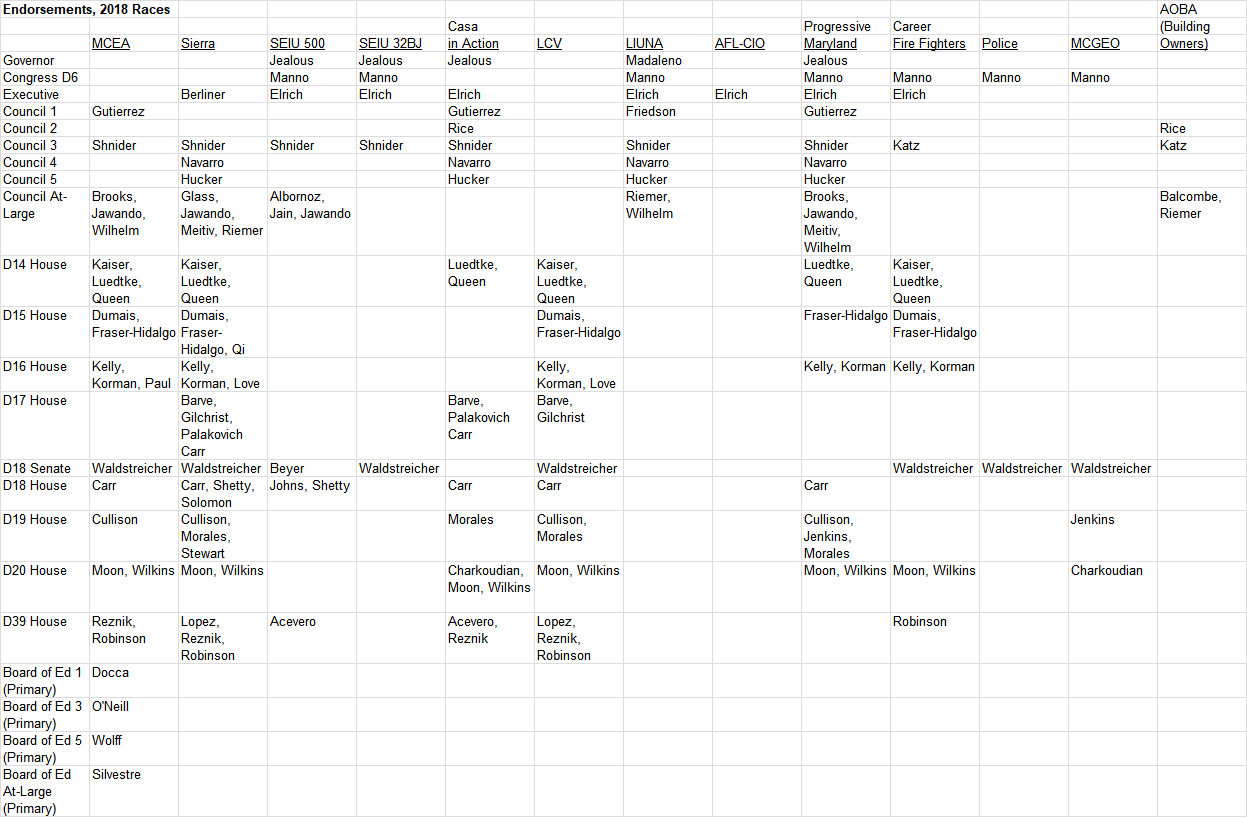
First, a note.  Many of the listed endorsing organizations have not finished their processes and may be announcing more decisions in the future.  Other important organizations (like the Washington Post, the Realtors and the Volunteer Fire Fighters) have not endorsed yet at all.  So this list is a work in progress.

That said, here are a few impressions.

Senator Roger Manno, who might be the most pro-union member of the entire General Assembly, is sweeping labor endorsements in his run for Congress District 6.  How far will that take him against Delegate Aruna Miller and Total Wine co-owner David Trone?

Council Member Marc Elrich, who is running for Executive, has put together an impressive string of progressive endorsements and he will be getting more of them.  He is definitely the favored Executive candidate of the left.

Ben Shnider, who is challenging District 3 County Council candidate Sidney Katz, has also become a darling of the left.  Will that be enough to take out Katz, who has been the most prominent politician in Gaithersburg for decades?  We will have an opinion on that in the near future.

Will Jawando, who is running for Council At-Large, has had a great six weeks.  He is the only non-incumbent who has assembled four influential institutional endorsements, including the Apple.  (Chris Wilhelm has three and Danielle Meitiv and Brandy Brooks have two each.)  Combine that with Jawando’s fundraising success, electoral experience and natural charisma and he is looking strong right now.

The good news for Delegate Jeff Waldstreicher, who is running for the District 18 Senate seat being vacated by Rich Madaleno, is that he is dominating the institutional endorsements over Dana Beyer and Michelle Carhart.  The bad news is that his dispute with House candidate Helga Luest is escalating.  Women are 60% of MoCo Democrats and this is a particularly bad cycle to run afoul of them.

While MCEA has made some county-level endorsements, it has postponed its decision on the incumbents (except for Sidney Katz).  The teachers are unhappy with recent MCPS budget decisions made by the County Council, especially with the breaking of their collective bargaining agreement two years ago.  With Ike Leggett’s recommended budget coming next week, we will learn more about what might happen to MCPS this year and that will affect the union’s thinking.  The remaining non-incumbents in the Council At-Large race will be paying rapt attention!

Speaking of the At-Large race, we wrote last April that the sole incumbent running, Hans Riemer, was going to be reelected.  We still believe that will happen and so do most of the folks running in his race.  But what happens if he is passed over by both the Apple Ballot and the Post?  The Apple is skeptical of council incumbents right now.  As for the Post, the newspaper endorsed Riemer in the 2014 primary in part because it said challenger Beth Daly was “dead wrong.”  But it dumped Riemer for a no-name Republican in the general election, saying he was “a first-termer with modest achievements.”  The Post has a lot more options in the 2018 At-Large field than it did last time.  Then throw in the facts that there are a lot of good folks in the At-Large race and Riemer’s name will be appearing near the end of a VERY long ballot.  If Riemer loses both the Apple and the Post and the hungry field of non-incumbents continues to impress, is he still a lock to win?  (Disclosure: your author used to work for Riemer.)

That’s it for now.  We’ll have more when the next wave of endorsements comes in!

Share

When They Go Low

District 18 Delegate Candidate Helga Luest’s statement that Del. Jeff Waldstreicher tried to lure her into the Senate race in order to aid his own move from the House of Delegates to the Senate has become quite the contretemps in District 18.

Jeff Waldstreicher’s Denial

After evading questions from me and refusing to comment on the record, Jeff finally issued this statement to Andrew Metcalf over at Bethesda Beat:

These claims are false, defamatory, and born of actual malice,” Waldstreicher, who has served as a delegate since 2007, said in the statement. “When they go low, I go high—standing up for our community’s progressive values, leading the fight for $15 minimum wage, investing in our schools and resisting the Trump administration at every turn.

Jeff ought to be a near lock for this seat. He’s a three-term delegate and has consistently garnered more votes than his opponent, regular state legislative candidate Dana Beyer, as Adam Pagnucco has pointed out. He hasn’t strongly alienated any constituencies, which should make it hard for her to gain traction.

But he seems to be doing his level best to turn this into a competitive race. Even leaving aside Helga’s claims, his public statement sounds like what Melania would say if she was a red-headed attorney.

Rather than issuing a standard denial or explaining the situation, it looks like Jeff is thinking like an attorney who has managed to turn Michelle Obama’s inspiring words into political pablum. Moreover, when an attorney uses legalistic words like “defamatory” and “actual malice,” it look like he’s hinting at a lawsuit in an effort to get Helga to stop talking.

That’s not going to happen.

It never looks good when the optics are of a politician trying to silence someone. In the current climate, a male candidate trying to get a female candidate to stop talking looks even worse. Of course, if he did file a lawsuit that would really torch his political ambition.

Jeff’s evasiveness and efforts to kill the story also haven’t helped. Jeff’s silence and avoidance of comment on any remotely controversial issue at last Sunday’s debate–he literally did not speak for the first 75 minutes–also reinforce the perception of an overly political approach.

#metoo?

Dana Bayer felt “it was demeaning” that Jeff suggested she run on a slate with him for delegate instead of competing for the Senate seat. That, however, seems like normal politics and a good offer.

On the other hand, an effort by Jeff to get Helga to run for the Senate to help him out, would appear much more manipulative and skeezy. Voters might well judge it less kindly, though I’m not sure if they will know or care.

Dana Beyer tried to push the narrative, which is also how Helga sees it, of criticizing Jeff’s alleged behavior in light of #metoo:

I trust her and believe the story.

I find it disturbing that Jeff would so crassly ask anyone to sacrifice themselves for his sake, let alone a woman. As if her commitment to public service was inconsequential, and beneath his concern.

She made a similar statement to Bethesda Beat:

“I have every reason to believe Helga’s story,” Beyer said. “The underlying principle is, I trust women.”

Except this is not sexual harassment but political manipulation. Dana would also gain more if she stayed in the background rather than appearing all too eager to garner political advantage. The idea that one always trusts women over men is also problematic.

I have never seen nor heard any stories of Jeff behaving remotely sexually inappropriately. Frankly, it would surprise me greatly. I should also emphasize that this is not what Helga says happened, though she sees his actions through the broader lens of misogyny faced by women.

Notwithstanding the bad optics of Jeff declaring Helga’s post as “defamatory” and “born of actual malice,” I see this situation more as maladroit machinations. Helga’s allegations could be completely true but not so much about gender as the political maneuvering referenced in the Bethesda Beat headline.

To the extent that Jeff is willing to engage in these too-clever-by-half political games, I think he’d just as easily ask a man if he thought that was the good play. If he’s guilty of anything here, it’s political malpractice and a self-inflicted wound, as all of this seems rather unnecessary for him to win.

At the same time, Jeff’s “totally false” statement had at least one glaring weakness and Helga has not hesitated to point it out. Specifically, they clearly did meet, as Helga has highlighted in her reply to Jeff’s public statement.

Final Notes

Helga mentions accurately that she told me about the story before she published her Facebook. For a variety of reasons, I didn’t feel comfortable publishing it. She did not mention that I contacted her when I decided not to publish the story.

I’m glad Bethesda Beat’s Andrew Metcalf covered this story instead of me. Frankly, I’m not a professional reporter and he did a better job than me of getting straight up on the record accounts.

Share

Toward Cost-Effective Transportation

By Neil Harris.

Transit is much more expensive to build than highways. It’s politically correct to focus on transit. But is it the best use of our tax dollars? Let’s look at the numbers.

Transportation planners in our region look at many. At the most recent Transportation Planning Board (TPB) meeting, there was a presentation on the ways that transportation plans are measured and approved factors – social equity, air quality, and many more. But when I asked if there was a cost-benefit analysis, it became clear that this did not appear to be on anyone’s list of measures.

By cost-benefit, I mean this: when you build a new transportation project, how much money does it cost to move people?

Over the last few weeks, I went back through some presentations and found the two slides shown below that have the numbers to tell an important story. I spent a lunch hour on the phone with TPB staff to verify that what I was seeing was accurate, and what it might mean. Here is what I learned from TPB’s data:

The DMV region plans to spend $42 billion to expand transportation capacity over the next 25 years, split between $27 billion on highway expansion and $15 billion on transit. This will result in 2.7 million more daily trips by auto and 300 thousand more daily trips in transit. By simple arithmetic, this means that it costs just over $10,000 to add capacity for another auto trip, and more than $53,000 to add another transit trip. Building transit capacity currently costs more than 5 times as much as highway capacity!


If this was the only factor that was important, then decisions would be easy. Any CEO would immediately allocate more money into adding highway capacity. Of course, it’s not the only factor. Not everyone can afford to travel by auto – we want lower-income people to be able to get to their jobs, so we need transit. Transit trips are less polluting than autos, although TPB’s data shows a steady decrease in auto pollutants thanks to greater efficiency and the growing number of electric, zero-emission vehicles.

The other key is that, for parts of our region, building new roads or even expanding existing ones is terribly difficult. Where would you put a new thoroughfare in DC, or in the close-in suburbs?

The costs I focused on so far are the capital costs for new projects. The same TPB information can be used for operating costs – how much it costs for each trip. It turns out that we’re going to spend $130 billion over the next 25 years on transit operations and repairs, about $5.2 billion annually, with capacity growing to 1.5 million daily trips, for a per-trip cost of about $9.50. Each time someone takes a transit trip, the government subsidizes the trip by that amount. We’ll spend $72 billion to maintain roadways during the same period, about $2.9 billion annually, to move up to 16.6 million trips/day. That comes to just under 50 cents per trip.

The operating cost information is useful in a couple of ways. At the same TPB meeting, the Commuter Connections presentation unveiled a new program, piloted in Howard County MD, where auto commuters can receive a $10 stipend for taking a rider along with them. That number is almost exactly right – it is comparable to the cost of putting someone on transit instead, but we don’t need to build more transit lines.

That is the kind of thinking we need. When we look at a new project or a new idea, does it move people more effectively than how we’re doing it now? Is it better for some reason, is it faster, is it cheaper?

For example, the TPB recently recommended that we find ways to encourage employers to let more people work from home. What if the government provided an incentive to the employers? With these numbers, we can make informed judgments about how much of an incentive makes fiscal sense.

The amount of money we have to transport people is limited, so we need to think carefully about optimization strategies to move people cost-effectively as well as focusing on all the other factors.

Neil Harris is a member of the Gaithersburg City Council and the Metropolitan Washington Council of Governments Transportation Planning Board.

Share

Gaithersburg Electeds Endorse Balcombe

By Adam Pagnucco.

Council At-Large candidate Marilyn Balcombe has announced endorsements from three elected officials in Gaithersburg: Mayor Jud Ashman and City Council Members Mike Sesma and Neil Harris.  Balcombe is the long-time President and CEO of the Gaithersburg-Germantown Chamber of Commerce and lives in Germantown.  Gaithersburg, including both the incorporated and unincorporated areas, has more than 40,000 registered Democrats of whom roughly 3,500 have voted in each of the last three mid-term Democratic primaries.

Left to right: Sesma, Harris and Balcombe, Ashman.  Credit: Balcombe for Council Facebook page.

Share

Blair Goes on TV

By Adam Pagnucco.

Businessman David Blair is the first County Executive candidate to go on TV.  Below, we print page one of his contract with WUSA (CBS Channel 9) for the week of March 6-12.  Blair chose to run three spots on morning news show Great Day Washington and three spots on The Late Show with Stephen Colbert for a combined cost of $5,070.  We have seen no evidence from Federal Communications Commission filings that any other local candidates have gone on TV yet other than Congressional candidate David Trone, who has purchased time on radio, WDVM-TV in Hagerstown and Univision.

Share

Progressive Maryland Endorses for County Council

By Adam Pagnucco.

Progressive Maryland, an umbrella organization containing several influential progressive groups, has announced it is endorsing the following candidates for County Council.

At-Large: Brandy Brooks, Will Jawando, Danielle Meitiv and Chris Wilhelm

District 1: Ana Sol Gutierrez

District 3: Ben Shnider

District 4: Nancy Navarro

District 5: Tom Hucker

Progressive Maryland has previously endorsed Marc Elrich for County Executive and Ben Jealous for Governor.  Brooks is an employee of the organization.  Hucker founded the group’s predecessor, Progressive Montgomery.

Two things strike us as interesting here.  First, this is the first major institutional endorsement not received by at-large incumbent Hans Riemer.  (SEIU Local 500 has endorsed three non-incumbents in the at-large race but left a spot open for Riemer contingent on further events in Rockville.)  Second, Progressive Maryland’s affiliates include MCGEO, UFCW Local 400 (grocery store workers), the SEIU Maryland/D.C. council, NOW and ATU Local 689 (WMATA), all of whom play in MoCo elections.  Does Progressive Maryland’s decision provide insight on which candidates may be endorsed by these other groups?

Share

Do You Believe Klausmeier’s Primary Opponent? I Do

Last week, I published a post on medical marijuana lobbyist Max Davidson’s strange, last-minute decision to primary Sen. Kathy Klausmeier (D-8). Davidson has given the bulk of his donations to Republicans and by far the most to Del. Christian Miele (R-8), who also just happens to be running for the seat.

Quick off the dime, Max Davidson is not. He took over three days to respond to my post, an eternity for a candidate not to respond to negative publicity. What is he, high? Oh, wait. . .

Clocking in at over 2100 words, his Facebook post reply feels more like the start of Leviathan than a campaign statement. If he’s this lengthy in chatting up legislators, no wonder it took so long for medical marijuana to pass in Maryland.

Nevertheless, I believe Max Davidson.

I believe “firmly pro-choice” Davidson gave $970 to “firmly pro-life” Miele because he cares deeply about abortion rights.

I believe Davidson when he says that he gave over four times as much money to Republicans as Democrats “in support of attempting to pass my most recent bill.” Lobbyists always give more money to minority party legislative opponents.

I believe Davidson gave $150 to Del. Kathy Szeliga (R-7) but not Chris Van Hollen because he is “a proven lifelong Progressive” and “Berniecrat.”

I believe Davidson even though he never addresses whether he discussed his bid with Miele in his very long reply.

I believe Davidson cares about issues other than cannabis legalization even though the word “cannabis” appears 21 times in his post.

I believe Davidson gave over $500 to Sen Justin Ready (R-5) because he cares passionately about “raising the minimum hourly wage to $15 per hour” and keeping education affordable.

I believe this is a good logo:

I believe electing a lobbyist like Davidson is “our chance to stop politics as usual in Annapolis.”

Share

Where Are the Voters?

By Adam Pagnucco.

With six Democratic candidates for County Executive and over thirty Democrats running for Council At-Large, the hunt is on for MoCo primary voters.  Luckily for the candidates, we are here to point the way!

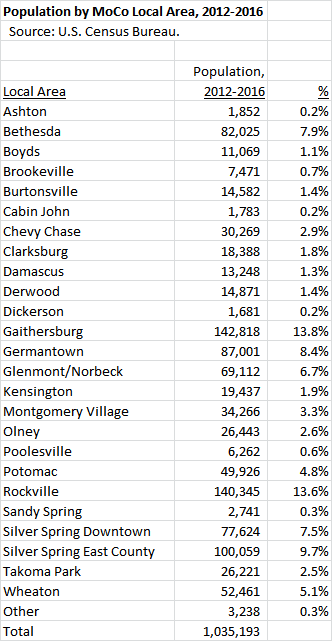
Let’s start by looking at population.  Residents are not distributed evenly across the county.  The neighborhoods closest to the D.C. border and close to urban centers are more dense than Upcounty areas.  Below we show population estimates by local area for the years 2012-2016 from the U.S. Census Bureau.  Local areas are grouped by zip codes.  For example, data for Rockville does not refer to the municipality itself, but to the four zip codes that comprise Rockville (20850, 20851, 20852 and 20853).  Because Silver Spring is such a large part of the county, we broke it into four pieces: Downtown (zip codes 20901 and 20910), Wheaton (20902), Glenmont/Norbeck (20906) and Silver Spring East County (20903, 20904 and 20905).

And so the population concentrations are where one might expect: Downcounty and near urban centers like Rockville and Gaithersburg.  But that’s not the end of the story.  Our elections are decided by closed Democratic primaries.  For state legislative and county offices, the general elections have not been relevant since 2006, when the last two Republican elected officials (County Council Member Howie Denis and Delegate Jean Cryor) were defeated.  And Democrats are distributed differently around the county than all residents.

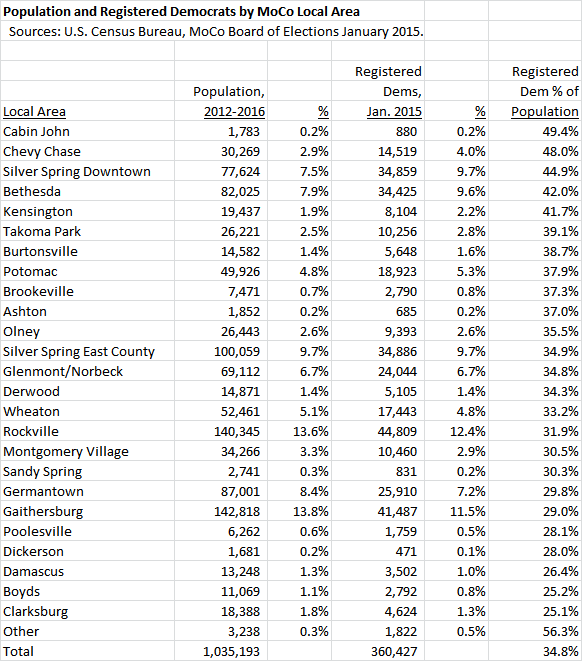
Right after the last cycle ended, we obtained a January 2015 version of the voter file from the county’s Board of Elections and spliced it with Census data to model local elections.  The number of registered Democrats in MoCo has risen by 5% in the last three years so, for the purpose of looking at geographic patterns, our existing voter model is not exact but is not too far off.  Below is a comparison of population by local area from 2012-2016 and the number of registered Democrats from January 2015.

There are large differences in Democratic density (the percentage of residents who are registered Democrats) between MoCo’s local areas.  In five local areas – Cabin John, Chevy Chase, Kensington, Bethesda and Silver Spring Downtown – more than 40% of residents are registered Democrats.  And in seven local areas – Dickerson, Poolesville, Damascus, Germantown, Gaithersburg, Boyds and Clarksburg – less than 30% of residents are registered Democrats.

Now let’s fine-tune this even further.  The chart below compares population by local area from 2012-2016 to the number of Super Democrats, whom we define as having voted in all three of the 2006, 2010 and 2014 primaries, in January 2015.  This Super Dem number has probably fallen slightly as a few folks who voted in those primaries have left the county or passed away, but the broad pattern will still hold.

Again, there are large differences in Super Democrat density (the percentage of residents who are Super Dems) between local areas.  In six areas – Cabin John, Chevy Chase, Kensington, Bethesda, Silver Spring Downtown and Takoma Park – at least 5% of residents are Super Dems.  In seven areas – Poolesville, Montgomery Village, Gaithersburg, Damascus, Germantown, Boyds and Clarksburg – less than 3% of residents are Super Dems.

Here’s the bottom line – countywide elections are decided in large part by voters in a Democratic Crescent stretching from Takoma Park in the east through Downtown Silver Spring, Kensington and Chevy Chase to Bethesda and Cabin John in the west.  These areas roughly trace the neighborhoods around the Beltway and between the Beltway and D.C.  They are the parts of the county that sent Jamie Raskin to Congress.  Together, the six areas in the Democratic Crescent have 23% of the county’s population, 29% of the registered Democrats and 37% of the Super Dems.  Every countywide candidate is going to want to play there.

Does that mean that a candidate whose chief appeal is outside the Democratic Crescent is doomed to fail?  Not necessarily.  Crescent voters have MANY suitors as most of the Executive and Council At-Large candidates come from those areas and will be aggressively pursuing votes there.  Council Member Nancy Floreen, who is a former Mayor and current resident of Garrett Park, won four straight at-large elections by combining women, moderates and Upcounty voters and her 2014 second-place finish was her best ever.  This model is no doubt being studied by County Executive candidate and former Mayor of Rockville Rose Krasnow and Council At-Large candidate and Germantown resident Marilyn Balcombe, both of whom Floreen has endorsed.

One more thing.  Some Upcounty activists have long complained of the influence of Downcounty on county government decision making.  Your author did not witness geographic parochialism on the part of any At-Large Council Members, all of whom come from Downcounty, during the time I was employed at the council.  But to the extent that Downcounty does exercise disproportionate influence, it’s because those residents turn out in Democratic primaries to a much greater extent than people who live Upcounty.  As long as primaries remain closed to party members, that will continue to be the case in any countywide elections regardless of structural changes in county government.  If you are an Upcounty resident and you don’t like that, the best remedy is to get your neighbors to vote in the primary.

Downcounty’s influence is only likely to grow because of one new factor in county politics: the implementation of public financing.  As we shall see, a large percentage of contributions to publicly financed candidates is coming from localities in the Democratic Crescent we described above.  That information will be published in the near future.  Stay tuned to Seventh State!

Share

Kim Propeack: Why Naming Names Isn’t So Simple

By Adam Pagnucco.

With the #Metoo movement continuing to impact society, the actions of the General Assembly to limit harassment and abuse are coming under scrutiny.  As a result, some are calling for harassment victims to start naming names.  Senator Cheryl Kagan (D-17) and House candidate Sara Love (D-16) did just that last week.  But there’s another side to this.  On Friday, Kim Propeack, CASA de Maryland’s long-time political and communications director, commented on why naming names isn’t so simple on Facebook.  With her permission, we reprint her remarks below.

*****

The raging debate about the testimony before the Womens Caucus on sexual harassment in the Maryland legislature has been fascinating. I am so proud of Nina Smith and so many others that came forward. But I have been absolutely perplexed by the comments from colleagues and on fb and other platforms expressing confusion about why people do not come out publicly. I want to share two stories from my own career that I think illustrates perfectly the thinking and or impact that challenging abuse in the legislature can have.

Many moons ago, my buddy Natali Faní-González testified against an anti-immigrant bill supported by then freshmen Delegates McDonough and Impallaria, both notorious anti-immigrants. As she and I left the committee room and stood in the hallway, we were accosted by the two delegates. Impallaria stood over Natali yelling at the top of his lungs that Natali must be an illegal. To underscore how racially targeted this was, Natali may have been literally the only Latina lobbyist or staffer in Annapolis at that time. McDonough was similarly standing over me screaming at me in the middle of the hallway. A male lobbyist who saw this going on ran over to physically block McDonough because he appeared close to striking me. McDonough then shoved that lobbyist and me to the ground. Natali and I filed ethics complaints against the two delegates. Finding of insufficient evidence despite the fact that this occurred in front of hundreds of people. But the male lobbyist who came to my aid let us know he really wanted the whole thing to go away. He said, “I have a professional career to think about.” He didn’t think he would be taken seriously in the future if he was embroiled in an ethics process.

Move ahead to my other example. In 2003, the late great Senator Gwen Britt was the lead Senate sponsor of the MD DREAM Act. And so her Chief of Staff decided that I should date him (I am not not naming that dude; I seriously don’t remember his name.) After weeks of uncomfortable conversations with him, I spent a particularly queasy hour on the phone with him dodging his repeated requests to go out on date while he poured over my looks what we would do, etc. I repeatedly went back to the stupid trope about how really it wasn’t him but I was involved with someone. I didn’t want to insult him because he was staffing my priority bill. So finally, I shut down the conversation with a definitive no. The following day, he starts actively undermining passage of the bill. He recruited people in the Senator’s district to attack her for having introduced the bill and recruited anti-immigrant voices to come down to Annapolis and testify against. Despite his efforts, the bill was voted out of the General Assembly. Then onto the Governor. This guy, the Chief of Staff to the lead sponsor of the bill, then recruited people to reach out to the Governor’s office to veto the bill.

I’m not laying Ehrlich’s decision at his feet. Bobby Ehrlich could be stupid on his own. But me as a relatively seasoned activist and certainly no wilting flower, got a serious lesson on how much more difficult your life gets when you don’t play game. And more importantly, how much the folks you are working for can be hurt. These are just two incidents among the various grab ass and more across the years. But I thought they were particularly relevant to respond to the Why Don’t We Just Name Names question.

Share

Telling Them Apart

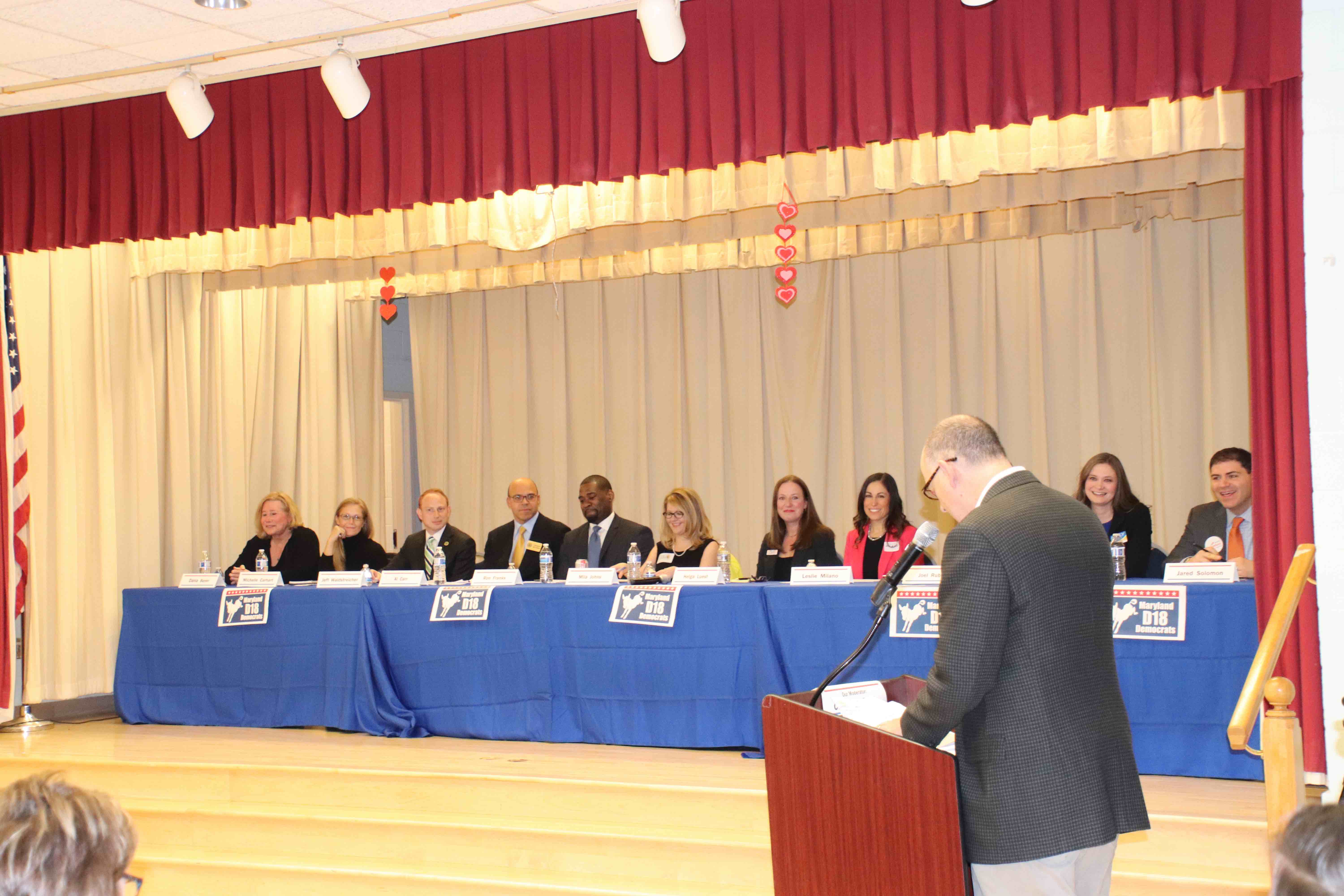
Last night, your scribe attended and live tweeted the District 18 state legislative debate sponsored by the District 18 Democratic Caucus. Though policy differences continue to be somewhat hard to find, voters could still glean much from what was said–and not said–as well as about the style and experience of the candidates.

State Senate Candidates

Dana Beyer possesses limitless self-confidence often associated with doctors. At one point, she tried to tell Moderator Charles Duffy how to conduct the debate. Highly intelligent, her most thoughtful response was about how the General Assembly’s first priority ought to be to undergird the healthcare system against federal attacks.

Towards the end of the debate, Dana declared that there is almost no policy diversity among the candidates, so voters need to elect someone who can bring the delegation together and lead. Unfortunately, she has a well-earned reputation of not working well with others.

While Dana gave voters a real opportunity to learn her views on a range of issues, Jeff Waldstreicher was reticent to the point of not speaking for the first 75 minutes. Loathe to say anything divisive, Jeff passed on opportunities to outline his views on issues such as liquor decontrol or single-payer healthcare.

Jeff finally spoke up to tout past and expected gun control legislation. A classic example of what political scientists call “credit claiming,” he steered clear of the more divisive issue of armed guards in schools. Complimenting Del. Al Carr’s work effusively, Jeff wooed his support. Jeff’s strategy is seemingly to avoid alienating any voters and run a focused “positive campaign” that ignores his challengers.

This was my first view of Michelle Carhart, the owner of a local chain of children’s gyms who jumped into the race at the last moment. Much less the pol than her two opponents, she came to the debate with the perspective of a local business owner who sees a need for both less bureaucracy and progressive change.

She complained about property taxes, and favors training over handouts as more useful and less demeaning. She argued that everyone should have to pay something for healthcare, so they’d have some skin in the game. Michelle has a lot to learn about public policy but could appeal to people looking for an ordinary citizen rather than a more practiced politician.

House of Delegates Candidates

Incumbent Del. Al Carr (who I support) demonstrated his comfortable policy knowledge on a number of issues and self-deprecatingly to laughter from the audience asked voters to send him as a “grizzled veteran” back to Annapolis after complimenting the strengths of the other candidates. He continues to emphasize the environment and climate change as a critical issue.

Since her respectable loss four-years ago in the primary, Emily Shetty has worked hard to position herself for this race by chairing the D18 Caucus and serving on the central committee. Among the most eloquent candidates, she advocated firmly for single-payer health care and is able to discuss the subject more fluently than many experienced legislators.

One of my favorite moments was when Ron Franks argued against the prevailing wisdom on police officers in schools. Making the case for people with diverse experiences by applying his own, he made a good argument that police officers serve as valuable role models and revealed a willingness to dissent thoughtfully.

Mila Johns stood out as someone unafraid to say what she thinks. In particular, when other candidates held back initially, she stated that the county should gradually get out of the liquor business because it’s killing off restaurants. She also advocated for making it easier for seniors to age in their own homes and death with dignity.

Joel Rubin highlighted his experience as an elected local official and seasoned policy advocate who has the communication skills and knowledge to fight for progressive ideals. Living with his mother-in-law (lovely woman, I’ve met her), he argued for incentives for multi-generational housing as one component to addressing senior living.

Helga Luest did not reprise her accusations against Jeff Waldstreicher at the debate. Speaking as the survivor of a murder attempt, she argued passionately for a trauma-centered approach and greater community connectivity to help address issues from kids prone to gun violence to isolated seniors. She believes a delegate should engage on leadership at the community level as well as outside the general assembly.

Jared Solomon’s answers gave the impression of someone who has studied the issues hard and would listen well but advocate forcefully. Labor should appreciate his advocacy of labor agreements as part of business incentive packages. He said education was his #1 priority. I hope higher pay for college professors is included!

Among the more knowledgeable candidates, Leslie Milano stood out as someone who would consistently advocate for economic growth. She referred to Amazon and Marriott tax incentives as normal business practices, which struck me less as politics as usual than someone who was being honest about the way the world works.

Issue Differences!

General similarities notwithstanding—everyone is anti-gun, pro-choice and wants to fight climate change—there was daylight between the candidates on a number of questions. While Leslie Milano expressed support for incentives to attract Amazon, Al Carr advocated investing in education and infrastructure that benefit all businesses. Emily Shetty wanted transparent negotiations, which was very popular, albeit wholly unrealistic. Dana Beyer said attracting Amazon is more important than keeping Marriott. Jeff Waldstreicher expressed no opinion.

Mila Johns, Ron Franks, Dana Beyer and Leslie Milano expressed support for getting the county out of the liquor business. I’d also like to know the opinion of other candidates.

In the most depressing part of the debate, Joel Rubin said he was okay with armed security guards if schools need them. Helga Luest highlighted the need for risk and threat assessment. Mila Johns and Leslie Milano opposed them with Leslie mentioning their impact on the culture of schools and suggesting bulletproof pods as an alternative.

Winner of the Debate

Adam Pagnucco. Hands down.

Candidates and the moderator referred to his posts here on Seventh State repeatedly with admiration.

Share

Maryland Politics Watch