
The Montgomery County Education Association (MCEA) has endorsed Marc Elrich for County Executive. The Washington Post has the story.

MCDCC Slams Phony Dem Club
By Adam Pagnucco.
The Montgomery County Democratic Central Committee (MCDCC) has issued a press release denouncing a group that claims to be a “Democratic club” but has not been chartered by the party. The group has attacked Delegate Aruna Miller (D-15), who is running for Congress. We reprint the release below.
*****
For Immediate Release
6/6/2018
Contact: Dave Kunes, Chair
Chair@MCDCC.org
The MCDCC has received several complaints about the origins of the officers and disputed claims of the unchartered organization calling itself, “Asian American Democratic Club.” While the Democratic Central Committee does not censor the comments of local Democratic voters or organizations, in this case we must publicly make clear, the group, “Asian American Democratic Club” has never applied for an official charter with the Montgomery County Democratic Central Committee.
Central Committee Chair Dave Kunes said, “We have already seen the damage fake news and fake groups can do to our elections. The ‘Asian American Democratic Club’ is representing itself as a chartered Democratic organization and publishing highly questionable claims about Democratic primary candidates. Earlier this year, the founding treasurer of this group was exposed as using an identity stolen from a Texas student from Baylor University. Based on these issues, the Montgomery County Democratic Party disavows this group. We are also filing a complaint with Facebook to stop outside influencers who masquerade as legitimate Democratic organizations in order to inappropriately influence our elections.”
“This unsanctioned group should not be confused with our chartered organization the Coalition of Asian Pacific American Democrats (CAPAD). CAPAD has a longstanding reputation of legitimate and outstanding work supporting the communities of Democratic Asian American and Pacific Islander communities in Montgomery County. The job of the Montgomery County Democratic Party is to protect our legitimate and chartered organizations, who put in the work to engage Democratic voters.”
Dave Kunes
Chair
Montgomery County Democratic Party
www.mcdcc.org
Leggett Endorses Alsobrooks
Montgomery County Executive Ike Leggett has endorsed State’s Attorney Angela Alsobrooks for Prince George’s County Executive. Here is the press release from the Alsobrooks campaign:
MONTGOMERY COUNTY EXECUTIVE IKE LEGGETT ENDORSES ANGELA ALSOBROOKS FOR PRINCE GEORGE’S COUNTY EXECUTIVE
LARGO, MD – Montgomery County Executive Ike Leggett today endorsed Angela Alsobrooks to be the next County Executive for Prince George’s County. During a press event at Alsobrooks’ campaign headquarters, Leggett said Alsobrooks was best prepared to hit the ground running day one and address challenges that impact the county and the region.
“After serving as Montgomery County Executive for the last 12 years, I know the leadership abilities a person needs to be successful in this job and Angela Alsobrooks has them,” Leggett said. “She is a leader who holds herself and everyone around her to the highest ethical standards and she leads by being present, getting to know those she serves so she can address the specific challenges they face. She also has a good temperament and the ability to work with anyone and everyone, even those who disagree with her, to get the job done. Her record as State’s Attorney speaks for itself and I know she will be a County Executive to lead Prince George’s County into the future.”
The endorsement continues to add to the broad and diverse support that Alsobrooks has earned during the campaign. She has also been endorsed by 15 local labor unions representing more than 65,000 working families and all four of the county’s public safety unions.
Vignarajah Eligibility Challenged in Court
Douglas Horn has filed a lawsuit against the Maryland State Board of Elections asking for a declaratory judgement that Krish Vignarajah is ineligible to run for governor and mandating the removal of her name from the ballot.
The claim essentially reiterates many of the same issues I have raised here regarding her failure to meet the requirement for being registered for five years in advance of the election. It cites her voter registration and record in D.C. along with her wedding license declaring D.C. her residence.
Here is the complaint:
The most likely successful defense by the BOE is related to laches, the idea that lawsuits must be filed in a timely manner. A court has already ruled that it’s too late to grant Valerie Ervin’s request for her ticket to replace the Kamenetz/Ervin ticket on the ballot even though it has much merit even according to the court.
Otherwise, I cannot see how Vignarajah wins on the merits. A more interesting lawsuit would be the one inevitably filed by the Republicans if she somehow won the nomination, as there would be plenty of time to remove Vignarajah from the ballot.
Larry Hogan’s First TV Ad
This is Governor Larry Hogan’s first TV ad of the cycle. The Baltimore Sun fact checked it and found that it “inflates tax relief claims” among other issues.
Lily Qi’s Video
Was Montgomery College Funding Cut? Councilmembers Clash
After what I thought would be a relatively non-controversial post about the huge asset that Montgomery College is to the county, I received a request for a correction from Council President Hans Riemer (D-At Large):
David, while I certainly agree that Montgomery College is a gem, it is not true that the Council cut the budget for MC. The Council increased the budget for MC. The college will receive about $2.5 million more this year than last year. The Council even increased the amount for the College over what Ike recommended, by $750,000.
Craig Rice wanted even larger increases. We weren’t able to provide them due to our fiscal constraints.
I would like to request a clarification. To forward the assertion that we have cut the College’s budget is not accurate.
Hans
I appreciate Hans taking the time to lend his view and provide more information on the subject. I asked Councilmember Craig Rice (D-2) for his perspective. He took the time to provide a very thoughtful discussion of the topic that is well worth reading for its insight into the process and the politics:
David,
I think the best way to explain it to you is the same way in which Montgomery County public schools does their budget. The board of trustees and the president come together with a budget that supports not only the additional programming but the overall expenses for the college in the particular year.
Then they present this budget to the county executive who then presents it to the County Council. The county executive reduced or cut the approved budget that was approved by the board of trustees and the president. That then was sent over to us at the county council. We (education committee and then full council) decided to restore some of those reductions or cuts to the tune of $750,000 but still left $1.1 million in cuts or reductions from the college’s approved budget.
Now while technically this is an increase over last year due mainly to MOE just as Montgomery County public schools has an increase every year if we were to not fund maintenance of effort or not find the Board of Education to request it would be seen as a reduction i.e. cut.And the crux of the issue is this. Montgomery college was very clear that it was stuck in a hard place between deciding on funding negotiations or funding equity gap programs or increasing tuition. We had a choice on the council to not force them to make that decision. But that did not happen.The other challenge is that Montgomery college actually already reduced/cut their budget to adjust to the numbers that the county executive was hinting that they needed to be at anyway. To then layer on another reduction on top of what they had already proposed initially is why the college was severely at a disadvantage.Craig Howard can give you exact numbers related to the college in terms of what they actually gave up. I have attached the packet for MC from Craig Howard which has more detail than you’d ever want. http://montgomerycountymd.granicus.com/MetaViewer.php? view_id=169&clip_id=14923& meta_id=154281 Thanks,Craig Rice
No Free Drinks for Me: The DLC Bites Back
Yesterday, the Director of the Montgomery County Department of Liquor Control wrote me regarding about my recent post on the DLC. It’s unusual for a civil servant to dive into public political debates involving his department, especially during an election, so I thought I would print his email and my response.
David,
As I finished reading your blog ON “THOSE GOOD UNION JOBS” AT THE DEPARTMENT OF LIQUOR CONTROL, I was inclined to finally respond to your ongoing one-sided, dated, often inaccurate portrayal of the DLC, and particularly your lack of knowledge of the Federal and State alcohol regulations.
Simply put, you need to get out more.
Even our most vocal critics have acknowledged the significant improvements that we’ve made. You should come and see for yourself.
We can disagree with this or that policy but the demeaning and disparaging comments that you made about our several hundred hard working and dedicated DLC employees really crossed the line. I am proud of the work they do. You should be ashamed of yourself.
Regards,
Bob
Here is my reply:
Bob,
I did not disparage the work. I also did not attack the job done by the employees as a group. However, I think it is well within my rights to describe the service experience as variable despite the stores having seemingly more staff than equivalent private competitors inside and and outside the County. It’s also utterly reasonable to think that the DLC should exist to serve county residents, not that we exist to provide employment at the DLC. I just saw your latest sales figures and I see little sign of any change in the sales pattern that would indicate residents perceive a change. Certainly, I have heard little in the community or from restaurant operators.
More broadly, I’m entitled to my opinion, and one voice countering the weight of the DLC and county government agitprop hardly seems close to balance. In any case, I get vocal pushback on many posts, but heard less criticism than I thought I’d get on that one.
I call them as I see them and I see no shame in that.
If you have good news to share instead of shaking your finger at me, please let me know. I’m always glad to learn more.
David
This Type of Employment is Growing Rapidly in MoCo
By Adam Pagnucco.
Data from the U.S. Bureau of Economic Analysis (BEA) confirms something we have reported before: wage and salary employment has been stagnant in MoCo for a decade. But BEA data indicates something else is happening too: proprietor (self-employed) employment has been growing rapidly here and it pays less than wage and salary jobs. That may not be a great sign for the county’s economy.
Unlike the U.S. Bureau of Labor Statistics (BLS), which we have cited in the past, BEA tracks two kinds of employment: wage and salary and proprietors. (Check here for a summary of methodological differences between the two agencies.) Proprietors are self-employed and operate through sole proprietorships (integrated with their personal income on their income tax returns), partnerships and tax-exempt cooperatives. According to the Census Bureau’s Survey of Business Owners program, less than one in five of MoCo’s businesses have paid employees. The county has a lot of self-employed people and little is said about them.
Here is the change in wage and salary employment between 2006 and 2016 for the seventeen Washington area jurisdictions tracked by BEA.
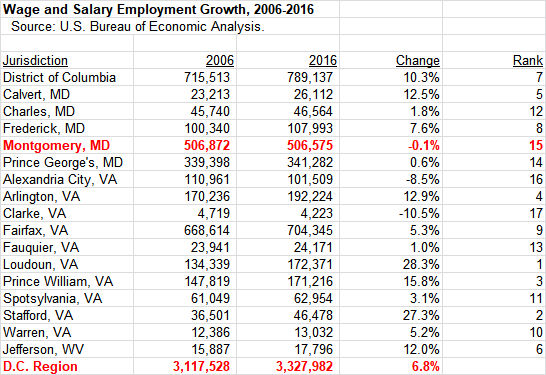
This data tells a similar story to BLS data we have previously presented: MoCo has trailed most of the region in job creation over the last decade. Only Alexandria City and tiny Clarke County, VA have fared worse.
However, proprietor job data tells a much different story. MoCo’s rate of proprietor job creation (36% over the last decade) is almost identical to the region as a whole.
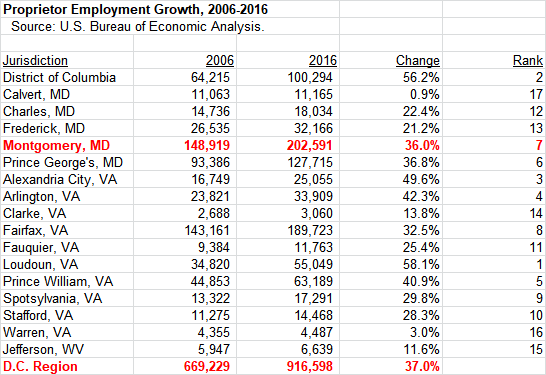
Proprietor jobs aren’t inherently bad and it’s good that MoCo has SOME kind of employment growth. But proprietors have much less security than full-time wage and salary workers. Proprietors have sole responsibility for their health and retirement benefits and many of them have little cushion when contracts and/or clients dry up. They also make less. In 2016, the average wage and salary plus employer contribution to pensions, insurance and government social insurance totaled $89,337 per wage and salary employee in MoCo. By contrast, the average earnings per proprietor totaled $66,498.
This isn’t happening just in MoCo; it’s a regional phenomenon. But MoCo is an outlier. The chart below compares wage and salary job creation and proprietor job creation by D.C. area jurisdiction between 2006 and 2016. In the region as a whole, 1.2 proprietor jobs have been created for every wage and salary job over the last decade. MoCo led the entire region in proprietor job creation with 53,672 jobs – a 36% growth rate. But MoCo was one of the worst performers in creating wage and salary jobs as one of just three jurisdictions with an absolute job loss. The result is a significant shift in MoCo away from wage and salary employment towards lower-paying contingent employment by a magnitude not seen in most of the rest of the region.
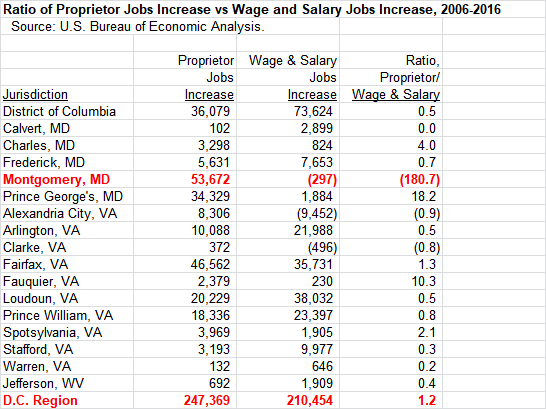
Unemployment rates don’t capture this kind of labor market shift. If a self-employed person working on contracts is not seeking a full-time job even if they would like one, that person will not be counted as unemployed.
Proprietor growth can be a good thing if it reflects job-creating entrepreneurship. That might be the case in places like Loudoun, D.C., Arlington, Fairfax and Prince William, all of which saw simultaneous increases in both proprietor and wage and salary employment. It’s possible in those jurisdictions that new proprietorships created wage and salary jobs. But MoCo is different from the above five places. Here, surging proprietorships coincided with stagnant wage and salary employment. Since proprietor jobs pay less on average, that may not be a good thing.
Let’s put this together with our previous work on the county’s economy. MoCo business formation has slowed to a halt. Private sector employers in the county have (at least through 2016) not restored their job counts above pre-recession levels. These factors have contributed to big budget shortfalls, a nine percent property tax hike and county usage of one-time transfers to balance the budget. Those MoCo taxpayers who have chosen to move out have higher incomes than those who are moving in. And in MoCo, lower paying self-employment is outgrowing higher paying wage and salary employment.
Voters, take heed.
Post Doubles Down on Blair
The Washington Post has written a second editorial endorsing David Blair for Montgomery County Executive. You can read it here.