County Executive Ike Leggett has recorded this video for Council At-Large candidate Hoan Dang.

By Adam Pagnucco.
Council At-Large candidate Brandy Brooks has issued a statement pushing back on Action Committee for Transit’s (ACT) scorecard. Your author received this scorecard in the mail today. The scorecard rates candidates with a plus, minus or no rating on five issues: the Purple Line, MARC trains, opposing M-83, streets safe for walking and housing near transit. ACT gave Brooks no rating on the above issues except for housing near transit, on which they gave Brooks a minus.
Brooks is disputing how her positions were characterized. We reprint her statement below.
*****
Michelle C. Whittaker
Brandy Brooks for County Council At-Large
michelle@brandy4moco.com
ACT Scorecard Falsely Represents Brandy Brooks’ Positions on Transit
MONTGOMERY COUNTY, MD (June 8, 2018) — Misinformation regarding Brandy Brooks’ publicly available positions on transit are being shared in the Action Committee for Transit (ACT) scorecard. Brooks is setting the record straight to make sure voters across the county have truthful and accurate information to make their decisions. Brandy Brooks is an at-large candidate for Montgomery County Council.
The ACT scorecard claims to be based on several criteria including public statements, answers to questionnaires, and the candidate’s website. However, the rating does not reflect publicly available information regarding Brandy Brooks’ views on transit and housing. The Brooks campaign has attempted to work with ACT representatives to clarify the misinformation.
“The Action Committee for Transit is a dedicated group of volunteers who have been doing tremendous work on Montgomery County transit issues for many years,” said Brandy Brooks. “We share a deep commitment to a transit vision for our county that adequately serves our communities and reduces our reliance on personal vehicle travel. So it’s frustrating to find my positions misrepresented by ACT when we should be working together to build the community power we need to ensure strong transit investments.”
Representatives from ACT informed the Brooks campaign that her negative score was based on tweets where she emphasized the need for more focus on affordable housing development. They claim that Brooks’ concern about “trickle-down affordability” — the County’s over-reliance on luxury housing developments with a small fraction of affordable units to meet its severe affordable housing deficit — means that she does not support housing development near transit. This is demonstrably false.
Ms. Brooks has repeatedly stated her commitment to preserving and developing affordable housing near transit nodes, such as the Takoma-Langley Transportation Center that will ultimately become a Purple Line station. Additionally, Brooks has expressed her strong commitment to creating transit solutions for areas of the county that have been overdeveloped without supporting transportation infrastructure, such as Clarksburg and Damascus.
The campaign launched the “Correct the Record: ACT Scorecard” information page to provide voters and the media with accurate details on Brandy Brooks’ positions.
The Democratic Primary is June 26.
By Adam Pagnucco.
At least one homeowner is voting for Council At-Large candidate Neil Greenberger and he printed a picture of the person’s house on his first mailer. To our knowledge, Greenberger is the only Democratic Council At-Large candidate to guarantee that there will be no property tax hike if he is elected. That’s because the county’s charter requires that all nine Council Members must vote to increase property tax collections above the rate of inflation and Greenberger promises to vote no.


By Adam Pagnucco.
The Suburban Maryland Transportation Alliance has released questionnaires completed by County Executive and County Council At-Large candidates on transportation issues. While many answers are similar – who doesn’t favor transportation funding? – others illuminate real differences on specific issues. Drawing on the questionnaires, here are four key projects on which the candidates disagree. (Note: unlisted candidates did not complete the questionnaire.)
Question: Do you support funding and building the missing link of the Mid-County Highway (M-83) to better connect Clarksburg and other Upcounty communities?
Executive candidates who said yes
David Blair
Robin Ficker
Rose Krasnow
Executive candidates who said no
Roger Berliner
Marc Elrich
George Leventhal
Council At-Large candidates who said yes
Rosemary Arkoian
Marilyn Balcombe
Robert Dyer
Lorna Phillips Forde
Neil Greenberger
Ashwani Jain
Michele Riley
Council At-Large candidates who said no
Gabe Albornoz
Bill Conway
Hoan Dang
Evan Glass
Seth Grimes
Will Jawando
Jill Ortman-Fouse
Hans Riemer
Question: Do you support the Maryland Traffic Relief Plan to add new express toll lanes on I-270 while keeping the existing lanes free of charge? (Editor’s note: this question contains a link to Governor Hogan’s proposals for I-270 and I-495.)
Executive candidates who said yes
Roger Berliner
Robin Ficker
Rose Krasnow
George Leventhal
Executive candidates who said no
David Blair
Marc Elrich
Council At-Large candidates who said yes
Gabe Albornoz
Rosemary Arkoian
Marilyn Balcombe
Bill Conway
Hoan Dang
Robert Dyer
Lorna Phillips Forde
Neil Greenberger
Jill Ortman-Fouse
Michele Riley
Council At-Large candidates who said no
Seth Grimes
Ashwani Jain
Will Jawando
Other answers
Evan Glass did not answer yes or no. He said, “I am not convinced that toll lanes are the correct solution to this problem.”
Hans Riemer did not answer yes or no. He said, “I support the council’s adopted vision for 270.”
Question: Do you support the Maryland Traffic Relief Plan (see link above) to add new express toll lanes on I-495, keeping the existing lanes free of charge?
Executive candidates who said yes
Roger Berliner
Robin Ficker
Rose Krasnow
George Leventhal
Executive candidates who said no
David Blair
Marc Elrich
Council At-Large candidates who said yes
Gabe Albornoz
Rosemary Arkoian
Hoan Dang
Robert Dyer
Lorna Phillips Forde
Neil Greenberger
Michele Riley
Council At-Large candidates who said no
Bill Conway
Evan Glass
Seth Grimes
Ashwani Jain
Will Jawando
Jill Ortman-Fouse
Hans Riemer
Other answers
Marilyn Balcombe did not answer yes or no. She said, “I don’t think we know all the options for how to expand capacity on 495.”
Question: Do you support studying the concept of a second Potomac River crossing, north of the American Legion Bridge?
Executive candidates who said yes
Robin Ficker
Executive candidates who said no
Roger Berliner
David Blair
Marc Elrich
Rose Krasnow
George Leventhal
Council At-Large candidates who said yes
Gabe Albornoz
Rosemary Arkoian
Marilyn Balcombe
Robert Dyer
Lorna Phillips Forde
Neil Greenberger
Jill Ortman-Fouse
Council At-Large candidates who said no
Bill Conway
Hoan Dang
Evan Glass
Seth Grimes
Ashwani Jain
Will Jawando
Hans Riemer
Michele Riley
By Adam Pagnucco.
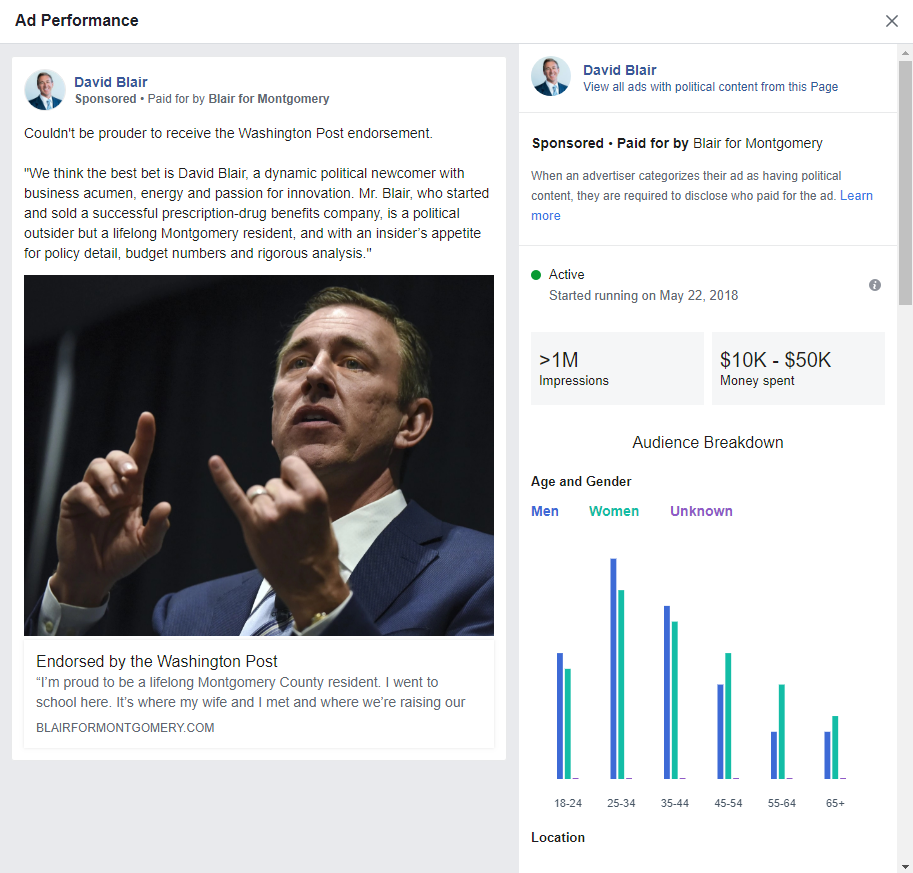
County Executive candidate David Blair wants you to know that the Washington Post has endorsed him. Wait, that doesn’t do it justice. He really, REALLY wants you to know that. Why do we say so? Because he may have purchased the most expensive Facebook ad in the history of MoCo politics to publicize it.
Most Facebook ads from state and local candidates cost less than a hundred bucks and run for a few days. The more you pay, the bigger the audience, but there is considerable variability in exposure and targeting. Still, a $50 ad on something good is a cheap way to get your name out there. If every exposure costs two cents (a VERY rough guesstimate with a lot of spread), that fifty bucks could get you on 2,500 feeds and draw a few dozen interactions.
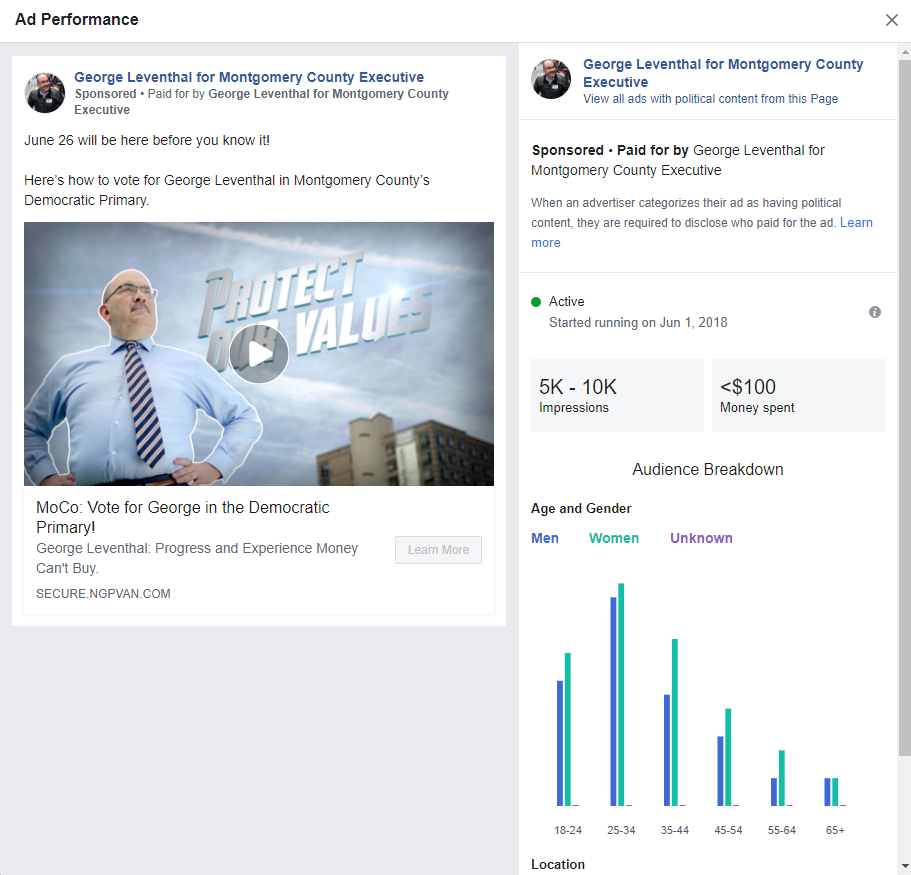
The exact stats on ad cost and engagements are available only to the advertisers. But Facebook has a political ad tracker that reports stats in ballpark ranges. Here’s a report of an ad that Council Member George Leventhal is running on his hilarious Avengers-themed campaign video. He spent up to $100 on the ad and it showed up on 5,000-10,000 feeds. (The actual people count will be less because some will have seen it more than once.) This is a very typical ad in MoCo politics.
Now here is the ad Blair is running on his Post endorsement. The report indicates that he spent between $10,000 and $50,000 and it showed up on more than a million feeds.
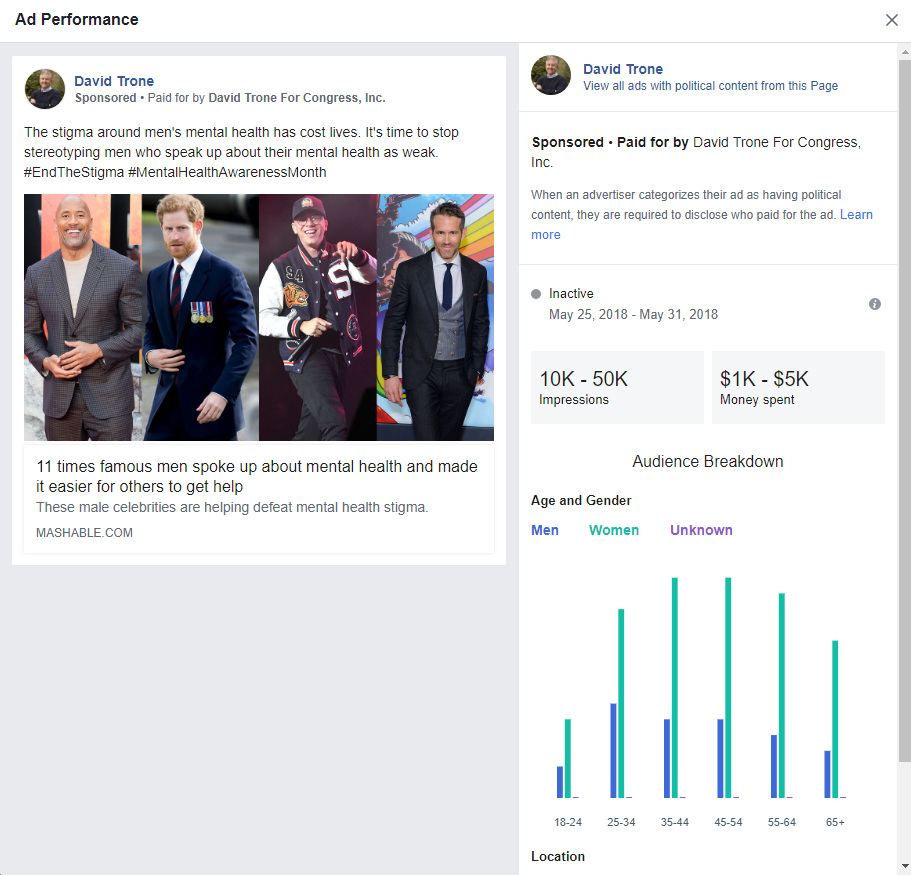
By the standards of MoCo politics, that’s unheard of. Even David Trone rarely spends more than $1,000 on his Facebook ads. We know of one ad – on men’s mental health – on which Trone spent between $1,000 and $5,000, receiving between 10,000 and 50,000 impressions.
So if you live in MoCo and have a Facebook account, we bet you know that David Blair has been endorsed by the Washington Post. And if you didn’t, well… you need to log in!
Disclosure: Your author supports Roger Berliner and spends way too much time on Facebook.
By Adam Pagnucco.
Transportation is an eternal issue in MoCo politics and most candidates mail on it. But this has been Delegate Marc Korman’s top priority since his first campaign and he has worked hard on this issue in the General Assembly, notably playing a key role in passing dedicated Metro funding. The only quarrel we have with this mailer is that Korman may not be taking enough credit for his work! Still, your author is a big Korman fan and we look forward to his second term.


By Adam Pagnucco.
Council Member Roger Berliner, who is running for Executive, has issued a statement saying that he is dropping the image of Donald Trump from his TV ad. The ad both criticized businessman David Blair, who is also running for Executive, and made a case in favor of Berliner. We print Berliner’s statement below.
*****
June 6, 2018
BERLINER CAMPAIGN DROPS TRUMP IMAGE TO SHARPEN FOCUS ON BLAIR’S LACK OF EXPERIENCE
The Berliner for County Executive Campaign will begin running a new version of its TV ad tomorrow on local cable stations designed to focus more attention on candidate David Blair’s lack of government experience and use of his personal fortune to buy the election.
The original ad showed a photo of Blair blending into a photo of President Trump. The overlay of Blair and Trump was designed to highlight the dangers of electing inexperienced business executives whose campaigns rely on lavish spending by a wealthy candidate.
Berliner said, “The comparison to Trump when it comes to zero experience and trying to buy the election is completely valid. We made this change because the reaction to the Trump image was so intense that it began to distract from our main charge that David Blair is unqualified to be County Executive. This new version will keep the focus on Blair and make our message even more powerful.”
Who knew a kiss could be so radical?
Political advertisements rarely do something different. In public, straight people kiss all the time. In the media, they often do a lot more. For all the real and significant advances of the LGBT-rights movement, LGBT people are far more cautious.
Even mainstream television shows with LGBT characters rarely show much basic, normal affection. Will & Grace, which has two major gay characters, is practically the archetype for the absence of physical affection. (Andrew Sullivan refers to Will as the “eunuch.”)
Political ads take it to a whole new level. After all, political ads try to present candidates as wholesome, family oriented individuals. Candidates don’t want to threaten target voters but make them think he or she is “one of us.”
By showing himself kissing his husband with his two terrific African-American children, Madaleno pushes the boundary – and not in a safe, made for cable series but in a political advertisement. It explicitly makes the case and challenges voters that his marriage and his family are just as good as anyone else’s.
Now THAT’s progressive.
By Adam Pagnucco.
Long ago, the overwhelming percentage of voting occurred on Election Day. Absentee and provisional ballots played roles mainly in tight races. So campaign activities were performed on tight, escalating schedules and reached a climax on the one day when voters headed to the booth. But in the era of early voting, it’s not so simple anymore.
Early voting in Maryland was established by a state constitutional amendment passed in 2008. It was first used in the 2010 elections. Usage of the option started slowly, with only 10% of voters voting early in the 2010 primary. But in the 2014 general and 2016 primary, 18% of voters voted early and the percentage spiked to 31% in the 2016 general. Democrats tend to vote early at higher rates than Republicans and unaffiliated voters.

Early voting has been less heavily used in MoCo than in the rest of the state but MoCo closed the gap in 2016. In that year, MoCo’s early voting percentages were very close to state averages.

There are huge variations in early voting between counties. Talbot County, on the Eastern Shore, is the early voting champ. Forty-five percent of Talbot’s voters voted early in the 2016 general election. Kent, Prince George’s and Queen Anne’s Counties also stand out. On the other side, early voting is least frequent in Western Maryland’s Allegany and Washington Counties.

What percentage of voters will vote early this time? Our hunch is that the huge spike in the 2016 general election was anomalous and related to strong feelings about the presidential candidates. If we throw those results out, the long term trend is still up. Our best guess is that between a fifth and a quarter of Democrats at the state level and in MoCo will vote early in the upcoming primary. We shall see if we are right!
