MoCo Dems Who Don’t Vote, Part Three

Today, I am pleased to present a guest post by Adam Pagnucco:

Age is the biggest difference between MoCo Democrats who always vote in gubernatorial general elections and those who don’t.  Here are a few other differences.

Household Income

The voter registration file contains the addresses of all registered voters.  The Census Bureau tracks household income over the 2009-2013 period by zip code, municipality and owner vs renter status.  We integrated Census income data with the voter file and found these voting patterns.

MoCo Democrats Average Household Income

Super-Dems and non-voters can be found in every income group but there is a correlation between voting and income.  The average household income of super-Dems is 17% higher than non-voters.  Super-Dems are more likely to have household incomes of $200,000 or above (19%) than are non-voters (11%).  Conversely, non-voters are more likely to have household incomes of under $100,000 (23%) than super-Dems (12%).

Geography

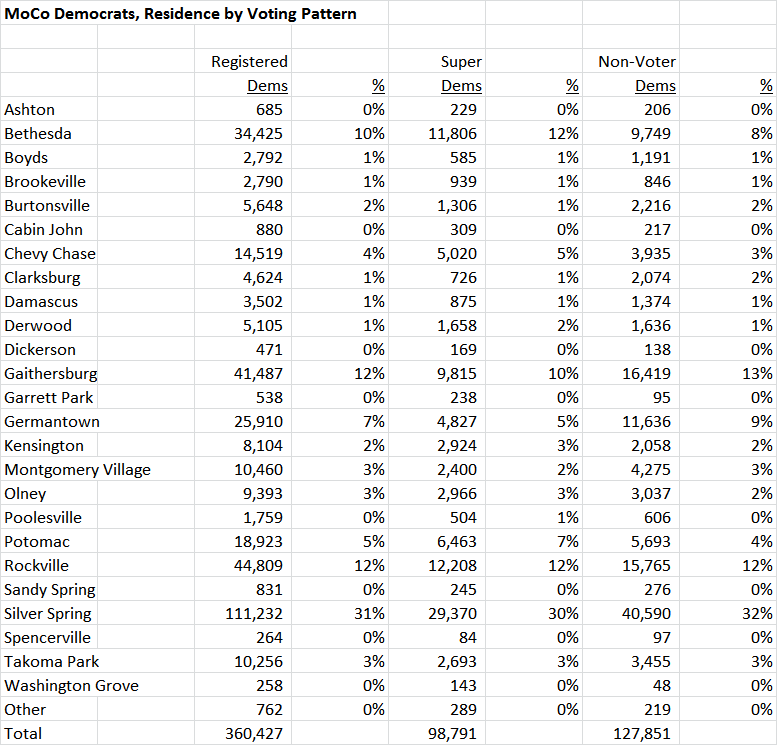
Super-Dems and non-voters also tend to have different residence patterns.  Below are their distributions by city and town.
MoCo Democrats Residence

Super-Dems are most likely to live in Kensington, Chevy Chase, Bethesda and Potomac, in that order.  Non-voting Dems are most likely to live in Germantown, Clarksburg, Montgomery Village and Gaithersburg, in that order.

Below is the same data presented by council and legislative district.
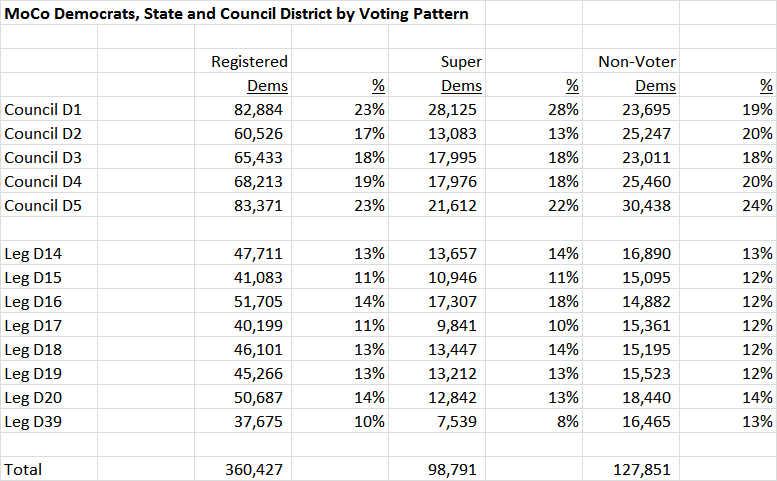
MoCo Democrats by District

Super-Dems are most likely to live in Council District 1 and Legislative District 16 – again, in the BCC-Potomac vicinity.  Non-voting Dems are most likely to live in Council District 2 and Legislative District 39, which contain Germantown and Montgomery Village.

Race

The voter file does not contain racial data.  But the Census Bureau does have racial data by Census tract, and we integrated that into the voter file.  Below is the distribution of super-Dems and non-voters in the precincts that have the highest percentages of black, Hispanic and Asian residents.
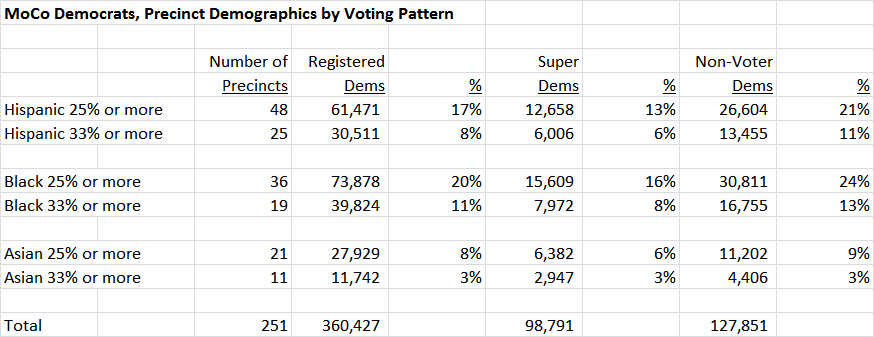
MoCo Democrats Race

Voting patterns in Asian precincts don’t vary much.  But non-voters are significantly more likely to live in precincts with high black and Hispanic populations than super-Dems.

In summary, the following characteristics apply to super-Dems in order of likelihood.  Super-Dems are most likely to:

  1. Be age 60 or over
  2. Be age 50-59
  3. Live in Kensington
  4. Have average household incomes of $200,000 or more
  5. Live in Chevy Chase
  6. Live in Bethesda
  7. Live in Potomac
  8. Live in Council District 1

Non-voting Dems are most likely to:

  1. Be age 39 or younger
  2. Live in Germantown
  3. Live in Clarksburg
  4. Live in precincts that are 33% or more Hispanic
  5. Live in Legislative District 39
  6. Have average household incomes of less than $100,000
  7. Live in precincts that are 33% or more African American
  8. Live in Council District 2

How can the non-voting Dems be turned into voting Dems?  We will conclude with a few suggestions to do that in Part Four.

Share

MoCo Dems Who Don’t Vote, Part Two

Today, I am pleased to present a guest post by Adam Pagnucco:

Who are these registered MoCo Democrats who don’t vote?  Let’s find out.

The table below presents data on registered Montgomery County Democrats from the January 2015 voter registration file.  As of that date, there were 360,427 registered Democrats in MoCo.  The file contains their voting histories in the primary and general elections from 2006 on.  Most MoCo Democratic candidates running in primaries, which tend to decide elections here, concentrate their voter contact on the 42,692 people who voted in each of the last three primaries.  (They account for 12% of MoCo Dems and 5% of the county’s voting age population.)  But for the purpose of this analysis, we will be examining three groups: all registered Democrats, those who voted in each of the last three gubernatorial general elections (Super Dems) and those who have voted in no gubernatorial generals (Non-Voting Dems).

MoCo Democrats by Voting Pattern

The first fact that stands out is that the non-voters are a larger group than the super-Dems.  There were 98,791 Democrats in the file who voted in each of the 2006, 2010 and 2014 general elections.  But there were 127,851 Democrats who did not vote in any of them.  That fact alone should worry state and county Democratic strategists who are looking to generate more turnout to defeat Governor Larry Hogan.

Another fact that stands out is that of the 127,851 Democrats who did not vote in any of the gubernatorial generals, 73,306 voted in at least one of the 2008 and 2012 presidential elections.  This group accounts for 20% of all MoCo registered Dems.  Why are they voting for President and not for Governor?  Let’s remember that Hogan’s statewide victory margin in 2014 was 65,510 votes.  If half of these presidential-voting Democrats showed up in 2014 and voted for Anthony Brown, Hogan’s margin would have been cut by more than half.  If half of all of the non-voting MoCo Dems had showed up to vote for Brown, Hogan’s margin would have been nearly eliminated.

Let’s zero in on a few demographic factors pertaining to MoCo Dems.

Gender

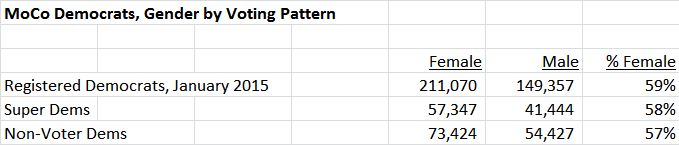
Women account for majorities of registered MoCo Dems, super-Dems and non-voters.  No surprise here.  Women dominate the rank and file of the Democratic Party even if they account for less than a majority of its elected officials.

MoCo Democrats Gender

Age

Age is the single most meaningful variable differentiating super-Dems from non-voters.  The average age of super-Dems is 61.  The average age of non-voting Dems is 39.  Fifty-three percent of super-Dems are age 60 or older.  In contrast, sixty percent of non-voting Dems are 39 or younger.

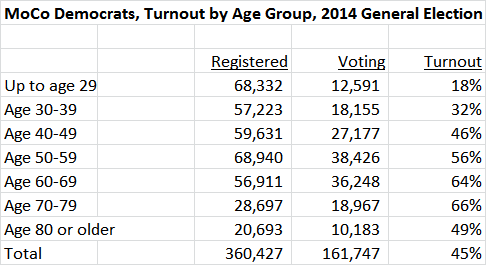
Here’s a different way of looking at age.  Following are the turnout rates for Democrats by age group in the 2014 general election.

MoCo Democrats Age Turnout

Democrats in their 60s and 70s were at least twice as likely to vote as Democrats in their 30s or younger.  Nearly 100,000 MoCo Dems in their 30s or younger did not vote in the 2014 general.

Low turnout among young people is not exclusive to MoCo – it’s a nationwide phenomenon.  But because so many young Democrats in MoCo are not voting, that suggests the party needs a strategy to get them to the polls to realize significantly higher turnout in 2018.

We will look at more differences between super-Dems and non-voters in Part Three.

Share

MoCo Dems Who Don’t Vote, Part One

I’m following the lead of my students and heading out of town on Spring Break. Fortunately, Adam Pagnucco has written a series on Montgomery Democrats who don’t vote. Today, I am pleased to present the first part:

General Assembly Democrats have decided to pursue automatic voter registration in this year’s session.  There’s a good policy rationale for it and efforts to increase resident access to voting are generally commendable.  There is also a fair dose of politics here. Democrats are pursuing this because they think it will net them more votes, and Republicans are opposing it for the same reason.  Yet, there’s little evidence in our state that increasing registration will automatically increase votes for Democrats in gubernatorial elections.

Instead of concentrating on people who don’t register, Democrats should look at a different group for the purpose of expanding their turnout: people who register as Democrats but don’t vote.

Why do people register but don’t vote?  Part of the explanation lies in how relentlessly targeted modern political campaigns are.  In a context of scarce resources, campaigns strive to touch voters who a) are likely to actually vote and b) are potentially receptive to the candidate’s message.  That means orienting mail, email, field operations and even social media towards voters with regular histories of voting.  Those voters who vote regularly get inundated with candidate communications.  Those who don’t get much less of it.

Consider me.  I moved to the county in 2003.  I had a long history of voting in D.C. and New York but that didn’t show up in my Maryland voter registration record.  I voted in the 2004 primary and general elections.  In my first state-level election of 2006, only two candidates sent me mail: Hans Riemer and Duchy Trachtenberg, both non-incumbents running for the County Council.  Both had well-financed operations and perhaps they felt they could take a chance on appealing to a wider field of voters than just those who had voted in 1998 and 2002.  County Executive candidates Ike Leggett and Steve Silverman, who raised over $3 million between them, didn’t contact me.

Now, if I was feeling ignored, that didn’t last!  I continued to vote regularly and by 2010, I got lots of mail.  Don’t ask me about 2014.  My recycling can is still recovering.

So what is likely to happen to all the new voters who are automatically registered under the state Democrats’ proposal?  They will probably be ignored by Democratic candidates for state and local office because they don’t have voting histories.  Some of them might vote in presidential elections because information on those candidates is easy to come by.  (Who on Planet Earth has not heard of Hillary Clinton or Donald Trump?)  But a combination of declining local media coverage and micro-targeted local campaigns will give them no information on local races and lots of them will sit out.

That is exactly what is happening in Montgomery County.  From the 1990 general election through the 2006 general election, voter registration rose from 365,960 to 507,924 – an increase of 39%.  At the same time, the actual number of general election voters rose from 211,199 to 308,429 – an increase of 46%.

Now let’s remember what happened around the end of that time period.  The presidential campaigns of Howard Dean and Barack Obama took voter targeting to a new level with email, data-mining and (later) social media.  Campaigns became much more efficient at reaching small groups of likely voters.  And all of this filtered down into state and local races, especially in MoCo, where so many candidates and campaign staffers have ties to the national level.

This had an impact in Montgomery County.  From the 2006 general election through the 2014 general election, voter registration rose from 507,924 to 634,663 – an increase of 25%.  But the actual number of voters dropped in 2010 and again in 2014.  The 2006 general saw 308,429 voters while the 2014 general saw 267,456 voters – a decline of 13%.  At the same time, the number of MoCo voters in presidential general elections has been rising steadily in every cycle since at least 1990.

What we are witnessing now is a shrinking snowball effect.  As each gubernatorial cycle passes, the pool of targeted voters shrinks as people who vote regularly pass away or move out.  And those without voting histories are ignored by candidates, and don’t vote, and so their numbers grow.

This should be a major concern for both Maryland and MoCo Democrats, because low turnout in MoCo (as well as Baltimore City and Prince George’s) significantly contributed to Larry Hogan’s winning the Governor seat.  More registration won’t fix it.  More efforts to turn out an ever-smaller group of regular Democratic voters won’t fix it.  But communicating with people who are already registered Democrats and who, for whatever reason, aren’t voting just might fix it.

So who are these Democrats who don’t vote?  We’ll find out in Part Two.

Share

McDonnell Cites Trone on “Buying Access” in Corruption Conviction Appeal

Premium Human Hair Lace Front Wigs | NiaWigs – niawigs

Former Virginia Gov. Bob McDonnell’s attorneys cited recent statements by CD8 Candidate David Trone in their brief appealing McDonnell’s corruption conviction:

The consequences of the Government’s construction confirm why it cannot be the law.  Extending bribery beyond efforts to direct a particular resolution of a specific governmental decision would upend the political process, vesting federal prosecutors with extraordinary supervisory power over every level of government.  If “official action”includes anything that could “have the purpose or effect of exerting some influence” on any imaginable sovereign decision (Pet.App.54a), then every official and campaign donor risks indictment whenever heightened access is provided in close temporal proximity to contributions.  That happens literally every day at political fundraisers nationwide.  As one businessman seeking public office recently explained: “I sign my checks to buy access.”  Bill Turque, David Trone Has Donated More than $150,000 to Republicans, Database Shows, WASH. POST, Jan. 28, 2016.

Now, there is an important legal difference between buying access via campaign donations – referenced here by Trone – and through direct gifts to the official. Nevertheless, McDonnell’s attorneys cite Trone’s statement as an explanation for why it’s acceptable that McDonnell used his powers as Governor to aid a businessman who gave him a Rolex and helped to pay for his daughter’s wedding.

Cynicism about the process is helping to power both Donald Trump and Bernie Sanders’ campaigns in very different ways. Sanders decries the corruption of American politics through corporate campaign donations.

Like Trump, Trone says forthrightly that, of course, he was “buying access.” A central basis of the Trump and the Trone campaigns is that they are so rich that they cannot be bought. Their wealth has become a qualification for office.

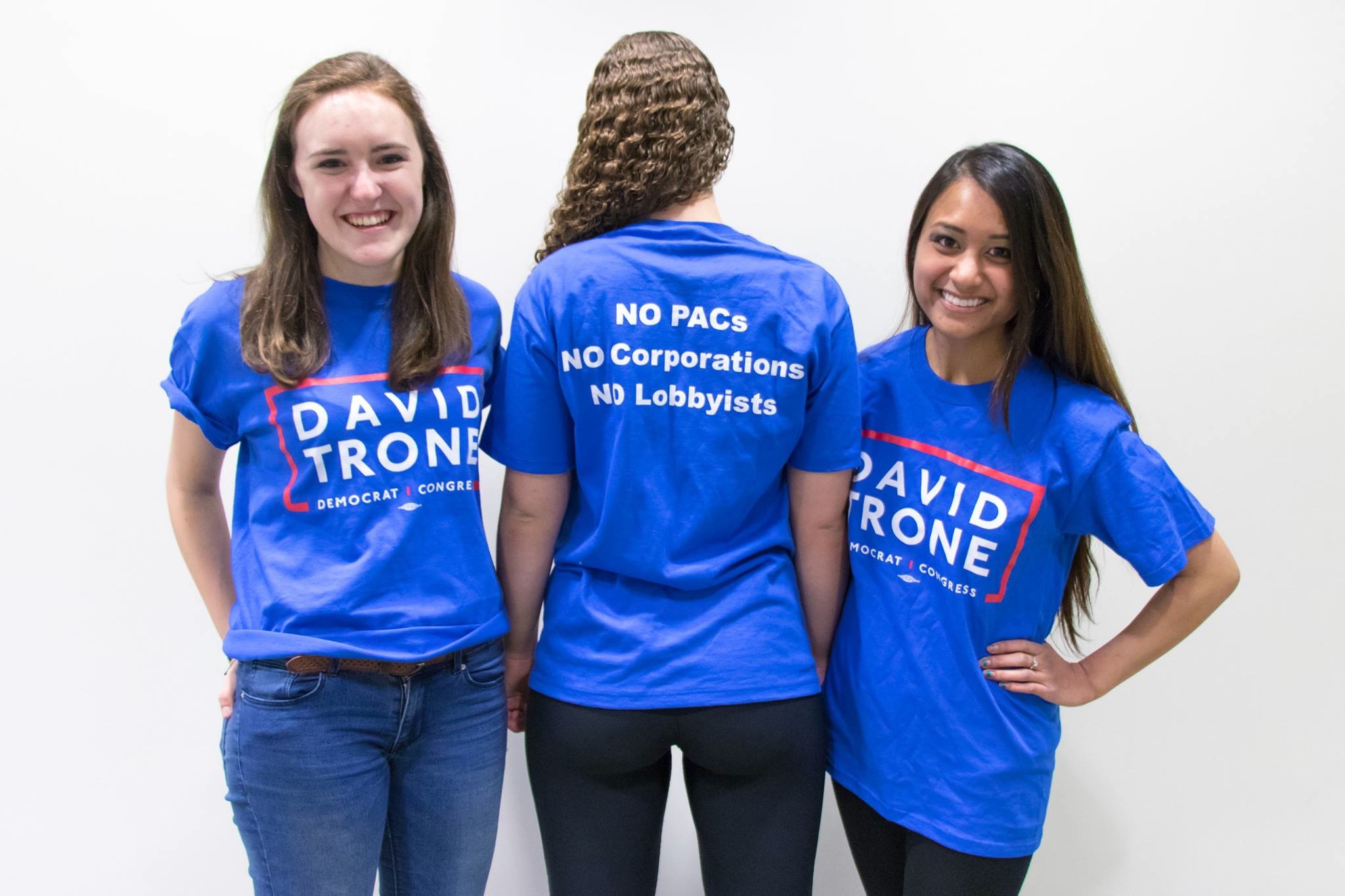
His campaign t-shirts even brag “NO PACs, NO Corporations, NO Lobbyists.” While a great slogan, the fact remains that David Trone runs a company that makes exactly these sorts of donations and that company employs lobbyists. The Center for Responsive Politics reports that, for example, Total Wine gave $12,500 to support Mitt Romney‘s presidential campaign.

I’m not bothered that Trone has a lot of money or is stimulating the economy by spending so much of it on his campaign. But why Trone thinks that he is a superior candidate because he is the corrupter rather than the corrupted remains a mystery to me.

Share

Profile in Silence: Larry Hogan

cruz-trump-rubio

Now that Larry Hogan’s man crush Chris Christie has exited the race after his presidential campaign experienced failure to launch, what is the Governor to do?

Hogan explained to Ovetta Wiggins of the Washington Post that he does not believe in the transitive property of endorsements, so Hogan is not following Christie’s jump on to the Donald Trump bandwagon. At least not yet. Hogan says that he “hasn’t decided” who to support. Hogan also hasn’t found time to return repeated calls from former BFF Christie who wants to talk Trump.

The Gov has no good options. While the media focuses on to Trump or not to Trump, Rubio and Cruz would be the most right-wing nominees ever and destined to lose Maryland by an even larger margin than McCain or Romney did against Obama.

All three are very anti-immigrant in a state that voted heavily for the Maryland DREAM Act. Both Rubio and Cruz oppose abortion even in cases or rape and incest – an extreme position on an issue that Hogan worked hard to avoid. They also want to continue the now lost marriage equality wars, which would raise the salience of yet another issue that Hogan is on the wrong side of Maryland voters and assiduously avoided in his campaign.

As almost all of the others have been voted off the Island of Misfit Candidates, it looks as if Trump, Rubio, or Cruz will be the nominee. If the nominee is Rubio or Cruz, I imagine Hogan will support them but be really quiet about it in the hope of not having to answer whether he agrees with them on a whole range of issues.

Trump is apparently still in the mix for Hogan, even if he cannot seem to touch base with Christie. But if Trump does as well as expected tonight, he’s not going to be able to stay silent much longer. Not an easy political place to be as supporting Trump could be a career killer but many of Hogan’s supporters will vote for him enthusiastically in Maryland’s primary on April 26th.

Share

David Trone’s Historic Spending

Today, I am pleased to present the following guest post from Adam Pagnucco:

CD8 residents are in the midst of an historic election, not merely because the congressional seat is opening up for the first time in fourteen years.  What makes it historic is that one candidate, Total Wine co-owner David Trone, is on pace to shatter spending records in local races.  In fact, he may wind up being the top self-funder in a U.S. House race anywhere in the country for all time.

Since announcing for Congress a month ago, Trone has deluged CD8 residents in mail, digital ads, paid social media, television commercials and more.  Our sources estimate that Trone has spent roughly $2.5 million on television and radio ads alone through the end of February.  (That’s about five times what Kathleen Matthews has spent.)  Throw in the cost of mail, digital, staff, vendors and campaign expenses and Trone has probably spent at least $3 million in one month of campaigning.  That puts Trone on pace to spend $10 million – and probably much more – by the end of the primary.

How does that stack up against expenditures in other prominent local races?

We added up spending totals of recent competitive races for Governor, U.S. Senate, U.S. House and Montgomery County Executive contests.  For Governor, we included Lieutenant Governor and slate accounts and deducted transfers between them.  Primaries and generals are listed separately unless either one was non-competitive, in which case we combine them and list them as “both.”  The data appears below.

Campaign Spending Recent MD

Trone’s spending could eventually be comparable to some gubernatorial races.  He probably won’t touch Bob Ehrlich’s total as an incumbent in 2006.  But he could approach the totals of Martin O’Malley’s two races and the amount spent by Anthony Brown in the 2014 primary.  He will almost certainly exceed what Ben Cardin and Michael Steele spent in their 2006 U.S. Senate race.  And he will blow away any candidates in U.S. House and Montgomery County Executive races in recent years.

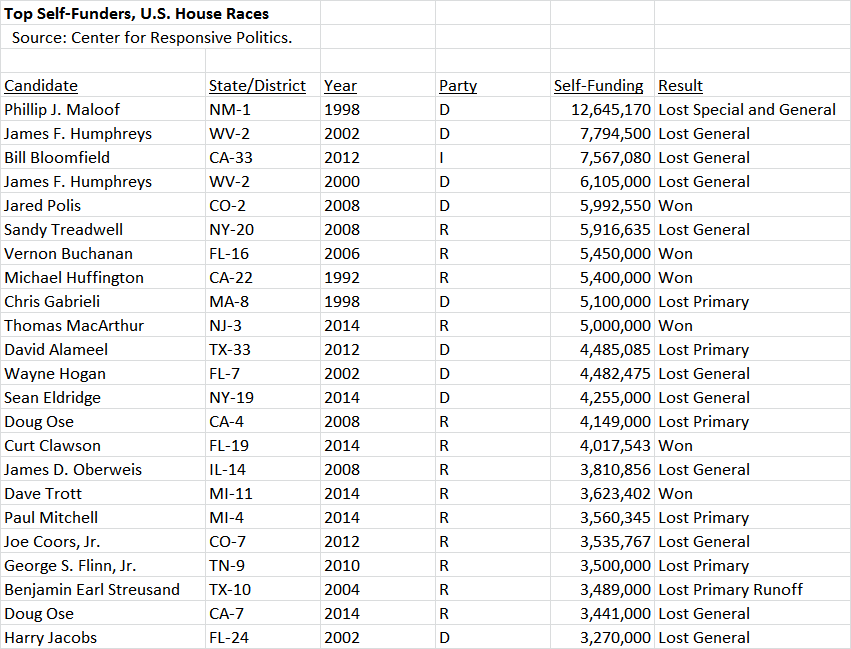
Trone’s campaign is almost entirely self-funded.  He has said that he will spend “whatever it takes” to win.  How will he compare to other self-funders in U.S. House races?  The Center for Responsive Politics periodically releases estimates of self-funding.  Below is a compilation of everyone we can identify who has contributed at least $3 million to their own campaigns, which is roughly the level Trone has so far given to his.

Top Self Funders US House Races

Self-funders come from both parties, often run in big states and usually lose.  The combined record of the above candidates is 6-18.  Phil Maloof, the leading self-funder, should have an asterisk next to his name because he lost both a special election and a general election to future Congresswoman Heather Wilson in the same year.  (Interestingly, Maloof’s family derived part of its fortune from beer distribution.)  If Maloof is discounted from the above list, David Trone could well be the top self-funder in a U.S. House race of all time, anywhere.  Even including Maloof, Trone could still be number one.

The Big Question in CD8 is . . . will it work?

Share

Rules for Dealing with Reporters

Today, I am pleased to present a guest post from Adam Pagnucco.

One of the most critical tasks for politicians, operatives and staffers is dealing with press. If you do it right, you can make sure that your point of view gets represented fairly and regularly. But if you do it wrong, you will lose opportunities to get your message across. Working with a number of sources who have experience in journalism, I present the following rules for dealing with reporters.

  1. Reporters are not your friends and they’re not your enemies. They are people who are doing their jobs. That’s it.
  1. Tell the truth. If you try to spin them, they will know. (You are not their first source!) If you lie to them and they find out, you are done and they just might expose you. They will never regard you as a trustworthy source again.
  1. Talk like a human being and don’t rely on canned pablum. A source says, “More and more operatives and flaks will only respond with prepared emails. It may feel safer, but it precludes exchanges that can actually be helpful or even enlightening.”
  1. If you have a problem with a story, point out the issue civilly and supply evidence that you’re right. Everyone makes mistakes, even seasoned pros. Never, ever question their integrity. And don’t go over their heads to their bosses. That’s a sure way to make an enemy.
  1. In regards to seeking a correction, it’s acceptable to dispute a factual matter but you will have less success in arguing against a reporter’s analysis or interpretation of events. Source: “There’s a distinction between a factual error – which a reporter will want to correct immediately – and, say, a disagreement with a reporter’s analysis, which is a different matter entirely.” Another source: “Any source who insists on a correction for what’s really interpretation will lose the respect of the editor.”
  1. Deal with multiple reporters and learn their interests. Over time, you will be able to match the right reporter with the right story.
  1. Until you have a relationship with them, always make clear when you are talking on the record or off the record. Source: “Tell the reporter in advance that you have information that can’t be attached to your name. Negotiate how the source will be attributed. Always inform the reporter that information isn’t on the record BEFORE sharing the information.” Another source: “Always assume that if you haven’t set up a prior arrangement and haven’t said the conversation is off the record, that it isn’t off the record. It is on the record.”
  1. Understand the limits of reporters’ ability to control the presentation of their story. Editors play in this. They can and do write headlines and change language in the article. One reporter I knew was regularly embarrassed by headlines written by editors. Source: “Reporters can’t promise a specific headline, placement in the paper or really what the story says.”
  1. If you try to overtly kill a story, it will probably backfire. Source: “Jumping up and down and yelling ‘There’s no story here’ will only encourage the scribe to persevere.”
  1. Deal in facts whenever possible. Never mischaracterize a rumor as a fact. It’s OK to say, “I don’t know.”
  1. When you get a request from a reporter, respond rapidly. Source: “In today’s day and age reporters expect you to get back to them quickly – in hours, not days. Even if you don’t have all the info, it’s best to get back to them with something initially, let them know you’re looking for the information and then once you have it, provide it to them.” Another source: “Please don’t ask ‘When’s your deadline?’ In digital 2016, that’s like asking for the nearest pay phone. Deadline is now. It’s as soon as you can provide whatever is being asked for.”
  1. Understand that you are one source among many. If you stop talking to a reporter, he or she will just move on to another source – and possibly a source who opposes your agenda and/or you. So get past the article that irked you last week and keep the dialogue going.
  1. Forget about Friday night surprises. Source: “Folks still believe that they can somehow sneak a negative story under the radar if they put it out late Friday afternoon. This thing called the Interwebs makes it a quaint idea. It only alienates the reporter by screwing up the start to his weekend.”
  1. Pick your shots. Not everything is newsworthy. Source: “A chief of staff, campaign manager or press secretary who tries to convince a reporter that there’s a story every time his or her boss goes to the bathroom will quickly become background noise and risks being ignored.”
  1. Never share a tip given to you by a reporter with another reporter. You are risking having a competitor scoop the person who was generous enough to give you that tip. And the person who got scooped will know it was your fault.
  1. Reporters don’t decide newspaper endorsements. If you get mad at a reporter because his or her publication didn’t endorse you, you are not helping yourself.
  1. Understand that some reporters talk to each other and to their successors when they leave. Your reputation as a source, good or bad, will make the rounds.
  1. Have a sense of humor! Reporters may not be at liberty to say what they really think about certain things, but almost all of them appreciate a good joke.

If this all seems like common sense, it should be. But I have seen many people run afoul of these rules. Some politicians believe that reporters can be schmoozed into being “friends.” Then when their “friend” prints an article they disagree with, they feel betrayed. Other politicians distrust the press so much that they speak rarely to them, if at all – thereby creating openings for their competitors. Many politicians perceive bias when a reporter makes a simple mistake. Some believe they can “control” the press when in reality a more achievable goal is to get your voice heard.


Those who break one or more of the above rules probably outnumber the ones who respect them. So be one of the people who adhere to them. If you do, you will have an advantage over the folks who don’t!

Share

Larry Hogan Does Not Play Well with Others

 Sen. Bobby Zirkin (D-Baltimore) condemns Gov. Larry Hogan’s attack on the General Assembly. Source: Bryan P. Sears.

Josh Kurtz deserves the prescient pundit award for the week for his column in Center Maryland:

On the day state Senate Democrats voted to override his veto of legislation restoring voting rights to 44,000 parolees and probationers, Gov. Larry Hogan (R) . . . was quick to condemn the vote and suggested that there could be political consequences for the senators who went against his wishes. Some, he predicted, “won’t survive the vote.”

Minutes later, like clockwork, Change Maryland, Hogan’s political organization, listed the 29 Democrats who had voted to override the veto, accusing them of “ignoring an overwhelming majority of Marylanders” and suggesting that they be targeted for their votes. In the days that followed, angry Marylanders let these lawmakers know how they felt – sometimes in intemperate, threatening ways.

Can we please, please discard the notion . . . that Hogan is a bipartisan governor?

Yesterday, Hogan confirmed his new, ahem, approach by doing a canonball right into the middle of the General Assembly:

Two-thirds of people approve of the job I’m doing and the legislature has decided to focus on the one third, and I’m not sure how any of them can get reelected by doing that. They come down to Annapolis like its spring break, breaking furniture, throwing beer bottles off balconies, and thankfully they’re going to go home in a few weeks and we can get back to running the State.

Bragging about how popular you are is much more Donald Trump than bipartisan leader. Popularity also often proves ephemeral, while the Governor will have to work with the General Assembly every year that he is in office.

Hogan’s comments may prove less than helpful to some of his friends. I can already hear the voice over in attack ads of Hogan telling Sen. Kathy Szeliga to stop acting like it’s Spring Break and then the narrator suggesting she do her job in Annapolis before running for U.S. Senate.

The Governor has huge advantages in commanding the attention of the press and the people. So it’s an impressive day when the Governor manages unaided to look like the kid in the sandbox who needs to be placed in time out.

Share

Metro Ridership Down Another 5% Last Year–Now at 2004 Levels

metro ridership

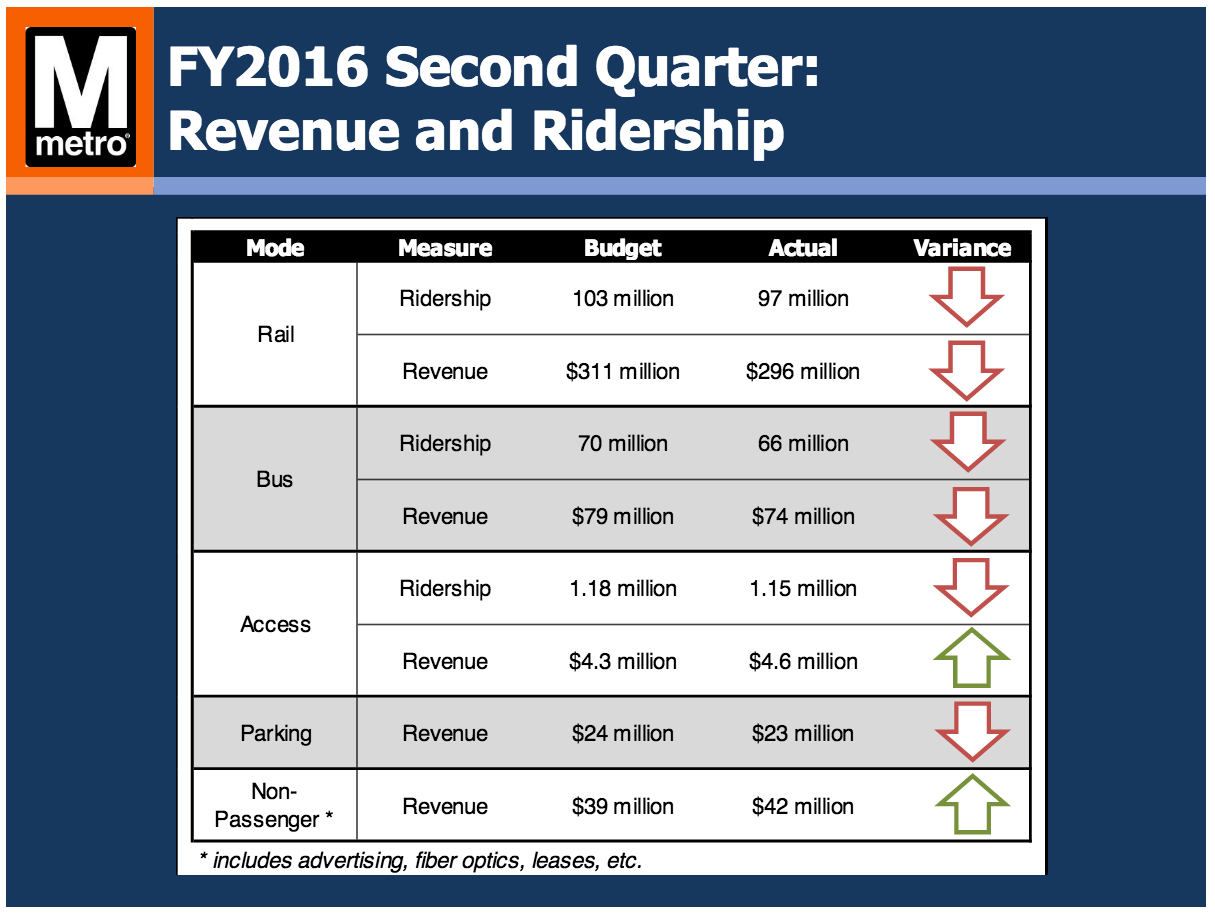
Metro ridership is down 5% over last year. As Metro did not project this decline, this means that Metro faces a substantial budget shortfall of $15 million from the decline in rail revenue and $5 million in bus revenue. Yet, Metro plans to add another 59 employees to the system.

If it raises fares, ridership will decline even further. Metro also needs to spend money on the rail system, as its reliability still seemingly continues to decline on a near daily basis. People don’t want to ride a system that is undependable.

Bringing it home to Maryland, it would be interesting to know how many few people are boarding or alighting at Maryland Metro stops. Additionally, how does the steady decline in ridership affect the projections for Purple Line ridership, as many of its passengers are expected to change to the Red or Orange Lines?

boardings

Share

Does Making Registration Easier Cause More Voting?

Today, I am pleased to present a guest post from Adam Pagnucco:

In this year’s session of the General Assembly, Democrats will be introducing legislation providing for automatic registration of voters.  While the details vary between proposals, the concept is that state agencies would proactively “forward to election officials data about anyone who meets the age, residency and citizenship criteria to vote.”  Individuals would be allowed to opt out if they wish.  Democrats clearly believe this would increase the number of voters who support their party.  Republicans also believe that since they are openly opposing the idea.

Are they right?  Would more registration lead to more voting?

The State of Maryland has taken many steps to make registering and voting easier, including early voting (2010), online registration (2012) and expansion of early voting from six to eight days (2013).  Same day registration during early voting will be in effect for the first time in 2016.  The state has also offered applicants for driver’s licenses the opportunity to register as voters in conformance with federal law since 1995.

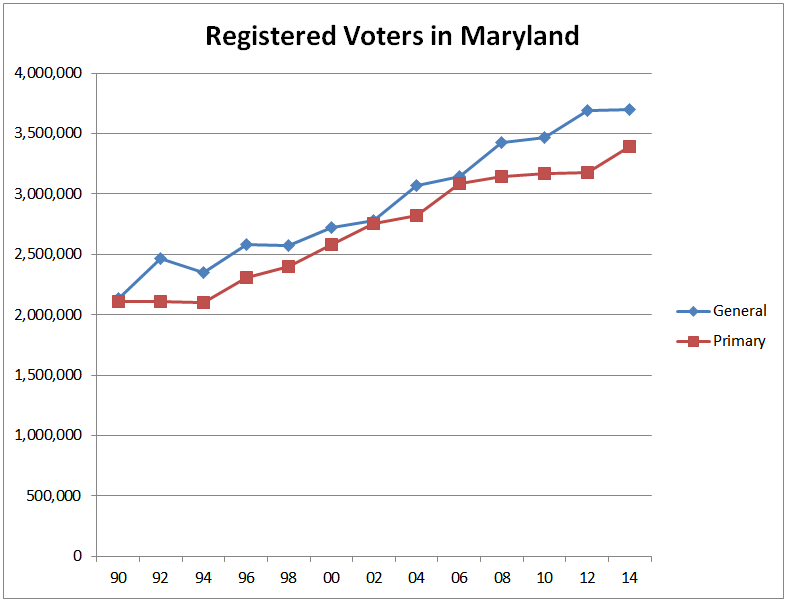
Maryland has seen steady increases in voter registration over the years.  The graph below shows statewide registered voters in both primary and general elections since 1990.  While there are slight variations in individual cycles, registration has gone up by about 4-5% every two years.

Voter Registrations graph

Has that resulted in more voting?  Much has been made of declining turnout in the past, and there is something to that: the turnout rate has fallen from 61% in the 1994 general election to 47% in 2014.  It has also declined from 81% in the 1992 general election to 74% in 2012.  But looking at the turnout rate alone can be misleading.  If the number of actual voters increases at a slower rate than the number of registered voters, the turnout rate can fall even if actual voting rises.  In fact, if more aggressive voter registration outreach brings in voters who are less likely to vote, that is exactly what could happen.  The test here is whether actual voting is going up along with registration.

First, let’s look at primaries.  The graph below shows the total number of primary election voters in Maryland since the 1990 elections.  These elections are very sensitive to the circumstances of offices on the ballot.  At the gubernatorial level, primary voting peaked in 1994, 2002 and 2006.  The former two years saw open Governor seats while the latter saw a rare competitive U.S. Senate race.  Primary voting tanked in 1990 and 1998, when incumbent Democrat Governors were running for second terms.  At the presidential level, primary voting surged in 2008 when Barack Obama was in a competitive race with Hillary Clinton.  Primary voting fell dramatically in years when an incumbent President was on the ballot (1996, 2004 and 2012).  These candidate dynamics overwhelmed any effects of increasing registrations.

Primary Voting graph

General elections see much steadier patterns of voting.  The graph below shows the total number of general election voters in Maryland since the 1990 elections.  The absolute number of voters in both gubernatorial generals and presidential generals has been rising steadily since the 1990s – with the notable exception of a divergence in the 2010-2014 period.  Presidential voting has gone up every year since 1996, but gubernatorial voting went down between 2010 and 2014.  This is the same period during which early voting (2010), online registration (2012) and an increase in early voting days (2013) were implemented.

General Voting graph

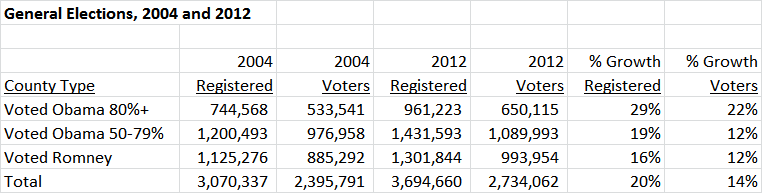
Let’s look at this presidential vs. gubernatorial split more closely.  The popularity of President Barack Obama may be a factor in increasing the number of voters in recent presidential elections.  Obama gained 62% of the vote in Maryland in both 2008 and 2012 and his approval rating in Maryland has been above 50% for most of his time in office.  The chart below shows changes in registrations and voting for each Maryland jurisdiction between the 2004 and 2012 general elections.  The two counties that gave Obama more than 80% of their vote in 2012 – Baltimore City and Prince George’s County – saw increases in both registrations and the number of actual voters greatly exceeding state averages.  Counties opposing Obama saw rises in registration and voting too, but not nearly as much.

Presidential Voting chart

The gubernatorial elections tell a very different story.  The chart below shows changes in registrations and voting for each Maryland jurisdiction between the 2010 and 2014 general elections.  Statewide, registrations were up by 7% while the number of voters fell by 7%.  But voting behavior differed between counties supporting Larry Hogan and those supporting Anthony Brown.  In the ten jurisdictions that gave Hogan 70% or more of their vote, the actual number of voters fell by 3%.  In the four jurisdictions that supported Brown, the actual number of voters fell by 8%.  Registrations rose by 7% for both groups.

Gubernatorial Voting chart

Increased registration has coincided with more voting in presidential elections and less voting in the 2014 gubernatorial election.  Why is that happening?  Here’s a theory: voters have access to much more information about presidential candidates than state or local candidates and are therefore more likely to vote for the former.  In fact, state and local candidates target voters with long histories of regular voting with their mail and field programs while they ignore voters with sparse histories – including new voters.  Declining local media coverage of state and local races reinforces this information gap.  So the registration efforts of Democrats through legislation and party activities may help fortify the margins of presidential candidates and federal candidates running in presidential years, but they did not help the party in 2014.  Not only did the Democratic nominee for Governor lose, but the Republicans picked up a record number of seats in the House of Delegates, captured the Howard County Executive seat and almost knocked off Congressman John Delaney – all while voter registration was rising.

There’s nothing wrong with making voter registration more convenient.  But given the above, there is little evidence to suggest that Democrats at the state and local level will significantly benefit from it.  There is also little evidence that Republicans should fear it.

Share

Maryland Politics Watch