Awkward!

By Adam Pagnucco.

On Tuesday, the County Council learned that their own spokesperson is planning on running for one of their seats.  Um, OK.  And… they learned about it like everyone else did by reading it on MCM.

Um… Awkward!

Neil Greenberger, who has been the council’s Legislative Information Officer since 2006, announced his potential candidacy by telling MCM, “I would chance to say I know as much about county government as anybody in the county.”  Including his bosses?  Um… well, you get the point.  Greenberger could run in District 2 if incumbent Craig Rice vacates his seat.  Otherwise, he would run at-large.  Greenberger said he would stay in his job while he runs for office and give it up only if elected.

To appreciate how strange this is, let’s understand that the two most sensitive staff positions for most elected officials are their Chief of Staff and spokesperson.  The former person is privy to the official’s most confidential discussions and decision-making.  The latter is the official’s conduit to the public.  Both individuals have to mirror the boss’s priorities exactly and can never diverge positions from them outside of closed doors.  That’s part of the deal when you work for an elected official.

Patrick Lacefield, Greenberger’s counterpart in the Executive Branch, works for one boss.  And Ike Leggett, by all accounts, is a good boss to have.  Greenberger has NINE bosses and not all of them are as gentlemanly as Leggett.  Imagine having nine ropes around your neck pulling in nine different directions and you have some idea of what it’s like to be Greenberger.  It is not an easy job.

Now imagine what happens if Greenberger actually runs.  During the day, he would continue to be the council spokesperson, working with the members and their staff to get out information to the public.  And then at night and on weekends, he would be a fellow candidate.  Let’s remember that open seat candidates are frequently asked what they would do differently than the incumbents.  So part of the time, Greenberger would be working for the Council Members and the rest of the time he would be critiquing them.
It gets even weirder.  If Greenberger runs at-large, he will be running against current at-large incumbent Hans Riemer, who is sure to seek a third term.  It’s also possible that he could run against District 5 Council Member Tom Hucker, who could run at-large.  Then there’s the matter of all the other at-large candidates (and there will be a lot of them).  Suppose Greenberger loses.  Will his victorious opponents then be required to retain him as their spokesperson?

We can’t recall another occasion when the council’s own spokesperson ran for one of their seats.  The closest recent analog to this situation happened in 2006, when George Leventhal’s Chief of Staff, Valerie Ervin, decided to run for the District 5 seat.  Since Leventhal was an at-large member, Ervin was not running against him.  But she still left her Chief of Staff position as the campaign started.

Greenberger has as much right to run for office as any other county resident.  But if he stays in his current job while he runs against one or more of his employers, he will be creating immense conflicts.  Council Members need to trust that their communications are written for their benefit and for the benefit of the institution – not for the personal political benefit of the individual writing them.  The fact that they were blindsided by the MCM article is not a good sign for future trust.

Unless adult supervision steps in – and we are talking about the council’s staff director, Steve Farber – this could be a wild ride.

Share

Setting the Record Straight

By Adam Pagnucco.

County Executive Ike Leggett has thrown in the towel on efforts to reform the county’s Department of Liquor Control (DLC).  We will have something to say about that soon.  But first, let’s address a claim the Executive has made in Bethesda Magazine: namely, that “the department’s critics have failed to put forth a proposal that included replacing the DLC’s profits.”

That is flat-out untrue.

On August 15, 2016, while the Executive’s DLC task force was meeting, your author posted a proposal on Seventh State for replacing DLC’s profits.  Our concept was to replace every dime of DLC’s net income with a combination of revenue sharing with the state, opening a few new liquor stores and financing the county’s liquor bonds with cable funds.  No new taxes or fees would be required.  In the email below, your author asked Bonnie Kirkland, the Executive Branch staffer running the task force, to have the proposal studied by the administration’s consultant.  Ms. Kirkland agreed to do that.  But the consultant’s report never examined our proposal and does not reference it at all.  And now the Executive claims that our proposal never existed.

Let’s give the Executive the benefit of the doubt.  No Executive is aware of every interaction his staff has with the public.  But it’s absolutely untrue that we had no proposal to replace DLC’s profits.  We did and we shared it with his staff.  It was simply ignored by his administration.

Below is the email exchange your author had with Ms. Kirkland as proof.  Let no one – not the Executive, not his staff, not anyone at the County Council and not anyone else – continue to claim that we presented no ideas for replacing DLC’s profits.

*****

From: Kirkland, Bonnie <Bonnie.Kirkland@montgomerycountymd.gov>

Sent: Thursday, September 1, 2016 3:47 PM

To: Pagnucco, Adam

Subject: Re: Proposal on liquor monopoly revenue

Adam – The proposal, along with the others, is under analysis by the consultant. They will present a preliminary report/analysis at the next meeting, September 15.

Bonnie

Sent from my iPhone

On Sep 1, 2016, at 2:28 PM, A P <acp1629@hotmail.com> wrote:

Hi Bonnie – have you had time to consider my request?  I believe it responds to the Executive’s view that he is prepared to depart from DLC’s monopoly status so long as the revenue gap is closed.  Adam

From: Bonnie.Kirkland@montgomerycountymd.gov

To: Acp1629@hotmail.com

Subject: RE: Proposal on liquor monopoly revenue

Date: Wed, 17 Aug 2016 17:13:08 +0000

Adam – Yes, I did receive your email. I am currently out of the office and will respond as soon as possible.

Bonnie

From: A P [mailto:acp1629@hotmail.com]

Sent: Wednesday, August 17, 2016 1:02 PM

To: Kirkland, Bonnie <Bonnie.Kirkland@montgomerycountymd.gov>

Subject: FW: Proposal on liquor monopoly revenue

Hi Bonnie – did you receive this email?  And if so, can you confirm that this proposal will be analyzed along with the others in the course of the DLC task force’s deliberations?

Thank you,

Adam Pagnucco

From: acp1629@hotmail.com

To: mcvim@aol.com; dwayne.kratt@diageo.com; mdharting@venable.com; molly@allsetrestaurant.com; rneece@esopadvisors.com; mmendelevitz@esopadvisors.com; mbalcombe@ggchamber.org; ggodwin@mcccmd.com; gitaliano@bccchamber.org; jredicker@gsscc.org; chris.gillis@montgomerycountymd.gov; joel.polichene@rndc-usa.com; bob.mutschler@rndc-usa.com; tbeirne@wineinstitute.org; jen@pwrjmaryland.com; sidney.katz@montgomerycountymd.gov; lisa.mandel-trupp@montgomerycountymd.gov; neal.insley@nabca.org; steve.schmidt@nabca.org; hgaragiola@alexander-cleaver.com; robert.douglas@dlapiper.com; sfoster739@comcast.net; mthompson@marylandrestaurants.com; jason@capstrategies.net; ashlie.bagwell@mdlobbyist.com; mcarter@vsadc.com; proddy@rwlls.com; lobbyannapolis@verizon.net; amy.samman@montgomerycountymd.gov; fariba.kassiri@montgomerycountymd.gov; bonnie.kirkland@montgomerycountymd.gov; ginanne100@aol.com

Subject: Proposal on liquor monopoly revenue

Date: Mon, 15 Aug 2016 12:00:24 -0400

Hi Bonnie:

I am requesting that this proposal on how to deal with liquor monopoly revenue be considered by the administration as part of its DLC deliberations.

https://www.theseventhstate.com/?p=6987

Thank you,

Adam Pagnucco

Share

The Most Vulnerable Republicans in the House of Delegates

Today, we take a peek at the two most vulnerable Republicans in the House of Delegates. Parts I and II in this series already outlined the safe Democratic and safe Republican seats.

Robert Flanagan

Robert Flanagan is the most vulnerable Republican in the House of Delegates. Representing District 9B in Howard County, Flanagan beat Democrat Tom Coale with 55% of the vote in 2014. Flanagan ran behind Larry Hogan, who beat Anthony Brown in the gubernatorial race by 16 points.

The district shifted back heavily to the Democrats in 2016 as Hillary Clinton defeated Donald Trump by 19%. If a backlash wave against Trump upsets Republican boats in the General Assembly, this is one of the first places that will be hit, as it holds many of the precise sorts of voters who tend to be ticked off by Trump’s antics.

Flanagan has $18,268 in his campaign kitty according to the report he filed in January. In this wealthy county, he is likely going to want to raise a lot more before the campaign. Howard’s trend toward the Democrats stalled in 2014 but Flanagan still goes into the 2018 elections with a big target on his back.

Herb McMillan

Del. Herb McMillan is one of those politicians who has been on the ballot for many years but always has close, and sometimes losing, races. He won the third slot the House from District 30 in 2002 by just 427 votes over his Democratic opponent. McMillan ran for the Senate in 2006 and lost with 47% against Sen. John Astle.

He must have been happy to win a return ticket to the House of Delegates in 2010. But his vote share, the equivalent of 51% in a single-member district, hardly discouraged challengers. Redistricting placed him in District 30B, a subdistrict that he shares with Democratic Speaker Mike Busch.

Undoubtedly, Busch hoped that the voters would send McMillan home from the redrawn district. However, in the same year that Hogan won the seat by 18%, McMillan surprised and came in ahead of Busch with the equivalent of 56% of the vote.

Despite coming off of his best race ever, McMillan remains at risk. Like Flanagan, McMillan represents a seat that Hillary Clinton won convincingly. Though Anne Arundel County split nearly evenly, Clinton won this portion by 15 points.

McMillan is more prepared than Flanagan with a $66,817 in his campaign treasury–good evidence that he is ready to run a tough race for this or the Senate. Even if Hogan does well, there will be no anti-Democratic backlash to aid McMillan this time as a highly controversial Republican sits in the White House.

Either way, Democrats will want to recruit strong candidates here and in Flanagan’s district to bring the fight to them in the hopes of padding their majorities or offsetting losses elsewhere.

Share

Five Facts About MoCo School Construction Funding

By Adam Pagnucco.

School construction has been one of the hottest issues for years in Montgomery County.  Enrollment in Montgomery County Public Schools (MCPS) has been increasing by close to 2,000 students a year for a decade with no sign of stabilizing.  The result is crowded schools throughout the county.

According to the Superintendent’s FY18 Recommended Capital Budget, 109 of MCPS’s 197 schools were over capacity in the 2016-2017 school year.  Of those, 35 had enrollments of at least 120% of their capacity.  Even if the Superintendent’s request is fully funded, by the 2022-2023 school year, 87 schools will be over capacity and 29 will be at least 120% capacity.  Overcrowding will continue because construction will not keep pace with enrollment, which is projected to grow by nearly 10,000 students over that period.  MCPS is using 388 relocatable classrooms this year, a number that has not changed much over the last five years despite significant spending on school construction.

Over 80 percent of MCPS school construction costs are paid by county taxpayers with the remainder coming from state aid.  Here are five facts about school construction that all MoCo residents should know.

  1. MCPS enrollment is growing faster than the rest of the state COMBINED.

According to the Maryland State Department of Education, September enrollment in MCPS grew by 15,036 students between 2005 and 2014.  Over that period, public school enrollment in the rest of Maryland SHRANK by 543 students.  MCPS’s absolute increase and its growth rate (11%) were both first in the state.  Other systems are growing too (notably Howard and Anne Arundel) and all counties have maintenance requirements.  But in terms of new capacity needs, MCPS is in a category of one.

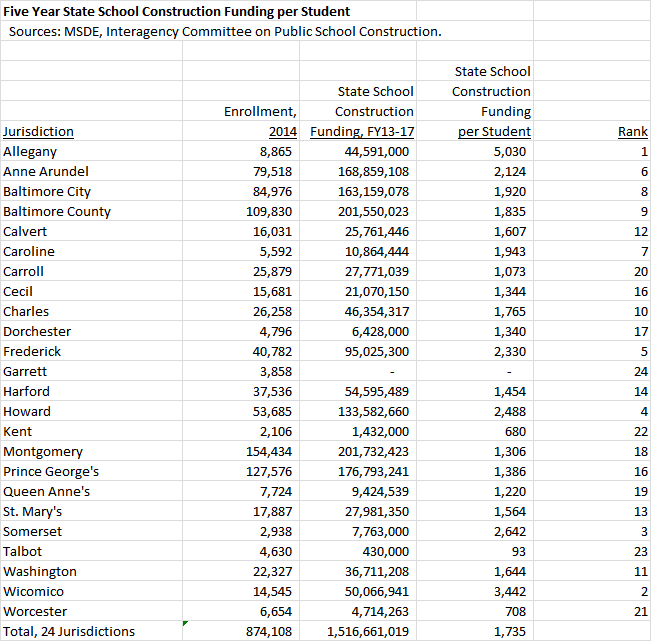
  1. MoCo gets less school construction money from the state per student than all but a handful of other counties.

Over the five-year FY13-17 period, MoCo received $201.7 million in state aid for school construction, just ahead of Baltimore County and tops in the state.  That’s a substantial amount of money.  But relative to its September 2014 enrollment, MoCo’s construction aid per student ($1,306) ranked 18th of 24 jurisdictions.  MoCo had 18% of the state’s public school students but received just 13% of state construction dollars, the biggest gap in the state.

  1. The state’s funding formula discriminates against school construction in MoCo.

The state finances a percentage of eligible costs for school construction projects approved for state aid with the local jurisdiction paying the rest.  MoCo is one of seven jurisdictions for which the state covers 50% of funding for school projects approved by the Board of Public Works, the lowest rate available.  Other jurisdictions including Prince George’s (63%) and Baltimore City (93%) receive much higher cost splits.

  1. State legislators from the City of Baltimore extracted a billion dollars from the state for their school construction program.

In 2013, Governor Martin O’Malley and the General Assembly’s presiding officers made passing a revenue increase for transportation a high priority.  Despite the fact that one of the projects to be funded was Baltimore’s $2.9 billion light-rail Red Line, city legislators withheld their votes until they got more money to rebuild their aging schools.  (City school enrollment fell between 2005 and 2014.)  The result was a new seven-year billion-dollar state aid program for city schools that greased the wheels for the transportation funding hike.  The city delegation’s work shows that significant progress can be made on this issue.

  1. MoCo residents are now paying a new tax hike in part to fund school construction.

Last May, the Montgomery County Council approved a recordation tax increase on home sales projected to raise $196 million over six years.  The council justified the tax hike on the grounds that $125 million of the money was supposed to be spent on school construction.  No recent media reports indicate that any other Maryland county has raised local taxes for the explicit purpose of financing school construction.

Disclosure: Your author’s son attends Flora Singer Elementary School in Silver Spring.  Despite opening just four years ago to relieve overcrowding at nearby Oakland Terrace, the school is already over capacity.

Share

Hogan and Senate Republicans Throw Tantrum in Support of Trump

Maryland Democrats have been trying to link Gov. Larry Hogan to Donald Trump. Now, Hogan has done it for them.

Following his pattern of avoiding all politically touchy issues when at all possible, Larry Hogan refused to comment on Trump’s travel ban because it is “the sole purview of the federal government.” An interesting view expressed by the same guy who proudly declared that Maryland would refuse to accept Syrian refugees. Among other issues, the ban resulted in a 5-year old Maryland boy being separated from his mother and held for hours.

Hogan continued his pattern of avoidance by not responding to Attorney General Brian Frosh’s request to sue the federal government on this issue. No doubt Hogan thought this was a clever way to say no while saying nothing, but Frosh upped the ante by taking Hogan’s silence as permission.

Hogan’s silent freeze out ended in a tantrum when the General Assembly voted to give Attorney General Brian Frosh the authority to sue the federal government on this and other issues. Article V of the Maryland Constitution permits either the Governor or the General Assembly to give the AG license to sue.

After he abdicated his responsibility on a difficult issue, Hogan immediately lashed out at the General Assembly for taking action to defend the State on this and other issues:

At a news conference later Friday, Hogan called the Senate vote “unfortunate, rank partisanship.”

“I don’t know why you have to change the rules now that we have a Republican governor, but they’ve been doing quite a bit of that lately,” he said. “I would rather not see that kind of political operation going on and just focus on the problems in the state.”

No change in rules. Just take a moment to read the Maryland Constitution. Don’t get mad when the Assembly exercises its rights just because you chose duck and cover.

Again, remember that for Hogan, Syrian refugees are a Maryland problem but detained child is “federal issue.” Quite a change from when Obama was president. Republicans in the Maryland Senate joined the tantrum by walking out during the discussion of the bill.

The Governor and Maryland Republicans have now taken a firm stand in favor Trump and his policies. While the Governor tried to dodge, he ultimately strongly fought the Assembly’s decision to allow AG Frosh to oppose them, breaking his much vaunted amity in order to vocally support the Trump ban along with plans to dismantle environmental protections and take away health care from thousands of Marylanders.

Share

2018 Maryland House of Delegates Ratings, Part II

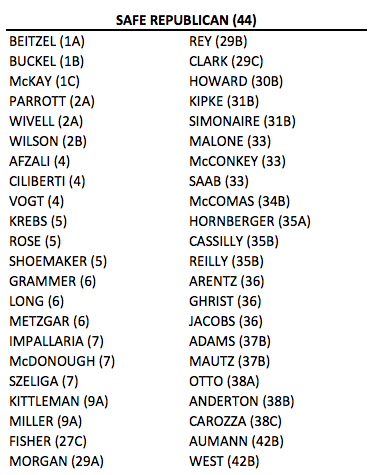
Continuing from yesterday’s list of safe Democratic seats in the House of Delegates, today’s post looks at safe Republican seats. All were carried by Trump in 2016 and Hogan in 2014. At 31% of the House, the 44 safe seats fall well short of being able to sustain a veto by a Republican governor.

Western Maryland

As with the Democrats, Republicans dominate certain regions of the state to their electoral benefit. They have nine safe seats in Western Maryland, a region with Republican loyalties dating back to the Civil War, like in much of Appalachia.

One delegate district (1A) centered on Garrett is arguably the safest GOP turf in the state. Portions of Allegany and Washington Counties used to be hotly contested with Democratic Speaker Cas Taylor hailing from Cumberland. Those days are over, as districts 1B, 1C, 2A, and 2B hold five more safe Republican seats.

Unlike the other Frederick County district,  District 4 is very safe Republican territory. It excludes the City of Frederick along with the southwestern portion of the County most oriented towards Washington, and can be depended up to elect three GOP delegates.

Eastern Shore and Southern Maryland

Save for the sole African-American majority subdistrict, the Eastern Shore is now solidly Republican. The districts east of the Bay (35A, 36, 37B, 38A, 38B, 38C) will reliably send nine Republicans to the House of Delegates in 2018.

Excluding heavily Democratic Charles County, Southern Maryland is now a great area for Republicans. Districts 27C, 29A, 29B and 29C centered on Calvert and St. Mary’s Counties are good territory for their four Republican delegates.

Baltimore, Carroll and Harford Counties

Carroll and Harford provide another trove of Republican seats with 5 (Carroll), 7 (Baltimore County and Harford), 34B (Harford), 35B (Cecil and Harford) electing nine more Republicans. District 42B, which takes in much of northern Baltimore County, has also been safe Republican turf for two more delegates.

Dundalk District 6 in Baltimore County is relatively new to electing Republicans. Before 2014, it sent three Democrats to the House of Delegates. Now, Republicans seem well ensconced in this working class white district at all level of government.

Anne Arundel and Howard Counties

Anne Arundel is a hotly divided county in many elections, such as the 2016 presidential and the 2012 referendum on marriage equality. However, several of its districts tilt heavily Republican–30B, 31B, 33–and will safely elect six Republicans in 2018.

As a whole, Howard tends to list increasingly Democratic. But District 9A, located in the more Republican western part of Howard with a bit of very Republican Carroll County added in for good measure, reliably elects two Republican delegates.

Conclusion

Bringing it all together, there are 44 solidly Republican seats:

Western Maryland: 9
Eastern Shore: 9
Southern Maryland: 4
Baltimore and Harford: 11
Carroll: 3
Howard (and Carroll): 2
Anne Arundel: 6


Share

2018 Maryland House of Delegates Ratings, Part I

While we await the Governor’s State of the State Address, 7S announces its first ratings for the 2018 elections to the Maryland House of Delegates. The House has 141 members–three times as many as the Senate. (See Senate Ratings Part I and Part II for ratings for the other body.)

Due to the much greater number of delegates, I focus only on safe Democratic seats today. Turns out that’s a majority of them.

Districts and Method of Election

All legislative districts elect three delegates and one senator. In most, the three delegates run at-large but others are divided into two (A and B) or three (A, B and C) subdistricts for delegate elections. Some, such as D37 on the Eastern Shore, are split in two to comply with protections for minority representation under the Voting Rights.

In other cases, districts are split to provide small counties the chance to elect one delegate. The division of D1 into three parts enables Garrett to elect a delegate and for Allegany to have one subdistrict entirely within its borders.

Political Geography

Each of the two major parties dominates large swaths of the State, resulting in a large number of safe districts. Let’s start with the Democrats, who by my estimation start of with 74 safe seats–three more than required for a majority.

All of these districts were won by Anthony Brown in 2014 and Hillary Clinton in 2016. Democrats have no worries about any seats in Baltimore City (Districts 40-41, 43, 44A, 45-6), Charles (28), Montgomery (14-20, 39), and Prince George’s (21-6, 27A, 47). These four jurisdictions alone get the Democrats to 65 seats.

Democrats are also sure to carry D37A, the sole African-American majority district on the Eastern Shore. For similar reasons, Democrats are a lock in D10 and D44B in Baltimore County. Along with D13, a liberal swath of Howard Country, that gives the them another six seats to get them up to 74.

Note that many of the current occupants of these may run for other offices or retire. In Montgomery, Dels. Luedtke, Platt, Carr, Waldstreicher, Kramer and Barkley may run for county office. Dels. Frick and Kelly have also expressed interest in running for other offices should the opportunity arise. There is also speculation that Dels. Gutierrez and Hixson may retire.

As in the Senate, the question is not whether Democrats will win a majority but if they can retain their ability to override vetoes should Governor Hogan win reelection.

Part II will look at safe Republican seats..


Share

Leventhal and Trone Duke It Out: Both Lose

George Leventhal and David Trone, two prospective candidates for county executive in 2018, made comments seemingly designed to make news–and they did in Bethesda Beat–as they debated the issue of pay-to-play politics. Leventhal charged that Trone’s contributions amount to pay-for-pay politics while Trone called Leventhal “a fool, F-O-O-L, and a bully.”

Trone’s Contradictory Statements

Leventhal’s attack centered on Trone’s political contributions:

“[T]he Trone brothers made enormous political contributions in order to get access to the Wisconsin market for their product,” Leventhal said. “They’re indicative of just one trend in the industry of paying off politicians to get what they want. The Trones have done that over a long period of time.”

Indeed, during his congressional campaign, Trone admitted bluntly “I sign my checks to buy access.” Now, he’s trying to walk it back:

Trone said he and his brother make donations to elected officials whom they believe have an interest in furthering “the common good” and who support economic initiatives that benefit the consumer.

Not Leventhal’s Best Issue Either

Leventhal attacks Trone for making supposedly corrupting donations to buy access. However, Leventhal has accepted hundreds of thousands of dollars of campaign contributions from business:

Leventhal says that he has never allowed any contributor to “buy access” but is well known for his support of development interests. While he contends otherwise, Leventhal’s situation is no different from that of any other person who accepted money from the Trone brothers.

Now, George Leventhal sidesteps this past showering in funds from business and touts his participation in the public campaign finance system as evidence of new purity:

“That’s precisely why I’m so delighted to participate in the public finance system,” Leventhal said. “That option wasn’t available to me previously, but I believe it will take the influence of big money out of politics.”

Except that not all of his colleagues took as much “big money” in the past as Leventhal. Marc Elrich, another rival for county executive, received very little from business. The 32% share of Elrich’s contributions from individual donations under $150 was also twice as high as the 16% of Leventhal’s contributions.

Leventhal’s Lurch Left

Following the debate on raising the minimum wage, this is now the second issue in a very short period on which George Leventhal has hugged Marc Elrich tightly. Abandoning his past business ties, Leventhal touts a $15/hour minimum wage with the fervor of a convert, and regularly plugs his embrace of public financing.

The strategy of imprinting himself in the media as the true progressive tribune is not a bad one. In recent weeks, his combination of abrasive outspokenness has gained him more media attention than his rivals. As Trump showed in the Republican primary, that can work wonders.

On the other hand, Leventhal has a long record. Will his new embrace of a much higher minimum wage and attacks on major campaign contributions gain him progressive support? Or will it just leave primary voters wondering why they should vote for mini-Marc when Marc is also on the ballot?

Share

Hogan’s Transportation Scam

By Adam Pagnucco.

A looming crisis threatens to devastate Maryland’s transportation program.  As much as one-third of the state’s transportation project spending could be at risk.  Key projects will be delayed, perhaps some indefinitely.  Is this because of the transportation transparency law that Governor Larry Hogan wants repealed?

No, not at all.  The real problem is something much more mundane, something Hogan does not want to talk about: a gaping budget hole.

The Transportation Trust Fund (TTF) is a segregated fund used to finance Maryland’s transportation programs.  Its largest sources of revenue are motor fuel taxes, titling taxes, registration fees and other Motor Vehicle Administration fees.  It also receives a substantial amount of federal funding.  Its proceeds are used to finance the Maryland Department of Transportation’s (MDOT) operating expenses as well as MDOT’s debt service and six-year capital program.  This means that funding for transportation capital projects is subject to variations in TTF revenue as well as changes in MDOT’s operating costs and debt service.

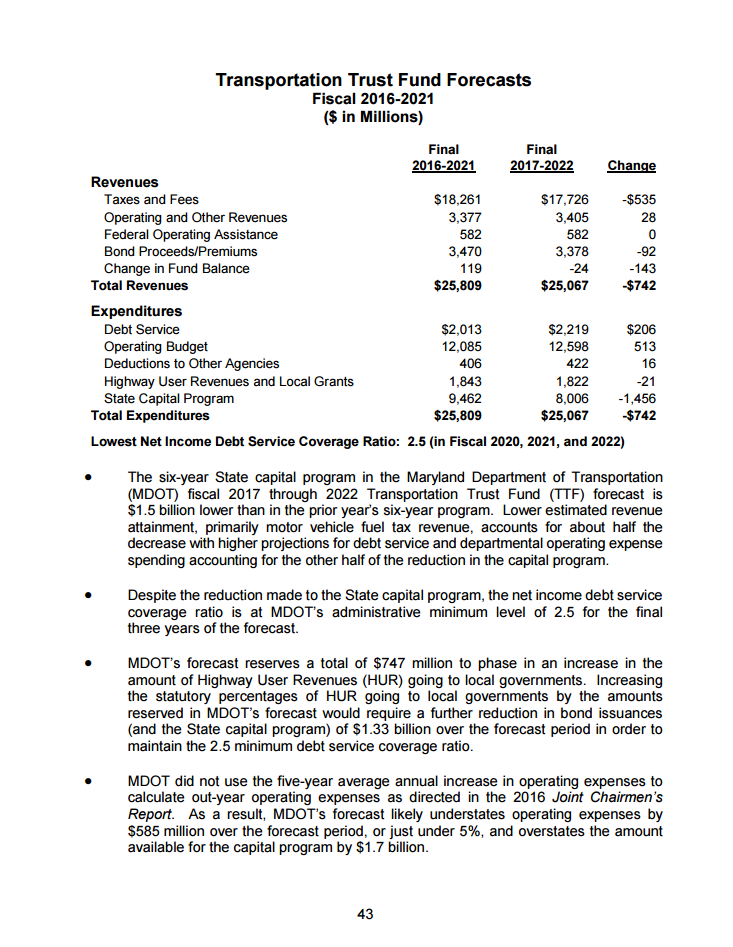
Page 43 of the Fiscal Briefing reviewed by the General Assembly last week shows a substantial deterioration in the TTF over the last year.  The briefing states:

The six-year State capital program in the Maryland Department of Transportation (MDOT) fiscal 2017 through 2022 Transportation Trust Fund (TTF) forecast is $1.5 billion lower than in the prior year’s six-year program. Lower estimated revenue attainment, primarily motor vehicle fuel tax revenue, accounts for about half the decrease with higher projections for debt service and departmental operating expense spending accounting for the other half of the reduction in the capital program.

The briefing continues:

MDOT did not use the five-year average annual increase in operating expenses to calculate out-year operating expenses as directed in the 2016 Joint Chairmen’s Report. As a result, MDOT’s forecast likely understates operating expenses by $585 million over the forecast period, or just under 5%, and overstates the amount available for the capital program by $1.7 billion.

Translation: $1.5 billion in forecasted transportation spending, or 15% of the state’s six-year total, has disappeared in one year.  And the administration’s underestimating of MDOT’s operating expenses could cause the capital program to drop another $1.7 billion.

That’s right, folks: one-third of all funding for state transportation projects could be evaporating.

Now let’s be fair.  Governor Hogan does not control revenues for transportation, which are chiefly determined by the state of the economy.  Their substantial drop suggests that the economy is not doing as well as Hogan says it is.  The economy could get even worse if Republicans in Washington repeal the Affordable Care Act – something that would cost Maryland tens of thousands of jobs – and push through substantial cuts to federal agencies.  The Governor is also only in partial control of MDOT’s operating expenses, which include substantial amounts of materials and supplies purchased from private vendors.  Those expenses are squeezing money for transportation along with the revenue shortfalls.

But one thing the Governor does control is his own behavior.  A reasonable Governor acting in good faith would go to the General Assembly and say, “Look folks.  We have a problem here.  Let’s get together and figure out how to deal with it.”  That would be in line with the Governor’s regular calls for bipartisan cooperation.

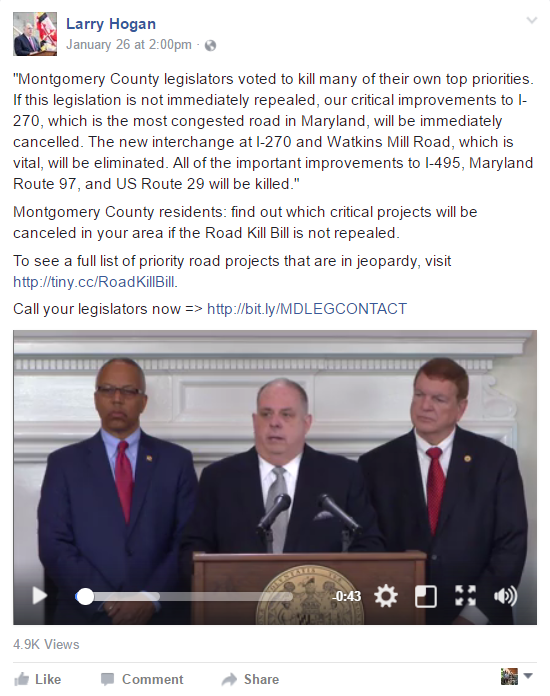
Instead, the Governor has launched a Holy War against the General Assembly’s transportation transparency law, which merely requires him to justify the projects he chooses to fund.  He falsely claims that the law would require him to cancel projects when it does no such thing and even announced funding for one project a week after he said it would be killed.  Instead of working with members of the General Assembly to remedy a real budget problem that threatens transportation projects, he assaults them on Facebook about a fake problem that he has made up.

One of several Facebook posts the Governor is using to target state legislators.

It’s a scam, folks.  This Governor does not want to deal with an impending transportation crisis that is happening on his watch.  Instead, he is trying everything in his power to shift blame to Democrats in the state legislature.

Don’t fall for it.

Share

Maryland Politics Watch