Unique Hub for U.S. and Global Senate Elections Results Now Online

One reason I haven’t had as much time to post as I would have liked lately is that I’ve been focused on putting together a new database for my Election Passport website containing results for 184 Senate elections held in 25 countries, including all U.S. Senate elections since 1998.

The online database is arranged by constituency (e.g. the states in the United States) and has results from countries as diverse as Argentina, Belgium, Burma, Poland, and Zimbabwe. The data are free and open to researchers who may be able to study elections by incumbency, gender and ethnicity. It could also help assess vote manipulation in less-free countries.

My book, entitled Minority Rules: Electoral Systems, Decentralization and Ethnoregional Parties Success, and a series of articles written for the Journal of Politics and the British Journal of Political Science spurred the creation of the online database. It took my team more than a year to gather, translate, and consolidate election results for use by anyone fascinated by the world of politics.

Latin American countries, such as Brazil, Chile, and the Dominican Republic, figure prominently in the database because so many of them, like the U.S., have directly elected Senates. I am grateful to the Center for Latin American and Latino/a Studies and the School of Public Affairs at American University for helping to support this project.

In the future, I plan to expand the database, updating it with more countries and additional years of results as they become available. Among the 30 countries that have held Senate elections since 1990, all but five are already included in the database.

Beyond Senate elections, Election Passport contains lower house election results from over 100 countries as well as information as how electoral systems operate in selected countries. Additionally, there are a welter of documents from countries that have never been digitized or publicly available previously, such as redistricting plans in Botswana and Lesotho.

Share

Will Taxpayers Fund Ficker’s Next Campaign?

By Adam Pagnucco.

As MCM and Seventh State have reported, MoCo political heckler Robin Ficker is running for County Executive.  That’s not shocking – Ficker has a long history of running for office and almost always losing.  What’s new is that Ficker is planning on acquiring a new source of campaign funds.

You, the public.

Ficker’s campaign website explicitly refers to the county’s new public financing system, under which the county matches campaign contributions made by individual residents (but not PACs, corporate entities or non-residents).  The system is opt-in; candidates can use the traditional financing system if they wish.  Ficker created a public financing account to run for Executive on February 8.  But that doesn’t mean he will necessarily get public funds.

Ficker’s campaign website home page.

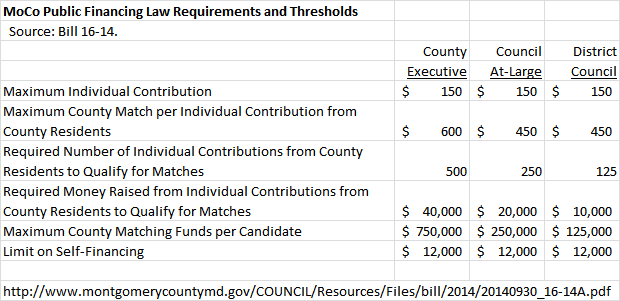
The county’s system does not distribute taxpayer money to everyone who participates.  Instead, it sets up a number of thresholds candidates must reach before they are eligible for public matching funds.  Under the law, a candidate for Executive must receive at least 500 contributions of $150 or less from county residents totaling at least $40,000 before he or she is eligible for public funds.  The candidate cannot accept money from PACs or businesses and cannot take individual contributions of higher amounts.  Once eligible, the candidate can collect up to $600 in taxpayer funds for each $150 contributed by an individual.  Lesser matching amounts apply to smaller contributions on a sliding scale.  Lower thresholds and different match levels apply to those running for County Council at-large and district seats.

Could Ficker get public money?  Ficker has used two campaign accounts over the last decade, the Robin Ficker for Homeowners Committee (which he used in two runs for County Council) and the Fickers for 15 Slate (which he used to run for the General Assembly along with his son in 2014).  The two accounts together raised $262,762.  Of that amount, Ficker self-financed $259,108, or 99% of his take.  A total of 33 individuals other than Ficker gave to the two accounts.  So Ficker has a long ways to go to get public money.  However, he does plan to use his term limits petition information to raise contributions.  Ficker gathered 17,649 signatures.  If just three percent of those folks contribute $150 or less to his campaign, Ficker will qualify for public matching funds.

And so here is the cost of public campaign financing.  If taxpayers are to fund the campaigns of candidates they might support, they may also have to fund the campaigns of those they do not.  Even the clown prince of political hecklers.  Even Robin Ficker.

Share

Perennial Candidate Robin Ficker Joins Executive Race

It never rains but it pours. After reporting that Councilmember Marc Elrich (D-At Large) has entered the public financing system to run for Montgomery County Executive, Robin Ficker (R-Running for Office Near You) is doing the same.

Despite winning one disastrous term in the House of Delegates in 1978 before being turfed out by voters, Ficker is best known for his persistent heckling at sporting events and his repeated brushes with the law and legal ethics.

Ficker has since run fruitlessly for a multiplicity of offices, desperately attempting to link himself to more popular pols as far back as Ronald Reagan. In 2016, he linked himself to the Cruz and the Trump campaigns at the same time. The following accounting of Ficker failure may not be complete as the online records die out in the early 1980s.

2016: Came in fourth for in the Republican Primary for the Sixth Congressional District with just 11% of the vote.

2014: Lost the general election in D15 for the State Senate with 39% of the vote.

2012: Came in fifth in the Republican Primary for the Sixth Congressional District with just 7% of the vote.

2010: Lost in the general election in MoCo Council District 2, previously won by Republicans, with 40% of the vote.

2009: After making a potentially fraudulent filing for office, Ficker lost a special election for MoCo Council District 4 with 39%.

2008: Robin took this year off, perhaps due to the suspension of his law license in 2007.

2006: Ficker ran as an independent for County Executive, gaining only 9% of the vote.

2004: No Robin!

2002: Ficker lost the general election for the D39 State Senate seat with 34% of the vote.

2000: Ficker came in fourth for the Republican nomination for the U.S. Senate with just 15% of the vote, losing to fellow perennial candidate Ross Pierpont and other unknowns.

1998: According to my search of the records, Ficker didn’t run for anything, even with all the federal, state and local offices on the ballot! Again, this may have something to do with an earlier suspension of his law license.

1996: No Ficker!

1994: Ficker came in fourth for the Republican nomination to the House of Delegates (D15), the office he previously held, and didn’t move on to the general election.

1990 and 1992: No Ficker! He claimed credit for an anti-tax initiative that Blair Lee reports he did not lead.

1988: A Ficker twofer! Ficker ran to be a delegate for Pat Robertson at the Republican National Convention from CD6, and lost with 3% of the vote. He also ran a losing race for MoCo School Board. (Earlier version of this post missed the School Board race.)

1986: Ficker-free election!

1982: Lost reelection to the House of Delegates (D15) to Democrat Gene Counihan.

1980: Lost Republican congressional primary.

1978: Won his sole disastrous term in the House of Delegates as a Republican from D15.

1972: Lost the Democratic Primary for the U.S. House.

Mistaking his term limits victory as a yearning for Ficker, we now know that the campaign will be loud and annoying but not dull.

Share

Ervin Criticizes Party Chair Election Process

Today, I am pleased to present a guest blog by Valerie Ervin, a former Montgomery County Councilmember (D-5) and now a Senior Advisor to the Working Families Party.

The Maryland Democratic Party is poised to choose a new party chair.  Unlike the National Democratic Party that to its credit engaged in a very open and transparent process that culminated in the close and historic election of Tom Perez, the first Latino to ever hold this position.  It also ensured that Rep. Keith Ellison, the candidate whose support came from the left of the party, would become the Deputy Chair.  The DNC is on the move as to build an inclusive party, one that promises to use its resources to build local state parties and to do that by grassroots organizing.

As the DNC moves forward, the Maryland Democratic Party remains stuck in the remnants of the past.  The Maryland Democratic Party is set to bypass democracy and transparency and make one of its most important decisions for the future of the party, in a small room with only a few invited guests present.

In the 2014 mid-term elections, a Republican became the Governor of Maryland, only the second Republican Governor since 1969.  Also, in 2014, Maryland experienced one of the lowest voter turnouts in its history.  Less than half of the state’s 3.7 million eligible voters turned out.  In the Maryland’s largest counties, Montgomery and Prince Georges, the turnout was particularly unimpressive.

Many Democratic voters stayed at home.  There was an enthusiasm gap to be sure.  Voters believed that the candidates running for state-wide office gave them little or no reason to go to the polls.

In a recent article by Steve Phillips author of Brown is the New White, he writes, “The largely untold story of the 2016 election is that more white Obama voters defected to third- and fourth-party candidates than the number who supported Mr. Trump.  That is the white flight that should most concern the next DNC chairman.  The way to win them back is by being more progressive, not less.”

The election of Tom Perez to lead the DNC is the starting point to what will be a long and difficult struggle to rebuild the party at the national and local level.  The older and often moribund officials who still hold the power to singularly impact the future of democrats in Maryland are still in charge.  The party will rebuild itself when we hold space for the emerging heart and soul of our party.  They are more brown, black, young, female and progressive.

How do we win back the voters that left the party?  Let’s first start by holding ourselves accountable.  We must lead by example. When the Maryland Democratic Party meets on March 1st to accept the resignation of its Chair and to choose an interim chair, I hope that the party will rise to the occasion and instead of making an appointment, that the party leaders would consider waiting to elect and not select the person who will represent Maryland’s Democratic Party as its chair.  Maryland is known as the Free State, let’s rise to the meaning of that creed.  Let’s get back to the job of electing candidates that reflect the progressive values of that we are known for.

Share

Ike Leggett’s Dump Fire

By Adam Pagnucco.

No one knows exactly when the worst dump fire in Montgomery County history started.  It was first reported to authorities on October 22, 1994.  A 40-foot high pile of trash at the Travilah Road dump had ignited and begun spreading airborne foulness throughout the vicinity.  The Washington City Paper reported, “The slow smolder spewed clouds of acrid smoke—filled with floating ashes and shreds of trash—and a putrid odor that engulfed the North Potomac area for miles around. The noxious fumes temporarily shut down Stone Mill Elementary School and forced residents from their homes; some had to take temporary refuge in motels.”  More than 200 people reported respiratory problems.

Incredibly, the county government did not act immediately to put the fire out.  Rather, it wanted dump owner Billy Mossburg and his family to put it out themselves despite their long history of bad blood with both the county and their neighbors.  The Washington Post reported, “The county doesn’t have the equipment to do the job, and it’s better for the company to spend its money under county supervision than for the county to spend tax money and bill Travilah Recovery later, said Capt. Ray Mulhall, a fire department spokesman.”  The county posted two environmental inspectors and three fire officials to the site to “ensure everything is done right.”

Internally, the administration of outgoing County Executive Neal Potter debated what to do.  Meetings of county officials went on for two hours or more without resolution.  Some in the administration worried about liability.  Others were concerned about who would pay to put out the fire.  Some worried about the difficulty of getting trucks into the dump or whether lights could be installed for night-time fire-fighting.  Just as a course of direction seemed in reach, someone would bring up more questions and the meetings would resume.  And the fire kept burning.

It was Paralysis by Analysis, then and now.

County Executive Ike Leggett has a dump fire, too.  It is otherwise known as the Department of Liquor Control (DLC).  Maligned for many years for its poor service to licensees and consumers, it was the subject of a landmark Washington City Paper story during Leggett’s first year in office.  The DLC is not a threat to public safety as Billy Mossburg’s dump once was.  But it chases away consumers, stunts the county’s restaurant industry and costs the county and state nearly $200 million a year in economic activity.  After a number of scandals including employee theft, employees drinking and driving on the job and use of an inventory system run with sticky notes, the County Council proposed a bill allowing private distributors to fulfill some special orders.  Delegate Bill Frick (D-16) went further, proposing a bill that would have allowed voters to decide whether to continue the liquor monopoly.  After initially supporting the council’s bill, Leggett opposed both of them and promised that he would fix the DLC through a task force.

The result of the task force?  Paralysis by Analysis, of course.  The task force’s eleven members included just two licensees and no consumers.  It had three meetings during which invited speakers extolled the benefits of government liquor monopolies.  It concluded with no task force statement and no proposal.  The administration completely ignored a proposal to recover DLC’s profits and pretended for months that the proposal never existed.  The Executive offered a tweak that no one else supported and later withdrew it, alleging that DLC’s problems were solved.  This is despite the fact that DLC suffered massive supply failures during the Christmas and New Year’s Eve week the prior two years.  On each occasion, Leggett defended the liquor monopoly just prior to its meltdowns.

The pattern here is the same as the reaction of County Executive Neal Potter to the Travilah dump fire.  Be cautious.  Worry about money.  Pretend that things aren’t so bad.  Play for time.  Maybe the problem will go away by itself.  Maybe public interest will move on to something else.

In the end, the Travilah dump fire was undone by an event it could not burn away: an election.  Incoming County Executive Doug Duncan raced from his inauguration directly to the Executive Office Building and demanded that county officials do everything possible to put out the fire.  Eight days later and roughly seven weeks after it was first reported, the fire was out.  The county later sued the dump owner to recover the cost of fighting the fire.

Here is the great lesson of the Travilah dump fire for today’s dump fire at the DLC.  Meetings and task forces won’t put it out.  Neither will consultants, financial analyses, promises, tweaks, defensive blog posts or PR campaigns.  One thing is needed to deal with the liquor monopoly.

Bold action.  From a new County Executive.

Share

A Reply to the County Executive on the Liquor Monopoly

By Adam Pagnucco.

Thanks to County Executive Ike Leggett for responding to my post on how his administration ignored my proposal to make up revenue for the Department of Liquor Control (DLC).  I stand by my piece and reply to several of his points as follows.

1.  Contrary to the Executive’s contention, my proposal was in fact never analyzed during the time of the DLC task force.  His consultant’s report never mentions it despite the agreement of his staff to include it.  Try finding my proposal, my name, a reference to Seventh State or an analysis of my idea for using cable funds to finance DLC’s debt in the report.  They are simply not there.

2.  The Executive alleges that I made a “basic math mistake” by omitting DLC’s debt service from the revenue needing to be replaced.  Not at all.  Anyone reading my proposal can see that I did not omit it.  I simply dealt with it separately from the return DLC sends to the operating fund since the two revenue streams require different fixes.

3.  The Executive is correct that the state has imposed numerous unfunded mandates and fees on the counties in recent years.  I should know.  I helped organize a campaign against the teacher pension shift in 2012 that included county governments, school boards, community groups and elected officials in both parties.  But rather than merely complain about the state, let’s recognize that it has a role to play in dealing with the liquor monopoly and the revenue question since DLC was created in state law.  A visionary Executive with a plan to transition away from the liquor monopoly would be invaluable in securing the state’s cooperation.

4.  The Executive is wrong about my proposal to use cable funds to service DLC’s debt in two ways.  First, he claims that I proposed raising the 5% fee the county currently levies on cable bills.  That’s not what I said, and in any case, the fee is already at the maximum level allowed by federal law.  Second, he claims that “Cable fund money cannot legally be used for purposes other than cable-related needs: technology and communication purposes. We cannot take Cable Funds to build roads and schools.”  That is absolutely wrong.  The county’s own cable lawyer advised the County Council in 2012 that the county has discretion over how the 5% fees can be spent, but not on amounts collected over that level or on behalf of municipalities.  Those amounts not subject to county discretion were excluded from my analysis.  In fact, the Executive transfers some money from the cable fund to the general fund right now.  The approved FY17 budget states, “Funds are transferred from the Cable Fund to the General Fund to cover the cost of certain administrative services provided by the County to the Cable Fund ($654,353) and other contributions ($5,163,433).”  That’s right, folks, the Executive’s statement in his reply to us is contradicted by his own budget.

Why is the Executive so resistant to the idea of using cable funds for DLC’s debt service?  Perhaps one reason is because cable fees are the source of millions of dollars for County Cable Montgomery and Montgomery Community Media, two public “news” outlets that provide “coverage” for county elected officials.  Try to locate an unflattering “news” article about county elected officials in any of the “coverage” provided by these outlets.  Good luck finding any because one of them is part of county government and the other is a non-profit that gets more than 80% of its budget from the county.  What’s the better use for this money?  Financing Pravda-style public relations or helping to fix the liquor monopoly?

5.  The Executive notes that Worcester County’s former monopoly on spirits may be coming to an end.  He is probably right about that.  Worcester’s monopoly, while not including wine and beer as Montgomery’s does, did an even poorer job of customer service than MoCo and was busted by the Comptroller for breaking numerous laws in 2010.  After Worcester’s monopoly was opened to competition in 2014, the county lost 42% of its wholesale business after a year (while keeping 96% of its retail volume) and its leaders may decide to exit alcohol sales altogether.  But if they do so, it will be because they have decided they can’t compete with private distributors.

That seems to be the rationale the Executive has for shielding DLC from competition: since (in his view) it can’t compete, competition shouldn’t be allowed.  How is that a good thing for licensees and consumers?  Isn’t there a chance that open competition could cause DLC to improve while making private wholesalers pick up their game?

Also, the Executive says, “In the liquor business it is the suppliers/manufacturers who decide which ONE distributor/wholesaler will sell their products.”  That may be true under most circumstances in Maryland, but COMAR 03.02.01.12 exempts county liquor dispensaries from this arrangement.  In other words, state law allows manufacturers to sell to both county liquor sellers and private distributors.  That is what happens now.  In fact, DLC couldn’t exist without this exemption.  Competition between DLC and the private sector can occur if the state allows it.  The Executive simply opposes it.

The County Executive’s response shows that he is sensitive to criticism on this subject.  If only that were enough to make real progress on the county’s shameful liquor monopoly.

Share

Shocking: Democratic Sen. Nat Oaks Sponsors Voter ID Legislation

Newly appointed Baltimore City Democratic Sen. Nathaniel Oaks (D 41) has sponsored a voter identification bill (see the text below). Such legislation is normally presented by Republicans in order to disfranchise Democrats, especially minorities, in the guise of combating the boogeyman of voter fraud.

In the House of Delegates, the same legislation has been cross-filed by Del. Neil Parrott of transgender paranoia fame and cosponsored by thirteen other Republicans. No Democrat has cosponsored the House legislation and no one has cosponsored Oaks’ bill.

Study after study has shown voter fraud is virtually non-existent. As Colombia University Prof. Lorraine Minnite put it, “The claim that voter fraud threatens the integrity of American elections is itself a fraud.” It’s appalling that Oaks is fighting to suppress the right to vote instead of to protect and to expand it.

UPDATE: I am told that Oaks did this by “mistake.” He asked for all of his House bills to be cross-filed and there was an error with the number. How this happened and why he never noticed or withdrew the bill, I don’t know. Sources say he plans to withdraw the bill but it’s still on the website, though languishing in the Rules Committee.

Share

Exclusive: Ike Leggett Responds on the DLC

Today, I am pleased to present a guest blog by Montgomery County Executive Ike Leggett:

REALLY Setting the Record Straight…

Adam Pagnucco’s blog entry, Setting the Record Straight, does anything but set the record straight. Let’s be clear – I did not “throw in the towel” on privatizing the County’s Department of Liquor (DLC). The record clearly shows that I introduced State legislation that would have privatized our DLC while also protecting and maintaining the significant revenue stream of over $30 million a year it contributes to the County budget. Some on our County Council and in the State Delegation felt that, given the progress we’ve seen in DLC since we brought in a new management team with considerable liquor industry experience, and a number of substantive changes we had made to the organization already, we should give them additional time to make even greater improvements.

Philosophically, I am not opposed to privatization, but I also stand by my statement that not one of the critics of the County’s Department of Liquor Control (DLC) put forth a viable privatization proposal that would hold the County budget harmless by replacing the DLC’s profits. The County DLC is a taxpayer asset that produces a net profit of over $30 million a year and to privatize without replacing the revenue would be a disservice to our taxpayers.

After months of soliciting proposals, not one person or organization offered a viable plan to privatize DLC while maintaining the approximately $30 million in profits, including groups that assured us they would. While Mr. Pagnucco claims that his plan would have done so, his route to privatization, simply put, was based on faulty assumptions.

Mr. Pagnucco’s proposal was not ignored. It was carefully reviewed by us in the County and it was also reviewed by a consultant hired to review privatization options It was judged not viable because the underpinnings of the proposal were either unworkable, not legal or just plain wrong. Here’s why:

First, Mr. Pagnucco made a basic math mistake. He estimated that the County receives $20 million in “profit” in FY17, therefore starting with the faulty premise that to make the County whole, only $20 million in DLC profits each year need to be replaced. Unfortunately, he ignores that in FY17, the Department of Liquor Control earmarked $20.7 million for transfer to the General Fund and another $10.9 million to pay debt service on Liquor Bonds – bonds that have paid for road, and school construction in our County.

Therefore, the revenue to be replaced equals $31.6 million, not $20 million.

Mr. Pagnucco’s proposal then makes the argument that there will be a huge economic spinoff from privatizing by increased sales. He relies on a report done by the Comptroller’s Bureau of Revenue Estimates, which was itself built on an amazing number of alternative facts. But, for the sake of argument, say it was a sound analysis. Even Mr. Pagnucco admits that the tax revenue estimates presented in the report actually proves the county’s point that opening the alcohol market really only benefits the State coffers. He himself noted the county would receive less than $1 million of the revenue, while the rest of the estimated $35 million in economic spinoff benefit would go to the state’s general fund.

So he suggested that we pass a State law to compel the State to share its new revenue with us. The consultant, and everyone familiar with how Annapolis works, rightly pointed out that first, it requires the state to be a willing partner, and second and more importantly, there exists a legitimate concern about revenue sharing with the State. What the State giveth, the State taketh away. Just in the 1990s alone, the following County revenue sources were reduced or eliminated by the State:

  1. Liquor tax revenue sharing: eliminated; loss of $4.4 million to counties
  2. Beer tax revenue sharing: eliminated; loss of $4.2 million to counties
  3. Tobacco tax revenue sharing: eliminated; loss of $12.7 million to counties
  4. Property tax grant: eliminated; loss of $82.5 million to counties
  5. Teacher social security: eliminated; loss of $145 million
  6. Financial institution franchise tax sharing: eliminated; loss of $17 million to counties
  7. Transportation taxes revenue sharing (not highway user): eliminated; loss of $19.6 million to counties
  8. Abandoned property revenues: eliminated, loss of $5 million to counties
  9. Corporate filing fee revenues: eliminated; loss of $1.6 million to counties
  10. Security interest filing fee revenues: eliminated; loss of $1 million to counties

Mr. Pagnucco claims that the County can replace the bond money by raising our cable franchise fee and siphoning off dollars from the Cable Fund. With this statement he negates his own argument that his proposal would be “cost neutral” since it would in fact require raising fees.

But what he more importantly failed to realize is that Cable fund money cannot legally be used for purposes other than cable-related needs: technology and communication purposes. We cannot take Cable Funds to build roads and schools. Plus, utilizing this revenue would just create a budget hole elsewhere.

Another faulty assumption in Mr. Pagnucco’s proposal is using Worchester County as an example of how privatization in Montgomery County would work smoothly. He claims that after privatizing its liquor business, Worchester experienced reduced revenues but that the loss was negligible and that such a loss would equate to a mere $5 million per year for Montgomery. However, in reality, the unhappy ending to the Worchester story of privatization is that Worchester County is now going out of the liquor business forever and will generate exactly zero revenue for its budget in the future.

The final faulty assumption in Mr. Pagnucco’s proposal is his assumption that the county could just open up more liquor stores, which he notes would create additional profits.  See paragraph above: Worchester’s unhappy ending is testament that it just won’t happen.

Finally, Mr. Pagnucco says he was not proposing getting rid of the DLC – he just wanted to provide competition (i.e.; “end the monopoly”) by allowing our licensees to decide from whom to purchase products. But that’s not how it works. In the liquor business it is the suppliers/manufacturers who decide which ONE distributor/wholesaler will sell their products. The so-called monopoly doesn’t end, it simply transfers from the County to the private sector. Why turn over this asset that belongs to our county residents to the private sector for nothing?

We should be looking forward, not back. The DLC is, as they say, under new management. It has a new director, and is on course to continue making positive changes to improve operations and customer service.

Ike Leggett
County Executive

Share

More Hogan Hypocrisy

Can we please stop pretending that Gov. Larry Hogan is a swell bipartisan guy?

Larry Hogan has been railing against gerrymandering in Maryland for some time. So it should have been an easy lift when seven Democratic U.S. House members asked him to support national redistricting reform.

Hogan turned them down flat.

If Hogan was really cared about fairer methods of drawing congressional districts, he would have said he’d be glad to do it. Or, at least, that he would be happy to support their bill for national reform if they’d support his efforts in Maryland. But not our Larry.

If you didn’t get the message, his public comments made crystal clear that Hogan only cares about redistricting reform because he thinks it will benefit Maryland Republicans. As he turned down national redistricting reform, he touted that several Democrats could “lose their seats” under his proposed reform.

This is part of a larger Republican pattern. Republicans fought redistricting reform tooth and nail in Arizona, trying to get the initiative overturned in court and then suing to overturn the plans passed by the nonpartisan commission. In Florida, a court recently imposed a new plan to overturn a gerrymander enacted by Republicans in violation of a reform initiative. Republicans have enacted congressional gerrymanders in major states like Pennsylvania, Michigan, North Carolina, Ohio, and Texas.

In contrast, Democratic California has a reformed commission system. New York Gov. Andrew Cuomo pushed through a redistricting reform that will go into effect with the next census. A rare bright spot for bipartisanship was acceptance by both parties of a reform plan for the state legislature (but not Congress) in Ohio.

Republicans like Hogan favor redistricting reform in Maryland not because it is generally the right thing to do but to gain advantage. Put another way, our governor cared enough go out of state to campaign for Chris Christie for president but he can’t be bothered to support national redistricting reform because that is a “federal” issue.

As when he threw his public tantrum to defend Trump, Hogan has shown his very partisan colors. It’s really time that the press and commentators stopped pretending otherwise.

Share

Maryland Politics Watch