
Yes, you read right. Andy Harris joined 68 other Republicans in voting against aid for Puerto Rico. Republican values at work.

A Reply to Nancy Floreen on MCPS Funding
By Adam Pagnucco.
Thanks to Council Member Nancy Floreen for writing about MCPS funding in recent years in response to my blog post. First, a note of appreciation. While we may disagree about MCPS, we agree wholeheartedly on the issue of economic growth, which is the anchor for the county budget. The political winds on growth shift back and forth in county politics over the decades, but Floreen has consistently pushed an economic development agenda. She was for jobs before jobs were cool! All the things the county has done right in economic development – and there have been a few of them – have Floreen’s fingerprints all over them. It’s one reason why your author admires her and is sad to see her leave the County Council.
Let’s begin with areas of agreement. First, Floreen is absolutely right about the terrible days of the Great Recession. The county had not faced anything like it since the 1930s. Everything had to go on the table in those days – spending cuts, layoffs, furloughs, broken collective bargaining agreements and an energy tax hike – because the alternative was default. Floreen was Council President in 2010, the worst year of the recession. She, the County Executive and her colleagues saved the county from fiscal disaster. That achievement should not be forgotten.
Second, Floreen mentions the state’s teacher pension shift as a stress point on county finances. Again, she’s absolutely right. For many years, the state’s payment of teacher pension benefits was the one state program that disproportionately benefited Montgomery County. That’s because our high cost of living as well as our prioritization of schools leads us to pay higher teacher salaries than the rest of the state, which results in higher pensions. In 2010, nearly all of MoCo’s state legislators running for election promised not to shift pension costs to the counties. But in 2012, Governor Martin O’Malley pushed a plan to do exactly that and most of our state legislators voted for it. The result is that Montgomery County pays roughly $60 million a year for teacher pensions now, more than any jurisdiction in the state. Compare that to the size of last year’s property tax hike, which was $140 million a year. No matter what is said about the county, the state should not be let off the hook.
Now to the areas of disagreement. It’s interesting that Floreen says our blog post is misleading but does not actually refute any of the data on which we rely. She simply picks other data and disagrees with our characterizations. We are sympathetic to her problem: it’s hard to refute data that happens to be true! One thing she contests is our choice of FY10 as a base year for comparison. We picked FY10 because it was the peak year of overall county spending before the Great Recession fully kicked in. So comparing FY10 to FY16, the year before the tax hike, is valid because it’s a peak-to-peak comparison that includes both the cuts to departments in the early part of the period as well as the restoration that occurred afterwards.
She also disagrees repeatedly with our referring to MCPS as going through austerity. Our basis for doing so was the county’s local dollar spending per pupil, which comes from county budget documents and was not contested by Floreen. In nominal terms, here is the county’s local spending per pupil from FY06 through FY17.
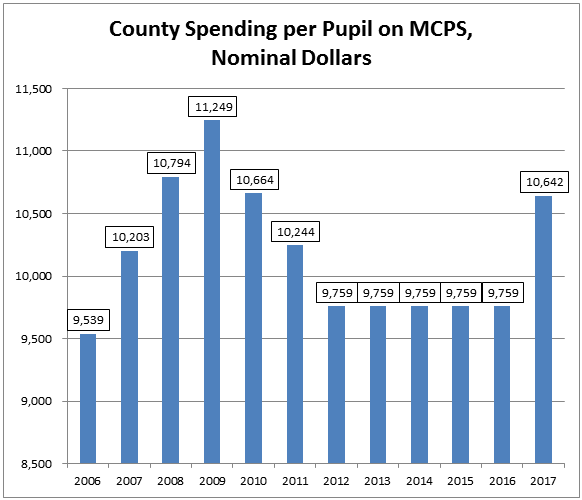
The data shows that the county cut its local per pupil contribution to MCPS for three straight years and froze it for four straight years. This period greatly exceeds the length of the Great Recession. The local per pupil contribution went up after last year’s property tax increase.
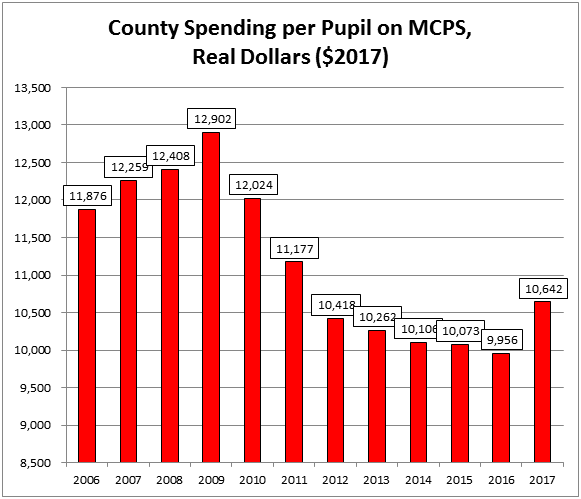
Last year’s per pupil bump looks significant, but here is the same data adjusted by the Washington-Baltimore CPI and presented in real terms using 2017 dollars. (We estimated 2017 inflation at 2.02%, the average rate of the preceding years in the chart.) Clearly, even with the tax hike, the county’s local-dollar commitment to schools is not what it once was. And the CPI underestimates major cost drivers for the schools, such as the costs of serving rising numbers of students who live in poverty and need language services.
Floreen then talks about the county departments that were cut during the recession. She’s right: they were cut. But after the recession ended, most of them were restored to levels exceeding what they were before the recession. Meanwhile, county dollars for MCPS were cut by $33 million between FY10 and FY16. Floreen doesn’t deny that, but she notes that local dollars aren’t the only source for MCPS’s budget. The schools get plenty of state money too. Floreen says this:
What really matters is the total MCPS budget, not the State share versus the local share. The higher State spending for MCPS in recent years reflects that the State’s funding formulas, at long last, are starting to recognize our students’ actual needs, as shown in our higher ESOL and FARMS populations. The State aid increases, which were long overdue, enabled us to provide continued strong support for MCPS during the Great Recession without further decimating every other function of government. Why is that not a good thing?
Floreen is conceding a central point of our original post which is reinforced in the per pupil data above: the county depended on state aid to keep MCPS afloat while it restricted its own contributions to the school system. Meanwhile, MCPS enrollment grew from 140,500 to 156,514 between FY10 and FY16, an 11% increase. The Great Recession by itself can’t be cited as a justification for restricting county dollars for schools because the restrictions continued long after the trough of the recession had passed. Indeed, fifteen other counties increased their local per pupil contributions after the recession ended, including nine controlled by Republicans. The message here is, “The state was paying for our schools so we didn’t have to increase county per pupil spending on them.” Is that “continued strong support for MCPS” as claimed above? Is it satisfactory for parents and voters? Let the readers decide.
Finally, Floreen repeats her longstanding point that last year’s 9% property tax hike was intended to support MCPS. That’s true: MCPS did get a big share of that money. But so did the rest of the government. Last year, we laid out how the county could have cut the tax hike in half, still given MCPS all the money requested in the County Executive’s budget and done it without spending cuts to other agencies. County Executive Ike Leggett, who originally proposed the tax hike, asked the council to cut the rate increase in half after the General Assembly passed a law easing the county’s liability from a U.S. Supreme Court decision on income taxes. But the council chose to keep every penny of the original tax hike and spread it across every agency instead. That’s not an Education First budget – it’s an Everything First budget. The result of the tax hike was a tremendous boost for the 40-point triumph of term limits at the ballot box. Even the council’s own spokesman at the time now says the tax hike was unnecessary and is vowing to stop another one if he is elected to Floreen’s open seat.
Look folks. We get this is tough medicine. We understand that elected officials don’t like to be criticized, especially around election time. And we understand that Nancy Floreen, a Council Member we respect, would like to go out on top. But it’s important to understand the past to prepare for the future. The schools need small, steady increases in per pupil funding to deal with their challenges. There can no longer be wild swings between extended periods of per pupil cuts and freezes followed by huge tax hikes intended to undo the effects of those cuts and freezes. To fund MCPS fairly without raising taxes, the county will have to restrain the overall growth of the rest of the budget to pay for it. There cannot be any more Everything First budgets. With four Council Members leaving and the Executive race wide open, it will be up to the next generation of county officials to chart a better way forward.
Setting the Record Straight on MCPS Funding
By Council Member Nancy Floreen.
Adam Pagnucco’s recent post on the County Council’s budgeting work made an astoundingly misleading claim: “The County imposed seven years of austerity on MCPS [in FY10-16] while lavishing double-digit increases on nearly every other function of government.” While I ordinarily ignore this kind of online misrepresentation of Council activity, this goes too far over the top to let pass.
As Council President in 2016, I plead guilty to leading the charge for two tax hikes to support MCPS. The FY17 property tax hike enabled us to reduce class size and focus on the achievement gap; we exceeded the State-required Maintenance of Effort level (MOE) for the MCPS operating budget by $89 million. The recordation tax hike enabled us to fund key school construction projects that would otherwise have languished. We did this in a historic partnership with the Board of Education, which agreed to channel more of its funds to the classroom, and, bravely, less to employee compensation.
Were the preceding seven years really a period of “austerity” for MCPS and “lavish” times for others? Consider the facts.
1. The choice of base years matters. FY10 was an anomaly. From FY01-09, we had funded MCPS at a total of $576 million ABOVE the MOE level, thus creating a much higher required spending base. But no good deed goes unpunished. When revenues sank like a stone during the Great Recession, this higher base became an impossible burden, even after we approved a property tax increase in FY09.
2. During the worst years of the recession, FY09-12, only two agencies – MCPS and Montgomery College – saw increased funding. To be sure, the increases were small (1.8 and 3.2 percent, respectively) and relied on higher State aid. But during this same period, vital County functions like Police, Fire and Rescue, and HHS were down 3.4, 5.0, and 14.7 percent, respectively. Recreation was down 23.5 percent, and Libraries was down 29.2 percent. These deep cuts were without precedent. The new spending base we were forced to create was so low that any later increase seemed disproportionately large. We consistently prioritized funding for MCPS and the College during this period. As the Rolling Stones would say, they didn’t get what they wanted, but they got what they needed. This we could not do for the rest of County government. I was Council President in that awful time. There were furloughs for all County employees, including first responders. MCPS furloughed no one.
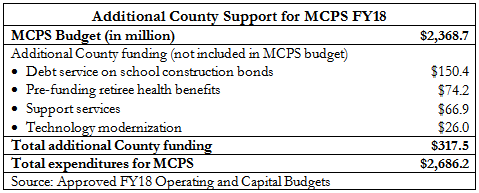
3. The “austerity” claim fails to account for massive additional County funding for MCPS that is not included in the MCPS budget or in MOE. So, for example, in FY18, we approved total expenditures for MCPS that include $2.37 billion for the MCPS operating budget PLUS $317.5 million more in the County budget. This pays for debt service on school construction bonds, pre-funding MCPS retiree health benefits, support services ranging from Linkages to Learning to crossing guards, and MCPS technology modernization. In FY13-16 alone, this additional County support totaled $1.08 billion. These dollars are not technically included in the MCPS budget, but they should be. To put the FY18 additional County support in perspective, this amount is larger than the total FY18 budget for Police, Fire and Rescue, or HHS. Again, this massive support for MCPS is all ABOVE the MOE level. And not counted.
4. Is the flip side of this alleged “austerity” for MCPS in FY10-16 really “lavishing double-digit increases on nearly every other function of government”? Tell that to one of our most important and beloved departments, Public Libraries. The libraries provide our one million-plus residents of all ages (including students from MCPS) with an ever-growing wealth of materials and technology. But the department’s budget of $40.3 million in FY09 did not reach that level again until FY16, seven years later, even in nominal dollars. The FY18 level, $42.7 million, is barely equal to FY09 in real dollars. “Lavish” indeed!
5. One key fact is that 90 percent of the MCPS budget is for the salaries and benefits of active and retired employees. MCPS’ benefits cost much more than the County’s. If MCPS’ employee share of health insurance costs was the same as the County’s, the savings would be $24 million. Add to this the fact we alone in the State fund a supplement to MCPS employees’ State pension benefit. This alone cost $25.3 million last year. The regular pension cost in FY18 is another $71.8 million, plus $56.8 million more for the State’s shift of teacher pension costs. We also pick up the tab for pre-funding MCPS retiree health benefits (paid from the County budget, not the MCPS budget). This set us back $74.2 million in FY18 and is now projected to cost $547.8 million in FY18-23. Is that what you call “austerity”?
6. What really matters is the total MCPS budget, not the State share versus the local share. The higher State spending for MCPS in recent years reflects that the State’s funding formulas, at long last, are starting to recognize our students’ actual needs, as shown in our higher ESOL and FARMS populations. The State aid increases, which were long overdue, enabled us to provide continued strong support for MCPS during the Great Recession without further decimating every other function of government. Why is that not a good thing?
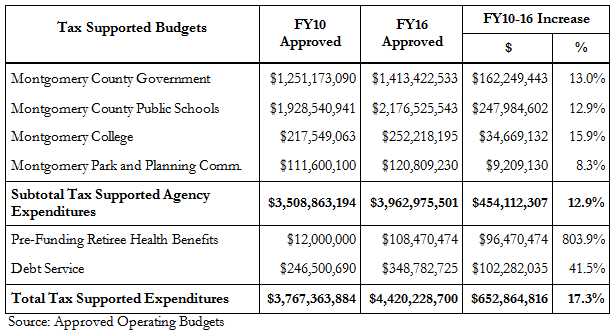
7. In fact, a more complete and accurate comparison of FY10-16 tax supported operating budgets by agency shows that MCPS received a 12.9 percent funding increase compared to 13.0 percent for Montgomery County Government, 15.9 percent for Montgomery College, and 8.3 percent for Park and Planning. In addition, a significant portion of the FY10-16 increase of 803.9 percent in pre-funding retiree health benefits and 41.5 percent in debt service benefited MCPS!
As we go into an election year of hyperbole and catchy phrases, know that the Council, on which I have been so privileged to serve, is committed to thoughtful fact and policy based budgets, responsive to ALL our residents’ needs. We are also constantly mindful of the burden that our decisions place on our residents’ pocketbooks. MCPS will always need more support. Has it been singled out for unfair treatment – “austerity” for MCPS and “lavish” increases for everyone else? The facts say otherwise.
Nancy Floreen has served on the Montgomery County Council since 2002. She was Council President in 2010, during the Great Recession, and again in 2016.
Elrich Slams Berliner on Minimum Wage
The following is by Councilmember Marc Elrich (D-At Large):
Earlier this week, the Council’s HHS committee voted 2-1 (Berliner and Rice vs Leventhal) to delay the full implementation of the minimum wage by two years for BOTH large and small businesses. (My bill cosponsored by 4 of my colleagues would raise the minimum wage 2020 for businesses with more than 25 employees and 2022 for those under 25.) While everyone acknowledges that there will be some impact on some small businesses, yet again no evidence was presented that demonstrated that it would be a significant impact. While there are numerous studies, the meta-analysis of those studies show slight to no impacts on employment.[1] Statements should be supported by data or analysis. The absence of data is part of what made the PFM study so bad, because their original massive job loss assertions, and even their second lower revised figure, did not reflect the data from anywhere (as this blog and others have documented[2]). On the other side of the scale, studies clearly show the devastating impacts of poverty on children and families. I taught for 17 years at a high poverty school, and I saw up close the impact of poverty on students.
We have an opportunity to move toward a decent standard of living for these workers who have been working hard at low wages. Councilmember Berliner’s amendment to delay large businesses by two years to 2022 puts us two years behind Target’s stated nationwide plan. That is particularly inappropriate given that our county is one of the wealthiest in the entire country.
Councilmember Berliner argued for the delay using Minneapolis as the model and said that Montgomery County should use the same timing as they had. Using Minneapolis’ implementation schedule as a model would assume that it is a comparable jurisdiction. But it is not. Below I compare the living wage in the two jurisdictions. There are some big differences.
This table compares the living wage NEEDED TODAY in each jurisdiction.
| Living Wage | Minneapolis | Montgomery County |
| Single adult | $11.36 | $15.80 |
| 1 adult 1 child | $24.68 | $29.82 |
| 1 adult 2 children | $31.04 | $34.87 |
| 2 adults 2 children | $16.85* | $18.72* |
*This number is per adult in the two-adult family
(Source: Living Wage Calculator, MIT)
In every case, more than $15 an hour is needed TODAY in Montgomery County, but the cost difference between living here versus Minneapolis is the equivalent of $4 an hour, or $2 an hour if 2 adults are working.
However, the most important factor in cost of living differences is housing. Housing costs are what drives the cost of living and necessitate a particular wage. Here is a comparison of housing costs:
| Jurisdiction | 1br yr/mo | 2br yr/mo | 3br yr/mo |
| Minneapolis | $7824/ 652 | $12635/1075 | $17967/1497 |
| Montgomery | $15684/1307 | $19476/1645 | $25728/2144 |
| Difference – or how much higher it is MoCo | $7860/655 | $6841/570 | $7761/646 |
(Source: Living Wage Calculator, MIT)
A MoCo resident would need between $570-655/month more than a Minneapolis resident to pay the difference in housing costs. For all other expenses combined, Montgomery County is a few hundred dollars per year more costly to live in than Minneapolis, but annual housing costs are between $6841 and $7860 higher for Montgomery County. To suggest that a wage in Minneapolis, or a schedule for raising wages, should be replicated in Montgomery County ignores the enormous cost difference between the two jurisdictions which leaves our working poor deeply mired in poverty. We are simply prolonging an untenable situation for tens of thousands of families.
Finally, there is one last incorrect assumption in delaying the implementation date, and that is that Minneapolis is noticeably more gentle to small business. It’s been said that the proposed rate of increase is too fast. However, the facts show a different story.
Here is the pace of increase in the two jurisdictions:
| Jurisdiction | Small business increase | # of years | Cost/year | Large business
increase |
# of years | Cost/year |
| Minneapolis | $7.25 | 7 | $1.03 | $5.50 | 5 | $1.10 |
| Montgomery County | $3.50 | 5 | $.70 | $3.50 | 3 | $1.16 |
In other words, the impact in Minneapolis on small businesses is greater in terms of total increase than Montgomery County ($7.25 vs $3.50) and greater as a per-year expense ($1.03 vs .70) For large businesses, the difference in total increase in Minneapolis is also greater than MoCo ($5.50 vs $3.50) but is slightly less per year ($1.10 vs $1.16).
So for small businesses, if the issue is pace, then the Minneapolis schedule is worse for their small business than what I’ve proposed, and for large businesses our target is 2020, no different than what Target has committed to nationally for 2020.
In short, Minneapolis is so different regarding affordability for its citizens that the impact of raising the minimum wage, and the urgency for raising the minimum wage, is simply not the same. Our residents are far more rent burdened and have far less disposable income. And if you’re worried about small employers, our steps are smaller, only 2/3 of the average annual increases that Minneapolis is implementing.
For one last comparison, I looked at Flagstaff, Arizona, which is also raising its minimum wage to $15. Their living costs are slightly higher than Minneapolis but still much lower than Montgomery County. And housing costs in particular are slightly higher than in Minneapolis, but about $6,000 a year lower than those costs in Montgomery County. Yet they are raising their minimum wage for all businesses from $8.05 in November 2016, to $11.00 in January 2018, and then up to $15 an hour in January 2021. So they are increasing by $7 per hour over just 5 years – a rate of increase that exceeds anything proposed in Montgomery County.
The minimum wage needs to reflect the costs that people have to bear in order to sustain themselves. Prolonging the implementation simply erodes the value of the wage. Frankly, in a perfect world we’d be close to $15 today and then let it rise with inflation. Even my bill, with 2020 and 2022 implementation dates will mean that when $15 is reached it will be worth less than $15 today, and I wish we could do better, but the proposed delay just makes things worse and is completely divorced from the reality that low-income families face.
[1] http://jaredbernsteinblog.com/the-minimum-wage-increase-and-the-cbos-job-loss-estimate/?utm_source=feedburner&utm_medium=feed&utm_campaign=Feed%3A+JaredBernstein+%28Jared+Bernstein%29 and https://www.hendrix.edu/news/news.aspx?id=64671
[2] http://www.epi.org/blog/the-montgomery-county-minimum-wage-impact-study-is-absurd-junk-science/
Valerie Ervin for County Executive?
A reliable source tells me that former County Councilmember Valerie Ervin (D-5) is planning to jump into the race for Montgomery County Executive. I’ve reached out to her for comment but have not yet received a response.
Valerie Ervin won election to the School Board in 2004 prior to winning the District 5 Council seat in 2006–the seat now held by Tom Hucker. A past President and Vice President of the County Council, she stepped down in the year before her term ended in 2014 to take a job with the non-profit Center for Working Families.
Ervin briefly sought the nomination for the Eighth Congressional District in 2016 before pulling out of the race, which she explained was due to the challenge of raising the enormous sums of money required to be competitive.
The new public financing system would likely make it easier for to run a competitive campaign for county executive without raising the huge sums required for a congressional contest. Still, she would need to act fast to catch up with other candidates.
If she enters the contest, Ervin will be the only woman, African-American, or nonwhite candidate in the race. As Montgomery County is now 19.5% black and only 44.7% non-Hispanic white according to Census estimates from 2016, this could prove an advantage. African Americans likely punch above their weight in the Democratic primary, as a disproportionate share are Democrats and vote compared to other racial and ethnic groups.
Democratic primaries are also disproportionately female, with women regularly comprising around 60% of the electorate, and sometimes even higher. Still, Montgomery voters have shown that they vote based on a variety of factors. Being from the same group as a voter may help get a candidate in the door but concrete issues and reasons are needed to gain a vote.
As I’ve mentioned previously, while in office, Councilmember Ervin had the knack for being well-liked by both labor and business, though the bloom was definitely off the rose in her relationship with labor by the time she left office. Her recent work for the Center for Working Families, however, has burnished her progressive credentials–helpful in a year when many are still energized by Bernie Sanders or angry about Donald Trump.
On other hand, many remain disquieted that Ervin left her Council seat early. In 2016, she endorsed Donna Edwards for Senate over Chris Van Hollen, who remains extremely popular in Montgomery and won handily here in the primary.
Interestingly, if she runs, Ervin would be running against her former boss, Councilmember George Leventhal. Both are officials who have eclectic sets of supporters in the past but would be trying to appeal to the progressive vote in this election.
Consequently, an Ervin candidacy would not help Leventhal’s prospects. It also could well provide an alternative to some Elrich voters, particularly those who would welcome a nonwhite candidate or our first woman as county executive.
At the same time, I imagine Marc Elrich would not be shy about pointing out occasions where he and Valerie diverged on business or social justice issues. Labor unions with long memories, especially MCGEO and the Police union, might enjoy exacting revenge. Ervin had good relations with SEIU but it might also join other unions in backing Elrich.
At any rate, Ervin’s entry would sure shake up an already interesting race. Will she take the plunge?
Random Bits, October 2017
By Adam Pagnucco.
Chris Wilhelm is Winning the Sign Wars
MCPS teacher and progressive at-large council candidate Chris Wilhelm has covered parts of Georgia Avenue and University Boulevard with his campaign signs. (It helps to speak Spanish!) Yes, we know signs don’t vote. But it shows that Wilhelm is working and that’s good for perceptions of his campaign.
Who Has Momentum in Council District 1?
Council District 1, which covers Bethesda, Chevy Chase, Potomac, Poolesville and a large part of Kensington, has more regularly voting Democrats and more political contributors than any other council district by far. It’s a prime seat. Right now, there are nine candidates in the race and there might be more on the way. Many good candidates in this district, like Bill Conway, Gabe Albornoz, Emily Shetty, Samir Paul and Sara Love, are instead running for council at-large or the General Assembly. There are lots of openings to choose from these days!
So who has the momentum right now? You could say Delegate Ana Sol Gutierrez, who is the only sitting elected official who is running. Or Reggie Oldak, who has qualified for matching funds in public financing. Former Planning Board Member Meredith Wellington should appeal to land use voters oriented towards Marc Elrich. Former Kensington Mayor Pete Fosselman was just endorsed by former Governor Martin O’Malley.
But we’re going with Andrew Friedson, who just had his kickoff boasting endorsements from his former employer, Comptroller Peter Franchot, along with Senators Brian Feldman (D-15) and Craig Zucker (D-14) and former long-time DNC member Susan Turnbull. Feldman is an old hand in the Potomac portion of the district and has not been seriously challenged in 15 years. Turnbull doesn’t usually play in local races but she has a national network in both the Democratic Party and the Jewish community. If she is all in for Friedson, that’s a big deal. Friedson, who is killing the field in social media, is feeling pumped up right now with good reason.
Where’s Duchy?
It’s unusual to see a large field of MoCo candidates without Duchy Trachtenberg among them. She has a long electoral history, losing a District 1 County Council race in 2002 by a hair, winning an at-large council seat in 2006, losing reelection in 2010, briefly running for Congressional District 6 in 2012 and getting annihilated in a challenge to District 1 council incumbent Roger Berliner in 2014. Now she has a full table of races to pick from, including council at-large, council District 1 and the District 16 General Assembly seats. Say what you will about Duchy – and we’ve said plenty – but she can raise money, she has a network and she has campaign experience. Is she done or is she just waiting to file at the last minute, as she has done before?
Can Greenberger’s Strategy Work?
Former County Council spokesman Neil Greenberger is torching his old bosses, saying they treat voters like ATMs and guaranteeing that if he is elected, there will be no property tax hikes. This is a new strategy for a Democratic council candidate made possible by the 2008 passage of the Ficker amendment, which requires votes from all nine Council Members to go over the property tax charter limit. Furthermore, it’s an unusual strategy from a historical perspective. Most council candidates over the last few decades have emphasized schools, transportation, development (pro or con) and a handful of other left-leaning issues but have not been explicitly anti-tax. That sentiment has mostly come from Republicans.
But two things have changed in Greenberger’s favor. First, the passage of term limits was rooted partly in opposition to last year’s 9% property tax hike. But it wasn’t just the increase alone that annoyed residents. Unlike the 2010 energy tax hike, last year’s property tax increase was not driven by the catastrophic effects of a recession, but was a policy choice by the council that could easily have been much lower. Voters didn’t see the tax hike as truly necessary, which increased their frustration with it.
Second, the number of votes needed to win an at-large seat could be much lower in this cycle than in the past. Over the last four cycles, at-large candidates have needed around 40,000 votes to have a shot at victory. (Incumbent Blair Ewing far exceeded that total in 2002 and still lost.)
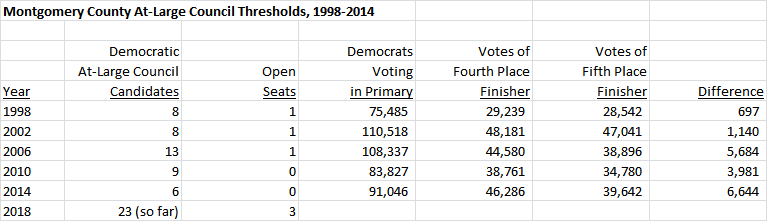
That number may no longer hold. No one knows what the turnout will be next year; informed observers disagree about that. But the candidate field will be two to three times larger than in any other recent cycle and only one incumbent is running. That could mean a very fractured electorate yielding a low win threshold and tight margins. That favors candidates with medium-sized but intense bases, whether geographic, demographic or ideological. In Greenberger’s case, if 100,000 Democrats vote, and 30,000 of them are sick of tax hikes, and Greenberger can actually communicate with them, he could win. And so could anyone else who can put together 30,000 votes.
Greenberger Guarantees No Property Tax Hikes
By Adam Pagnucco.
Former County Council spokesman Neil Greenberger, who is running for an at-large seat, has released a campaign video guaranteeing that if he is elected, there will be no property tax hikes in the next term. Greenberger cites a section of the Montgomery County charter that prevents property tax hikes above the rate of inflation unless all nine Council Members vote to do so. If only one member votes no, the tax hike would fail. The nine vote requirement is the result of a ballot question submitted by Robin Ficker which was approved by voters in 2008.
While other at-large candidates have been skeptical of further tax hikes, none of them so far have taken as hard a line against them as Greenberger.
No-Win Situation: Council Angers Two Influential Groups at the Same Time
By Adam Pagnucco.
Suppose you’re a County Council incumbent gearing up for the next election. There are eight months to go. The economy isn’t great. A big, unpopular tax hike was passed a year ago. Seventy percent of the voters just voted for term limits. Dozens of challengers with all kinds of messages carrying the powerful weapon of public financing are fanning out through the county. So what do you do?
There may not be a lot of good options these days, but antagonizing two of the more powerful groups in the county would not be a high priority on anyone’s list. And that’s what happened last Tuesday.
The pebble in the council’s shoe this time was debt service. Much of the county’s six-year capital budget is financed by bonds, and of those, the biggest single financing source for projects is General Obligation (GO) bonds. GO bonds are not tied to specific revenue sources as some other bonds are; rather, they are backed by the full faith and credit of the county. The county is rightly proud of its AAA GO bond rating, the highest rating offered by credit agencies, and kept it even through the terrible years of the Great Recession. But maintaining a AAA rating, which allows the privilege of paying the lowest interest rates on the market, is difficult. When a local jurisdiction carries too much debt relative to its resources, it risks a downgrade and higher interest rates. County leadership is justifiably careful about this and has acted to protect its bond rating in the past.
Recently, County Executive Ike Leggett requested that the council cut the level of GO bonds issued in future years, saying that the current amount is excessive and might be regarded as a credit risk. Last Tuesday, the council unanimously voted to cut the six-year issue of GO bonds from $2.04 billion (the level in the last capital budget) to $1.86 billion. On an annual basis, GO bond issuances would decline from $340 million in FY18 to $300 million in FY22-24.
The concerns of the Executive and the council about GO bonds are legitimate. Bonds are paid off through debt service, which is part of the operating budget and competes with other types of spending. But debt service is a different kind of spending than any other county expenditure. Once bonds are issued, they MUST be paid one way or the other or the alternative is default. Below is the recent history of county debt service payments in comparison to the total tax-supported budget. Debt service roughly doubled between FY05 and FY18. As a percent of the tax-supported budget, it fell from 7.3% in FY04 to 6.0% in FY09, but has since risen to 8.5% in FY18. If it keeps rising, it will eventually squeeze out money for public schools operations, public safety and a range of valuable services.
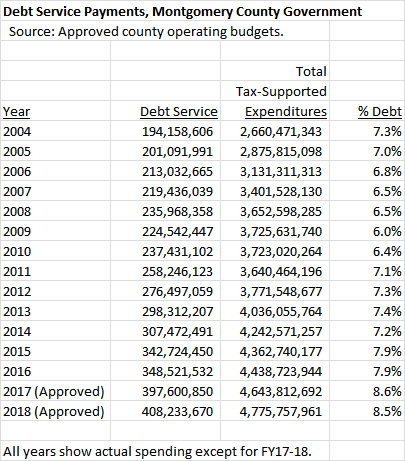
Much of the increase in debt service has been driven by school construction. The county’s six-year capital budget in FY05-10 included $786 million in local funding for school construction. By the FY17-22 capital budget, that total had risen to $1.4 billion. That’s real money, folks! And while the state kicks in school construction money too, it could do a better job of it.
The council’s cut of GO bonds is normally the kind of action that occurs after an election, not right before one. Now the county’s elected officials are in trouble with two influential groups.
The PTAs
The Parent Teacher Associations (PTAs) have one of the largest networks in the county. Almost every one of the county’s 200 or so public schools has a PTA. Most have groups of officers and many have volunteer committees. Perhaps most importantly, most have listservs with parents on them. No one really knows exactly how many parents are on the PTA listservs, but it is at least in the thousands. The PTAs don’t endorse candidates, but they have a large latent communication capacity to inform parents about the actions of politicians. Accordingly, they are one of the great sleeping giants of county politics.
Perhaps the number one issue for the PTAs is school construction. Last year, they strongly supported a recordation tax increase proposed by Council Member Nancy Floreen that was marketed at the time as being mostly intended to pay for more schools. The size of that tax hike (roughly $200 million over six years) is close to the size of the present cut in GO bond issuances ($180 million over six years). That suggests that the tax hike will be at least partially supplanted and – after capital money is moved around – will now be effectively used to reduce future debt service, not to finance additional school construction as the council promised. That is not going over well with the PTAs.
The Realtors
The Realtors are one of the most active political players in the county, especially inside the business community. They spent $45,000 on direct contributions to county-level candidates in the 2014 cycle – including to County Executive Leggett and eight winning council candidates – and spent tens of thousands more on mailers promoting their endorsees. Nonetheless, they were targeted by the recordation tax increase and fiercely resisted it. If the increase were marketed as paying down debt service, which now could be the case through the backdoor, the PTAs would never have come out to support it and it would probably have died. Now the rationale used to defeat the Realtors – school construction – has been put in question by subsequent action of the council.
The PTAs and the Realtors may have disagreed about the recordation tax hike, but they may now both see it alongside the GO bond cut as a bait and switch. One big group got a tax increase it didn’t want. The other big group may not get the spending increase it did want. Neither group is happy.
So here’s the question. What happens next?
Maryland Universities Mixed Commitment to Free Speech
Free speech is essential to academic inquiry not just by faculty but to students. Limits on free speech inhibit the open discussion and debate that exposes students to new ideas, challenges their existing beliefs, and their ability to argue and to analyze.
FIRE, the Foundation for Individual Rights in Education, keeps tabs on free speech rights at over 400 colleges and universities around the country? How did institutions in Maryland rated by FIRE fare?
FIRE Rating System
A “red light” institution has at least one policy that both clearly and substantially restricts freedom of speech. A “yellow light” institution is one whose policies restrict a more limited amount of protected expression or, by virtue of their vague wording, could too easily be used to restrict protected expression. If a college or university’s policies do not seriously imperil speech, that college or university receives a “green light.”
Green Light Institution
University of Maryland–College Park
Freedom of expression and an open environment to pursue scholarly inquiry and for sharing of information are encouraged, supported, and protected at the University of Maryland. These values lie at the core of our academic community. Censorship is not compatible with the tradition and goals of the university. Source: Policy on the Acceptable Use of Information Technology Resources.
Yellow Light Institutions
Frostburg State University
Fliers that will NOT be approved for posting: … Fliers containing content that would be considered offensive to the reasonable person (e.g. nudity, obscenities, etc.) Source: Residence Hall Posting Guidelines.
Three areas of the campus have been designated as “public forum” areas for use by approved student groups, off-campus organizations and individuals: 1) the area of the clock tower, 2) the University Drive triangle between Chesapeake Dining Hall and Annapolis Hall, and 3) the library quad. No other areas may be used for gatherings, speeches or distribution of literature unless first approved by the Office of the President. Source: Policy on Communication of Information.
Verbal/Written Assault includes verbal or written acts, including social media sites, which place a person in personal fear or which have the effect of harassing or intimidating a person. Source: Harassment Policies.
Towson University
To foster a safe and inclusive campus, the University will investigate all incidents motivated by bias. In order to prompt an investigation, the incident must be reported. . . . [Bias incidents include] inflicting mental or emotional distress upon a person through a course of conduct involving abuse or disparagement of that person’s actual or perceived identity or group membership(s). Source: Reporting Hate Crimes and Bias Incidents.
Each user must accept the responsibility for his/her actions and agree to: … Use appropriate language, behavior and style. Source: Guidelines for Responsible Computing.
Chalking that includes discriminatory, threatening, harassing, lewd and/or obscene language is not allowed. The university reserves the right to remove anything that violates these guidelines and to bill the responsible individual or group. Source: Chalking Procedures.
Offensive items or language shall not be displayed on a door (i.e., room, suite, quad, or apartment) or be viewable from outside a room, quad, suite, or apartment. Source: University Housing Policies.
Red Light Institution
Johns Hopkins University
Rude, disrespectful behavior is unwelcome and will not be tolerated. Source: Principles for Ensuring Equity, Civility and Respect for All.
Unacceptable use of IT Resources includes, but is not limited to: Intentional, non-incidental acquisition, storage, and/or display of sexually explicit images, except for acknowledged, legitimate medical, scholarly, educational, or forensic purposes. Exposure and/or display of such material may be offensive, constitute sexual harassment or create a hostile work environment. Source: Information Technology Use Policies.
On the more positive side:
Our university is committed to the steadfast protection of the right to academic freedom. This commitment emerges from the university’s time-honored role in the creation of knowledge and the sifting and winnowing of ideas. Without full and vigorous protection of this principle, the university’s capacity to discharge its hallowed mission would be compromised. Source: Academic Freedom at Johns Hopkins University.
Unrated Institutions
FIRE doesn’t rate Mt. St. Mary’s. Here is some information from the Student Conduct Code:
Mount St. Mary’s University, believing in [freedom of expression], will protect the freedom of action and freedom of speech for students, so long as their speech and actions are not of an inflammatory or demeaning nature, are truthful and accurate, and do not interfere with the students’ living and study conditions.
Students may invite and hear speakers of their choice on subjects of their choice, subject to the limitation that the University may withhold approval of an event or a speaker if holding such an event or providing a forum for the speaker is determined to be contrary to the mission of the University.
University Policies
R. Posting and Solicitation
a. Posting without approval of a University administration or staff member;
b. Posting on exterior of buildings, trees, lamp posts, stretched or hung across hallways, doors, ceilings, slipped under doors, or posting anywhere in residence halls without approval from Residence Life; . . .
d. Unapproved canvassing and other promotional activities; . . .
f. Posting or display of any material which goes against the Freedom of Expression statement.
g. Display of lewd, indecent, or obscene material.
Morgan State University
I also checked out Morgan State University’s guidelines but did not find any statements that would appear to limit student free speech rights in my quick scan of the Code of Student Conduct.
The Faculty Handbook states the following:
It is essential also that faculty members be granted the right to express their views in a responsible manner without fear of censorship, reprisal or penalty. In the academy, administrators, faculty, staff and students bear a mutual responsibility to exercise professional competence and to extend to each other the trust and mutual respect which foster an environment for the exercise of academic freedom as well as collegiality.
More on MCPS Funding
By Adam Pagnucco.
Word has reached Seventh State that the governing establishment in Rockville is displeased with our recent post on MCPS funding, questioning whether our data is accurate. Let’s establish the data’s presence in the public record.
The assertion in our post generating the most unhappiness is that the county cut local support for MCPS while it gave most other functions of government double digit increases over the FY10-16 period. Local funding for MCPS can be found in the County Executive’s recommended budget. The table excerpted below shows a $33 million cut in local funding for MCPS between FY10 and FY16. That happened at the same time that enrollment grew from 140,500 to 156,514, an 11% increase. Another item of interest is how dependent the county is now becoming on state aid for school operating funds. For much of the 1980s and 1990s, at least 80% of MCPS’s operating budget was financed with local funds. Now, the local share is down to roughly two-thirds.

As for the other departments and agencies, actual funding for FY10 can be found here and approved funding for FY16 can be found here. Those data points, along with the MCPS local funding history above, are assembled in the table below which shows how much of an outlier MCPS was during the FY10-16 period. Three notes. The Department of Environmental Protection’s big increase is due to a hike in the water quality protection charge, which is used to finance stormwater projects mandated by the state. It does not reflect a significantly greater draw on property tax revenues. The Department of Housing and Community Affairs’ budget drop reflects a significant one-time expenditure for the Housing Investment Fund in FY10. It does not illustrate a slash in the department’s operating activities. The Department of Transportation’s operating budget is not included in this data because it was subject to departmental restructuring in FY11, preventing an apples-to-apples comparison.

Data on the county’s local per pupil contribution to MCPS can be found in this Office of Legislative Oversight report appendix and in County Council budget packets like this one. This information was the basis of our statements that the county cut per pupil local funding for three straight years and froze it for four straight years, as illustrated by charts we published a year ago. The Maryland State Department of Education’s Fact Books are our source for the actions of other counties after the Maintenance of Effort (MOE) law was changed. During the first three years of the new MOE law, most other counties – including ones controlled by Republicans – increased their local per pupil contributions while Montgomery County did not.
Let’s be fair. There is an intellectually honest argument to explain these actions. Here’s a statement from Hypothetical Council Member X, who has decided to level with constituents about the county’s history of funding public schools.
Yes, we cut MCPS during the Great Recession. We had to. Our reserves were being drained to zero and we were about to lose our bond rating. We were raising the energy tax, breaking our collective bargaining agreements, furloughing county employees and laying some of them off. State law prevented us from cutting MCPS like the other agencies, so we did what we had to do. The state also shifted a portion of its responsibility for paying teacher pensions down to the counties and now we are paying $60 million a year for that. But it’s true that we squeezed MCPS longer and harder than any other part of county government and that was a mistake. We tried to reverse that with the 9% property tax hike. Going forward, we should give MCPS small and steady increases so we don’t run into problems with our schools again and we will pay for it by restraining growth in the rest of the government.
There’s a reason why intellectually honest arguments are not often used in politics: they are not pretty! But it’s time to be honest about where we have been and where we are headed. That SHOULD be what the next election is about.
One more thing. The establishment may choose to respond with a guest blog. We welcome fact-based debate. But we caution anyone who responds that they must acknowledge and address the data we present here that appears in the county’s own budget documents. Failure to do so will be perceived as political pap and puffery by Seventh State’s discerning readers.