In Their Own Words, Part II: Marc Elrich

We continue with our County Executive questionnaires today with Councilmember Marc Elrich (D-At Large).

What was your most important achievement in your current or past office? How do you think it demonstrates your leadership ability?

My most important achievement has been increasing the minimum wage in Montgomery County, and helping to increase it in Prince George’s County and Washington, DC as well.  Opponents of minimum wage increases often try to pit neighboring cities and counties against each other, inaccurately arguing that raising wages in one area will cause employers to flee to surrounding lower-wage localities.  I helped convince lawmakers in these three jurisdictions that joining forces and pushing for higher minimum wages together would defeat this erroneous argument while delivering a real economic win for hundreds of thousands of people.

While I pushed hard for Montgomery County’s minimum wage to increase automatically with inflation, I ultimately accepted a bill without that provision, and with a slower phase-in than I had wanted, to secure the votes necessary for it to pass the Council.  I didn’t give up, however, and have continued to fight for a living wage for county residents, sponsoring a $15 minimum wage bill that earned the support of a majority of my colleagues last year.  Though that bill was vetoed, I am confident that we will soon succeed in passing a version of the legislation I reintroduced.

I believe this achievement demonstrates both my recognition that our residents’ needs demand urgent action and my ability to produce tangible changes through the political process.  I begin by listening to and working with affected communities.  Whether you’re a full-time worker living in poverty or a resident who loves your community and wants to be certain that, as we grow, the county provides the schools, transportation, and other infrastructure necessary to handle that growth without harming the environment, I am committed to getting results for you.  Master planning must include residents; transportation solutions must be affordable and appropriate; and protecting green spaces and water quality, preserving existing affordable housing, and encouraging the use of alternative energy must be priorities.

As County Executive, I know how to build the coalitions with our residents, businesses, and organizations to continue to help this county work for all of us.

Share

Trump’s Addams Family Values

They’re creepy and they’re kooky, mysterious and spooky, they’re altogether ooky, the Trump family.

Once again, Don Jr. gives us another example of the amorality that pervades the Trump family with his exploitation of his child not for a harmless campaign photo but for a creepy political tweet. Oddly and unintentionally, he makes the exact opposite of the point intended about crass entitlement.

Be sure to check out two excellent replies, one by a liberal and one by a conservative, below the screenshot of the original post. But also remember how virtually the entire Republican Party and its agitprop media supporters are complicit in these daily violations of basic  norms of how people, let alone leaders, should behave.

Liberal Reply:

Conservative Reply:

Share

In Their Own Words, Part I: Roger Berliner

Together, Adam Pagnucco and I put a short list of seven questions to the candidates for county executive. We’re grateful that all four have taken the time to respond thoughtfully and in detail.

Unlike interest groups that ask candidates to fill out questionnaires in the hope of garnering an endorsement, our purpose here is a combination of allowing each candidate to better introduce himself and his priorities to you along with questions regarding a selection of issues facing the county we regard as important.

We found their answers illuminating and hope you do too. Today, we start with Councilmember Roger Berliner’s (D-1) response to our first question:

What was your most important achievement in your current or past office? How do you think it demonstrates your leadership ability?

I think my single most important achievement in office has been keeping your lights on.

Pepco was one of the most unreliable utilities in the country.  Our power would go out for days at a time – during storms and even on “sunny days”.  Lives were at risk.  Those who could afford it bought back-up generators so they could keep their lights on.  Most of us simply suffered. It was totally unacceptable.

I led our county in asking for a state investigation of Pepco.  The state regulators at the Maryland Public Service Commission have 100% control over Pepco.  The state granted our request.  During the course of that investigation, we learned for the first time that in terms of reliability, Pepco had been in the lowest quartile nationally for five years in a row.  When I asked whether Pepco would be held responsible, the regulators said that Maryland didn’t have reliability standards so how could Pepco be punished?

I was not satisfied with that answer. I researched laws in other states, drafted state legislation and shared it with the Governor and legislative leaders. Under the leadership of now-Senator Feldman, the legislature passed a law that has made Pepco financially accountable for its reliability.  And guess what?  Pepco has gotten better.  Our power does not go out nearly as much. That makes your lives so much better.

I think what this demonstrates about my leadership is that I fight for consumers; that I am not afraid to take on powerful interests; that I roll up my sleeves and do the nitty gritty work necessary to be effective; that I am able to work collaboratively with our state officials to get things done when they are beyond our county’s ability to do so on our own; and that I have a track record of improving the day-to-day quality of life of Montgomery County residents, which is what a County Executive should do.

Share

Stop Giving Robin Ficker More Ammo

By Adam Pagnucco.

Right about now, the happiest man in Montgomery County lives in Boyds.  He is 74, a huge sports fanatic, a long time attorney, a former state Delegate, a perpetual candidate and a tireless activist.  He loves the County Council because some of its members give him endless material for use in his never-ending demagogic campaign to weaken and ultimately paralyze county government.

Yes folks, we are talking about the notorious political heckler Robin Ficker.  And he must be jumping for joy at the news that some members of the council are considering a possible new soda tax.

Ficker has been running for office and placing charter amendments on the ballot, mostly intended to limit taxes, since the 1970s.  The huge majority of his amendments have failed, often because the political establishment labeled them “Ficker amendments” to exploit the national infamy of his heckling at Washington Bullets games.  One exception was the razor-tight passage of his 2008 charter amendment mandating that all nine Council Members vote in support of exceeding the charter limit on property taxes.  But Ficker has never had more ammo than in the last four years and he has used it to push his anti-government agenda.  Consider what has happened.

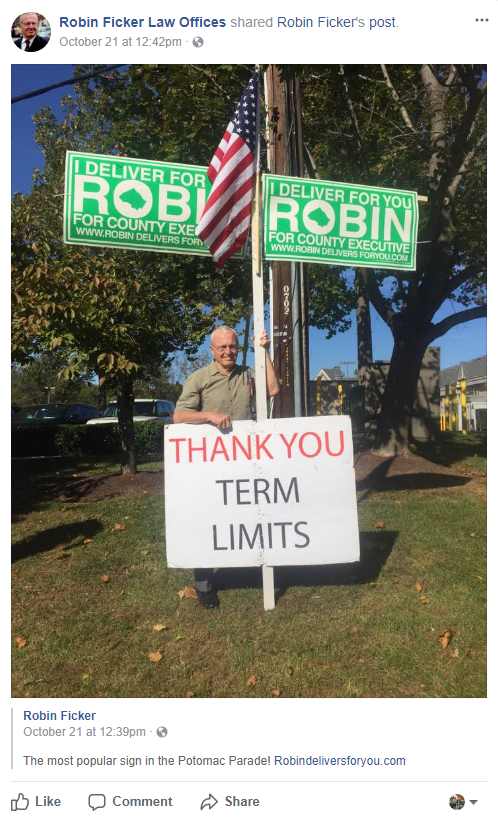
The council’s approval of a large salary increase for its members in 2013 and its passage of a 9% property tax hike in 2016 gave Ficker’s term limits charter amendment momentum.  Some Council Members then used their campaign funds to finance a lawsuit to keep term limits off the ballot, which failed.  Council Member Nancy Floreen’s “exasperated” and “defensive” performance in a television debate with Ficker and Council Member George Leventhal’s comparison of term limits supporters with Brexit voters didn’t help.  Ficker predicted term limits would pass by twenty points; instead, they passed by forty.

Robin Ficker thanks MoCo voters for giving him his biggest political win ever.
That’s not all.  Ficker has enrolled in the public financing system established by the council for his latest Executive run.  And he requested the county government’s email lists after another resident obtained them under the Public Information Act.  Any competent campaigner – maybe even Ficker – should be able to use those thousands of emails to raise enough money to qualify for public matching funds.

And now we have news of the soda tax, which prompted gleeful self-promotion by Ficker in Bethesda Magazine’s comment section.  Expect a Facebook ad soon.

Your author does not enjoy writing this column because we find merit in this particular tax.  Sugary drinks and soda are public health menaces, especially to children.  The intended use of the money for early childhood programs is a good idea.  And the current tight budget does not give any quick or easy options for funding undeniable, but expensive, priorities like early childhood education.  But the counter-argument from Ficker, who calls Council Members “tax increase specialists,” is obvious.  “They’re not listening to you,” Ficker will tell the voters.  “You told them no more tax hikes and they’re going to do it anyway.”  Even Leventhal, who has voted for numerous tax hikes and has done as much to promote public health as any Council Member ever, has come out against the new tax.

The danger here is not that Ficker will be elected.  Voters made that mistake once all the way back in 1978 and have never come close to repeating it since.  The real problem is the next charter amendment that Ficker will inevitably introduce after his latest election campaign fails.  Whatever else Ficker is, he is an astute student of Maryland county tax policies.  He is fully aware of the taxation and spending limits in the Prince George’s County charter, such as the requirements that the property tax rate may not exceed 96 cents per $100 of assessed value and that bond issues, new taxes, other tax increases and some fee increases be approved by voters.  He is also aware of provisions in the state constitution and several county charters that forbid legislative bodies from adding spending to executive budgets.  Indeed, some of his past charter amendments have been variants of such policies.

It’s one thing to raise taxes during terrible economic downturns as the county did in 2010.  That simply had to be done.  It’s a very different thing to discuss new discretionary tax hikes in times when voters are not convinced that they are absolutely needed.  If the council would like to have more money available for worthy programs, it should focus on growing the economy, stop adding ongoing miscellaneous spending financed by one-shot revenue sources, redirect cable fund money to purposes that actually benefit the public and restrain some parts of the budget to finance expansions of others.  Doing those things will free up tens of millions of dollars, and maybe more, over time.  But constant talk, and occasional passage, of discretionary tax hikes will only help Ficker place a Prince George’s-style anti-tax doomsday charter amendment on the ballot.  Should such a thing pass, no soda tax will save us.

Hence a warning.  If you give Robin Ficker enough ammo, even he will eventually hit the target.

Share

Luedtke Proposes Alcohol Sales Reform

There are two major components to frustration with Montgomery County’s alcohol laws: (1) the distribution monopoly by the Department of Liquor Control (DLC), and (2) the limitations on where consumers can buy alcohol. Del. Eric Luedtke’s (D-14) bills would address the latter (see press release below).

In a nutshell, one bill would allow supermarkets to get around the current limits that make it impossible for them to sell all types of alcohol at multiple locations by allowing them to open stores within their stores operated by the DLC.

I suspect supermarkets will be chary of giving up sales space when they cannot control the sales experience and have to negotiate over which products are sold. My bet is that they would much prefer to be able to sell just beer and wine within their own stores. Hopefully, the bill can be amended towards that end.

However, MCGEO, the DLC union, will likely resist any effort to move away from the absolute DLC control model. Though supermarket employees are unionized, it is a different union, and MCGEO won’t want to lose the opportunity to expand its muscle–and ability to protect the hated distribution monopoly.

The second bill loosens certain restrictions on DLC stores and Sunday alcohol sales. My bet is that non-DLC stores that sell beer and wine will fight allowing DLC stores to sell soft drinks and cold beer and wine. They’ll be outraged that they still have to deal with DLC’s distribution monopoly yet see the DLC encroaching on a valuable share of their business.

Bottom Line: If some major kinks can be worked out, especially the need for a DLC-operated store within a store, consumers will regard this as a major step forward. But the bills do nothing to address the hated distribution monopoly that jacks up prices and drives restaurant business out of the county.

Here is Del. Luedtke’s press release:

Delegate Eric Luedtke Seeks to Make Montgomery Alcohol Laws More Consumer Friendly

Bills include provisions that will eliminate outdated blue laws, expand choices for retail alcohol consumers

Montgomery County, MD, October 30, 2017 – Delegate Eric Luedtke (D-Burtonsville) announced plans today to introduce two bills aimed at making Montgomery County alcohol laws more consumer friendly. One of the bills, MC 16-18, will allow for separate beer, wine, and liquor dispensaries to be located inside grocery stores. This store-within-a-store model has been used successfully in other states. Under this model, large grocery stores will be eligible to have a separate store located within them selling alcohol, similar to coffee shops or bank branches located in many grocery stores now.

The second bill, MC 4-18, titled “The Montgomery County Alcohol Modernization Act of 2018,” will overhaul a number of outdated laws that limit consumer options and place unnecessary limits on businesses. Among its many provisions, this bill will allow county liquor stores to sell cold beer and wine, soft drinks, and growlers. The bill also eliminates some of the last remaining blue laws in Montgomery County, such as laws that prevent some alcohol licensees from serving alcohol as early on Sundays as they do on other days of the week.

Delegate Luedtke stated about this effort, “Our debates about alcohol laws in Montgomery County have too often ignored consumers. The most common complaint I hear from residents about our alcohol laws is a lack of beer and wine in grocery stores. It’s time we focused more on consumer needs and fixed some of these outdated laws.”

Both pieces of legislation will be filed as local bills, and there will be public hearings held on them before the Montgomery County Delegation in December.

###

Delegate Eric Luedtke represents District 14 in Montgomery County, which includes Brookeville, Burtonsville, Damascus, Olney and parts of Silver Spring. Delegate Luedtke is chair of the Education Subcommittee on the House Ways and Means Committee.


Share

MDOT Swastika Update

The debate over MDOT’s unfortunate graphic evolved into an article in the Baltimore Sun. Christina Tkacik reports that Transportation Secretary Rahn has pulled the image from a brochure published by the state that appeared on its website. When asked about it, your gentle blogger said:

“Of course it looks like a swastika,” said David Lublin, a professor with American University who posted a photo of the image on his blog, which chronicles Maryland politics.

But Lublin said he wasn’t offended by the image, assuming it was just a “brainfart.” MDOT has “flubbed a lot” over the years, he said.

“There’s enough hate in the world without us searching out for it,” he said.

I believe the last especially strongly. The Sun‘s Erin Cox drew attention to it for the hilarity of this wonderful forehead-hits-keyboard moment and to spur discussion. If anyone seriously thought that this reflected anti-Semitism on the part of the Hogan Administration, this would’ve been front page news–not a tweet.

Taking a moment to state the obvious, the unfortunate swastika graphic is completely different that Donald Trump’s retweeting of neo-Nazi images containing some of the worst anti-Semitic tropes. Moreover, unlike the Orange Occupant of the White House, I’m sure that Gov. Hogan has at least the sense the Lord gave a turnip and just rolled his eyes and moved along.

Share

More on MoCo’s Mighty Seven Zip Codes

Readers raised very good questions on our Facebook page about median as opposed to mean income after reading Adam Pagnucco’s conversation sparking post on Montgomery’s most and least affluent zip codes.

As the above table shows, they were right to suspect that wealthy households skew average income higher than the median, especially in the seven high-income zip codes where the median is 71% of the mean as opposed to 79% in low-income zip codes. The difference in median income levels between the high and low income zip codes is also one-third smaller than for the mean.

Middle-class has always been very elastically defined in America. Keeping that in mind, it nevertheless remains accurate to say that the data project a picture of a largely middle-class jurisdiction. The data lower for income zip codes–called lower and not low for good reason here–paint a portrait of areas that are mainly lower-middle to middle class.

The high-income zip codes are predominantly upper-middle class with good chunks of more middle class and more affluent people–and some very affluent people who drive up the mean income. The median income statistics show the danger in relying solely on mean income as an indicator of how people live. While unquestionably home to an unusual number of very well-off to extremely wealthy people, upper-middle class better describes the income of most households in this expensive area.

The poverty statistics provide a good indicator of people who struggle greatly. One should assume their share is higher since many people who live above the poverty level also have real difficulties making basic ends meet. These show that a significant minority in the lower-income zip codes are poor, despite their clear middle-class character. Poverty is as minimal as just about anywhere in America in the higher-income zip codes.

In short, while there are real and large differences between these groups of zip codes, which after all were selected by Adam precisely to highlight these real differences, Montgomery County is dominated by varying types of middle-class people even in these areas. Adam mentioned rightly that people are aware of the differences. I’d add that they are also aware of the basic similarities. This matters a lot because middle-class values and problems provide a common reference point, even though the higher-income zip codes obviously have more resources to meet challenges and people are aware of these differences.

As a result, our politics tends to be oriented around a common set of goals and problems related to the quality of education, safe neighborhoods, transportation and so forth that resonate to broad majorities just about everywhere in Montgomery. Without negating resource differences or suggesting neglect of the real problems faced by poor Montgomery-ites, this is a good thing because it makes bridging geographic-income divides much easier.

Doubters might consider the greater gaps in outlook faced by jurisdictions like the District of Colombia, Prince George’s and Baltimore City—let alone the extremes of New York, Chicago, and Los Angeles—that possess greater concentrations of neighborhoods of concentrated poverty as well as wealthy neighborhoods.

Share

Because, In this Administration, We Just Can’t Get Enough Swastikas

As Erin Cox from the Sun points out, this is perhaps a badly timed graphic goof coming out of an administration that just worked to woo pro-Israel voters. Gov Hogan is in charge of MDOT, and it’s off his post-Charlottesville message and change of heart on the Taney statue designed to communicate “I’m not Trump.”

Just please don’t claim it’s a sheriff’s star or an exit on the Beltway.

Share

Andy Harris Votes to Increase Deficit $1.5 Trillion

Republican Rep. Andy Harris (MD 1) voted to allow tax cuts of $1.5 trillion dollars without requiring any offsetting spending, increasing the deficit and debt dramatically.

The proposal is particularly anti-Maryland as it would “doom the current deduction for state and local taxes,” which benefits Marylanders disproportionately, as it does residents in New York and New Jersey. Other tax deductions up for elimination that might spread the pain more evenly, such as the home mortgage interest deduction, or closing corporate loopholes, have been ruled out by tweet or as sacred cows. Nevertheless, unlike the bulk of Republicans from those states, Harris still voted yes.

Harris has undergone a Damascene conversion on the deficit and national debt since the Obama years:

His budget never solves the deficit problem, much less begins to pay down the exploding national debt we will leave to our grandchildren. . . . Once again, the House will have to take leadership on reining in the debt and deficit by proposing a budget that makes the tough choices that are necessary to head off a Greek-style federal bankruptcy.

Harris logic says that ballooning the debt by much less than the Republican budget is madness that will cause rack and ruin associated through “a Greek-style federal bankruptcy” when it’s proposed by Obama but not when Trump-Ryan want it.

Even leaving aside the unfunded giveaway to the wealthy that is done in a way that limits benefits to Marylanders, especially more middle-income residents who still deduct, the complete shift on the debt and importance of balancing the books shows the situational ethics and moral bankruptcy of Andy Harris–and the many other Republicans who said more or less the same thing.

Share

MoCo’s Mighty Seven Zip Codes

By Adam Pagnucco.

For a long time, Montgomery County has been thought of as a wealthy jurisdiction.  It has long appeared in lists of the nation’s richest counties (although it is about to drop out of the top twenty).  Politicians elsewhere in Maryland view it as a gold mine, with Senate President Mike Miller famously saying, “It’s like Never Neverland for other legislators of the state.”  The county is regularly shorted by state wealth formulas which disproportionately distribute state aid, especially for public schools, to other parts of Maryland.

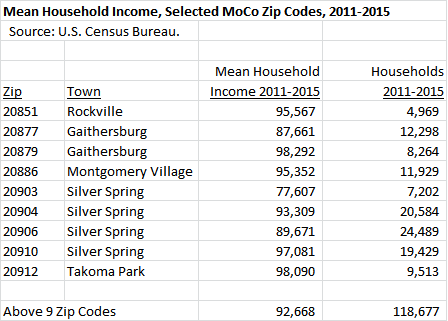
But most of Montgomery County is not particularly rich.  Its wealth is concentrated in seven zip codes which skew its mean household income upward and make the county as a whole appear richer than it really is.

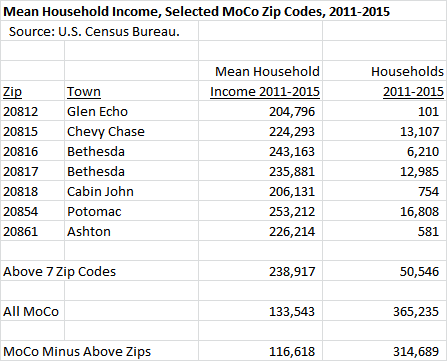
All residents of MoCo understand that there are huge differences between areas in the county even though many outsiders do not.  According to the U.S. Census Bureau, the county’s mean household income was $133,543 over the 2011-2015 period, just barely squeaking past Howard County ($132,751) for tops in the state.  But that conceals big variations.  MoCo has nine zip codes in which mean household incomes were under $100,000.  The combined mean household income of these areas ($92,668) is roughly equal to the mean household income of Prince George’s County ($90,268).

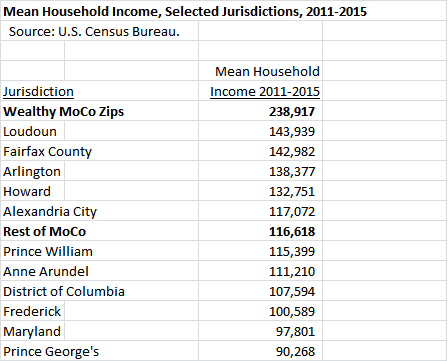
MoCo has seven zip codes in which mean household incomes were over $200,000 in the 2011-2015 period.  These zip codes, mostly located northwest of D.C., account for 14% of the county’s households and 25% of its household income.  If these zip codes were regarded as a separate jurisdiction, their combined mean household income would be $238,917.  The combined mean household income of the rest of Montgomery County is $116,618 – about half the income of the Mighty Seven.

How do the mean incomes of the Mighty Seven and the rest of the county compare to the rest of the region?  We show the mean household incomes of those two parts of the county along with the other large jurisdictions in the region below.  The Mighty Seven as a group are easily at the top although we suspect that extracts of the wealthiest parts of Loudoun, Fairfax, Howard and D.C. would also be in that range.  As for the rest of the county, its income is average compared to the rest of the region.

That’s right, folks – with the exception of its wealthiest zip codes, MoCo is a middle-income jurisdiction by the (admittedly high) standards of the Washington region.

This reality has interesting implications for policy makers and candidates.  The issue of equity between different parts of Montgomery County is getting traction as a political issue in the upcoming election.  But in terms of who pays the county government’s bills, there is no question that county revenues are hugely dependent on a limited number of wealthy neighborhoods, especially in the absence of robust economic growth.  If those residents decide that they can get a better deal by living somewhere else, that would be a huge threat to the county’s tax base.

As for the state level, there’s a tendency to look at differing incomes and wealth BETWEEN counties but not INSIDE counties.  That’s how state wealth formulas work – they compare counties to each other but not local areas to each other.  How many state policy makers have understood prior to reading this blog post that there is a large part of Montgomery County that is economically comparable to Prince George’s?  It’s time for a serious examination of how to direct state aid to local areas in need regardless of which county borders they happen to occupy.

Share

Maryland Politics Watch