Lost in Potomac: Stuart Rothenberg Eviscerates the Trone Campaign

National Political Pundit Stuart Rothenberg wrote a devastating account of his meeting David Trone:

Maryland Democrat David Trone, who is running for Congress in the 6th Congressional District, came to my Potomac community to talk about his candidacy – and he brought plenty of wine for residents to sample while they chatted with neighbors before turning their attention to the candidate. . . .

What made all the politicking odd is that my community is not in the 6th District but rather in the 8th, currently represented by Democrat Jamie Raskin, who beat Trone in the Democratic primary last year. In other words, Trone touted his credentials, talked about his views and supplied wine to a roomful of people who could not vote for him next year.

Oops.

But it gets even worse:

[My] second question involved my doubts that he is suited to being a lowly freshman who would have little influence. I noted his self-funding and his previous race, as well as the fact that he had flirted with running for county executive before deciding on a second race for Congress. I also noted that his earlier comments about leadership, about the county government and about his experiences in the private sector suggested he would be more effective in an executive position.

Trone seemed to dislike the question. He turned away from me and addressed others in the audience, insisting that his wealth was an asset not a liability, emphasizing that he would be politically independent, and promising that he could bring change. He was passionate, certainly, but he didn’t address my concerns about his temperament, district-shopping and suitability for a legislative office.

Trone took another question but suddenly had to run. He never stressed his Democratic label, instead embracing the “no labels” movement in response to a question and talking about his pro-business bent.

Running as the “no labels” candidate in a Democratic primary gives the impression that he thinks he has it sewn up. No voter likes being taken for granted or having his questions given the “talk to the hand” treatment–something you would think someone who runs a business with excellent customer service would know.

Rothenberg concluded his analysis with some sage advice for Trone:

His odds will improve if he campaigns among voters who actually live in the district where he is running.

I’d be glad I owned a liquor store after reading this piece.

Share

Moon Country Club Bill Could Generate $10 Million for MoCo

By Adam Pagnucco.

A local bill introduced by Delegate David Moon (D-20) that would end property tax breaks for country clubs would eventually generate $10 million a year for Montgomery County Government according to General Assembly analysts.  That’s welcome news for the county, especially considering its current budgetary difficulties.

Under current state law, the State Department of Assessments and Taxation (SDAT) is allowed to strike agreements with country clubs having golf courses to cap the assessed value of their land.  To be eligible for such agreements, the clubs must have at least 100 members who pay dues averaging $50 or more annually for each member; restrict use of their facilities primarily to members, families, and guests; have at least 50 acres of land; and have a golf course with at least 9 holes and a clubhouse.  In practice, the agreements limit assessed land values to $1,000 an acre.  In return for the assessed rate, a club with an SDAT agreement must agree not to sell its land for subdivision and to not discriminate on race, color, creed, sex or national origin.  If a club with an agreement does sell its land for subdivision, it must pay back taxes equivalent to what it would have been paying without an agreement.

Not long ago, your author asked SDAT for all of its agreements with country clubs in Montgomery County.  SDAT sent us ten of them but we later learned that there are actually fifteen of them in the county.  One of them was signed in 1980 and three more were signed in 1981; all four of these are fifty year agreements.  Two more were transferred from prior owners.  One agreement, for the Lakewood Country Club in Rockville, was signed in 2017.  In tax year 2016, when the agreement was not effective, the club’s 175 acres had an assessed land value of $1.94 million.  Once the agreement takes effect, the club’s assessed land value will be $175,000 – a 91% reduction.

Moon’s local bill would abolish such agreements with country clubs in Montgomery County as of their expiration or June 30, 2029, whichever date is earlier.  Because Maryland’s state constitution requires uniform rules for the assessment of land, Moon’s bill takes the form of a constitutional amendment carving out MoCo country clubs and golf courses from that requirement.  The amendment would have to be approved by voters.  We understand that Moon may also introduce a statewide bill to deal with SDAT agreements everywhere.

The fiscal note on Moon’s bill indicates that MoCo country clubs with SDAT agreements have a combined 3,000 acres currently assessed at $3 million.  In the absence of the agreements, the fiscal note estimates that the club’s assessed land value would be $983.3 million.  So once the agreements are all gone by Fiscal Year 2030, the fiscal note estimates that the state would collect an additional $1 million a year in property taxes from the clubs and the county would get an additional $10 million annually.

That’s right, folks – if the country clubs simply pay property taxes at the same rate the rest of us do, the Montgomery County Government would get an extra $10 million a year.

Delegate Moon’s country club bill is the biggest no-brainer of all time.  There is no justification for the richest of the very rich to get a property tax break that no one else does.  And if they are required to pay the same as everybody else, the county government would get a nice revenue bump to help it deal with our significant and increasing needs.

We hope every single MoCo Senator and Delegate will join David Moon and support his bill.

Share

Frick Attacks Opponents for Budget Shortfall

Montgomery County is facing a budget shortfall and across-the-board operating budget cuts of 2%–and warning that’s just a start. Del. Bill Frick is highlighting the cuts to go after his three opponents in the Democratic primary for county executive who have served for many years on the County Council:

It is time for new leadership in Rockville.  Our councilmembers ignored warnings from County Executive Leggett to restrain spending.  Despite an increase in the recordation tax, and a nearly 9% increase in property taxes, we find ourselves without sufficient revenues to pay for these councilmembers  pet projects, and, as a result, public services are being cut.  Our county deserves better.

The full press release and supporting documents are posted below.

Frick Press Release on MoCo Budget Shortfall by David Lublin on Scribd

Share

GOP Tax Bills Discriminate Against Maryland

By Adam Pagnucco.

Much has been written about the tax bills passed by the U.S. House and Senate in recent weeks.  Overall, both bills offer small tax cuts to the poor, modest ones to the middle class and large cuts to the wealthy and corporations.  But in order to partially offset the massive tax cuts going to those at the top, the bills do something else.

They discriminate against taxpayers in Maryland.

Why do they do that?  One key feature of both bills is that they abolish the ability of individuals to deduct state and local income taxes from their federal incomes.  (Property tax deductions would still be allowed up to $10,000.)  According to IRS data for Tax Year 2015, U.S. federal taxpayers deducted a total of $334 billion of state and local income taxes from their incomes, more than the amounts they deducted for mortgage interest ($278 billion), charitable contributions ($222 billion), real estate taxes ($187 billion) and state and local sales taxes ($17 billion).  Abolishing the state and local income tax deduction hits people who itemize their deductions and pay significant amounts of state and local income taxes.  Marylanders are targeted on both those measures.

Itemizing Deductions

According to the above IRS data, 46% of Marylanders itemized their deductions on their federal tax returns in 2015.  That’s the highest rate in the country, far surpassing the national rate of 30% and red states like Arkansas (22%), Mississippi (23%), Louisiana (23%), Texas (24%), Alabama (26%), South Carolina (27%) and Georgia (33%).

State and Local Income Tax Deductions

In terms of state and local income tax deductions per return (including non-itemized returns), Marylanders ranked fifth in the nation at $4,217 per return.  Maryland trailed New York, D.C., Connecticut and California.  Virginia ranked tenth, indicating that the abolition of this deduction will hit the Washington, D.C. metro area particularly hard.  The states least impacted are mostly red states and those with little or no income taxes.

Inside Maryland, the impact will be felt differently across the state.  That’s because residents of some jurisdictions pay much more in state and local income taxes than others.  According to 2015 income tax data from the Comptroller, MoCo and Howard County residents pay by far the most state and local income taxes in Maryland.  Residents of many parts of Western Maryland and the Eastern Shore pay the least.

Consider this.  If you itemize your deductions, are paying $5,000 in state and local income taxes – roughly the average in Maryland – and your effective federal income tax rate is 15%, you will owe $750 more to Uncle Sam because of the abolition of the state and local income tax deduction.

Does that mean you will owe more federal taxes overall?  That depends.  If you are wealthy, you could get huge offsetting cuts because of changes to the top income tax brackets and tax cuts on pass-through income from your businesses.  If you are poor or middle class, you could benefit from an increase in the standard deduction and an increase in the child credit, but that could be offset by an elimination of the personal exemption.  An analysis of the Senate bill two weeks ago by the Institute on Taxation and Economic Policy found almost all of the tax benefits from that bill going to the top quintile of Maryland taxpayers.  Changes prior to the Senate floor vote and in conference committee may tweak the details but not the overall impact.  And it could get worse: wealthy Republican donors are already complaining that their tax cuts are not big enough.

There are many evils in the GOP’s tax bills: redistribution to the one percent, big tax breaks for multi-nationals who ship jobs overseas, losses of insurance coverage under the Affordable Care Act and more.  But for Marylanders, the additional slap in the face is that the bills shift the federal tax burden away from states like Texas, South Dakota, Alaska and Mississippi and onto residents of the Free State.  All Marylanders, including Republicans, should oppose that.

Share

Ron George: “Leftist Democrats” Believe Businesses are “Slave Plantations”

By Adam Pagnucco.

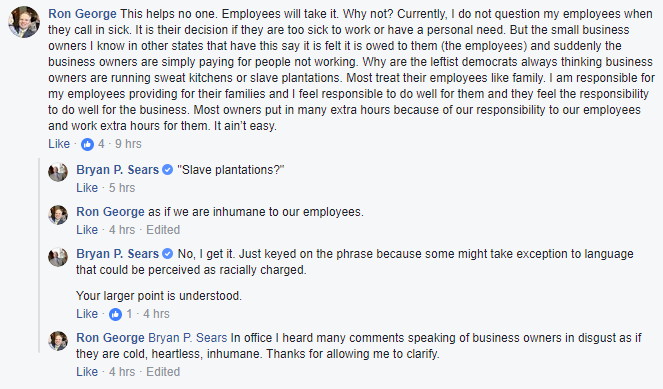
Former GOP Delegate and gubernatorial candidate Ron George, who is running for State Senate in District 30, said on Facebook that “leftist Democrats” think businesses are “running sweat kitchens or slave plantations.”  When challenged on his language by a reporter, he did not back down.

The Facebook exchange occurred on Daily Record reporter Bryan P. Sears’s page.  When Sears posted a video of Delegate Luke Clippinger weighing in on Governor Larry Hogan’s newest sick leave proposal, George wrote:

This helps no one. Employees will take it. Why not? Currently, I do not question my employees when they call in sick. It is their decision if they are too sick to work or have a personal need. But the small business owners I know in other states that have this say it is felt it is owed to them (the employees) and suddenly the business owners are simply paying for people not working. Why are the leftist democrats always thinking business owners are running sweat kitchens or slave plantations. Most treat their employees like family. I am responsible for my employees providing for their families and I feel responsible to do well for them and they feel the responsibility to do well for the business. Most owners put in many extra hours because of our responsibility to our employees and work extra hours for them. It ain’t easy.

George owns a jewelry store on Main Street in Annapolis.

When Sears raised the possibility that George’s reference to “slave plantations” might be viewed by some as “racially charged,” George replied, “In office I heard many comments speaking of business owners in disgust as if they are cold, heartless, inhumane.”  The full exchange appears below.

We get that as a business owner, George may not particularly enjoy the government setting his workplace practices.  But multiple polls find that huge majorities of Marylanders support paid sick leave.  Even Governor Hogan has introduced not one but two sick leave bills.  Are they all “leftist Democrats” who believe that business owners treat employees like slaves?  Or is Ron George as out of touch with Marylanders as he is inclined to the use of racially charged rhetoric?

Share

Washington Challenges Conway, Part II


Today, we continue our look at the upcoming Democratic primary challenge by Del. Mary Washington to incumbent Sen. Joan Carter Conway (D-43).

Del. Mary Washington brings a record of serious work on issues and constituency service to her challenge to incumbent Sen. Joan Carter Conway. She has been keenly interested in expanding community schools that help link students and their families with services that can help in times of crisis or to overcome barriers to gaining an education.

Washington has also gained attention for her effort to prevent homes for being sold for unpaid water bills—a real problem in Baltimore City because of spiking rates and major glitches in the new water billing system that have led to over 1000 homes and churches facing the threat of sale. These are serious problems for people on fixed incomes.

Washington is poised to make a more serious bid to challenge Conway than Henry’s unsuccessful effort in 2014. First, Washington will have already represented the exact same constituents as Conway for eight years. Additionally, she ran a strong campaign for the House twelve years ago, so she’s well-known in the district and on the ballot.

Second, Washington is much more strongly positioned form a financial perspective. Her last report revealed that she had $81,572.45 in her campaign account. While less than Conway has, or will be able to bring to bear in a tough primary, Washington already has enough to afford key expenditures for a serious challenge.

On the other hand, the two sitting delegates, Maggie McIntosh and Curt Anderson, have made clear that they will stick with Conway. Like Sen. Mike Miller, who will also back Conway, Del. McIntosh is an experienced, skilled politician who can bring significant dollars to bear and plays for keeps. They’re key backers that Conway needs—and has—and not the sort of opponents anyone wants to face.

If Conway decides to retire, Anderson has indicated that he is inclined to enter the race, though the betting appears to be that Washington would defeat him. It will be interesting to seek how tight a joint effort the other incumbents run and if Washington aligns with other challengers.

Washington’s challenge appears to be having the effect of causing Sen. Conway to dig in her heels and want to run for a sixth term. While Conway is a seasoned incumbent who has won her spurs in tough races, it remains unclear how aggressively she could or would campaign. In contrast, Washington is clearly hungry for the seat.

This will be a great race to watch.

Share

Not Exactly the Ideal Rollout for Turnbull

Gubernatorial Candidate Ben Jealous Introduces Susan Turnbull as his Running Mate for Lieutenant Governor

Sometimes, it’s worth doing a third take.

Apparently, a car accident outside interrupted Ben Jealous’s effort to do his introduction of Susie Turnbull as his running mate for Lieutenant Governor. After investigating, they came back and did this second take.

It contains some real clunkers. Ben Jealous speaks of removing Gov. Larry Hogan “from the White House.” This Freudian slip only reinforces the perception that Jealous is a lot more knowledgeable and comfortable speaking about national issues and his real interests lie outside the State.

Incredibly, Turnbull then makes the same gaffe by referring to when she “moved to Washington” even though she quickly realizes her mistake and attempts to correct mid-course. She ends up saying:

For the last 40 years, I’ve been engaged in politics. Since I moved to Wash <pause> to Washington and Maryland, especially to Maryland, in the last . . . years ago, what I have done is build coalitions and work in my community.

Leading with her political chops without also highlighting any specific accomplishments doesn’t help sell the message. The takeaway for many may not be their message of “change” and “doing big things” but that Jealous has chosen yet another longtime well-off political insider, much of whose work in her community consists of serving in elite party positions.

Many in the DC area think of themselves as Washingtonians and identify heavily with the metro area. Saying you’re from more well-known Washington rather than Bethesda is natural for Turnbull. Yet Washington insider is not normally the image cultivated by a Sanders candidate. Describing herself as being from “Washington” will surely play poorly elsewhere in the State.

The jiggling camera puts a Maryland spin on it by reminding people of The Wire. I suppose the low production values can be sold as a form of authenticity but I would’ve thought a campaign intending to do a roll out would’ve been prepared to film it.

Jealous has gained a running mate who will reassure the political establishment and may help him raise money – two excellent reasons for Turnbull’s selection. Many people think highly of her and we’ll have future opportunities to hear from them. But this video utterly fails to sell why the broader public should think that she is a great choice for Lieutenant Governor.

Share

Washington Challenges Conway, Part I

Sen. Joan Carter Conway (D-43) has not made her intentions clear regarding running for reelection but that has not stopped Del. Mary Washington (D-43) from throwing down the gauntlet and declaring her intention to run for the seat.

After winning election to the Baltimore City Council in 1995, Conway was appointed to the Senate in 1997 when Sen. John Pica, Jr. retired. Since then, she has won the Democratic nomination—tantamount to election in this district—five times. While Conway has faced stronger challenges in recent years, she has continued to win convincingly.

Past Democratic Primary Results in District 43
2014: Conway, 64.5%, Councilman Bill Henry (D-4), 35.5%.
2010: Conway, 69.5%, Hector Torres, 30.5%
2006: Conway, 92.0%, Dave Vane, 8.0%
2002: Conway, 100.0%
1998: Conway, 100.0%.

In 2014, Conway dispatched Councilman Bill Henry with ease, winning by a margin of 29%. Henry’s expenditure of $45,687.36, while not insubstantial, was below the threshold needed to take on an entrenched incumbent. Challengers don’t need to outspend incumbents but they do need enough for key expenditures.

Conway spent $146,993.41 in 2014 and this does not include any independent expenditures made on her behalf, though it does include some expenses for the general election. Though she once again contemplating retirement, having packed up her Senate office, Conway remains financially prepared to wage a serious reelection battle with $108,567.58 in her campaign account according to her January report from this year.

Conway has an interesting relationship with Senate President Mike Miller. While they don’t get along personally, Conway has long been part of Miller’s leadership team as Chair of the Education, Health and Environmental Affairs Committee. After the primary in 2014, Conway transferred $35,000 from her campaign account to Miller’s Democratic Senatorial Committee Slate and another $5,000 to conservative Sen. Roy Dyson (D-29). In short, there has been little friction on legislative or political matters even if Miller and Conway will never be BFFs.

Tomorrow, we take a closer look at the challenger, Del. Mary Washington.

Share

Susan Turnbull is Running for Office. Is it Lt. Gov. with Ben Jealous?

Former national DNC member and Maryland Democratic Party Chair Susan Turnbull established a state-level campaign committee on November 22.  Her committee filing does not list the office for which she is running.  Her campaign chair is former Montgomery County Democratic Central Committee Chair Karen Britto and her treasurer is federal lobbyist Matthew R. Schneider.

It may not be a coincidence that gubernatorial candidate Ben Jealous just sent out a blast email stating that he will announce his pick for Lieutenant Governor tomorrow. Indeed, private reports indicate that Turnbull has agreed to be Jealous’s running mate.

We have asked Turnbull about the office for which she is running.  When (if?) she replies, we will update this post.

If nominated, Jealous-Turnbull would be the first Democratic ticket with no white male on it. I imagine Jealous is hoping that Turnbull will help in Montgomery County, Turnbull’s home. She also has a lot of connections as a former state party chair that could prove useful in raising money and building support around the state.

At the same time, Turnbull’s status as a party insider cuts against Jealous’s effort to campaign as an outside challenger to the establishment. In that sense, opponents can easily cast Turnbull as the ultimate insider despite her lack of experience in public office.

Share

County Executive Candidates on the Liquor Monopoly

Question: The county’s liquor monopoly has come under heavy criticism–not least from Seventh State. If at all, how would you reform or change, or press the state legislature to change, the Department of Liquor Control?

Roger Berliner

At the county level, I have been the chief advocate for ending our unique – and counterproductive – liquor monopoly.  As someone who has fought monopolies most of my professional life, I know in my bones that monopolies are rarely, if ever, in the public interest.  Government monopolies are generally even less efficient.  And a government monopoly that tries to do a job that the private sector does in the rest of the country is almost always less efficient.  That is true in MoCo.  As a result, our residents vote with their feet.  Almost one-third of our purchases of liquor are made outside Montgomery County.  Our restaurants hate it.  Top flight restaurants have said that they would never come here. Bottom line: our monopoly needlessly perpetuates the reputation of our county being anti-business and anti-consumer and stunts our economy.

However, the state is a critical partner in this conversation.  It is state law that created our monopoly, and state law must be passed to change it.  The positive side of this dynamic is that the state would be the principal, direct beneficiary of increased liquor sales.  I would work with the Governor and our legislature to split the savings that the state would derive and hold the county harmless as it weans itself from this monopoly.  The dollars are not that significant given that our retail operations should continue to do well – assuming that they can compete!  And in the long run, our county will prosper more without the monopoly than with it.

Marc Elrich

Any discussion of the Department of Liquor Control (DLC) must acknowledge that the Montgomery County budget relies on over $30 million in liquor revenue per year.  That is no small amount of money, and it supports critical county services, including almost $11 million for bond payments.  Nobody who has proposed privatizing the county’s liquor supply has a workable plan to fill the budget hole privatization would create, likely because there is no way to do so that doesn’t create other problems for the state.

Privatization proposals thus should not be taken seriously; instead, we should continue to look for ways to make the DLC more efficient and effective than it has been in the past, and to increase sales so that we can increase the revenue that the DLC generates.

We’ve already changed the way the DLC is run by bringing in industry professionals, including the director and the warehouse manager, who have improved the operations of the liquor system and brought in a philosophy of continuous improvement.  I’ve also encouraged introducing lower markups for more expensive items, which they did, and I’ve supported and will continue to support efforts to help local breweries and wineries sell and distribute their goods.  Both the new director and I want to hear and consider other ideas for helping transition the DLC from something that the county has long taken for granted into a professionally run system.

In fact, if a private-sector business had a division that produced a substantial profit but was identified as having management problems and customer service issues that prevented it from being more profitable, its most likely course of action would be to change management, work to improve services, and strive for greater profits.  That is exactly what we have been doing with the DLC.

Bill Frick

I have been the state’s leader on fixing this abysmal broken system.  My “end the monopoly” effort, helped immensely by the Seventh State’s Adam Pagnucco, fell short in 2016 in large part because of vigorous opposition from the Council and County Executive.  We agreed to let the Executive lead a work group on the issue, but that work group served no real purpose other than to push the issue onto the desk of the next Executive.

This is a great opportunity.  The DLC has value, and I have proposed to ensure that the value stays with Montgomery County by selling off the DLC’s assets, such as its franchise rights to beer distribution, its stores and warehouse, to generate millions in capital dollars that can be spent on school construction.  Because the elimination of the DLC will generate millions in repatriated sales and excise tax dollars, I would work with my colleagues in the legislative leadership to help return some of those revenues to the County.  Finally, we all know that the work of alcohol distribution will not disappear with the end of the DLC, rather, those jobs will migrate to the private sector and will likely grow in the County as our consumers come home to buy their beer, wine and spirits here.  I will work with the private sector distributors and unions to find the best outcomes for current DLC employees as we get the County out of the liquor business.

George Leventhal

I am willing to entertain serious negotiations with parties who are willing to make a serious offer to purchase the right to distribute beer, wine and spirits in Montgomery County. In FY 2018, that enterprise generated more than $33 million in surplus revenue over expenses to the county’s general fund, of which $11 million was spent on debt service for approximately $100 million in Liquor Control Revenue Bonds, which were issued more than a decade ago to pay for transportation improvements, including the Montrose Parkway. I think we should commission an independent economic analysis of the present value of a guaranteed revenue stream of more than $30 million each year. My understanding is that it would come to hundreds of millions of dollars – more than enough to retire the bonds. I do not think the county should simply give away these valuable rights, which belong to the people of the county. However, serious offers from serious buyers should be considered. Simply giving the rights (and the associated revenues) away would require that the bonds be retired or refinanced through other means. If general obligation bonds were used to refinance the Liquor Control Revenue Bonds, it would reduce the county’s ability to construct new schools and other capital projects by $100 million.

In the absence of a serious offer to buy the rights to the entire enterprise, I continue to support the County Council’s 2015 proposal to privatize special order sales of beer and wine. Problems with delivery of special orders comprise the vast majority of complaints from restaurants, but the Montgomery County delegation to Annapolis declined to take up the County Council’s proposal in the 2016 session after County Executive Leggett asked for more time for study.

The Montgomery County delegation also declined to take up proposals for immediate privatization or for a voter referendum. Candidates for County Executive who have concerns about the Department of Liquor Control’s shortcomings should remember that liquor laws are made in Annapolis, not in Rockville. I would also support action by the state legislature to allow sales of beer and wine in grocery stores. Beer and wine stores will soon be able to sell spirits under legislation that passed in the 2017 session, which I supported.

Share

Maryland Politics Watch