MCDCC Part III: Renovation or Takeover?

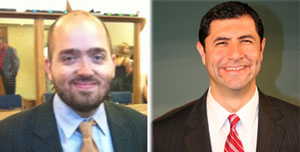
Kunes AlbornozDave Kunes and Gabe Albornoz

Check out Part I and Part II of this four part series on the contretemps at MCDCC.

In the wake of the boycott of the Spring Ball, the Montgomery County Young Democrats (MCYD) and labor unions started applying pressure for major changes on the Montgomery County Democratic Central Committee (MCDCC) to include more labor representation and more young people.

The prime movers in this effort appear to be Dave Kunes, Chair of MCYD at age 24, and Gino Renne, MCGEO President. Renne is the most senior of the leaders of the three unions–the others are the FOP and the Firefighters–involved in government operations in Montgomery County.

Labor talked up running an alternative slate for MCDCC. Kunes, who then worked for Del. Tom Hucker and now works for MSEA as well as chairing MCYD, organized a PAC to back candidates for MCDCC. MCGEO donated to the PAC. At this point, perspectives on the story diverge.

No one disagrees on the basic facts, essentially a meeting occurred between MCDCC Chair Gabe Albornoz and others, including Kunes, where they agreed to put together a unity slate that would incorporate significant new members.

It’s the interpretation that varies. Some see Gabe as taking advantage of the situation to renovate a MCDCC in need of new ideas and new blood. Others see it as Gabe suing for peace in order to avoid competing slates and more acrimony within the Montgomery County Democratic Party.

Either way, the result turned out the same. MCDCC set up committees of five people who were not running for MCDCC to interview people for slots on the unity slate. So far, so good.

Except that laudable step was undercut completely by the closed, secret nature of the process. Only certain people, essentially current MCDCC members and selected Young Democrats, were invited to apply. If the goal is truly renovation rather than major change to benefit specifically MCYD and labor, why keep it secret and limit applications?

The people involved may call on Captain Hindsight to lament this approach. Sorry but not buying. They organized it specifically to accomplish their goals. They own it.

Regardless, this lack of transparency and the limited nature of the invitations had the desired effect. Roughly eight members of the unity slate, or one-third of candidates, are young Democrats. As a result, the committee is set to take in a major influx of people who helped place the pressure on MCDCC to change.

Additionally, some changes were further negotiated between the major players behind the scenes after the interviews. In particular, the unity slate dropped Young Democrat Brígida Krzysztofik in favor of Kevin Walling, who had raised money for his delegate race in District 16. Both are LGBT. Krzysztofik was quietly promised that she would get a slot next time.

Some of the unity slate choices make more sense than others. I was surprised to learn that the slate didn’t include Jay Wilson, a very talented, smart Young Democrat and Vice President of the African-American Democratic Club. (I know Jay through his work for a nonprofit that we both support.) Despite passing on Jay, African Americans comprise roughly one-third of the slate.

Most of the retiring members have done so by choice but a few were defenestrated from the slate against their will. The primary example is Harold Diamond, who won a seat in District 19 challenging the slate in 2010, but was not selected for the unity slate.

Diamond chaired both the Ballot Questions Advisory Committee as well as the precinct officials meeting to vote on them. He had the nice sounding but dreadful in practice idea of populating the committee with essentially anyone who volunteered. Not the best means to recruit a group of volunteers who are particularly sensible, representative, or sensitive to the variety of interests and trends within the party.

The meeting of the precinct officials also left several key issues until very late in the evening and Diamond repeatedly tried to steer matters in the direction he favored. No surprise he was left off the slate. Nonetheless, he will be seeking reelection from District 19.

Despite labor’s grievances avowedly being a prime motive for unhappiness with MCDCC, only one of the new members has a direct link to the three governmental unions who were upset with MCDCC–Erin Yeagley works for MCGEO. However, Dave Kunes also works for MSEA and the Young Dems as a group are perceived as labor proxies.

The oddness doesn’t end there. The dispute began because labor was frustrated with the County Council. But MCDCC’s major power is to fill vacancies in the legislature. Vacancies on the County Council are filled by appointment. On the other hand, Gino Renne will likely view it as mission accomplished if he can prevent MCDCC from sending out another sample ballot endorsing a question opposed by organized labor even if unanimously supported by an all-Democratic County Council.

Some view all of this as simply an power play by Dave Kunes supported by the unions. Certainly, the idea that crisis is another word for opportunity has more than a dollop of truth. Nevertheless, harnessing ambition for public goals can be a powerful force for change. Kunes revitalized the Young Democrats and made them a force in the County. Regardless of how it came about, the changes at MCDCC provide a real chance to regenerate the party.

Politics is perhaps the only profession in which people are supposed to loudly protest their lack of ambition or desire for advancement as they move their way up the ladder. So what if ambition played a role in his organization of this renovation/partial takeover? All our officials should be so skilled and talented.

The final part in this series will explore the upcoming election for MCDCC as well as its future.

Share

Trans Marylanders Make Their Voices Heard

The following are excepts from testimony by Trans Marylanders from the committee hearing in the House of Delegates:

Zane Walsh is a trans teen:

Things about me– I’m not a dirty prostitute or a pervert lurking in the men’s bathroom which is the image that comes up in a lot of people’s minds when the word ‘trans’ is mentioned. I am a normal kid. I love animals and rock music. I play drums and I sing. I cherish my dog Bebe. I love punk music and Billy Idol.

Maybe I love playing music so much because it does not judge based on appearance, like so many bigots do. The people who are watching me in concert don’t care about my sexuality or what gender I was assigned at birth, just my music. I LOVE dogs.

I am not that different. I get up, I eat breakfast, I take care of Bebe, I go to school, I come home, I eat, I listen to music and play with Bebe and sometimes even play with my sister who by the way has more rights than me which is downright unfair.

We are normal children so why don’t you support us?

Jennifer Fischetti spoke about being fired from her job:

The tension that week broke at 8:30am Wednesday as I arrived for a managers’ meeting and was pull out by a peer. I was to find out; it was his job to terminate me. I was being let go for what was described as performance deficiencies. I could easily refute any allegation with facts and stats, for I had to keep those records, but the peer who dismissed me simply shrugged his shoulders as if to say “It’s out of my hands”.

Yet when I filed unemployment, the agent at unemployment was astonished at the fact the company did not contest my claim. They replied I was dismissed for lack of work; that they could not afford to pay me because business was off. Yet the very next day someone else occupied my old office, holding the same capacity as I had just held. The auto industry is a very small and close-knit. Word traveled quickly and I have not held a position in my given career of 19 years since. That was nearly 10 years ago.

Blake Wideman is a police officer in Prince George’s County who worries about losing his job and ability to support his family:

I was born African American in Baltimore City which seemed to be a curse that I learned to turn into a gift. I grew up in poverty and learned to persevere through all the discrimination and hatred I had to face on a daily basis because my skin was darker, even darker than the average black person. My black features were prominent and afforded me many opportunities to be ostracized from jobs and housing that were rightfully mine. All adversity aside I and many like me not only survive but thrive.

At a very young age I knew that I was different, and not due to the color of my skin but because I had a burning desire to become great in every facet of my life. And honestly for a while I did very well, I was the first of my mother’s children to graduate high school and attend college. I have no criminal record, and even more exciting I am a part of the law enforcement sector. Every day I wear that bullet proof vest, gun, and badge to serve and protect a state and city that will not protect me because I am Transgender.

Even though I currently have a job. I work in Prince George’s County a jurisdiction that does not currently protect me from discrimination based on my gender identity. I am afraid what might happen to me and my family if I get a supervisor that doesn’t like transgender people.

I put my life on the line. I am a law abiding citizen. I pay taxes. Yet I am not protected by Maryland’s anti-discrimination laws.

Share

Dem Gov Hopefuls Testify for FAMA

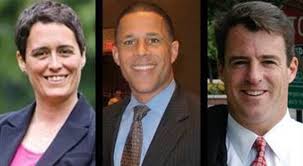
govhopefulsDel. Heather Mizeur, Lt. Gov. Anthony Brown, and AG Doug Gansler

We’re fortunate that all three of the major Democratic candidates for governor are strong supporters of the Fairness for All Marylanders Act, the trans equality legislation. I know many appreciate their united support despite other differences, so I thought I’d share snippets of their testimony.

Today, Lt. Gov. Anthony Brown will testify before the House Health and Government Operations Committee in support of the bill. He issued a press release stating:

“No Marylander should face discrimination based on gender identity or sexual orientaion,” said Lt. Governor Brown. “By passing the Fairness for All Marylanders Act we will take an important step forward for equality and provide Marylanders with the assurance that here, in our State, all citizens will be afforded equal rights and protections under the law.”

Attorney General Doug Gansler advocated for marriage equality long before it become fashionable. Here is a portion of the testimony he submitted to the Senate Judicial Proceedings Committee:

The Constitution’s command to provide “the equal protection of the laws” applies to “any person” within a state’s jurisdiction, regardless of that person’s identity. We deprive our citizens of that equal protection when we allow discrimination against them on the basis of their gender identity. Inequality for any person is inequality for all of us. Gender identity, like race, sex, sexual orientation, and creed, must not be tolerated as a ground for denying any person the opportunity to obtain employment, housing, and public accommodation.

Del. Heather Mizeur is a member of the LGBT Caucus and a longtime advocate for this legislation. As the Washington Blade reported, she advocated strongly in favor before the Senate committee:

Baltimore County and City, Montgomery and Howard Counties – four of our state’s larger jurisdictions have stepped up to provide nearly half of our state’s residents protection from gender identity discrimination.

But protection against discrimination shouldn’t depend on your zip code.  We need a statewide law.

And we cannot wait.  Real people are suffering real consequences of our inaction.

Fear and prejudice are not acceptable reason for assigning a vulnerable group of Marylanders to a future of discriminatory practices in employment, housing, and public accommodations.

17 states and the District of Columbia have stepped forward to do this.  The Chrissy Lee Polis’s in Prince George’s County, Southern, Northern, Western Maryland, and the Eastern Shore are expecting us to do the right thing – to prove to them that Maryland really is the Free State where everyone – EVERYONE – gets protected equally under the law.

There can be no exceptions. And there are no excuses.

The House has passed a version of this bill previously. Now that the blockage in the Senate has cleared, we should “get it done” as Heather put it in her testimony and to me.

Share

Colburn v. Eckardt in Top Senate Primaries III

D37Eastern Shore District 37

This is the third in a series on the top Senate primaries in the State (Part I and Part II).

District 37 (R): This primary matchup between Sen. Richard Colburn and Del. Adelaide (Addie) Eckardt is almost as personal as the one previewed yesterday in neighboring District 36. Colburn and Eckardt have served together in the General Assembly since 1995. According to The Quinton Report, Colburn walked up to Eckardt and on the night she filed and said “You used to be my friend.”

Colburn was elected in 1982 to the first of two terms in the House of Delegates. In 1990, he sought the Republican congressional nomination and came in third with 12% of the vote in a highly fractured contest. When very conservative Democratic Sen. Frederick Malkus, Jr., retired, Colbun won election to the Senate in 1994, easily winning the primary and then the general by 10%.

Eckardt is the most serious challenger Colburn has faced since gaining his Senate seat. Beyond being smart and likeable, she has also represented most of the same people as Colburn for nearly two decades. They are both known quantities.

Colburn also goes into the primary with less money than Eckardt as he has $32K in his campaign account to her $44K. Neither can raise money during the session, so they will have little time to raise much more before the primary occurs in June.

One advantage held by Colburn is that he already represents all of District 37. Eckardt represents District 37B, which elects two of the three delegates. Much of the advantage, however, is illusory. District 37A was drawn as a majority-black district, and so has comparatively few Republicans. In 2012, only 18.5% of registered Republicans lived in 37A–only around one-half what one would expect if Republicans were evenly distributed.

Moreover, Eckardt has decided to strike when Colburn is at his weakest. He has been under scrutiny for ethics questions, having spent “more than $40,000 in meals, gas, lodging, flowers and Baltimore Orioles tickets” out of his campaign funds, as reported in the Daily Times. The article has led to editorials calling for Colburn to “clean up his finances.”

On top of that, Colburn has had a very public divorce with allegations of an affair with his aide. His now ex-wife was even thinking of running against him but agreed to support him politically once they agreed to a divorce settlement.

Eckardt also appears more respected in the General Assembly than Colburn. While the number of Republican senators remains few, Colburn has somehow never managed to hold a Republican leadership position according to his bio. Eckardt chaired the House Republican Caucus for five years. However, it’s well known that a lack of respect in the Assembly often has little relation to political support at home.

In her remarks to the press, Eckardt expressed an interest in policy, even speaking about making health care reform work, rather than the usual staple of Republican talking points:

“Even though there’s been a lot of difficulty with the exchange, this is one of the most exciting times to be here in Annapolis because we’ve had 140,000 new people get on the Medicaid medical assistance who didn’t have heath care ­before, and that’s really important,” ­Eckardt said. “But we have to make sure it’s cost-effective and we have to make sure that, as we go forward, it’s a functioning system, because otherwise we would just be putting more money in technology and not getting the results. I’d rather see money go to care for individuals.”

Yet, she remains a firm conservative, especially on social questions. Colburn tends to position himself more as a regional champion, playing on the Shore as a victim of the State.

Needless to say, this will be an exciting contest. They’re both from Dorchester so neither has a home bailiwick. If anyone can topple Colburn, it should be Eckardt. Both seats in 37B will be open, so this race will likely feature high turnout amid an unusual level of interest in state legislative contests. Rating: Toss Up.

UPDATE: A friend on the Eastern Shore says that Colburn provides very good constituent services and has a reputation of being very responsive to individual requests, which will aid him in his hour of need in this tough primary.

Share

Fairness for All Marylanders Act Passes Senate

The Fairness for All Marylanders Act (FAMA) easily passed the Senate on a 32-15. Sponsored by Sen. Rich Madaleno (D 18) and strongly supported by floor leader Sen. Jamie Raskin (D 20), the bill protects the rights of transgender Marylanders.

The bill was earlier amended by the Senate to strengthen it after it had been weakened, though passed, by the Judicial Proceedings Committee. The bill now heads over to the House of Delegates, which has passed versions of this legislation in previous sessions.

The passage of marriage equality and then the referendum vote by the people of Maryland in favor of it seems to have taken the sting out of LGBT legislation. There is a lot lest angst about voting for this relatively straightforward anti-discrimination bill now that the tide has turned on the LGBT issue which attracts the most press.

Sen. Kittleman (R 9, Howard) was the only Republican to vote yes. Four Democrats voted no: Sens. Astle (D 30, Anne Arundel), De Grange (D 32, Anne Arundel), Dyson (D 29, Calvert, Charles, St. Mary’s), and Mathias (D 38, Somerset, Wicomico, Worcester).

Kittleman voted for the marriage bill and is probably the Republican who represents the most pro-marriage Republican district, as Howard voted strongly for marriage equality. More surprising are the no votes by two Anne Arundel Democrats. Anne Arundel also voted for marriage equality, and presumably more strongly in areas prone to elect Democrats.

The no votes by two Democrats hailing from southern Maryland and the Eastern Shore shock less. Marriage equality lost in both of their districts, though with more support than one might expect. Here is how the Senate voted:

YEA: Miller, Benson, Brochin, Conway, Currie, Feldman, Ferguson, Forehand, Frosh, Gladden, Jones-Rodwell, Kasemeyer, Kelley, King, Kittleman (R), Klausmeier, Madaleno, Manno, McFadden, Middleton, Montgomery, Muse, Peters, Pinsky, Pugh, Ramirez, Raskin, Robey, Rosapepe, Stone, Young, Zirkin.

NAY: Astle (D), Brinkley, Colburn, De Grange (D), Dyson (D), Edwards, Getty, Glassman, Hershey, Jacobs, Jennings, Mathias (D), Reilly, Shank, Simonaire.

Share

Forehand Endorses Kagan in D17

CherylJennieCheryl Kagan and Sen. Jennie Forehand

The press release announcing the endorsement of Cheryl Kagan by current Sen. Jennie Forehand surprised me because Kagan challenged Forehand in the last election. People often do not want to support people who opposed them in the past for obvious reasons. Bad news for Del. Luiz Simmons, as this decision tells Forehand supporters where to go and signals a lack of cohesion between him and the rest of the D17 delegation.

The press release with Forehand’s statement emphasized Kagan’s progressive stances:

Cheryl and I share a deep commitment to progressive Democratic values. Whether it’s domestic violence, human trafficking, or gun control, I can trust that Cheryl will consistently speak up on the progressive side.

However, support like this will only matter if Kagan can get the word out through a strong ground operation and has the money to send out a sufficient number of mail pieces–areas where Simmons is already active and running a strong campaign.


Share

MCDCC Part II: Rockville Spring

picketball

As outlined in Part I, voters seemingly had settled the battle between the Fraternal Order of Police (FOP) and the County over effects bargaining in favor of the County. In the 2012 referendum known as Question B, 58% of voters supported  the County’s decision to allow the Police Chief to take more actions without the need to consult  FOP management.

The referendum turned out to be the beginning rather than the end. The public employee unions (FOP, the Firefighters, and MCGEO) struck back by calling for a boycott of the annual Democratic Spring Ball. For those of you who are not regular attendees at this soiree, it is essentially a giant coffee klatch for local politicos and their fans complete with dancing. It’s held, like virtually all of these events, at the Bethesda North Marriott Conference Center.

Having felt abandoned by the local Democratic Party, the unions–long party stalwarts–decided to withhold their money and to make their displeasure public. Ingeniously, they styled the boycott as a picket line, knowing that labor-loving Democrats hate to cross them (or at least be seen crossing them). As none of the workers at the Center were on strike, it wasn’t really a picket line in the traditional sense but it made for great optics and amped up the pressure.

Republicans, as usual, were mad that they hadn’t thought of the idea first. Montgomery Republicans would get far better attendance at their events if people thought that they would have the privilege of strike breaking in the process.

The Montgomery County Young Democrats (MCYD), led by President Dave Kunes, jumped on the boycott bandwagon. Kunes, formerly an aide to Del. Tom Hucker (D 20) and now Maryland State Education Association (MSEA) Field Director, had some experience with seizing opportunities to challenge organization leadership, as he led the successful insurgent slate that took control of MCYD in 2012.

The problem for MCDCC was less monetary–donors stepped up and helped the party cover losses–than morale and the apparent division. It also put the Democratic elected and party leadership on the defensive politically and ideologically.

None of this had any chance of  helping the Republicans. Remember, Montgomery is a one-party county and this battle was about jockeying for power and influence over the one political vehicle worth driving–not a clunker.

Part III looks at the major upcoming changes on MCDCC.

Share

Election Snow in MoCo?

Is today’s snowstorm going to put a dent in County Executive Ike Leggett’s reelection prospects?

Salt Shortage, Show Removal Problems

It has been a long winter and Montgomery County ran short of salt to pre-treat the roads for the storm. In many areas, the streets were first plowed before they were salted, uncovering a sheet of ice underneath the snow that will now likely to have to wait for warmer weather–not to arrive for at least a couple of day–to remove.

Smaller municipalities were especially hard hit. At first, the the County did not even want to release any salt to smaller municipalities that rely on it to supply it through longstanding arrangements. They were not happy.

Why and How it Could Matter

These problems play into Doug Duncan’s strengths. As County Executive, he was known as an avuncular guy focused on handling basic services very well. To the extent that the storm weakens Leggett’s reputation for the same, it could help Duncan and hurt Leggett.

The impact depends on three factors: (1) the severity of the problems, (2) how well surrounding jurisdictions do, and (3) whether Duncan is positioned to take advantage of it. My quick peek at traffic cameras around the County indicate that many major streets are looking good, though some still have problems.

If DC and Prince George’s open the schools but Montgomery does not, the County Executive will likely face at least some grumbling and have to answer questions about the lack of preparation. Winters vary in the amount of snow they bring, and residents rightly expect that the County will get more salt if needed. But if the schools in all three close, it looks like we’re all in the same boat.

Normally, our County officials do not get much attention. Not because they don’t merit it but because our news media covers the entire metro area. They choose to focus their coverage heavily on the District even though Montgomery, Prince George’s, and Fairfax all have far more people.

Bad events, however, can turn their gaze in our direction to the disadvantage of incumbent officials. It will be also interesting to see if members of the County Council raise questions about the level of preparation or choose to stay mum.

What It’s Not

Some may want to exaggerate and make the inevitable recollection of the disastrous handling (really non-handling) of snow in DC by Marion Barry on one famous occasion. Bad analogy. Leggett is not Barry. He’s the anti-Barry: a steadfast calming, often quiet, problem solver. Moreover, these problems are a minor hiccup compared to that fiasco. Don’t go there.


Share

Maryland Politics Watch