Can SNCF Derail the Purple and Red Lines?

Maryland wants to create a public-private partnership (P3) to build and operate the Purple Line. Keolis North America, 70% owned by La Société Nationale des Chemins de fer Français (SNCF) is one of the finalists selected by the State.

Keolis’s proposal has run into trouble because of SNCF’s role in transporting Jews from France to Nazi death camps. Lea Lieberman who lost her father in the Holocaust gave moving testimony yesterday to the Senate Budget and Taxation Committee yesterday:

When the Nazis occupied Paris, my parents fled to Vichy France. Subsequently, the Gestapo arrested my father and left my mother to tend to a three year old child alone. . . .

Shortly after his arrest in Vichy France, he was taken to Drancy (the notorious holding camp in the outskirts of Paris) and subsequently shipped to Sobibor concentration camp via the French National Railroad, where he was murdered. . . .

Three days ago, a representative for SNCF, the French National Railroad, shirked any moral or legal responsibility by stating and I am paraphrasing, we were an occupied country, the trains were operated under Nazi command, there was nothing we could do except to obey our Nazi occupiers.

Ironically, this is similar to what the German soldiers stated in the Nuremburg trials after the War. Following orders is not a moral excuse to murder. I find that prototypical statement of helplessness to be even in and of itself. SNCF was complicit with the Nazi regime in the murder of innocent Jews, including my father. Indeed, it has been reported that the company has acknowledged guilt in France and paid out for than $6 billion in reparations, but only to French citizens and certain deportees.

Holocaust Survivor Leo Bretholz vociferously disputed SNCF’s rationale that it had no choice but to obey he occupiers in a commentary in the Baltimore Sun:

SNCF carried out its transports with precision, cruelty and deception. On each convoy, we were packed into 20 cattle cars, 50 people each. For the entire multi-day trip, we were given only one piece of triangular cheese, one stale piece of bread and no water. There was hardly room to stand or sit, and in the middle of the train was a single bucket to relieve ourselves. . . .

I even have a copy of an invoice SNCF sent the French government, seeking payment for the services it provided. They pursued payment on this after the liberation of Paris, after the Nazis were gone. They even charged interest for late payments. This was not coercion, this was business.

SNCF was not coerced into using cattle cars. It was not coerced into sending bills after the war. It was not coerced into serving no water on the trains. Had SNCF resisted, the number of those killed from France would have been greatly reduced. Had SNCF not imposed horrific conditions on its trains, many additional lives could have been saved.

Instead of taking responsibility for its actions during the past 70-plus years, the company has spent millions of dollars on a lobbying and public relations campaign to rewrite history and avoid accountability for its pivotal role in one of history’s greatest atrocities.

Leo Bretholz died earlier this month before he could testify on the bill.

Regardless of one’s views on SNCF’s guilt, one need not wrestle with SNCF’s excuse of having to comply with the Nazi German occupiers for the simple reason that SNCF has already admitted guilt and paid reparations in France.

If that’s the case in France, it ought to be the case in Maryland. There is something deeply grotesque about a willingness to pay lobbyists to avoid accountability here when it has already admitted liability in its home country.

In response to SNCF’s refusal to pay reparations to American survivors of the Holocaust, Sen. Joan Carter Conway (D-43, Baltimore City) and Del. Kirill Reznick (D-39, Montgomery) have filed legislation to require SNCF to pay reparations if it wants to bid for the project.

The bill has been complicated by claims that any interference with the bidding process could derail federal funding. The Federal Transit Administration (FTA) sent a letter to the Maryland Transit Administration (MTA) stating that the bills “raise legal concerns regarding the ability of MTA to comply with federal full and open competition requirements” and thus “jeopardize federal funding” for the Purple and the Red Line.

MTA and the Maryland Department of Transportation (MDOT) have unsurprisingly lobbied hard against the bills. However, the letter from FTA was unusually artful and carefully couched to avoid any firm determination of the impact of the bills on federal funding.

Presumably, the State of Maryland could request a more definitive answer from FTA. Is the Obama Administration really not going to fund transportation projects because the State wants to use its leverage from this $6 billion contract–one of the largest it has ever awarded–to aid Holocaust victims?

The Jewish Community Relations Council (JCRC) has testified in favor of the bill. And some legislators have stated that they feel more strongly about the principle than the $900 million in funding recommended by FTA. As the Washington Post reported:

“We want the Purple Line, but is this the price we pay — to do business with these guys?” Sen. Roger Manno (D-Montgomery) said Thursday after a Budget and Taxation Committee hearing. “Maybe if that’s the case, maybe we can’t build it.”

Others feel differently. Del. Kirill Reznick is willing to modify his legislation to avoid the loss of federal funds.

It’s in SNCF’s power to resolve this issue and bid for the project. Doing so would bring honor to SNCF and to France.

Share

Eberly Endorses Bohanan

St. Mary’s Professor and Blogger at the Freestater Todd Eberly issues his first endorsement–ever–for Del. John Bohanan:

Del. Bohanan was narrowly reelected in 2010 and Republicans now outnumber Democrats in St. Mary’s county, but I believe that voters would be sorry if Bohanan were defeated. The simple truth is that Bohanan is the only member of the St. Mary’s delegation who has any real influence in Annapolis. He is the chair of the powerful Spending and Affordability committee and sits on the Appropriations committee. His seniority and committee assignments allow him to “deliver the goods” to St. Mary’s county. Were he to be defeated, he would be replaced by a freshman Republican. I don’t particularly care if I’m represented by a Republican or a Democrat, I just want a representative with integrity and the power to be a forceful representative of my community. Were a Republican, such as candidate Deb Rey, to replace Bohanan she would go to Annapolis as a member of a minority party that is outnumbered by a 2-to-1 margin in the Assembly. A party with virtually no influence in the General Assembly. She would have no seniority, no prime committee assignments, and no chance of ever chairing a committee – in other words she would have no leverage and little to no ability to ensure that St. Mary’s county had a voice that was heard in Annapolis. St. Mary’s county is one of the fastest growing counties in the state and we cannot afford to be voiceless. . . .

Voters will have a choice to make in 2014, they can vote to deprive St. Mary’s of any meaningful voice in the General Assembly, or, they can reelect John Bohanan and ensure that the needs of our county are heard loud and clear. To me, that’s an easy choice to make.

I would add that Bohanan’s vote on marriage equality was very gutsy at the time but now seems prescient. A little political courage is a good thing in a delegate.

It goes without saying that one should listen to both professors and bloggers.

Share

Top Senate Primaries Ratings Summary

Here is a summary of my ratings of the hottest Senate primaries in Maryland with links to more detailed information on each race. The ratings give my sense of the race when I wrote the profile. Of course, events and new information can always lead me to revise my opinion, so please keep me posted!

Share

Turner Takes on Muse in Prince George’s D26

D26Prince George’s District 26

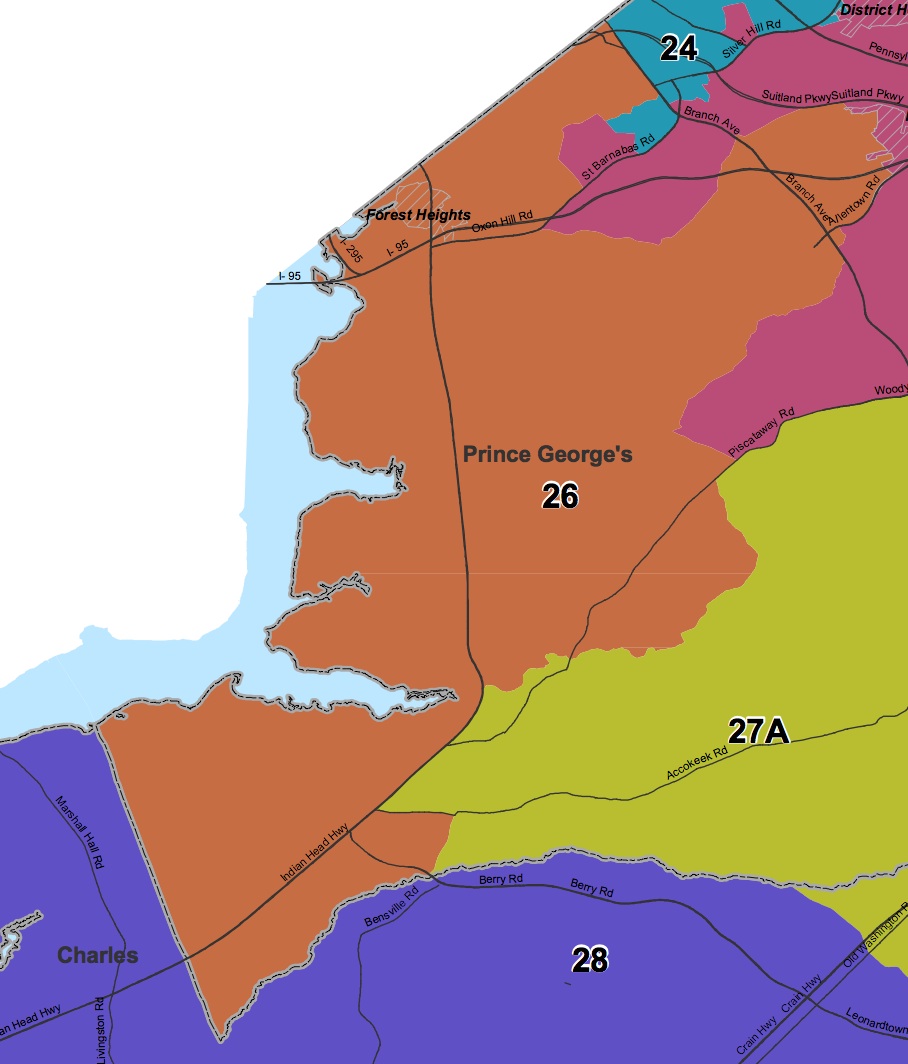
District 26 in southwestern Prince George’s County is 78 percent black in voting-age population. These days, it’s perhaps best known for Prince George’s showcase National Harbor development, soon to be home to Maryland’s MGM Casino.

Sen. Anthony Muse is facing a tough fight for a third Senate term. Muse first won a term in the House of Delegates in 1994 and then narrowly lost a challenge to Sen. Gloria Lawlah, the first African-American elected to the Senate from this district, in 1998.

Muse ran for County Executive in 2002 but came in third with just 19% of the vote. He beat Del. Obie Patterson in 2006 with 55% to win the Democratic nomination for Senate. (Patterson now represents County Council District 8.) In 2010, Muse faced no significant opposition. Muse ran a quixotic campaign against U.S. Sen. Ben Cardin in 2012, taking just 16% of the vote and failing to carry his home county.

In 2014, Muse faces a tough challenge from Del. Veronica Turner, first elected in 2002. Two other candidates have also jumped into the race, Jerry Mathis and Brian Woolfolk.

Mathis, a former member of Prince George’s Community College Board of Trustees, won only 13% in his unsuccessful bid for the 2010 Democratic nomination for the District 8 Council seat. He seems unlikely to be a factor, especially since he has no campaign account (or at least I cannot find it in the database). However, he probably holds a grudge against Muse for filing a bill designed to stop him from running for the County Council in 2010.

Brian Woolfolk is an attorney who previously worked for Rep. Bobby Scott (D-VA), who is viewed as a smart and highly competent Member of Congress, and as Counsel to the House Judiciary Committee. Woolfolk has $50K in his campaign account with $45K of the $65K raised in the form of a loan to his campaign. In contrast, Muse has $52K in his campaign account while Turner has $25K.

As the leader of a 2000-member church in his district and an incumbent who has appeared on the ballot many times, Muse would seemingly go into this race with a strong advantage. His wife, popular NBC4 Anchor Pat Lawson Muse, is also a major asset to his campaign.

Except that his church has now had to file bankruptcy. Muse blamed the problems on the struggles of the church’s middle-class members during the recession. But Muse’s previous church also filed for bankruptcy in the 1990s at the height of the economic boom after getting mired in $6 million of debt. Among the current church’s major debts are $610,000 owed to Muse and his wife, which includes loans they made to the church.

One can imagine Turner recruiting support from the many people Muse has tangled with over the years, such as Gov. O’Malley, Sen. Cardin and Councilmember Patterson, who might not sorry to see him lose. Muse is also one of the more conservative members of the Senate. He opposed Gov. O’Malley’s wind power initiative and marriage equality, so Turner may attract support from progressives.

An additional boost for Turner is that she is rumored to be quietly forming a slate with David Sloan, tipped as the most promising of the non-incumbents running for delegate.

Support from the other incumbent delegates–incumbent Del. Kris Valderrama and Del. Jay Walker are both running– could also help either Muse or Turner. I have no information here; as always, please post on Facebook if you do. Of course, they could also choose to join neither ticket. Valderrama and Muse have not always had a strong relationship, so I don’t see her as a lock to slate with Muse. Alliances often change over time though, so who knows?

The number of candidates could prove a barrier for Turner in unifying the anti-Muse vote. Woolfolk is a new candidate but can bring money to bear on the race and has a solid credentials. Mathis should not be a factor but may grab a few votes.

At the same time, Turner has been on the ballot several times, so she undoubtedly has her own network of positive supporters who will rally to her. In other words, her campaign is not merely centered on unifying those tired of Muse. Moreover, women will make up a heavily disproportionate share of the electorate.

Interestingly, Turner is listed as one of Brown’s endorsers while Muse is not. Her support for Brown could work to her advantage if Brown does well in this district on primary day.

I need more information to get a more informed sense if this one leans one way or another yet. I tend to think it is between Muse and Turner, and that either could win, but it will be interesting to see if Woolfolk gains traction. Rating: Toss Up.

Share

Marijuana Decriminalization Advances in Senate

On March 7, the Senate Judicial Proceedings Committee voted 8-3 to report favorably on SB 364, a bill to make possession of marijuana a civil rather than criminal offense, sponsored by Sen. Bobby Zirkin (D 11, Baltimore). Sens. Frosh (D), Brochin (D), Forehand (D), Jacobs (R), Muse (D), Raskin (D), Shank (R), and Zirkin (D) voted in favor. The three opposed were Gladden (D), Hershey (R), and Stone (D). Not a very partisan vote.

Today, the Senate accepted two amendments offered by Chris Shank (R 2, Washington). The first amendment allows courts to sentence offenders to drug treatment programs. The second requires any monies collected to go toward drug treatment and education. Both were accepted by the sponsor and the bill passed second reading in the Senate without a recorded vote.

The marijuana decriminalization bill now moves towards third and final reading in the Senate. At this point, no more amendments may be offered, so third reading will likely consist of an up or down vote on the merits of the bill as it stands. Obviously, the House of Delegates would need to pass the same bill for it to become law.

Share

Alternative to Inheritance Tax Cuts

estate_inheritance_large

Much ado has been made of the necessity of cutting inheritance taxes in Maryland in order to avoid driving away wealthy people from Maryland looking to leave their assets unencumbered by state taxes. Sounds like a reasonable theory. And it’s a priority of Senate President Mike Miller and House Speaker Mike Busch.

Except that there is only anecdotal rather than systematic evidence that these specific taxes actually drive people away. The more thorough analyses indicate little impact. In any case, it’s not clear that even if it were so, that the changes will accomplish the goal, as other states have no inheritance taxes at all.

Since revenue estimates keep declining, it’s not at all clear that tax cuts are advisable at all at this time. If we’re not careful, the State may end up having difficulty paying its bills. Alternatively, the General Assembly would need to identify spending cuts to match the tax cuts. After all, tax cuts are another form of expenditure.

If the State desires to cut taxes, there is a better way. Instead of cutting a tax that does designed to accomplish the illusory problem of preventing wealthy taxpayers from fleeing the State, let’s simply raise the minimum amount on which state income taxes are paid.

This alternative has many virtues. First, it puts more money directly in the pocket of ordinary people who need the money and whose incomes have stagnated for some years. Second, people with less money are more likely to spend it and stimulate the economy.

As it turns out, lots of poor, working, and middle-class people can generate jobs just fine with their spending power. Contrary to propaganda that only the rich are job creators, basic economic theory says that everyone generates jobs through their consumption and savings (i.e. investment).

Finally, this sort of tax cut benefits everyone who pays taxes. The wealthy get a sum too–the same amount as most who pay taxes. It nonetheless remains a smaller amount of their income. A fairer way to reduce the burden on all of the people who are bear it rather than a select few who don’t need a break. More crucially, there is no solid evidence that doing so will aid our State’s economy.

Share

M-D James Strong in Harford D34

D34Harford County District 34

Links to Part I, Part II, Part III, Part IV, and Part V of this series on top Senate primaries.

Sen. Nancy Jacobs (R) is stepping down, so District 34 is an open seat. The Democratic primary features Del. Mary-Dulany James, who has served four terms, against former Sen. Art Helton, who served two terms from 1975-83. He also served for two years on the Harford County Council before entering the Senate.

Helton sought to regain his Senate seat in 2002 but incumbent Sen. Nancy Jacobs beat him with 60% of the vote. He challenged Jacobs one more time in 2010 but she won again with 56%, though Helton narrowly carried the Harford portion of the district. His 2014 bid nearly came to an early end when the Board of Elections found he did not reside in District 34. However, they reversed their decision. Similar issues arose during Helton’s 2010 race.

James comes from a political family. Her father, William James, served in the General Assembly for three decades, including as Senate President from 1963-74. After he left the Senate, James served three terms as State Treasurer. The James Senate Office Building in Annapolis is named after him.

James and Helton were nearly evenly matched in campaign funds at the beginning of the year with $50K for James and $48K for Helton. But while James raised $84K, Helton raised less than $1K and loaned his campaign $60K. His campaign finance entity owes him $297K in loans.

I suspect slates matter less here than in other parts of the State because Harford Democrats have a strong incentive to develop a personal brand due to the County’s Republican lean. James has come in a very strong first in all four Democratic primaries for delegate, winning almost every possible vote after the first.

It is hard to see how Helton competes with this level of electoral strength. Moreover, James has shown a consistent willingness to work hard to keep a firm hold on a tough delegate seat. Her fundraising ability also indicates a depth of support even if she may well envy Helton’s ability to self finance. Moreover, she has Senate President Mike Miller on her side.

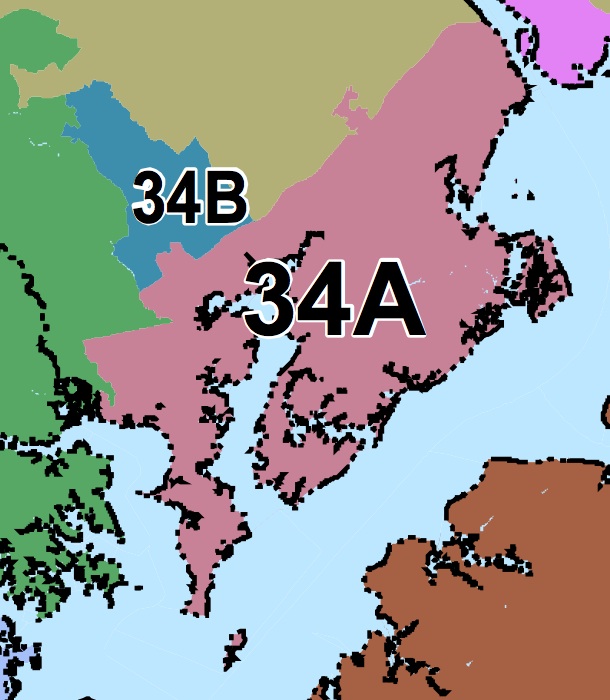
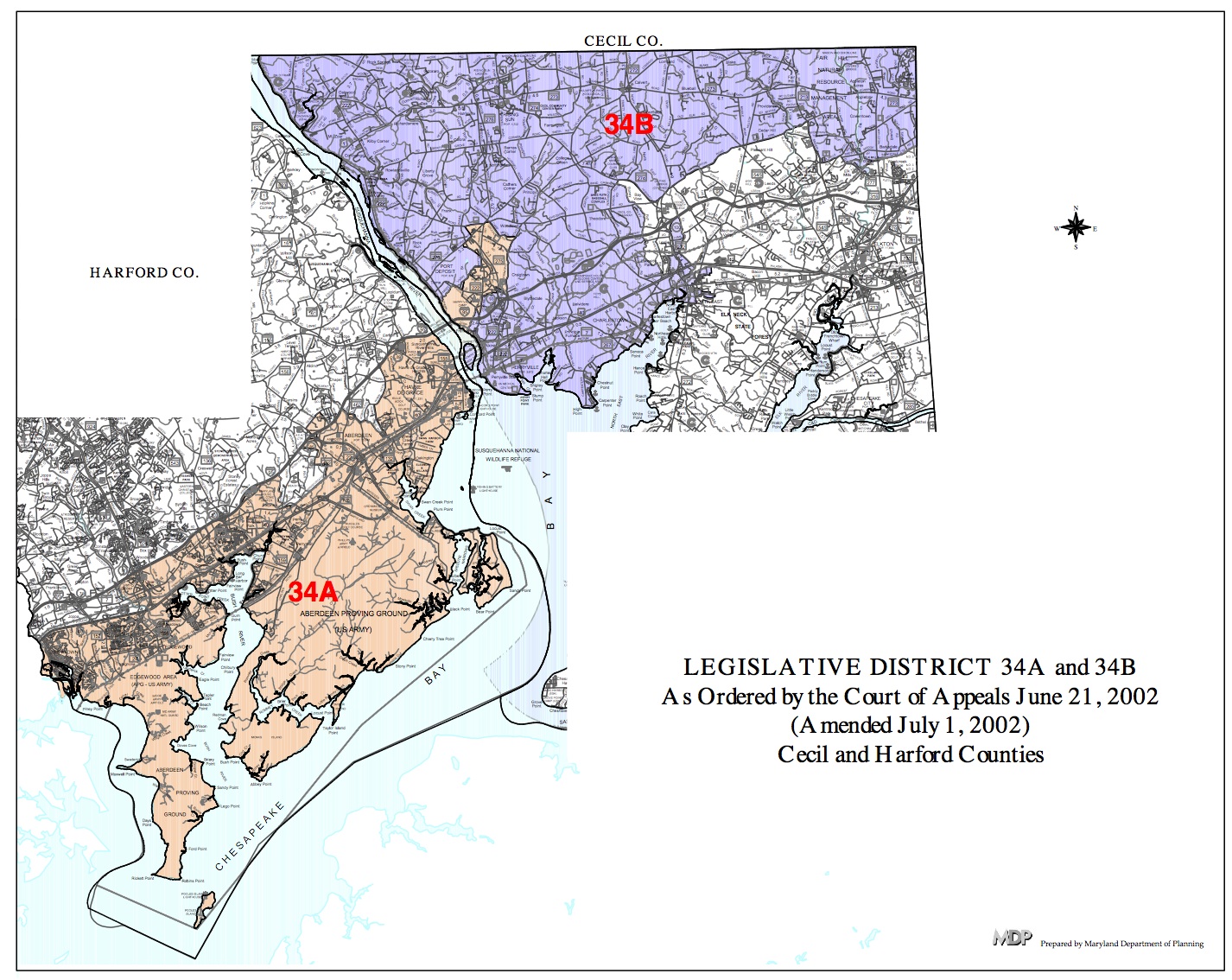
Redistricting greatly altered District 34. Previously, District 34A included south Harford and a tiny piece of Cecil around Manor Heights, and District 34B was north Cecil (see below). The new District 34 (see above) no longer includes any portion of Cecil. Instead, it pairs most of 34A with former District 35B centered on Bel Air in Harford County.

D34Old2010 Senate District 34

The new district has roughly the same partisan balance as the old district. The old District 34A has a slight Republican lean–O’Malley and Ehrlich were in a virtual tie though O’Malley won handily statewide. The old District 34B and District 35B were both carried by Ehrlich over O’Malley by roughly 2-1.

So the overall district has a Republican lean but is as Democratic as possible in Harford. Whoever wins the Democratic primary will still have to fight hard to win the general election. Republican Bob Cassilly is a former Bel Air Mayor and Harford County Councilman who left office in 2006 when called up to serve in Iraq.

However, Cassilly has only $15K in his campaign account–not a sign that the Republicans feel encouraged about the race despite the district’s Republican tilt. It also seems telling that the two Republican delegates filed for reelection rather than for the Senate.

James’ electoral record likely intimidates. In her first general election in 1998, she came in first. In 2002, James came in a close second even as the other Democratic incumbent went down to defeat. She easily outdistanced the rest of the field in both 2006 and 2010. Her willingness to work hard for votes no doubt helps–she claims to have knocked on over 10,000 doors already.

Primary Rating: Likely James.

Share

The Election and the Future–MCDCC Part IV

Check out Part I, Part II, and Part III of this four part series on the contretemps at MCDCC.

The Election

In the June Democratic Primary, voters will choose the new members of the Montgomery County Democratic Central Committee (MCDCC). There are no challengers to the self-named unity slate formed after the serious challenge from labor and the Young Democrats in Districts 17 and 18. But other candidates are running in the remaining districts and for the at-large seats.

Perhaps most interestingly, Brian Anleu is trying to unseat incumbent Arthur Edmonds in District 14. Edmonds has fallen out with the D14 state legislators who consequently support Anleu. Should be one of the more interesting of these invariably little heralded contests for seats on MCDCC.

Two non-slate candidates, Anis Ahmed and Kris Verma, are seeking seats in District 15. Ahmed received no votes when he sought the appointment to the delegate vacancy created by Brian Feldman’s move to the Senate. The City Paper recently ran a long piece with the subtitle “Why did D.C. let a disbarred lawyer serve as a workers’ comp judge?” about Verma.

In District 19, Harold Diamond won as an insurgent candidate in 2010 and is seeking reelection despite his failure to win a slot on the slate. As I explained in Part III, Diamond’s performance on the ballot questions advisory committee left many unhappy:

He had the nice sounding but dreadful in practice idea of populating the committee with essentially anyone who volunteered. Not the best means to recruit a group of volunteers who are particularly sensible, representative, or sensitive to the variety of interests and trends within the party. The meeting of the precinct officials also left several key issues until very late in the evening and Diamond repeatedly tried to steer matters in the direction he favored.

In District 20, Ed Kimmel, an attorney specializing in bankruptcy law and frequent political photographer, did not interview for the slate but has filed for MCDCC. Similarly, Loretta Jean Garcia, a Bethesda attorney, has filed for a District 16 seat.

Three non-slate candidates are seeking at-large seats. Steve Boliek has more money than most MCDCC candidates to support his bid. Natalia Farrar went through the Emerge program that promotes leadership by women. Pavel Sukhobok is the final candidate not on the ticket who has filed for an MCDCC at-large seat.

The Future

So labor spearheaded by MCGEO and the Young Democrats have engineered at least a partial takeover of MCDCC. Now that they have the keys to the car, where will they drive it?

The key problem is that there is a desire to regenerate MCDCC but no clear plan to do so or what it means. There will undoubtedly be degrees of suspicion between old and new members. Almina Khoraiwala is tipped to be the new MCDCC chair and will have her work cut out to establish her authority and a new direction for MCDCC. Fortunately, she’s talented and is as likely as anyone to have the intelligence and focus to achieve these goals.

The new MCDCC’s first steps should be to put one together. It needs to focus less on policy but the less sexy hard work of politics–the precinct organization and GOTV–that is the staple of party organizations. Of course, policy motives are often powerful ways to achieve these goals.

The danger is that many of the new members have expressed interest in policy rather than party building. Will they be ready to roll up their sleeves and not just develop renovation plans but carry them out so that MCDCC becomes a more vital organization? Will they also prove to be the reformers as advertised? Or will they simply serve as the arm of the labor unions?

Change to the membership of MCDCC is coming. Whether it will lead to real change at MCDCC remains to be seen. In other words, I look forward to seeing if they can walk the walk.

Share

Kessler Main Threat to D18 Delegates

kessler

This morning, I profiled the incumbents in the District 18 delegate race. Now, I assess the strength of the four challengers.

CHALLENGERS

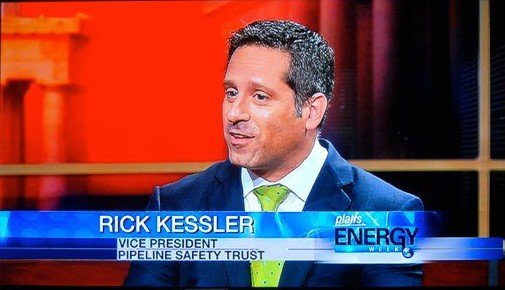
Rick Kessler has $69K in his campaign account after having raised $84K last year. $5K came from people with the Kessler surname. Rick’s donor list reads more national and Capitol Hill than the incumbents, though he has many local donors.

His donors tended to have the opposite profile of Al’s, as many gave larger amounts of $250 or more. Another $6K arrived from PACs, including $4K from Dow Lohnes, a law firm. $1K from Rep. John Dingell’s (D MI) PAC, and $1K from Rep. Frank Pallone’s  (D NJ) PAC. Dingell is a past boss.

Rick strikes me as the greatest threat to the sitting delegates. He has been active in the district for a long time and is well-liked with Central Committee Member Vic Weissberg chairing his campaign. Beyond raising the second-highest sum of all candidates, Rick knows how to run a campaign and will do well at the doors. The sitting delegates will no doubt be unhappy at the thought that he can raise even more money during the legislative session but they can’t.

Elizabeth Matory has $16K left in her campaign account, though she has raised $26K. Relatives account for a little less than one-fifth of all of her donations. Liz has received some support from two in-district local elected officials, Kensington Mayor Fosselman and Kensington Councilmember Paul Sexton.

She has a degree from Columbia, a law degree from Howard, and is completing her MBA at Maryland, and works in nonprofit fundraising. Nevertheless, I suspect that the main problem for this otherwise appealing candidate is a lack of funds. Liz has yet to raise enough to mount a competitive campaign against three incumbents.

Emily Shetty has just $10K in her campaign account. Roughly one-quarter came from people who share her surname. Emily works at the Leukemia and Lymphoma Society with Lisa Fadden, extremely talented, well-liked, and well-connected in Montgomery politics. She also served recently as the Program Director for the MoCo Young Democrats and previously worked as the legislative director for now retired New York Rep. Ed Towns.

Unfortunately for Emily, she is not well-known in the district and does not have the funds to compete. On Facebook, she has been friendly with Rich Madaleno’s opponent but seems reluctant to turn it into a slate, likely because it would close off a lot of avenues not just in this campaign but the future.

Natali Fani-Gonzalez has raised essentially no money–she filed an affidavit attesting to having raised and spent under $1K. A Latina, she filed in the mistaken belief that Ana was not going to run and would support her bid. Natali attends a lot of events but there is no sign of a campaign that would raise her profile among voters.

UPDATE: I have learned once again not to estimate age based on photos (face palm). Natali Fani-Gonzalez may be unhappy not to be described as young (as in the original version of this post) in our youth-oriented culture but she is older than I realized.

Also more successful. Natali is a businesswoman who heads a public relations firm that works for a variety of progressive organizations from unions to promoting healthcare. Perhaps most prominently, she previously worked as a lobbyist for CASA de Maryland on the highly successful push for the MD Dream Act.

She still needs a lot more money that she reported in January if she wishes to run a viable campaign for this seat but also has the resume of a potentially strong candidate.

BOTTOM LINE

Only Rick Kessler seems positioned to have a real shot at toppling an incumbent. The other challengers may influence the outcome by taking votes from this or that candidate but it’s hard to see their path to victory.

Even Rick has a tough road because he has not only to attract votes but also see one incumbent’s votes reduced sufficiently to become endangered. But Rick has key ingredients–an attractive candidate, sufficient funds, and knowledge about how to campaign–to capitalize on opportunities. Rick’s chances will rise if the three incumbents ultimately fail to form a united slate as it would render the situation more fluid.

Share

Maryland Politics Watch