Barve Touts Asian American Support

The following is a press release from the Barve campaign:

ASIAN AMERICAN LEADERS UNITE BEHIND BARVE

Members of Congress, Maryland Leaders Endorse Congressional Campaign

Rockville, November 5, 2015 – Kumar Barve for Congress announced today the endorsement of Asian Congressional and Maryland leaders for his campaign for Congress.

“Kumar Barve is a leader in the innovation and technology sectors and is a proven job creator. He is a fighter for the middle class and working families,” said U.S. Rep. Ami Bera (D-CA). “His family history is the American immigrant success story and I would welcome him as a partner in Congress”.

“The AAPI community is united behind Kumar Barve in Maryland”, stated U.S. Rep. Grace Meng. “Kumar is a fighter for social justice. AAPIs are underrepresented in Congress and Delegate Barve has been a long been a national leader in promoting and protecting the civic and political rights of the Asian American and Pacific Islander communities”.

“Kumar Barve rose through the Montgomery County Public School system to become a groundbreaking leader in our community. His story – from his grandfather’s fight for citizenship to his historic election as the first Indian American state legislator – is our story” said Delegate Aruna Miller, who represents state legislative District 15 which is included with the 8th Congressional District. “Kumar has been a great mentor to those of us who have followed in his path”.

Barve is one the headliners tonight of the Maryland Democratic Party’s Mid-Autumn and Diwali Celebration in Gaithersburg that will gather AAPI leaders throughout the state. AAPIs, comprising about 8-9% of the population, represent a growing and increasingly active community within the 8th District of Maryland. Since his historic election in 1990, Barve has worked to increase the participation of the AAPI community in the civic and political life of their communities.

List of Endorsements
U.S. Rep. Ami Bera (D-CA)
U.S. Rep. Madeline Bordallo (D-GU)
U.S. Rep. Judy Chu (D-CA)
U.S. Rep. Mike Honda (D-CA)
U.S. Rep. Grace Meng (D-NY)
Norman Mineta, former U.S. Secretary of Transportation and Member of Congress
Maryland Delegate Mark Chang
Maryland Delegate Clarence Lam
Maryland Delegate Aruna Miller
Maryland Delegate Kriselda Valderrama
Virginia Delegate Mark Keam
Tufail Ahmad
Alan Cheung, former Member, Montgomery County Board of Education
Ed Chow, former MD Secretary of Veterans Affairs
Suresh Gupta
Rajan Natarajan, former MD Deputy Secretary of State
Farook Sait
Congressional Asian Pacific American Caucus Leadership PAC
Asian American Action Fund

Share

MoCo Doesn’t Need Its Liquor Money

Today, I am pleased to present a guest post by Adam Pagnucco:

Even though MoCo consumers are fleeing the county’s archaic liquor monopoly, county officials are going all out to save it. Their arguments boil down to essentially one point: we need the money, and terrible things will happen unless we get it. The County Executive’s spokesman has said that a reduction in liquor monopoly money “means a reduction of county services or an increase in taxes.” And Council Member Hans Riemer has said that a loss of liquor money would mean “jeopardizing our ability to hire teachers or police officers.”

Are they right? Let’s look at the data.

First, let’s consider the nature of the county’s budget. It is not a static, zero-sum thing. Rather, it is a dynamic and growing thing that increases almost every year. The county deliberately sets property tax rates to increase collections at the rate of inflation (its charter limit) regularly. Income and energy tax collections rise with private-sector growth. State aid, mostly going towards public schools, has been rising. All of these factors have contributed to a steadily growing county budget.

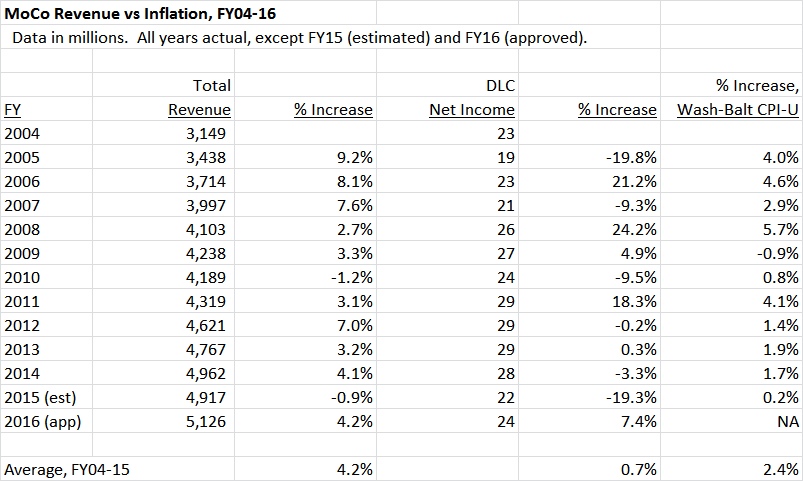
The chart below shows a comparison of total county revenues, net income from the county’s Department of Liquor Control (DLC), and the rate of inflation in the Washington-Baltimore metro area from Fiscal Year 2004 through Fiscal Year 2016.

MoCo Revenue vs Inflation

A few things stand out. First, total revenues grew in ten of these twelve years, with small declines occurring in 2010 and 2015. (Data for the latter year is still an estimate). Second, total revenue has been growing at an average rate (4.2% a year) that is almost double the rate of local price inflation (2.4%). Third, net income from the liquor monopoly is a tiny fraction of the county’s budget and has been largely stagnant. In 2004, liquor money was 0.74% of the county’s budget; in 2016, it is projected to be 0.47%. Part of this is because the county has begun issuing bonds against liquor profits and thus must pay debt service. But another part is that the monopoly is poorly managed. Over this period, the county saw an average annual revenue gain of $25 million from liquor and $140 million from other sources.

That means county revenues would still go up even without liquor monopoly money. There would be no need for cuts.

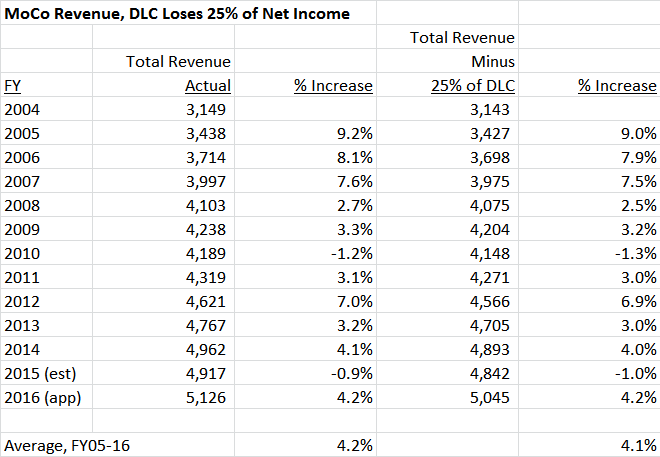
Comptroller Peter Franchot has proposed allowing the private sector to compete with the county’s Department of Liquor Control (DLC). What would happen to county revenues if that were to occur? That depends on how retailers, restaurants and consumers react. Let’s consider what would happen if DLC were well-managed, price competitive and truly focused on customers. Under this scenario, it might lose just 25% of its net income. Here’s how county revenues would have performed since 2004 if that were the case.

DLC loses 25 percent

In the real world, the county’s total revenues grew by an average 4.2% a year. If DLC had lost 25% of its net income, the county’s total revenues would have grown by an average 4.1%. There would be almost no difference to the county’s bottom line.

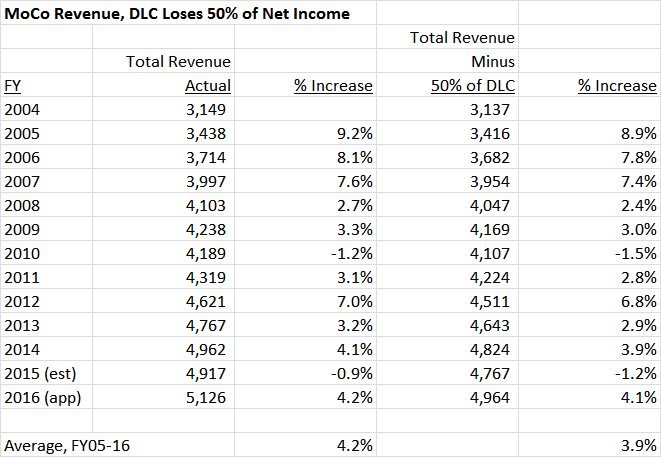
Now let’s suppose that DLC loses 50% of its net income. Here’s how that scenario would have played out.

DLC loses 50 percent

The county’s average annual total revenue growth changes from 4.2% to 3.9%. Again, not much difference.

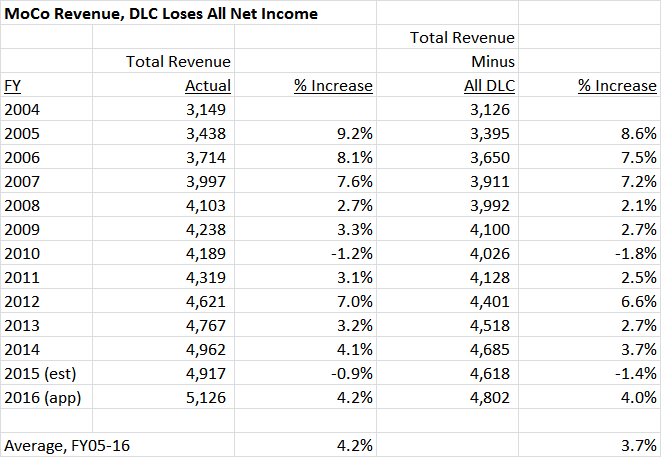
Finally, let’s look at what would have happened had DLC net income disappeared entirely.

DLC loses 100 percent

The county’s annual total revenue growth changes from 4.2% to 3.7%. The latter number is still 55% greater than the average rate of price inflation in the Washington-Baltimore area (2.4%). Furthermore, let’s keep in mind that this scenario would only occur if DLC were so awful that all of its customers fled. If that’s the case, why should DLC be protected by a monopoly at all? And the data above completely omits any extra revenue the county would earn from a revitalized private sector free of the monopoly that it calls “an Evil Empire.” Extra money from property taxes and income taxes could close some of this gap.

This discussion is not exclusively hypothetical. In July, the County Council passed a mid-year savings plan that trimmed $54 million from the budget it had passed only two months before. That amount is more than twice as much as the county earns from its liquor monopoly. Public education and public safety were not jeopardized. That’s because the overall budget provided for a $209 million increase from the prior year’s estimated revenue. County government continues to grow and no apocalypse has occurred.

Finally, consider this. There are more than three thousand counties in the United States. Very few of them have MoCo’s resources. All of them except us have figured out how to pay for their priorities and balance their budgets without needing a liquor monopoly. Are MoCo’s elected officials the only county leaders in the entire United States who can’t figure out how to live without one? I think not; I have seen them deal with much more serious budget problems effectively.

The county government doesn’t need its liquor money. So let’s End the Monopoly.

Share

Election Night Preliminary Results

The results are starting to come in and here are the preliminary results:

Rockville is not reporting vote totals but it looks like a good night for incumbents all around. Mayor Bridget Newton has won reelection, as have Councilmembers Beryl Feinberg, Virginia Onley, and Julie Palakovich Carr. Former Councilmember Mark Pierzchala will also return to the Council, leaving the balance on the Council much the same as before the election.

(Update: The Sentinel is reporting Rockville vote totals on twitter:
Mayor: Newton: 4069, Osdoby: 2182. Council (top 4 elected): Beryl Feinberg: 3,387, Julie Palakovich Carr: 2,947, Mark Pierzchala: 2,755, Virginia Onley: 2,698, Gottfried: 2,416, Schoof: 2,375, Mullican: 2,367, Hill: 2,317, Reed: 2,243.)

Patrick Wojahn has been elected as the new mayor of College Park. Here are the preliminary results (top two elected in each council district):

Mayor: Wojahn 1236, Mitchell 846
District 1: Kabir 698, Nagle 569, Sanders 170.
District 2: Brennan 160, Dennis 135, Conway 68, Blasberg 80
District 3: Stullich 402, Day 386, Belcher 366, Rigg 365, McCeney 38
District 4: Cook 184, Kujawa 163, Hew 130, Gregory 47

In Gaithersburg, Jud Ashman is the new mayor. Here are the preliminary results:

Mayor: Ashman 2380, Maraffa 1003, Bell-Zuccarelli 251
City Council (top three elected): Spiegel 2567, Wu 2498, Harris 2374, Sayles 2094.

Congratulations to Mayors Newton, Wojahn, and Ashman as well as all of the other winners and candidates.

Share

Dems Attack Redistricting Reform Proposal

The following is a press release from the Maryland Democratic Party (you can read my analysis of the partisan impact of the proposals here):

MARYLAND DEMOCRATIC PARTY STATEMENT ON REDISTRICTING REFORM COMMISSION REPORT
Annapolis, MD – Maryland Democratic Party Executive Director Pat Murray released the following statement on the Maryland Redistricting Reform Commission’s recommendations:
   
“Larry Hogan’s hand-picked commissioners received their marching orders on the day they were appointed. The outcome was predetermined by a small group of Republican insiders, the process lacked transparency, and the recommendations are fundamentally flawed.
    
“Congressional districting is a national issue, and it deserves a national solution. Republicans drew the lines in six of the nation’s ten most gerrymandered states and eight of the nation’s ten most gerrymandered districts. If Larry Hogan is serious about reform, he should ask his allies in the GOP-controlled Congress to schedule hearings on legislation to provide a national solution.”
Share

Kurtz on Madaleno

In Center Maryland, see Josh Kurtz’s column about Rich Madaleno’s role as a central opponent of the Hogan administration:

With Hogan riding high in the polls – a circumstance fueled partially by his commitment to cutting taxes, fees and tolls (regardless of the consequences to state government) – Madaleno has become a one-man truth squad. No one in the legislature has so consistently questioned the governor’s policies and the arguments behind them – especially on fiscal matters, where Madaleno, vice chairman of the Budget & Taxation Committee, has a particular expertise. . . .

“It did strike me at the beginning of this term, Hogan ran on a budget and tax platform,” Madaleno says. “I became the vice chair of the Budget & Tax Committee. It just seemed that I was positioned to be able to make the counter-arguments to the governor’s, I think, flawed agenda. So I was happy to step up and push back on what I think are many misrepresentations of what we’ve done over the last eight years.”

Madaleno has been especially vocal about critiquing Hogan’s education spending priorities. When Hogan announced earlier this fall that he was cutting certain fees for state services, Madaleno was quick to try to point out what he saw as the consequences – and take issue with some of the governor’s accounting.

Share

No Wonder Republicans Love the Idea of Redistricting Reform

CompliantThe Governor’s Redistricting Reform Commission has hashed out a set of recommendations for redistricting reform. No doubt Common Cause, the Washington Post, and Gov. Larry Hogan will hail them as major progress toward a fairer redistricting process.

I look forward to reading the detailed, final recommendations but, based on reports in the media, the Democrats would be committing political malpractice to accept them.

According to Maryland Reporter, “The commission will recommend that any new independent commission apply current state standards for legislative districts to congressional redistricting.” As they note, current requirements for state legislative districts include:

  1. Equal populations
  2. Adherence to the Voting Rights Act
  3. Contiguity and compactness
  4. Minimize disruption of political subdivisions.

Congressional plans already have to adhere to the first two requirements as well as create contiguous districts. Compactness and minimizing the disruption of political boundaries would be new. Both would likely hurt Democrats, particularly the command to minimize disruption of political subdivisions.

Consider the above map, which I drew quickly as a plan that might comply with the Commission’s recommendations. The districts are about equal in population and it still contains two districts in which blacks form a majority of the voting-age population.

Due to Maryland’s geography and the need to minimize disruption of County boundaries, it is a virtual certainty that Republican districts would have to be drawn in both Western Maryland and the Eastern Shore.

Unsurprisingly, as indicated in the table below, both would be safe Republican territory. President Obama won just 41% of the vote in each of them in 2012. That one change alone would take the current delegation from 7-1 Democratic to 6-2 Democratic.

CompliantStatsDemocrats are highly concentrated in certain portions of Maryland. That fact combined with the requirement to minimize crossing county and municipal boundaries would make more likely the inclusion of yet a third Republican district. In this plan, the Eighth District (Anne Arundel, Calvert, and St. Mary’s County) would favor Republicans, as President Obama won only 47% of the vote there.

This would take the overall delegation from 7-1 to 5-3–a real victory for Republicans. No doubt advocates for redistricting reform will say that this is very fair, as this would more closely match the partisan division of the state.

Except that parties usually receive a significant bonus in seats when they have as solid an advantage as the Democrats do in Maryland. The current plan has very erose boundaries. But the results are not unusual for states where one party is highly dominant at the federal level, as Massachusetts, Oklahoma and Utah demonstrate.

Democrats might try to force the creation of at least six Democratic districts. However, Republicans would be sure to sue if they could produce a plan that violated fewer county and municipal boundaries while complying with other provisions.

Unilateral Disarmament?

In 2010, Maryland was one of the few states in which Democrats controlled redistricting. Unquestionably, Maryland’s lines squirm around the State–more for incumbency protection than necessary for partisan reasons.

Republicans, however, have zero problem drawing odd lines or using their power to advantage their party when they control the process. In 2012, Democrats won a majority of the U.S. House vote in North Carolina but only won 3 of 13 congressional districts.

If Gov. Hogan could bring the gospel of redistricting reform to more large Republican states, it would be easier for Maryland Democrats to follow. Right now, it is hard to imagine why the Democrats would assent to a reform that assures Republican gains–possibly as many as if they got to draw the lines.

Share

Fundraising in Congressional District 8

Today, I am pleased to present a guest post by Adam Pagnucco:

Money talks and people are talking about money. That’s the vibe in CD8, which could turn out to be the most expensive congressional race in Maryland history. Bethesda Magazine’s Lou Peck and the Washington Post’s Bill Turque have written about the overall numbers and individual donors in the race. Today, I dig deep into the data to reveal more details of the Democratic candidates’ fundraising.

First, the top-line numbers through the third quarter reported by Kathleen Matthews, Senator Jamie Raskin (D-20), Delegate Kumar Barve (D-17), Will Jawando, Delegate Ana Sol Gutierrez (D-18), David Anderson and former Montgomery County Council Member Valerie Ervin (who has withdrawn). Much of this has already been reported and it shows Matthews first, Raskin a close second and Barve third. With almost $3 million raised and more than two quarters to go, this race looks like a record breaker.

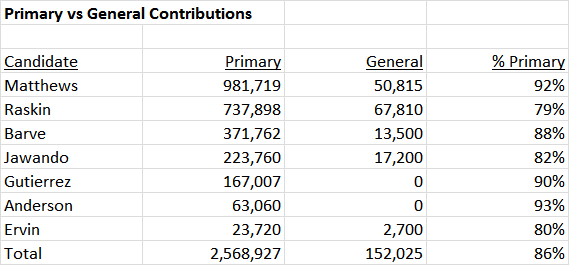
CD8 Top LineUnlike state and county contributions, federal contributions must be designated for the primary or the general. Among primary contributions, Matthews’ lead over Raskin grows slightly.

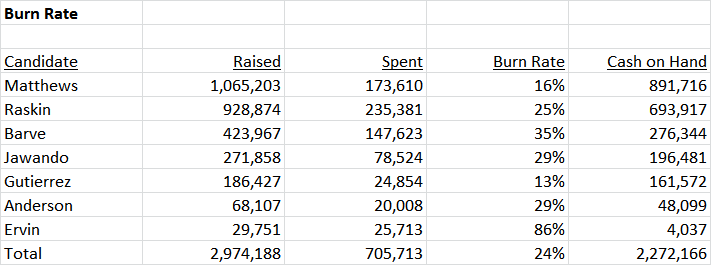
CD8 Primary GeneralBurn rate is the percentage of money raised that has already been spent. Matthews’ burn rate (16%) is far lower than Raskin’s (25%) or Barve’s (35%). That reflects her strategy of saving up for television.

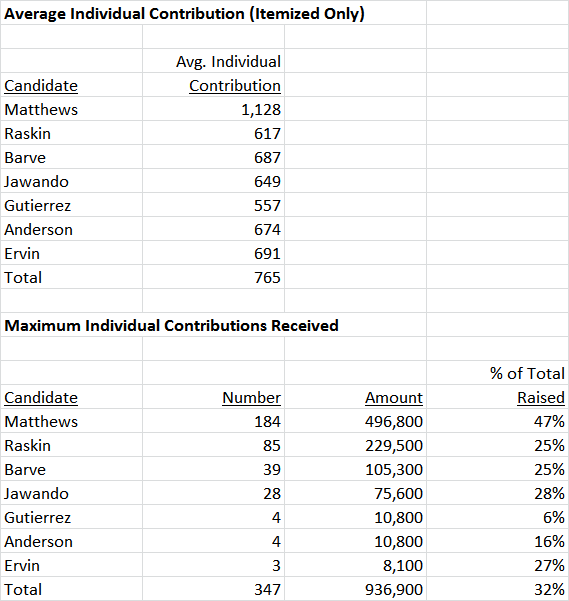
CD8 Burn RateMatthews leads in big contributions. Her average individual contribution is nearly twice the amount of the rest of the field. Almost half of her fundraising has come from maximum individual contributions of $2,700 each. So far, Matthews has received more maximum checks than the rest of the field combined.

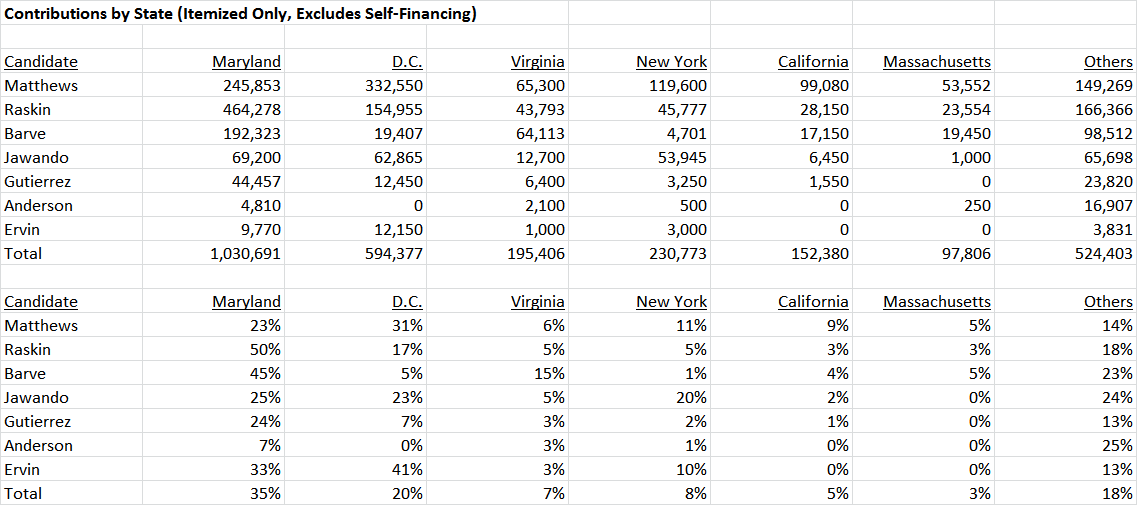
CD8 Avg Individual ContributionWhile Matthews has raised the most money, Raskin has a big edge in money raised in Maryland. In-state contributions have accounted for half of Raskin’s total, much higher than Matthews’ 23%. Barve’s in-state 45% ranks second, though he has raised less than half of Raskin’s total in Maryland.

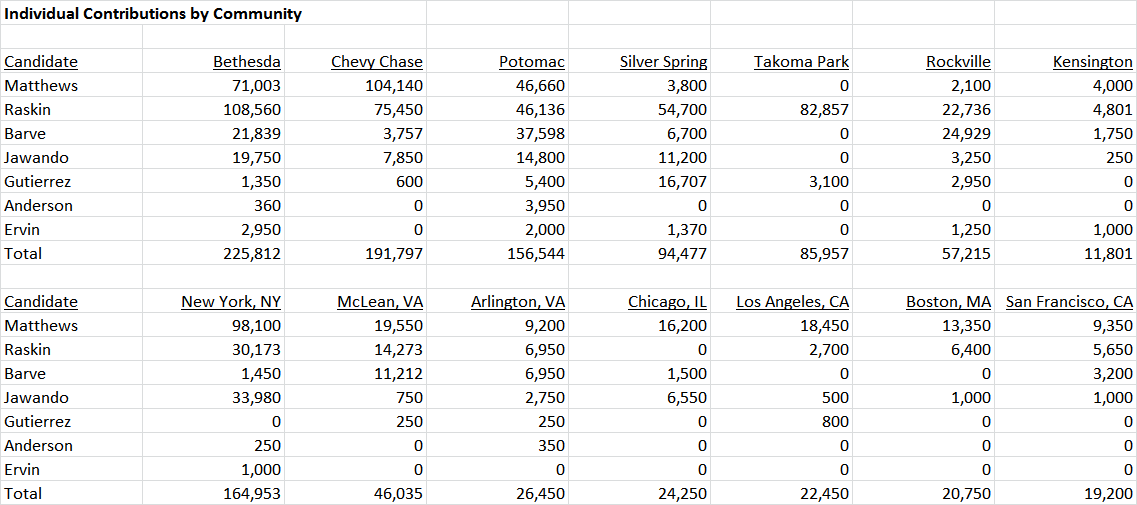
CD8 Contributions by StateHere’s a look at fundraising from individuals in selected communities. The top seven locations are the largest population centers in CD8. Matthews leads in Chevy Chase and (narrowly) in Potomac, but Raskin has the lead in most other places. The bottom seven locations are major sources of contributions outside CD8 and Matthews leads everywhere (including in D.C.). Interestingly, Matthews has raised more money from New York City than from Bethesda. Also, Matthews has raised more money from Los Angeles than from Silver Spring, Takoma Park, Rockville and Kensington combined. That reflects her ability to tap into the Democratic establishment’s national donor network.

CD8 Individual Contributions by CommunityHere are a few takeaways from this data.

  1. Kathleen Matthews’ campaign was predicated on blowing away the rest of the field in fundraising. That is happening with the notable exception of Senator Jamie Raskin, who has so far remained close to her. One factor that could change that is if Matthews’ wealthy supporters open a Super PAC on her behalf. Super PACs are not supposed to coordinate directly with candidate campaigns, but they can raise unlimited contributions and spend them on both positive and negative communication. One can easily imagine twenty Matthews supporters each chipping in $100,000, thereby instantaneously bringing an extra $2 million into the race for their candidate.
  1. Senator Raskin’s strategy of community organizing is paying off big-time for his fundraising. He is leading or nearly tied in fundraising in every populous CD8 community except Chevy Chase and his relatively low average contribution rate leaves plenty of room for repeat contributions. His two biggest challenges are countering Matthews’ likely appeal to women and what happens to his campaign once he has to go back to Annapolis for session next January.
  1. The other candidates are either plainly non-viable or on the verge of getting there because they have not been able to keep up in the money race. That may have been a factor behind the Sierra Club’s endorsement of Senator Raskin. Delegate Barve is the Chair of the House Environment and Transportation Committee and that gives him enormous ability to shape state environmental legislation. He has been a serious player on a wide range of environmental issues that long predates Senator Raskin’s service in the General Assembly. The Sierra Club faced a tough choice between the two candidates from the perspective of policy and record, but they chose to jump in for Raskin. That’s not a knock on Barve, but more likely a judgment that Raskin is a stronger choice to take on Matthews. If more progressive groups make that kind of decision, the race will consolidate into a two-person contest between Matthews and Raskin.

And if that happens, here is the key question that will determine who wins. What will matter more? Senator Raskin’s large, enthusiastic and growing grassroots network? Or Kathleen Matthews’ fundraising prowess, media skills and membership in the electorate’s largest sub-component, white women? Your guess is as good as mine!

Share

Mayor Newton’s Planning Commission Nominee Will Moderate Tonight’s Mayoral Debate

Attorney Don Hadley, who was nominated by Mayor Bridget Newton to the Planning Commission and has been a business associate of her husband, will moderate a debate tonight featuring both mayoral and council candidates being held tonight at the King Farm Community Center. The debate will be telecast live on Rockville’s public television channel starting at 7:30, though there is a live meet-and-greet at 7:00.

Hadley, now the Chair of Rockville’s Planning Commission, served as an agent on a property owned by Newton’s husband.  Unfortunately, the questionable choice of Hadley to moderate tonight’s debate is probably the least of the challenges regarding transparency and the role of developer interests in the the City of Rockville.

It follows past cozy practices. When then-Councilmember Newton nominated Hadley to the Rockville Planning Board in 2010, she did not disclose the business relationship in the public session. but merely said “I think he’ll do a wonderful job,” as shown in the video clip below (click here for the the full session and minutes).

Moreover, Newton’s husband may have benefited from the Council’s decision in 2010 not to consider historic designation for the property at 408 Great Falls Road–the same property development which involved Hadley as well as Newton’s husband.

What happened? The then-owner of 408 Great Falls Road applied to have the property rezoned in a manner more favorable for its development (from R-90 to R-90 HD). Staff recommended that the historic designation for the property, so the city council had to decide whether to initiate the process for public consideration of historic designation. Note that this initial step was not to designate the property as historic but only to start the public process of consideration of the idea.

As is common, the property owner opposed designation and thus did not want the Council to move forward with the public process. At this meeting, after first pushing for the property owner to be given a chance to speak, Newton announced that “I need to recuse myself from this vote” because her husband had “made an offer on the property last Spring. The offer was not accepted. I want to be above board and let you all know that that happened.” (See the video below at 12:58 and click here for the full meeting and minutes).

So far, looks like the action of a good public official. Indeed, one of her colleagues, John Britton, wondered publicly why Newton needed to recuse herself, stating: “I understand your recusal and I guess that’s your personal choice. I understand your interest in the property but it’s a past action with no current interest.” (See the video at 15:19.)

Newton responded by saying that “she wanted to avoid the appearance of impropriety.” This statement and her decision makes Newton appear even more transparent and careful–seemingly avoiding any taint on the the Council decision not vote to pursue historic designation.

Newton’s stated desire to avoid “the appearance of impropriety” renders it all the more surprising when she informed her colleagues that her husband had “recently secured the property under contract. She disclosed this information just nine days after her silence regarding Britton’s assumption that her husband had no ongoing interest in the property.

The people of Rockville may not think any of this a problem. After all, it was water under the bridge when Newton was elected mayor two years ago. Nevertheless, it serves as an example of the powerful role development interests can end up playing in a process in which they have a keen interest–and why true transparency rather than its appearance matters.

In any case, I still wonder why Don Hadley, someone who Bridget Newton nominated to the Planning Commission and has done business with her husband, is thought to be the right choice to moderate the debate tonight including Newton.

Share

Early Voting Glitches

Rockville, like Gaithersburg, is currently conducting early voting for its municipal elections. According to a report I received, the City of Rockville is trying out new election systems for the state. A glitch in the system could influence results for Council candidates.

Apparently, only seven of the nine candidates appear on the first page of Council candidates. In order to vote for either of the two on the second page (Clark Reed or Patrick Schoof), voters have to go to the second screen before competing their ballot. Voters may cast up to four votes for city council members.

These sorts of seemingly minor ballot design issues can have a real impact on elections. Indeed, they were at the center of a dispute over a close congressional race in Sarasota, Florida in 2008.

UPDATE: Watch this demo video for the new machines and it will become clear rapidly why this problem occurs.

Share

Maryland Politics Watch