Franchot Endorses Matthews

From the press release:

“As a proud resident of Maryland’s 8th Congressional District, I am happy to announce my support of my friend, Kathleen Matthews, in her campaign for Congress,” said Peter Franchot.  “Having known Kathleen for many years, I believe she will bring to Congress a fresh perspective, new talent and a sensible approach to the challenges facing our state and country. She is a proven advocate for equality and social justice, and one who is also capable of reaching across the aisle to achieve meaningful results at a time when toxic partisanship has crippled Washington and alienated countless Americans from our political process.”

This is a nice endorsement for Kathleen Matthews. Franchot used to represent the same territory as her leading opponent, Jamie Raskin. He is the probably the most well-known in-state official to endorse Matthews.

Over the years, Franchot has tacked from being seen as one of the stronger progressive leaders to a leading voice for fiscal restraint. This endorsement should help Matthews continue to consolidate support from business and fiscally moderate Democrats.

On the other hand, this endorsement helps set up the primary as one of Jamie Raskin and the progressive wing versus Kathleen Matthews and and more centrist Democrats. As the progressive wing has been increasingly ascendant in Montgomery Democratic primaries, this provides opportunities for Raskin.

Raskin’s current problem, however, is that he will be tied up in Annapolis for the legislative session, while Matthews is free to campaign aggressively. Dels. Kumar Barvé and Ana Sol Gutiérrez, who are also in the mix for this seat, face the same challenge.


Share

Republicans Still Angry Marriage is Legal and Discrimination Against Same-Sex Couples Isn’t

As I pointed out not long ago, Republican Del. Richard Metzger is still on the anti-same-sex marriage hobby horse and sponsoring a bill designed to allow discrimination against same-sex couples under a bogus claim of protecting religious freedom.

Governor Hogan responded weakly, with his office saying that he would wait for the legislative process to proceed. Contrast this lack of backbone to stand up for established law and actual Marylanders with his willingness to oppose Syrian refugees–an issue on which he has zero power. A real profile in courage.

Wrong on the Basic Facts

Red Maryland, however, has not been silent. A pity, as their post contained a real whopper:

2012’s Question 6, which was supported by Maryland Democrats and current Republican Senate candidate Chrys Kefalas, contained not a single provision protecting the religious liberties of any Marylanders.

Has Brian Griffiths read the legislation to which he linked?

Section 2 reads:

SECTION 2. AND BE IT FURTHER ENACTED, That an official of a religious order or body authorized by the rules and customs of that order or body to perform a marriage ceremony may not be required to solemnize or officiate any particular marriage or religious rite of any marriage in violation of the right to free exercise of religion guaranteed by the First Amendment to the United States Constitution and by the Maryland Constitution and Maryland Declaration of Rights. Each religious organization, association, or society has exclusive control over its own theological doctrine, policy teachings, and beliefs regarding who may marry within that faith. An official of a religious order or body authorized to join individuals in marriage under §406(a)(2)(i) of the Family Law Article and who fails or refuses to join individuals in marriage is not subject to any fine or other penalty for the failure or refusal.

Section 3 and Section 4 are also about religious protection:

SECTION 3. AND BE IT FURTHER ENACTED, That:

(a) Notwithstanding any other provision of law, a religious organization, association, or society, or any nonprofit institution or organization operated, supervised, or controlled by a religious organization, association, or society, may not be required to provide services, accommodations, advantages, facilities, goods, or privileges to an individual if the request for the services, accommodations, advantages, facilities, goods, or privileges is related to: (1) the solemnization of a marriage or celebration of a marriage that is in violation of the entity’s religious beliefs; or (2) the promotion of marriage through any social or religious programs or services, in violation of the entity’s religious beliefs, unless State or federal funds are received for that specific program or service.

(b) A refusal by an entity described in subsection (a) of this section, or of any individual who is employed by an entity described in subsection (a) of this section, to provide services, accommodations, advantages, facilities, goods, or privileges in accordance with subsection (a) of this section may not create a civil claim or cause of action or result in any State action to penalize, withhold benefits from, or discriminate against the entity or individual.

Of course, all of these provisions are redundant of the Constitution’s protections of religious freedom but were included to assuage concerns nonetheless. Red Maryland also neglects to mention that marriage equality expanded religious liberty by finally permitting religions that want to conduct legal same-sex marriages to do so. Yep, many religious people are pro-same-sex marriage.

I hope that Red Maryland corrects the record and apologizes to Republican Chrys Kafalas for their inaccurate claim in their slam against him for showing the content of his character by standing up courageously for religious freedom and his own civil liberties. Chrys demonstrated what used to be called leadership in the pre-Trump Republican Party. But I’m not holding my breath.

The Republican Discrimination Agenda

Red Maryland describes Metzger’s bill as follows:

Basically, the law is designed to ensure that religious organizations that have a moral objection to gay marriage don’t have to be forced to participate in one. You would think that this would be a basic common sense idea, that religious individuals would not be forced to officiate or participate in a same-sex marriage.

Not one rabbi, priest, minister, imam etc. has been forced to officiate a single same-sex marriage against their will in any place in the nation. Not one. So let’s put that red herring to bed.

Instead, the bill is designed to protect the likes of Kim Davis, who as a public official has a duty to issue marriage certificates that are now perfectly, but she finds repugnant. Where does this end? Religious beliefs are personal and vary endlessly. Can people like Kim Davis refuse to issue marriage certificates to mixed race couples if it offends their religious beliefs? What about divorced couples? Or to people who have committed adultery?

The idea of not forcing religious individuals to participate in same-sex marriage is equally broad. Should Holy Cross or Adventist Hospital be able to prohibit a same-sex spouse from being with their spouse or making medical decisions if needed on the grounds that it would force a religious organization to “participate in marriage” as described by Brian Griffiths.

This is not a religious freedom agenda. This is an effort to roll back anti-discrimination protections for lesbians and gay than have been established law in this State since 2001 with no problems not withstanding the howls from the right. Red Maryland thinks that the reality of same-sex marriage is a good excuse to change this.

Again, where does it end? If you follow the logic, anyone can discriminate against anyone on religious grounds because religious beliefs are inherently personal. It would be the undoing of all anti-discrimination law, which is the point.

In our daily lives, we all have to rub up and deal with lots of people who live their lives differently than we choose. As it turns out, the people of Maryland and the First Amendment are managing just fine without this legislation. Marylanders understand that it takes all kinds to make a world and are not such special snowflakes that they need protection beyond the boundaries enshrined already in law and the Constitution against the reality of same-sex marriage. After all, they voted for it.

Share

County (Ab)using Liquor Stores for Political Speech

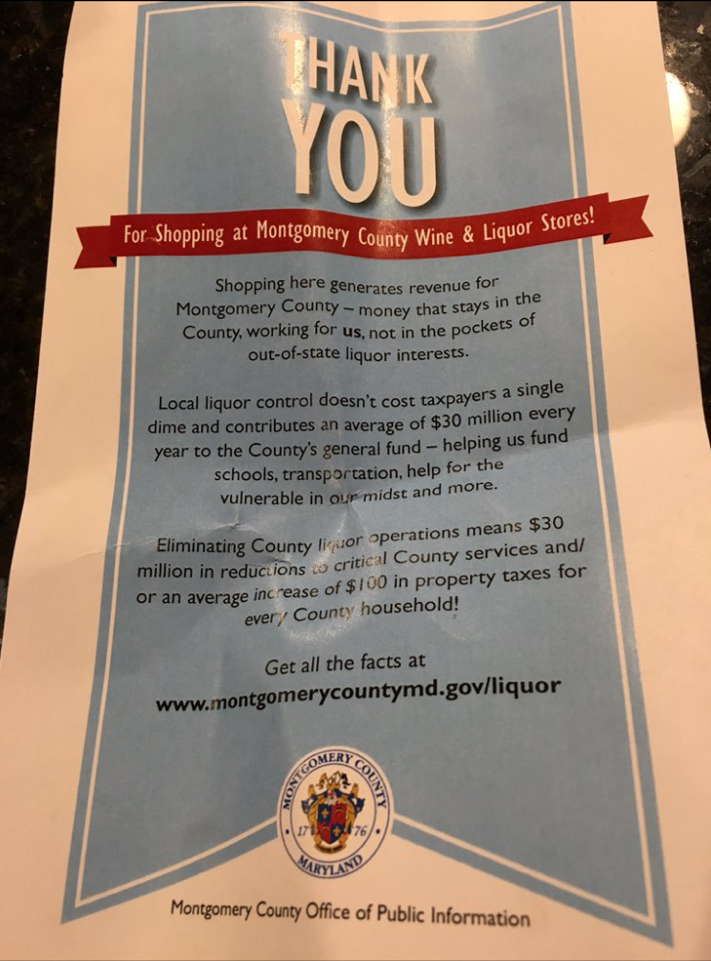
DLC liquor store flyerAdam Pagnucco sent Montgomery County Attorney Marc Hansen the following letter:

Hello, Mr. Hansen.  This is Adam Pagnucco.  I am working with a group of folks who are advocating for Delegate Bill Frick’s legislation to allow competition in the county’s alcohol industry.

I am in receipt of the attached flyer which I understand is being distributed in county liquor stores.  The flyer is unquestionably a political communication and not a commercial advertisement.

As you know, the state’s Court of Special Appeals has ruled that the county “may speak to advance its existing policies and programs, to advocate for policy changes, and to advocate against policy changes.”  http://www.mdcourts.gov/opinions/cosa/2015/0175s14.pdf   However, during the Question B campaign of 2012, the county ran ads for its point of view on Ride On buses and denied the Fraternal Order of Police the same opportunity.  ACLU of Maryland protested that and the county decided to allow FOP ads, but it was too late in the campaign for the ads to appear.  The ACLU wrote, “When the government privileges one side of a political debate in a forum open to private speakers, as Montgomery County is doing here, it engages in viewpoint discrimination clearly prohibited by the First Amendment.”  http://www.aclu-md.org/press_room/82

As the County Attorney, here is my question to you.  If the county is using its facilities to distribute political speech, as it did with the Ride On buses, can county citizens with a different point of view use those same facilities to also distribute political speech?  In other words, can we request that our flyers be distributed along with the county’s flyers?

Adam Pagnucco

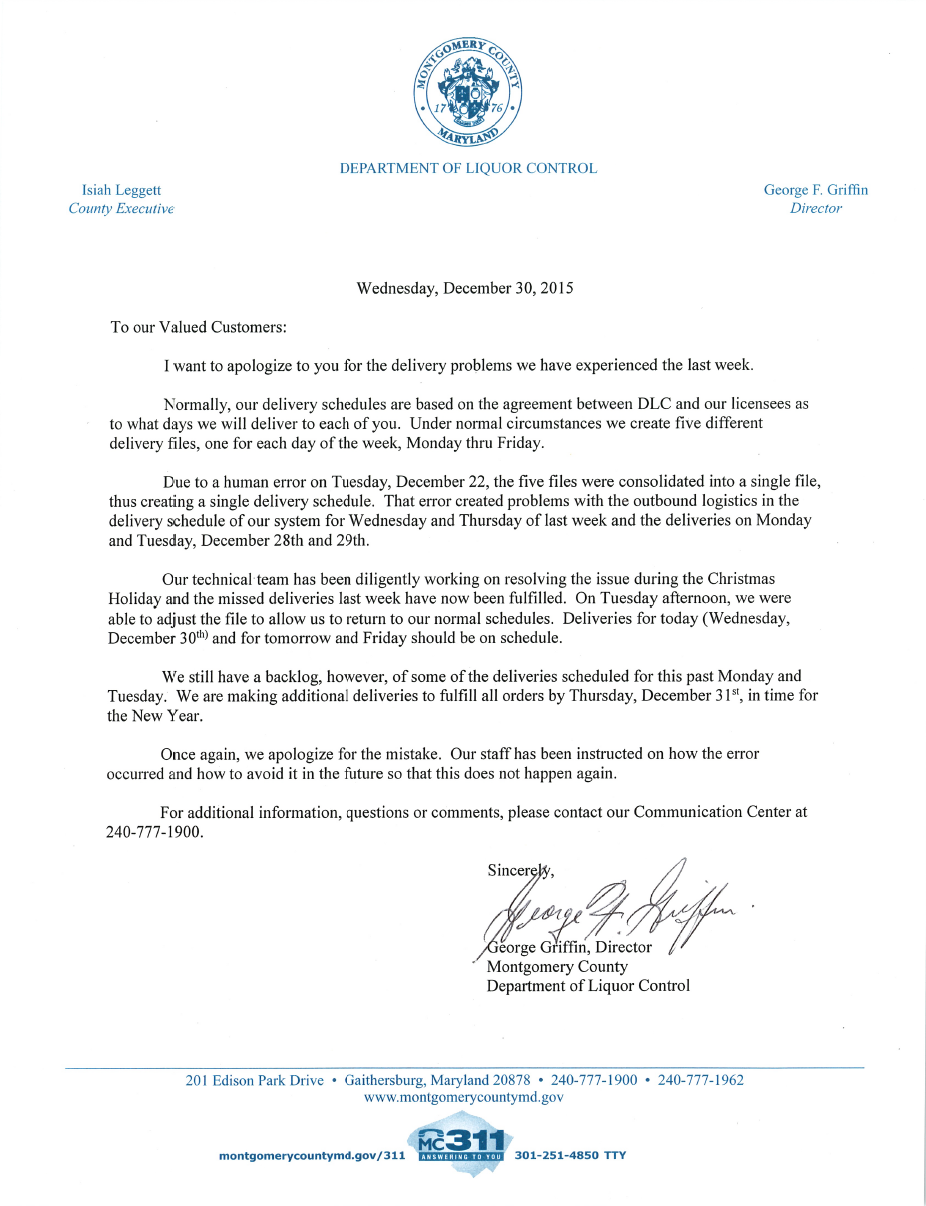
It looks bad that the County has had time to arrange to get these fliers into county owned liquor stores even as the Department of Liquor Control caused a major snafu with delivery screw-ups in the week before New Year’s Eve.

Share

Projected Impact of Congressional Reapportionment in 2020

Maryland

Election Data Services (EDS) has produced its annual projection of seat gains and losses for the U.S. House. As usual, Maryland is not expected to gain or to lose a seat in 2020. The average district will contain just over 783,000 people in Maryland.

We are closer to gaining a ninth seat than to losing our eight seat. According to EDS, Maryland would require 293,188 more people than expected to gain a seat. On the other hand, the Census would need to show 485,502 people than projected to lose a seat.

States Expected to Gain Seats

Arizona +1 (from 9 to 10)
Colorado +1 (from 7 to 8)
Florida +2 (from 27 to 29)
North Carolina +1 (from 13 to 14)
Oregon +1 (from 5 to 6)
Texas +3 (from 36 to 39)

California and Virginia are the nearest other states to gaining a seat. A gain of just 29,302 people would give California the last seat in the U.S. House instead of Florida. Virginia missed gaining one more seat by 69,841 people.

Similarly, the lost of 15,608 people by Florida would cost the Sunshine State its second additional seat. Arizona would gain no new seats if it has 13,741 fewer people than expected.

States Expected to Lose Seats

Alabama -1 (from 7 to 6)
Illinois -1 (from 18 to 17)
Michigan -1 (from 14 to 13)
Minnesota -1 (from 8 to 7)
New York -1 (from 27 to 26)
Ohio -1 (from 16 to 15)
Pennsylvania -1 (from 18 to 17)
Rhode Island -1 (from 2 to 1)
West Virginia -1 (from 3 to 2)

These counts do not include overseas military personnel. In 2000, their inclusion shifted a district from Utah to North Carolina.

Share

Congressional Progressive Action PAC Endorses Raskin

PAP

Sen. Jamie Raskin has just gained a valuable endorsement from the Progressive Action PAC, the political arm of the 72-member Congressional Caucus, in his bid for the Democratic nomination in the Eighth Congressional District.

Why is this good for Jamie Raskin?

Validation. Jamie Raskin has campaigned as the progressive leader in the race. This endorsement provides important validation for his message from national leaders. It’s fine to have have a message but candidates need other leaders to vouch for it.

Spotlight. Other candidates in the race are also trying to position themselves as strong progressives. This endorsement sends the message that Jamie Raskin is the progressive choice. Put more bluntly, progressives should rally around this candidate.

Money. While the Progressive Action PAC will undoubtedly provide some money directly to the campaign, the endorsement is even more useful as a signal to donors. It reinforces the endorsements from other progressive groups and leaders.

Effectiveness. The endorsement makes clear that Jamie Raskin is the candidate with whom other progressives in Congress want to work. The established relationships indicated by the endorsement suggests that he would find more doors already open.

Beyond an Identity Group. Del. Kumar Barve has won support from Asian Americans in Congress while EMILY’s List has gotten behind Kathleen Matthews’ effort. No question that support from these groups is extremely valuable in multiple way. Not having them would send a negative message. But endorsements from issue-based groups allow a candidate to build beyond an identity constituency.

From the press release put out by the Raskin campaign:

SILVER SPRING, MD – Progressive Action PAC, the political arm of the 72-Member Congressional Progressive Caucus, announced today that it has endorsed State Senator Jamie Raskin in his campaign for Congress in Maryland’s 8th District.

“Jamie is a passionate progressive, has a proven record of legislative accomplishment, and has put together an impressive grassroots campaign that engages in serious policy discussion about the critical issues of our time, including gun safety, criminal justice reform, and environmental change,” said Congressman Raul Grijalva, co-chair of the Congressional Progressive Caucus. “I am endorsing Jamie because I know he will be an effective progressive leader for the people of Maryland when he comes to Congress.”

“I’m honored to endorse Jamie Raskin for Congress. He’s not just a progressive activist but a national thought leader and a seasoned legislative actor who gets things done,” said Congressman Keith Ellison, co-chair of the Congressional Progressive Caucus.

“With Jamie Raskin, Maryland Democrats have the chance to send to Congress one of the country’s most effective progressive leaders,” said Congressman Mark Pocan, First Vice-Chair of the Congressional Progressive Caucus. “Whether it is voting rights, campaign finance reform, gun violence prevention, environmental progress or civil rights and liberties, Jamie has delivered time and again as a Maryland State Senator and a respected professor of constitutional law. I’m endorsing Jamie because we need him to stand up in Congress for the American people against big-money special interests and to defend the Constitution and Bill of Rights against the Tea Party.”

The Congressional Progressive Caucus (CPC) is the largest caucus within the House Democratic Caucus and consists of 72 Congressional members. Founded in 1991, the CPC is a diverse and powerful caucus that advocates for a strong progressive agenda. Progressive Action PAC is the political arm of the Congressional Progressive Caucus and endorses candidates for Congress across the country who champion progressive change in America.

“What an honor,” said Senator Raskin. “I want to thank the Progressive Action PAC and Members of the Congressional Progressive Caucus for their support.  I’m inspired and fortified by great leaders like Congressman Grijalva, Ellison and Pocan, and I will work with all the Members of the Congressional Progressive Caucus to go out and elect a Democratic Congress and a progressive agenda.”

Senator Raskin added: “I’m running on a decade-long record of effective progressive leadership in Annapolis. I want to go to Congress take on the NRA to pass common-sense gun reform, to combat climate change and break from the carbon barons, and to address the striking economic and political inequality in America that is eroding the middle class and thwarting opportunity for millions of people.”

Share

Republicans Still on the Anti-Same Sex Marriage Train

Baltimore County Delegate Richard Metzgar (R-6) has pre-filed a bill that would allow discrimination against same-sex couples–or just about any sort of couple–in the name of religious freedom:

The key section of the cookie-cutter legislation is almost identical to a bill that has been filed in Virginia. While in the guise of protecting “religious freedom,” the bill is cast so broadly that it would allow broad discrimination in public accommodations. For example, hospitals operated by religious institutions could refuse to allow husbands or wives of same-sex couples to visit their spouses as a “privilege” related to marriage.

As should be well known, there is no need to pass legislation to protect religious institutions from having to perform marriages they oppose–a widely-respected right protected by the Constitution and Maryland law. Del. Metzgar is either hysterical on this issue or hopes to broaden the right to discriminate against same-sex couples.

Indeed, this extreme legislation would override the state’s law against discrimination in public accommodations, which covered gays and lesbians long before the State legislated same-sex marriage and then upheld it in a referendum. Moreover, it also would allow discrimination against interracial couples on religious grounds, so same-sex couples may be the target but not the only victims.

What Will Hogan Do?

After having opposed same-sex marriage during the referendum, Hogan claimed to have “evolved” and to desire to downplay these issues during the campaign:

“They have no part in this campaign whatsoever,” he said. “We’ve been completely focused on the issues that all Marylanders are focused on right now, and that’s economic issues.”
 After his election, the Governor’s spokesman went even further:

“We’re opposed to discrimination — all forms of discrimination,” Hogan spokesman Matt Clark said Friday regarding the governor’s position.

So now that Hogan is on board with opposition to discrimination against same-sex couples, will he take a strong stand against Metzgar’s bill as unnecessary and divisive? Or will the leading force of the Maryland Republican Party stand silent in the face of continued efforts by members of his party to fight to allow discrimination?

Share

Awaiting the Verdict from Del. Mary Washington

Today, I received the following from Del. Mary Washington (D-43):

Like most of you, I have followed the trial of Officer William Porter with a passion for justice and a deep concern for our city’s future. Now, as we await the jury’s verdict, my thoughts are not only with the family of Freddie Gray but with the thousands of diverse and dedicated people across our city who are working hard to stem the violence that chokes so many of our communities – from the advocates fighting to stop police violence, to those police officers who are struggling to keep our streets safe, to the activists trying to reclaim streets blighted by drugs, decay, and decades of disinvestment.

There is no doubt that this case, and the ones to follow, are historic. But the work and dedication of our city’s citizens are more long-standing than the verdict in any of these cases. Because if and when the jury reaches a verdict for this case, that verdict will represent its judgment on the facts presented in the case against Officer Porter. It will not be a verdict on the character of our city or the justice of our cause or the value of our work.

Whatever the jury finds, we will continue to work to stop racial profiling and excessive force by law enforcement officers– to see to it that our police serve the communities they are sworn to protect and to hold them accountable when they behave more like an aggressive occupation force than the public servants our communities need.

Whatever the jury finds, we will continue to work to make clear that Black Lives Matter – and to stand up to judicial systems, public officials, and entrenched institutions that fail to value the lives and needs of too many of our citizens.

Whatever the jury finds, we will continue to work to change a system of mass incarceration that often warehouses the poor and homeless in terrible jails – and leaves too many city residents trapped in a downward spiral of addiction and incarceration.

Whatever the jury finds, we will work to make the kind of investments in our schools, in drug treatment, in alternatives to incarceration, in job training, in affordable housing, and in community development that can lift neighborhoods decimated by drugs, despair and violence toward a brighter future.

As your State Delegate I will work with city and state leaders during the upcoming session and beyond to make sure that we not only hold law enforcement accountable when they cross the line into violence but hold all our institutions to higher standards in working to bring hope and possibility to our most vulnerable residents.

Whatever the jury finds this week, that unfinished work will continue.

In Partnership,

Mary L. Washington, Member
Maryland House of Delegates, 43rd Legislative District, Baltimore City

Share

MoCo’s Stunted Restaurant Industry

The following is a guest post by Adam Pagnucco:

One of the dimensions to the current debate about Montgomery County’s Department of Liquor Control (DLC) that has not been empirically explored is its impact on the county’s restaurant industry.  Restaurant owners have many complaints about DLC and some have said that entrepreneurs will not open new establishments here because of it.  However, several urban districts in the county have lots of restaurants that seem to be doing just fine.  So what’s going on?

Let’s investigate.

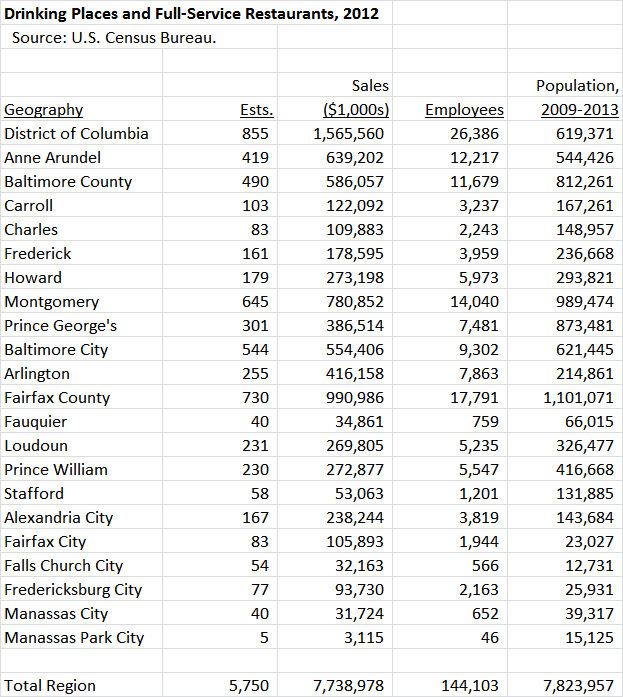
One of the many programs run by the U.S. Census Bureau is the Economic Census, a very detailed look at industries by geography that is updated every five years.  Among the statistics collected by the Economic Census are the number of establishments, the sales of those establishments, and the number of employees.  Below are the combined totals of two industry segments – drinking places (industry code 7224) and full-service restaurants (industry code 722511) – for 22 jurisdictions in the Washington-Baltimore region in 2012.  This data does not include limited service restaurants (like fast food places) that often do not sell alcohol.  Data on drinking places for Fauquier and Stafford Counties and the Cities of Fairfax, Falls Church and Fredericksburg is not available because it does not meet the reporting thresholds established by Census.
Restaurant Stats
MoCo is a significant player in the region’s restaurant industry.  It has 11% of the region’s bars and restaurants, 10% of sales and 10% of employees.  But it also has 13% of the region’s population.  MoCo matters because of its sheer size.  What happens when the restaurant industry’s statistics are presented on a per capita basis?  Using Census population data for the five-year period of 2009-2013, here’s what that looks like.
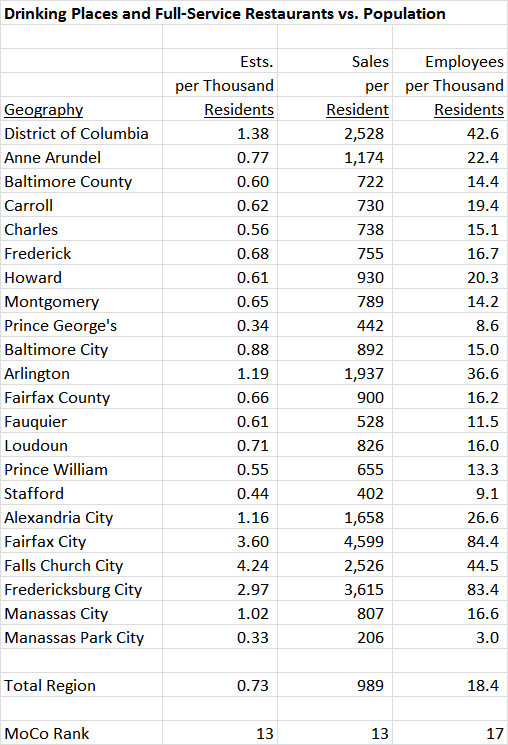
Restaurant Stats per Capita
In terms of establishments per thousand residents, MoCo (at 0.65) is not terribly different from the regional average (0.73).  MoCo’s figure is also close to the two jurisdictions which most resemble it in education and income levels, Fairfax (0.66) and Howard (0.61).  But on the next two measures, MoCo falls short.  MoCo’s restaurant sales per resident ($789) are 20% below the regional average ($989).  They are also below Fairfax ($900), Howard ($930) and Loudoun ($826).  MoCo’s restaurant employment is just as bad.  MoCo’s figure (14.2 restaurant employees per thousand residents) is 23% below the regional average (18.4) and lags most other places in the region, large and small.

Why could this be happening?  It’s not because of low income levels – MoCo does just fine on that measure as do many jurisdictions in the region.  It’s not because of comparative tax burden.  The District of Columbia’s Chief Financial Officer finds that MoCo’s tax burden is not out of line with its neighbors.  Do MoCo residents simply not like going out to eat?  Are we a county of shut-ins?

Frank Shull, the Chief Operating Officer of RW Restaurant Group, which owns several county restaurants, explained why the industry is lagging when he appeared before the County Council last spring.  According to Bethesda Magazine:

A partner in the Robert Wiedmaier Restaurant Group testified Friday that Montgomery County’s Department of Liquor Control (DLC) is “an evil empire to most people in the business.”

In testimony before the County Council’s Ad Hoc Committee on Liquor Control, Frank Shull said poor selection, bad service and high prices keep Washington, D.C., restaurateurs from opening restaurants in the county.

“A majority of good operators in D.C. will not come into the county,” Shull said. “We have this discussion all the time. Restaurants don’t want to because they don’t want to deal with the DLC.”

Jackie Greenbaum, owner of Jackie’s Restaurant and the Quarry House Tavern in Silver Spring, detailed the challenges of dealing with DLC when she signed our petition to End the Monopoly:

I own 2 restaurants in Montgomery County, both well known for the breadth of their beer, wine and liquor lists. The difficulty in creating and maintaining these lists because of the county controlled system is extraordinary. It adds hours of unnecessary labor to my payroll costs, diminishes the quality of my beverage programs through the inconsistency of stock, unavailability of products and errors in delivery, and drives up the cost of the products we sell–which must either be absorbed by us (therefore diminishing our profits) or passed on to the consumer resulting in higher menu prices. This system causes all but the most intrepid restaurant owners to dumb down their offerings because it’s far far easier and ensures Montgomery County will never compete with DC in terms of the quality and creativity of its restaurants.

What would happen if MoCo’s restaurant industry were average in size relative to its population?  In other words, how big would the industry be if it had 0.73 establishments per thousand residents, $989 in sales per resident and 18.4 employees per thousand residents, which are the averages for the Washington-Baltimore region?  Extrapolating from the data above, the county would have 82 more restaurants, $198 million more in sales and 4,184 more employees.  All of this would create more tax revenue for both the county and the state.

How do we get there?  Let’s be honest and acknowledge that there could be many factors governing the size of the county’s restaurant industry and DLC is just one of them.  But in the opinion of the folks who actually run restaurants, DLC is an important impediment to their doing business.  The County Council has proposed reform, but in the opinion of the two largest alcohol distributors in the state, it won’t work and they won’t participate.

Restaurants are not just businesses.  They are critical cultural assets.  People decide where to live in part because of the abundance and quality of food options.  This industry is a large part of our quality of life.  By unleashing its spirit of entrepreneurship, we enrich all of society.  So how do we do that?

Here’s one way.  End the Monopoly.

Share

Maryland Politics Watch