David Trone is a Major Republican Donor

David Trone is jumping into the race for the Democratic nomination for the Eighth Congressional District. He calls himself a “strong Democrat” but will have to explain quickly his major heavy donations to Republican candidates.

Trone Donated Far More to Republicans Than Democrats in State Elections

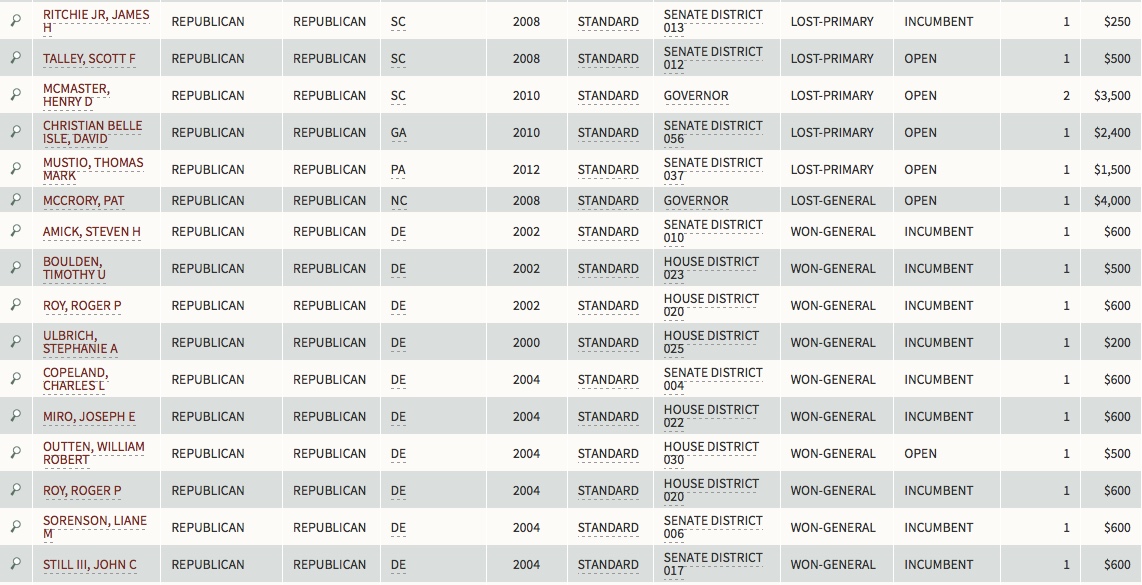
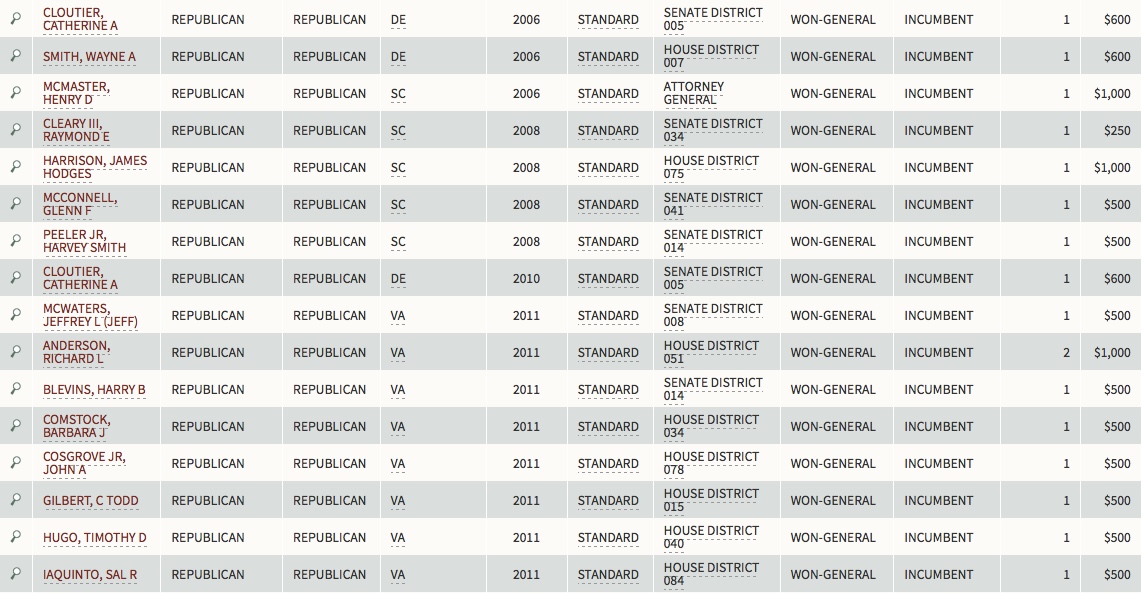
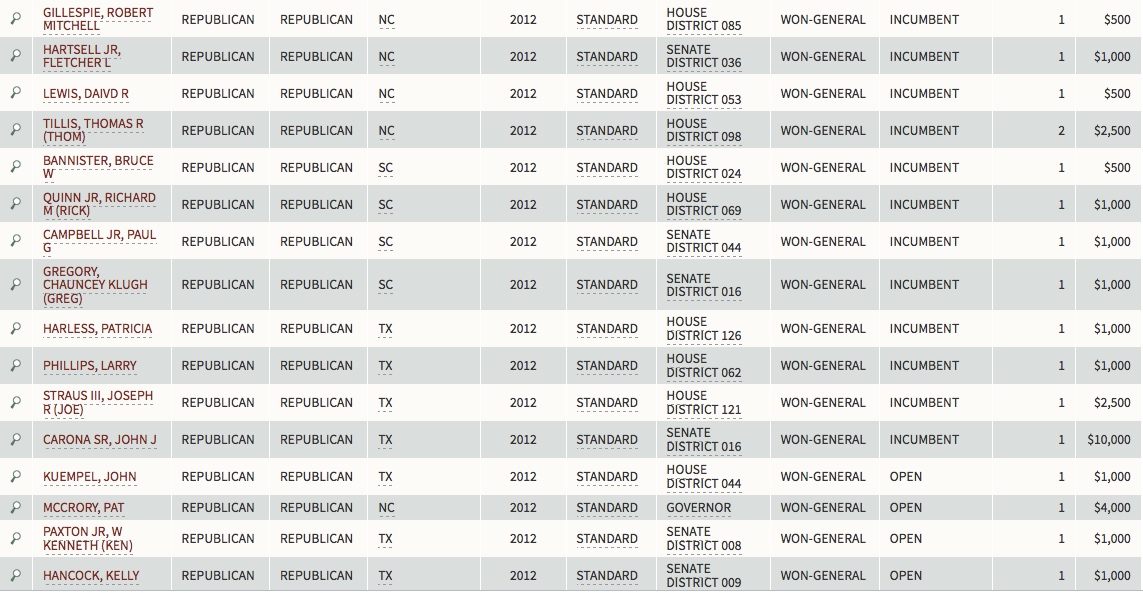
Trone has donated far more to Republicans than Democrats in state contests. According to followthemoney.org, he gave $161,016 to Republican candidates since 2000 (see below). That compares to just $94,113, or 29%, to Democrats and $37,850 to unidentified candidates. Interestingly, all $26,500 of his donations in Maryland were to Democrats.

Trone has donated to right-wing conservatives, including:

  • $8,941 to Texas Gov. Greg Abbott.
  • $15,000 to Texas Lt. Gov. Dan Patrick.
  • $2,500 to Thom Tillis, North Carolina U.S. Senator and former Speaker of the North Carolina House.
  • $8,000 to North Carolina Gov. Pat McCrory.
  • $4,500 to Henry McMaster, South Carolina Lt. Governor and former Attorney General and State Senator.

More Democratic in Federal and Other Donations

The Center for Responsive Politics reports that the direction of Trone’s federal donations has been quite different–lopsidedly in favor of Democrats. Since 1990, Trone has given $55,050 to Democratic candidates, including the maximum legal donation of $2,700 to Martin O’Malley’s presidential campaign. He also donated $1,000 to Republican William Gormley’s in support of his unsuccessful  2000 U.S. Senate bid in New Jersey.

Trone’s has also made thousands of dollars in donations to state parties, legislative caucuses, and PACs. Like his federal donations, these have listed more in the Democratic direction, though he donated $2,975 to the Senate Republican Caucuses in South Carolina and Virginia.

Bottom Line

David Trone has given a lot of money to a variety of staunch conservatives. While self-funding his own campaign, he has also funded many Republican campaigns. Kathleen Matthews can argue her $2,600 donation to conservative Republican Sen. Roy Blunt was a one off. But this record shows a pattern of giving large sums to Republicans over many years.

Trone Has Donated to These Republicans

Trone R Donations1 Trone R Donations2 Trone R Donations3 Trone R Donations4 Trone R Donations5 Trone R Donations6

Share

David Trone Jumps into Eighth Congressional District Race

Bethesda Beat has the story:

Saying that he had been thinking about running for Congress since he was in his 20s, David Trone, the 60-year old co-owner of Bethesda-based Total Wine & More, is jumping into the race for the Democratic nomination in the 8th Congressional District—and is planning to use his considerable wealth to self-fund his campaign.

We’ll have more on Trone in the morning.

Share

Snowzilla Communication Breakdown

Thanks to Adam Pagnucco for this guest post:

Snowzilla has turned out to be a historic storm. Every local jurisdiction from the City of Baltimore to Northern Virginia has struggled to recover from it, and Montgomery County is no exception. While MoCo residents complain about the pace of snow removal, with and without justification, there is no evidence that the county has performed worse than comparable jurisdictions. But one area in which it has fallen short is communicating with its residents.

Most residents have one question on their minds: when can I escape from my neighborhood? Let’s be fair: during a mega-event like Snowzilla, that’s a really hard question to answer. The county is coordinating a large fleet of employees and contractors, as well as working with other agencies like the state, Metro, Park and Planning and MCPS. A great deal of the equipment being used is not GPS-enabled. The most honest answer is also the least satisfactory: we don’t know.

The county chose to rely on its snow removal map to deal with resident questions. The county’s Department of Transportation repeatedly directed residents to the map on Twitter.

MCDOT map tweet 1-23 MCDOT map tweet 1-25The problem is that the map wasn’t showing any useful information. Below is an image of the map as of Tuesday, January 26. The map shows that every county street in Glenmont, Wheaton and unincorporated Kensington was “in progress.” It showed similar information all over the county. That’s physically impossible. The county doesn’t have enough equipment to be everywhere at once and residents know that.

Snowmap 1-26-2016Faced with a non-functioning map, residents overwhelmed MC 311. Some called only to hear a recording. Even if they got through, no answers were available. Again, the county simply didn’t know when individual neighborhoods would be cleared, even though they claimed the map would say so.

Meanwhile, municipalities appeared to be doing a better job. Consider the Facebook posts of Gaithersburg Mayor Jud Ashman. On Saturday, January 23, the Mayor reported that all city streets had received a first pass. He then reported that all streets would receive a second pass the following morning. This is a period during which county plows had not reached neighborhood streets at all. Residents of unincorporated areas, for which the county has responsibility, have friends in municipalities and were aware of their performance. This only increased their frustrations.

Jud first pass Jud second passCouncil Member Hans Riemer (my former employer) nailed it in a post on Facebook. Noting his work on securing funding for an upgraded snow map and planning for pedestrian mobility during snow storms, he wrote: “Better communications technology would save our residents a lot of anxiety during snow events, and enable them to more adequately plan for their work and family lives. If technology answered more questions, it would also take pressure off of our 311 call center, which has been completely overwhelmed by the volume of calls they’ve received during this storm.” And he’s absolutely right.

Hans snowSnowzilla was a gigantic storm and public employees across the region deserve tremendous credit for their recovery efforts. But MoCo had a communication breakdown that made a stressful event worse. Here’s hoping that Council Member Riemer and his colleagues can help the county prepare to do better next time.

Share

MSEA Decries Hogan’s Effort to Shift Public Dollars to Private Schools

msea

The following is from MSEA’s press release:

MSEA Statement on Gov. Hogan’s 2016 Education Proposals

Proposed BOAST Program Would Divert Taxpayer Dollars From Public Schools to Private Schools

Annapolis, Maryland — This morning, Gov. Hogan’s office released details on his 2016 proposals for education initiatives, including the same BOAST legislation he unsuccessfully introduced last year. Betty Weller, president of the Maryland State Education Association, made the following statement:

“If Gov. Hogan’s goal is to make sure every student has the opportunity to succeed, BOAST (now called the Maryland Education Credit by private school advocates) should have been the last option on his list. It’s a voucher-like scheme designed to move tens of millions of taxpayer dollars from public schools into private schools. Not only does it create new tax breaks for corporations, it would only help students who can already afford to attend private school. It would do nothing for low-income students except make it harder to fund their public schools.

“BOAST is opposed by nearly 60% of Maryland voters—including a plurality of Republicans—at a time when Marylanders believe their public schools need more funding, not less. Support for private school education is a distraction from the larger education issues at hand, like reducing standardized testing, closing opportunity gaps, and increasing public school funding.

“Educators look forward to working with legislators to reject this proposal—and a similar $5 million giveaway proposed in the governor’s budget—and advance effective solutions that truly improve our public schools.”

Share

How a Trone Race Could Help Matthews

The following is a guest post by Adam Pagnucco:

As first reported by David Lublin and followed by Bethesda Magazine and the Washington Post, Total Wine Co-Founder David Trone is considering a run in the Eighth Congressional District. The conventional wisdom seems to be that a Trone candidacy would hurt Kathleen Matthews. Bethesda Magazine’s Lou Peck writes:

At first blush, it would appear that a Trone candidacy could be a political blow to Matthews, who—despite a lack of prior political involvement in the 8th District—has become a top-tier candidate thanks to a fundraising base that has drawn big-name contributors from Washington well as from several other major cities across the country. (Among the recent donors to Matthews: Robert Trone, also a Potomac resident, who gave her the maximum $2,700 contribution last June.)

While Matthews has sought to emphasize her prior background as a local TV news reporter and anchor, her tenure at Marriott over the past decade has given her a base of business backing that Trone could cut into. And Trone’s ability to self-fund a campaign could neutralize Matthews’ large campaign warchest, accumulated since last summer thanks to her network of contacts and those of her husband, MSNBC talk show host Chris Matthews.

The Post’s Bill Turque writes:

Should Trone decide to run, it would not be good news for Matthews, who is courting the kind of business community support that Trone could also claim. Trone would also likely diminish Matthews’s fundraising advantage (more than $1 million through Sept. 30), which she has accumulated through the network of corporate and political contacts developed in tandem with her husband Chris Matthews, host of MSNBC’s “Hardball.”

Lou Peck and Bill Turque are both great reporters, but I disagree with the opinions of their sources. If Trone gets in, it could actually help Matthews win the race. Here’s why.

1. The business community has money, but they don’t have a lot of loyal voters – especially in Montgomery County Democratic primaries. My hunch is that Matthews already has raised enough money to put on a competitive campaign. We will find out in a few days when the end-of-year finance reports come in. And her nationwide Democratic fundraising network, bolstered by her famous and well-connected husband, goes far outside the business community. As for Trone, he doesn’t need to compete with Matthews for money because he can self-finance.

2. If Trone gets in, that means Matthews would be the only woman running a competitive campaign against three men–Trone, Sen. Jamie Raskin and Del. Kumar Barve. Del. Ana Sol Gutierrez has so far not raised enough money to be a top-tier contender.  (I am sorry for saying that, Ana!)  There are many examples in recent MoCo political history of female candidates doing well against men, either one-on-one or facing groups of men. They include:

Cheryl Kagan, 2014: Kagan, a former Delegate, was significantly outspent by incumbent Delegate Lou Simmons in the open seat primary for the District 17 Senate seat.  Kagan won by ten points.

Ariana Kelly, 2010: Kelly was the only female challenger in a jam-packed primary for an open District 16 Delegate seat.  Fellow challenger Kyle Lierman spent almost twice as much as Kelly, but she picked up the Apple Ballot and won a tight contest.

Ariana Kelly, 2014: Challengers Marc Korman and Hrant Jamgochian each spent significantly more than Kelly as they battled it out for an open seat.  Kelly was the only woman who ran a viable campaign and she finished first in the primary by nearly a thousand votes.

Sheila Hixson, 2014: The long-time incumbent faced a scrum of challengers for two open Delegate seats, one of whom self-financed over $400,000.  But Hixson, the only female candidate, smoked everyone and had a margin of more than 2,000 votes over the second-place finisher.

Nancy Floreen, 2010 and 2014: In 2010, Floreen competed with two other top-tier female candidates, fellow incumbent Duchy Trachtenberg and Becky Wagner, and finished third in the council at-large primary.  In 2014, Floreen was the only female at-large incumbent and had just one viable female challenger, Beth Daly.  This time Floreen finished second, her best result ever.

Yes, there are mitigating circumstances in all of the above races and women don’t always win.  In 2014, female challengers took on popular male incumbents in Council District 1 and Senate District 18 and lost badly. But there is definitely a pattern here for open seats and multiple seat races, because:

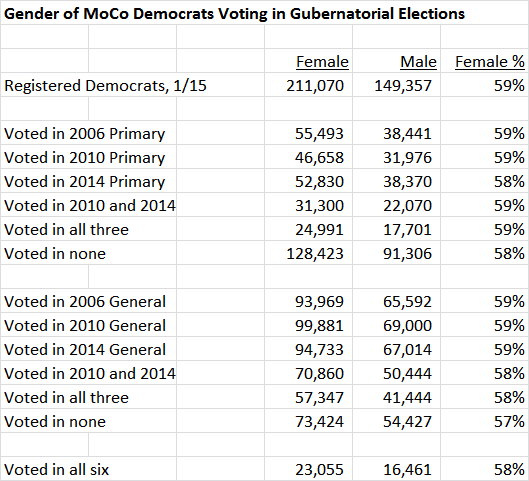
3. Women are majorities of Democratic voters, no matter how you slice the data. Below are extracts from Montgomery County’s voter registration file as of January 2015. First, let’s look at MoCo Democratic voters in gubernatorial elections.
Gender GubernatorialNext, let’s look at MoCo Democratic voters in presidential elections.
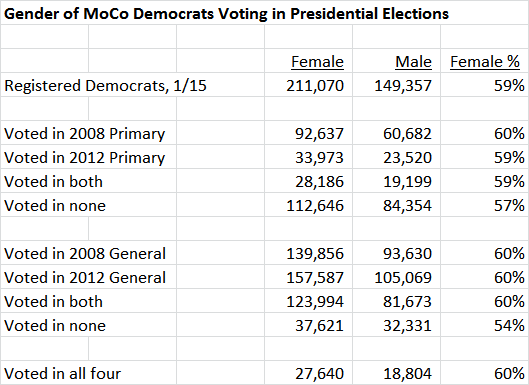
Gender PresidentialWomen are majorities in every single category of MoCo Democrats.  When just one woman is running a competitive campaign against two or three competitive men, that matters.  It also matters that Hillary Clinton is on the ballot and the possible departure of Donna Edwards from Congress could create an all-male federal delegation from Maryland.

All of these things bode well for Kathleen Matthews.  If I were in her camp, I would say, “Mister Trone, welcome to the race.”

Share

Will David Trone Take the Plunge?

Washington Post Reporter Bill Turque has confirmed that David Trone is “mulling” a bid for Congress. The news that Trone had a poll in the field testing messages about himself and two opponents was “first reported” here at the Seventh State.

Turque’s report concurs with my assessment that a Trone run “might cut more” into Kathleen Matthews’ support:

Should Trone decide to run, it would not be good news for Matthews, who is courting the kind of business community support that Trone could also claim. Trone would also likely diminish Matthews’ fundraising advantage (more than $1 million through Sept. 30), which she has accumulated through the network of corporate and political contacts developed in tandem with her husband Chris Matthews, host of MSNBC’s “Hardball.”

Indeed, several think Trone is considering the plunge precisely because of concerns regarding Matthews:

 Some District 8 political insiders speculate that Trone is weighing the race because private sector leaders are not confident that Matthews, also a political novice, can beat Raskin, a popular incumbent state lawmaker from Takoma Park[.]

Trone is wealthier than Matthews, so he would be able to spend even more money on his own campaign. Other than that, I don’t know why Trone would be a better candidate than Matthews, who brings oodles of media and public relations experience to her campaign.

Women compose a disproportionate share of the Democratic primary electorate, so Matthews might have the advantage there as well. Matthews is one of two women in the race along with Del. Ana Sol Gutiérrez (D-18).

No doubt Trone’s poll may provide some private illumination to help him assess his chances. The filing deadline is February 3rd, so we’ll know if Trone is in or out within eight days.

Share

Hogan Throws Commerce Secretary Under the Bus

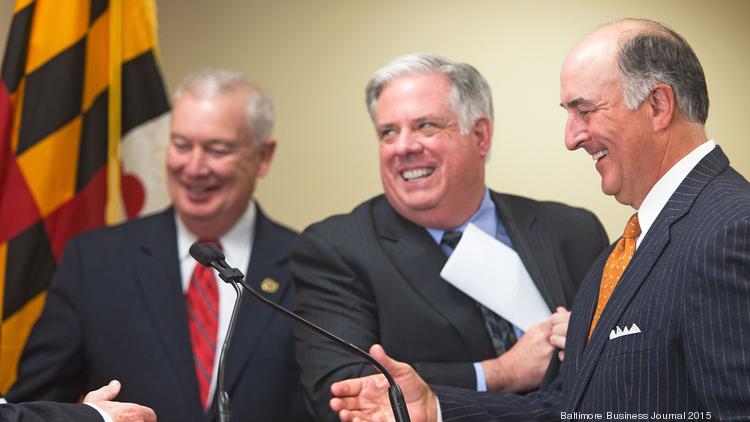
gill with hoganNo longer all smiles between Governor Larry Hogan (center) and Secretary of Commerce Michael Gill (right)

From the Daily Record:

A proposal to create a tax incentive for manufacturers to relocate to Maryland represents a change of course for at least some in Gov. Larry Hogan’s administration.

The governor’s announcement earlier this month reverses a position expressed less than a year ago when Michael Gill, Hogan’s recently appointed secretary of what is now the state Department of Commerce, penned a letter urging lawmakers to focus on existing manufacturing in the state.

But late Friday, after The Daily Record posted online a story referencing Gill’s letter, a Hogan spokesman said the governor was unaware of the letter and that it was not authorized.

“It does not represent the views of the governor,” said Douglass Mayer. “The governor has been a long-time supporter of Governor [Andrew] Cuomo’s effort and program in New York.”

In the words of Cool Hand Luke, “what we’ve got here is a failure to communicate.”

I hope to have more assessment of this tax proposal shortly and look forward to hearing from the Governor what he plans to cut in the budget to fund this proposal. Sen. Roger Manno (D-19) had already planned to introduce a similar idea this session.

Share

Select Trone Family Donations

TronesFurman’s President presents a symbolic key to the new Trone Student Center to David, June, and Robert Trone who donated $3.5 million

David Trone’s decision to conduct a poll made it known unintentionally that he is thinking about becoming a late entry into the race for the Democratic nomination in the Eighth District. Trone is 60, lives in Potomac. He has voted in every election since 2006 except for the 2010 and 2010 primaries.

Along with his younger brother, Robert, he owns Total Wine, a major retail outlet for alcoholic beverages based in Montgomery County. This successful chain known for its excellent prices operates stores in a variety of states but cannot open one in Montgomery due to limitations placed by the State and the County liquor monopoly.

The Trone family is quite active in giving money to a range of causes and politicians, including many beyond those detailed here. David Trone recently donated $15 million to the ACLU to reduce the prison population and help ex-convicts get jobs:

David Trone, of Potomac, cited Total Wine’s support of the “ban the box” movement — which seeks removal of the criminal-record check box from job applications — as a factor in his gift and an example of what private-sector partners can accomplish.

“Yes, people make mistakes,” he said. “But if they paid the price and now want to build a better life, why should that mistake have to carry with them the rest of their lives?”

Previously, David Trone and his wife, June, have donated over $1 million to the ACLU. June has also contributed to Republicans, including Mitt Romney and the RNC.

Interestingly, on June 9th of last year, Robert Trone made a $2,700 contribution to Kathleen Matthews, who is already running hard for the Democratic nomination in the Eighth.

Share

Adam Pagnucco: Outside the Statehouse, Franchot is King

The following is a guest post by Adam Pagnucco:

Senate President Mike Miller and Comptroller Peter Franchot have renewed their decade-long feud, to the delight of journalists, bloggers and pundits alike. Whether it’s about slots, tax collection issues, Baltimore County public school air conditioners or just the joy of a good barroom brawl, the Miller-Franchot war sometimes abates but never ends. Speculation pops up every couple of years that the Senate President will find a challenger to take the Comptroller out. After all, Miller is arguably the most powerful non-Governor in Maryland history and the statehouse is his domain. But outside the statehouse, Franchot is King.

Why do I say that? Consider the following.

1. Statewide Results

Below are the vote totals and percentages of major party candidates for Governor, Comptroller and Attorney General for the last two general elections. (Attorney General Doug Gansler, who had no opponent in 2010, is omitted.) Franchot’s results are the best in the field. In fact, to find statewide politicians who regularly matched or exceeded his margins, you would have to go back more than a decade to the days of William Donald Schaefer, Louie Goldstein and Joe Curran.

Franchot Top Statewide Vote Getters

2. County Results

Lieutenant Governor Anthony Brown was the ultimate creation of the state Democratic establishment. And Franchot? Well… let’s just say he’s not. Below is a comparison of the votes obtained by the two in every county in the 2014 general election. Franchot received more votes than Brown in every local jurisdiction, including Brown’s home base of Prince George’s. In the big three liberal jurisdictions (Montgomery, Baltimore City and Prince George’s), the vote totals for Brown and Franchot were similar, suggesting that loyal Democrats supported both of them. Franchot’s edge came from the rest of the state. He received at least 50% more votes than Brown in 15 of 24 counties, including the critical swing jurisdictions of Baltimore County and Anne Arundel. Brown carried just four jurisdictions against Larry Hogan – Prince George’s, Baltimore City, Montgomery and Charles. Franchot carried all of them in the general election, plus Anne Arundel, Baltimore County, Dorchester, Howard, Kent and Talbot. Tell me again why Franchot should fear the establishment?

Franchot County Results

3. Legislative Districts and Sub-District Results

The State Board of Elections has data on the performance of Franchot, Brown and Hogan for every one of Maryland’s 67 legislative districts and sub-districts. (The state has 47 Senate districts but many of them are carved up into smaller sub-districts for Delegates.) This further illuminates the electoral dominance of Franchot over Brown.

Franchot received more votes than Brown in 63 of the 67 districts. All four in which Brown did better were in Prince George’s. Franchot received more votes than either Brown OR Hogan in 32 districts – nearly half of them. Franchot’s occasional deviations from progressive orthodoxy didn’t hurt him in liberal Montgomery or Baltimore City, as he out-polled Brown in every district either entirely or partially within their boundaries.

In the following nine districts, Franchot received more than twice as many votes as Brown.

Franchot Brown DistrictsThese districts go from moderately red to deep red. They are represented by a combined 8 Republican Senators, 21 Republican Delegates and 1 Democratic Senator – Baltimore County’s renegade blue dog, Jim Brochin. In many of these places, liberal Democrats are considered alien life forms. But Franchot has a following here.

Perhaps the most interesting of these districts is Dundalk-based District 6. Dundalk is a fabled ancestral home of white, blue-collar, unionized Democrats, but it has been trending to the GOP. In 2014, Hogan defeated Brown here with 76% of the vote. Democratic Delegate John Olszewski Jr. lost the Senate race to unknown Republican Johnny Ray Salling, who raised just $15,429. The district’s three Delegate seats flipped from all Democratic to all Republican – and it wasn’t close. A Republican succeeded Olszewski’s father in Dundalk’s County Council seat with 62% of the vote. Baltimore County Executive Kevin Kamenetz lost the fifteen Dundalk precincts to an obscure, underfinanced Republican by a 59-41% margin. Attorney General Brian Frosh lost to a no-name Republican here by 53-41%. But Franchot won the district 52-48.

I know what you’re thinking: Franchot had a weak opponent. Sure. But 2014 was a year in which seemingly weak Republicans had great success. They knocked out numerous Democratic incumbents, including prominent ones like Olszewski, Senator Roy Dyson, Delegates John Bohanan, David Rudolph and Norm Conway, and Wicomico County Executive Rick Pollitt. They came close to defeating Brochin and Senator Ron Young. The ultimate no-name Republican was Larry Hogan, a man who had never served in public office, had no starting name recognition and had to draw on public financing to compete with the MUCH better funded Anthony Brown. Remember when Brown referred to the general election as “a little bit of a mole hill?” But Hogan won in the best year in recent memory for “weak” Republicans. Amid all this tumult, Franchot increased his win margin in the general election by two points over 2010.

Here is the key question: could it be that Franchot’s socially liberal, fiscally moderate stance combines the best of Hogan and Brown and has made him Maryland’s most popular state-level Democrat? Maryland voters approved gay marriage and the Dream Act in 2012, and according to a recent Washington Post poll, support many liberal priorities. But they elected an openly anti-tax Governor and, according to the above poll, rank the economy and taxes as their second and third issue priorities. (Education is number one.) This mix of liberalism and moderation fits Franchot’s issue profile better than any other prominent Maryland politician.

Democrats should ponder all of this as they prepare to campaign against Hogan in 2018.

Share

MCDCC Taps Zucker for Senate

zuckerCraig Zucker

The Montgomery County Democratic Central Committee (MCDCC) voted 25-2-1 to nominate Del. Craig Zucker to fill the vacancy caused by the retirement of Sen. Karen Montgomery. Central Committee Members Venattia Vann and Loretta Garcia voted instead for former Del. Herman Taylor. MCDCC Vice Chair Arthur Edmunds, who lives in District 14, abstained.

Once Gov. Larry Hogan formally appoints Zucker, MCDCC will once again have to fill a vacancy, this time in the House of Delegates. The current delegation is supporting Central Committee Member Pam Queen for that spot. Herman Taylor left open the possibility of seeking the seat when I spoke to him prior Zucker’s appointment.

Craig Zucker may well become the first person ever to vote to override the Governor’s veto in both chambers of the General Assembly. Earlier this week, he joined with the House majority to overturn the veto of the bill to restore the voting rights of ex-felons. The Senate has delayed the override vote until after the Governor fills the District 14 vacancy. Of course, all of this is perfectly legal and ethical but will make for an interesting bit of political history.

Congratulations to Craig Zucker. He already represents the same people in the House of Delegates so his set of constituents will remain the same. Former Del. Herman Taylor may not have won support from MCDCC but merits thanks for putting himself forward as well as his past work in the House of Delegates.

Share

Maryland Politics Watch