Metro Ridership Down Another 5% Last Year–Now at 2004 Levels

metro ridership

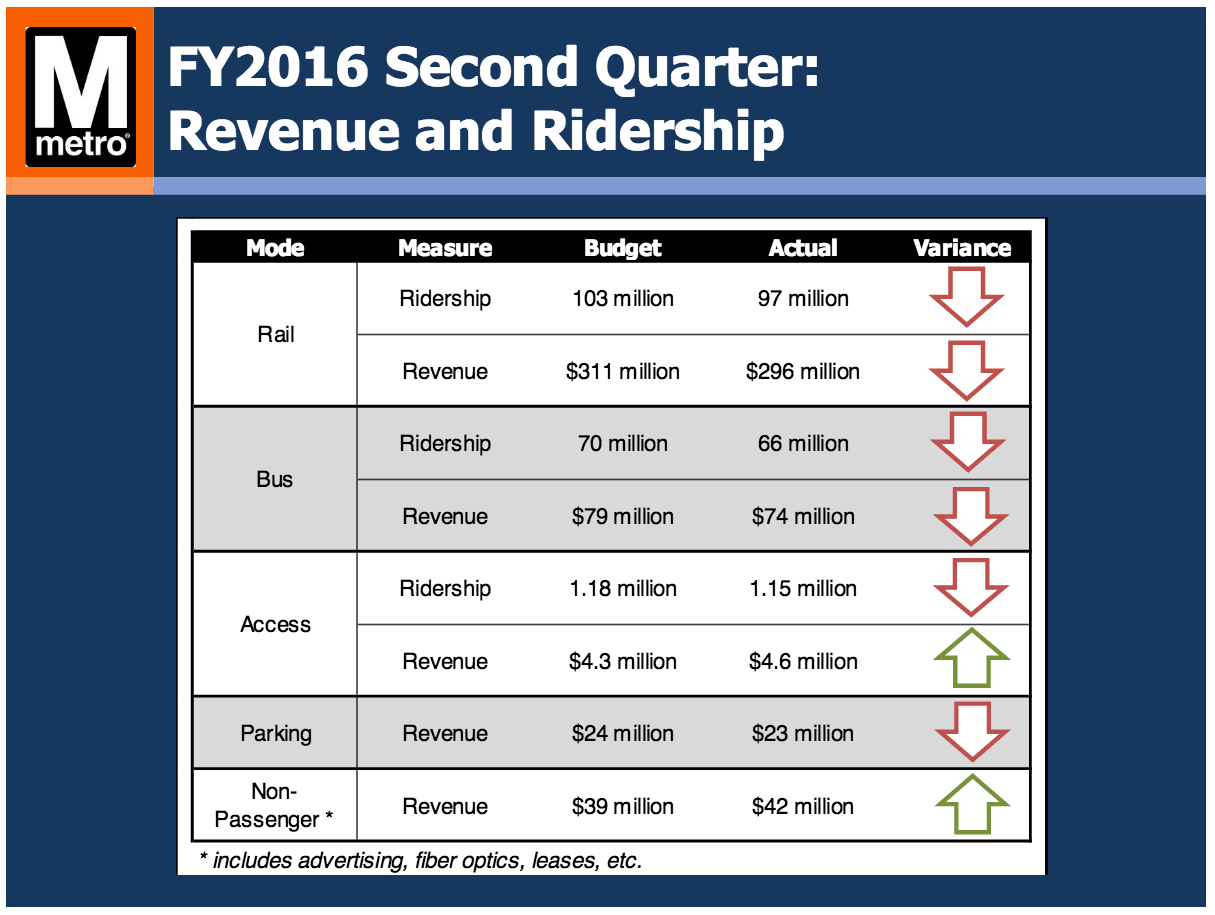
Metro ridership is down 5% over last year. As Metro did not project this decline, this means that Metro faces a substantial budget shortfall of $15 million from the decline in rail revenue and $5 million in bus revenue. Yet, Metro plans to add another 59 employees to the system.

If it raises fares, ridership will decline even further. Metro also needs to spend money on the rail system, as its reliability still seemingly continues to decline on a near daily basis. People don’t want to ride a system that is undependable.

Bringing it home to Maryland, it would be interesting to know how many few people are boarding or alighting at Maryland Metro stops. Additionally, how does the steady decline in ridership affect the projections for Purple Line ridership, as many of its passengers are expected to change to the Red or Orange Lines?

boardings

Share

Does Making Registration Easier Cause More Voting?

Today, I am pleased to present a guest post from Adam Pagnucco:

In this year’s session of the General Assembly, Democrats will be introducing legislation providing for automatic registration of voters.  While the details vary between proposals, the concept is that state agencies would proactively “forward to election officials data about anyone who meets the age, residency and citizenship criteria to vote.”  Individuals would be allowed to opt out if they wish.  Democrats clearly believe this would increase the number of voters who support their party.  Republicans also believe that since they are openly opposing the idea.

Are they right?  Would more registration lead to more voting?

The State of Maryland has taken many steps to make registering and voting easier, including early voting (2010), online registration (2012) and expansion of early voting from six to eight days (2013).  Same day registration during early voting will be in effect for the first time in 2016.  The state has also offered applicants for driver’s licenses the opportunity to register as voters in conformance with federal law since 1995.

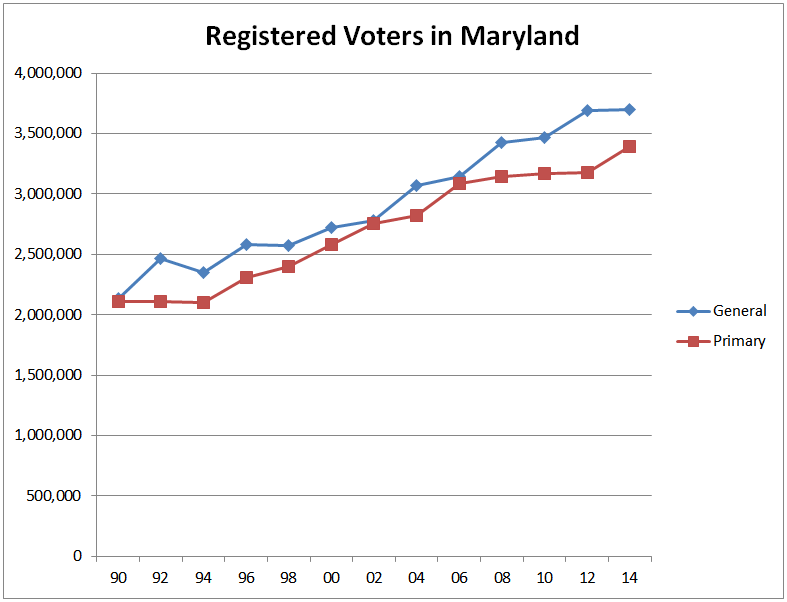
Maryland has seen steady increases in voter registration over the years.  The graph below shows statewide registered voters in both primary and general elections since 1990.  While there are slight variations in individual cycles, registration has gone up by about 4-5% every two years.

Voter Registrations graph

Has that resulted in more voting?  Much has been made of declining turnout in the past, and there is something to that: the turnout rate has fallen from 61% in the 1994 general election to 47% in 2014.  It has also declined from 81% in the 1992 general election to 74% in 2012.  But looking at the turnout rate alone can be misleading.  If the number of actual voters increases at a slower rate than the number of registered voters, the turnout rate can fall even if actual voting rises.  In fact, if more aggressive voter registration outreach brings in voters who are less likely to vote, that is exactly what could happen.  The test here is whether actual voting is going up along with registration.

First, let’s look at primaries.  The graph below shows the total number of primary election voters in Maryland since the 1990 elections.  These elections are very sensitive to the circumstances of offices on the ballot.  At the gubernatorial level, primary voting peaked in 1994, 2002 and 2006.  The former two years saw open Governor seats while the latter saw a rare competitive U.S. Senate race.  Primary voting tanked in 1990 and 1998, when incumbent Democrat Governors were running for second terms.  At the presidential level, primary voting surged in 2008 when Barack Obama was in a competitive race with Hillary Clinton.  Primary voting fell dramatically in years when an incumbent President was on the ballot (1996, 2004 and 2012).  These candidate dynamics overwhelmed any effects of increasing registrations.

Primary Voting graph

General elections see much steadier patterns of voting.  The graph below shows the total number of general election voters in Maryland since the 1990 elections.  The absolute number of voters in both gubernatorial generals and presidential generals has been rising steadily since the 1990s – with the notable exception of a divergence in the 2010-2014 period.  Presidential voting has gone up every year since 1996, but gubernatorial voting went down between 2010 and 2014.  This is the same period during which early voting (2010), online registration (2012) and an increase in early voting days (2013) were implemented.

General Voting graph

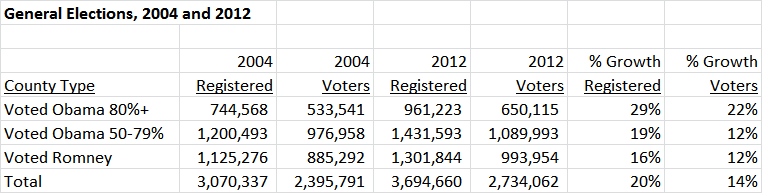
Let’s look at this presidential vs. gubernatorial split more closely.  The popularity of President Barack Obama may be a factor in increasing the number of voters in recent presidential elections.  Obama gained 62% of the vote in Maryland in both 2008 and 2012 and his approval rating in Maryland has been above 50% for most of his time in office.  The chart below shows changes in registrations and voting for each Maryland jurisdiction between the 2004 and 2012 general elections.  The two counties that gave Obama more than 80% of their vote in 2012 – Baltimore City and Prince George’s County – saw increases in both registrations and the number of actual voters greatly exceeding state averages.  Counties opposing Obama saw rises in registration and voting too, but not nearly as much.

Presidential Voting chart

The gubernatorial elections tell a very different story.  The chart below shows changes in registrations and voting for each Maryland jurisdiction between the 2010 and 2014 general elections.  Statewide, registrations were up by 7% while the number of voters fell by 7%.  But voting behavior differed between counties supporting Larry Hogan and those supporting Anthony Brown.  In the ten jurisdictions that gave Hogan 70% or more of their vote, the actual number of voters fell by 3%.  In the four jurisdictions that supported Brown, the actual number of voters fell by 8%.  Registrations rose by 7% for both groups.

Gubernatorial Voting chart

Increased registration has coincided with more voting in presidential elections and less voting in the 2014 gubernatorial election.  Why is that happening?  Here’s a theory: voters have access to much more information about presidential candidates than state or local candidates and are therefore more likely to vote for the former.  In fact, state and local candidates target voters with long histories of regular voting with their mail and field programs while they ignore voters with sparse histories – including new voters.  Declining local media coverage of state and local races reinforces this information gap.  So the registration efforts of Democrats through legislation and party activities may help fortify the margins of presidential candidates and federal candidates running in presidential years, but they did not help the party in 2014.  Not only did the Democratic nominee for Governor lose, but the Republicans picked up a record number of seats in the House of Delegates, captured the Howard County Executive seat and almost knocked off Congressman John Delaney – all while voter registration was rising.

There’s nothing wrong with making voter registration more convenient.  But given the above, there is little evidence to suggest that Democrats at the state and local level will significantly benefit from it.  There is also little evidence that Republicans should fear it.

Share

Sebastian Johnson Announces Wave of Endorsements

Former Student Board of Education Member Sebastian Johnson is  seeking an at-large seat in the 2016.

Advantages and Challenges

Johnson’s strongest asset is his impressive resume. After graduating from Montgomery Blair, Johnson received his B.A. in Economics and Government from Georgetown and a Master’s in Public Policy from Harvard’s Kennedy School. Johnson has already worked with kids in the classroom as a teacher and in the community. He’s done a lot at a young age.

Johnson’s biggest campaign challenge is that he is not an MCPS parent. As a result, he doesn’t have experience with MCPS from that perspective. Nor does he have links to the PTA network that often produces successful Board of Education candidates.

Endorsements

Today, his campaign was pleased to announce endorsements from seven elected officials:

Maryland State Delegate David Moon (D-20)
Maryland State Delegate Marice Morales (D-19) Maryland State Delegate Will Smith (D-20)
Montgomery County Councilman George Leventhal (D-AL) Montgomery County Councilmember Nancy Navarro (D-4)
Takoma Park Mayor Kate Stewart
Somerset Mayor Jeffrey Slavin

Some of the positive comments from elected officials included:

Nancy Navarro: I had the privilege of serving on the Board of Education with Sebastian, and I witnessed his steadfast dedication to public service. He has a keen understanding of the current issues facing our school system, and he brings a fresh perspective to the Board table. I am proud to endorse his candidacy.

George Leventhal: I’m very excited by the prospect of Sebastian returning to the Board of Education, where he served as student member. Sebastian’s life story embodies the success that we seek for all students. I wholeheartedly support his candidacy.

Kate Stewart: As mayor, an advocate for young people and a parent, I trust Sebastian to do what’s right for all of our kids. As a product of Montgomery County schools, he brings a keen insight to the challenges we face today. I can’t think of a better person to serve on the Board of Education, and I strongly endorse his candidacy.

Share

Federal Employees in CD4 and CD8

Today, I am pleased to present a guest post from Adam Pagnucco:

Candidates in both Congressional Districts 4 and 8 are targeting predictable Democratic Party constituencies like women, liberals, environmentalists, African Americans and Latinos for votes. That’s standard operating procedure in most Democratic primaries. But because of the geographic peculiarity of the two districts, there’s another constituency that could play a major role in deciding the election: federal employees.

Because Montgomery and Prince George’s Counties border the District of Columbia, they have countless thousands of residents who commute to federal jobs downtown every day. The two counties also have numerous large federal employers of their own, including the National Institutes of Health, Andrews Air Force Base, the Census Bureau, NASA, the Food and Drug Administration, the Department of Health and Human Services, Walter Reed, NOAA and more. Prince George’s is making a strong bid to host the FBI. Anne Arundel County, which has part of CD4, is home to Fort Meade and the Naval Academy.

According to the U.S. Bureau of Labor Statistics and the U.S. Bureau of Economic Analysis, federal employers constitute about ten percent of each county’s employment and personal income.

Federal Employees MoCo PG

But this counts only federal establishments located within each county; it does not count residents who commute outside their boundaries. It also doesn’t count contractors who depend on federal clients or the various industries surrounding the federal government, like lobbying, consulting and legal services. One private sector economic firm estimates that 52% of the Washington area’s total job base is tied in one way or another to the federal government. Regardless of the statistics, it’s reasonable to assume that both CD4 and CD8 have tens of thousands of residents who either work directly for the federal government or who have family or friends who do so. It’s also reasonable to assume that they vote, particularly in Democratic primaries.

One thing that can be said about this group is that they are under stress. Consider recent events pertaining to federal employees.

Salary

While many federal employees are represented by unions, their pay levels are set by federal law and not by collective bargaining. Federal pay was frozen during the 2011-2013 period and rose by 1% in 2014, 1% in 2015 and 1.3% in 2016. Accounting for local area price inflation, federal employee pay fell by 7% in real dollars between 2010 and 2015.

Parental Leave

Federal employees do not have paid parental leave. When they have children, they must either use accumulated sick leave and vacation time or accept unpaid leave. When Sens. Barbara Mikulski and Brian Schatz (D-HI) introduced a bill to provide paid leave last year, Schatz noted, “While private companies are beginning to see the benefits of providing paid family leave, America is still the only industrial nation in the world without a program that gives working parents the time off and income they need to care for a new child.” President Obama provided for paid leave in his latest budget, but congressional Republicans are ignoring it.

Sequester and Shutdown

The rise of a Tea Party Congress led to a spending sequester and a government shutdown in 2013. Shutdowns were barely avoided in September and December of 2015. The sequester has chilled not merely the federal government but the entire regional economy for years.

Budget Uncertainty

Congress’s growing reliance on continuing resolutions and last-minute budgetary showdowns have played havoc with department budgets and make it harder for federal employees to do their jobs. One federal manager commented, “What people don’t realize is that once the budget is approved, it takes time for the money to trickle down to agencies. For example, managers in my agency still don’t have the ability to spend their budgets without getting approval for everything from a contract to a stapler. And we don’t have a firm estimate of when we will be able to spend freely.” Training and travel are often adversely affected.

Retirements and Turnover

Led by Baby Boomers, an exodus of federal employees is underway. Turnover among young workers is also considerable. This puts pressure on those who remain. One federal lawyer commented, “I see that all around me – so many young lawyers that were in my office when I started 5 years ago are gone. Sure, some are leaving because they get fed up with bureaucracy, or want to move onto something else, but being a pawn and/or punching bag of Congress doesn’t help. And the advantages of working in the private or non-profit sector for attorneys can be huge in terms of schedule flexibility (non-profit sector, including universities) or salary/benefits (private sector).”

Republicans in Congress

Make no mistake: Congressional Republicans are targeting federal employees. Last year, the House and Senate each proposed budgets that went after the federal workforce. According to the Sun, “While details of the House and Senate versions of the budget differ, both chambers have approved slashing the size of the federal workforce by 10 percent through attrition, increasing the contribution workers make toward their retirement savings and cutting the share of health insurance covered by the government.” Months later, Senate Republicans floated a plan to fund highway spending by cutting federal pension rates of return. The Chair of the Senate’s committee that oversees the federal workforce opposes the existence of federal unions, wants to trim pension benefits and wants to cut the federal workforce by 10% and contractors by 15%. Another Republican Congressman wants to eliminate dues checkoff for federal unions, a move designed to cripple their finances.

Republican Presidential Candidates

The federal government and its employees are a frequent target of GOP presidential candidates. Carly Fiorina has said, “We have come to a pivotal point in our nation’s history where this nation’s possibilities and potential are being crushed by a government grown so big, so powerful, so inept, so corrupt, and a political class that refuses to do anything about it. . . . the truth is 75 percent of the American people think the government is corrupt.” Rand Paul has said he would like to see “a government so small I can barely see it.” John Kasich wrote that “Washington is obsolete” and wants to gut the Education and Transportation departments. Scott Walker wanted to ban federal unions. But none of them can touch Ted Cruz, who wants to eliminate five departments and 25 smaller agencies that he says “prop up special interests at the taxpayer’s expense.” Cruz’s targets include Commerce, Education, Energy, HUD and the IRS. Cruz would also replace across-the-board pay raises for federal workers with “more opportunities for merit-based pay increases.”

U.S. Senator Barbara Mikulski and Congressman Chris Van Hollen have been strong advocates for federal employees and that has been a component of their immense popularity with their constituents. All candidates in both CD4 and CD8 would be wise to emulate their example. Whoever emerges as the top defender of the federal workforce might get an edge in what could be two close races.

Share

Leventhal Endorses Taylor

George’s letter to MCDCC:

I’m writing to express my hope that MCDCC will appoint Herman Taylor to the District 14 Delegate seat.

With a Republican governor in Annapolis, it is more important than ever that Montgomery County build closer relationships with other Democratic-majority jurisdictions, especially Baltimore and Prince George’s County. Herman was an officer of the Legislative Black Caucus and has warm, long-standing friendships with the senators and delegates from those jurisdictions.

The central committee’s process is — correctly in my judgment — being criticized for failing to give District 14 voters a voice. Herman was elected by those voters twice already, in 2002 and 2006.

I like and respect Pam Queen, Chris Bradbury and Mark Feinroth. I understand these are tough choices. But there is no doubt in my mind that Montgomery County will be best served at this moment by putting Herman back in the seat he occupied previously.

Thank you for considering my point of view.

Warm regards,
George Leventhal

Share

Herman Taylor on LGBT Rights

The contest for the vacant delegate seat continues to heat up. While the District 14 delegation, Muslim Democratic Club, and MD NARAL PAC have backed Pam Queen, the Montgomery County Democratic Clubs of Color, Councilmember Nancy Navarro, and the NAACP Political Chair are behind Herman Taylor.

Taylor has defended his record on abortion rights vociferously in response to attacks on his past voting record in the House of Delegates by MD NARAL PAC. Backed by supporters, Taylor promises a 100% pro-choice voting record. Competing records on LGBT rights may well become the next issue to come under scrutiny as the Central Committee fills the vacancy this evening.

In 2008, almost all Montgomery County delegates received perfect ratings of 100 from Equality Maryland’s PAC. Taylor tied with Luiz Simmons, defeated in his 2014 bid for the Senate, for the lowest score in the House delegation at 60. Taylor stood out in the MoCo delegation one of only three delegates not to sponsor marriage equality. No votes were held on the issue, so sponsorship was a key signal of support.

Taylor again tied Simmons for the lowest score among Montgomery delegates in 2009. He was one of the few legislators in the County not to consponsor either marriage equality or the bill to add gender identity to existing state law prohibiting discrimination. Again, votes were not held, so sponsorship was a key signal of public support.

As anti-LGBT bills continue to surface in the General Assembly, I hope the Central Committee asks not just Herman Taylor but all of the candidates good questions on their views regarding protections for LGBT Marylanders.

Here are the complete 2008 and 2009 scorecards from Equality Maryland PAC:

Share

Kurtz’s Take Down of the Democratic Field

Center Maryland Columnist Josh Kurtz has written must-read analysis on the race for the Democratic nomination in the Eighth District. Fearless in its criticism, I doubt any of the candidates will be rushing to put quotes from it on their brochures.

On Trone and Matthews:

In this primary, for starters, we have the mega-rich and the merely rich.

In the former role is David Trone, the Bethesda booze baron who entered the Democratic primary just two weeks ago and immediately dropped $900,000 on TV and web ads, which have already become unavoidable.

In the latter category is Kathleen Matthews, the former broadcaster and Marriott executive who is married to MSNBC yakker Chris Matthews. Kathleen and Chris are part of the D.C. elite. . . .

[Y]ou also get the feeling that Trone and Matthews don’t know a lot about the rest of us – and the communities they are presuming to serve. Do we really want someone with a sky’s-the-limit approach to campaign spending like Trone to represent us in Congress? Do we want someone like Matthews who seems to be accepting campaign contributions from every K Street lawyer, D.C. financier, media celebrity and bold-faced name?

On the trio of state legislators:

State Sen. Jamie Raskin is an accomplished legislator, a genuine progressive, a nice guy – and a legal scholar to boot. But he has said he wants to be “a transformational” member of Congress – when all he’ll be, for the foreseeable future, is a junior member of the minority party. Raskin is running a grass-roots campaign. . . . But this isn’t quite like Bernie Sanders . . . . Raskin has plenty of big donors, too – from the extensive list of D.C. lefty intelligentsia.

Del. Kumar Barve . . .  is also an accomplished lawmaker and a nice guy – and doesn’t take himself too seriously. But Barve has been perhaps a little too cautious in his political career. You can’t help feeling that somehow, his moment to ascend to Congress should have been a decade or two ago.

Del. Ana Sol Guttierez is also a committed progressive who was one of the first public figures . . . to acknowledge and craft policy that reflected the county’s demographic changes. But she has never really laid out a rationale for her congressional bid. Gutierrez would be a freshman member of Congress at the age of 75. She is not running a serious campaign.

On Jawando and Rubin:

Will Jawando and Joel Rubin are young guys who have worked for the Obama administration and on Capitol Hill. There are tens of thousands of people just like them rattling around the D.C. area. They are smart, attractive guys and dedicated public servants with political acumen . . . . But maybe they should have looked at running for a more humble office than Congress to launch their political careers.

Read the whole column.


Share

Manufacturers Say Proposed Tax Cuts Hurt Manufacturing

RMIProponents of the manufacturing tax cut pushed by Governor Larry Hogan and many legislators in the General Assembly received major pushback from existing manufacturers. The Regional Manufacturing Institute (RMI) of Maryland has issued a letter with a detailed critique of a proposal for manufacturing tax cuts. Here is a copy of the complete letter from RMI.

Key aspects of the proposed tax cut include (1) a ten-year exemption from state taxes for new manufacturers, and (2) a ten-year exemption of workers in these companies from state taxes who earn up to $65,000. In the version of the bill referenced in the letter, the tax cuts would occur only in special zones designed to attract heavy manufacturing to Maryland.

RMI fears that the proposal would undermine existing manufacturers in the State:

A major unintended outcome will be that Maryland companies will lose workers who would seek positions with companies that qualify for 10 years of no income tax for workers. This would be a serious blow to smaller and medium sized companies that in some areas would put companies out of business. Engineers, machinists, line workers, technicians working in manufacturing would jump at the chance to work for a company and not pay state taxes for 10 years. Maryland has a serious shortage of workers and this would make it worse for existing companies. Companies who employ machinists would be hard hit if the new companies hire machinists.

Instead, RMI suggests an array of incentives to keep existing manufacturing in Maryland and to encourage these manufacturers to move subsidiaries here. Their suggestions include several designed to aid not just the firms but also workers, such as support for training and college tuition for workers and their families. Additionally, RMI supports drug rehab centers with manufacturing training and access to available manufacturers.

Share

Jawando Facing Renewed Scrutiny for Unreturned Turing Pharma Donations

Will Jawando is running to be the Democratic nominee for the open Eighth Congressional District. Earlier in the campaign, he faced scrutiny for his acceptance of large donations from infamous Turing Pharamceuticals CEO Martin Shkreli. Jawando had promised to refund these donations or to give them to charity but the Center for Responsive Politics reports that Jawando still has half the money:

About 8 percent of [Jawando’s] money — $28,300 — was given by either Martin Shkreli or employees of his former company, Turing Pharmaceuticals. After Shkreli became the infamous “pharma bro” — a superlative he earned when Turing hiked the price of a lifesaving drug from $13.50 to $750 per pill last year — Jawando did not give all of Shkreli’s money to charity, as he said he would. Rather, he kept half of it, or $2,700 the campaign had earmarked for the general election.

Jawando’s campaign told OpenSecrets Blog in an email that it would donate the rest of the money after Jawando wins the primary.

According to the Center for Responsive Politics, Jawando misled the Washington Blade about having already donated the entire sum:

In an email to the Washington Blade in early January, the campaign said it had already donated the money. Federal Election Committee records tell a different story. The day after the Baltimore Sun article ran, on the day Shkreli resigned as Turing’s CEO, Jawando’s campaign donated half of what Shkreli had contributed.

“Our compliance attorneys told us that that other half is earmarked for the general election,” a representative of the campaign told OpenSecrets Blog; he said the rest of the money would be donated to the Boys and Girls Club if Jawando wins the primary. If he loses, the campaign will have to refund that money to Shkreli.

Moreover, Jawando has not returned donations from other employees of Turing Pharaceuticals:

But what about the $22,900 from six other Turing employees? The campaign is keeping that. “They didn’t do anything illegal,” said Aubrey Sylvester, Jawando’s campaign manager. “They weren’t indicted for anything.” Asked whether the fact that such a significant portion of the campaign’s total contributions has come from employees of a single company — one that’s currently being investigated for pharmaceutical price gouging — would affect Jawando’s policies, Sylvester said no.

Jawando is the only candidate that five of the six other Turing contributors have supported with contributions.

Has Jawando done anything illegal? Absolutely not. Indeed, I imagine he would say that it will all end up refunded or donated, so what’s the difference?

The problem is strictly political. Failure to get rid of the donations despite reports that this was planned and even occurred will not enhance views of Jawando among voters and keeps continued focus on a negative story. Instead, it would have been better to act decisively and return these problematic donations or just be up front and say he’s going to keep them but retains the same stands he’s always had on these issues.

Not a permanently disabling move by this promising young Democrat who performed very respectably in the 2014 Democratic primary for delegate even if he didn’t win a seat. But also not good news for his underdog congressional campaign.

Share

Maryland Politics Watch