John Delaney Endorses Bill Conway

By Adam Pagnucco.

Congressman John Delaney has endorsed Council At-Large candidate Bill Conway.  We are not aware of Delaney endorsing other county-level candidates.  We reprint the Conway campaign’s press release below.

*****

FOR IMMEDIATE RELEASE: Monday April 30, 2018

Congressman John Delaney Endorses Bill Conway for County Council

Bill Conway, candidate for County Council At Large, announced today that he has been endorsed by Congressman John Delaney of Maryland’s Sixth Congressional District.

“I am proud to endorse Democrat Bill Conway for an At Large seat on the Montgomery County Council,” Congressman Delaney said. “Bill would bring policy and business experience to the County Council. He is a consensus builder who combines progressive values and a deep commitment to social justice with clear-eyed practicality and fiscal prudence. We need Bill’s leadership on the Council to grow our tax base with new jobs, control our choking traffic problems, and reduce the performance gap in our schools,” Delaney added.

“John Delaney is one of the most thoughtful and innovative leaders in Congress. He has served the people of the Sixth District with distinction and would lead our country wisely if elected to the Presidency. I am honored to receive his endorsement,” Conway said.

Share

Van Hollen Endorses Katz

Sen. Chris Van Hollen has long been considered the most popular politician in Montgomery County, so this is a good get for the Katz campaign. Councilmember Sidney Katz endorsed Chris Van Hollen for Senate in 2016.

The following is the Katz campaign’s press release:

GAITHERSBURG, MD – Sidney Katz, running for re-election to Montgomery County Council District 3, announced he has received the endorsement of Senator Chris Van Hollen.

“I’m proud to endorse Councilmember Sidney Katz’s re-election campaign,” said Senator Van Hollen. “From his time serving the City of Gaithersburg, Sidney understands how local government works and he’s been an effective advocate for his constituents. Sidney has also been a leader on important issues like criminal justice reform – spearheading Montgomery County’s new Mental Health Courts, and ensuring our seniors can age in place. Sidney has also been a leader in the fight to get big money out of politics and to put the public interest first.”

“I’m honored to receive Senator Van Hollen’s endorsement,” said Katz. “He’s been a progressive champion for our state as a state legislator, congressman, and now senator. He’s been a strong advocate for Maryland on issues ranging from education funding to the environment to campaign finance reform. I’m proud to have his endorsement.”

Katz has also been endorsed by the Montgomery County Public Schools Retirees Association, IAFF Local 1664 Montgomery County Career Fire Fighters, Fraternal Order of Police Lodge 35, the Coalition of Asian Pacific American Democrats of Maryland (CAPAD-MD), Metropolitan Political Action Committee – MD, the Brickyard Coalition, and over 25 local officials, including County Executive Ike Leggett and former District 3 Councilmember Phil Andrews.

Katz was first elected to the Montgomery County Council in 2014; he is serving his first term. Previously, Katz served as Mayor of Gaithersburg for 16 years and on the Gaithersburg City Council for 20 years. His civic career started in 1976 when he was selected to be a member of the Gaithersburg Planning Commission.

Share

The Not Marcs

Marc Elrich has cornered the progressive market in the county executive race. He has scooped up the lion’s share of endorsements from progressive groups and unions, and stands out as the most left-wing candidate in the race. Marc’s civic activism around the county has also won him a great many fans.

As Adam outlined yesterday, the challenge for the other candidates is to emerge as the alternative. Who is best positioned to do this?

Roger Berliner is probably the best County establishment candidate. After several terms on the Council, he has compiled a highly marketable record of leadership on environmental issues, especially for voters who are more concerned about climate change than economic equality. We’re a wealthy county, so even in a Democratic primary, there are lot of these voters.

Roger’s challenge is building a larger coalition is his record on business concerns. He has steered a middle course on these issues, which may be where many county voters are, but impedes him being a convincing champion of business or change. Roger is doing his best to make the case that he’s the person to lead on innovation and reinventing county government but it’s a hard sell for a multi-term councilmember.

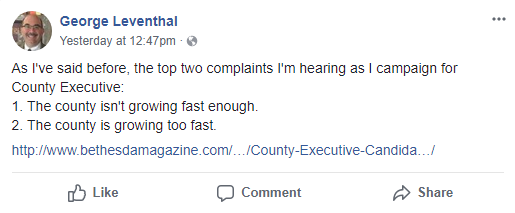
George Leventhal’s comments on Facebook after the recent business forum reporting that he hears complaints about too much and too little growth from different people pretty much capture it all. Candidates simply cannot come across as annoyed with voters. What do those people want anyway?

Even more bizarre was George’s comment at the forum: “Democracy is not a spectator sport. If the business community wants to be heard, you have to speak to us.” Really? After 16 years on the Council, you have no idea what the business community thinks? They have lobbyists and are often highly engaged with the process. Politics is about addition, not subtraction.

Rose Krasnow has some clear strengths in the race. She’s the only female candidate in the #metoo election, though sometimes she sells it a little too hard. Her time as Mayor of Rockville, working on Wall Street, and as a senior staffer at the Planning Board allow her to make a very convincing case that she has the experience to lead the county in a new direction. The Planning Board is a great place to meet a lot of leaders around the county, especially in the not always popular but well-funded development community.

While Democrats are often not too keen on Wall Street, Rose’s real problem, ironically, is her identification with the Planning Board. It’s like flypaper for all the problems in the county and almost worse than being an incumbent when voters are in a mood to shake things up. Too much traffic? Too many portable classrooms? Blame the Planning Board. It may not always be fair (or unfair) but if you want fair, politics is the wrong line of work.

Businessman David Blair is certainly making a splash around the county. He’s already on TV and sending out mail, giving him profile among county voters as a sunny guy in a way that resembles David Trone’s last congressional bid. Empower Montgomery, which he helped found, seems ready to launch an independent expenditure campaign on his behalf.

If he spends enough, he could well become the not Marc. Of course, he’s going to have to compete with David Trone who will also be filling our airwaves. There is also the question of how many rich businessmen do Democrats want to elevate in the days of Trump. Still, I’ve heard positive feedback from some about his business plans, though his press interviews have at times demonstrated a lack of fluency with issues or government. Could this stall his campaign once he faces greater scrutiny?

Last but not least, Delegate Bill Frick is an interesting candidate. Although he’s an elected official, he is not associated with county government, so doesn’t carry their baggage. In short, he manages to combine appealing experience without the blame – a combo that worked rather well for former Rockville Mayor Doug Duncan. As someone widely seen as smart and a good, often passionate speaker, he ought to be an appealing candidate.

So far, however, his campaign has yet to catch fire. Insiders ding him for switching races but I seriously doubt voters know or care. He needs an issue and the county’s strongly disliked liquor monopoly looks like a good target notwithstanding the mud MCGEO has thrown at him. Frick needs convince voters, donors and opinion leaders opposed to Marc that he is best positioned to unite an alternative coalition to renovate county government. He has a good case.

Share

Waldstreicher Misleads on Endorsements. Again.

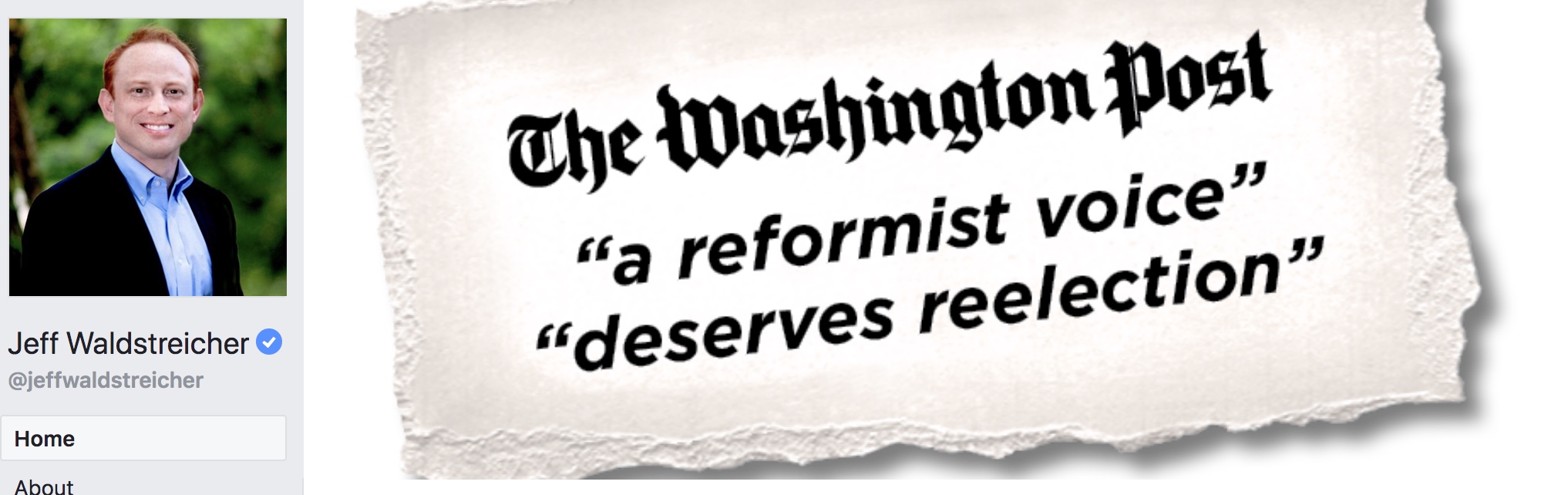
Del. Jeff Walstreicher, running for the open D18 Senate seat, has a graphic at the top of his campaign’s Facebook page with quotes from the Washington Post calling him is “a reformist voice” who “deserves reelection.”

Unfortunately, these quotes are from the Post’s endorsement of Waldstreicher for reelection as delegate four years ago. I suppose one could argue that the word “reelection” indicates that it’s old, as Jeff is not running for reelection but the Senate. But it’s easy to miss that clue and fail to make the connection.

Waldstreicher and frequent state legislative candidate Dana Beyer, his main opponent for the Senate seat, both ran for the House of Delegates in 2006 and 2010. The Post endorsed neither in the 2006 primary. In the more recent 2010 primary, they endorsed Beyer but not Waldstreicher even though he was the incumbent.

Jeff has also posted the following to his Facebook page:

While Jeff is a certified gun sense candidate, he has not been endorsed by Moms Demand Action. Indeed, MDA sends out the following in their notification email:

[B]eing a Gun Sense Candidate should not be considered a formal endorsement from Everytown for Gun Safety Action Fund and multiple candidates running in the same race may receive the Moms Demand Action Gun Sense Candidate distinction.

Like all certified gun sense candidates, including Dana Beyer, he is free to use the logo but not to claim an endorsement. However, Jeff’s campaign intentionally modified the logo to turn the Moms Demand Action imprimatur into an endorsement. If you want to see an example of how to properly use the logo, check out Mila Johns’ delegate campaign webpage.

This isn’t the first time that Jeff has misled regarding endorsements. Previously, I noted that he made it easy for voters, including me, to think that he had been endorsed by Rep. Jamie Raskin even though that was not the case.

I don’t know why the frontrunner who collected a nice passel of genuine endorsements needs to give the false impression that he has endorsements that he doesn’t. It just feeds an impression of someone who is less than wholly trustworthy.

I should mention that I learned about Jeff’s Facebook page from an anonymous tip. I asked Dana Beyer directly and she replied that “I did not” send it, though did not respond to a follow-up asking if someone from her campaign had sent it. Similarly, I asked Jeff for comment as well as a copy of his endorsement letter from Moms Demand Action and have not yet heard from him. You do the math.

Share

The Executive Contest is a Two-Candidate Race

By Adam Pagnucco.

The Washington Post recently published an article declaring that the contest to succeed County Executive Ike Leggett was seen as “anybody’s race.”  Pshaw!  One of two candidates will win it.  One of them is Council Member Marc Elrich, who finished first in the last two Council At-Large primaries and is nearly sweeping progressive endorsements.  The other is…

We don’t know yet.  And we don’t know if we ever will.

During the 2016 Congressional District 8 race, your author called up one of the smartest people in state politics we know.  This fellow lives outside MoCo but he tracks all parts of the state and has sources everywhere.  When we asked him who was going to win, he said, “When I talk to the various campaigns, all of them say they’re gonna be the last one at the end along with Jamie Raskin.  When I hear that over and over, when I see that they all think that Jamie is the man to beat, that leads me to think Jamie will win.”  That dynamic is going on now in the Executive race.

Elrich’s long-time message combining opposition to development with far-left progressivism has earned him an overlapping base of land-use voters, liberals and Downcounty residents, especially in and near Takoma Park, where he served 19 years on the City Council.  In the 2014 Council At-Large race, Elrich finished first in every council district except 2 (where he finished second to Nancy Floreen) and first or second in every local area in the county except Damascus and Laytonsville.  He finished first in 138 of 251 precincts.  In the 2010 Council At-Large race, Elrich finished first in all five council districts and in every local area in the county except Cabin John, Damascus, Darnestown and Laytonsville.  He finished first in 166 of 243 precincts.  No other MoCo politician running for county office in this cycle has a base of this kind.

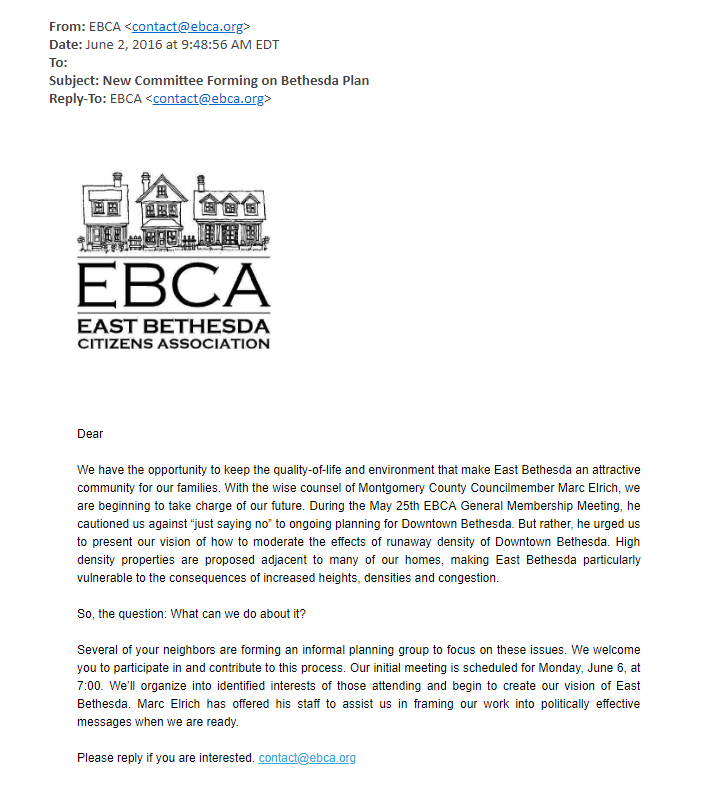
How did he assemble it?  For many years, Elrich has been assisting residents who oppose master plans all over the county.  And whether they won or lost, those development opponents came away from the fight with Elrich as their hero.  Here is an illustration: an email sent out by the East Bethesda Citizens Association on 6/2/16, on the eve of the council’s consideration of the Downtown Bethesda Master Plan, describing their meeting with Elrich and calling for action:

A year later, Elrich cast the lone vote against that master plan as he has with several other plans.  This plan’s opponents have now been incorporated into Elrich’s base – assuming they were not part of it already.

While other candidates struggle to attract volunteers, Elrich’s volunteer base is well established.  In 2014, the campaigns of Elrich and his ally, Beth Daly, posted poll coverage sign-ups on Signupgenius.com.  They were able to recruit coverage on 67 precincts, many on more than one shift, with particular strength in the voter-rich areas of Silver Spring, Takoma Park and Leisure World.  No one other than the Apple Ballot could touch this.  Now that he is running for the county’s highest office, how many precincts will Elrich be able to cover?

Among the influencers and highly informed activists, this election is rapidly becoming defined by whether you’re with Elrich or not.  If you don’t believe us, check out the Council District 1 candidates.  They’re an interesting group that collectively spans the differences of opinions in the county district containing the most Democrats.  Bethesda Magazine reporter Andrew Metcalf asked them during a recent debate for whom each was going to vote in the Executive election.  After significant prodding, here’s how the candidates responded:

Bill Cook – would vote for Marc Elrich

Pete Fosselman – undecided; wouldn’t vote for Elrich

Andrew Friedson – undecided; disinclined to vote for Elrich

Ana Sol Gutierrez – torn between Elrich and George Leventhal

Jim McGee – would probably vote for Elrich

Reggie Oldak – refused to say; would not vote for Elrich

Dalbin Osorio – would vote for Elrich

Meredith Wellington – undecided

All of the non-Elrich candidates have potential as well as challenges.  Council Members Roger Berliner and George Leventhal are running on their experience and qualifications.  (Disclosure: your author respects both but supports Berliner.)  Berliner is trying to get known outside his council district and Leventhal has been severely out-polled by Elrich in the last two elections.  Delegate Bill Frick, former Rockville Mayor Rose Krasnow and businessman David Blair are the fresh faces.  But they are little-known in most parts of the county and Blair started as a complete unknown.  All of these candidates have a long way to go and each of them is in the others’ way.

To contrast with Elrich effectively, a non-Elrich candidate needs to hit this sweet spot dead-on: “We live in a great county, but we can be even better.  Here are some ways we can improve.”  That involves a bit of threading the needle for the two council incumbents.  It’s understandable that they might react to critiques of the county’s economic performance as criticism of their records, but they should think of it like this: every Executive leaves unfinished business for the next Executive.  Ike Leggett inherited his share of problems from Doug Duncan, who in turn inherited some issues from Neal Potter.  This is entirely normal, so who is the best choice to lead in the future?  As for the non-incumbents, they aggressively point to the need to improve, but they tend not to have many specific proposals to get better because they don’t know the history and operations of county government as well as the two Council Members.  To be fair, how could they?  If no one hits this sweet spot, that leaves Elrich as the only candidate with a crystal-clear message that is distinct from the others.  Those who hear Elrich’s message and agree with it are less likely to peel off to someone else than tentative supporters of the other candidates who might change their preferences between them.

One more thing: we wouldn’t be surprised if most, if not all, of the non-Elrich candidates have polled.  If so, they all probably found similar results.  And so they could all tailor their messages in similar ways and maybe even say the exact same things.  That would blur the differences between them and make Elrich stand out even more.  This may already be happening as Berliner, Blair and Frick all repeatedly mentioned “innovation” at last Friday’s Executive forum.  Was that a coincidence?

If questioned privately, we bet all of the non-Elrich candidates would grudgingly admit that it’s a problem that five of them are in the race.  Each of them wants to be the person who gets to take on Elrich one-on-one.  So each of the five is looking at the others and saying, “If YOU all get out of the way, I can beat Elrich.”  But no one is dropping out because they all think they have a shot.  The big winner from this is – you guessed it – Marc Elrich.

One non-Elrich candidate needs to emerge from the pack and consolidate everyone that is not in Elrich’s camp.  If that happens, Elrich is beatable.  But if nothing changes and this election continues down the path it is on, Elrich will win with less than 40% of the vote.

Share

Executive Candidates React to Sage Consulting Report on MoCo Economy

By Adam Pagnucco.

Last Friday, the candidates for County Executive attended a forum to discuss a report by Sage Consulting listing numerous problems with the county’s economy.  Afterwards, most of the Executive candidates commented on the report and on the economy more generally via email and social media.  Their responses say a lot about which ones take the economy seriously, an issue that has drawn much attention from Seventh State.

Council Member Roger Berliner (whom your author supports) sent out this email over the weekend.

Our county has serious work to do to improve our business climate, diversify our economy, and increase the number of good jobs. It must be Priority #1 if we are going to be able to meet the needs of our school system, reduce congestion, invest in public safety, and protect our environment.

I have a record that I am proud of on improving our economy and a vision for our future that you can read about here. Some of my competitors have records too. Others have just words. It’s important to consider what we have done in pursuit of increasing prosperity, not just what we say we will do.

My record includes leading the successful effort to reduce our energy tax three years in a row; creating the small business navigator and a micro-loan program to help our local small businesses and entrepreneurs thrive; and playing a leading role in our Amazon bid. My vision is of a forward leaning county that embraces innovation, education geared towards the jobs of tomorrow, and vibrant urban centers served by state-of-the-art transit.

Yesterday, a consultant tasked with assessing our business climate and outlook, issued a scathing report. It highlighted one startling statistic: that “between 2011 and 2016, the number of [business] establishments in Montgomery County increased by 6, or roughly the population of businesses at a strip mall.” The report concludes that “Montgomery County therefore desperately needs to step up efforts to expand its commercial tax base.” You will get no debate from me on that point.

At the same time, the report declares:

This should not be mistaken for an assertion that Montgomery County is anything other than the finest possible location for Amazon HQ2. It will be difficult for Amazon to identify an area that is as open to new ideas, offers such abundant human capital, is as saturated with transportation options, supports such high quality public education, is as institutionally rich, and is as committed to shared prosperity as Montgomery County, MD.

So, while it is true that we have our challenges, challenges that must be met head-on, it is also true that we have extraordinary assets and a quality of life to match. I will build on our assets as your next County Executive, work diligently to improve our business climate, and am 100% committed to expanding a “shared prosperity.”

Life is good in Montgomery County, but we can make it better still. That’s my goal: a “more perfect” Montgomery County.

In service,

Roger Berliner

Delegate Bill Frick (D-16) sent out this email hours after the Executive forum ended.

Something doesn’t add up. How does a county with our talent, our people, our great public schools and our values lag behind the rest of our region in job growth and economic development? How is it that private sector employment has declined by 12,500 jobs from 2006 to 2016? How is it that, during that same time period, Montgomery County created on net just six new businesses?

The answer is clear. As I told the Montgomery County Business Roundtable earlier today, it is our political culture. My opponents have built a political culture in Montgomery County that doesn’t want to work with businesses to thrive and grow here in our County.  And if we elect someone to be County Executive who is part of that culture, things will not get better for business.

I am an outsider to Montgomery County Government and yet I have real governmental leadership experience as the Majority Leader of Maryland’s General Assembly. I have the relationships in Annapolis that can help our County. But since I am not a multi-millionaire, and unlike three of my opponents, I am not spending your taxpayer dollars to fund my campaign, I need your help to communicate with Montgomery County residents who deserve leadership that the current members of the County Council will not provide.

Montgomery County is an awesome place to live. It’s why I’m raising my two children here and sending them to our public schools. But we have a problem, and that is that we must reform in order to create new private sector jobs and increase our tax base. We have to focus on the core functions of county government – education, public safety, and transportation – and those need to be our priorities for our budget. Our County Government does not need to be in the liquor business, a failed venture that is hurting our food culture to the benefit of downtown DC restaurants. We have to have a culture of ‘yes’ in county government so that we are trying to find reasons to say yes to businesses rather than find reasons to say no.

Sincerely,

Bill

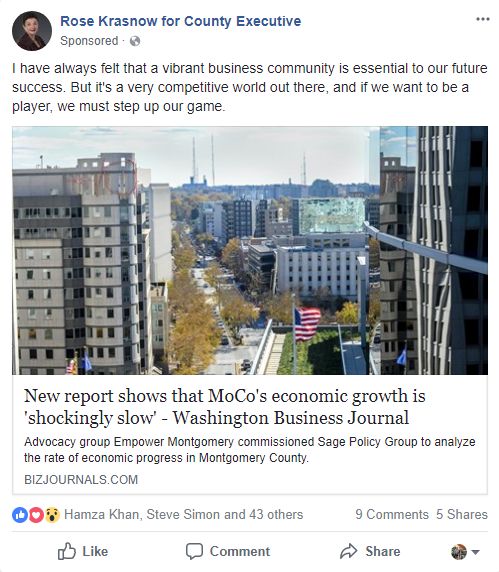
Former Rockville Mayor Rose Krasnow ran this Facebook ad.

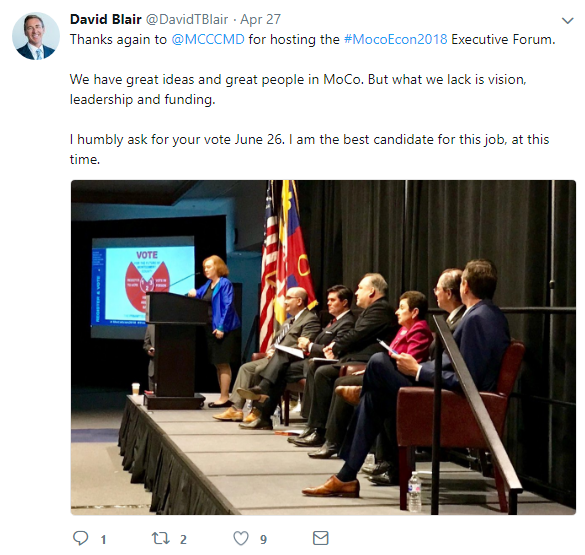
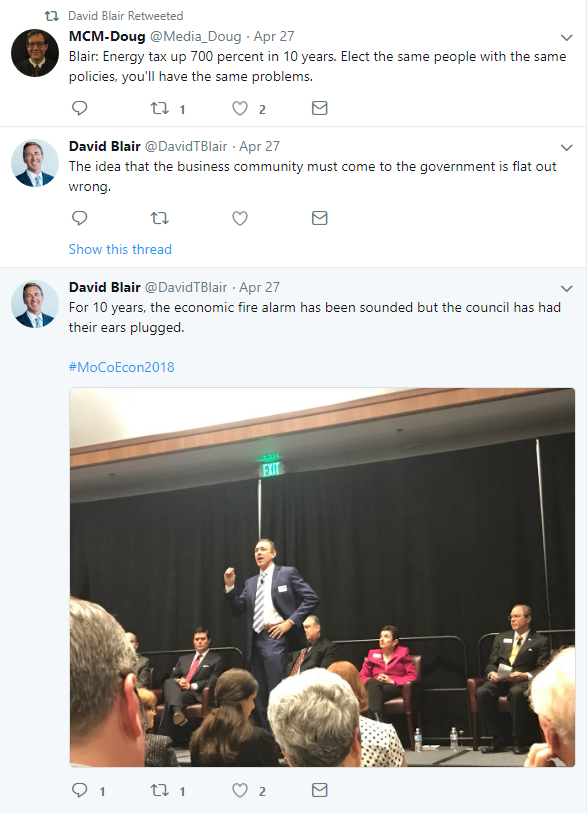
David Blair commented on Twitter.

Council Member George Leventhal commented on Facebook.

We are not aware of Council Member Marc Elrich commenting via email, Facebook or Twitter.

Share

More on Ben Jealous’ Voting Record

Ben Jealous’s campaign blasted my posts about his voting record with its own blog post earlier today. If nothing else, my posts have helped clarify the voting records of the candidates, a topic Larry Hogan will be sure to bring up if the nominee is vulnerable.

Could I have done so in a better way? You bet. (For example, it was pointed out to me last night that I should have indicated that Krish Vignarajah was simply too young to vote in some elections on the chart.) Jealous’s post, however, is a combo platter of legitimate grievance, high dudgeon, and deception by omission.

Agreed Facts

Jealous says he has voted in Maryland exactly four times: the 2012 general election, the 2014 election, and the 2016 primary and general elections. This is exactly what I reported in my post on the Maryland voting records of all candidates.

As Jealous has now made clear, he did not vote in Maryland previously because he was living in D.C. and California. When he became NAACP President, he moved “back to D.C.” The NAACP headquarters are in Baltimore, though the organization also has a Washington bureau.

Jealous further claims that, contrary to my statement, that he has “long been” a Democrat but then says that he “chose to be formally unaffiliated during his time as president of the NAACP.” Fair enough, but this also means that was, in fact, not a registered Democrat from 2009 to 2013.

More interestingly, Jealous states “Since leaving the organization, in 2013, Jealous has voted consistently as a Democrat in Maryland, including participating in the 2016 Democratic presidential primary election.”

This neatly elides over and omits that he didn’t participate in the 2014 Democratic primary, the only gubernatorial primary for which he has been eligible. He left the NAACP in 2013, so his stated reason for being unaffiliated no longer held. Certainly, the 2014 Democratic primary was exciting with a gubernatorial race between Anthony Brown, Doug Gansler, and Heather Mizeur.

Though Jealous touts his record on supporting women and people of color, he chose not to vote in that primary. (Krish Vignarajah faces the same problem far more acutely. She routinely lambastes the lack of women and people of color in elected positions in Maryland but elected not to vote in Maryland in 2014 or the hotly contested Edwards-Van Hollen primary in 2016.)

Bottom line, Jealous has voted four times in Maryland since 2012. He has never voted in a gubernatorial primary, as he skipped the 2014 Democratic primary. According to Jealous, he was not a registered Democrat in 2012, so he was unable to vote in that primary.

High Dudgeon

Jealous spends much of the post, which appeared today, attacking claims I made two days ago but realized on my own were not right and corrected within hours as soon as I had that facepalm moment.

I took the unusual step of putting out a separate post highlighting the corrections, so that everyone who gets 7S in their mailbox would see it. Additionally, I tweeted and put up a post on the blog’s Facebook page with the correction. All state: “My apologies not just to Ben Jealous but to readers for the errors.” The original post is not only corrected but contains the same wording at the top highlighting the corrections.

I make mistakes and I try to take my lumps and to correct them when brought to my attention. It’s part of my effort to maintain trust with the people who read as well as my own standards. My time is limited since I have a full-time job and other responsibilities, so I mess up sometimes but I do my best. While I certainly have opinions, I regard facts as friends and try to adhere to them.

I can only speculate why Jealous chose to spend so much time expressing outrage about the corrected errors. It might be in order to distract from that his voting history and residency in Maryland in much shorter than others might think. He might also rather direct attention to me rather than his failure to vote in the 2014 Democratic primary.

Legitimate Grievances

Where Jealous has a good point is that I did not know about his California voting history, which occurred in the middle of his two periods voting in D.C. Why didn’t I know? I looked as his campaign bio page, which makes no mention of having lived in either D.C. or California.

Instead, it says “Ben grew up spending summers in West Baltimore and has lived in Maryland throughout his career as a civil rights leader and businessman.” However, his never voted in Maryland prior to 2012 and did vote elsewhere, which indicates that he has not lived in Maryland “throughout his career.”

I learned that Jealous had previously voted in D.C. Like Vignarajah in Maryland, he was never purged from the rolls during his time in California. I had no idea from his bio, which I looked at prior to putting up the post, that he had lived in California. So I wrongly stated that he had missed elections in D.C. when living in California.

Nevertheless, in retrospect, it would have been best to have taken the time to ask the Jealous campaign. Of course, Jealous could have done the same if he wanted the errors corrected. We both know how to contact each other and my corrections and apology for the errors indicate a willingness to fix others. Unlike me, he has a professional, paid campaign staff. Instead, his blog post blasts me two days after many of the errors were corrected.

Conclusion

I’m certainly not above criticism. When you put your opinions out there, you should expect some flak, especially when you make mistakes. At the end of the day, however, I’m not up for election. It’s up to voters to decide if Jealous’s voting history or residency matters. I imagine voters have a range of opinions on these topics – and they’re absolutely the ones who matter here.

Share

Placeholders Have No Place in the MCPS Capital Budget

By Laura Stewart.

Have you ever heard of the term “placeholder” in the county budget? I never had, until as a PTA President, I started to advocate for an elementary school that had 9 portables. The terminology surrounding placeholders was confusing.  At first it sounded like a planning tool that might be helpful.  But as I have looked at the scenarios in front of us in this budget cycle, I believe that real solutions need to take place instead of placeholders.  I will explain by using two real life scenarios below, followed by a review of the consequences of the current County Council’s SSP (Subdivision Staging Policy.)

Scenario 1:

An elementary school has just received an addition due to housing turnover, new development, and a boundary change that was intended to address split articulation patterns and crowding at other schools.  After the addition was completed, the school immediately became over-crowded again and now has four portables. More development is underway in the area, and it will cause even more crowding at the school.

Due to county policy, future development goes into moratorium when a school is forecast to be over 120% capacity at year 5 in the budget, unless there is a “solution.” That solution can be a “placeholder,” money put in the budget that covers the extra seats a development will create, based on the County’s “student generation rates.”  This money is not tied to a specific plan. It is only there to prevent the area from going into moratorium. The school system promises to develop an actual project in time for the seats to materialize in the next 5 years.  This school gets assigned a “placeholder” by the Council since a capacity project is not included in the Board of Education’s recommended FY19 budget.

Scenario 2:

A school has been over 120% capacity since 2011 and is at 151% today.  A plan to address the overcapacity is not included in the Board of Education (BOE) Recommended FY 19-24 budget.  Since there are no pending development projects in this part of the county, no “solution project” is proposed by the County Council, and the area officially goes into a housing moratorium.

Scenario 1 is in Bethesda, scenario 2 is in East Silver Spring.  Neither community is happy with place holders!

I will first explain why the areas with development aren’t happy.  The scenario 1 school, Bethesda ES, is in an area where housing development continues.  In fact, there are an additional 11 buildings submitting applications in the area under a recently approved master plan. Somerset Elementary School is in a similar situation and the Council has proposed a placeholder for that school as well. There is no actual plan for another addition at the Bethesda school (which may not even be possible, given the small site size,) or a plan for a new elementary school nearby. New schools, even at properties MCPS already owns, are much more expensive than additions. Additions also can cost more than the placeholder price tag that is included in the budget. Placeholders are supposed to guarantee seats in 5 years, but the past has shown that projects almost never get done in that time period.  Of the last five placeholders that had a due date before 2018, only one project finished by the due date. Another 4 placeholders added in FY15 were postponed the following year. Continuing development with a placeholder causes schools to go way over capacity, often much more than the initial 120% threshold, by the time there is a real solution.

Now let’s look at Scenario two.  East Silver Spring does not have pending development. The school that is the most overcrowded in the area is Burnt Mills ES, at 151% and over 200 children are in portables. In fact, this school has been over the 120% threshold since 2011, when the feasibility study was done. No project for this school is in the FY2019-2024 CIP. They will be considered in the new renovation and expansion program in a future CIP, but there are limited funds and there are many schools that will be considered. There are no guarantees for this school. So this area is now officially in moratorium, and has been for a while.  Relief at Burnt Mills seems elusive without any project on the books. Parents feel like they do not get the attention that other areas with lots of development get.  They are not wrong. Even though placeholders aren’t solutions, at least the conversation about a possible solution takes place at the County Council.

Seven areas are in housing moratorium in Montgomery County, but only three had placeholders proposed to be added in this budget cycle, two in Bethesda and one in Gaithersburg. I’ve spoken to parents in Bethesda that would rather have a building moratorium take place so the County could take time to come up with a real planned solution. The Gaithersburg school, Judith A. Resnik ES, had an addition project scheduled with a completion date. The enrollment there is trending down slightly, but is still projected to be at 122% capacity within 5 years.  To avoid a moratorium, the County removed an actual project (the scheduled addition), and added a placeholder.

Real money is taken out of the MCPS budget for placeholders, instead of actually using those funds for planned projects. In fact, several projects that were proposed in the BOE Recommended FY19 Budget are slated to be delayed due to lack of funds, including Col. E. Brooke Lee Middle School. It is considered a “sick” building by many teachers and parents. Mold and other issues come up regularly. They were elated to have a project that had a completion date of September 2021, only to be deeply disappointed when they were included in the delay list. Placeholder money – used to avoid putting development in moratorium- could be allocated NOW to schools with greater needs than the areas with pending development. Placeholders compete for scarce funds in the CIP.

There is another unintended consequence of giving placeholder money to areas of higher growth. These areas tend to be more affluent. So the optics continues to perpetuate the perceived and the real divide between East County and West County. For instance, there are huge disparities in wealth in our two scenarios. Bethesda ES has a 7.3% Free and Reduced Meals Rate (FARMS.) Burnt Mills ES has 67.1% FARMS.  The affluent area gets the attention of councilmembers and solution/placeholder projects – that may or may not actually come to fruition – while poorer areas are left out. This policy also divides the County North and South too, because rural areas do not have the growth that down county areas receive.

I am in no way blaming Councilmembers or insinuating that they mean to ignore certain areas of the County. I know that many fight for scarce resources, and fight to bring economic growth in underperforming areas of the County. I am blaming the processes and policies that perpetuate inequalities and perception of inequalities in our school system. I propose changing the system.  We can come together as a community and find a better way forward. Let’s get developers, Council Members, the Board of Education, the MCPS Division of Long Range Planning, and the Planning Department together and come up with REAL solutions so we can finally build real classrooms for kids, no matter in which zip code they live.

Laura Stewart is the CIP Chair for the Montgomery County Council of PTAs.

Share

Navarro Blasts Krasnow, Blair and Frick Over Racial Equity

By Adam Pagnucco.

County Council Member Nancy Navarro is blasting County Executive candidates Rose Krasnow, David Blair and Bill Frick over their comments on her racial equity resolution.  The council resolution would have the county measure racial equity impacts of budget items and legislation.  Its action language states:

The Council is committed to examining the data needed to develop an equity policy framework that would require the County to question how budget and policy decisions impact equity.

This effort must be a partnership between the County Council, County Executive, County Government, county agencies, institutions, and our community. The County Government
must challenge itself to bring new and different partners to the table. Partnering with other jurisdictions as members of the Government Alliance on Race and Equity (GARE) will also enhance the County’s effort and commitment to fostering equity.

Equity analyses should be part of capital and operating budget reviews, appropriation requests, and legislation. Program and process oversight should be undertaken viewing programs and processes through an equity lens. Equity targets and measures of progress must be put in place.

The Council will provide additional FY19 Operating Budget resources for the Office of Legislative Oversight to develop a baseline report describing current disparities in education, employment, housing, health, employment, land use, and other measures of opportunity by May 31, 2019. Following the transmittal of the baseline report, the Council will introduce legislation for the County to develop an equity policy framework to inform the delivery of all County services.

The entire council, including the three members running for Executive (Roger Berliner, Marc Elrich and George Leventhal), has co-sponsored the resolution.  But fellow Executive candidates Rose Krasnow, David Blair and Bill Frick criticized it in the Washington Post:

Democrat Rose Krasnow, the county’s deputy planning director and a former mayor of Rockville, said she worried the measure would lead to “paralysis by analysis.” She also questioned the timing of the resolution: “It seems like such a political statement in an election year.”

Del. C. William Frick (D-Montgomery) said growing “private-sector jobs” and wages is the best way to eliminate disparities. Businessman David Blair applauded the vote but the Democrat wrote in an email that “we shouldn’t confuse activity with progress. . . . Where’s the progress been the past 12 years?”

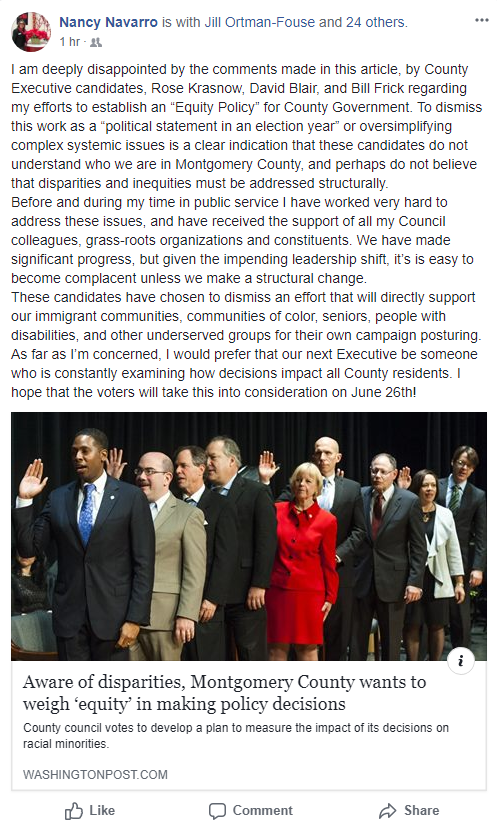
That drew Navarro’s wrath.  She denounced the three candidates on Facebook, writing:

I am deeply disappointed by the comments made in this article, by County Executive candidates, Rose Krasnow, David Blair, and Bill Frick regarding my efforts to establish an “Equity Policy” for County Government… These candidates have chosen to dismiss an effort that will directly support our immigrant communities, communities of color, seniors, people with disabilities, and other underserved groups for their own campaign posturing. As far as I’m concerned, I would prefer that our next Executive be someone who is constantly examining how decisions impact all County residents. I hope that the voters will take this into consideration on June 26th!

We see Navarro’s point.  Montgomery County, like the rest of the United States, is rife with inequities of all kinds.  Navarro’s resolution does not prescribe specific remedies; it only initiates the process of measuring inequities so that they can be considered in public policy decisions.  It’s hard to understand how any progressive candidates for office could oppose that.  Perhaps Krasnow, Frick and Blair would like to comment further before their existing remarks are set in stone.

Share

Maryland Politics Watch