Franchot Tacitly Supports Hogan

While Democratic Comptroller Peter Franchot says he wants to remain “neutral” in the gubernatorial race, it’s a big win for Hogan that the statewide official won’t endorse the Democratic nominee. Moreover, as reported in the Baltimore Sun, Franchot’s comments make his true feelings clear regardless of his nominal neutrality:

Franchot said he considers Hogan a friend.

Jealous and Franchot represent different ideological wings of the Democratic party, even though both claim the anti-establishment mantle and share many views on social issues. Jealous, who won the Democratic primary last week, is a strong progressive on economic issues, while the comptroller has positioned himself as a fiscal conservative.

Without directly referring to Jealous, Franchot said voters want Democrats to offer them something other than the type of expansive social programs Jealous is proposing.

“The don’t want higher taxes, they don’t want higher fees, they don’t want pie-in-the-sky programs that sound great” but are too expensive, Franchot said.

It’s fascinating that Franchot is now seen as a fiscal conservative, as he not too long ago cast himself as a leading progressive. In any case, Franchot is coasting to reelection and just did his buddy on the Board of Public Works a solid.

Share

MoCo Democrats are Badly Divided

By Adam Pagnucco.

This may not be the most polite thing to say in the wake of the MoCo Democrats’ Kiss and Make Up Party, but it’s the truth: MoCo Dems are badly divided.  Consider the following.

The photo finish in the Executive race between Marc Elrich and David Blair is exacerbated by the fact that many Democratic activists are part of Anybody But Elrich or Anybody But Blair factions.  No matter who wins, that person will have 29% of the primary vote, far lower than any prior MoCo Executive.

That’s not the only divide in the Executive race.  The three incumbent Council Members received a combined 52% of the vote.  The three outsiders received 48%.  That suggests an even split between those who want more of what they have seen from the council and those who want something different.

Gubernatorial candidate Ben Jealous won MoCo with roughly 36% of the vote, four points ahead of Rushern Baker and 22 points ahead of MoCo State Senator Rich Madaleno.  No one wants to talk about this publicly, but there are quite a few county Dems out there who will consider voting for Governor Larry Hogan.

Now Nancy Floreen has filed a declaration of intent to run for County Executive as an independent.  This is sure to attract the attention of some Dems who are upset that the nine-member County Council will include just one woman.  Floreen is one of the most prominent female Democrats in the county’s history.  No woman has been elected countywide more times than Floreen since charter government was established in 1970.  If she does indeed get on the ballot, a not-insignificant number of Dems – especially women – could vote for her.

All of this adds to county Democrats’ pre-existing divide about land use, the Upcounty vs Downcounty split, long-standing tensions between progressives and moderates and the Hillary vs Bernie disputes of two years ago (and the Hillary vs Obama disputes before that).  Throw that in with the fact that a majority of Democrats voted for term limits and there’s a lot of bubbling in the cauldron right now.

The county’s two most popular Democrats are U.S. Senator Chris Van Hollen and Congressman Jamie Raskin.  Neither is known for intervening in and settling local disputes.  County Executive Ike Leggett is widely respected but is leaving office.  The Governor is a Republican who is happy to see Dems fight Dems.

As for the Republicans, they must be kicking themselves that they couldn’t find anyone else to run for Executive other than Robin Ficker.

Share

Nancy Floreen Files Intent to Run for County Executive as an Independent

By Adam Pagnucco.

Bethesda Magazine just reported that Council Member Nancy Floreen has filed her intent to run for County Executive as an independent.  But getting on the ballot is not as simple as filing.

The magazine noted that Floreen is still a Democrat and that could present a legal difficulty.  But there is more.  According to § 5-703 of the state’s election law, Floreen has until the first Monday in August to submit petition signatures sufficient to place her on the ballot.  The law states:

A candidate who seeks nomination by petition may not have the candidate’s name placed on the general election ballot unless the candidate files with the appropriate board petitions signed by the lesser of 10,000 registered voters or 1% of the total number of registered voters who are eligible to vote for the office for which the nomination by petition is sought, except that the petitions shall be signed by at least 250 registered voters who are eligible to vote for the office…

The number of registered voters required to satisfy the requirements of paragraph (1) of this subsection shall be determined as of January 1 of the year of the primary election for which the nomination is sought.

The state’s voter registration report for January indicates that there were 644,179 registered voters in Montgomery County at that time.  So Floreen’s absolute minimum threshold would be 6,442 MoCo voters.  To be safe, she probably needs at least 10,000 signatures to account for inevitable disqualifications.

She has until August 6 to get them.

Following is Floreen’s statement.

Today I filed an Intent to Declare Candidacy with the Maryland Board of Elections to run for County Executive in the November general election.

Let me be clear: I would like to have waited for the final count of ballots in the County Executive race. However, State law sets July 2 as the deadline for declaring an independent candidacy.

I did not support either David Blair or Marc Elrich. Whichever candidate prevails in the count will do so with less than 30 percent of the third of Democrats who voted — a fraction of a fraction. That’s less than 40,000 votes in a County of more than a million.

I believe ALL Democrats, Republicans, and independents would benefit from a third, independent choice.

I will announce my final decision on candidacy once all the primary votes for County Executive have been tabulated and certified.

Share

A Pattern in the Absentee Ballots?

By Adam Pagnucco.

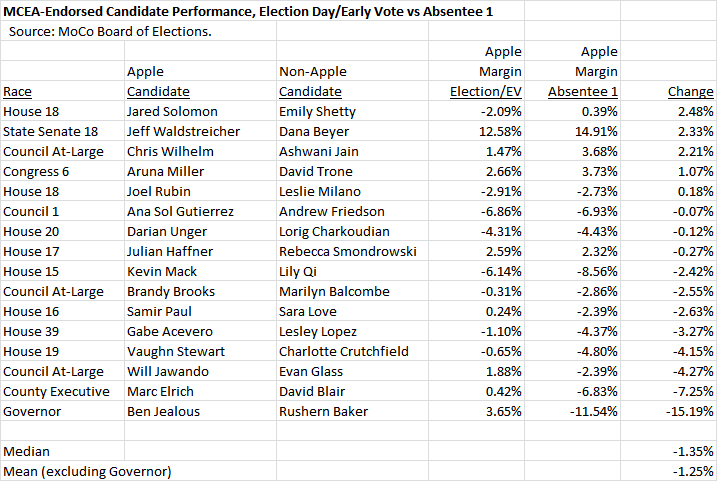
All eyes in political MoCo are on the County Executive race, which will be decided by absentee and provisional ballots.  After the first absentee canvass, Marc Elrich’s lead over David Blair has declined from 492 votes to 149 votes, guaranteeing an absolute squeaker of a finish.  Lots of folks are asking why.  A preliminary analysis of absentee voting data suggests one reason: for the most part, candidates endorsed by MCEA, of whom Elrich is one, are performing slightly less well in absentee voting than in early voting and election day voting.

The Montgomery County Education Association (MCEA), which represents MCPS teachers, has historically been the most powerful interest group in MoCo elections.  Its political program has combined mail and poll coverage where its mighty Apple Ballot is distributed.  This year, its mail program has been partially diverted to the Governor’s race (where the union helped pay for three mailers on behalf of Ben Jealous) and Congress District 6 (where the union sent three mailers for Aruna Miller).  Its remaining mailers were one for its State Legislative District 16 endorsees (one of whom was teacher Samir Paul), one for its Council At-Large endorsees (one of whom was teacher Chris Wilhelm) and one with the Apple Ballot itself.  The latter mailer was the only one to include Marc Elrich, who was endorsed late.  In past years in which races for Governor and Congress were not an issue, MCEA’s mail program was entirely focused on state legislative and county races.

Alterations to the mail program may explain variations in absentee ballot voting.  People who vote early, on election day and through provisional ballots may encounter Apple Ballot poll coverage.  And it’s not just MCEA who distributes it; candidates who are featured on it often distribute it too.  But absentee voters do not go to a polling place.  They must be contacted through other means.  As stated above, MCEA’s mailers were drawn into races for Congress and Governor and if the union has a robust digital program, we have not seen it.  All of this means that absentee voters in General Assembly and county-level races are less likely to be influenced by the Apple.

The table below shows sixteen close performances in county races between Apple-endorsed and non-Apple candidates.  (We excluded incumbents to remove any incumbent effect on absentee voting.)  In each race, the margin between the two in election and early voting results is shown alongside the margin in the first absentee canvass.  (Both sets of results are unofficial and there will be another absentee canvass.)  In eleven of these sixteen races, Apple-endorsed candidate performance declined in absentee voting.

Now some of these races have other things going on.  In Congress District 6, Aruna Miller benefited from MCEA’s three mailers and her performance actually rose a tiny bit among absentees.  In the gubernatorial race, a clear outlier, Rushern Baker may have benefited from the Washington Post’s strong endorsement.  (This year, the Post did not endorse in Congressional or state legislative races.)  David Blair got not one, but two Post endorsements.  Elrich’s late endorsement from MCEA handicapped his ability to publicize it, which may have impacted absentee voters.  And so on.

The Apple Ballot is arguably the best endorsement in the county.  Blair would already have won the Executive race if Elrich had not received it.  But the data above, however tentative it is, suggests a pattern: the Apple has been slightly less effective in absentee voting.  The median performance drop is 1.4 points.  The mean performance drop excluding the outlier race for Governor is 1.3 points.  So let’s round it in rough terms to a point-and-a-half decline.  That’s not enough to affect most races but it is having an impact on the razor-thin contests for County Executive and House 16.  MCEA should consider this in designing its future political programs.

Share

The Democrats Gamble on Jealous

The Democratic have placed a bet with the nomination of Ben Jealous that a more left-wing progressive candidate will energize voters, especially the growing share of minority voters, and beat Gov. Larry Hogan. As Barry Goldwater once said, Jealous “will offer a choice, not an echo.”

Will it work? It’s an interesting test for the progressive wing’s thesis that the Democrats need to run more vocal, left-wing candidates. If it doesn’t work in blue Maryland in what is shaping up to be a very good Democratic year, where and when can it work?

This strategy runs counter to the 2014 gubernatorial post-mortem. Many argued that then-Lt. Gov. Anthony Brown’s 2014 campaign needed to deliver a message more clearly. But few thought his defeat resulted from an insufficiently left-wing platform. After all, the O’Malley-Brown administration had raised taxes to protect against the decimation of state services during the recession and to fund transportation infrastructure. O’Malley led the successful referenda fights on the Maryland DREAM Act and marriage equality.

The Jealous Agenda

Nevertheless, Jealous will run on the most left-wing platform in living memory. Jealous wants to enact single-payer health care, raise teacher pay by 29%, fund full-day pre-K education, make college free, staff schools with mental health professionals, spend significant dollars fighting the opioid epidemic, provide summer youth employment, expand public transit substantially, and offer public sector jobs when no private sector work is available.

Jealous has also attacked incrementalism or half measures, telling voters how his grandmother said that if you solve half of a problem, you still have a problem. As a result, it’s now hard for Jealous to backpedal and talk gradualism. It runs counter to his whole message.

How Hogan Will Attack Jealous

In a previous post, I looked at Jealous’s advantages heading into the general election. But what vulnerabilities will Hogan exploit?

Jealous’s agenda is expensive. Very expensive. Gov. Larry Hogan’s campaign will go after Jealous, as they would any Democratic opponent, as wanting to raise taxes. Jealous says it will only be on the top 1% of taxpayers and on legalized marijuana. Combined with savings from criminal justice reform and building fewer roads, that will pay for everything.

The list of extremely expensive services Jealous wants to add to the state budget may render voters doubtful of these claims. Many voters will also be concerned about the impact of another tax hike and an indexed $15 minimum wage on the economy. Unlike in a Democratic primary, attacking Hogan (and thus voters on the fence) as needing a stronger commitment to social justice if they have qualms will alienate rather than impress.

Hogan will undoubtedly try to use fear of major tax hikes to divide the Democratic coalition, and to pick off economically successful voters, disproportionately white and Asian, who may be more liberal on social than economic issues. Jealous will attempt to frame the debate as the 1% versus the rest of us. Hogan will alternatively style himself as a protector of taxpayers.

Jealous’s embrace of altering school funding formulas to take more money from wealthier counties to give more to needier counties will aid Hogan’s efforts. In Montgomery, for example, Hogan can position himself as a protector of the county’s prized school system, against Jealous’s efforts to send yet more MoCo money elsewhere.

It’s hard to imagine an issue more likely to pry Democratic voters away here. In Maryland’s secular heartland, lots of people have an ambivalent relationship with organized religion but everyone believes in education with fervor.

Jealous’s characterization of the violence in the wake of Freddie Grey’s death due to injuries inflicted during his arrest as an “uprising” rather than “riots” will also to raise eyebrows. Few would dispute that the Baltimore City police is in dire need of radical reform. But Hogan may well ask Jealous how senseless destruction advanced the causes of police reform and racial justice?

One building that burned down was a nearly finished project to provide affordable housing for seniors and a community center with job training and HIV counseling among other services. (Rev. Donte Hickman’s tireless efforts resulted in the project’s completion despite these daunting setbacks.) Again, attacking Hogan or voters for being insufficiently woke or committed to racial justice seems an unlikely vote-winning strategy.

Will Linking Hogan to Trump Work?

Beyond his own message, Jealous will relentlessly link Hogan to Trump and the need to send a message to the Republicans. However, Hogan hasn’t touched the hot-button social issues and hasn’t stopped gun control legislation. Despite his loud grumbling about taxes, Maryland has not undergone anything like the disastrous state downsizing in the name of tax cuts that has failed so miserably in Kansas and Louisiana.

Even O’Malley’s gas tax remains in effect with Hogan happy to travel around the state announcing new roads. Jealous promises to refocus the money, which also seems likely to displease the many voters who favor the new road projects. Hogan’s pie-in-the-sky plan to widen I-495 and I-270 gains fans from people who like that he is at least thinking about addressing to their traffic woes and don’t think transit will get them there.

Conclusion

Jealous has an exciting vision to sell. It also provides a buffet of avenues for a Republican to attack. By running as a left-wing progressive, Jealous has also left open centrist turf that Hogan will be eager to occupy as a mainstream problem solver. It will be up to Jealous to prove skeptical political observers, who rate the race as Likely Republican, wrong.

Share

Baltimore County Exec Race Even Closer

If you thought the Montgomery County executive race was tight with Marc Elrich leading David Blair by 269 votes and lots of ballots yet to be counted, just take a look at Baltimore County.

After counting the first set of absentee ballots, former Del. Johnny Oleszewski, Jr. leads Sen. Jim Brochin by 42 votes! The current totals are 27,270 for Oleszewski, 27,228 for Brochin with Councilmember Vicki Almond close behind with 26,211.

As in Montgomery, we’ll have to wait until after Independence Day when the rest of the absentee ballots and the numerous provisional ballots are counted. I don’t know how many of each are outstanding but it’s surely enough to leave the winner up in the air.

Share

County Exec Race Going to Be Extremely Tight

Yesterday, Adam Pagnucco explained that David Blair needs to win the outstanding ballots by 6.2% in order to pass Marc Elrich in the final vote tally. The absentee ballots counted yesterday suggest that this is entirely possible.

Yesterday, 3793 absentee ballots were counted. Among those voters, 3292 participated in the Democratic primary. Fewer voters tend to cast votes as one goes down the ballot, a phenomenon known as roll-off. In the Democratic primary for county executive, 3140 cast valid votes.

Blair lead Elrich by 7.1% among the absentees counted, which allowed him to pick up a net 223 votes and close the gap with Elrich to 269 votes. Substantial numbers of absentee and provisional ballots have yet to be counted.

Why the difference between election day and absentee voters? It could be a number of factors. One reason might be if Blair had a better absentee voter program than Elrich. Once an absentee ballot is requested, it’s vital for campaigns to contact a voter in order to try to obtain their vote. Another explanation might be that voters who made decisions prior to election day tended to vote differently than those who cast ballots on the day itself.

In any case, it now looks like the final count may be exceedingly close. We’ll almost certainly have to wait for provisional ballots to be counted, after Independence Day. Provisional ballots may show a different pattern than for absentee ballots, but that is a wild card and we don’t know how voters affected by the MVA screw-up tended to vote compared to the whole electorate. (It turns out the number of registered voters affected has crept up again and now reached 90,000.)

Even when the count is finalized, I could well imagine the losing campaign requesting a recount.

Share

House of Delegates Wrap Up: Districts 39-47

Top Line

Three incumbents go down in Democratic primaries: Bilal Ali, Jimmy Tarlau and Carlos Sanchez.

By the District

Remember that the returns are incomplete as we are still waiting on absentee and provisional ballots.

District 39 (Montgomery) was full of surprises this year. Incumbent Dels. Shane Robinson and Kirill Reznik decided early on to run with Lesley Lopez. Lopez topped the ballot but Robinson fell into fourth and Reznik struggled to stay ahead of Robinson in third. Gabriel Acevero won the second slot.

Just before the election, Acevero’s employer, MCGEO, summarily decided to cease efforts on his behalf because the African-American Democratic Club of which Acevero is president did not endorse candidates to MCGEO’s liking. Acevero will be the first openly gay African American elected to the General Assembly.

Incumbents Frank Conaway and Nick Mosby won renomination in District 40 (Baltimore City) but Conaway fell into third behind newcomer Melissa Wells. He nonetheless finished comfortably, albeit not light years, ahead of an array of other challengers.

Newcomer Dalya Attar stormed on to the District 41 (Baltimore City) scene and took first place, narrowly ahead of incumbent Del. Sandy Rosenberg. Incumbent Tony Bridges struggled to stay in third. Bridges currently leads Angela Gibson by 237 votes. Meanwhile, incumbent Bilal Ali is now in fourth, as he trails Gibson by 9 votes.

Incumbent Democratic Del. Stephen Lafferty faced no opposition for renomination in District 42A (Baltimore). He will face Republican Stephen McIntire in the general election. No incumbents are seeking reelection in Republican-leaning 42B (Baltimore). The GOP primary was easily won by Nino Mangione and Tim Robinson. Mangione is a former talk radio host.

In District 43 (Baltimore City), incumbent Del. Maggie McIntosh led the field. Dueling for second place are incumbent Del. Curt Anderson, who faces sexual misconduct allegations, and Regina Boyce, who ran on a ticket with Sen. Joan Carter Conway and McIntosh. Nilesh Kalyanaraman trailed Anderson by 0.9%, or 369 votes, in preliminary returns.

Incumbent Del. Keith Haynes faced no opposition in District 44A (Baltimore City). Incumbent Dels. Charles Sydnor and Pat Young won renomination in 44B (Baltimore) against healthy opposition from Aisha Khan and Aaron Barnett.

In District 45 (Baltimore City), incumbents Talmadge Branch and Cheryl Glenn won easily and will be joined by Stephanie Smith, who beat out Caylin Young and an array of other candidates. Young now trails Smith by 1.6%, or 498 votes. Incumbent Democrats easily won renomination in District 46 (Baltimore City).

Incumbent Del. Jimmy Tarlau fell to Julian Ivey, son of former State’s Attorney Glenn Ivey and now County Councilmember-Elect Jolene Ivey, in District 47A. Tarlau trailed Ivey by 386 votes in the preliminary results. Incumbent Del. Diana Fennell led the field and easily won renomination. In 47B, incumbent Del. Carlos Sanchez also lost reelection. Sanchez received just 39% as opposed to 59% for Wanika Fisher, a former assistant state’s attorney as well as staffer for the county council and former Sen. Victor Ramirez. She now works in Ramirez’s law firm.

Share

House of Delegates Primary Roundup: Districts 24-38

Remember that all vote totals are incomplete as absentee and provisional ballots have yet to be counted.

In District 24 (Prince George’s), Prince George’s Councilmember Andrea Harrison snagged the open slot, coming well ahead (1352 votes in the election night returns) of the fourth-place candidate, LaTasha Ward, in a crowded field. She’ll join incumbent Dels. Erek Barron and Jazz Lewis.

In District 25 (Prince George’s), incumbent Dels. Darryl Barnes and Dereck Davis cruised to reelection with Barnes besting Economic Matters Chair Davis by 878 votes in election night returns. They will be joined in the House by Nick Charles who easily captured the third seat, beating fourth-place finisher Wala Blegay by 2022 votes.

Incumbent Dels. Jay Walker, Kris Valderrama and former Del. Veronica Turner cruised to the Democratic nomination in District 26 (Prince George’s). Turner returns to the House after losing a primary bid against Sen. Anthony Muse by 51% to 33% in 2014.

Del. Susie Proctor, appointed to the House for District 27A (Prince George’s & Charles) after the death of her husband, won the nomination in her own right with 55% of the vote. Her nearest challenger, Lynn Jackson, won 19%. The incumbents in 27B (Calvert & Prince George’s) and 27C (Calvert) faced no primary opponents.

In District 28 (Charles), incumbent Dels. Edith Patterson and C.T. Wilson easily won renomination. They will be joined by County Commissioner Debra Davis, who won the open seat by a very comfortable margin. Charles now has an entirely African-American state legislative delegation, and one wonders if one of the three delegate nominees, all experienced elected officials, wishes they had run against Mac Middleton, who lost renomination to a first-time candidate.

The three incumbent Republican delegates in 29A (St. Mary’s), 29B (St. Mary’s), and 29C (St. Mary’s and Calvert) faced no opposition for renomination.

District 30A (Anne Arundel) has seen strong competition in general elections. Speaker Mike Busch topped the Democratic ticket and will be joined on the ballot by Alice Cain. Though well behind Busch, Cain easily won the second slot. On the Republican side, there are no incumbents and newcomers Bob O’Shea and Chelsea Gill won the nominations. Shea, who unsuccessfully sought the Republican nomination for Annapolis mayor in 2013, was well out in front, while Gill beat third-place finisher B. Darren Burns by 183 votes in preliminary returns. Incumbent Del. Seth Howard (R) won renomination in District 30B (Anne Arundel) by a 3-1 margin.

Incumbent Del. Ned Carey (D) faced no primary opposition in District 31A (Anne Arundel). Incumbent Del. Nick Kipke (R) will be joined on the ballot by Brian Chisholm, who easily outdistanced the competition for the second slot in 31B (Anne Arundel). Chisholm came in fourth in the 2014 primary.

Incumbent Del. Mark Chang led the Democratic field in District 32 (Anne Arundel). He’ll be joined on the ballot by J. Sandy Bartlett and Mike Rogers, who won comfortably over the fourth-place candidate. Bartlett is a member of the Anne Arundel DCC, while Rogers is a retired army colonel. Both are African American. The three Democrats will face Republicans who had no primary competition.

The three incumbent Republicans in District 33 (Anne Arundel) won renomination, though Tony McConkey struggled hard for a long-time incumbent. Running well behind the other two incumbents, he beat Stacie MacDonald by just 288 votes in preliminary returns. In the past, McConkey has lost his law and real estate licenses, and was reprimanded by the House for trying to get a bill passed to make it easier for him to get the latter back.

In District 34A (Harford), incumbent Del. Mary Ann Lisanti cruised to renomination but the battle for the second Republican slot was very tight with Steve Johnson edging out Sarahia Benn but less than 1% or 66 votes. The Republicans had a four-way fight in 34B (Harford). In a very weak showing for an incumbent, Susan McComas won renomination with just 31.5% of the vote, or 34 votes more than Walter “Butch” Tilley, who has given over 100K in campaign donations to members of both political parties.. Assuming her lead holds up, McComas will face Democrat Jeff Dinger in the general election.

The Republican incumbents faced no opposition in Districts 35A (Cecil) or 35B (Cecil and Harford). The three Republicans incumbents also cruised to renomination in District 36 (Caroline, Cecil, Kent & Queen Anne’s Counties). Michael Smigiel, Jr., whose father of the same name was formerly a delegate, trailed badly in fourth, but carried his home Cecil County.

Incumbents faced weak opposition in District 37 with Democratic Del. Sheree Sample-Hughes winning by more than 3-1 in 37A and Republican Dels. Christopher Adams and Johnny Mautz far ahead of the competition with Mautz well out in first.

In Districts 38A (Somerset and Worcester) and 38B (Wicomico), the Republican incumbents cruised to renomination. In 38C (Wicomico & Worcester), Ocean City Councilman Wayne Hartman won the nomination with 49%. Joe Schanno trailed with 39%. Hartman faces no general election opponent.

Share

Does Blair Have a Chance?

By Adam Pagnucco.

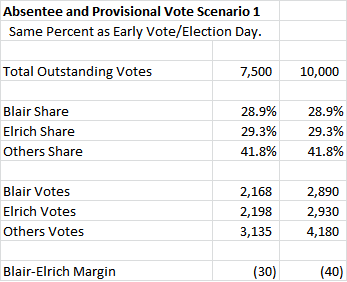
With early votes and election day votes counted, Marc Elrich leads David Blair by 452 votes to win the Democratic County Executive nomination.  This would be a close margin in a House of Delegates race but it’s incredibly close for a county-wide race.  The final outcome will now be decided by absentee and provisional ballots.  Does Blair have a chance or will Elrich hold on to win?

According to Bethesda Magazine, the county’s Board of Elections received 4,900 Democratic absentee ballots as of Monday.  In addition, 3,614 provisional ballots were cast but that total includes all parties.  For the sake of discussion, let’s assume that 2,500 of those provisional ballots came from Democrats.  If there are only 5,000 Democratic absentee ballots received, that is 7,500 outstanding votes.  A higher end assumption would be that 7,500 Democratic absentee ballots come in, resulting in 10,000 outstanding votes.

Let’s do a math exercise on the final outcome of the absentee and provisional votes.  In the first scenario, let’s assume that the percentages of three categories – Blair’s percentage, Elrich’s percentage and the percentage of all the other candidates – exactly match the shares recorded during early and election day voting.  In this scenario, Elrich picks up between 30 and 40 votes more than Blair and he would win.

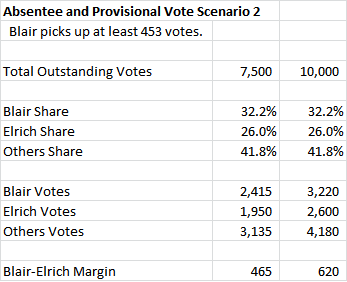
Now let’s do a scenario in which Blair wins.  Since Blair and Elrich are the top two and no one else is even close, it’s the margin between them that will determine the victor.  In this second scenario, we will hold the percentage of all the other candidates constant and merely adjust the totals for Blair and Elrich.  Adding 3.3 points to Blair and subtracting 3.3 points from Elrich produces a net gain for Blair of 465 votes in a 7,500 vote universe, enough to win.  That margin would go up to 620 votes in a 10,000 vote universe.  But note that this scenario requires Blair to lead Elrich by 6.2 points among these groups, a very different result than Elrich’s 0.4 point lead in early and election day votes.

We adjusted the percentage for the other candidates up and down and didn’t find much change in the margin Blair needs, which is more than six points over Elrich.  Again, this is a departure from the cumulative early vote and election day totals.

Will it happen?  Readers, you tell us!

Share

Maryland Politics Watch