Did I Get It Wrong on the Blair Poll?

Normally, when people feel I got something wrong in a post, I hear from them very quickly. So I was a little surprised when Aaron Kraut, the David Blair’s Communications Director, contacted me to say that I got it wrong in yesterday’s post on the poll recently released by Blair.

According to Aaron Kraut, “The topline poll question cited in our press release was asked before any further questions.” This would mean that the polling results were not skewed by the sorts of priming and message testing that occurred during the poll.

I asked to see the polling results because that, after all, would quickly settle the matter. To me, as I said in the original post, it doesn’t make much sense to still be message testing at this point. Blair’s poll doesn’t jibe with a recent independent poll by Data for Progress.

The Blair campaign won’t share their polling data, feeling that they shouldn’t have to prove that something is false. They have a point and that’s why I am writing this post. The poll was done by a highly reputable polling firm. The Blair campaign is quite emphatic that the numbers they presented were the topline and not the post-message testing numbers.

As Hans Riemer’s campaign pointed out, the numbers presented by candidates often skew in their direction if only because candidates tend not to release unfavorable polls. Campaigns release information selectively, as the Blair campaign did, but everyone knows that.

More generally, doing good polling is getting more difficult. As is often said, the only poll that matters is the one at the ballot box.

Share

Electronic Ballot Format Criticized

One of the hotter races this year in Montgomery County is the race for the four at-large seats. Incumbents Gabe Albornoz, Evan Glass and Will Jawando are seeking reelection. Incumbent Tom Hucker is looking to jump from his district seat to an at-large seat. Newcomers include Brandy Brooks, Dana Gassaway, Scott Goldberg and Gaithersburg Councilmember Laurie-Anne Sayles.

But the electronic ballot divides the candidates on two pages with only Sayles appearing on page 2. As you can guess from my listing of the candidates above, she drew the short straw due to her having the last name latest in the alphabet.

As we all learned in the 2000 election, ballot design can influence outcomes in close contests. It disadvantages Sayles to be on the second page. I don’t know what the Montgomery County Board of Elections can do to address this problem at this point.

In general, ballot order can shape outcomes. Candidates with names ending in A-L do better, on average, than candidates with names ending in M-Z for this reason. In polling, respondents are most likely to give the first or last choice as their answer.

One way to address these biases is to randomize candidate order. Pollsters purposefully scramble the choices to avoid these sort of biases. In statewide contests, California attempts to minimize the problem by having a different ballot order in each county.

Share

Saqib Ali’s Campaign Roiled by Abuse Allegations

Former Del. Saqib Ali is trying to regain a seat in the House of Delegates in District 15. He previously represented District 39 but left after one term to run unsuccessfully for Senate in 2010. This year, Ali’s well-funded campaign has been roiled by severe domestic problems.

Ali’s wife filed a petition for protection from domestic violence on May 24th. This was dismissed with the agreed upon condition that Saqib Ali attend anger management:

Mr. Ali will be evaluated by Dr. Fred Oeltjen with Maryland Counseling Center for anger management. Mr. Ali will complete anger management. The anger management program shall be recommended by Dr. Fred Oeltjen.

However, matters did not resolve. In a preliminary divorce complaint, Ms. Ali alleged:

On June 22, 2022, upon return to the marital home he once again became violent toward the parties’ older minor child, necessitating the Plaintiff [Ms. Ali] and the minor child to flee the marital home. On June 24, 2022, Plaintiff filed another Petition from Domestic Violence in the Circuit Court of Montgomery County on behalf of the minor child.

Defendant’s [Saqib Ali’s] ongoing abusive behavior toward Plaintiff and the minor children cause Plaintiff to have grave concerns over the mental stability of Defendant and his ability to be an effective and safe parent of the parties’ minor children.

Saqib Ali denied the allegations and tried to spin this as something that “sadly, a lot of people have been through” as part of a divorce. In texts available in public documents, he went further, essentially claiming that his wife is an unfit parent and a danger to at least one of his children.

Except that not only has he consented to anger management training, he also agreed on July 1 to give up custody of his kids for a full year as part of a consent final protective order:

Petitioner is awarded interim physical and legal custody of the minor children.

Respondent shall have non-overnight access with the children as agreed upon by the parties.

[T]his Order shall stay in full force and effect for one (1) year or until further Order of Court or written agreement of the parties.

This agreement makes me doubt Saqib Ali’s claims. Parents who genuinely believe that the other parent is unfit and a danger to their kids don’t normally give up custody but fight to keep them, as his wife did. Even a parent who believes the other parent is capable usually shares custody. Instead, he has given up not just custody but also the right to overnight visits. You do the math.

Share

Blair’s Bad Poll

David Blair recently trumpeted poll results produced by his campaign that claim he trails incumbent County Executive Marc Elrich by only a single point. They oddly left Hans Riemer out of the graphic in the blast email and press release, which present Elrich at 29%, Blair at 28% with 23% undecided. The poll was conducted by a highly reputable pollster.

Councilmember Hans Riemer’s campaign has repurposed this poll that has him in third place with 20%. They claim the poll shows Elrich falling but discount the better numbers for Blair because it came from his campaign. Their graphic excludes Blair just like Blair’s leaves out Riemer.

Except that the poll really show Blair’s weakness.

The poll was taken only after voters were primed with a bunch of messaging questions. Voters were asked questions related to Blair’s endorsement by the Washington Post and the Sierra Club combined with standard messaging. Blair’s campaign also asked negative questions about Elrich and Riemer’s longevity in office combined with a positive spin for Blair.

Priming can have large effects on poll outcomes. Beyond heavily skewing the information presented to voters, people like to please and are more likely to give an answer if they think it will make the interviewer happy. Yet even after all this priming designed to drive Blair’s numbers up and Elrich and Riemer’s down, Blair still trailed Elrich.

This message-testing poll suggests a few conclusions quite opposite from those presented by Blair as well as Riemer to a lesser extent.

First, Elrich almost certainly has a lead and quite possibly a strong one. If the Blair campaign had polling results that were at all good for him without priming questions, they would show them to us and even share the details.

These results instead suggest that Blair’s campaign is stalling despite his millions in spending. Blair’s omnipresence on television may not matter much when fewer people see the advertisements because they stream or scroll past commercials on their DVR. I have literally seen one Blair ad while streaming a YouTube video.

Second, Riemer is running uncomfortably well from the Blair campaign’s perspective. Just as the poll depresses Elrich’s numbers, it does the same to Riemer. Dropping Riemer from their graphic was hardly accidental. Blair is trying to convince people that it is a two-person race with Riemer faring poorly.

This is the logical purpose of the poll as no campaign is message testing at this late date. Campaigns have already settled on their plan and focused on execution. Other recent polls suggest that Blair and Riemer are statistically tied. My view is that Riemer has been running the best campaign of the three candidates, which would help explain why he hasn’t fallen behind Blair despite expectations and Blair’s very large wallet.

It doesn’t hurt that there are hundreds of thousands of dollars in expenditures funded by California donors on Riemer’s behalf separate from the campaign. (UPDATE: This is an anti-Elrich group that helps both Riemer and Blair.) Unlike four years ago, Riemer is the only councilmember challenging Elrich. Of course, Riemer’s campaign can’t have it both ways—the numbers understate Elrich’s support as well as his own.

Rather than convincing me that Blair is coming on strong and positioned well in the final weeks, this poll confirms his weakness.

Share

Foxwell Slams Franchot

Len Foxwell’s Facebook posts about his former boss and gubernatorial candidate, Comptroller Peter Franchot, have the marks of a kamikaze pilot rather than that of highly skilled political operative trying to rebuild his career after a major stumble.

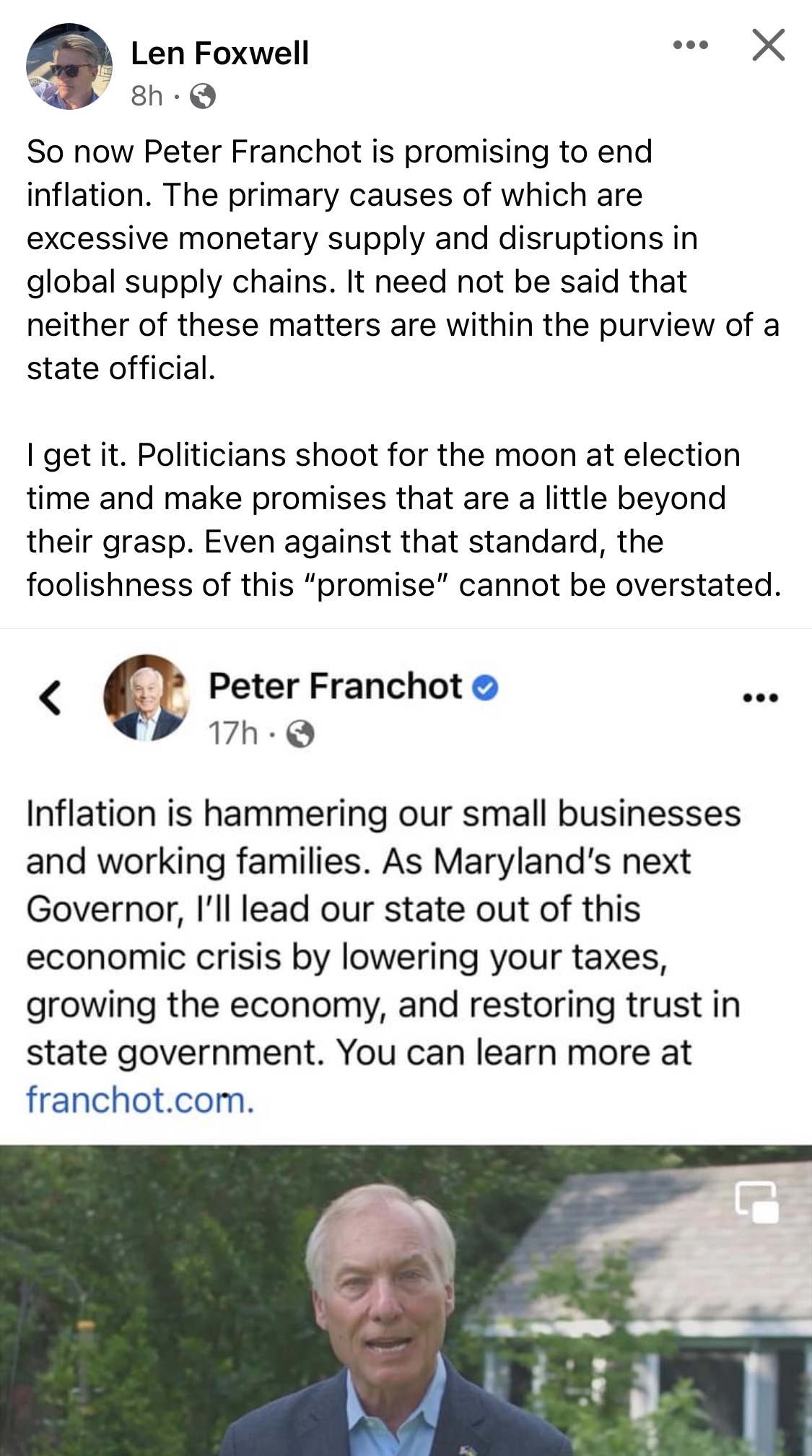
Almost the least of these attacks was his takedown of a Franchot ad:

Earlier, Foxwell boosted Jill Kamenetz’s devastating video blasting Franchot’s behavior in office and at her husband’s funeral:

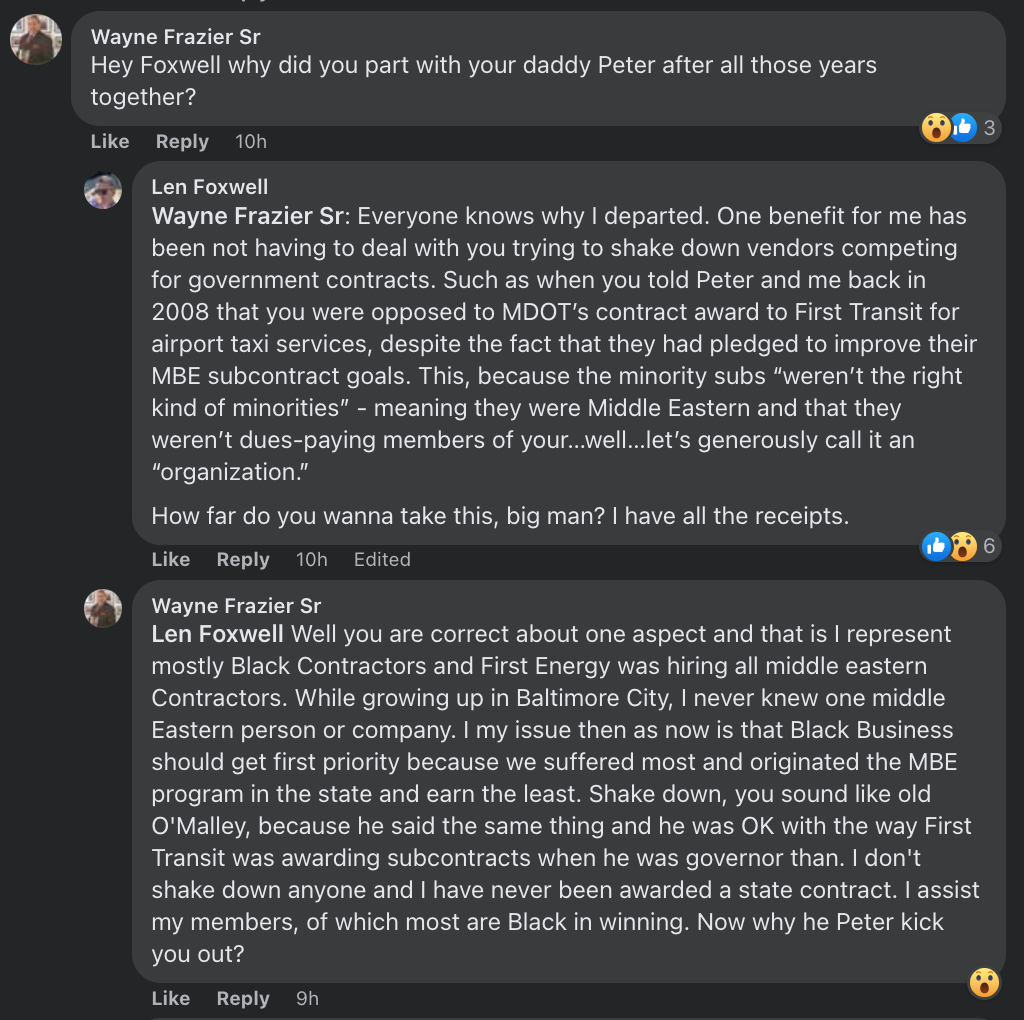
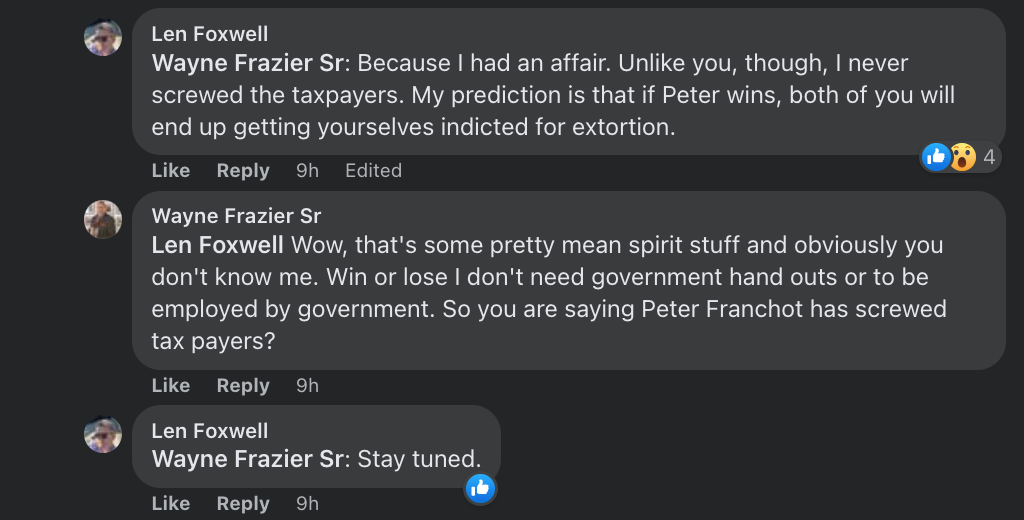
But most incredible was his exchange in the comments with Wayne Frazier in which he accuses Frazier of “trying to shake down vendors competing for government contracts” and writes “I have all the receipts.” He later replies: “My prediction is that if Peter wins, you will both end up getting yourselves indicted for extortion.” When asked for evidence that Franchot “screwed taxpayers”, Foxwell replied “Stay tuned.”

This is a stunning turnabout for Foxwell, who was Franchot’s biggest booster right up until his termination.

Regarded by many as Franchot’s political Svengali, Foxwell unquestionably played a critical role in Franchot’s office. First elected as a left-liberal, Franchot rebranded himself as a consumer advocate fighting for the little guy during Foxwell’s tenure as his chief of staff.

This smart positioning is a sweet spot for Democrats that counters an increasingly educated elite stereotype. It has echoes of popular Gov. William Donald Schaefer’s bread-and-butter focus, such as his “Reach the Beach” campaign resulting in new bridges and bypasses that cut beach traffic.

Positioning himself as a public ally of a Republican governor may seem more questionable but remember that Gov. Larry Hogan remains more popular than not with Democrats. While still risky, so many Democrats are fighting for the progressive label that it leaves room in the primary for Franchot. One can’t help but wonder where Franchot might be now with more of Foxwell’s help.

Though understandable from a personal perspective, Foxwell’s attacks make little professional sense, being as likely to inflict wounds on himself as Franchot. Politicians and others surely must hesitate before hiring someone who turned publicly on his former boss, wondering if he might do the same to them. If Franchot was so awful and corrupt, why did Foxwell boost him relentlessly? It makes Foxwell appear hopelessly cynical and unscrupulous, tainting himself as well as Franchot.

Franchot and Foxwell’s detractors, many of whom work at the General Assembly and clashed with both, will enjoy watching.

Share

Executive Race Lane 3: Needs a Job

Councilmember Hans Riemer (D-At Large) is being turfed out of office by term limits. Like Marc Elrich four years ago, Riemer was the top vote getter in the previous election’s Democratic at-large council primary. Riemer’s achievement perhaps lacks some the luster since he was the only incumbent. But it doesn’t hurt.

Running for County Executive doesn’t appear to have been Riemer’s preferred path. When the Council was debating its reconfiguration in response to the initiative to eliminate the four at-large seats and move to all districts, Riemer proposed creating a separately elected Council President. The new office could likely evade the Council term limits and provide the well-known incumbent with another opportunity.

This didn’t pass the laugh test with his colleagues. The Council currently elects its President annually with the job rotating among the members. Why on earth would the rest of the Council want to give up the chance of being Council President to put Riemer in charge? I suppose one can admire Riemer’s chutzpah if not his political sense.

Until recently, Riemer was the upbeat urbanist warrior on the Council. That’s changed. Riemer has become stridently negative with his campaign marked by nearly incessant attacks on both incumbent County Executive Marc Elrich along with wealthy businessman David Blair.

Riemer has raised a tremendous amount of money through the public financing system. While it’s hard to compete with David Blair’s wallet or the developer PAC spending $500,000 on his behalf, it is still impressive. My sense is that his team has built a strong campaign.

Notwithstanding his strong fundraising and high name recognition, Riemer faces challenges. His urbanist base is split with David Blair. Some of his natural supporters find Blair’s past run and deep pockets a stronger bet than Riemer’s lengthy experience. Despite their revulsion towards Trump, Democrats seem happy to elect wealthy businessmen to office (e.g. David Trone and John Delaney), including many in Riemer’s crowd.

Riemer’s reputation among political observers who inform other voters and influencers also doesn’t help. In contrast to, say, Nancy Floreen, many see Riemer as a well-meaning guy but not a political or policy heavyweight. Though a fervent believer in his own proposals, he often doesn’t seem to know his brief and appears out of depth in answering questions.

Riemer’s campaign conversion on privatizing alcohol sales tends to confirm this view. After having previously headed the MoCo Nightlife Commission and years of telling us is that all we needed is to be able to buy craft beers, he has only now connected the dots and discovered that the alcohol monopoly is a problem.

When one of Riemer’s (very nice) campaign volunteers knocked on my door, I was amused to be handed a walk piece claiming that Riemer got the Purple Line done. I guess he has a different definition of “done” than I do. If we’re lucky, the light rail will be up and running around the time the next County Executive finishes his term complete with massive cost overruns. Though a shinier object, the unfinished Purple Line contrasts uneasily with Elrich’s ability to get the Flash BRT and up and running faster at a far lower cost.

Riemer and Elrich have never been BFFs and Riemer has dogged the Elrich administration relentlessly. But even in quieter times, councilmembers have trouble getting much attention from the public. Notwithstanding Riemer’s strong criticism of Elrich’s handling of the pandemic, and that many of the necessary choices were bound to alienate blocs of voters, voters view Elrich’s handling of it favorability to the chagrin of detractors.

Though the Washington Post had some kind words for Riemer (and harsh ones for Elrich), their endorsement of Blair helps confirm Riemer’s third-place status. Riemer has done his best to distinguish himself from both Elrich and Blair and run better than expectations. Still, it will be a real surprise if he wins the primary.

Share

Baker/Navarro Suspend Campaign

Former Prince George’s County Executive Rushern Baker and Montgomery Councilmember Nancy Navarro have suspended their ticket’s campaign for governor and lieutenant governor. While Baker was a major candidate for the Democratic nomination four years ago, his campaign just didn’t catch fire this time.

Baker cited the financial challenges facing the campaign. Navarro, who has a comparatively small political base in Montgomery and was unlikely to woo Latino voters and organizations away from Tom Perez’s campaign, didn’t hurt Baker’s campaign but also didn’t give it the additional lift it needed.

Of course, this frees up Navarro to spend more time sparring with County Executive Marc Elrich, something that seems only likely to increase after their public clash on “The Politics Hour with Kojo Nnamdi” and Navarro’s endorsement of David Blair.

Even though Baker’s campaign didn’t get far, I am sure that other campaigns would welcome the endorsement of this well-known and respected figure in what remains a fluid race. I’ve already received a statement from Wes Moore’s campaign praising Baker and I am sure others are to follow if they haven’t already been issued.

Share

Rent Stabilization Has Ended: That’s Good News

Del. Jheanelle Wilkins lamented yesterday that Montgomery County has ended its 2022 0.4% cap on rent increases:

Today, May 15, marks the end of Montgomery County’s limitation (.4%) on rent increases. Unlike most areas across the country, MoCo residents have been able to avoid sky-rocketing rent increases. I fear for what’s next as this limit lifts.

Takoma Park has its own rent cap, which has risen from 2.6% last year to 7.3% this year, an increase that Del. Wilkins described as “pretty high!”

At the height of the pandemic, temporary controls on top of the freeze in evictions might have made sense except that there was no evidence that rents were going up. (Freezing evictions made sense as so many had their income temporarily disrupted, we wanted people to stay home, and how on earth were people supposed to move?)

Since then, Montgomery County’s cap has had the effect of reducing rents in real terms because the cap was set far below the current inflation rate. While the cap was set at 0.4% starting in February 2022 (and 1.4% prior to that), inflation has been running at 7.3% in the D.C. metro area. Even if a landlord raised rent by the full 0.4%, they saw a 6.4% decline in real income.

Nevertheless, Del. Wilkins would like rent stabilization made permanent:

Rent stabilization should be the standard everywhere. MoCo’s successful rent limit experiment demonstrates that stabilization works! While rent has risen all around us, MoCo residents have had this strong protection.

Many oppose rent control on liberty and freedom grounds. After all, rent control is the government forcing people to sell the right to use their property at arbitrarily low prices to whoever happens to occupy it. Though this weakening of property rights is promoted as a transfer from the wealthy to the poor, there is no guarantee the rent-controlled units are occupied by the poor or that their landlords are necessarily rich.

Of course, many renters have salaries that are not keeping up with inflation. But that’s not the landlord’s problem. Banks don’t cut landlords or other mortgage holders a break when their income isn’t enough to pay the mortgage. Landlords aren’t automatically granted an extra big rent increase when their tenant gets a major salary bump.

If we maintained the cap for additional years, as Del. Wilkins supports, the gap between what are now effectively rent stabilized and market rate units would only grow. The more we require landlords to rent at artificially low rates and limit earnings potential, the less incentive there is to build housing. Even if laws exempt new housing, developers are understandably reluctant to build in areas that are willing to adopt controls on existing housing. The same controls could be extended to their property.

The longer rent control or stabilization stays in place, the more it distorts markets. People don’t want to leave rent-controlled apartments because they are unusually cheap. They become an even better deal as the decline of new building results in even higher housing prices.

The combined attack on property rights and on new housing eventually led both Massachusetts and New York—not exactly known as right-wing hotbeds—to eliminate or to drastically curtail rent stabilization and control. Since the value of rental buildings is heavily tied to income generated by the rent, avoiding rent control also prevents denuding the tax base–important to remember if you want the county to keep up the schools or to pay for expensive social programs.

Del. Wilkins is right that prices may swing up precisely because they have been kept artificially low. We already have measures in place designed to assure that new projects provide social benefits, such as MPDUs, at financial cost to developers. Let’s avoid shrinking the housing supply through long-term price controls.

Share

Brooks Out, Albornoz In

The Montgomery County Education Association (MCEA) has revoked their endorsement of Brandy Brooks and instead endorsed Council President Gabe Albornoz.

The teachers overlooked Tom Hucker, who is attempting to jump from District 5 to an at-large seat after pulling back from a bid for county executive. Some may see this as a bit of a snub since Hucker had been supportive and close to labor in the past.

In their choice, MCEA went with a safe bet for re-election and also overlooked one fresh candidate, Scott Goldberg. (Note: this is a correction. I mistakenly wrote Laurie-Anne Sayles was also overlooked but she had been endorsed by MCEA previously.)

Their decision is the latest in a line of organizations, such as CASA and DSA, that have pulled their endorsements from Brooks in the wake of a former staffer’s accusation of sexual harassment. Brooks has started participating in forums again but still has not spoken directly on the issue.

Share

Kelly Schulz and the Republicans Have a Major Roe Problem

The likely imminent reversal of Roe v. Wade deeply wounds any chances that the Republicans have of holding the governor’s mansion this November in strongly pro-choice Maryland.

Former Delegate and Secretary of Commerce Kelly Schultz, is running as a Hogan Republican and is seen as the more viable of the two major Republican candidates. She issued a statement designed to counter fears over abortion rights.

Thirty years ago, Marylanders voted to make abortion legal in Maryland, and any decision forthcoming on Roe v. Wade will not change that. The continued politicization of the Supreme Court is shameful and those fearmongering over Maryland abortion rights are only adding to that. While Kelly Schulz is personally pro-life, as governor, nothing will change with respect to current Maryland law on the issue.

But the statement doesn’t appear on her website or twitter feed.  It’s almost like she’s trying to hide it from Republican primary voters. Her statement doesn’t mention that she was endorsed by Maryland Right to Life as a candidate for the House of Delegates.

Democrats are ready to pounce. The Democratic Governors Association has already pointed out that she sponsored a constitutional amendment to ban abortion with no exceptions and that she has previously touted her “100% solid” pro-life record.

Maryland’s governor remains the most powerful in the nation. Would Schulz use these extensive powers in ways that curtail abortion access, particularly for poor women? Is her statement conditional on the election of enough numbers of Democrats to the General Assembly to override gubernatorial vetoes, as is currently the case?

Schulz’s major opponent, far-right loony Del. Dan Cox who embraces Trump’s election conspiracy theories, has also voted against abortion rights bills in the General Assembly.

Share

Maryland Politics Watch